Responding to Orwell: October 30
George: I must again commend you on your succinctness. “Fine, not very hot. One egg” likewise describes many sad Sunday mornings in my twenties. There was a period in which I would wake up alone in my San Francisco hovel after a night of unsuccessful carousing, realizing that it was “not very hot” in both the literal and figurative senses. I would then walk to the refrigerator, ponder breakfast, and observe that there was one lone egg in a cardboard carton. (Which in turn reminds me of my crazed attempt to soundproof a basement at the age of nineteen. But that’s another story, George, for another one of your dutiful diary entries!) I had developed a strange habit of cooking many eggs on Saturday morning, but had not yet developed the dexterity to cook a decent omelette. But I was more ashamed by my failure to count the eggs. Looking at the sad shelled elliptic leftover, it seemed somewhat futile to whip up some scrambled eggs from one yolk. “Scrambled egg” was the more accurate breakfast appellation, but it sounded like a 75 cent side item on a dive menu. You could have the “scrambled egg” if you had were a bum with change jangling in your pocket. But real men ordered “scrambled eggs, sausage and toast” for $4.99. Regrettably, I was often too lazy to walk to the convenience store down the street. It was an altogether different walk of shame from me — a bachelor who couldn’t keep track of his eggs, much less perform shopping with any reasonable frequency. And so I would cook the one egg, sometimes singing a Ray Davies song to tap into some irony that really wasn’t applicable, consume the scrambled concoction and realize that it wasn’t what you might call a reasonable breakfast. Fine, not very hot. One egg.
Replace “Waldo” with “Joe the Plumber” and You’ll Have a Cottage Industry!
John McCain: a closet Spartacus fan?
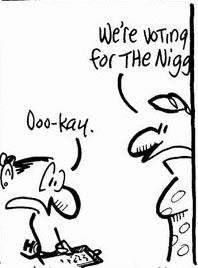
Passive-Aggressive Newspaper Drones in Training at Montclair
I learned through The Beat (via Eric) that an installment of Keith Knight’s The K Chronicle has caused an uproar at the Montclair State University newspaper. Despite Knight basing his strip on a real-life incident and not even printing the full word in question, the editors of the student newspaper issued a campus-wide apology, with Montclarion editor-in-chief Bobby Melok stating, “It is never The Montclarion’s intention to offend its readership, and we sincerely apologize to all who were upset with this comic.”
I don’t know what’s more disheartening here: a newspaper of any sort lacking the courage to “offend” by depicting the truth or Melok’s current spinelessness-in-training, a passive-aggressive quality that will serve Melok well should he somehow nab one of the few jobs left at a Sam Zell-owned newspaper. To apologize for an artistic depiction of the word “nigger” (which, incidentally, never appeared in Knight’s strip in its entirety) is to draw greater attention to racial division, to give that word more significance than it deserves, and to suggest that anything probing into the cancer of racism is somehow racist. If anything, Melok should apologize for lacking the guts or the brains to determine what he deems appropriate. Melok went on to write, “We assumed because it was part of the syndicate, it was appropriate.” And I assume that because Melok assumes, Melok is incapable of the most elementary editorial judgment.
Obama, the Medicare “Doughnut Hole,” and the Working Poor
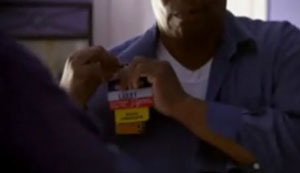
Last night, on Twitter, I got into a lively exchange relating to last night’s Obama infomercial. I had initially watched ten minutes of this broadcast, and I grew increasingly upset by the manner in which basic realities about health care and the working poor have been severely overlooked in this presidential race. Upon being pressed, I watched the whole thing from the beginning. “Those weren’t the working poor in that video? The 72 year old guy working at WalMart not poor enough?” argued Seth Harwood. While retired railroad man Larry Stewart putting on his Wal-Mart badge and taking out a loan on his house to help his ailing wife is indeed a crushing story (beginning at 7:30 in the Obama video), at least the Stuarts have a house to take a loan on. What of the doughnut hole created by a Republican-led Congress through the Medicare Modernization Act of 2003? What of those trapped in Medicare with chronic conditions who skip out on vital medications because they don’t have the money? The situation is this: Under the Medicare Part D prescription drug program, if a senior has more than $2,250, but less than $5,100 in annual drug costs, the senior is required to pay these costs out of pocket.
Now consider the case of 65-year-old Frances Acanfora. Thanks to the MMA, this retired school lunchroom aide saw her drug costs jump up from $58 to $1,294 courtesy of the doughnut hole. She even had to temporarily stop taking her drugs after talking with her doctor. Did Acanfora have a partner or a home to fall back on? We know that she had a credit card. But is she still alive? One wishes that the Washington Post would conduct a followup story. Meanwhile, other seniors have stopped taking their drugs altogether. They couldn’t afford it.
 While it is true that Obama advocates the federal government negotiating with the drug companies to reduce prices under the Medicare Part D drug program (similar to what the Department of Veteran Affairs now gets), permitting citizens to purchase prescription drugs from outside of the United States, and closing the doughnut hole, let’s consider why this policy was effected in the first place. The MMA came into being because of rising costs in prescription drugs and the inability of the federal government to allocate enough funds to pay for it. What we have here is a scenario in which the pharmaceutical companies hold all the cards. The companies set the prices. The generic drugs that were supposed to save people money have proven to be more costly thanks to the MMA. The companies claim that the drug prices are high because the companies need to spend this money on R&D. And, of course, the drug companies have lobbyists.
And if the drug companies hold such power, how can there possibly be negotiation? I can see the conversation going something like this:
Government: We need you to lower the costs of drugs. Now we’ll be happy to take them all off your hands, guaranteeing X number of drugs over the next five years, if you’ll lower the prices.
Drug Companies: You’re already going to be getting X number of drugs over the next five years from us. With all due respect, what’s changing here? We’re your supplier. And wait a minute. I thought we agreed back in 2003 that we wouldn’t be negotiating.
Or as Robert Laszewski put it, “If you go to a car dealer and tell him you’re going to buy his car no matter what, and then try to negotiate, you’re not going to get a very good deal.”
 Which puts the government in the awkward position of going overseas to import its drugs for Medicare. But if Medicare’s chief drug source comes from another country, how then can the FDA provide the essential oversight for the drugs? This leaves the government coming back to the pharmaceutical companies with its tail between its legs. I’ve looked around numerous places, but Obama has not specified how he can “negotiate” with these draconian realities in place. But to his credit, he did issue a press release last year condemning the Senate’s failure to consider legislation permitting Medicare negotiation.
Let’s return to the issue of Larry Stewart and Frances Acanfora. The rhetoric in this presidential race has involved speaking to Main Street and the middle-class, who we are told increasingly are having to “tighten their belts” to make ends meet. But what is not really being talked about by either camp are the 29.4 million Americans — up 4.7 million from 2002 to 2006 — living below the national poverty line. Tayari helpfully directed me to this Democracy Now! segment from a few days ago, which goes into this issue at some length. And indeed why should either candidate talk about low-wage workers when Obama leads 2 to 1 over McCain? (Incidentally, a majority of low-wage workers polled in this article indicated that their personal finances were unlikely to change — even with an Obama presidency.)
When you consider Medicare’s reliance upon pharmaceutical companies and this regrettable framing emphasis away from the working poor, what Obama essentially presented to us last night was comfort food for the middle-class. (So flexible is the term “middle-class” that one can make a six figure salary and still remain lodged within an income bracket that likewise includes someone making $20,000 a year.) But none of this takes away from the fact that nearly 30 million Americans are impoverished, and that 47 million Americans are without health care. What this nation needs more than “hope” is a concrete and realistic plan. We need something more than promises to “negotiate” in nonnegotiable situations. Something that returns us to the dialogue kickstarted by John Edwards last year. Something that ensures that the dread P word spelling out our poverty will return to our national dialogue with neither shame nor flash, but with the maturity and grace that Obama has built his campaign image upon.