- So the Nobel Prize goes to Jean-Marie Gustave Le Clézio — a writer who I’ve never read. And it’s all because I’m one of those thuggish American idiots who Engdahl is complaining about. Mr. Orthofer, as usual, has the goods here.
- I hope that I might atone for my unworldly nature by once again mentioning one of the best films that played the New York Film Festival, Tokyo Sonata. I assure you that my coverage of this movie is far from over. And I am pleased to report that the film now has an American distributor. It will be released by Regent in March 2009. I don’t yet know how many theaters it will play, but if it plays in your area, by all means catch it if you can.
- Bill Peschel, playing directly to my perverse nature, has kick-started a promising series: Great Moments in Literary Sex. Unfortunately, Mr. Peschel has yet to employ the gerunds “pounding” or “thrusting” in his posts. Let us hope for more Harlequin action in forthcoming installments.
- I must publicly denounce Random House for failing to send me books with bawdy covers. Oh well. Perhaps someone else will come through.
- The Wall Street Journal talks with David Lodge, and has me a bit sad that I lack the financial resources to travel to London to interview the man and conduct a proper conversation. (via Frank Wilson, who dutifully takes the WSJ on for getting the tone in Lodge’s oeuvre so fundamentally wrong)
- Also from Frank: A Hard Day’s Night in Yiddish.
- I got a tip on the new Pynchon novel a few weeks ago, but I was so busy with assignments and the New York Film Festival that I was unable to investigate. But thankfully, David Ulin has confirmed it with The Penguin Press.
- Mark Athitakis reminds us once again that there is more to Steinbeck than crowd-pleasing and ideological novels. I’m by no means a lover of all of Steinbeck’s work, but I’ve likewise never quite understood this rap. This is a nation in which writers are impugned if they get through to the masses, vilified if they don’t kiss the tastemakers’s asses, and celebrated if they abide by the take-no-chances boilerplate. There are exceptions to this, and certainly Steinbeck was an exception in his lifetime. But leave it to the next generation of closed-minded critics who would rather play predictable contrarians rather than attempt to parse books for what they are.
- And if people aren’t reading on the subway, then surely they can’t be reading in blue-collar Latino neighborhoods either! Daniel Mendelsohn is likely to pop his ignorant gaskets upon hearing this news.
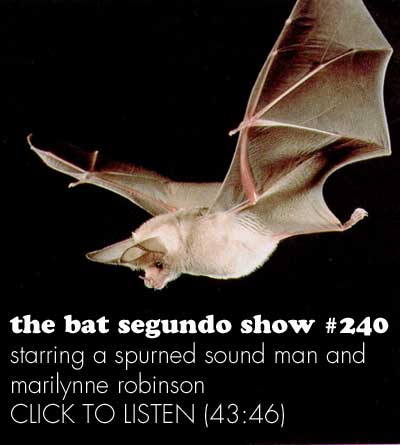
The Bat Segundo Show: Marilynne Robinson
Marilynne Robinson appeared on The Bat Segundo Show #240. Ms. Robinson is most recently the author of Home.
Condition of Mr. Segundo: Avoiding the relationship potential of malfunctioning XLR cables.
Author: Marilynne Robinson
Subjects Discussed: Revisiting the Gilead universe, Lawrence Durrell, Robinson’s aversion to sequels, the parable of the prodigal son, the role of letters and text within Gilead and Home, text as a lively and disturbing realm, affirming identity by chronicling detail, seizing the day, Bob Marley, the depiction of the home in Housekeeping in relation to the vertical landscape, “home” as a value-charged word, listening to vernacular hymns, characters who listen to the radio, music as the great common ground, music and memory, banishing certain words, whacking sentences down, characters and educational background, the advantages of not speaking, circular food in the Boughton household, the virtues of toast, family meals and communion, the frequency of dialogue in Robinson’s novels, the predestination colloquy in Gilead and Home, James Wood’s review, the advantage and limitations of third-person perspective, interpretation vs. living the events, the shifting definition of sin during the 20th century, Iowa and anti-miscegenation laws, the Chrysler DeSoto vs. Hernando De Soto, the Kennedys, secular figures within novels, Jonathan Edwards, hypocrisy and religion, the origins of character names, the role of judgment within family, Das Kapital and Jack’s Marxism, the history of The Nation, the writer-reader relationship, using a BlackBerry, and parody and the contemporary novel.
EXCERPT FROM SHOW:
 Correspondent: I wanted to ask you about the tale of the prodigal son, which of course comes from Luke 15:11. The onus of guilt in that parable, however, falls largely on the son. Specifically, the quote is “Father I have sinned against heaven, and before thee / And am no more worthy to be called they son; make me as one of thy hired servants.” But Jack, he calls his father “Sir.” Not “Dad.” Although there’s a slight discrepancy near the end. He works on the DeSoto of his own accord. He’s often summoned to play on the piano and the like, and also work in the garden. But he’s sometimes an unapologetic sinner. And other times, he drowns his sorrows in alcohol. So the interesting question here about the prodigal son is: The framework of the Scriptures is clearly there in this book, but I’m curious as to when you decided to launch away from that. Likewise, was this actually a starting point? Or was it an intuitive process of trying to obvert what we know about that particular story from Luke?
Robinson: Well, I have a slightly different interpretation of that story than the one that’s generally circulated.
Correspondent: I think so. (laughs)
Robinson: You notice that the prodigal son says, “I am no longer worthy to be called thy son.” But from the father’s point of view, this is never an issue. He doesn’t ask for the son to satisfy any standards of his. He doesn’t ask for confession. He doesn’t ask for some plea for forgiveness. He sees his son coming from a distance and wants to meet him before he knows anything about him, except that he’s his son coming home. And I think that the point of the parable really is grace rather than forgiveness. The fact that the father is always the father. Despite and without conditions. And this is true in Boughton’s case. As far as he concerned, Jack is his son. And that’s the beginning and the end of it. Jack is not able to accept his father’s embrace.
Correspondent: It’s basically approaching a parable or a well-known story from a kind of cockeyed manner. Really, it comes down to this notion of the text as Scripture. I think certainly in Gilead, that was the case. And in this case, you have them throwing away letters. You have, of course, the love letters that are thrown down the drain. The letters that Jack sends out, which come back RETURN TO SENDER. And of course, they’re schlepping off a number of magazines to Ames, who lives down the block. So this is very interesting to me. Whereas the first book dealt explicitly with this idea of text as this panacea for loneliness, this book deals with disseminating the text out to other people, or getting rid of text. Which is why I ask the question as to how this relates to Scripture. Is text really something for us to cling onto in this? Whether it be a book or whether it be the Bible? Whether it be religious or literary or what not, there are matters of interpretation in life that go well beyond text and well beyond the idea of fulfilling this need to cure loneliness.
Robinson: Well, I think of text — by the analogy to Scripture that you’re making — I think of it is as something that is lively and disturbing. Disruptive. I mean, for example, say that Ames’s best hopes are met and his son receives the voice of his father when his son is an adult, that would completely jar the sense of memory, the sense of proximity to another human person, and all kinds of things that we think we understand. The letters that come to Jack and the letters that don’t come to him — they’re central. They’re alive, even though they are profoundly problematic. And I think of, in a way, text and Scripture as active in that way. As a sort of eccentric presence in human experience.
BSS #240: Marilynne Robinson (Download MP3)
This text will be replaced
Listen: Play in new window | Download
Wrapping Things Up
Okay, folks, after about seventeen or so films (and manifold shorts) in two weeks, I’m officially finished with the New York Film Festival. I have seen two films devoid of dialogue (save a handful of lines). I have seen a ten-minute long take of a sheep giving birth. I have watched actors lose considerable weight for the sake of their art. I have witnessed Jonathan Rosenbaum’s eloquence stand out on an overcrowded panel. And I’ve written close to 15,000 words on all this.
So I think it’s safe to say that I’ve fulfilled my obligations to world cinema, that I’ve been a “good” cultural reporter. But I am now in need of a messy grindhouse flick and some bourbon to stabilize the artsy images and subtitles I have taken in during the last two weeks. The situation has become so severe that I am now having strange dreams with subtitles. I think that’s a sign that I’ve had enough world cinema for now. Which is not to say that I won’t be crawling back to the artsy IV drip in a few weeks.
There are a few more interviews and a few more reviews forthcoming pertaining to the New York Film Festival. But I should be shifting back to literary matters, as well as delving into a few other subjects. Thanks to all for participating in this crazed journalistic experiment! We march ever onwards!
McCain’s Economic Plan from Outer Space
Unanticipated Communiques from 2000
I have learned through Rachel Sklar via Twitter that Google, celebrating its 10th anniversary of collecting private data from individuals to sell advertising, has permitted users to search through the Google index as it existed in 2001. I performed numerous search experiments on several fascinating names and terms, revealing fascinating results, before turning the algorithm on myself, where several frightening emails that I had sent to my longtime pal, Tom Working, were uncovered. There was a specific purpose to “Jimmy.” But revealing this purpose causes one to lose sight of the interpretive possibilities within these deranged e-epistles. So here they are:
Date: Tuesday, September 5, 2000
Subject: enter “the Wolfe”Dear Mr. Working,
Dawn Wells has expressed disapproval at being associated with such a subversive cadre. This has not stopped her from being trapped on the island with the other Survivors. She’ll join our complex love menagerie and we’ll get in a carnal quintet before December. The ink is fresh and the paper is as disposable as a Joel Schumacher film.
Jimmy remains silent with the Washington office for three main reasons – (1) He is hard at work lobbying Congress to declare November 17 as a national holiday in his honor (this works in well with the production start date); (2) he was held up at the Smithsonian, mistaken for a rare elk species that resides in the Amazon jungle (and accidentally stuffed by several underpaid attendants); and (3) all he wanted was a Pepsi.
My safety is intact. I have lathered my body in baby seal oil and I have tested my flesh for flammability. Aside from burning my left eyebrow, I’m okay. And I anticipate applying the Zippo to my right eyebrow with the desired mixed results.
Which brings me to the issue of the Westcoast Six. I know that they’re into this whole comic book fanboy business. But their obsession with kryptonite has got to stop. I’ve called Marty Bernstein in Colorado and he’s flying in tomorrow with a lead box (codename – Pandora) that should settle the matter in a day. This should satisfy the money people for now.
How Jimmy will take this is anyone’s guess. I’ve been concerned that his pancreas will give out before the shoot. But I’ve ushered Jimmy into several free clinics for a second opinion. This is a tricky matter, given his traumatic experience in Washington.
And don’t worry about the Arizona market. We’re licensing Smell-O-Rama from John Waters for this production. Waters himself has expressed minor interest in the project. But he insists that we set the movie in Baltimore. I’ve convinced Waters that we will feature at least three shots of dogshit. He seems content with channeling Divine from the grave.
As you know, this represents considerable snowballing on my part.
“Wolfe” Habernathy sounds like a strong last-minute contender. I am, however, worried about his special requests. Six gallons of Vaseline every hour is a hard thing to come by. But if Habernathy wants it, I’ll just have to tell the Arizona and Colorado people that we just have to hang tough and provide it.
And I’ve got Ron Howard on board. He won’t be directing, but he’ll be appearing full frontal. Our test market scores indicate that a Jimmy-Ron Howard-Tipper Gore three-way will do extremely well in the Flagstaff market. Now I realize that this is an election year. But Tipper’s agent has expressed interest in becoming involved, if only to atone for the scathing censorship campaigning in the ’80’s. I’ve been perfectly honest about the circumstances. But who am I to argue? She wants to do it, if only to secure the smut bloc in Gore’s direction.
Bernstein, however, wants more. He talks deliriously of double-penetration. Can you ask the Wolfe just what kind of film we’re making here? Because the way Marty’s talking, I don’t think we’ll get the PG-13 rating.
I’ve taken care of the AOL problem. Steve Case wants a tie-in deal with the project and that should secure the capital. Never mind that the film takes place in the Middle Ages. But I have William Goldman busy doing rewrites and I’m sure we’ll figure something out.
Date: saturday, September 9, 2000
Subject: jimmy’s seen to that.Dear Mr. Working,
Well, it seems that we’ll have to recruit Ms. R. to inspire Jimmy to get in touch with his dog side. Since Jimmy seems to be fond of flagellation, I would suggest that he be repeatedly punched by her and conditioned to enjoy the fetishistic side of violence. We will keep Ms. R. at a distance and, for her protection, allow her to be in Jimmy’s presence for no more than ten minutes at a time, with several National Guard officers poised to shoot Jimmy’s kneecaps in the event that he gets “a little crazy”.
Ms. R. stands to make a killing off of this. The contract intends to split the profit as follows…
Publisher overhead 25 percent
Tom 20 percent
Ed 20 percent
Ms. R. 20 percent
Jimmy 3 percent
The SPCA 11 percent
Florence Henderson 1 percentI trust that you will agree that the deal is fair. And I wouldn’t worry about the literary angle. Joyce Carol Oates has been commissioned to write the review for the New York Times Book Review and she has expressed to me her admiration for Jimmy’s work.
The bodies, as you know, are a figment of Jimmy’s imagination. Jimmy would understand this, if only he had found a partner for his game of Tic Tac Toe. Sadly, the money people could not provide him with said partner.
Wink Martindale has expressed some interest in having Jimmy on as his first contestant for the new revival of Tic Tac Dough. But sadly, Wink wants to write the foreword of the book. He has tentatively titled his 2,000 word foreword – “I Never Understood My Adam’s Apple.” But sales reports indicate that we would lose 23 percent of the gross should this foreword be included. I’ve been on the phone with the Mark Goodson people trying to find another game show tie-in.
Date: Thursday, September 14 2000
Subject: a shocking developmentDear Mr. Working,
We here at the Walt Disney Corporation have recently learned of your plan (with your two associates, one Edward Champion and a man who is identified only as “Jimmy”) to cast one of our enduring characters, Mary Poppins, in a licentious light. We have also been informed of your attempts to contact Julie Andrews and involve her in this sordid offering.
Please be informed that we have muzzled Julie Andrews and provided her with all the penises that she could possibly desire for the next ten years. Accordingly, she has no interest in your project.
Concerning your use of our trademark character, I have one word to communicate to you – Stop.
While we admire your associative latitude with our creations (for they are, after all, OUR creations and not those of the overworked animators whose vocal chords have been conveniently cut), please understand that we will pursue your two-bit operation with every legal power we have under our wing.
However, your descent into porn comes at a time in which our corporation is considering pursuing similar markets, in much the same manner that we opened up our Touchstone film division to R-rated entertainment in the 1980’s.
Under the aegis of our newly created film division, Pound Politely Pictures, we would like to involve your associate, Jimmy, in Disney’s first multi-million dollar digital video porn feature. While we appreciate the input of you and Mr. Champion, we have come to realize that this Jimmy character is more sexually desirable to our demographic than the two of you put together.
In the spirit of compromise, we intend to throw loose women your way. Please keep in mind, however, that these women have serviced our lonely animators in the past and you may find that they malfunction upon climax.
Again, I request that you refrain from the “Mary Pophercherry” project and consider the benefits that our robots… er… women can offer you.
Thank you for your attention to this matter.
Sid Disney III
Executive InternP.S. Concerning the microwave, it is our hope that you can provide one.