Edward Douglas, Hopeless Hack and Amental Film “Journalist” — Part Two
Last week, Reluctant Habits initiated a weekly series on New York hack “journalist” Edward Douglas, a creative typist employed by ComingSoon.net and an intellectual coprophiliac quite happy to scarf down the moist cloacal deposits offered by film publicists. Unfortunately, in the last seven days, Mr. Douglas’s work has not improved much. We see traces of anti-intellectualism and a failure to comprehend basic nouns, along with other unpardonable sins.
MR. DOUGLAS’S OFFENSES AGAINST JOURNALISM AND THE ENGLISH LANGUAGE — THE WEEK OF JUNE 8, 2008
Edward Douglas offers this stunningly idiotic sentence:
Director M. Night Shyamalan often gets a bad rap, not because of his movies, whether you like all, some or none of them, but because people claim him to be an arrogant egomaniac.
Not only do we get another typical instance of Mr. Douglas mangling his clauses, but we get the redundancy “arrogant egomaniac.” Is Mr. Douglas then suggesting then that Mr. Shyamalan is a humble egomaniac? Or is he simply clueless with nouns? One thing’s for sure. Mr. Douglas has no problem wrapping his well-oiled orifice in Mr. Shyamalan’s presence. While boasting about his “10-minute lightning round interview” (such insight!), Mr. Douglas writes, “You have to admit that he doesn’t make movies haphazardly though, always spending a good amount of time thinking about every aspect of the story and characters and how they might be perceived by the public at large.”
There are many filmmakers, of course, who spend a good deal of time thinking about movies. Consider the time that Michael Cimino expended to think about every detail in Heaven’s Gate, right down to the period underwear. And we all know how that film is currently regarded. But it does not logically follow that, because a filmmaker has used up time and energy, he has put out a quality film.
Mr. Douglas’s paralogia can also be witnessed in such dunce questions as “With all the paranoia in the air, can this movie still be seen as escapism?” (presumably, Mr. Douglas has a limited definition of the escapist blockbuster) and “This is a very short movie compared to your other movies, but it’s only 90 minutes and I was curious about that.” In clinging to such boilerplate, Mr. Douglas remains as graceful as a two-year-old who requires a life preserver in a wading pool.
Mr. Douglas also suggests that Scientific American “grilled” Mr. Shyamalan in asking about science. I must presume that Mr. Douglas is referring to the innocuous question, “Do you see part of this movie being a statement about science and technology being all you need in the world?” If this question did indeed come from Scientific American, it does not grill in the slightest. It is a question founded on legitimate inquiry. Perhaps by “grilled,” Mr. Douglas is referring to a vaguely intellectual area he will never inhabit. But rather than asking more specific questions about The Happening‘s relationship with science (Scientific American‘s George Musser had the decency and the smarts to ask him aboutthe great Guy Maddin. But don’t let Mr. Maddin’s importance fool you into thinking that Mr. Douglas offered anything approximating interesting inquiry. Early in the conversation, Mr. Maddin offers an intriguing answer about Michael Burns okaying a rough outline for My Winnipeg. And rather than asking Mr. Maddin about just how loose he can get with Burns and the level of rejection he receives as a maverick filmmaker, Mr. Douglas asks instead, “Did you still do any kind of research at all?” (Incidentally, Mr. Burns was recently fired, which leaves one to wonder about Maddin’s remaining allies at the Documentary Channel and the freedom he still has a filmmaker. But, of course, Mr. Douglas is too gutless a questioner to follow up.) He doesn’t even ask about the relationship between writing with wholesale invention and relying upon preexisting fact, which would seem an important component to a film dealing with urban legends in some form.
When one interviews someone like Guy Maddin, the interview practically writes itself. But there are too many times in which Mr. Douglas cannot parse the conversational trajectory in front of him. Mr. Douglas’s interview is a fine example for anyone wondering how not to conduct an interview.
The Brooklyn Book Festival: Hopelessly Manhattanized?
I don’t wish to sound ungrateful for the gratis plastic cup of wine that I enjoyed on Friday night, but the Brooklyn Book Festival launch party was more than a tad pedantic. The crowd of elitist insiders, bored organizers, and exhausted publicists — all hoping that cheese and crackers would serve as a surrogate dinner, all speedily adopting that predictable industry pretense of snubs and meaningless status, all more than a little uncomfortable with Brooklyn President Marty Markowitz’s call for a moment of silence for the late Tim Russert — gathered together in a manner that was more evocative of Manhattan rather than Brooklyn. Circular buttons of various Brooklyn neighborhoods were available with elliptical offerings of nuts on various tables. But my old neighborhood, Prospect Lefferts Gardens, wasn’t represented among this mostly Caucasian representative provincialism. I suspect that this jittery atmosphere, combined with a recent bout of deadline-induced cabin fever, caused me to be excessively ebullient. And thus I apologize to my blogging peers and friends if I affrighted or unnerved them in the process.
Nevertheless, the truth of the matter was that one could not be one’s natural literary self at this shindig. And nobody had the heart or the decency to suggest congregating elsewhere. We were obliged to stay for some reason, believing that the name Brooklyn would magically translate into streetcred.
But who were the big authors announced? Jonathan Franzen — a man who openly joked that he had only spent three nights of his life in Brooklyn, remarking that they were not happy. Joan Didion — who has almost certainly done more for Manhattan than Brooklyn. Dorothy Allison — who will certainly be more accepted in Brooklyn than in Manhattan, assuming that the Brooklyn Book Festival has not become as hopelessly Manhattanized as I fear.
The Shitty and the Pillar
What do you think is your own best novel? I don’t answer questions like that. Ever. And you ought not to ask them.
Well, it was a great pleasure talking to you. I doubt that.
(via Jenny D)
[UPDATE: Vidal on Kucinich’s impeachment proceedings.]
Oh Come On, Russell T. Davies
I have been watching an episode of Doctor Who called “The Unicorn and the Wasp” that is set around Agatha Christie’s disappearance. The giant wasp flying around, in clear defiance of the laws of gravity, is bad enough. But I cannot for the life of me accept an episode that includes the following story holes:
1. Despite the fact that Agatha Christie disappeared for eleven days in December 1926, everything outside is inexplicably sunny. And the formal wear is inexplicably summery. No snow or winter winds, eh?
2. Donna, the companion played by Catherine Tate, brings up Miss Marple, who Christie introduced in December 1927 (“The Tuesday Night Club,” Issue 350 of The Royal Magazine), the year after her disappearance. This is a neat effort on Roberts’s part to suggest Christie being influenced by Donna. The problem is that Christie got the name from a railway station she was stranded in. Noticing the sign, the name stuck.
3. Donna also references “talking pictures” and Agatha Christie is baffled by such a concept. Actually, talking pictures were already showing as shorts. Before The Jazz Singer appeared in 1927, Al Jolson spoke in the 1926 Vitaphone short, “A Plantation Act.” And cinema with sound wasn’t entirely a crazed concept.
4. In front of an entire kitchen staff, the Doctor performs a wild pantomine and, using his Gallifrey biology, manages to escape cyanide poisoning. Everybody, including Christie (who was a nurse), accepts this preternatural discovery without a second thought. The next cut has everybody seated at dinner.
5. Where is Agatha Christie’s daughter? As I understand it, she went upstairs to kiss her shortly before disappearing.
I’m about 25 minutes into this, and I’ve now almost totally lost interest in the story. I can suspend disbelief up to a point. But when the writers clearly think so little of audience intelligence, when they cannot perform even the most rudimentary research on a major figure who, quite frankly, I’m hardly an expert on (all of the above, with the exception of the story reference, was lifted from my noggin) — a British icon, no less — one wonders whether there was even anyone trying for accuracy on this. And then one is reminded that Russell T. Davies remains the producer. The handoff to Steven Moffatt cannot happen fast enough.
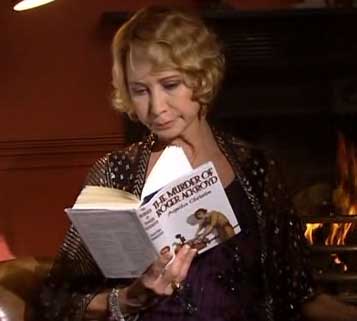
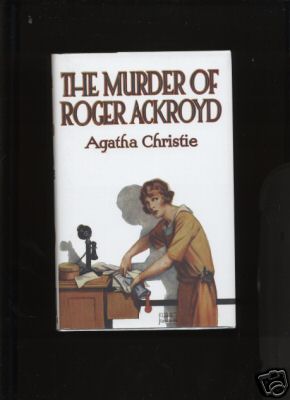
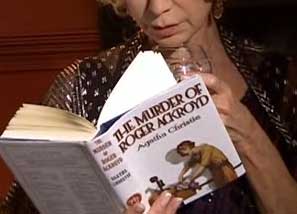
UPDATE: Okay, maybe I’m just being too damn picky, but surely the art director on Doctor Who could have spent more time getting the title font kerning right, as well as making sure the artist’s signature was there the woman’s skirt. The drop shadows are off too.
A still from the episode:
The dust jacket from the 1926 edition of The Murder of Roger Ackroyd:
And here’s a closer shot. The woman is arched over too much. And I’m wondering if the actor is holding the book in that way because the art director messed up something on the lower left-hand corner.
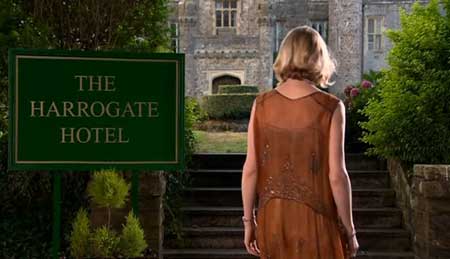
And here’s Agatha Christie returning after her disappearance to the Harrogate Hydropathic Hotel, with a hilarious modern-looking sign and an exterior that looks nothing like the place (now called the Old Swan Hotel).