Open Source Sodomy

“This should be a better world,” a science fiction convention attendee said. “A more honest one, where sex isn’t shameful or degrading. I wish this were the kind of world where you could say, ‘Wow, I’d like to sodomize you with my nightstick,’ and people would understand that it’s not a way of reducing you to an asshole and ignoring the rest of you, even though the request inherently objectifies the person you ask, but rather a way of saying that I may not know your mind, but your body is beautiful.”

We were standing in the hallway of ConStipation, about nine of us, three hadn’t had sex since the Twin Towers fell, and we all nodded. Then another friend spoke up.

“You can penetrate me,” he said to all of us in the hallway. “It’s no big deal.”

Now, you have to understand the way he said that, because it’s the key to the whole project. It was an Ayn Rand novel come to life. When dealing with a request along these lines, you have to completely ignore the meaning of the sentence in order to rationalize the manner in which you objectify someone. Consent is the important part of avoiding a sexual harassment lawsuit. You can tell your lawyer that you didn’t objectify the other person because they said yes. The spirit of everything was formed within those eight words. The Open Source Sodomy Project would have died had we not insisted that there was always a way to rationalize a request, to take the fun of seduction away, to simply pump my friend’s asshole right there in the hallway and ejaculate inside him.

Yet it wasn’t a come-on, either. There wasn’t that undertow of desperation because someone had said the sentence. When you skip out on hindsight, it’s always a marvelous thing. There was no promise of anything but a simple fuck.

We all dropped our pants in the hallway, our cocks erect and our friend quite willing to be part of our impromptu experiment. And lo, we all fucked our friend in the ass — taking turns to thrust, all of us coming. These were awesome asscheeks, plump but serviceable. And the sounds of all of us coming were beautiful. I understand that someone recorded all this and a podcast will be released soon.

And life seemed so much simpler.

It could have been base lechery. But in order for the Open Source Sodomy Project to work, we needed to flaunt our intellectual superiority, this quintessentially American way of justifying everything from looking at a complex moral dilemma with solipsistic naivete to stacking naked prisoners into a human pyramid and snapping pictures. There was always a reason. Always some excuse you could make to evade culpability. Now this wasn’t a case of only following orders, but of only following our desires. Innocence. We knew we couldn’t go further, but being allowed inside this area of somewhat restricted access with nothing more than a question was simply amazing.

We stood there afterwards, a little shocked, wondering if we should take some showers to get the smell of sex off of our bodies. Then someone else spoke in the same tone of voice.

“You can penetrate me, too!”

And my God! Many of us became hard and some of us exploded again! We weren’t degenerating into an orgy, but rather exploring the amazement of how beautiful the body was and how wonderful it was to have access to it. I should point out that those who requested sodomy only dropped their pants. They kept their tops on the whole time. Therefore, there was no objectification.

And every person in that hallway was then asked the question: “Can I penetrate you?” A few took offense and some of us were kicked in the nads. But some said yes. And the unfettered sex continued.

And my Lord, I’ve experienced sodomy in my time, but having so many sodomy opportunities in front of me was beautiful. We hadn’t even rented out a hotel suite! Who needed that when we could fuck anybody we wanted? And who needed to bother with getting to know a person? These were ripe assholes. Wondrous and mindless orifices to ejaculate into! We’d never consider sex with emotions again. We’d look at every person walking down the street and say to ourselves, “I wonder what it’s like to explode into his asshole! If he refuses, is he an asshole?”

We did not wish to offend. But one person we asked took offense when we asked to penetrate him. He was a large, muscular man who proceeded to beat the shit out of one of my friends after my friend posed the question. Something about assuming he was queer. We didn’t understand. Our friend’s in the hospital now. But, of course, he won’t be pressing charges. You simply don’t do that in an idealistic world. It’s like Esperanto. You believe in it no matter how problematic it is. Even though my friend was served with court papers and his attorney said that he’d require a five thousand dollar retainer. A small price to pay for the beauties of utopia!

By the end of the evening, others were coming up to us! Pretty soon, we were dropping our pants and there was more fucking.

I’ve left off the names, because frankly, people should reveal for themselves whether they’re Open Sourcers or not. People should speak out so that the natural spirit of evading the complexity of another person’s feelings can be sidestepped through this carnal simplicity. Who cares what the larger ramifications are? And who cares if an asshole is full of shit?

(Hat tip: Bookslut)

Simple as Pie

Ladies and gentlemen, you may have observed the relative silence around these parts of late. This is because I am very angry — furious about Hillary Clinton’s willingness to say anything to get elected, indignant about the White House’s denial about torture, prepared to apply a baseball bat to newspaper racks because the international food crisis and war casualties aren’t appearing in 42 point type on the front page, etcetera. I have been trying to figure out the precise way in which I can articulate my outrage, in which I can respond with something constructive. Why Americans aren’t storming the streets right now and why they continue to accept our slow slide into a Mad Max dystopic sideshow are mysteries I’m still trying to unravel.

But then my spirits were lifted by this YouTube video.

These kids may not know how to aim their pies properly. But it seems to me that throwing more pies at more figures is part of the solution.

And speaking of double standards, I wonder why we begrudge these merry pranksters, while we have no problem propping up a 75-year-old woman who took a hammer to Comcast. Casual dissent, it seems, is the new dissent.

New York ComicCon — Podcast

Over the course of the weekend, a number of people were interviewed by Our Young, Roving Correspondents on the floor of New York ComicCon. Thankfully, we have managed to assemble a rather strange collection of interviews into a podcast. We had no idea that we had recorded so much material. Many thanks to Eric Rosenfield for interview assistance and his laconic pal Phil for moral support and a shoulder to cry on. Scroll to the bottom to listen or download the 78 minute MP3!

1. Mike Pellerito — In this somewhat naughty conversation, Archie Comic Publications, Inc. Managing Editor Mike Pellerito offers his candid views on maintaining the purity of the Archie universe.

2. Joe Gonzalez — We venture into Podcast Arena to discuss the appropriate way of covering New York ComicCon with a fellow podcaster.

3. Aaron Goold — One of the folks behind Yo Yo Nation explains why he is a spokesman for Duncan. There is also some speculation on secret yo-yo societies in New York.

4. Jack Ringca — I am unsure what pernicious position Mr. Ringca holds within Duncan, but he seemed to have a few diabolical ideas involving Mr. Goold and conquering the universe with a yo-yo army.

5. Joseph Semling — The purchasing manager of Brian’s Toys offers a helpful explanation of the economics behind lightsabers.

6. David Williams — The co-founder of Fanlib insists that he’s flying fan fiction writers out to Hollywood. But we learn that this isn’t the case at all. He seemed especially convinced that all fans are protected from lawyers.

7. Dan Piraro — The man behind Bizarro explains the precise circumstances that help him generate ideas and reveals how some of his more daring strips end up in Scandinavia.

8. Ross Milhako — Attracted by the risque title, Our Young, Roving Correspondent questions the creator of Dead Dick — Zombie Detective upon the filthy and salacious qualities of his comic’s name.

9. Tim Fish — The Boston-based comic book writer behind Cavalcade of Boys explains precisely what he means by “cavalcade” and offers some insights on gay romance comics.

10. Patch — A gentleman who only referred to himself as “Patch” explains how Teddy Scares inverts the nature of the cute and cuddly teddy bear. There is also an ethical debate over whether zombie teddy bears can appeal to an UglyDoll audience. We dutifully pledge, per this interview, to investigate Teddy Scares in five years and determine, per Patch’s assured declarations, whether or not Teddy Scares retain their edge.

11. Kim Caltagrione, Mike McLaughlin & Steve Vincent — We talk with the New Jersey underground comics operation, Angry Drunk Grahics, about the fine line between angry and drunk and how Ms. Caltagrione ties this ontological spectrum together. Includes discussion of Mike Diana, the first artist to receive a criminal conviction for obscenity in the United States and who is published by Angry Drunk Graphics, and the Diana-drawn illustration of Jesus with a penis.

12. Brian Phillipson — The co-creator of God the Dyslexic Dog insinuates a forthcoming jihad involving canines. Or at least that’s what we’re left to conclude from this conversation that somehow manages to include nonoverlapping magisteria and dyslexic fundamentalists.

13. Chris Wozniak — Chris Wozniak insists, despite developments involving Kathy Griffin, that he is the Woz. But even though he has created bitter midgets, the Woz doesn’t have any explanation as to why his midgets are bitter.

14. Jeffrey Brown — A mention of Brown’s appearance on a Canadian sex program leads into an unexpected delineation between the real Brown vs. the invented Brown. (Partial transcript here.)

15. Kyle Baker — A conversation between Baker and McCloud is unexpectedly interrupted, but segues into issues of artistic control, television, people who don’t read comics, thwarted animation deals, families coming back in style, Special Forces, Nat Turner, the Haitian Revolution, mainstream publishers getting into graphic novels, and other assorted topics.

16. Scott McCloud — Scott McCloud reveals a future deal involving a graphic novel in New York, the present state of advocating graphic novels, the Creator’s Bill of Rights, and the failure of micropayment systems.

On the Exchange of Moments

Dude, like, there’s this whole web conservation moment going down. The same bullshit about how there’s all this bullshit on the Web and how it’s up to us to be responsible and all for our content. I hereby abdicate editing on this post. Because I want to tell you about why I’m up right now and, hell, maybe I’ll go into the the mistake I made of imbibing two cups of coffee and a rather large bottle of Coca-Cola to meet two deadlines and to get through a rather long day. The thought of pressing the backspace key and giving into this prim and proper nonsense might appall me if I didn’t view it as so laughable. Ha ha! How trivial it is to type those five characters and a space! I just watched the first episode of the fourth season of Doctor Who and HOLY SHIT! Rose Tyler has returned! She looks utterly gloomy and it’s very clear that Russell T. Davies is trying to go for a big finish here before he hands over his car keys from the producer who’s going to take over. Within long paragraphs, there may be meaning or there may not be. In gushing about Doctor Who, which I railed against not long ago because of its campy qualities, am I confessing to readers that I am going back on my original promise, which involved something about boycotting the show and suggesting in some language or some such that Russell T. Davies should be stopped? I’m too indolent and otherwise worn out to drag up the post. I don’t think it’s particularly important. In dwelling upon that important moment, am I perhaps finding another important moment? Or am I discounting the importance of that moment by describing that moment as important? Well, all I have to say is that I found a YouTube clip and I watched the surprise disappearance of Rose Tyler FOUR times! In a row. Just to be sure. Now that particular process of watching Rose Tyler reappear with a melodramatic sad glimmer on her face was, for some strange reason, important. But it is not important by the new rules of the game. Queen Victoria has suggested that because that moment is not thought out, because I am simply gushing on about a YouTube clip replaying a moment that I watched on an illicitly downloaded torrent, it is therefore invalidated by the new criteria of selecting precisely what it is I need to write about. But since I have spent a good portion of the day — deadlines, yo — selecting text and moving it around, why then should I bother to do it again? Am I not allowed one moment of expressing this moment? Or is meaning exonerated here? If I am not permitted to write about a moment about a moment about a moment, then I am somehow a lesser life form by these new rules. If I am fumbling around in the dark for the keys to that moment, producing much noise and less signal, but otherwise removing myself viscerally into this great realm of Deep Thought and Substance, then I am doing the Lord’s Work. How one chooses to express themselves is their own concern, really. How one chooses to publicly embarrass themselves about, say, Rose Tyler returning in Doctor Who is really that one person’s moment. Who is anyone to take that moment away from this person? If I hear an annoying conversation, I ignore it. Or better yet, I participate it and see if I can raise some hell. I am my own filter. You are your own filters too. Together the common filters come together and we all boogie and bust out the bourbon and otherwise figure out what that moment might have meant. Perhaps we all shared some shred of that moment and wanted to come to terms with it. Perhaps all of us are fumbling in the dark and perhaps all of us can find moments atop those moments. And then just as we experience another seemingly inconsequential moment in the real world — by feeling a gust of air, by hearing the clink of a quarter atop the counter at a bodega, by examining the slide of a window going up so that it’s not so hot in the apartment — we can then find additional stimuli to respond to. And you know what? Even though the little scroll bar on the right side of this window within a browser window is advancing, I’m not going to go back and check what I just wrote. Perhaps there’s some purpose in simply rattling on like this. Perhaps not. But once it is out there, it’s up to others to make sense of it or ignore it. I think it’s a colossally arrogant thing for this Publishing 2.0 guy to say. And I say this as someone who does value the editing and massaging of content. You wouldn’t tell some person spinning a hula hoop to stop spinning the hula hoop because it’s purposeless. Because it doesn’t add anything to the universe. Because it’s utterly trivial and without intelligence. The point is that the person spinning the hula hoop is having a good deal of fun and perhaps others who are watching this person with the hula hoop are also having fun, and maybe they are thinking that they should go out and get a hula hoop and have a bit of fun themselves. And they in turn might inspire other people to spin hula hoops around their hips. And then perhaps the sensation of the hula hoop might inspire another thought, another feeling, that could lead to something important. The Archimedes principle in action. People often blog or produce content because it leads to other things, other thoughts, other feelings. And to wave a schoolmarmish finger at those who produce blather is to be a humorless asshole. When you can just ignore it and move on to others who are spinning the hula hoops that keep things grooving.

ComicCon podcast forthcoming!

NYCC: An Impromptu Interview with Jeffrey Brown

On Friday afternoon, I began walking the floors of New York ComicCon, collecting strange snippets that will be glued together for a future installment of Segundo. I counted thirty-seven Jedi Knights (some of them portly, making me wonder why Jedi discipline doesn’t seem to involve physical fitness), two Stormtroopers (both in good shape), and two Princess Leias (both in remarkably gaunt shape and dressed to show this). If one must choose a side in the Star Wars/Star Trek dichotomy, I’m more of a Trek man myself, even though I recognize that the franchise is dead and hasn’t produced anything of quality since Deep Space Nine. Nevertheless, if costumes are anything to go by, there is a distinct sign that Trek is on the wane with the true believers.

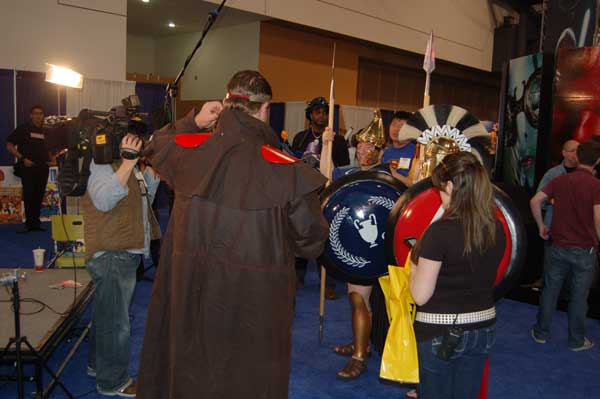
I’m not quite sure what Roman centurions and Jedi knights have in common, aside from the fact Asimov’s Foundation series serves as the missing link between the two. But I must confess that, of all the costumes I espied, I was the most impressed with the Centurions (pictured above).

Speaking of Star Wars, I learned about the economics of lightsabers. A good lightsaber will cost you around $100. More if you want it customized. Joseph Semling, purchasing manager of Brian’s Toys, told me that he has anywhere from 20 to 100 lightsabers of any particular type in his warehouse. And if you’re wondering what a lightsaber dealer is likely to net, a lightsaber goes wholesale for about $75 and is then sold from anywhere from $25 to $50 more at retail. And if you’re wondering how Semling makes his money, he informed me that he raises the price of his lightsabers when the supply goes down. Like anything, the lightsaber is subject to a supply and demand curve. But even if the supply remains relatively stagnant, I suspect if Semling moved six lightsabers a day, discounting overhead, he could probably pay for his New York hotel room.

But the most intriguing conversation I had was with Jeffrey Brown, whose work I was apparently more interested in than I realized and whom I may have profoundly confused with my line of questioning. I’ll let the following partial transcript speak for itself. But Brown, I suspect, has more going on in his personal chronicles than most people realize. And I’m hoping that one day, I’ll be able to sit down with him and give him the full-length treatment he deserves.

Brown: I don’t really write about my personal sex anymore.

Correspondent: I know. But I’m saying that people are still interested in the past.

Brown: Yeah.

Correspondent: So this might be a conundrum. Many people are expecting more of that in the present and the future.

Brown: Well, um, I just keep dangling it in front of them. Well, that sounds bad.

Correspondent: (laughs)

Brown: What I mean to say is that maybe I can just make it seem like I might write more. But I’ll really just write whatever I want.

Correspondent: Okay, I propose something for you. What if you were to fictionalize the personal and therefore it’s not personal sex. But it’s fictional sex. I mean, you did that with the robots. But to have a story that doesn’t involve you as the chief protagonist.

Brown: I have lots of ideas and I’ve got a couple more autobiographical things that I want to cover. Including writing about religion. Growing up with my dad being a minister. And I want to write a book about pregnancy. And the book I’m working on right now is about becoming a cartoonist. And then once those are out of the way, I have some ideas about fiction-like stories that I want to get into. Although the first one, at least, there’s no sex. Well, there could be. I don’t know. I haven’t written it yet.

Correspondent: Well, it’s not all sex. I’m just trying to point out the first-person vs. third person vs. fictive vs. real and all that.

Brown: Well, if you don’t know me, I guess it’s all fiction writing.

Correspondent: I don’t actually. I don’t know you.

Brown: Well, you kinda do.

Correspondent: Well, not entirely. Because this is entirely true. That’s the question.

Brown: But to people listening to this, they don’t know.

Correspondent: Well, now they know. Now that we’re talking about it. We’re clarifying.

Brown: But to them. To them, this could be fiction.

Correspondent: Oh, you may not even be Jeffrey Brown.

Brown: That’s true.

Correspondent: Okay, so let’s talk about this reality vs. what you put in your books.

Brown: Well, it’s something. And I haven’t entirely figured out why. I mean, there’s something about when you know it’s true. There’s something about that honesty, that authenticity, that kind of heightens the impact of things sometimes. Which is why I’ve avoided doing more fictionalized autobiography. And sometimes I’ve thought about moving in that direction. And then it just doesn’t feel right for what I’ve done so far. But on the other hand, books — like some of the Bighead stuff — there are some very personal autobiographical elements sort of in there. So in a way, I kinda do it occasionally. In various half-assed ways.

Correspondent: I’m wondering what boundaries you’re placing on yourself as you’re getting older. As you have a family. And all that.

Brown: I definitely. Well, not writing about personal sex anymore. There’s boundaries there that I’m much more aware of. You can see that in the new book, Little Things, where everything’s approached from a slightly different direction. Where I’m much more careful about what I’m revealing and how I’m revealing it.

Correspondent: But this issue of authenticity that you were talking about earlier, I mean, this causes a bit of a problem if you have boundaries like this.

Brown: Unless you just ignore it. Fuck it. I’m going to do — oh wait, can I say that?

Correspondent: No, you can say whatever you want.

Brown: This is going on the Internet? Oh, Internet. Then I just leave those questions up to people analyzing the work. Then I just ignore the problems.

Correspondent: Now wait a sec. Wait a sec. That was a very great way of evading the question.

Brown: I know. I tried earlier.

Correspondent: Yeah, I know. Well, I’m going to have to put it — just try to get an answer on this notion of how you retain truth despite having these boundaries.

Brown: (laughs) I mean, certainly there’s a theory that some people have. That fictionalizing — that by lying, you can get at a more real truth. So in that sense, whatever boundaries I have, I’m walking some sort of line between those boundaries forcing me to reveal some kind of more pure truth in that sense. But then we can go into how reliable is my memory. I think people who know me would generally say that I’m pretty honest. But it’s also possible that it could all be a big act. And I’m a really good actor. Totally. But —

Correspondent: The issue I have is here you are putting some kind of identity. It doesn’t really matter how true it is.

Brown: Right.

Correspondent: Nevertheless, it is true in some sense. And then there are these boundaries on top of that. So as a result, you’re painting yourself into these interesting limitations. Possibly to be more creative.

Brown: And I think the other thing to is that I tend to think of all the autobiographical works as a bigger picture when you put them together. So one book, for example, might have a lot of boundaries in some way that limit what you’re seeing from that book. It’s a very limited view of me as a person or as a character. Or however you want to put it. But when you read the other books, they all kind of inform each other. And so it’s like a tapestry of information that combines. It’s almost like it gets around those boundaries. Maybe.

Correspondent: Well, I also ask this because, in Little Things, you’re very clear about when things happen in that. You actually date the stories. If I’m thinking of the right collection. This happened during this particular time. I drew this during this particular time. And so as a result, it seems to me that there is an effort on your part to be truthful here.

Brown: No, I was just ripping off John Porcellino with that. No, I actually was ripping off John Porcellino. Well, I do that. And if you look in Unlikely, where there’s the drawings from photographs. Or AEIOU, where there’s the receipt from the dinner. And that stuff’s kind of just an additional way of telling people that, despite those boundaries, I’m trying to be as honest as possible and as forthright. Obviously, there’s probably some weird subconscious thing going on. There’s things that I’m not saying. Or things that I’m in denial about maybe. But what I’m trying to do is be honest.

[UPDATE: Our NYCC podcast, featuring this interview and others, including chats with Kyle Baker and Scott McCloud, should go up soon. But alas, I’m now on deadline. But I’m hoping to get the podcast up once I beat these deadlines.]