NYCC: The New York Comics Legend Award

Eric Rosenfield reports:
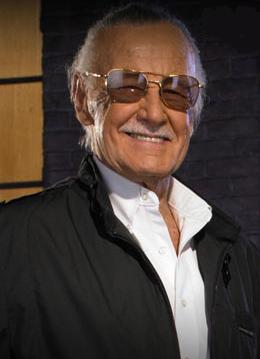
The first annual New York Comics Legend Award was held at the Virgin Megastore in Times Square where a number of die-hards ponied up $350 each to see the award given to Stan Lee, co-creator of Spider Man, The Hulk, The Fantastic Four, The X-Men, etc. etc. He’s something close to the PT Barnum of comics, fond of such catchphrases as “True Believer” and “Excelsior!” I had come with this guy. At first, we milled around and ate the excellent canapés. We were upset because the luminaries—including Stan Lee, Marvel editor-in-chief Joe Quesada, his DC counterpart Paul Levitz, and long-time comics writer Peter David—were all sequestered away in their own area, separate from the people who had paid so much money to be there. Then the show began. Peter David got up and told a number of amusing stories about Stan, including the way that Stan saved his family. (Basically, when Peter was getting a divorce, both he and his wife wanted custody of the children. Peter got a character reference from Stan, which had apparently astonished the court-appointed psychiatrist and made the judge awestruck. His wife said that, during the whole time she was with the psychiatrist, all he wanted to to was talk about was how Peter knew Stan Lee.) Next up was Sharad Devarajan, the CEO of Virgin Comics, who didn’t actually know Stan and seemed to be there only because we were all in the Virgin Megastore. At least he seemed to understand his irrelevance and got off quickly. Then Joe Quesada came up to the dais and talked about how Stan always liked to rip into him. Joe: “Every once in a while I’ll get a call from Stan and he’ll say, [doing Stan Lee impression] ‘This is Stan Lee. I’ve just read the last few months of Marvel Comics. [Dramatic beat] What’s wrong with you?'”

Then there was Stan himself. He apologized for not having a speech prepared. He hadn’t known he was supposed to give one. He made fun of Joe Quesada a little and then talked for a bit about comics and his new book, Election Daze, where he wrote captions, speech bubbles and thought balloons on photographs of political figures. Finally he threw his hands up and said “Excelsior!” The crowd erupted in applause.

Afterward, the comics luminaries did come out and mingle with the crowd. I managed to corner Joe Quesada for an interview, though, being the professional that I am, I didn’t bring an audio recorder. I asked him about whether he thought that the big crossover events that Marvel has been doing (Civil War last year and Secret Invasion this year) might be intimidating to new readers who maybe don’t want to buy all these different books in order to keep up with the storyline. He acknowledged that this had been a problem in the past (I mentioned some cross-overs from the nineties, Captain Universe and The Evolutionary War, which were particularly hard to follow without buying an enormous number of comics), but he said that the way they had built these series was by making them contained within the few issues of their own comic. You only had to read the other comics if you wanted to delve deeper into the story. You could get a complete comics experience just in the seven issues of Civil War, for example. This method has been successful: “I think Civil War has gotten more new readers into comics,” he said, “then anything else in the past ten years.” I asked him if having two Marvel Universes, the original and the “Ultimates” might confuse new readers or dilute the characters, and he said that both the original and Ultimate comics were selling very, very well, and he’s heard of a lot of people getting into comics through the Ultimates. “A lot of people told me that a long time ago the first comics they ever bought were GI Joe, back when they did these TV/comics crossovers. Nowadays people tell me that Ultimate Spider-Man was the first comic they ever bought.”
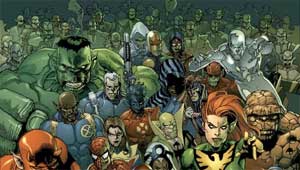
There’s a scene at the end of the first issue of Secret Invasion in which duplicates of many Marvel characters dressed as they appeared in the seventies show up. I asked Quesada if there was any worry about cognitive dissonance with all the characters in seventies’ clothing. Because in the Marvel Universe continuity, none of them are old enough to have been around in the seventies. The extreme example of this is Luke Cage—Power Man—walking around with a giant afro and a tiara on his head. He said, “Yeah, Power Man had that tiara and it was six years ago [in Marvel continuity], he was just having a real fashion problem then. You know, that’s the least of the problems with the Marvel Universe. Every story practically contradicts other stories because we’re coming out with so many of them all the time. That’s what a lot of people don’t understand. You can’t get caught up in these things.” And then he leaned in conspiratorially, “I’ll tell you something about comics. We just make this shit up. Every day we go in there and just make this shit up.”

I found Quesada’s attitude refreshing when compared against sticklers in the comics world — the type so ably parodied by Comic Book Guy on The Simpsons — who get upset when any little thing seems out of place. Some might not understand why these issues of details and crossovers and parallel universes are so important and why Marvel’s attitude toward them is so interesting. You see, since the eighties, Marvel’s big rival, DC Comics, has been fanatical about updating their characters for new generations, constantly rewriting the histories of Superman, Batman, Wonder-Woman and so on to make them more “relevant.” Like Marvel’s current situation with the Ultimates and the main universe, DC once had two universes, one which took place in the contemporary DC Universe and one which was about the characters from the “Golden Age” of the thirties and forties, a universe where Superman grew old and married Lois Lane and Batman had a child with Catwoman. DC eventually decided that these two universes were too confusing and basically destroyed them both in Crisis on Infinite Earths, creating a new, “Post-Crises” DC, resulting in mixed reactions from the fans. My conversation with Quesada tells you a lot about Marvel Comics’s attitude and why it’s been more successful than DC for decades now; at DC, everyone seems very concerned about making everything just right, where as at Marvel they just seem to be having a good time.

Finally I managed to squeeze into the crowd and get a moment with Stan the Man himself. “Stan!” I said, “I’m Eric Rosenfield!” He looked at me for a moment before quipping, “THE Eric Rosenfield?” “Yes,” I said. Knowing I was only going to have a few more seconds with him before he was whisked away, I shot out the one burning question I had of the old Jewish comics maven, “I wanted to see you on Saturday [at the New York ComicCon] but I can’t because it’s on Passover! Why are you speaking on Passover?” I didn’t mention that it was particularly galling for the ComicCon to be taking place on Passover when New York is the epicenter of Jewish comic creators. “I don’t know what to tell you,” said Stan sweetly. “I may not be getting into Heaven, but at least we got to meet here.”

As Ed and I shuffled out, we were given a gift bag full of Virgin Comics. [ED: I politely declined the bag.] It didn’t matter that these comics are awful. It didn’t matter that we had to muscle out through the crowds in the Virgin Megastore into the crowds in Times Square. I was skipping with joy. After all, I’d just met Stan Lee.

Edward Champion reports:

Thursday night’s event had the feel of a corporate retreat initiated on a casual Friday. Crammed throngs transformed the basement into a semi-sweltering exposition. Caterers, dressed in red Spider-Man shirts and wearing false smiles, were casually ignored. Guests extended their anonymous tendrils onto trays and gulped down the food without thanks. Black plastic spiders were placed delicately in martini glasses. I observed one apparent reporter who wore a prominent button for Stan Lee’s book, Political Daze, and I had to wonder if the reporter was there to cover the event or serve as a Marvel advertisement. As Peter David observed during his remarks, “Ten people came up to me with business cards, wanting to give me more.” Did many misconstrue this brush with the greats as a networking session?

Nevertheless, I couldn’t help but remain somewhat impressed by the madness of it all. Stan Lee had an entourage that, as Eric remarked later, resembled a Latin American potentate. Here was a man whose greatest creation was, as Joe Quesada observed, Stan Lee himself. During the ten minutes he sauntered through the crowd, flashing a politician’s smile. He’d place an arm around a fanboy’s shoulder for a quick camera snap, only to spin around and toss out a quip to another. He never spent more than thirty seconds with any one person. The crowd, of course, ate this up with the same zeal in which they scarfed down the canapés.

“Truth, above all, is his major contribution,” said Peter David. But I wondered what kind of truth was on display here. Being relatively clueless, I had no idea that people had shelled out $350 for this event until Eric pointed this out to me. Lee proudly boasted to the crowd that he was a tightwad. And I had to wonder whether some magical Marvel accountant had figured out a way to pull off this awards ceremony to ensure that Marvel made a sizable profit.

As Eric talked with Joe Quesada, I couldn’t help but observe a short man protectively clutching a plastic bag containing original Marvel artwork. Another comics fan began talking with this man, asking him how much he had paid for it. “Too much,” said the man. When the fan begin to open the top folds of the bag, the man shrieked and waved the fan’s arm away. He told the fan that the artwork was very personal to him because he knew many people. But if he knew many people, why then was he spending much of the party alone?

The comics industry is built on hardcore fans like the man with the plastic bag. And these fans were willing to pay considerable money to spend only a few seconds with the men they considered masters, hoping to feel important by proximity. But what made me feel truly sad was the way they had been casually sequestered away from their heroes, while their heroes saw no ethical conundrum in profiting at their expense.

[UPDATE: Comic Foundry senior editor Laura Hudson reports that because she has written critically about Virgin that she would be banned from future Virgin events. Meanwhile, Lance Fensterman reports that there were many unhappy fans because Stan Lee wasn’t signing anything.]
200

Today, there are two notable pieces of news: The Bat Segundo Show has now crossed the 200 episode mark, with shocking developments involving Mr. Segundo, and Mark Sarvas‘s Harry, Revised hits bookstores. In an effort to tie both pieces of news together, one of the podcasts released today involves an interview with Sarvas himself. But if you’re thinking this is squeaky-clean literary stuff, an excerpt from the show should rectify this impression.

Correspondent: Anna is actually a palindrome. Is that intentional?
Sarvas: No. And the thing that really troubled me with Anna was that I was, I think, a year and a half into writing this book when John Banville’s novel, The Sea, came out. And in The Sea, the main character Max is mourning the death of his wife Anna. And I thought, “Oh my God. Everybody’s going to think that this is my Banville homage.” And this was really not. I was looking for a simple and an elegant name. And Anna floated into my mind. That was a more instinctive choice than anything else.

Correspondent: And yet there’s inarguably an elegant variation in this. I have to ask you about “a dancing St. Elmo’s fire of the groin.”

Sarvas: Okay, you…

Correspondent: This was really — all you had to say was that it was an erection.

Sarvas: Well, see, you mentioned that. You sent me a text message, and…

Correspondent: I asked five people about this and they said, “What the fuck?” (laughs)

Sarvas: But, and look. First of all, this is a book of nearly 300 pages. Not every single metaphor’s going to sail. There will be those that don’t.

Correspondent: Well, it’s definitely memorable. That’s for sure.

Sarvas: But to my mind, I was not describing an erection. I didn’t intend to. And the fact that you thought that that was what I meant argues that I didn’t do my job well. Because what I was really hoping to describe. And this is perhaps not the stuff of a normal Segundo podcast and I hope my wife isn’t listening to this….

Correspondent: (laughs)

Sarvas: …is that weird sort of tingling, pre-erotic moment that announces the onset of an erection. Where you’re beginning to feel that surge, that electricity in that way. But you haven’t actually flown the flag up the pole yet. And that’s what I meant. If I wanted to say erection or boner or some other, I would have said that.

Correspondent: But the fact that it’s ambiguous is very interesting. Because then it leaves — I mean, this could be discussed endlessly in book clubs across the country.

Sarvas: And I think it’s actually better that way.

Correspondent: It’s the phrase that definitely I can’t get out of my mind and makes me look at you in a sort of cockeyed way.

Damon Lindelof and Carlton Cuse Plan Season Five

INT. LOST PRODUCTION OFFICE — DAY

DAMON runs ALL THE WAY THE FUCK INTO THE OFFICE, passing SIX FUCKING WRITERS. He carries a latte — A FUCKING VENTI LATTE, MOTHERFUCKERS! Teach that FUCKING BARISTA a lesson!

CARLTON holds up his hand. Holy. Fucking. Shit. It’s the BIG FUCKING HAND of a FUCKING BIGSHOT TV WRITER!

CARLTON
Emphasis is important.

DAMON
We need more fucking.

CARLTON
More fucking Flann O’Brien.

DAMON
Jack fucks the dead fucking skull of Flann
Fucking O’Brien?

Damon spills his latte onto the boardroom table. Holy. Fuck!

CARLTON
Fuck. Where’s Brian when you need him?

The writers cower underneath the table. BENT and BROKEN! This is a REALLY INTERESTING standoff and suddenly —

BRIAN
Christ, do I need to straighten out another fucking
mess from Season 3?

ON CARLTON. Yeah. Oh yeah. Fucking camera tight on FUCKING Carlton! GET AS CLOSE AS YOU CAN ON HIS FACE OR I’LL CANCEL YOUR LUCRATIVE SENFUCKINSATIONAL CONTRACT, YOU DIRECTOR CUNT!

What? The? Fuck? Writer!

CARLTON
(seriously fucking backpedaling)
Have the intern look up Faraday on Wikipedia again.
Maybe there’s some bullshit science we can throw
in. Keep the fucking websites guessing.


But oh no! YOU FUCKING DIDN’T BRIAN!

And then Damon’s got this like BIG FUCKING LOOK OF HATRED — like he’s going to FUCK Brian. Up. The. Ass.

DAMON
Hey, comic boy. You want to pull some Bryan Fuller shit
on me?

BRIAN
No, man. I was only —

DAMON
Because I’ll write a script with more fucks than
a callgirl’s monthly ledger.

CARLTON
Fuck you.

DAMON
No, fuck you!

And the other writers are like totally RUNNING THE FUCK AWAY as Carlton and Damon are TOTALLY FUCKING BEATING THE SHIT OUT OF EACH OTHER!

– BLAM! BLAM! BLAM! Oh yeah baby! That FUCKING sound. Instantly recognizable as a fucking emphasis. We’re IN THE SHIT here, folks. Make up some kickass camera moves, MOTHERFUCKERS.

And if Brian has some FUCKING IDEAS on where to go from here, well then YOU KNOW HIS FUCKING PHONE NUMBER!

Fuck YOU!

(Tip: Bookshelves of Doom)

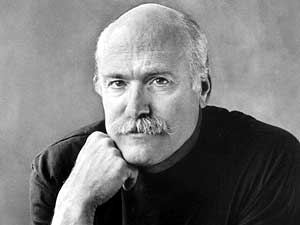
Interview with Tobias Wolff

This week, The Bat Segundo Show will cross the 200 episode barrier. A future program will feature a conversation with the writer Tobias Wolff, whose most recent book, Our Story Begins, is a short story collection containing previously collected tales — including the classics “Bullet in the Brain” and “Hunters in the Snow” — and more recent offerings like “A White Bible,” a gripping narrative that takes the notion of entitlement to task, but leaves judgment to the reader. In the New York Times Book Review*, Liesl Schillinger wrote, “To read a story is to sink into the soft seat of your grandfather’s strong, modest old Buick and let yourself be carried through an America of small towns, small joys, small struggles and small despairs — a landscape so familiar as to be invisible, the landscape of homeland.” Wolff’s stories are certainly a place to recognize readily identifiable qualities, but what makes him a fabulous writer is the way in which these quotidian moments are charged with import without coming across as overtly portentous.

I got the chance to talk with Wolff last week when he was in New York. He was a confident figure beating a bad cold. And while he was interested in how readers interpreted his stories, he had no desire to offer explanations. But I did pry further. And I was able to unfurl some of the science Wolff brings to his tales. What follows is a partial transcript of our conversation.

Correspondent: This idea of first-person narration that is somewhat removed — maybe this is more of a classical sense of the short story, in the sense that today, contemporary short stories are, as you point out, more of a gushing therapy session. Maybe that’s what we’re talking about.

Wolff: Well, I don’t know. Again, when I think, for example, of Philip Roth’s first-person narrators, they are interested in the world at least as much as they are interested in themselves and interested in other people. And that shows up in the narration. It would be a pretty boring story that was so — if I could put it this way — narcissistically defined if you didn’t get a sense of the world beyond the narrator or of other people beyond it. I would think that, unless it was deliberately taking on the pathology of narcissism, it would be a deficiency of the story. Some stories, of course — some first-person stories — rely on a very heavy colloquial. And that may be something that you’re noticing with some of the stories. Like the one I just quoted from, “Next Door,” is quite colloquial. In other stories, you get the sense that the narrator is telling the story not in the immediate moment of the story, but perhaps from a distance. Which also would give you a wider vision of the circumstances and the people involved. And also perhaps a more articulate voice. A more capacious voice. So it isn’t just a Catcher in the Rye, moment-by-moment narration, but something that would open up a little more in the way of Philip Roth or William Trevor. The way their first person stories work.

Correspondent: I’m wondering if it’s something similar to Nabokov’s idea — that he had to know the lay of the land before he could write any particular novel or short story or what not. Maybe this is your concern.

Wolff: Well, by the time I write the last draft of a story, which — well, when Nabokov wrote his first drafts, they were like the last drafts of anybody else’s. By the time I write the last draft of the story, I certainly do know more than I can ever tell about my characters’ situations. So you’re just seeing a part of it.

Correspondent: I wanted to ask about the very subtle use of symbols throughout these stories. They are essentially straightforward realism. But you have, for example, in “A White Bible,” the attention to Frontage Road. You have the light shutting off at the end of “Say Yes.” And also, I really love the tule fog at the end of “The Rich Brother.” So these are really symbolic. But also, at the same time, they come from this realism. And I should also observe that, particularly with these endings, these symbols pop up often when you have a concise story.

Wolff: Well, they’re not symbols in the way that a high school English teacher teaches symbols. They are features of the story that a reader can probably sense some consequence without being able to define it. Yeah, at the end of “A Rich Brother,” Pete’s in a bit of a fog. But it’s also a very real fog. If you drive through that valley in California — the Central Valley, that time of night — you’re going to be in a fog. So what symbolism there is simply what life itself gives us. I mean, we actually navigate our lives by symbols. That is, by the outward signs that lead us in one direction or the other. Nature is filled with these things. And, of course, writers make use of them.

Correspondent: Well, in terms of endings, I think also of “Powder” and “Say Yes,” which have endings before the endings. In the sense that we think it’s going to end at a particular point, but, in fact, it ends before that point. And we are then forced to speculate upon where these characters are going. I mean, again, this supports the theory I’m throwing out at you that these concise stories have more going on or the action needs to be stopped at intervals.

Wolff: Well, the ending of a story, I think, contains all that the reader needs to have an intuition of how the story might continue. And they shouldn’t necessarily spell those things out, as some readers do. Tolstoy, for example, writes short stories as if they were novels. But to make a contrast, Chekhov draws enough of an arc that you imaginatively complete the circle yourself. You’re given all you need to do that. And my own practice as a short story writer has tended to gravitate toward that. One of the things I like about the story form is how much it can imply. Not as a kind of guessing game or some cute riddle you’re playing on the reader, but in the way that situations in life imply other situations. I mean, we actually, in our daily lives, become quite adept at intuition, at teasing out implications of present situations in order to get a sense of how the future might unfold. When we go out with a girl on the first time, we’re doing that. We have our first week at a new job, we’re doing that. We meet a new friend. We’re just constantly in these. It’s a very natural and emotional exercise that we do. And I try to find a way of expressing that in the forms of my stories. I don’t close things down because they aren’t closed down in life. The way that Tolstoy closes things down is that he has his characters die at the end. And that is a pretty neat way to do it. But they’re not going anywhere then. I love his stories, but they aren’t the kind of stories that I write.

* — One must point to good fiction coverage in Tanenhaus’s rag from time to time, with the unrealistic hope that such plaudits will correct unpardonable oversights elsewhere.

Anders in the Flesh

Tobias Wolff’s short story, “Bullet to the Brain” concerns Anders, a critic so removed from the joys and pleasures of life that he is reduced to niggling over every ontological detail. Because of this, reality trumps his existence. The story is unspeakably tragic in its final paragraphs, as we learn that there are pleasures that Anders is incapable of remembering. I don’t know if Lee Siegel has ever read this tale, but his embarrassing appearance at the New York Public Library on Thursday night revealed a sad sack so detached from life that I could not help but empathize, even as he tried to bait me by declaring to the crowd that I wasn’t a writer.

Siegel was there to talk about Against the Machine, a book so ineptly argued that the Washington Monthly‘s Kevin Drum was forced to abandon his review, but not without offering his notes. He was joined by Nicholson Baker and Heidi Julavits. But Siegel dominated the conversation, refusing to let even the moderator Paul Holdengraber, who tried to be as gracious and as patient as he could, finish his questions. Seigel’s entitlement was evident in one petulant exchange late in the talk.

“It’s my goddam book,” pouted Siegel.

“It’s my goddam conversation,” retorted Holdengraber.

It should be observed that Siegel is 50 years old.

When the talk was done, I congratulated Julavits for being “part of the supporting cast.”

Another anti-Internet crusader, Andrew Keen, is at least aware that his tirades are something of an act. But Siegel really seems to believe that the Internet is worse than cancer, poverty, and war combined. A true thinker actually considers an adverse viewpoint or is willing to consider that he might be wrong. Siegel, by contrast, refused to accept Nicholson Baker’s examples of items from the Web that depicted art and beauty. “How can I respond to that?” he barked. When the remarkably patient Holdengraber, casually tossing around references to philosophers, attempted to ask Siegel if there was anything good about the Internet, Siegel merely said that he liked email and Amazon, and that everything else was the morass. (There is a certain hypocrisy here in Siegel’s affinity for Amazon, considering that he rails against the Internet as a commerce-driven medium.) Holdengraber tried to frame this question many times and Siegel grew agitated, insisting that he had already addressed the issue. But I must ask: what kind of human being could not find one shred of joy within billions of offerings?

Only a person thoroughly removed from linguistic pleasures would quibble with the semantics of “assclown.” It was a surprise to me to see Siegel taking umbrage with the term. “Assclown is a really funny word, though,” grinned Nicholson Baker, who did his best to try and get through to the pigheaded Siegel. But it quickly became apparent that Siegel would not be moved and I watched with some sadness as the cheery, ruddy-faced Baker shifted to profound and silent empathy for this lost soul.

Lee Siegel belongs to that miserable genus of people who defecate upon any pleasure, tear up any moment of beauty, and who cannot locate the capacity to understand another person’s thoughts or feelings. You’ve probably met a few in your time. And like them, Siegel’s a lesson on how not to live. During the Q&A session, the good Levi Asher tried to engage Siegel in a gracious manner, pointing out that the New Republic hostilities might have been troubling because they at long last revealed what his readers really thought of him. A woman attempted to respond to his points in a fair-minded manner. But Siegel would have none of this. Unable to argue competently, he proceeded to dismiss specific terms and thoughtful angles that others presented. Siegel seemed unaware that such an attitude often causes setbacks.

Spiegel spewed out more straw men than a scarecrow population on a three hundred acre pumpkin patch. At one point, Baker suggested that Siegel once had a fascination with the Internet, pointing out that he had written many articles for Slate.

“That’s a fine conceit,” responded Siegel. “That’s one of the things that makes you a great novelist. Your negative capability.”

“Negative capability? What does that mean?” asked a baffled Holdengraber.

Where Baker hinted at the fun of all of us becoming filterers because of the Internet, Siegel snapped, “I don’t need more filtering.” Ever the hypocrite, Siegel said that the Internet was laden with false personas, but bristled when asked about the sprezzatura incident. He bemoaned being called “asshole,” “douchebag,” “fucktard,” and “shithole” on the New Republic. Being called a pedophile was the last straw. (Never mind that Siegel once called James Kincaid a pedophile.) “They all had it in for me,” cried Siegel. He wanted to give them a taste of their own medicine.

“No,” said Baker, “you cannot overlap.” Baker pointed out that Siegel using the third person while pretending not to be himself went beyond the boundaries of acceptability.

Unable to offer anything of substance, Siegel then began employing inept humor. “My BlackBerry is hooked up to my heart with wires, and to my testicles. I’m on Amazon all the time, and when my numbers go up, I get an erection.”

Siegel had a few supporters in the crowd, but there was, for the most part, an uncomfortable silence after this witless barb, as if they had just observed David Brent dancing.

I now find myself staring at my many notes and feeling extremely sad. Should I tell you about Siegel’s casual racism directed at Indian call centers? Should I tell you about the way that Siegel dismissed Baker’s praise for notpretty.com, a now defunct blog written by an overweight woman trying to make sense of her place in the world, by wondering why anyone would trouble with such pedantic thoughts? Should I trouble you with Siegel’s condemnation of 2 Girls 1 Cup, which he declared the ultimate reductio ad absurdum of the Internet? (And what makes Siegel the final arbiter of what people find interesting? What gives him the right to judge?)

All this nastiness from Siegel overshadowed Baker’s sense of wonder at the photos taken by a tethered camera or Heidi Julavits’s giddy confession of looking up diseases on the Internet to abate her hypochondria. Spiegel’s spite spoiled what should have been an evening of meaningful discussion.

Siegel frequently suggested that criticism of the Internet is a good thing. I think it is too. But when you openly rail against the Web using only a few bad examples without offering a single example of anything that’s good, it’s a fallacy of insufficient statistics. It isn’t a logical position.

I’m tempted to damn Siegel on these pages. But that would involve feeding the very bitterness that Siegel thrives on. So instead, I’ll simply declare Siegel a sad and incurable Anders. A man who might one day find his assumptive illogic greeted by a far less forgiving thug and who will never remember the joys that made him a writer in the first place.

[4/16 UPDATE: In a related story, Portfolio’s Jeff Bercovici reports that Lee Siegel is terrified of talking to anybody who even remotely criticizes him. Furthermore, the Bookscan number for Against the Machine, as of yesterday, is a mere 3,038 copies.]