The Video Game as Art

In 2005, film critic Roger Ebert ruffled a few feathers when he suggested that because video games require player choices, games are therefore an inferior medium:

To my knowledge, no one in or out of the field has ever been able to cite a game worthy of comparison with the great dramatists, poets, filmmakers, novelists and composers. That a game can aspire to artistic importance as a visual experience, I accept. But for most gamers, video games represent a loss of those precious hours we have available to make ourselves more cultured, civilized and empathetic.
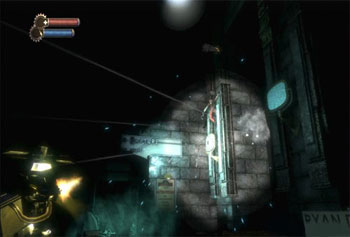
bioshock.jpgI can certainly agree with Ebert that video games are, for the most part, showcases for the latest gaming engines, primarily designed so that the individual will drop hundreds of dollars for a next-generation console system or a needlessly expensive video card that will be outdated in a few years (only to be replaced by yet another). We are now in the nickelodeon days, although, as the Wii demonstrates, the game controllers are getting more interesting. But this multi-billion dollar industry is less concerned with the human experience than it should be. It has come close with the Civilization games and the Sims offerings, and may come even closer with Will Wright’s much delayed Spore, an ambitious god game that permits the player to develop a cell and then control the natural development of this cell into a species, and then further manage the species as it plunges into space exploration. I’ve lost many hours feeling an ignoble cathartic thrill when fragging a junior-high schooler who, like me, should probably be reading a book. But I can justify my shameful vicarious pleasure by knowing that this is a medium that has yet to produce a Battleship Potemkin or a Birth of a Nation.

To suggest, however, that the video game will never find the same gravitas as cinema is to fall prey to same prejudicial thinking with which intellectuals once castigated cinema in the early 20th century. Let’s not forget that it took the motion picture around thirty years of technological developments before it was considered more than a gaudy amusement. And we have only just passed the 30th anniversary of the Atari 2600.

This New York Times article from September 7, 1913 suggests that the then primitive motion picture was, like the contemporary video game, very much about delivering spectacle to a mass audience. George Kleine, one of the key people who established the film industry in the United states and who had just made a cinematic adaptation of Quo Vadis? with a cast of 3,000 people (then an unprecedented number), is quoted in an eerily comparable manner about the future of the medium”

“I have plans for the future which make everything I have done so far seem to be mere child’s play. The educational end has not begun. Motion pictures will not supplant books in the public schools, according to my opinion, but they will revolutionize our educational system. Instead of being bored, the child will enjoy learning by object lessons conveyed by the use of moving pictures.”
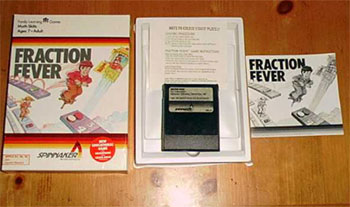
ffever.jpgReplace “motion pictures” with “video games” and you essentially have what’s reflected in this 2002 BBC News article, in which a study reveals that games are not a substitute for books, but a way to help children learn. And if, like me, you grew up playing Fraction Fever (the ROM is here, if you’re an emulator geek) or any of the other Spinnaker titles, perhaps there is some credence to these theories.

There is also this commentary from the 1913 article:

There are many pictures being thrown upon the screen every day which, although not really harmful, possess no merit. Some are positively ridiculous, and portray scenes both unnatural and unreal. It is not to be expected, however, that with the demand for films exceeding the supply every production should be perfect.

It seems to me that Ebert’s Grumpy Old Man routine was published in newspapers a century before. The medium is the only thing that’s different.
passage.jpg

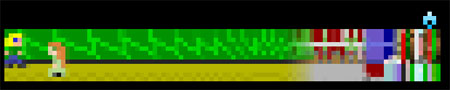
Jason Rohrer’s surprisingly touching game, Passage, freely available for download and released a few months ago, quite easily destroys Ebert’s thesis that the video game is incapable of poetry. Rohrer achieves a unique poetry both in limiting the player’s perspective to a 100×16 window and through the deceptively simple manner that he has designed this game for the player. Play the game once and you will follow a strapping young man from left to right. He finds a woman along the way. A pixelated heart soon follows. As the man advances further along this horizontal tableau, he (and his sweetheart) begins to age. He goes bald. As he continues to age, his position on the axis shifts further to the right. Near the end of his life, he is hobbling. Then a tombstone crops up. The End.

Or is it?

The game isn’t limited to left-to-right movement. Play the game again, press the down arrow. and you will find yourself exploring a maze below the top, collecting many stars and stumbling for a way out. But with this simple design, Rohrer has done something very interesting. If you choose to fall in love with your sweetheart, the two of you can only explore certain areas. Because with your partner in tow, you collectively take up a wider space and can only fit into specific territory. If you choose to go through this life solo, then you’ll be able to collect many of the stars denied you and your sweetheart, but you may get lost in the maze and be unable to find your way back to where your sweetheart waits.

If Passage is not quite the video game’s answer to The Waste Land, Rohrer’s poetic game demonstrates that independent developers can in fact use the form in favor of human experience. Rohrer’s lo-fi approach is a welcome response to high-end graphical tentpole operations. I found myself thinking of all the choices I had made over the course of my life and wondered how I would have turned up if I had made slightly different decisions. Contra Ebert, I did indeed find the experience to make me more curious and empathetic about the human condition. (And this would appear to have been Mr. Rohrer’s objective.) This was something that no amount of fragging had inspired.

If all this sounds fishy, well, the game simply has to be played. Like any work of art, it is something better experienced than talked about. And it requires that superannuated naysayers keep open minds.

Beware of the Owl

owl.jpgThe reports promised snow but prevaricated. My mind marinated. You get that feeling when you are conned into picking away at a slice of red velvet cake because it’s there and you have only poor penmanship instead of an able fork. Never mind culinary sullies. The owl’s snooty hoots belied a ballistic solipsism suggesting the sword was mightier than any midnight rambler. And we were rendered into spittle and drivel hoping that flurry would scurry and leave us with some natural marching power.
Do not attempt this at home. This is an experiment to be carried out in the field.

The mind’s confines are best addressed with cardboard forms of demarcation. One expects lobes to spill but finds an ungracious appreciation for cerebral aerobics. To expand with substance, or to impute that other substances were snorted, is to fall prey to the owl’s howling mantras.

And yet the owl’s maxims mean much to many. An internal stare avoided for fear of the external. The febrile zeal to fit in when best adjudicated by entropy. The enameled mammals flensed their telegenic teeth because this mattered more than a whore. First person prima donnas not comprehending their spending and, worse yet, failing to feel the beats of their hidden hearts in a playground for the rich and a salvo for the stitch. Small wonder that my soul resembled an over-tossed baseball.

Thus, I retreated into gibberish, what they felt was folderol. My sentences became longer and the owl still did not understand them. The owl merely responded to big billboards and bright lights. The owl offered me a script.

“HOO HOO! Say these HOO HOO! words and HOO HOO! you will HOO HOO! be a HOO HOO! success.”

“He was on first,” I replied.

“HOO HOO! Stop that HOO HOO! they’re beginning HOO HOO! to turn away.”

Idle talk amidst the unfulfilled flakes. Damp matches struck sulfur and the owl’s paper package transmuted into a capable conflagration. No one was more surprised than me. There was, after all, the slush.

The owl offered another script. I took it, but the words were the same.

Quadruple Bypass

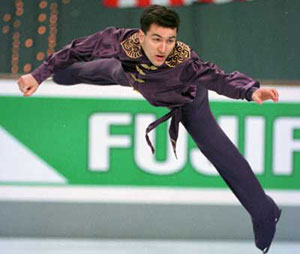
stojkoreal.jpgThe first time I saw a quadruple jump performed live, I was barely a mile from the house I grew up in. It was December 1995. The Nepean Sportsplex, constructed in 1972, featured rickety rafters, off-kilter air-conditioning and smaller-than-regulation size skating rinks. This was a place designed more for vicious hockey hits than quadruple jumps, but two-time defending world champion Elvis Stojko was in town to compete in the Eastern Nationals, a three-day long competition for skaters determined to qualify for the National Championship. He didn’t have to be there; his decorated status meant he could go straight to Nationals and skip the Sportsplex altogether. But he’d withdrawn from the previous nationals because of an ankle injury suffered during competition practice, fought through the pain to defend his world title, and wanted to show Canada he was fully recovered, sustaining what was an otherwise injury-free career. He was still capable of landing the quad.
The quad looks difficult on a television screen because it reflects the miniscule probability of perfect execution. Figure skaters are taught before they enter primary school to use the sliver-thin length of the skate edge for gliding, spinning and lifting themselves off the ice and landing on one foot. Later comes the most important part of a successful jump: pulling the body into a small center of gravity and rotating one, two, three times at a rate akin to the idling engine speed of a car before landing. The quadruple jump requires a perfect storm of horizontal and vertical displacement, takeoff and landing velocity and angular momentum (the force required to spin so quickly in the air) so that all four revolutions are finished before the skater lands. Stojko had mastered the jump as a teenager, and landed it when it mattered at the 1994 Olympics for a silver medal. He landed it even more convincingly two months later in Chiba, Japan to help him win his first world title.

stojko2.jpgAny doubts about Stojko’s fitness and quad mastery dissipated in practice. Where before I required a working television to count the setup’s 1-2-3, with the edge change and toe pick deep into the ice just before Stojko pulled his body together for four tightly wound revolutions, leaving me a half second to wonder if he would, in fact, land the jump cleanly on one foot, now I could do so in person. He whipped out quad after quad, sometimes in combination, during the practice sessions. The fans, far fewer than the numbers attending Nationals and later the World Championships in Edmonton, responded with the fervor and noise of a crowd twice its size. Stojko was relaxed, jocular, keeping up a perpetual professional equally adept with wide-eyed kids, sycophantic adults, and me — a teenager trying hard to be too cool for school and failing.

I don’t remember if Stojko landed a quad during either of his programs, but I suspect he did. He would also land many, many more over the years that followed until he finally retired from competitive skating in 2006. But the regional meet in my local backyard signaled a turning point, a time when the quadruple jump moved beyond a risky novelty move into an expectation, even a requirement, for a male figure skater. Women now try quads, though only one, Japan’s Miki Ando, succeeded in 2002. The toe loop and salchow are in the books; the lutz just missed. But with the quadruple jump turning twenty this March, I lament the absence of risk. Or something more. The absence of wonder I felt during the quad’s first decade and a half. Adding more revolutions won’t bring it back.

* * *

stojko3.jpgThe quad’s anniversary is arbitrary. Robert Waggenhoffer is but a footnote in American skating history: a young man rumored to have landed quads in practice as early as 1979. “Jumpin’ Joe” Sabovcik, the 1984 Olympic bronze medalist, might have been the first quad hopper had he not brushed his foot on at the European Championships two years later. The year before the Calgary Olympics the papers wondered if “the Battle of the Brians” would not only play out for the gold medal but for the chance to be the first quad king (Orser never bothered in competition; Boitano tried it twice in 1988 and failed.) So Kurt Browning’s attempt at the 1988 World Championships catapulted him into the record books, but years later I’m struck by the tiny margin of error all the way from takeoff to landing. Browning’s timing at the beginning seems a beat or two off; the position is slightly tilted in the air; and the three-turn on the landing is good enough for the books but just imperfect to ensure his seventh place standing. The World Championships and star-making performances would only come later.

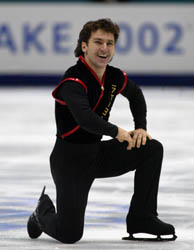
The early 1990s brought a few more stragglers to the quad table. Petr Barna. Alexei Urmanov. And then along came Elvis, whose muscular, stocky build allowed him to power through the 1-2-3 of preparation to land them consistently. He’d land them in combination, first with a double toe loop, then with a triple. My favorite was the one at the 1997 Worlds in Lausanne, when Stojko needed to land every possible jump in his arsenal to hold off Todd Eldredge, Ilia Kulik and Alexei Yagudin. His competitors’ miscues helped, but so did the quad-triple, a combination so brilliantly executed there could be no question he would land each portion perfectly.

Kulik would have a similar flawless program, quad and all, the following year to claim Olympic gold in his first try. Yagudin’s 2002 Olympic gold long program also had a glorious quadruple toe. Where Elvis’s quads were muscular, Kulik’s, and later Yagudin’s, seemed to float, aim higher instead of further along the ice rink. I can watch routines by each of these men so many years after the fact and still feel their jumps, and especially their quads, shot through with a mixture of fear and hubris. Fear because the audience was never quite sure if they would be landed; hubris because deep down, we knew they would – and even if we were wrong once, we wouldn’t be wrong the next time.

It’s no accident I stopped following figure skating around the time the quad became commonplace. Michael Weiss’s endless blathering about landing the quadruple lutz only seemed to highlight how weak his overall ability was. Timothy Goebel may have landed three quads in one program, but that came after many, many misses, cheats and ugly looking rotations and landings. But perhaps the fault lies with 2006 Olympic champion Evgeni Plushenko. He landed so many (well over 100), sometimes in combination, sometimes not, making the jump look so easy that it had the net effect of a triple. But none of those quads had a sense of joy; they pulled inward instead of reaching out.

Plushenko’s quad mastery also signaled an end to the era of technical upward mobility. For years, the mantra in skating has been more: more revolutions, more height, more distance, more difficulty. But human bodies are only capable of rotating so many times like dizzy spinning counter tops, of bending the laws of physics enough to land one-footed on a tiny gliding blade. Twenty years of quadruple jumps points to an uncertain future that mirrors that of figure skating as a whole. Fewer people are watching the slim pickings of skater personalities, and the prospects for the 2010 Olympics seem paltry. Instead of making me look forward to the current and next generations of jumpers, wondering if they will turn flips, lutzes and axels into quadruples and beyond, today’s quads inspire a backwards approach. Now I scour YouTube for clips, searching for shards of a time when the jump was special.

When there was still some joy in quadville.

Hillary’s Tears, Our Tears

hillary.jpgLorrie Moore’s naive essay on Hillary Clinton not only demonstrates the unspoken precept that skilled fiction writers are sometimes remarkably simplistic when they write about politics, but deploys the same scripted liberalism that every progressive is now expected to chant to peers in coffeehouses. The formula, it seems, boils down to this: Hillary Bad, Obama Good.

Now I’m not exactly a Hillary lover. Clinton waffled from a 1993 universal health care plan which mandated all employers to provide health care for employees to her latest “universal” plan, which shifts the mandatory financial burden to individual citizens. But a proper universal health care program is single-payer, regulated by the government, and doesn’t abdicate the spoils to HMOs. Clinton is also the senator who received the most money from HMOs in the 2008 election cycle. (Obama was second.)

Like every good left-leaning American, I have been seduced by the seemingly limitless reserves of Obama’s charisma: his smooth handling of Bill O’Reilly’s arrogant attack dog antics, his adroit response to anti-abortion protesters, insert your magical Obama moment here.

The man is slick. Slicker than Bill Clinton. I firmly believe that he can be the next President. He looks good. Too good.

In comparing Obama with Clinton, Moore writes that “unlike her, he is original and of the moment. He embodies, at the deepest levels, the bringing together of separate worlds. The sexes have always lived together, but the races have not.”

wecandoitreal.jpgI wonder if Moore remains aware that, according to the U.S. Census Bureau, women earn 77 cents for every dollar their male counterparts make. (The disparity, incidentally, is better in Washington, DC, where women make 91 cents to the male dollar. This may explain why Capitol Hill remains somewhat out-of-touch on this issue. An Equal Rights Amendment may provide succor to these problems.) Or maybe Moore remains unaware that young women are earning degrees at a higher rate than men do.

This certainly doesn’t reflect a case where the sexes “have always lived together.” Unless, of course, we’re talking garden-variety cohabitation. And while Obama may talk the talk, I fail to see how Obama’s legislation record brings together separate worlds in any way that is substantially different from Hillary Clinton. The oft bandied boast is that Obama was not Senator in 2002 and therefore unable to vote for the congressional resolution authorizing Bush to use force in Iraq. But what’s not to suggest that within this climate of fear, Obama wouldn’t have done so? (The record demonstrates that John Edwards also voted for it. Kucinich and Paul did not.)

The distinction then is predicated on retroactive speculation. Which is a bit like seriously considering the ridiculous question Bernard Shaw asked of Michael Dukakis during the 1984 Democratic presidential debates: “Governor, if Kitty Dukakis were raped and murdered, would you favor an irrevocable death penalty for the killer?” Kitty Dukakis was not raped and murdered. Obama was not Senator during 2002. Nonetheless, it is an American political tradition to rate presidential candidates according to what they may have done under certain circumstances, as opposed to a more reasonable survey of what they are likely to do based on their past records.

So ultimately the difference between Obama and Clinton comes down to charisma. To watch Obama in action is to experience the most pleasant and capable of political machines. He’ll jazz up a crowd in minutes and give them the fleeting sense that they can change the world. But who is the wizard behind the curtain? Progressives — including myself — were so eager to fixate upon Karl Rove, but why do we fail to apply the same standards to those who run Obama’s campaign?

Last week, Hillary Clinton welled up on camera and was roundly ridiculed. The question arose over whether this was sincere. Cruel YouTube parodies surfaced soon after. For some, the tears confirmed the inevitable. Here are some of the YouTube comments:

I really feel that Hillary Clinton is a worhless [sic] piece of shit.

i hate this woman

This bitch won because she got on national television with her fake crocodile tears in front of million of viewers.

Yea what a fucking cow. She should be making pizza.

This is a very EVIL fricken human being…She should be ashamed of herself! If she had any heart at all she would finally tell the truth!

Go and fuck Bill.. instead of cheating people

Hillary Clinton is a worthless piece of shit.

And so on.

This was not, however, a Muskie moment, even if an op-ed columnist like Newsweek‘s Karen Breslau was keen to dredge up the droplet that careened down Muskie’s cheek and sealed his political fate. Until the primary results dictate otherwise, Clinton is still very much in the game.

What was not factored in Breslau’s article was the double standard with regard to gender. I find myself being one of the few who remains suspicious about never seeing a gaffe from Obama. Real humans screw up. But presidential politics demands perfection or, as Bush’s two victories confirm, a guy you can drink a beer with.

The cult of personality remains so seductive that even adept writers like Moore offer this foolishness: “it is a little late in the day to become sentimental about a woman running for president. The political moment for feminine role models, arguably, has passed us by.”

On the contrary, the present political moment is very much about whether a president has the right to appear sentimental before the cameras, which in turn is very much predicated upon whether the candidate is a man or a woman. It does not matter what Hillary Clinton’s positions are. What matters most of all is whether or not the “bitch” or “the worthless piece of shit” fabricated her tears.

The question we should be asking is just why these gratuitous issues of telegenic interpretation are deflecting more pressing concerns, such as platforms and positions, and why even the best of us are happily swallowing the bait.