Sprezzatura the Maligned

It’s been more than a year since the manboy cultural critic Lee Siegel was temporarily suspended from The New Republic for allegedly posting anonymous comments on its blog, under the name “sprezzatura.” And while Boris Kachka has interviewed Lee Siegel, Filthy Habits recently received an email from an individual claiming to be “sprezzatura.” He wished to set the matter straight. Sprezzatura’s email, which contained three mysterious JPEG attachments (among them, a picture of an alpaca in a compromising yet family-friendly position), claimed that he had been misrepresented, that Siegel was not “brave, brilliant, and wittier than [Jon] Stewart,” and demanded immediate reinstatement to the New Republic message boards. It remains a mystery to me why sprezzatura thought I had the keys to the New Republic castle. But this was a desperate email written in a desperate time.

“It is there where my shallow invective flowed best,” wrote sprezzatura of the New Republic website. He offered to send me $100 if I would interview him. I declined on moral principle. Then sprezzatura demanded an interview with me gratis by email because “Kachka had proved to be a wuss with his softball questions.” And I agreed, only because I had no wish to receive an email from sprezzatura ever again. I have been unable to confirm whether this “sprezzatura” is the same “sprezzatura” unleashed on Siegel’s blog. Indeed, I do not how many “sprezzaturas” there are. But I suppose it’s pedantic mysteries like this that have many of us wasting long hours on the Internet.

sprezz.jpgWhy don’t you just get a blog?

Because that would be too easy! And if I had devoted a blog just to clarifying my identity, I would have been thought a kook!

Actually, most bloggers are cranks. I speak with some expertise on the subject. But I don’t see how you’re making a case here, Lee.

Do not address me with that name! Those days are far behind me! We must forget that regrettable episode!

So you are Lee Siegel.

If you’ll pardon a metaphorical leap, Lee Siegel is a tuna melt poorly prepared with half-melted cheese. John Battelle never responded to any of my thoughtful queries. Therefore, he is an imbecile who cannot recognize my genius. David Brooks rested his argument on the flimsiest of premises. I do not need to inform you what these premises are. Just trust me. They’re flimsy. And when Cox wanted to draw attention to herself, she used the word “cunt” to make a point. Plus, she made more money than I did. And she’s a woman two decades younger than I am. It’s not fair!

Lots of invective there, sprezza baby. But can you cite any specific examples? Some might argue that you are using “cunt” to make….well, not exactly a point, but to stand out with an irrational Dale Peck-style explanation.

It doesn’t matter! Malcolm Gladwell’s hair was adopted for television as American Idol. I have tried to stop them from supplying him with shampoo, but they keep arresting me!

Lee, step away from the Internet and get some fresh air. We’ve had some unseasonably warm weather in January. Go for a walk.

I love the Internet, I’m on it all the time. I couldn’t have written my book so quickly without it. Thanks to the Internet, I didn’t have to think. I could just cut and paste some boilerplate, bang out a book and make a quick book and show those New Republic bastards exactly who mattered. I don’t think it’s making more people connected than they were before, not at all.

It didn’t have to be this way, Lee.

I react very badly when mediocrity is associated with my name.

Well then, write well!

That is hard when you are “sprezzatura” and you have been banned from your own magazine’s message board. Will you give me a hug?

Only if you stop using the moniker “sprezzatura.”

Forgotten Statue, Forgotten Spirit

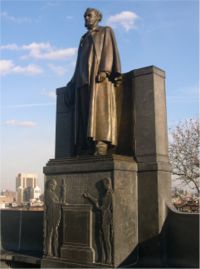
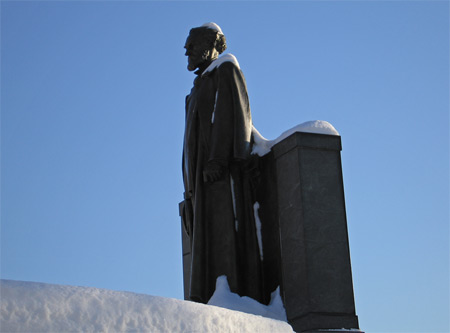
schurz.jpgLike many statues nestled along the rectangular trestles of Manhattan’s parks, Karl Bitter’s bronze depiction of Carl Schurz — situated at the corner of Morningside Drive and 116th Street — is regularly overlooked by many New Yorkers. They walk their dogs. They chat on their cell phones. They rush to important appointments or set out to beat a jogging record. But they rarely stop to observe this rather tall and intriguing figure who remains memorialized.

That’s saying something, considering that Schurz is quite vertical in design (he stands nine feet tall), his left foot juts a mite forward, and his portly girth, disguised by a thick and definitive bronze coat and cape, demands attention. To look over the promontory where Schurz is propped, you must walk up three stone steps to get an unoccluded view. But no matter what building your eyes settle upon, Schurz will remain in dogged peripheral vision. Maybe pedestrians are vexed by Schurz’s hatless and Germanic form — for what it’s worth, he does politely hold his hat in his right hand — invading Harlem’s horizontal vista, which, like every Manhattan neighborhood, is now undergoing terminal gentrification. Perhaps to live in New York, the New Yorker cannot look upon the past, but must continue contending with the swift-paced momentum of the present. And if that means accepting glass monstrosities in lieu of charming brick buildings without remonstrance, so be it. But this willful acceptance also extends to figures like Schurz, who reminds us that there was indeed a New York before the present one.

The Schurz statue is unsullied by the verdigris now eating away at another of Bitter’s sculptures — that of Franz Sigel residing on West 106th Street and Riverside, currently earmarked for renovation. Schurz and Sigel both have parks named after them. (Karl Bitter, alas, does not. New York reserves its laurels for its heros, not the artists who render the legacy.)

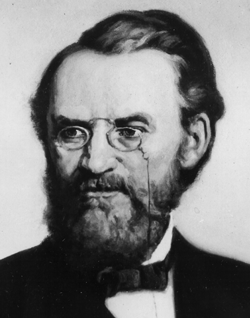
We know that Schurz was a military man, a political reformer, and a journalist. He spent the majority of his life outside of New York, served as Secretary of the Interior for President Rutherford Hayes, moving to the city in 1881, ostensibly to retire. But a man of his insurmountable energies could not settle down. He had twenty-five years left in his life to make a name. And he did. Starting with his immediate rise to editor-in-chief of the New York Evening Post in 1883 and followed by becoming one of the Mugwumps supporting Grover Cleveland the following year. He spoke out against Tammany Hall, drawing enthusiasm for his remarks even as a fife and drum corps passed by.

The first fact that, in our efforts for good government, stares us in the face is the existence of an organization — Tammany Hall — whose very purpose it is to give the city the worst government it dares, to the end of making money out of it. And this organization has been for years, and is now, in full possession of the municipal power.

schurzreal.gifSchurz spoke these words as two friends of his were the top mayoral candidates. He would not let friendships get in the way of principle. Likewise, he did not think much of William Jennings Bryan and also campaigned against him.

As the New York City Department of Parks & Recreation is proud to announce, he was an adopted New Yorker and was often unpredictable with his political choices. Schurz was gleefully antagonistic, and on September 22, 1900, he resigned his Presidencies of the National Civil Service Reform League and the Civil Service Reform Association of New York, observing, “I frankly confess that on account of my position of antagonism to other policies of the Administration, the performance of my part of that duty is especially unwelcome to me.” But he could not quite give this ghost up and was elected the following year as President of the Civil Service Reform Association.

When Schurz was buried in Sleepy Hollow in May 1906, he had an audience both rich and poor. Andrew Carnegie and Joseph H. Choate stood beneath one umbrella. The Times described Schurz as “a publicist and patriot.” The funeral was attended only by relatives and close friends, but policemen had to stop many who hoped to get a view of Schurz’s coffin. It was Choate who ensured that the statue now standing in Morningside Park was completed.

Schurz had a reformist ebullience scarcely seen in the present political age. We now seem to settle for charisma and monoglot messages about hope. Those who do stand out are censored or declared too lunatic for the political arena. This stands in sharp contrast to the words Choate unfurled during the statue’s unveiling, “As a leader he did what is so seldom seen and yet so necessary in the upholding of the best in public life. He put expediency above personal and party advantage. He never allowed party to lead him in the wrong direction, and for years he stood alone, an independent figure in party and public life.”

At the pedestal before Schurz’s form are the words: CARL SCHURZ Defender of Liberty and Friend of Human Right.

schurz2.jpg

Today, who knows Schurz’s name outside of hard-core history buffs, fans of The Who, and curiosity seekers? Not long ago, when I visited Schurz’s statue, I observed a broken bottle of Gilbey’s upon the faded ornamental brick. The bottle had apparently been thrown at Schurz, and the glass shards glistened more resolutely than the brick. While the bottle, in all likelihood, had been hurled by a cavalier youth, I couldn’t help but contemplate whether there was a rejection of Schurz’s spirit in the air. History was apparently the work of others. But it seemed to me that it was the other way around.

Weekend Sightings: “People in Order”

The question of whether life represents a parabolic arc is taken up by Lenka Clayton and James Price‘s short film “People in Order” — in which 100 people are edited together and proceed to beat on the same drum over the course of three minutes. It’s an inventive spin on the Michael Apted formula. The people here have been arranged by age, starting from the age of 1 and ending at 100. What’s particularly striking is the varying levels of enthusiasm, both in the people expressing their age and in their need to bang the drum. Some of the figures are happy at any age. Some are sad. Some seem to wonder what all the fuss is about.

Rosebud 2.0

undress.jpgI lean into my computer screen chin on fist, eyes leveled. Before me, a woman lies face down on an unremarkable bed. A man moves the woman’s hands behind her back. The woman waits patiently as he ties her hands together securely but comfortably with a simple rope. His wedding ring gleams as he pushes up her cotton frock and takes his time easing her panties down over her thighs. For the next several minutes, he fondles her. His caresses move from the swells of her buttocks to the folds of her genitals. She undulates and rears up against his hands. His fingers disappear inside her. She exhales pure desire in this otherwise quiet scene. At one point the man clutches the woman’s hand in a silent, tender communication. Then he reaches for something off screen. Shuffling noises ensue. A twisted tube of lubricant and vibrator appear. The play becomes more aggressive, as do the woman’s reactions. She strains to open her legs against the binding panties around her knees and another rope around her ankles.

I swallow hard.

Three quarters of the way through Amateur Bondage Video, I abort my research efforts. A few minutes after that, my jeans are a jumble on the floor and I am smoky-eyed on my own bed, basking in the aftermath.

The perfect pornographic experience? Not entirely. Sure, the end result was enthusiastic enough, but I had to swim through a dangerous ocean of flesh to get here, proving that nothing is easy.

egyptfellatio.jpgPeople often assume that women dislike pornography or that they don’t like it as much as men. That’s an oversimplification. I want to like porn. But professional videos are less concerned with what feels good for a woman and more hard pressed on what is visually arousing for men — fellatio for instance. I’m not knocking it. It’s a wonderful erotic act that men love to watch, but that only gets me so far. On the flip side, pro porn constantly depicts cunnilingus as if it were a lollipop-licking contest with a misplaced emphasis on the visual. I always roll my eyes at that and think: Too bad. If he were doing it right most of the pink stuff wouldn’t be viewable.

And the subtleties: barely audible breathing escalating to a wide-eyed moan, finger strokes that tighten into a desperate clutch, the widening eyes of climax. Ideal porn would show all of this without the ridiculous staging, faux boobs and silly plots involving pool boys and “nurses.” But the professional efforts are all about those things, which is why I gave up on them years ago. One could argue that the actors love the work and the camera, but I doubt Jenna Jameson ever works for free. Pro porn stems from the exchange of money. Successful sex is about the exchange of desire.

So when XTube.com went live nearly two years ago with the option of user-generated adult content, it was a revelation–a naked YouTube, without the snarky comments. The idea seemed flawless: finally, a free-of-charge amateur alternative to the Internet’s bogus claims of 100 percent free XXX! The parade of copycat sites followed — PornoTube, YouPorn, Megarotic. The list gets longer every day. There’s a healthy dose of desire splattered on these sites. The Web 2.0 actors and directors are doing this because they want to and they want me to watch. I’m not paying to attend this soiree. I’ve been invited.

leek.jpgThe initial orgy was a blast. The woman sashaying nude down a busy street with a cigarette in one hand and a swinging purse in the other was so funny that I posted the clip on my blog and titled the entry “Confidence.” I assigned pithy quips to my discoveries and emailed the links. I asked, “Got vichyssoise?” of a huge leek being used as a dildo. “Her lips are sealed” was my commentary on the woman matter-of-factly tying her labia into a knot. These weren’t about arousal, but fun. If the people posting them were doing it to bolster their self-esteems, judging by the hit counts, they had to puff up like peacocks. I might have watched on with bewilderment, but why shouldn’t Super KnotGirl be proud of herself?

Things got cagier when I searched for something to arouse me. I passed over the male-concentric thumbnails that dominate these sites and clicked on images or titles that might have something for 42-year-old housewife and mother in Cleveland, Ohio. My five foot one stature earned Petite Amateur Keeps Fucking a click. It featured the reverse cowgirl position, which showcased the woman’s body beautifully, but her clitoris was a mile away from the action. Even 38 seconds of that was too long — I was out in 10. The thumbnail for Mature Wife And Her Special Friend looked promising with a lush sex toy and lacy stockings, but it went south when a loud radio jock’s voice suddenly plugged an event “sponsored by new Heineken Premium Light, the first light beer worth the name Heineken!”

Ugh.

I hated it when that deer-in-the-headlights thing overcame me during mediocre or bad footage. I’d push the fast forward bar along and think: will he ever take that thing out of her mouth? If he did, but only in order to ejaculate all over her face, it was an emotional pinch for me. Amateur porn is real sex, not someone’s job. I don’t want to be treated that way. How did the woman on the screen feel? I’m not judging her sexual experience, but when it comes to watching sex, I’m selfish. I can’t help but project what I see on the screen onto my own paradigm. Someone else might be doing it, but it’s still all about me. Hence, I quickly found that no matter how graphic and banal the footage, it was almost always complex.

A click here, another over there. My eyes frenetically scanned screen after screen of thumbnails. The search, with all its primal stimuli, became tiresome, even annoying. There was very little that was sexy to me. The endless surfing was the zenith of frustration particularly when I was unsuccessful. Who wants to waste an hour looking at porn that doesn’t turn them on?

I admit there are gems and high-riding waves among the online porn like Amateur Bondage Video. And I love it that 47-year-old Doris from accounting, brought up on the mantra Good Girls Don’t Do Certain Things, can slip into the den and furiously rub off while watching Lonely Housewife Fucking Her Vacuum after a lifetime of guilty curiosity. One big surprise was the relief I felt at finally seeing what other women’s genitals look like and how women touch themselves. Men have been comparison checking ever since the locker room. Board members often have nowhere to hide. Vaginas are different. Unless you’re a gynecologist or a gay woman, you don’t see them. The pink panther stays under wraps until we open it up. Even to view my own, I have to fold up like a pretzel on the bathroom floor with all the lights on and get tricky with a mirror. Playboy is no help. Hefner’s minions either Photoshop out any indication of an orifice or leave a tiny hairless line that peeps, “I’m a very well-behaved little muff.”

Double ugh.

But the online amateurs are fleshy beauties, lush with folds and colors from pink to brown to dusky rose. These are the childbearing workhorses of human sexuality, unapologetic and closed five days a month, thank you very much. They roar, “I am pussy!” and get my unconditional support.

Then there was this: the image of a man buried between a woman’s thighs moved me to click through to Female POV 3. The man was handsome and muscled. The woman was filming the action. “It’s taking too long,” he said as he looked up and revealed his flaccid penis. Next was a failed attempt at intercourse. Then the woman bent over and fingered herself to provide a visual. The man stared into her, his face vulnerable and desperate, his right hand furiously stroking. “The camera and stuff just makes me a little bit nervous,” he said. She urged him to ignore it. Nothing worked. The man collected his clothes from the floor and left. “Hey,” said the woman, whose face remained hidden, “Close the door, please.”

I blinked back tears. I was furious over the woman’s indifference. But at the same time, I waxed protective — even feeling maternal — for the man. Women complain about sexual objectivity all the time. This was the same sort of sexual abuse made worse by the unavoidable evidence, all of which was recorded by that obnoxious little broad’s camera. I wanted to reach into the screen and grab her by the neck, plop her down and say, “Think you’re such hot shit? Don’t forget that all your shaved sweetness did nothing for that man. Everything here failed, including you.”

And that is how XTube, self-billed as “the greatest thing since the orgasm,” managed a total eclipse of my arousal for the rest of the day.

I later realized that the clip was not a failure, but the most evocative footage I’d seen, hands down. It had every right to be online and then some. So it goes when you sail the sea of free online sex. Every adjective applies. It’s funny and sad and sexy and messy and arousing and painful and infuriating and, well, a lot like real sex.

But we’ve been recording real sex forever. What’s different about Porn 2.0? This new porn frontier is thriving because the logistics that heretofore governed adult content are stripped away. To procure the new sex, all I have to do is step into my home office and fire up the Mac, which is miles away from the seedy “Adult” stores on the other side of town. Once online, I’ll find all the amateur footage I want compliments of high-speed Internet and inexpensive digital cameras. The broadcasts come from across the globe.

It can be overwhelming.

The sheer volume and range of content makes me feel as though I am standing with my nose one inch away from a fifty-foot billboard that is glaring and blaring a million different sexual messages. Thus far, Web 2.0’s John Q. Public editor might be dealing aces over at Wikipedia, but not here. In fact, the more he gets his paws into online sex, the more raucous it becomes. After all, honest sex doesn’t come with six-pack abs and good lighting. Perhaps it’s no surprise that the public editors of Wiki have spent the past two years making that world look like a real reference site and making XTube look like real sex.

But do I really want Editor 2.0 to clean this sex up?

I don’t think so. Despite my quibbles, I’m rooting for all this diverse new unbridled sex with all of its imperfect beauty. And even though I don’t drop in that often, I’ll be checking in once in a while to see how things are (ahem) coming along.

Visit the 1/11/08 entry of O’Brien’s blog for pertinent links.

Interview with Jami Attenberg

(Note: The full interview excerpted here can now be listened to as the 172nd installment of The Bat Segundo Show)

For my first 2008 interview, I met up with writer Jami Attenberg at her Williamsburg apartment. During our conversation, Attenberg’s very friendly and intelligent cat, Cracker, proceeded to climb upon my leg and claw at the wires. He then deposited his slinky corporeal mass upon my lap and, later, climbed atop the table and deliberately occluded my notes. I was then forced to wing a portion of the interview. But the cat’s daring locative intervention proved pertinent to the conversation at hand.

Attenberg’s second novel, The Kept Man, is as much about a woman’s relationship with topographical territory as it is about a passive thirtysomething drifting on the dregs of her husband’s legacy. To my mind, the two themes were linked. And during the course of the interview, I asked Attenberg about the connections between her protagonist, Jarvis Miller, and the neighborhood she inhabited. (The full interview will appear in a future installment of The Bat Segundo Show.)

attenberg.jpgCorrespondent: I’m wondering also about the Terri Schiavo narrative, because it does play in more later in the book than in the beginning of the book. Did you know immediately that there was this almost quasi-allegorical feel to that? Or did it start with the fact that you had Martin Miller in this coma?

Attenberg: It started with Martin being in a coma. I knew that. Actually, the first chapter that I wrote in the book was about the donut girls at one point.

Correspondent: Oh, interesting.

Attenberg: That was the first thing. Because I wanted to write a little bit about the art world. I knew that. And then I knew that there was this man who was in a coma. I wanted to do that. But I didn’t know how it was going to end. I’ve said this before, but when you have a guy in a coma, you set the stakes really high like that. There’s only three ways that it can possibly end, which is that he dies, or he wakes up, or somebody kills him. Or he just keeps floating along, I suppose. But that wouldn’t be a very good ending to a book now, would it? So I didn’t know about the more political stuff until I got to the end of the book. I don’t want to give away the ending though.

Correspondent: No, no, no. We’re not.

Attenberg: But I really have no idea when I start writing a book how it’s going to end at all.

Correspondent: So you actually had sort of a mish-mash here. You jumped from Point A to Point 6 to Point Z, etcetera, throughout the course of writing these novels? And that’s how you sort of stumble upon the narrative?

Attenberg: I mean, the first two books I wrote — this is the second book — I wrote in about a year. So everything, like I said, it’s very organic. I just sort of making up things around me and putting them into a book. Eventually, when you get to the end, you filter out what worked and what didn’t work.

donuts.jpgCorrespondent: Okay, well, if Davis and the donut girls was one of the key starting points, was this an imagined experience? Or was this drawn from anything specific that you observed? Because I am certainly not familiar with this phenomenon. (laughs)

Attenberg: With donut girls?

Correspondent: Yeah, yeah.

Attenberg: Well, you have to live in this neighborhood. It’s more north side. We’re on the south side right now. And we’re doing this interview in my apartment. And on the south side, it’s very Hassidic and Puerto Rican and Dominican, and then when you head towards more of the north side, it’s Greenpoint. And then it’s really Polish over there. So you notice the Polish girls that are out there. And some people are really fascinated and obsessed with beautiful young woman.

Correspondent: Yeah.

Attenberg: And they’re recent immigrants. And they’re definitely a force in the population.

Correspondent: Well, I’m wondering though. Donut shops in particular. It seemed…

Attenberg: There is a donut shop! In Greenpoint. On Manhattan Avenue. And it just stuck in my brain. I think I went there after seeing a rock show. So it’s sort of like that donut shop. And it just sort of stuck in my head. And I wanted to write about it.

Correspondent: Did you observe any specific pickup artists there?

Attenberg: No. I don’t even know if people really do pick them up. It was just in my imagination that they did.

Correspondent: Interesting. Or even someone constantly buying clothes and this whole modeling thing.

Attenberg: Right.

Correspondent: The whole thing escalating into something else. This was the imagined part.

Attenberg: But that’s no different from Jarvis wanting to be taken care of. Or these men wanting to be taken care of. That there are these people in the world who look to other people to sponsor them or meet their needs. But they provide something in return. I think I missed the point that I wanted to make, which was that, after I had all these ideas about these characters and plot points, I came across the idea of being kept or held back. Once I realized that that was going to be the title of the book and that was a major theme, then it was really to go back to move forward and make sure that every character has something that’s holding them back or keeping them into their life. That’s where it comes from.
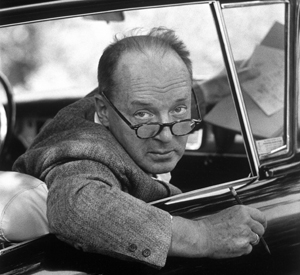
nabokov.jpgCorrespondent: Going back to this issue of topography as a launching point, it’s reminiscent to me of Nabokov’s rule, where he basically said that he could not write a novel until he actually had a particular location. Likewise, in addition to this inspirational momentum, I wanted to first of all find out if this was a factor for you in terms of writing this. And it also leads into another question about Jarvis’s perspective, where she’s generally taking a small item and putting it into a larger neighborhood. For example, there’s a pack of cigarettes she observes. And she’s very clear in the way that she describes it as coming from a particular deli and how it was actually purchased and the like. So I wanted to ask you about this phenomenon. Was this a way for you to generate momentum in your book? You needed to get the lay of the land before the lay of the characters?

Attenberg: I’ve lived here for five years. And I’ve lived in New York for ten years. So, for me, it’s not conscious in any sort of way. I wanted to write about the neighborhood that I lived in. And I take a lot of pictures. I go out a lot to document. And I have a blog. So I have been writing about the neighborhood a lot. So, for me, it’s just a natural — I don’t know. It’s not like — it’s not a conscious thing. I would love to take credit for it being some sort of conscious, deliberate act on my part. I just write about the world around me. But I did feel like, at that moment I was writing the book, that there was so much going on in Williamsburg. I mean, this is a rapidly gentrifying neighborhood. Thematically, it did feel perfect for Jarvis. Because Jarvis needs to break out of something in Williamsburg. And Williamsburg was very quietly becoming something. Then all of a sudden, it burst out and there was all this development. And people were really concerned with its development. And I think people in this book suddenly become very concerned with Martin Miller’s life as well.

Correspondent: Well, concerning this gentrification, you have Jarvis fleeing — almost like the Trail of Tears — across the river. And yet, she is very taken with, for example, bagel shops. The laundromat as a kind of social nexus. As well as finding comforts in the very locations that she often despises. So I’m wondering when did you know that this was coming up. Did this come about from knowing the neighborhood or as an extension of Jarvis’s consciousness?

Attenberg: I think that, if you’re going to write a true New York story, you have to write about all of these little shops and stores. We don’t know our neighbors a lot of the time. Our friends tend to live really far away from us. Or it’s not like you can walk down the street and knock on someone’s door and see them. So it becomes really crucial where you have these relationships with a person at your bodega, with a laundromat. It’s just an interesting community. And in Williamsburg, where there’s so many different kinds of people here, and there’s this big influx of young people who really like to engage, it just seems really natural. I don’t know. That’s just my version.

Correspondent: So it sounds like it very much is a topographical concentration.

Attenberg: But she’s not me. But it’s just how someone like her would. You know, I certainly identify with her. I don’t think that I’ve ever done anything that she’s done before. And I’ve certainly never had anyone support me.

* * *

For related conversations, see Jami Attenberg in conversation with Kate Christensen and Ryan Walsh interviewing Attenberg at Largehearted Boy.