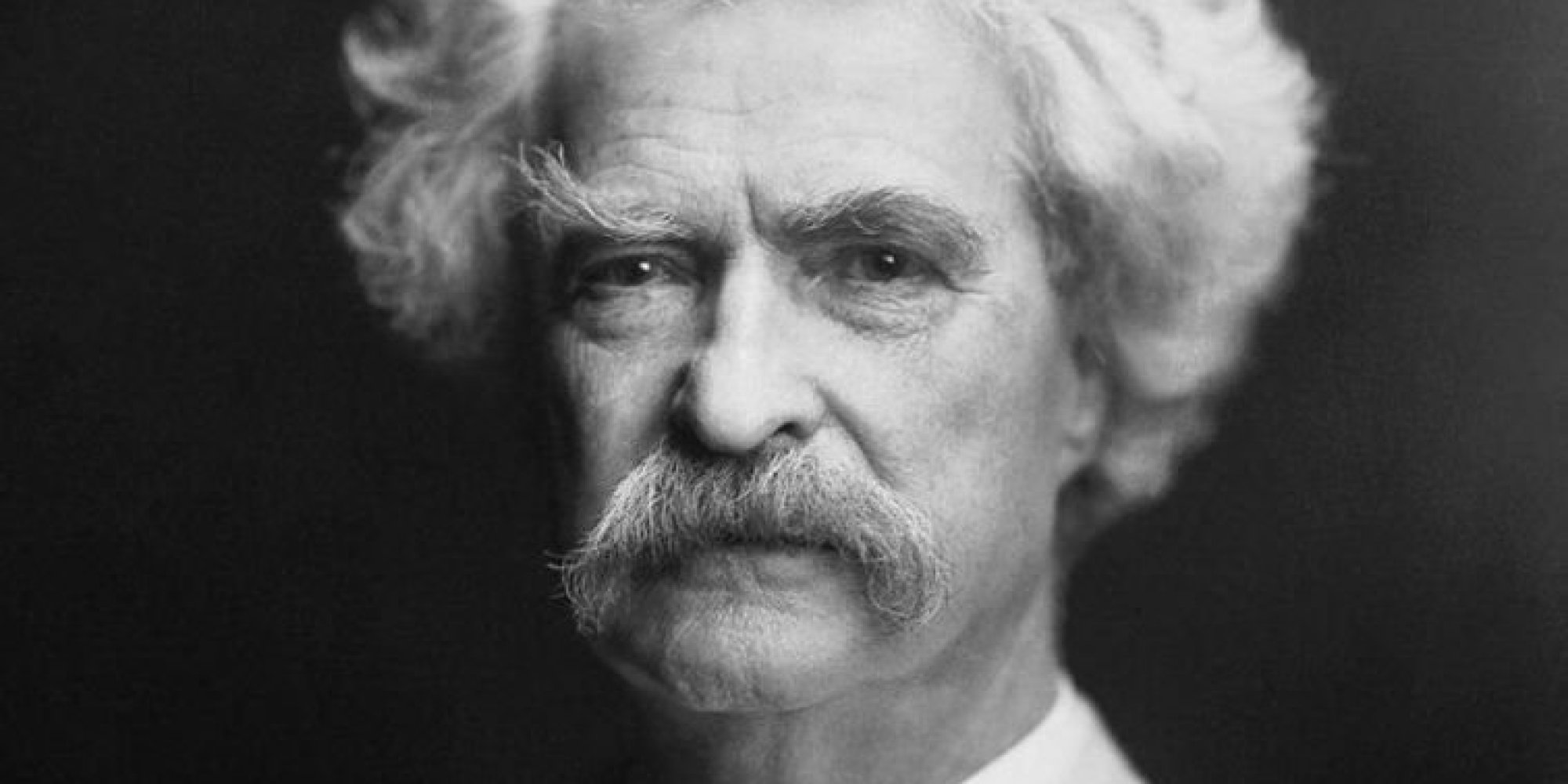
Fred Phelps, Hateful Homophobic Monster, Dead at 84

Fred Phelps is dead at 84. He claimed to be working on behalf of a religious deity, but he had more poison flowing through his veins than half the diamondback rattlesnakes in Florida. Like most venomous reptiles who live to be beheaded by the end of a shovel but that somehow elude that pragmatic instrument, Phelps found his greatest pleasure swallowing innocent mice whole. The small mammals that could not find their way down Phelps’s giant gullet became his willing accomplices and did his bidding through the Westboro Baptist Church.

Phelps was capable of striking at a distance of five states. “Troll” seems too miniscule a word for this craven and atavistic monster, who memorialized his words by picketing funerals of those he deemed immoral. There will be those, even those who stand against Phelps, who will play the “respect for the dead” card, but Phelps deserves neither esteem nor veneration. Let’s not sugarcoat the horror show. He caused insufferable grief to the families of men who served our country and those who struggled to come to terms with their natural identity. His hatred was so electric that it was capable of powering small towns in Kansas and turning innocent people into malicious beasts. Pissing on this ruthless hatemonger’s grave is a rare humanist act.

On the other hand, maybe Phelps’s repugnant conduct was needed to ignite a movement, to get America closer to a less bigoted society that accepts LGBT people as good and vital souls. In 1998, Matthew Shepard was a 21-year-old man who was tortured and killed because he was gay. He was tied to a fence and left to die. It was an unspeakably barbaric act that only a sociopath could fail to shed tears over. Fred Phelps arranged for his followers to picket Shepard’s funerals and this was the beginning of his despicable actions. When Judy Shepard, Matthew’s mother, was asked how she felt about Phelps, she replied, “Oh we love Freddy. If it wasn’t for him there would be no Matthew Shepard.” And look how far this nation has come in the sixteen years since. Sixteen states that issue same-sex marriage licenses. 59% of America supporting gay marriage, according to a March 2014 Washington Post-ABC News poll. Phelps’s life and legacy raises the unsettling possibility that some extremism may be necessary to make a more tolerant nation.

There was a time in Phelps’s life in which there was a part of his vicious core committed to doing the right thing. As a lawyer in the 1960s, Phelps devoted himself to civil rights, taking on cases that no other counsel would touch. But some baleful piece stirred inside Phelps’s tormented spirit and turned him evil in the subsequent decades. But here’s the thing about intolerance. It has a way of courting intolerance in others. I felt guiltless relish in writing the first two paragraphs of this obituary. I had many friends of varying sexualities when I lived in San Francisco. I hated Fred Phelps with every fiber of my being. The fear he stitched into the American fabric, the insurmountable pain he summoned inside people who did nothing wrong. But I also resent Phelps for summoning these vengeful impulses in the name of humanism. It all makes me want to take a cold shower, yet I feel compelled to stare fearlessly back into the beast.

Near the end of his days, Phelps was excommunicated from the Westboro Baptist Church. He was too much even for that abhorrent entity, which will no doubt get a ride of free publicity in the forthcoming weeks. A snake is said to be a solitary beast when it isn’t mating. But it does not back away from confrontation. Its rattle is loud and aggressive, but slightly softer when it scuttles closer to humans. Time will tell if Phelps serves as an inspirational figure for more willing to saunter down the low path or just another poisonous coil dead in a forgotten cave.

Dorthe Nors, Save NYPL, and Blake Bailey (The Bat Segundo Show #538)

This program contains three segments. The main one is with Dorthe Nors, who is most recently the author of Karate Chop. There is also a brief Blake Bailey interview. He is most recently the author of The Splendid Things We Planned. And our introductory segment involves the Save NYPL campaign.

Guests: Dorthe Nors, Blake Bailey, members of the Save NYPL campaign, Matthew Zadrozny, members of Raging Grannies.

Subjects Discussed: Mayor Bill de Blasio’s failure to live up to his July 2013 promise to save the New York Public Library, the greed of rich people, political opportunism, Charles Jackson, The Splendid Things We Planned, the differences between biography and memoir, being the hero of your own story, subjectivity as a great muddler, the Bailey family’s tendency to destroy cars, being self-destructive, contending with a brother who threw his life away, the problems that emerge from being cold, the differences between American and Danish winters, unplanned writing, the swift composition of Beatles lyrics, the courageous existential spirit within Swedish literature, Danish precision, the Højskolesangbogen tradition, the influence of song upon prose, Kerstin Ekman, Nors’s stylistic break from the Swedish masters, Ingmar Bergman, Flaubert’s calm and orderly life, the human-animal connections within Karate Chop, considering the idea that animals may be better revealers of human character than humans, animals as mirrors, emotional connections to dogs, the human need to embrace innocence, judging people by how they treat their pets, “The Heron,” friendship built on grotesque trust, how the gift exchange aspect of friendship can become tainted or turn abusive, writing “The Buddhist” without providing a source for the protagonist’s rage, how much fiction should explain psychological motive, the hidden danger contained within people who think they are good, how Lutherans can be duped, “missionary positions,” Buddhism as a disguise, ideologies within Denmark, when small nations feel big and smug, Scandinavian egotism, Danesplaining, whether Americans or Danes behave worse in foreign nations, buffoonish American presidential candidates, how “The Heron” got to The New Yorker, Nors’s early American advocates, being a tour guide for Rick Moody and Junot Diaz, how Fiona Maazel brought Dorthe Nors’s fiction to America, Copehagen’s Frederiksberg Gardens as a place to find happiness, happiness as a form of prestige, when happy people feel needlessly superior, Denmark’s subtle efforts to win the happiest nation on earth award, setting stories in New York, how different people react to large tomato, Stephen Jay Gould’s The Mismeasure of Man, how measuring objects reveals aspects of humanity, the tomato as the Holy Grail, flour babies, why strategically minded people shouldn’t be trusted, the creepy nature of control freaks, how human interpretation is enslaved by representations, competing representations of reality, whether fiction is a more authentic representation of reality, how disturbing ideas presented in books can calm you down, exploring the Danish idea of a den to eat cookies, working with translator Martin Aitken, what other nations get wrong about Denmark, Hans Christian Andersen, superficial knowledge of Denmark, Danish writers who need to be translated, Yahya Hassan, and Danish crime fiction.

EXCERPT FROM SHOW:

Correspondent: I wanted to talk about the economy of these stories, which is fascinating. I mean, you have to pay very close attention to learn the details and to learn some very interesting twist or some human revelation in these stories. So this leads me to ask — just to start off here — I’m wondering how long it takes for you to write one or to conceive one. Is there a lot of planning that goes into the idea of “Aha! I’ll have the twist at this point!” I mean, what’s the level of intuition vs. the level of just really getting it down and burying all the details like this?

Nors: I don’t plan writing. It happens. Or I get an idea or I see something. Or there’s a line or a passage that I write down. And sometimes it just lies there for a while. Then a couple of days later, I will write another passage, perhaps for another story, and sometimes I put them together. They start doing things. But I write them pretty fast. When the idea and the flow and the voice and the characters are there, I just go into the zone and it kind of feels like I’m singing these. It’s like you find the voice for a story and you just stick to it and write it. It doesn’t take that long. Seven of these stories were actually written in a cottage off the west coast in Denmark. Two weeks.

Correspondent: Two weeks?

Nors: Yes.

Correspondent: For seven of the stories?

Nors: Seven of the stories.

Correspondent: Wow.

Nors: And then I would take long walks and I would go home. Boom. There was this story. So the writing process with this one, it was like that.

Correspondent: That’s like the Beatles writing the lyrics for “A Hard Day’s Night” on the back of a matchbox in ten minutes.

Nors: When it happens, it happens, right?

Correspondent: Well, to what do you attribute these incredible subconscious details? Are these details just coming from your subconscious and they’re naturally springing? Or are they discovered in the revision at all?

Nors: I think they come from training. Because it has something to do with the neck of the woods that I come from. Scandinavia. I was trained in Swedish literature. That was what I studied at university. And the Swedes have this very bold and courageous brave way of looking at existence. I mean, it turns big on them. And they look at the darkness and the pits of distress and everything. Then if you take that richness of existentialism, you might even call it, and pair it up with the Danish tradition — which is precision, accuracy, Danish design, cut to the core, don’t battle on forever. If you combine these two, you get short shorts with huge content that is laying in there like an elephant in a container and moving around all the time. And this style came from training. This came from reading a lot and writing a lot. Suddenly, I think I found my voice in these stories. I think this was a breakthrough for me in Denmark also. That I found out how I can combine the Danish and the Swedish tradition.

Correspondent: So by training, how much writing did you have to do before you could nail this remarkable approach to find the elephant, to tackle existence like this?

Nors: Well, I started writing at eight. And this book was written when I was 36.

Correspondent: But you didn’t have the Danish masters and the Swedish masters staring over you at eight, did you?

Nors: No. But I had the Danish song tradition. We have a book in Denmark called Højskolesangbogen. You’ll never learn how to say that. But it’s a songbook.

Correspondent: (laughs) She says confidently. You never know. I might learn!

Nors: You wanna try? But that songbook — in the real part of Denmark that I come from, all the farmers, they would use that songbook a lot. And there was no literature in my household. It was middle-class. A carpenter and a hairdresser. But this book was there. And what I learned from that was that these songs, they were written by great Danish poets and then put into music. It would be so precise. I love that book. I sang these songs. I read these poems. And then later on, there was my brother’s vinyl covers. It was Leonard Cohen. It was all these guys that he had up in his room and I could read. And a lot of the training came from that. And then later on, university, of course, and the boring part of training.

Correspondent: The analytical stuff. Well, that makes total sense. Because there is a definitive metric to these particular stories. You mentioned that they were akin to singing. And I’m wondering how you became more acquainted with this musicality as the stories have continued. And also, how does this work in terms of your novels? Which are not translated. There are five of them. And those are obviously a lot larger than a short story. So how does the musicality and that concise mode work with the novels?

Nors: Well, I think my first novel was extremely influenced by a Swedish writer called Kerstin Ekman, who I wrote my thesis on. And it was so influenced by her that I kind of shun away from it. Because I don’t want to sound like her anymore. And then on my third book, I started to find that the voice that blooms in Karate Chop — and there’s a breakaway there; it’s like a break in my writing.

Correspondent: A karate chop!

Nors: It really is! Because the first three of my novels were classic structures. They had plots and peaks and this whole Swedish abyss of existentialism and darkness. But then with this one, I broke away. And the next two novels I wrote are short novels. And they’re more experimental in their form and they’re very close to the whole idea of accuracy. And that line, that sentence, has to be so precise. And it has to sing. And it has to have voice. And it has to be just so accurate. That’s the sheer joy for me: to actually be able to write a sentence and to know people will get this.

Correspondent: This is extraordinary. Because if you’re writing a short story so quickly, and it’s not singing, what do you do? I mean, certainly, I presume that you will eventually sing in this mode that you want to. But that’s a remarkable speed there. So how do you keep the voice purring?

Nors: Well, actually, I do a lot of reading out loud while I do it. And the rhythm has to be good when I read it aloud myself. I talk a lot. I walk a lot. And I think literature like this has a lot to do with listening to how the words sound and how they work together. But that’s an intuitive thing. There’s no math in this. Either you can carry a tune or you can’t perhaps, right?

Correspondent: Sure. Absolutely.

Nors: So it’s something instinctive, I think.

Correspondent: I’m curious to know more about the tension between the Swedish existential dread and angst and the Danish identity. You touched upon this a little bit. I saw your little Atlantic soliloquy about Bergman and how you looked to him as a way of living a tranquil life and not living a wild life, which gets in the way of…well, gets in the way of living, frankly.

Nors: Exactly.

Correspondent: I’m wondering. What do you do to live or draw upon experience or to move into uncomfortable areas? Or is your imagination stronger than that? That you don’t really need the life experience. Your imagination in combination with the singing that we’re identifying here is enough to live a tranquil life? Or what? And also, I was hoping you could talk about the tension between the Swedish and Danish feelings and all that.

Nors: First of all, I try to live my life as any other human being. I just try not to really be destructive about it. I’m 43. I’m not afraid to tell you how old I am. So I tried a lot in my life and a lot of it has been dramatic. And it has been filled with emotions and breakups and stuff like that. And, of course, I draw on the experience from that. But these days, I think the discipline is very important. I don’t need more drama in my life. I don’t know why you should seek out drama. Causing pain in your life? That’s an immature thing to do at my age, I think. You can’t avoid it. It’s going to happen anyway. People you love will pass away. Your cat will be hit by a car. Or stuff like that. You don’t have to seek it out. It’s coming to you.

Correspondent: But I’m wondering if that impulse isn’t necessarily a writerly impulse, but just a human impulse. Because when we get closer to forty, we start to say, “Well, do we really want to live this way?” Our choices sometimes become a little more limited. Our responsibilities are greater. We now have a duty to other people. And so is that really a writerly thing? I mean, is the writer doomed in some sense to almost be a child to some degree?

Nors: I think you’re absolutely right. I don’t think it’s necessarily a writer thing. I think it’s a time in your life where you think that. Or you go haywire and you go right into the abyss, right? Ingamr Bergman was around 47 when this happened for him. Because he lived a pretty crazy life. Having children all over the place and women. Pretty destructive.

Correspondent: Locking Liv Ullmann up.

Nors: Yeah, exactly. Being very chaotic. An emotionally chaotic life. And then around this age, he took this path also of not living like a monk. Because he certainly didn’t. But he was just very structured and disciplined. And I enjoy that. It sounds boring to people. But I really enjoy it. Don’t need more drama in my life.

(Loops for this program provided by Martin Minor, Mooz, 40A, Tim Beets, Tim Beets, Aien, and DANB10.)

The Bat Segundo Show #538: Dorthe Nors, Save NYPL, and Blake Bailey (Download MP3)

This text will be replaced

Save NYPL: How an Organized Movement to Stop the Destruction of Libraries is Being Ignored by Mayor de Blasio

It was a Wednesday in mid-March: the presumed wane of a long and relentless winter that had caused many fine minds to crack. Two buildings had exploded four miles northeast in East Harlem. Two more buildings dedicated to the pursuit of knowledge — the very framework of the New York Public Library system — were threatened by a fiendish desire for greed.

Only a few hours after the New York Public Library stage-managed a few beatific rays of sunshine in the form of the belated Lotte Fields, who bequeathed $6 million to the NYPL simply because she loved to read, imposing gray clouds drifted over the stunning stone edifice of the New York Public Library’s main branch. The twin lions rested regal as raindrops pelted upon sixty brave souls, gathering in a steady drench to protest the Central Library Plan, a scheme to close and sell off two vital hubs of the system — the Science, Industry and Business Library (known as SIBL) and the Mid-Manhattan branch — for a wasteful consolidation of books into a overcrowded space that is estimated to cost more than $300 million.

savenypl2

Last July, Bill de Blasio — then Public Advocate, today the chronically tardy Mayor of New York — railed against the plan, lambasting the lack of “forethought to the building’s historical and cultural integrity.” But despite the vocal admonitions from the Committee to Save the New York Public Library — which gained prominent publicity a few weeks ago through a Humans of New York entry featuring a young man named Matthew Zadrozny eating chicken that went viral, the Mayor has remained steadfastly silent. His glaring inaction, together with continued meetings behind closed doors, has forced the Committee to amp up its efforts.

“The Board of Trustees of the New York Public Library is meeting today,” said Theodore Grunewald, a dapper man of the streets with horn-rimmed glasses, a bushy beard, and a three-piece purple windowpane suit. He identified himself as the Vice President for the Committee to Save the NYPL and was fond of standing next to a de Blasio cardboard cutout, a mildly unsettling likeness reminiscent of the flattened, life-size, B-grade stars that once advertised dicey action movies in video stores.

“One of the items on their agenda,” continued Grunewald, “is, no doubt, the $350 million+ costs of this project, which consists, by the way, of selling the Mid-Manhattan Library to real estate developers, then moving that facility into the Central Research Library. But in order to make room for it, they have to remove seven levels of book stacks underneath the Main Reading Room. Those books serve the Rose Reading Room. They make it possible for scholars and researchers to do their work. Their absence from this building and the banishment of 1.5 million volumes from the key research collections of the New York Public Library to off-site storage will decimate this research library as a research institution.”

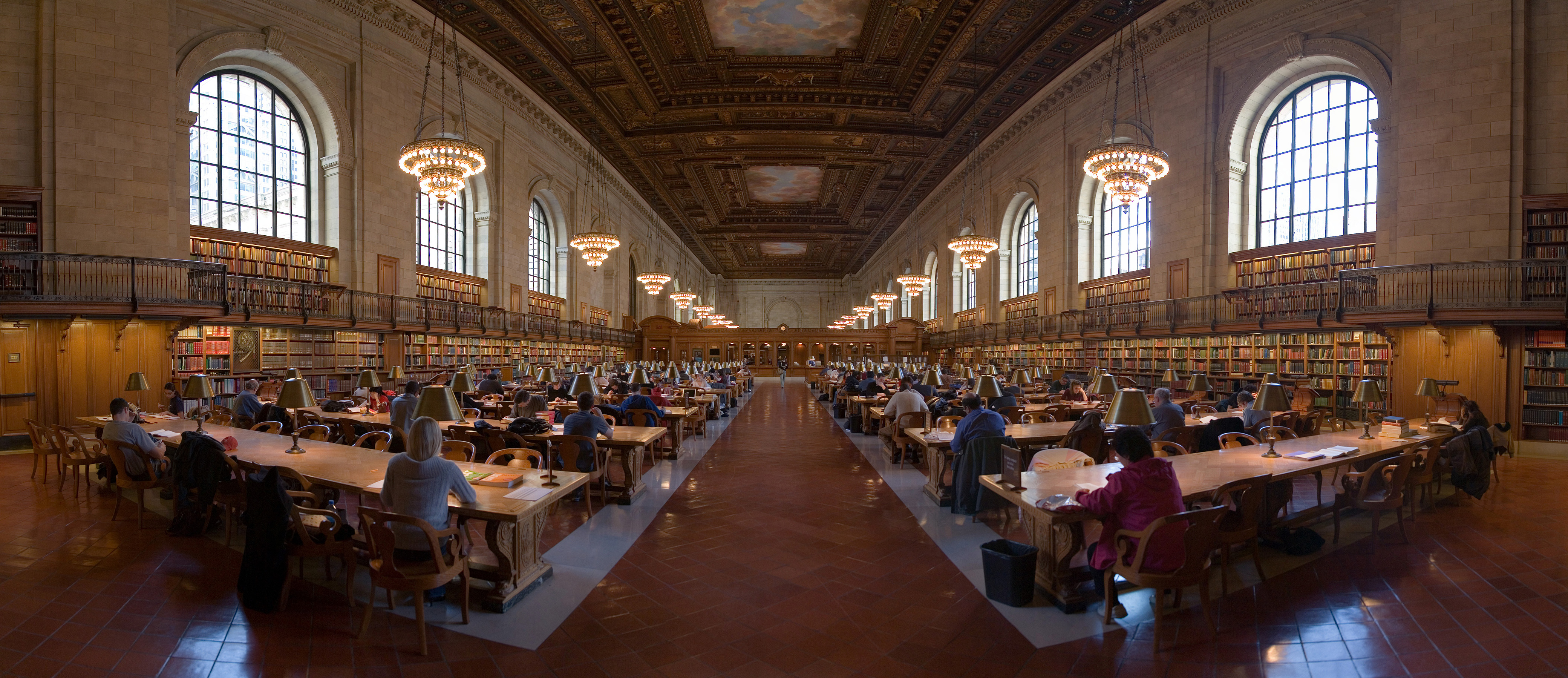
Grunewald observed that the main branch, along with the Bibliothèque nationale de France and the British Library, was one of the three greatest research libraries in the world. But unlike the other two research libraries, the NYPL is open to anyone. You do not need to show your credentials to use the facility. In many ways, this open policy makes the main branch the ultimate public library.

“This is one of the most remarkable and innovative buildings in the world,” said Charles D. Warren, an architect and President of the Committee. “Not just because of its great exterior, but because inside its stone frame is a steel structure like a skyscraper building. That’s what holds up the books. Not only does it hold up the books, but it holds up the floor of the Rose Reading Room. And to take those out completely diminishes the meaning and the purpose of this building.”

Warren claimed that the main branch was not in need of serious renovation. “New air conditioning. New fire suppression. That’s it.”

savenypl3

Mass protests usually attract disparate activists. The hope is that a passion for one cause will inspire a protester to put time in another. One protester disseminated a “gift” bag featuring leaflets for an education project that had nothing whatsoever to do with the library.

But the Wednesday rally was mostly on point. It included Citizens Defending Libraries and the Library Lovers League. Representatives from each of these groups had attended Tuesday night’s city budget meeting on libraries.

I was fond of the Raging Grannies. Despite the insinuated belligerence, the Raging Grannies were a calm and lively group of women with an affinity for music.

“Sometimes we sing against the war,” said Raging Granny Judith Ackerman. “Sometimes we sing against fracking and nuclear reactors.”

But on Wednesday, the Raging Grannies came armed with a fistful of library songs, one of which can be heard below:

[haiku url=”http://www.edrants.com/_mp3/raginggrannies.mp3″ title=”The Raging Grannies Sing a Library Song” ]

3 and 4

There is also a small book published by the Committee — The Library of Libraries — which is being sold for $5 to help generate funds for the campaign. Publicists for the Save NYPL campaign were kind enough to provide me with a copy earlier this week. The book, described as “a parable,” is written and illustrated by Simon Verity. It contains many red hearts inserted among the prose and depicts vicious rhinos roaming the inner sanctum of the library with malicious intent. The book is an elaboration on Verity’s 2013 commentary, previously published at the Institute of Classical Architecture & Art’s blog.

All this represents the beginnings of a flourishing movement. But the more practical matter of getting an ostensibly progressive mayor to take time away from his hyperbolic Swedish programs to fulfill his pledge and avert the destruction of a major cultural part of New York remains a more grueling challenge. The Committee was a bit diffident on this point.

When I asked about the Committee’s efforts to contact de Blasio, Grunewald reported that the Committee was “working assiduously to reach out to him.” I asked if the Committee had heard anything from de Blasio’s office. Grunewald ignored this question, pointing to an online petition with 4,600 signatures. It was at this point that a mysterious gentleman named Jack, hearing my inquiries, suggested to Grunewald that “we should probably be getting these signs up.” I tried again as Grunewald excavated the many vivacious signs from the plastic wrap.

“Have you actually heard a single peep from him by email, by phone, or anything like that?”

“It is a concern,” said Grunewald. “We did reach out to the Community Affairs Office at City Hall. We’re waiting to hear back.”

But while the Mayor refuses to meet or return calls, the Committee has made efforts to cut through the high-paid lobbyists and consultants, finding some elected officials who are willing to talk. Committee President Charles Warren wouldn’t name anybody specific, but he seemed optimistic.

“We are trying to talk with any elected officials we possibly can,” said Warren. “We have had some very good meetings and we have some upcoming meetings with some of them. We would love to meet with the Mayor.”

Warren suggested that the Council and the Controller may be receptive to the Committee’s message. He also pointed to the State’s landmark authority over the main branch, which is still being litigated. It is still possible that the State could reject any attempt to modify the building’s structure. Warren noted that two court actions were holding up the Central Library Plan: one by a citizens group and one involving Weiss and Hiller (representing plaintiffs Edmund Morris, et al.).

zadrozny

Several protesters informed me that they would take the rally to City Hall if they had to. But what remains unclear is the timetable, the manner in which the Committee is organized, and whether these efforts have any bewitching effect beyond a popular photoblog.

It turned out that Matthew Zadrozny, the aforementioned pollo-eating beefcake, was at the rally. He went out of his way to approach me. He asked if I was a reporter. I told that him I was in a way. And we chatted.

[haiku url=”http://www.edrants.com/_mp3/matthew.mp3″ title=”The Raging Grannies Sing a Library Song” ]

Correspondent: Who are you in relation to the Committee?
Zadrozny: I am working with the Committee. I’ve been with the Committee since December. I’ve been attending these protests since June of last year. And every Saturday, I’m organizing the weekly work-in protests at the library. We’re asking the public to come and protest while you work by sitting in the Main Reading Room, getting your work done with a www.savenypl.org sticker on your laptop.
Correspondent: I’ve seen those protests being announced. How much turnout? I mean, that seems more of a passive-aggressive form of protesting, I think.
Zadrozny: Well…
Correspondent: This is very active, however.
Zadrozny: Today’s protest is very active. On Saturdays, we want to garner the regular users of the library and give them ways to express their outrage at what’s happening by just getting their work done with a sticker.
Correspondent: Aha.
Zadrozny: It’s as simple as that.
Correspondent: It’s protesting for introverts.
Zadrozny: Protest…not necessarily. We encourage them to email the Mayor at savenypl.org. But we also encourage people to come out afterwards, get a drink with us, and talk about the future of the library.
Correspondent: Mayor de Blasio has remained silent. So are these protests doing any good?
Zadrozny: Mayor de Blasio, as Public Advocate, came out criticizing the plan. As Mayor, it’s true. He’s remained silent. We’re still waiting to hear from him. But we’re hopeful.
Correspondent: You’re hopeful. Why are you hopeful?
Zadrozny: We’re hopeful because he took a stand as Public Advocate and we believe that he understands the impact that this would have on the city and on local communities.
Correspondent: Is it possible though that the Committee was used in a political gesture rather than an actual act of true political movement?
Zadrozny: Uh…we don’t think so.
Correspondent: Why?
Zadrozny: Because we believe that the Mayor understands that this is, in many respects, an issue of equality, of opportunity. We believe the Mayor understands that if the Mid-Manhattan and the Science, Industry, and Business Libraries close, the amount of space in the system will be reduced. We believe that the Mayor understands that if Mid-Manhattan closes, there will be less space for students in the CUNY system to study. We believe that the Mayor understands that this is bad for New Yorkers.
Correspondent: Is it possible though that the Mayor has changed his mind?
Zadrozny: (pause) We’ll find out.

[May 7, 2014 UPDATE: The New York Public Library abandoned the Central Library Plan, opting to renovate the Mid-Manhattan Library on Fifth Avenue instead. The main library is no longer under threat.]

Julia Angwin (The Bat Segundo Show #537)

Julia Angwin is most recently the author of Dragnet Nation.

Author: Julia Angwin

Subjects Discussed: How much we’re being spied on, the great American historical tradition of spying on needless people, Jay Feldman’s Manufacturing Hysteria, why post-9/11 surveillance is worse than all previous forms, comparisons between the NSA and the Stasi, privacy as a confusing construct, climate change, life mediated by the technological existence, wading through content, a period in American culture where people wore pink and turquoise, when all life choices become part of a permanent record, personal data being shared among companies, Lane v. Facebook, Inc., Sean Lane’s surprise diamond ring exposed by Facebook, Google Street View collecting the names of wi-fi networks (followed by Android), Faraday cages, wrapping your phone in aluminum foil, the black helicopter lifestyle becoming more legitimate, not having access to the data that online giants create, disputing your credit vs. disputing your terrorist status, the informal lack of statute of limitations over stupid things you expressed years ago, giving civil liberties to terrible people, the price of free speech, comparisons between the Stasi and the NSA, how Google changes the way that you browse, switching to DuckDuckGo, people who are attracted to convenience, canned food, local food, fair trade coffee, whether it is possible to vote with our dollars, the convenience of ordering goods through your phone, the hidden costs of convenience through ordering diapers, acknowledging your phone before acknowledging your spouse, using a credit card with the name of Ida Tarbell, when alias are uprooted by people who know your name, automated fake names, MaskMe, attempting to organize a birthday dinner using encrypted instructions, the new responsibility of defending your online territory, hacking, Tor and privacy, the problems of privacy software having no consumer market, the importance of open source software, GitHub, the glacial pace of anonymizing traffic, Sarah Abdurrahman’s detention at the Canadian border, Yassar Afifi being harassed by the FBI over a Reddit comment, the difficulties of Muslim Americans being able to express themselves in the present law enforcement climate, the World Press Freedom Index 2014 issued by Reporters Without Borders with the U.S. dropping in rank, journalism as a tightrope involving the illusion of press freedom, confidential information, meeting with Jacob Appelbaum, the deeply ingrained habit of taking your phone wherever you go, “To Protect and Infect,” Angwin’s inability to get data from data brokers, and the benefits of using encryption badly.

EXCERPT FROM SHOW:

Correspondent: We’re in a room. I don’t think we’re being spied on right now. But that may actually change. Well, we do have our phones.

Angwin: You know what? First of all, we have our phones. And I’m sure there’s a camera here somewhere.

Correspondent: Anyway, let’s start off and look at this from a historical standpoint. Between J. Edgar Hoover’s harassment of dissidents in the early 20th century and the American Protective League — a volunteer organization during World War I that spied on “persons unfriendly to the government” — with the exception of technology that enables spying to be done faster, the so-called “dragnet nation” that you identify fits in with this regrettable American tradition. There’s a wonderful book by Jay Feldman called Manufacturing Hysteria, I’m sure you’re familiar with it, that’s a good overview of this. What makes any of the post-9/11 developments any different?

Angwin: Well, what we have post-9/11 is better spying technology, first of all. And it’s cheaper. So we have much bigger dragnets. And that’s why I called my book Dragnet Nation. Because we see this new kind of surveillance, which is vast, computerized, and impersonal, right? You’re not a suspect. You’re not even a customer of the company that’s tracking you. You have no relationship anymore with the person who’s spying on you. And it used to be that spying was hard enough that, although there were many regrettable incidents of spying on the wrong people, it still took effort on the part of the spies to do that.

Correspondent: There’s the Stasi comparison to the NSA, which we’ll get into in a little bit. But I am curious about this. You get into the relationship between privacy and behavioral economics quite a bit. It seems to me that there’s a voluntary impulse on the part of most Americans. You bring up experiments from Carnegie Mellon professor Alessandro Acquisti, where people are less willing to pay for privacy when they don’t already have it. You also bring up Dan Ariely’s findings on irrational compulsion to keep doors open — I talked with him; he’s a blast — when you try justifying why you, Julia, still have a LinkedIn profile. And one of the ultimate problems here is that, well, we have to be part of these services in order to get a job that will allow us to pay our rent and feed our families. We have to use social networks to keep in touch with our family and our friends. So honestly, it seems to me that we’re complicit in this devil’s bargain. So what do we do? Is there a way to exist with this dragnet culture without giving everything away?

Angwin: Well, you know, the thing is that you’re right. Privacy is a very confusing construct. No one wants to pay for it. No one really understands what it is. It’s kind of murky. But the thing is that we’re in a situation. I think what everyone can understand is the idea that you do want certain things to be within a certain channel. Like the way that you portray your day at the end of the day to your spouse is different from the way that you would portray your day to your boss, for instance. These are just very simple examples. But I think everyone can understand that not all audiences are the same. And so we’re in this world where you really can’t trust who the audience is. It’s most likely that the whole world is your audience. And so that’s sort of the fundamental psychological problem that we have. Now when we talk about the aversion to paying for it, as Alessandro has demonstrated, we are just unwilling to pay for things we don’t have. And since we basically perceive that we have no privacy, we don’t want to pay for it. But we’ve had this experience in the past with the environment. We had a really dirty environment. We lived with a lot of pollution. Our rivers caught fire. Our air was filled with soot. And no one wanted to “pay” for that. And then as a society, collectively, we actually figured out ways to adjust that situation so that now we don’t have as much rampant pollution. So we have dealt with similar types of issues.

Correspondent: Well, we do have climate change and rising waters. I hate to break it to you. (laughs)

Angwin: The problem with the environmental comparison is we didn’t adequately capture all the threats. But of the ones that we saw on the ground, like the rivers catching fire and the air being filled with soot, we containerized those. We basically said we’re willing to live with a certain amount of particulates, but not our rivers catching fire.

Correspondent: So inevitably in the question of privacy, it seems to me that we’re going to have to find a compromise solution, if we find any solution at all.

Angwin: We’re going to have to find where we are going to draw the line. Right now, it’s really kind of a Wild West. On the commercial side, there are very few laws that regulate our commercial entities that collect data about us. And then as we’ve seen since Edward Snowden’s revelations, the government side possibly didn’t have the oversight. Congress was surprised at what they were doing. And so both sides feel a little Wild West.

Correspondent: Well, you had mentioned a little bit earlier about this idea that what we portray about ourselves online, our virtual selves, doesn’t necessarily match our real selves. Is there enough in that to counter the problems of all this data scooping? Of all the stuff that we are willfully giving up? Of all of the search results that Google grabs? Of all of the little details on Facebook that we share? Is there anything about that separation that is positive? That might actually be used to fool the authorities who are happy to go ahead and scoop scoop scoop?

Angwin: Right. So when I did this book, I tried to answer the question of what can we do about everything. Exactly what you’re saying. Is there something we can do to protect ourselves in this world of indiscriminate surveillance? And I tried a whole bunch of strategies and one of my most effective strategies was what you’re describing. Which is basically spreading disinformation about myself. Which sounds a little unethical. (laughs)

Correspondent: Especially since you have a problem lying, as you say in the book.

Angwin: I do.

Correspondent: Although you’ve been very good about outing yourself as Ida Tarbell, just for the record.

Angwin: Right. So I did struggle with this idea of lying about myself online. And I went through certain steps to try and understand whether I felt that it was ethical. And in the end, I decided that I was in a situation where what was being done, collecting all my data, was also unethical and that this was my best strategy. And so given those constraints, I was willing to do it, but only within the legal limit. So I didn’t do anything illegal, I’d just like to point out. But I did create fake identities and spread disinformation about myself. And I did find that this was an effective counterstrategy. I think the question we have to ask as a society is: Do we want to live in a society where everyone is doing that? Because I think that that is unfortunately not going to be pretty.

Correspondent: Especially since we promulgate the George Washington notion. “I shall never tell a lie!” Well, in order to actually have an honorable existence that is, in fact, claimed by corporations, we do have to lie now. And we all have to feel like a criminal. And that’s just incredible!

Angwin: Yes. Right. So that’s actually what indiscriminate surveillance creates. It creates this thing where everyone says, “Oh, I have nothing to hide.” But the truth is that there are enough laws out there that, if everything is known about you, you have broken some law somewhere and there is now going to be this opportunity for discretionary justice, right? You are in the crosshairs because you’ve spoken out against some government official and they will have an opportunity to have something on you. And so we do have now the perfect tools for any bad politician who wants to do that.

Correspondent: We’ve only been talking for a little bit, Julia. But I have a feeling that you are someone who likes to stare into the bleak truth while maintaining some hope of optimism. And I’m wondering. Okay, let’s say that most Americans are placed into this existence where they constantly have to lie and spread misinformation. What would that do to are digital identity? To our digital culture? To our national culture? I mean, is this a reasonable expectation of what the next five, ten, twenty years will bring?

Angwin: Well, we did have — think about it. Our life online, living in a world that’s so mediated by all this technology, is really new. And basically in the first ten years of it, it was so awesome. Because we were empowered as citizens and individuals and as consumers in ways that we never had been before, right? Remember the days where you had to call every airline to get a fare. Now you know…

Correspondent: Kayak.

Angwin: They’re all competing. And so we have, as consumers, really benefited from this. But the problem is now that the tables are turning. We had kind of our ten years of fun. Now that the companies have got better weapons than we do. And now they’re going to spread in just the same way that you notice that it’s harder to get a good fare these days — and no one has proved it yet, but there have been so many rumors that they are tracking which fares you search for and then they lock it in at some higher price. And of course that is technically perfectly possible. So even if no one’s doing it now, somebody will. So the problem is that the companies are going to start organizing in their own way, spreading a little disinformation to shape how you behave and then as a natural countermeasure, we’re all going to start doing the same. Now what this does is actually very similar to pollution, which is what I was saying before. It pollutes the common environment, right? The idea of the Internet was that it was this amazing place where we could all have equal access to the world’s information and it was incredibly empowering. And it still is. But the more we pollute that environment, with propaganda on the company side and propaganda on the individual side…

Correspondent: Mutually assured disinformation.

Angwin: It is mutually assured disinformation. And it’s something that we have to think about as an environmental problem, I think.

(Loops for this program provided by SintheticRecords, kneegwahh, ebaby8119, and ferryterry.)

The Bat Segundo Show #537: Julia Angwin (Download MP3)

This text will be replaced

RIP Harold Ramis

On Monday morning, Harold Ramis passed away after a four year battle with autoimmune inflammatory vasculitis. He was 69.

Much like the subtle and unassuming presence he exuded through his crisp form of comedy, Ramis stayed quiet about his illness. He was such a reliable bedrock in any film that he wrote, directed, or appeared in — whether as Ghostbusters‘s Egon Spengler, one of Ramis’s many doctors, or as Ben’s dad in Knocked Up — that comedy feels inequitably barren without him.

While Ramis worked with many Canadians, he was an American, Chicago born. In his early days, he had the tall hair and lanky mien of someone born to play scientists. Yet he brought an odd gravitas and clarity to his scripts. Of the three men who wrote National Lampoon’s Animal House, it was Ramis who was the one to write Bluto specifically for John Belushi. And it was Ramis’s knack for apt casting on the page that led him to become a natural director, where he restored Rodney Dangerfield’s flagging career in his first feature film, Caddyshack, and coaxed Imogene Coca to appear as Aunt Edna in National Lampoon’s Vacation, despite Coca’s reservations about the character being too vituperative.

As both writer and director, Ramis had a formidable dexterity with ensemble comedy. Aside from co-writing Stripes (it was Ramis who reworked the script for Bill Murray and himself) and Ghostbusters (Ramis was the one to balance Dan Aykroyd’s affinity for the paranormal within the rooted world of New York), he was also enlisted to direct four episodes of The Office, including “Beach Games” and “A Benihana Christmas.”

If his comedy films floundered a bit near the end (Analyze That, Year One, and an ill-advised remake of Bedazzled), Ramis atoned for this by attempting a blend of film noir and dark comedy with The Ice Harvest — a script written by Richard Russo and Robert Benton. But his directorial chops were very much alive in the energetic episodes he helmed for The Office. If the vasculitis hadn’t nabbed him, what would he have accomplished if he had been given a television series like Christopher Guest’s Family Tree?

We still have the summer camp heart of Meatballs, the carefully realized underbelly of road trips gone awry in Vacation, and the overlooked Stuart Saves His Family, among many others. Much like a John P. Marquand novel, Stuart managed to celebrate its subject without resorting to cheap ridicule. That human quality was what made Harold Ramis’s subtlety so masterful.