A Few Words on Lou Reed

“But if you think that you get kicks from flirting with danger / Danger, oooohh / just kick her in the head and rearrange her” — Lou Reed, “Wagon Wheel”

“What does Robert Christgau do in bed?” growled Lou Reed during a performance of “Walk on the Wild Side” on Take No Prisoners. “I mean, is he a toefucker? Man, anal retentive, A Consumer’s Guide to Rock. What a moron! ‘A Study’ by, you know, ‘Robert Christgau.’ Nice little boxes: B+. Can you imagine working for a fucking year and you get a B+ from some asshole in The Village Voice?” Christgau would later review the album, awarding it a C+ and thanking Reed for getting his name right. But Christgau apparently did more than that. He nominated Reed for a MacArthur Foundation grant, which Reed never received. Reed never forgot the early slights. When Christgau was introduced to Reed at a Sire luncheon, Reed sneered at Christgau when the critic offered his hand.

To dismiss Lou Reed as a mere irascible motherfucker, as Christgau did last night in his obituary for Spin, severely discounts the ferocious spirit that Reed took with him to the grave: an unapologetic artistic commitment, alive in all those great records, that is ever more in short supply in our conformist age of crowdsourcing, +1ing, and an unhealthy compunction to always be liked. Reed’s death was not strange in its police blotter statistics. 71 is a remarkable tally for a man who lived as hard as Reed did. But the great gaping cavity that has opened up is unquestionably weird. Some wailing mirror has squealed long and loud into the night, a force demanding new and dangerous innovation on all fronts.

What artist today name-checks Saul Bellow and Yeats on stage? Or calls for a full-scale sexual revolution while masterfully weaving in a tuba line? (That’s “Make Up,” from Reed’s solo album, Transformer.) How many lives did Reed save by singing about subjects that no one else did? And is there any performer today, one so artistically ahead of the curve and never flinching from experimentation, who can inspire a thousand musicians to start new bands with one new track?

Reed’s commitment to sparsity (“One chord is fine. Two chords is pushing it. Three chords and you’re into jazz.”) was such that he was able to write two of The Velvet Underground’s finest songs (“Heroin” and the magnificently raucous “Sister Ray”) without a bass guitar, paving the way for The White Stripes.

It’s possible that the chalky apocalyptic atmosphere of the early 1970s, fluctuating in the wake of crushed 1960s idealism, allowed Reed to do what he did. He was unquestionably aided in his early years by Andy Warhol, who spotted The Velvet Underground in the East Village, and Delmore Schwartz, who taught him at Syracuse University. Would Reed have found the courage to write “Heroin” without Schwartz? Would he still be toiling as a tunesmith for Pickwick if Warhol had not stopped by CafĂ© Bizarre with filmmaker Barbara Rubin and incorporated Reed’s band into the Exploding Plastic Inevitable? More than four decades later, Reed’s essence remains so indomitable that it’s easy to see him as someone who could have easily mowed down all resistance to his vision. But he needed eccentric and caring benefactors. And maybe that’s one truth we can take away from Reed’s passing in our crowdfunding age. Lou Reed is irreplaceable. But patience for the pugnacious innovators, for the scrappy workhorses toiling assiduously in odd corners, may be what we need to keep tomorrow’s culture as elastic and as indelible as Reed’s contributions.

The Modern Library Nonfiction Challenge

mlnfindexJust under three years ago, I began the Modern Library Reading Challenge. It was an ambitious alternative to a spate of eccentric reading challenges then making the rounds. These included such gallant reading missions as the Chunkster, the Three Card Monte/Three Sisters Bronte, the Read All of Shakespeare While Blindfolded Challenge, and the Solzhenitsyn Russian Roulette Challenge. It took a fairly eccentric person to place the literary embouchure ever so nobly to one’s lips and fire off a fusillade of eupohonic Prince Pless bliss into the trenchant air. But I was game.

In my case, the idea was to write at least 1,000 words on each title after reading it. The hope was to fill in significant reading gaps while also cutting an idiosyncratic course across the great works of 20th century literature, with other intrepid readers walking along with me.

Over the next twenty-three months, I steadily worked my way through twenty-three works of fiction. Some of the books were easy to find. Some required elaborate trips to exotic bookstores in far-off states. When I checked out related critical texts and biographies from the New York Public Library, I was often informed by the good librarians at the Mid-Manhattan branch that I was the first soul to take these tomes home in sixteen years. This surprised me. New York was a city with eight million people. Surely there had to be more curiosity seekers investigating these authors. But I discovered that some of these prominent authors had been severely neglected. When I got to The Old Wives’ Tale, Arnold Bennett was so overlooked that I appeared to be the first person to upload a photo of reasonable resolution (which I had taken from a public domain image published in a biography) onto the Internet.

There were other surprises. I became an Iris Murdoch obsessive. I was finally able to overcome my youthful indiscretions and appreciate The Adventures of Augie March as the masterpiece that it was. My mixed feelings on Brideshead Revisited proved controversial in some circles and caused at least one academic to condemn me. On the other hand, I also sparked an online friendship with Stephen Wood, who was also working his way through the Mighty 100, and was put into contact with an extremely small yet determined group of enthusiasts making similar reading attempts in various corners of the world.

Yet when I told some people about my project, it was considered strange or sinister. When I mentioned the Modern Library Reading Challenge to a much older writer, she was stunned that anyone my age go to the trouble of Lawrence Durrell. (And she liked Durrell!) Her quizzical look led me to wonder if she was going to send me to some shady authority to administer a second opinion.

One of the project’s appeals was its methodical approach: I was determined to read all the books from #100 to #1. This not only provided a healthy discipline, but it ensured that I wouldn’t push the least desired books to the end. Much as life provides you with mostly happy and sometimes unpleasant tasks to fulfill as they arrive, I felt that my reading needed to maintain a similar commitment. This strategy also created a vicarious trajectory for others to follow.

Everything was going well. Very well indeed. Henry Green. Jean Rhys. The pleasant surprise of The Ginger Man. With these authors, how could it not go well? I was poised to read to the finish line. I was zooming my Triumph TR6 down a hilly two-lane highway with a full tank of gas. Cranking loud music. Not a care in the world.

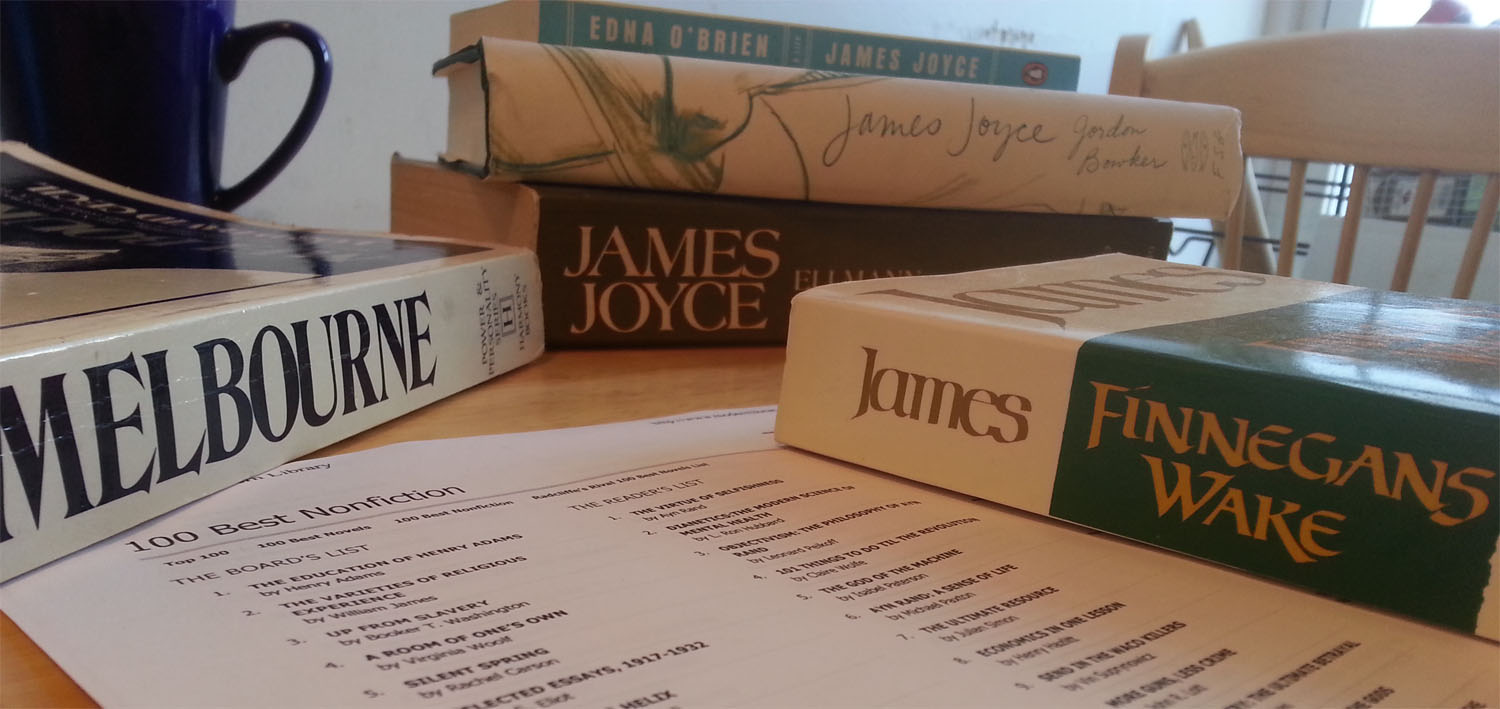
And then I hit Finnegans Wake.

To call Finnegans Wake “difficult” is a woefully insufficient description. This is a book that requires developing an ineluctably Talmudic approach. But I am not easily fazed. Finnegans Wake is truly a book of grand lexical riches, even if I remain permanently stalled within the voluble tendrils of its first 50 pages. I have every intention of making my way through Finnegans Wake. I have reread Dubliners, A Portrait of the Artist as a Young Man, and Ulysses. I have consulted numerous reference texts. I have even listened to all 176 episodes of Frank Delaney’s excellent podcast, Re: Joyce. These have all been pleasant experiences, but I am still not sure if any of this significantly contributes to my understanding of Finnegans Wake. However, when you do something difficult, it is often best to remain somewhat clueless. If you become more aware of how “impossible” something may be, then you may not see it through to the end. Joyce remains the Everest of English literature. I am determined to scale the peak, even if I’m not entirely sure how reliable my gear is.

The regrettable Finnegans Wake business has also meant that the Modern Library Reading Challenge has been stuck on pause. It has been eleven months since I published a new Modern Library installment on these pages. And while I have certainly stayed busy during this time (I have made a documentary about Gary Shteyngart’s blurbs, attempted to fund a national walk that I intend to fulfill one day, canceled and brought back The Bat Segundo Show, and created a new thematic radio program, among other industries), I have long felt that persistent progress — that is, an efflorescent commitment to a regular fount of new material — is the best way to stay in shape and keep any project alive.

I have also had a growing desire to read more nonfiction, especially as the world revealed itself to be a truly maddening and perilous place as the reading challenge unfolded. Some have sought to keep their heads planted beneath the ground like quavering ostriches about all this. There are far too many adults I know, now well in their thirties, who remain distressingly committed to the “La la la I can’t hear you!” school of taking in bad news. But I feel that understanding how historical and social cycles (Vico, natch) cause human souls to saunter down dark and treacherous roads also allows us to comprehend certain truths about our present age. To carry on in the world without a sense of history, without even a cursory understanding of ideas and theories that have been attempted or considered before, is to remain a rotten vegetable during the more important moments of life.

It turns out that the Modern Library has another list of one hundred titles devoted to nonfiction. And the nonfiction list is, to my great surprise, more closely aligned to the fiction list than I anticipated.

In 1998, the Washington Post‘s David Streitfeld revealed that the Modern Library fiction list was plagued by modest scandal. The ten august Modern Library board members behind the fiction list had no knowledge over who had voted for what, why the books were ranked the way they were, or how the list had been composed, with many of the rankings more perfunctory than anyone knew. Brave New World, for example, had muscled its way up to #5, but only because many of the judges believed that it needed to be somewhere on the list.

So when the Modern Library gang devoted its attention to a nonfiction list, it was, as Salon‘s Craig Offman reported, determined not to repeat many of the same mistakes. University of Chicago statistics professor Albert Mandansky was signed on to ensure a more dutiful ranking progress. Younger authors and more women were included among the board. Mandansky went to the trouble of creating a computer algorithm so that there could be no ties. But the new iron fist approach offered some drawbacks. There was a new rule that an author could only have one title on the list, which meant that Edmund Wilson’s To the Finland Station didn’t make the cut. And when the top choice was announced — The Education of Henry Adams — the crowd stayed silent. It was rumored that one board member scandalously played with his dentures as the titles were called.

Perhaps the Modern Library’s second great experiment reveals the unavoidable pointlessness behind these lists. As novelist Richard Powers recently observed in a National Book Critics Circle post, “The reading experiences I value most are the ones that shake me out of my easy aesthetic preferences and make the favorites game feel like a talent show in the Iroquois Theater just before the fire. Give me the not-yet likable, the unhousebroken, something that is going to throw my tastes in a tizzy and make my self-protecting Tops of the Pops slink away in shame.”

On the other hand, if it takes anywhere from five to ten years to get through a hundred titles, then the reader is inured to this problem. Today’s favorites may be tomorrow’s dogs, and yesterday’s lackluster choices may be tomorrow’s crown jewels. As the Modern Library reader grows older, there’s nearly a built-in guarantee that these preordained tastes will become passe at some point. (To wit: Lord David Cecil’s Melbourne, the first book I will be reading for this new challenge, is now out of print.)

So I have decided to take up the second challenge, reading the nonfiction list from #100 to #1. Modern Library Nonfiction Challenge titles shall flow from these pages as I slowly make my way through Finnegans Wake during the first challenge. Hopefully, once the disparity between the two challenges has been worked out, I will eventually make steady progress on the fiction and nonfiction fronts. But the nonfiction challenge won’t be a walk in the park either. It has its own Finnegans Wake at #23. I am certain that Principia Mathematica will come close to destroying my brain. But as I said three years ago, I plan to read forever or die trying.

To prevent confusion for longtime readers, the fiction challenge will be separated from the nonfiction challenge by color. Fiction titles shall carry on in red. Nonfiction titles will be in gold.

I’ve started to read Melbourne and I’m hoping to have the first Modern Library Nonfiction Challenge essay up before the end of the month. This page, much like the fiction list, will serve as an index. I will add the links and the dates as I read the books. I hope that these efforts will inspire more readers to take up the challenge. (And if you do end up reading along, don’t be a stranger!)

Now let’s get this party started. Here are the titles:

100. Melbourne, Lord David Cecil (December 27, 2013)
99. Operating Instructions, Anne Lamott (January 14, 2014)
98. The Taming of Chance, Ian Hacking (March 23, 2014)
97. The Journalist and the Murderer, Janet Malcolm (July 17, 2014)
96. In Cold Blood, Truman Capote (November 11, 2015)
95. The Promise of American Life, Herbert Croly (January 21, 2016)
94. The Contours of American History, William Appleman Williams (February 7, 2016)
93. The American Political Tradition, Richard Hofstadter (February 18, 2016)
92. The Power Broker, Robert A. Caro (May 11, 2016)
91. Shadow and Act, Ralph Ellison (November 3, 2016)
90. The Golden Bough, James George Frazer (13 volumes, Third Edition) (November 14, 2016)
89. Pilgrim at Tinker Creek, Annie Dillard (November 23, 2016)
88. Six Easy Pieces, Richard P. Feynman (November 30, 2016)
87. A Mathematician’s Apology, G.H. Hardy (December 3, 2016)
86. This Boy’s Life, Tobias Wolff (June 15, 2017)
85. West with the Night, Beryl Markham (August 21, 2017)
84. A Bright Shining Lie, Neil Sheehan (December 6, 2017)
83. Vermeer, Lawrence Gowing (February 22, 2018)
82. The Strange Death of Liberal England, George Dangerfield (September 16, 2018)
81. The Face of Battle, John Keegan (December 26, 2018)
80. Studies in Iconology, Erwin Panofsky (January 23, 2019)
79. The Rise of Theodore Roosevelt, Edmund Morris (February 20, 2019)
78. Why We Can’t Wait, Martin Luther King Jr. (February 28, 2019)
77. Battle Cry of Freedom, James M. McPherson (September 11, 2020)
76. The City in History, Lewis Mumford (September 12, 2020)
75. The Great War and Modern Memory, Paul Fussell (March 3, 2022)
74. Florence Nightingale, Cecil Woodham-Smith (June 14, 2022)
73. James Joyce, Richard Ellmann (December 22, 2023)
72. The Gnostic Gospels, Elaine Pagels (March 16, 2024)
71. The Rise of the West, William H. McNeill
70. The Strange Career of Jim Crow, C. Vann Woodward
69. The Structure of Scientific Revolutions, Thomas S. Kuhn
68. The Gate of Heavenly Peace, Jonathan D. Spence
67. A Preface to Morals, Walter Lippmann
66. Religion and the Rise of Capitalism, R.H. Tawney
65. The Art of Memory, Frances A. Yates
64. The Open Society and Its Enemies, Karl Popper
63. The Sweet Science, A.J. Liebling
62. The House of Morgan, Ron Chernow
61. Cadillac Desert, Marc Reisner
60. In the American Grain, William Carlos Williams
59. Jefferson and His Time, Dumas Malone (6 volumes)
58. Out of Africa, Isak Dinesen
57. The Second World War, Winston Churchill (6 volumes)
56. The Liberal Imagination, Lionel Trilling
55. Darkness Visible, William Styron
54. Working, Studs Terkel
53. Eminent Victorians, Lytton Strachey
52. The Right Stuff, Tom Wolfe
51. The Autobiography of Malcolm X, Alex Haley and Malcolm X
50. Samuel Johnson, Walter Jackson Bate
49. Patriotic Gore, Edmund Wilson
48. The Great Bridge, David McCullough
47. Present at the Creation, Dean Acheson
46. The Affluent Society, John Kenneth Galbraith
45. A Study of History, Arnold J. Toynbee (12 volumes)**
44. Children of Crisis, Robert Coles (5 volumes)
43. The Autobiography of Mark Twain, Mark Twain (3 volumes)
42. Homage to Catalonia, George Orwell
41. Goodbye to All That, Robert Graves
40. Science and Civilization in China, Joseph Needham (5 volumes, abridged)*
39. Autobiographies, W.B. Yeats
38. Black Lamb and Gray Falcon, Rebecca West
37. The Making of the Atomic Bomb, Richard Rhodes
36. The Age of Jackson, Arthur Schlesinger, Jr.
35. Ideas and Opinions, Albert Einstein
34. On Growth and Form, D’Arcy Thompson
33. Philosophy and Civilization, John Dewey
32. Principia Ethica, G.E. Moore
31. The Souls of Black Folk, W.E.B. Du Bois
30. The Making of the English Working Class, E.P. Thompson
29. Art and Illusion, Ernest H. Gombrich
28. A Theory of Justice, John Rawls
27. The Ants, Bert Hoelldobler and Edward O. Wilson
26. The Art of the Soluble, Peter B. Medawar
25. The Mirror and the Lamp, Meyer Howard Abrams
24. The Mismeasure of Man, Stephen Jay Gould
23. Principia Mathematica, Alfred North Whitehead and Bertrand Russell (3 volumes)
22. An American Dilemma, Gunnar Myrdal
21. The Elements of Style, William Strunk and E.B. White
20. The Autobiography of Alice B. Toklas, Gertrude Stein
19. Notes of a Native Son, James Baldwin
18. The Nature and Destiny of Man, Reinhold Niebuhr
17. The Proper Story of Mankind, Isaiah Berlin
16. The Guns of August, Barbara Tuchman
15. The Civil War, Shelby Foote (Three volumes: Fort Sumter to Perryville, Fredericksburg to Meridian, Red River to Appomattox)
14. Aspects of the Novel, E.M. Forster
13. Black Boy, Richard Wright
12. The Frontier in American History, Frederick Jackson Turner
11. The Lives of a Cell, Lewis Thomas
10. The General Theory of Employment, Interest, and Money, John Maynard Keynes
9. The American Language, H.L. Mencken
8. Speak, Memory, Vladimir Nabokov
7. The Double Helix, James D. Watson
6. Selected Essays, 1917-1932, T.S. Eliot
5. Silent Spring, Rachel Carson
4. A Room of One’s Own, Virginia Woolf
3. Up from Slavery, Booker T. Washington
2. The Varieties of Religious Experience, William James
1. The Education of Henry Adams, Henry Adams

* December 15, 2018 Update: While I am striving to read the unabridged versions of all works for this project, upon further reflection, I’ve realized that the cost of obtaining the full 27 volume set of Needham’s opus is well beyond my price range. Each volume ranges from $40 to $200, in part due to the extortionate pricing of Cambridge University Press, a publisher that has proven deaf to my inquiries about obtaining a review copy. This effectively makes this purchase equal to the price of a used car. In addition, it is rather insane for any reader, even one who possesses my ridiculous ambitions, to devote some 8,000 pages to one author. I have reluctantly opted to substitute the five volume Shorter Science and Civilisation in China when I get to this particular essay. As of now, I do have the unabridged The Golden Bough under my belt. And I will spring for the unabridged Toynbee. I hope readers following along can forgive me for cutting corners on one entry. But I do want to complete this project before I depart this earth. And pragmatically speaking, this is the only way to do it.

** August 3, 2022 Update: Four years ago, it was possible to get a copy of the full twelve volume set of Toynbee for under $200. But in a testament to how rapidly these books are going out of print, getting a copy of the full set has become increasingly difficult to find. I may have to tackle the abridged version, with great reluctance.

Nicholson Baker (The Bat Segundo Show #520)

Nicholson Baker is most recently the author of Traveling Sprinkler. He previously appeared on The Bat Segundo Show #200.

Author: Nicholson Baker

Subjects Discussed: Attempting to talk in the early hours of the morning, the many beginnings offered by poems vs. the many beginnings offered by the Internet, digital enjambment, tobacco dip videos, Paul Chowder’s songwriting, Baker’s protest songs, Method writing, the development of song lyrics over the last few decades, Dance Music Manual, when dance songs go on too long, Lopoerman, loops, buying a shotgun mic from B&H, phones that beep during conversations, being a proponent of the kick drum, the theology of percussion, how fiction and music composition create different principles in drawing from other work, Medea Benjamin, Glenn Greenwald, the importance of sticking it out, Paul Chowder’s politics vs. Jay’s politics in Checkpoint, Edward Snowden, the difficulty of writing controversial books, when world leader surnames become too incantatory, attending political protests, political recoil, a highly attuned relationship to language and its effect upon political commitment, language as overused wooden blocks, songs as a way of taking back familiar words, Obama’s kill list, synesthesia, stretching out a word to melodic effect, Marvin Gaye’s “Sexual Healing,” Tracy Chapman’s “Change,” how repetition causes you to look at a word in a different way, Paul Chowder’s “The Right of the People,” the discomforting sight of protesters who are pepper sprayed, peaceful assembly, singing the Bill of Rights, cultural appropriation, Robin Thicke’s “Blurred Lines” and Marvin Gaye’s “Got to Give It Up,” Thicke’s injunction against Gaye’s family, Ray Parker’s “Ghostbusters” and Huey Lewis’s “I Want a New Drug,” the scant chords and melodies available in pop music, the swift creation of “Blurred Lines,” George Harrison’s “My Sweet Lord” and the Chiffons’ “He’s So Fine,” Baker’s views on the movie music business, why Hans Zimmer is a hack, Baker’s appreciation for Paul Oakenfold and trance, the bassoon, how Harry Gregson-Williams ripped off John Powell’s score for The Bourne Identity, Carol King, efforts to duplicate songs in the 1970s, “Narrow Ruled,” putting a dot on a margin to note a passage vs. favoriting a tweet, filling notebooks with quotes from other books, analog vs. digital forms of “signing someone else’s mind signature,” anthologists who hunted for Shakespearean gems, Logan Pearsall Smith, the downside of typing too fast, forgetting handwriting, the foreign nature of writing a thank you note in the digital age, the importance of exertion, articles about the end of handwriting, handwriting vs. keyboards, how reading things aloud slows time down, Baker’s recent Harper’s essay arguing against Algebra II, the socioeconomic impact of abolishing Algebra II, Jose Vilson’s response to Baker’s article, knowledge vs. the way teachers express knowledge, Algebra II as a requirement that increases human suffering, turning core subjects into electives, educational budget cuts, compulsory education, negative high school experiences, fallacious approaches to teaching the essay, E.B. White, Robert Benchley, Baker’s attendance at the School Without Walls, the burden of having to know and do things that you don’t like, Dan Kois’s unpardonable anti-intellectualism, the importance of challenging perceptions, the importance of sitting still, migration routes of the Goths through Europe, including more choice into education, living a life where nobody is asking you to do anything, the trancelike state of being bored, House of Holes, Samuel R. Delany’s notion of pornotopia, Katie Roiphe’s advocacy of House of Holes, why so much of literary sex is a downer, House of Holes as realist novel, Grindr, Tinder, small town life, Yellow Submarine, Baker’s appreciation for Schmidt’s soliloquies in The New Girl, Baker’s appearance on The Colbert Report, why penis is an insufficient name, using the deep hindbrain words, “The Penis Song,” Victorian pornography that appears throughout many of Baker’s novels, John Cleland’s Fanny Hill, Librivox and audio books, the presence of radio in the Paul Chowder novels, how audio reveals the inflection of words, the inclusion of more Chowder lead-ins in Traveling Sprinkler, Baker’s secret stash of personally recorded radio bumpers, and talking into field recorders.

EXCERPT FROM SHOW:

Correspondent: In The Anthologist, the first of these two novels, there’s this moment where Paul Chowder describes how he’s fond of books of poems. Because no matter where he flips around, he can always be at the beginning. And as he says, “Many, many beginnings.” It occurred to me that this is also the perfect description for the Internet, which actually appears quite prolifically and is almost a cultural repository in the second Paul Chowder book, Traveling Sprinkler. You seem to have, in many cases, swapped the names of poets and real people from The New Yorker with people in bookstores, such as the great Miss Liberty at River Run Books.

Baker: Oh yes.

Correspondent: And, of course, I actually found a lot of those tobacco dip videos on YouTube. You were actually quoting directly from them.

Baker: Oh sure! You don’t want to make those up.

Correspondent: (laughs) You don’t want to make those up?

Baker: No, they’re too great as is.

Correspondent: Well, you’ve written a good deal about the Internet in essays. And I have to ask: to what extent do you feel that the Internet has almost replaced or augmented poetry? There’s certainly plenty of digital enjambment out there. So I’m wondering about this.

Baker: (laughs) Digital enjambment. What a great idea! Well, I think what the Internet has done is that it’s enormously enriched our lives. And it does have that feeling of pieces, many of them. Breaks. Fragments. All over the place. And poems also are short and fragmentary and you kind of come across them and have that moment and go away. But I guess the difference is that I use the Internet — I kind of dip in constantly to learn things. Whereas when I’m in a mood to read a poem or when I just happen to read a poem, it slows everything down. And it has kind of the opposite effect on me. It doesn’t make me want to leap off in eighteen directions. It makes me want to just stop and say, “Oh my god! That pulled that thing apart! That held me still.” So it has that opposite effect. So the two are identical. In some ways, they’re in competition with each other. But in some ways, they’re similar.

Correspondent: What’s the future of poetry with these promising distractions? This enjambment of a different sort?

Baker: The future of poetry is independent, I think, of the way that we publish things. And it’s probably more closely linked to the future of pop music than some poets would want to admit. Because they want to have that division. They want to say that song lyrics aren’t poems. But obviously the two are short clumps of words that often rhyme or have some kind of metrical thing happening. And certainly the future of song lyrics is terrific, I think, isn’t it? I mean, have we ever — certainly in the history of my life — has there ever been a time when you are just constantly discovering new songs and old songs and comparing things? These great websites that tell you the history of a certain lyrical idea. I mean, it’s really happening. So I would think that the strength of that thread, or that theme, is going to propel poetry forward. And then there’s also kind of the realization that some of modernism was a mistake. Not all of it, but some of it. It was aggressive in the wrong way and was kind of disturbingly exclusive and rejecting of comprehensibility and all that. So the poets I like have learned from all of those terrific things that happened in the early part of the 20th century, but they want to be read, you know?

Correspondent: Paul Chowder’s songwriting is not a new development. There is, in fact, this song in The Anthologist that goes “I’m in the barn / I’m in the bar-harn / I’m in the barn in the afternoo-hoon.”

Baker: (laughs) Yes.

Correspondent: So why do you think songwriting turned out to be more of a muse than poetry for Paul Chowder this time? Was it from jumping off some of the hip-hop schemes that you were analyzing in The Anthologist? You were, of course, recording these songs and putting them onto YouTube, which many of us were watching with some degree of curiosity. So to some degree, I guess, this is a form of Method writing. I’m wondering how Chowder’s sensibilities as his affinities permutated here.

Baker: Well, I think Chowder is a guy who would love to be a better poet than he is. And he’s looking for a way out. He’s looking for a way out of a kind of situation in which he’s trapped in the level he can reach as a poet. So he’s looking for a way out. But he’s also looking for a way back in. And, I mean, I certainly share this with him. I share 90% of his thoughts. So I can just say that poetry is beautiful and calls to you. And then there’s moments where you just think, “God, I need something different. Something more. I don’t understand it. I don’t understand why so many people do it. All that feeling.” And getting back to music and trying to fit two art forms together is really hard and excitingly challenging. It was for me to imagine him as a lyric writer, not a very good one. But you know, he does his best. Because song lyrics are so different. They have to be simpler. And when you’re writing song lyrics and trying to match them to a melody or invent a melody, the words that come out are different than the words that come out if you’re just sitting with a typewriter. So I think it was just the thrill of the chase. It was the excitement of the idea that this maybe is the key. So if he, and if I, can possibly write some tunes or get some rhythms going that have a certain bouncy danceability or hummability or something? Wow! That is fun! And then manage to get some words going. I mean, it felt to me, once I started to play with music again, like a new chapter in my life. And so when I was writing the book, and I was writing the novel and songs at the same time…

Correspondent: Did you also become an astute scholar of all the various dance genres much like Paul Chowder? Did you go down that rabbit hole as well?

Baker: Yeah! Sure! Of course I bought a textbook called Dance Music Manual.

Correspondent: So it was actually that textbook.

Baker: Oh yeah. I studied it! Very, very thick. A very heavy textbook. And dance music really puzzles me in a way. Still I don’t really fully get it. Because the songs are too long. I love to listen to a loop. And I’ll happily listen to sixteen bars of a loop and then another layer comes in. And 32. At some point, I want the song to be over. And I think that because I grew up with the Beatles, I want it to be over at around two and a half to three minutes. And dance songs, because you’re supposed to dance to them and they are segued with other songs, go on a very long time. And so I really still haven’t learned the form of the dance song. But when I’m writing, I listen to them all the time.

Correspondent: But all of the songs that you did as Nick Baker get into that kind of trance state of a constant loop and a constant series of rhythms where you’re sort of promulgating some kind of concern about politics or something along those lines. Some of them go on quite long as well. So is the loop really the way to identify the dance song? I mean, did you start off with loops? I almost don’t want to direct you to Looperman. Are you familiar with this site? They have all sorts of loops you can use for free that I use for this particular program.

Baker: Really? Well, I don’t ever use loops. I use Logic Pro.

Correspondent: Okay.

Baker: Which is Apple’s music software. Just as my character does in the book. It’s $200. Tons of instruments. Fantastic deal. And it does everything that you need it to do. Although it isn’t Pro Tools, which is the industry standard and all that. Which is $600. And I couldn’t afford that.

Correspondent: Did you actually go down [like Paul Chowder in Traveling Sprinkler] and get a shotgun mic from B&H? (laughs)

Baker: Absolutely.

Correspondent: You did! Okay.

Baker: All that software.

Correspondent: You had that similar problem of “Oh, do I need to lay down a lot of money for this great mic?” Wow!

Baker: No. All my theories about the importance of stereo sound versus mono sound I just dumped into the book. I believe in stereo. I’m a strong believer in stereo. So I bought the mic not from B&H — oh, yes! I bought it, but not from — yeah, I bought it from B&H!

Correspondent: Wow.

Baker: And in fact, I thought of bringing it along. Because it’s kind of soothing when you’re traveling to do some music. And I thought I could practically fit the mic stand. The mic is about three feet long. And it’s pretty durable. So I thought I could put it in the suitcase. And then I thought, “Nah. Something might happen.”

Correspondent: Is it the Rode mic?

Baker: I can’t remember. It’s ATK or something.

[Mysterious beeping sound.]

Baker: I’m sorry. That’s me. I’ll turn this off.

Correspondent: (clutching his dying smartphone, which has less than 5% battery life) No, it’s actually me. Or is it you?

Baker: I think it’s me telling me. It’s telling me that tomorrow I’ll be in Washington DC. (laughs) How helpful!

Correspondent: I’m turning mine off too.

Baker: The DC Book Fest.

Correspondent: My power’s actually about to go out. So there you go. So okay…

Baker: Okay. So let me. Okay. So loops. There are different ways to think about the word “loop.” And most dance songs, and a lot of pop songs these days, are built on the looping principle. But what you don’t want to do is take somebody else’s loop and say, “Ooh! That sounds good. I’ll use it in my song.” Or at least I don’t want to do that. Because you want to build something that is your own. So I usually start with a little piano riff that goes on for four or eight bars. A little something. A chord. Just an interesting chord. Or I start with maybe a hi-hat sound that sounds just a little bit odd and interesting. Or maybe some percussion that has a bit of pitch to it that then makes me think of another sound. Then I layer, using a lot of trial and error and a certain amount of just dumb luck and whatever; incompetence — layers over that. Until I have, say, fifteen layers of sound. And that’s my loop. And the nice thing, when it goes right, is that the loop is in all of its fully official, big time, near-the-end-of-the-song glory. But you might want to take out five tracks from that when you start. And, of course, the kick drum might come in. And suddenly, sixteen bars along or something.

Correspondent: You’re a big proponent of the kick drum.

Baker: Everybody is. You can’t not be a proponent of the kick drum!

Correspondent: (laughs)

Baker: Except that it’s kind of an embarrassing term. You know, “kick drum.”

Correspondent: (laughs)

Baker: It sounds sort of like the da-da-da-dum-dah-dum.

Correspondent: You make it sound like John Philip Souza or something.

Baker: Yeah. It sounds like that. But what it is, it’s a massive kind of a chest-vibrating sound that happens every beat or however you want to vary it. And once you get into this world, the theology of kick drum sounds.

Correspondent: A theology?

Baker: The number, the thousands of tiny variations. And the way you can make a chesty kick drum, but with this element of a pop on the top so that you can still get the sense of something bursting, but also get that subwoofer whomp. All of that. People think about that. You have no idea how seriously people take that. Well, you probably do. You’re into music.

Correspondent: Yes. Well, this is really interesting that in your own particular music, you basically say no to taking another loop. And yet in the fiction, we’ve established that you’re drawing very close from reality and from real world examples. Which might almost be like taking a loop and meshing it with another loop.

Baker: Interesting.

Correspondent: And I’m wondering why music allows one set of principles and fiction offers another one. Or is it really simply the expression of a sentence that offers the distinction between music taking loops and fiction taking from cultural reference and so forth?

Baker: Well, yeah, that’s really an interesting thought. I think that I’m always reluctant to quote anything without quotation marks. So I don’t believe in it. The hip-hop world uses sampling a lot, where you take a number of nice sounds — the riff, maybe the chorus — and do things. And it’s obviously brilliant. And they’ve made such great discoveries and combinations. It’s just not something that I’m ready to do yet. I think it’s because, as a writer, I can’t bear the idea that, even involuntarily, I would without remembering quoting somebody else’s phrase and thinking it was my own. It’s just not something that I ever, ever want to do.

Correspondent: Unless you devise a specific sound that can be offered in lieu of a quotation mark.

Baker: (laughs) Who?

Correspondent: A very special percussive sound that nobody else has, that everybody agrees upon. “Alright! Here’s the time where we take from a 70s Funkadelic song.” (laughs)

Baker: Exactly.

Correspondent: There’s another thing I wanted to ask you about. In Traveling Sprinkler, Paul Chowder name-checks both Medea Benjamin and Glenn Greenwald. There’s an interesting line. And this was written before Edward Snowden. “What good does it do me to read Glenn Greenwald’s excellent blog? He’s right about everything and I’m glad he’s doing it. But it doesn’t seem to have any effect.” Well, au contraire!

Baker: (laughs)

Correspondent: Granted, Paul is talking about this in relation to Roz. But Paul Chowder to me is more of a short-sighted version of your typical Baker hero, who is really taking in the world and seeing it with a kind of wonder. And also, it’s not unlike what he said of podcasters, where he says, “They’ll keep on pumping it out. But then they’ll puff up and die.”

Baker: (laughs)

Correspondent: To which we got into a minor disagreement. But that got cleared up. But I actually wanted to ask you. Why do you think that Paul Chowder does not really appreciate the long-term effect of keeping at it and sticking at it? Because that is just as much a part of the journey of being an observer, of being an intellectual seeker, of being a curious type. And so that is very curious why this is outside his temperament.

Baker: Well, I think you put it beautifully, Ed. You have to be patient. You have to keep saying the things over and over again. But that doesn’t mean we all don’t have moments of despair. Which happened, say, in the ramping up to the first Iraq War. All those brilliant op-ed pieces. All that marching. All that sustained argumentation that made the case that this was a mistake was for naught. It was going to happen. It was scheduled, planned, whatever. The launch date was planned. And it happened. And that filled me with a kind of despair. Because I thought, What is the function of rational argument and public discourse when it’s just not going to work? When there’s that feeling, that wave of almost frenzy or a thirst for war. And I think it’s worth including that sentiment if we’re going to be true to our own political lives, which are mixtures. You go up and down. Sometimes you think, “Well, my god, we’re making progress and good ideas are coming out. And good people like Medea Benjamin are saying incredibly powerful, moving things and brave things.” And then it all seems for naught. And it doesn’t get anything accomplished. So you then feel that despair. So I just had Chowder follow the ups and downs of that. But I’ve hinted that towards the end. You know, there’s a moment where his friend Tim gets arrested. And he says, “I’m glad Tim is writing the book.” And the point is that Paul Chowder is too caught up in his own worry, his own love complexities, and the mixed-upness of his own life to do something sustained like write a book against drones. But he’s very glad someone else is doing it. And at some point, he thinks that maybe he can actually do something. In my case, I’m trying to, in a sneaky way, do the same thing. I’m trying to say, “I’m going to present you with a human life.” And this is a person that, if it works, you’re going to recognize this guy. You’re going to see some things about people in this person that you think, “Oh, that’s familiar.” And you’re going to see him struggle and have dissatisfaction and give you some little political ideas to think about. So by the end of the book, I’m not going to have tired you out or disgusted you with overpoliticizing, I hope. Although maybe I redlined there. But I’m going to have included that component in a fictional life. So that the aim of the book was political in a sense. It was to try to write some sort of anti-intervention book, but to do it singingly. To sing the pain a bit and include all the other distractions that a normal life has.

Correspondent: But there are two interesting points here. Because both Glenn Greenwald and Medea Benjamin this year — I mean, when Medea Benjamin basically shouted out to Obama in a way that nobody else would, suddenly, at that moment, she was taken seriously after all these years of ridicule. Same goes with Greenwald. You centered on the two figures who stuck it out and actually became a vital part, I think, of the political discourse. Simultaneously, I’m also thinking of Chowder’s vacillating political position and comparing it to Jay from Checkpoint, where he wants to assassinate Bush for the good of humankind. And that also is a kind of intervention as well. And I’m curious why every political argument that you approach in your fiction tends to involve an intervention of some kind. It’s either an intervention that comes from within or an intervention that comes from without. I mean, is this really just kind of what you see as the American impulse right now? I mean, we’re clearly not in the streets complaining about drones or complaining about the surveillance state and all that. But it is something that this conviction does face intervention in all of your fiction, I think.

Baker: Well, first, I totally admire and — I mean, who wouldn’t admire what Glenn Greenwald did with Snowden? Which was all before. But I love his blog. I admire it so much. I’m terribly jealous of his ability to stick with it and to be patient and to go after and to say similar things, but bring new facts into it. And Medea Benjamin — I mean, I just can’t stand it. She’s so brave. And I love that.

Correspondent: You’re envious of the bravery?

Baker: Well, you know, I have been to marches a little bit. And I published a political book. Human Smoke was a very controversial book. And it’s really hard. It really hurts sometimes. The criticism, the sneering, the unfairness. The kind of misrepresentation of what you’re trying to do in order to make you into a figure of ridicule. In order to make whatever you have to say not have any weight. You know, it does hurt. And it’s hard. And I can only do it once in a while. And even when I’m doing it, I’m doing it about the Second World War! I’ll write a few letters and sign some petitions and I’ll march. I mean, I was up in Portland at an anti-Syrian intervention. Candlelight vigil. Lighting candles. But I’m going to retreat to another time and try to make the argument a different way. I’m trying to undermine the militarist impulse by undermining some of the justifications for the Second World War. I’m trying to do it indirectly. But it’s also an escape. I mean, it’s so hard to talk about the present in a fresh way. That’s the hard part. The names. The names are so familiar. And I don’t want to hear the name “Obama.” I don’t want to hear the name “Assad.” I’m tired of the names. And yet obviously those are the names you have to use. And so, you know, it feels like you need to figure out another way.

(Loops for this program provided by ShortBusMusic, ferryterry, danke, and Progressbeats5.)

The Bat Segundo Show #520: Nicholson Baker (Download MP3)

This text will be replaced
Can a $900 Handgun Change Your Life? Yes!

When you first buy an HK45, the Ferrari of handguns, two thoughts are likely to pass through your mind. The first is “Can I really kill people now in a reckless and irresponsible way?” And the second is “Wow, I can finally murder all the people who disagree with the pablum published at Slate and argue it was self-defense!”

At least those are the thoughts I had after Heckler & Koch slipped several Benjamins into my maximizer codpiece brief in a creepy hotel room several weeks ago and claimed that anything I wrote about this fine German defense manufacturing company — which also specializes in assault rifles! submachine guns! grenade launchers! and other assorted weapons that are fun for the whole family! — would be of the highest journalistic integrity.

I hadn’t planned to make this purchase; indeed, I had not purchased anything. I was bent over with fellow hack journalist Catherine Price while several greasy men from Madison Avenue were throwing dirty dollar bills onto our naked backs and swaying our spent forms with their privileged equipment beyond the Marquis de Sade’s imagination. I’d merely followed some malnourished J-school grads with mountains of unpayable student debt to the Heckler & Koch demonstration stand, where a fast-talking young man with a headset, a phony smile purchased by venal corporations, and an impressive set of handguns pointed at quavering heads was telling several promising writers to sell their souls to the lowest bidder or be blown to smithereens on the spot. I watched as he shot down an aspiring Glenn Greenwald type who believed in principles. I witnessed him puree twenty years of carefully cultivated journalistic tenets with a smoothly delivered threat.

There were regrettably no samples. I wouldn’t be able to fire a gun until I had signed an NDA with a team of attorneys hovering above me, watching me with the cold look of casual traducers trading the last of their morality for a small piece of the pie. I capitulated everything: waived class action, my right to privacy, my very soul. A dumb bitter man named Dan Kois stood next to the attorneys, insisting that signing the contract meant that I wouldn’t have to eat my ethical vegetables. Comrade David Haglund, an easily manipulated ex-Mormon who had sold out his PEN America principles for a pittance, ensured me that the chow was better on the other side of the line. Comrade Matthew Yglesias said, “Selling your soul? No worries. The remaining shell’s got electrolytes.”

The Longform people were right behind me. But I knew I could get there first. I’d taken out my credit card. The damage? $900.00 — payable back to me once my sponsored “fact-checked” article ran.

As I crossed the exhibition hall, feeling the burden of a moral code drift away from my body like a human trafficking victim shrieking her last cry of innocence, I began to question what I’d just done.

That’s when I heard a voice call out to me.

“Oh, grow up!” the voice cried in a vaguely Canadian accent. “Do you think you’ll get a paying job anywhere where you’ll be able to practice unimpeachable journalism?”

I turned to find Malcolm Gladwell waggling a finger at me, a huge smile on his face. This man had some connection to the Heckler & Koch booth and had apparently bribed Jacob Weisberg with just enough cash to get a review-sized space purporting to address his critics without actually addressing the criticism. And because skepticism and critical thinking were swiftly disappearing from the American psyche without anyone noticing, Gladwell was able to move a few more copies of his latest volume, David vs. Goliath.

Gladwell purported to just feel so passionately about the handguns, in much the same way that he had professed passion about tobacco years before. He had been paid by Heckler & Koch to shout enthusiastically at any sad bastard who had just sold himself down the river. The Germans knew that Gladwell’s presence would rub away all tears. Gladwell was the human Kleenex for those who extruded any remaining snot of doubt.

“I love my HK45,” continued Gladwell, enunciating every syllable, before launching into a soothing and simplistic presentation of how every dyslexic on the planet would grow up to become all-powerful mutants, conquering the humans with newly discovered powers that included the manipulation of energy, sonic scream, an ability to pass through solid matter, telekinesis, and the ability to project misleading messages on other people’s tablets and smartphones in exchange for tracking their every movement and text message. Everyone who signed on to the Heckler & Koch contract, overseen personally by Beelzebub, would also become dyslexic. Would lose the ability to read. But who needed to do that anyway after the soul was compromised?

It was a strong, if odd, endorsement. And as I walked away, Gladwell’s words ringing in my ears, my anxiety over the price of selling out (did I really value myself that low?) quickly morphed into something else: excitement. Perhaps I might destroy the earth in a vengeful frenzy with my fellow dyslexics, to pay the bastards back for ignoring my secret genius for so long. I had worked 10,000 hours, dammit. And what did I have to my name? A few articles published for no compensation on The Awl. But now that I had crossed the line, I would join my companions. We would write more incoherent listicles for BuzzFeed. We would flood Tumblr with more animated GIFs that nobody would care about in three weeks. We would write more dumb articles for Slate. We would watch our fingers type unwise and unedited words on screens until the very last American had capitulated the ability to shout into the streets, “Oh for fuck’s sake! Enough is enough!”

Kathryn Davis (The Bat Segundo Show #519)

Kathryn Davis is most recently the author of Duplex.

Author: Kathryn Davis

[PROGRAM NOTE: During this program, there is a moment in which Kathryn Davis and Our Correspondent blank out on the name of a religious studies professor who has been studying the intersection of robots and spirituality. That professor’s name is Noreen Herzfeld. And her book, Technology and Religion, examines how technology alters our approach to religion and spirituality. Our apologies to Professor Herzfeld!]

Subjects Discussed: Dogs and babies who occupy Central Park, Leibniz’s idea of the multiverse, the idea of gods forcing followers to believe in a false world, Thomas Wolfe’s Look Homeward Angel, casual reading of quantum mechanics, how drawing from one’s own reality creates phantasmagorical realities, the influence of Alice in Wonderland, being declared the offspring of Virginia Woolf and Lewis Carroll by Joy Press, To the Lighthouse, Orlando, fluidity of consciousness, when unfinished novels have greater moral standing and gravitas than finished novels, the human need for resolution, Davis’s love for murder mysteries, the 1967 Dudley Moore/Peter Cook film Bedazzled, Drimble Wedge & The Vegetations, the sin attached to destroying endings, the decline of mainstream nihilism, the museum scene in Batman, The Passenger, Eric Schlosser’s Command and Conquer, whether today is less traumatic than decades past, the edge of the world as a real place, when limitless realities involve soul searching, fluidity of time and fluidity of place and the commodification of the soul, questions of the animating spirit, essential essence buried in Duplex, castigating the unadventurous human spirit, when people value states more than having a soul, consumption vs. the spirit, the false notion of “having it all,” word origins of “aquanaut” and “robot,” the aquanaut and robot as spiritual ways of being human, whether the age of a word affect its usage, living in a pre-Snooki Jersey Shore, attempting to pin down how the concept of being out in the open air came to define living, viewing the word “monster” in a positive light, the etymology of “monster” (which has the same Latin root as “monitor”), writing someone off with a word, conquering fears by understanding the history of a word, having sympathy for monsters, when robots are fond of naming things, broadening interest in the Other, applying finite nouns in an infinite universe, how technology can generate its own creation myths, why Davis didn’t always explore the nature of religion in Duplex, developing the “rain of beads” parable, The Thin Place, approaching spirituality from a secular place, the tech crowd’s alignment with atheism, singularity, Noreen Herzfeld’s thoughts on the soul in the machine, Davis’s fondness of dachshunds, literary connections to dachshunds, Gary Shteyngart, Nabokov, babushka dancing, extremely geeky literary dog jokes, horse storytelling, Jane Smiley, writing for Significant Objects and incorporating the material in Duplex, Molly Peck’s remarkable video in response to Our Correspondent’s Significant Objects story, being an unapologetic magpie, how yellow bears helped to inform Davis’s sense of a sorcerer, the violent sexuality within Duplex, intimacy and pilfering space, the appalling horror of growing up, observations from Alizah Salario, how real women aren’t immune to time, gender roles and age, including an entire lifetime in a book, triangular sideburns, Charlie Sheen’s strange haircut in Major League, baseball players and facial hair, trading cards, the Cabbage Patch Dolls vs. the Garbage Pail Kids, negotiating difficult territory, Calvino’s “Body-without-Soul,” the hesitation when opening doors, how language provides a path forward in the novel, when writers force themselves to stay in a place where they are clearly bored, Kate Atkinson, and writing about what you want to know about.

EXCERPT FROM SHOW:

Correspondent: This morning, I was reading this piece at Aeon Magazine by Andrew Crumey about how much of contemporary art is still wrestling with Leibniz’s ideas about the multiverse. Now Leibniz claimed that all possible worlds exist in the mind of God and that he ultimately chooses one universe made consistent by a principle of harmony. And of course, I was reading this and thinking, “Oh! This is absolutely what Kathryn’s doing with her book.” God is usually benevolent, but he wouldn’t make us believe in the reality of a false world, according to Leibniz. But your novel Duplex seems to be resisting this idea to some extent. Because you’re almost asking us to believe in a world that is almost post-reality. So I’m wondering, just to start off here, to what degree did Leibniz and the spirit of the multiverse inform the writing of this book? Just a minor little question like that.

Davis: An easy question. I would say that there was nothing so specific as something I read that informed the universe of the book. But the universe of the book is, in fact, the universe I dwell in. So that in a way, I feel like Duplex is as much a work of realism as Look Homeward Angel.

Correspondent: (laughs)

Davis: I don’t know why that occurred to me.

Correspondent: Especially since he writes very fat books. Thomas Wolfe.

Davis: That’s right. And I didn’t want this to be a thick book.

Correspondent: Are you claiming to be Eugene Gant in any way?

Davis: No. Not a bit. But I do feel like it’s my experience of the world that I was trying to replicate in the book. Now I, at one time, read an enormous amount of cosmology, got very interested in that without being at all trained as a scientist. So I got interested in the way that non-scientists do, taking a more metaphoric…

Correspondent: Quantum mechanics is lay reading basically.

Davis: Yeah. And that is true also of topology, which I’m attracted to without understanding anything about it really. And yet the idea that there are ways to think about the world we live in that stretch the logical mind into a shape that doesn’t resemble anything recognizable — that is very appealing to me.

Correspondent: So what I’m getting here is you’re drawing initially from your particular reality.

Davis: Yes.

Correspondent: Whether it be suburban, whether it be smaller city. And you’re using much of this additional reading to create the kind of fantastic and phantsmagorical experience. I’m wondering, aside from just how it subverts the experience, how language plays into this as well. Because that’s extremely curious. Why do you think you’re reading something along the lines of this gives your novel an edge? I mean, are you always resisting the prosaic or what here?

Davis: Well, I don’t know that I resist the prosaic. In fact, writing this book, I felt that, with my experience growing up on a suburban street in Philadelphia, I really wanted to replicate that, which was a very — in its own way — prosaic experience. And yet it was also clear to me that the prosaic had, if you unfolded it or untucked the edge…

Correspondent: Unboxed it.

Davis: Yes. There would be things much less prosaic going on, as, for example, a family of robots living on the street.

Correspondent: Which is clearly drawn from reality.

Davis: Absolutely!

Correspondent: (laughs)

Davis: I won’t name the family, but there certainly was a family where the oddness of the family, as on any suburban street — I would say anyone. Ask anyone and they will say, “Oh yeah. There could have been a family of robots living on our street.” There could have been a sorcerer who came and messed around with the souls of the young people. That would be another way of describing a family that just didn’t seem like all the other families.

Correspondent: So what you’re basically doing is that you’re trying to, I suppose, avoid the prosaic or chronicle the prosaic by really tapping into all forms of perception.

Davis: Yes.

Correspondent: And, as a result, this is why this particular world in Duplex has no time, no space, has edges that are constantly shifting, has waves that are constantly intruding. To my mind, it seemed like you were challenging the reader to look at something typical. I guess what I’m trying to get at here is that anything typical can become magical simply by just tilting it any kind of direction.

Davis: Yeah. And when I was a kid, the book that my parents read to me, the book that I loved the most and that always seemed like the purest expression of the world I lived in, was Alice in Wonderland. I could not get enough of it. And it really described to me the world I grew up in, the house I grew up in, the people I spent my time with. So in a way, I’m doing nothing different in this book than I feel that Lewis Carroll was doing in Alice.

Correspondent: Well, I know Joy Press once said that you were the offspring of Virginia Woolf and Lewis Carroll.

Davis: Right. I loved that!

Correspondent: Which has cropped up in a couple of interviews I’ve read. But that does bring to mind: would you say that you err more on the side of Carroll than Woolf? Or what?

Davis: Oh, I’d like to think I’m equal parts. I feel like what I learned from reading Virginia Woolf — and again it was the same kind of encounter with a book. In the case of Virginia Woolf, it was To the Lighthouse. And reading it, I couldn’t believe that someone had written that book that just so perfectly talked about the way I experienced the world, which is what you really want, I think, a book to do even if it takes you by surprise. Even if it’s talking about climbing Mount Everest or something, which you’ve never done. But it tells you something that you sort of knew, but in a way that you didn’t know you knew it. So the language of Virginia Woolf and the psychological realm that she so amazingly dwells in and describes: that is every bit as important to me as the perverse antic quality of Carroll’s prose and the world he describes.

Correspondent: So I guess the grounding in consciousness of Virginia Woolf, or even the fluidity of consciousness seen in something like Orlando, which is a favorite of mine…

Davis: I love that book too.

Correspondent: It can also be qualified as science fiction.

Davis: Oh, absolutely.

Correspondent: Why do you think so much of fiction just puts a border there when we’re talking about consciousness? It basically says, “No, you actually have to go ahead and adhere to this idea that life must be crammed into the valise of narrative.” You know what I mean?

Davis: I don’t know. I think it’s a more boring approach to the world of possibility when you’re writing. I certainly know that if I felt like I had to subscribe to a set of rules — if that’s what you had to do in order to be a writer of fiction, I wouldn’t have wanted to be a writer of fiction. I think my sense of not wanting to be a mathematician when I was much younger was because it just seemed like a whole bunch of rules. It turns out I was wrong about that. But the sense that you are being told you can only go this far and no further is of no interest to me.

Correspondent: Yeah. There was an essay in Bookforum — I believe in July. And I can’t remember who wrote it. But it was basically saying that the unfinished novel is of greater moral uplift than the finished novel. Because as you’re writing a novel, this essay said, you’re basically fighting against some kind of mortality. And that mortality is fresh and alive when it’s unfinished. How do you contend with this notion? Because resolutions in your books are not always neat, nor are they actually clear-cut. And I’m wondering. What are your thoughts on this idea of keeping that mortality alive in something that is both unfinished but, as it so happens in your case, is also finished?

Davis: That’s a great question. I’ll say that one of the forms that really appeals to me is the murder mystery.

Correspondent: Yes! I know that.

Davis: And I love everything about a murder mystery actually, except the ending.

Correspondent: Yes. Because you have to have resolution. When I found this out — I was doing research — I was going to ask you about that. Because, I mean, how could you love a form so much? What do you take away from it as a reading experience when you have the cop explain everything or the criminal say, “Here was my plan all along”? I mean, how do you wrestle with such a genre? Which I love, by the way. And actually I do happen to love some of those explanations myself. But what do you take away from it?

Davis: I too — I would hate to read a murder mystery. I would hate to read a P.D. James and not have a resolution. I would want to strangle her. Because the book is set up to give you that. But the form, the generative form, the form where something happens early on or something is said or there’s some sense of a mystery that is established very early on in the book — and part of your pleasure and job as a reader is to track down what’s happening — that feeling is one of my favorite feelings in life. I love not being given a piece of evidence or a clue. I mean, this all goes back, I’m sure, to the house I grew up in. Where nobody said anything outright and you were always trying to figure out what’s going on.

Correspondent: Ah! I see.

Davis: By reading between the lines and reading the clues.

Correspondent: So a constant life of mystery and a constant reading life of mystery.

Davis: Yes! And for my own part, I actually thought, “Well, you love reading these murder mysteries. Why don’t you just write one?” I believe firmly you should write what you love to read. It turns out that if you want to write a murder mystery, you really have to figure out an awful lot of stuff ahead of time in a way that I am just not interested in doing. It would be boring to do that. And I’ve written some books that seem to me, that feel to me to sort of make use of that genre. I felt like that was true of The Walking Tour, for example. But I didn’t want there to be the detective calling everybody into the drawing room and telling everyone what happened.

Correspondent: You must be a big fan of the Antonioni film L’Avventura.

Davis: Oh yeah.

Correspondent: In which the missing girl is never explained. It never actually is explained. I mean, Antonioni to me would seem to be your match for literature. Because there’s so much rich life. And even in his most narrative film, The Passenger, even there you don’t have a clean-cut resolution. You have Jack Nicholson disappear. And you’re still invited to witness this amazing display of life at the end of the picture. I guess the way to continue this conversation is to ask why this is something to be resisted. Why is this a strange underground attitude or set of sensibilities to inhabit in 2013?

Davis: That’s a great question. I mean, I guess…

[A baby cries in the background.]

Correspondent: That was a little critic walking past.

Davis: Sad at the idea of lack of completion.

Correspondent: (laughs)

Davis: I think it makes people very nervous. I think life makes people nervous. And part of what makes people nervous about life is not knowing what lies ahead, even though, if you knew what lay ahead, the idea of actually knowing what’s about to happen is so appalling to me that I don’t even want to think about it. But I also know that the human wish to feel contained and part of a logical system, one that isn’t going to pull the rug out from under you, that’s a very, very strong wish. And it’s probably some kind of a survival mechanism also.

Correspondent: It’s not just a survival mechanism. It makes me think of the joke in the Peter Cook/Dudley Moore movie Bedazzled. There’s one situation where Peter Cook is the Devil. It’s a marvelous movie.

Davis: I love that movie.

Correspondent: The remake is terrible, but this is a genius movie. And there’s one part where Peter Cook picks up mysteries and he’s ripping out the last..

Davis: Ripping out the last page!

Correspondent: Every single one! And the fact that that’s actually condemned as something demonic or something that only the Devil can do, I think says much about our need for resolution, right? (laughs)

Davis: Oh yeah. Well, I felt like the Devil in that movie, in many ways, was doing exactly what you would want…

Correspondent: What you would want to do!

Davis: What you would want to have done! When he scratches the records.

Correspondent: Yes. And, of course, the wonderful song, the terrible pop music song in that, which is hilarious.

Davis: Yes! Scratch that record! Yes, pull out those pages!

Correspondent: But it’s a rebellious act. It’s an act of nihilism. I mean, that’s the thing. Remember — now that we’re thinking cinematic here, it makes me think of Jack Nicholson again as the Joker in Batman, going into the museum and just throwing paint and destroying art. This used to actually be something we contended with in mainstream pictures, mainstream books, mainstream art. And now it’s fascinating to me that with the nihilism, now you have to go to a house like Graywolf in order to actually explore these questions. Why do you think that is?

Davis: Boy, that’s a big question, but I have an answer!

Correspondent: You do!

Davis: Yeah. I think that the timidity, the cultural timidity, has to do with the fact that the world is a frightening place. But is it more frightening now than it was, say, in 1960? No. I don’t think so. In fact, the threat of nuclear annihilation was so present in everybody’s mind.

Correspondent: But maybe it’s out of sight, out of mind. There’s an Eric Schlosser book called Command and Control, which deals with how fragile the entire nuclear infrastructure is.

Davis: But nobody talks about it.

Correspondent: Nobody talks about this. Just as people are accepting the NSA surveillance. People want to accept this kind of thing. Maybe they’re beaten down. Maybe we’re just putting on more blinders these days. Maybe we don’t want to actually open up the floodgates to every single problem. And maybe this is what you say. It’s about living life and accepting it in all of its hard knocks and all that.

Davis: But it is really true. And I’ve thought a lot about this. Because people don’t want you to write books that don’t end happily.

Correspondent: Unlikable characters, which has become a big issue this year.

Davis: Right. Movies. It is now the case where if you go to the movies, especially with the movies made in this country…

Correspondent: You have to go to television to get a gripping narrative.

Davis: And you’re not ever going to see something where there’s going to be an inconclusive or really, really unhappy ending. So I realize the suspense level is eradicated by the fact that, even when somebody’s clinging to the edge of a cliff and you’re thinking, “Oh my God! I hope he’s going to survive,” you know he’s going to. Because they don’t make movies where people drop off cliffs. Because he’s the hero.

Correspondent: So narrative is doomed to go for the default heroic state.

(Loops for this program provided by 40a, cork27, danke, and GamingXSportXClub.)

The Bat Segundo Show #519: Kathryn Davis (Download MP3)

This text will be replaced