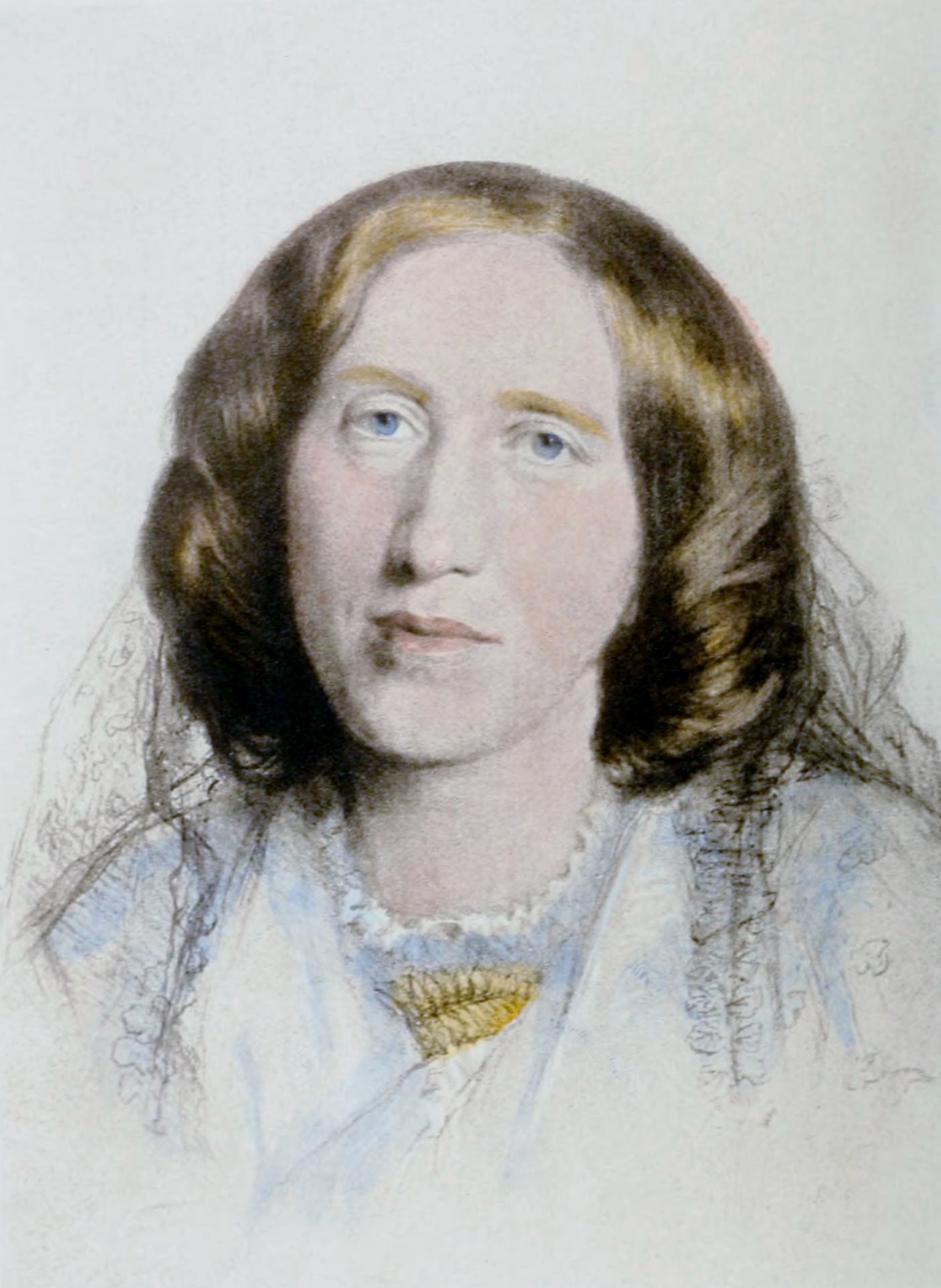
Since Buzzfeed has decided to republish Middlemarch (it is, after all, in the public domain), we have decided to republish George Eliot’s novella, The Lifted Veil, which we obtained through Project Gutenberg. Please note that this eBook is for the use of anyone anywhere at no cost and with almost no restrictions whatsoever. You may copy it, give it away or re-use it under the terms of the Project Gutenberg License included with this eBook or online at www.gutenberg.net.
THE LIFTED VEIL
Give me no light, great Heaven, but such as turns
To energy of human fellowship;
No powers beyond the growing heritage
That makes completer manhood.
CHAPTER I
The time of my end approaches. I have lately been subject to
attacks of angina pectoris; and in the ordinary course of things,
my physician tells me, I may fairly hope that my life will not be protracted
many months. Unless, then, I am cursed with an exceptional physical
constitution, as I am cursed with an exceptional mental character, I
shall not much longer groan under the wearisome burthen of this earthly
existence. If it were to be otherwise—if I were to live
on to the age most men desire and provide for—I should for once
have known whether the miseries of delusive expectation can outweigh
the miseries of true provision. For I foresee when I shall die,
and everything that will happen in my last moments.
Just a month from this day, on September 20, 1850, I shall be sitting
in this chair, in this study, at ten o’clock at night, longing
to die, weary of incessant insight and foresight, without delusions
and without hope. Just as I am watching a tongue of blue flame
rising in the fire, and my lamp is burning low, the horrible contraction
will begin at my chest. I shall only have time to reach the bell,
and pull it violently, before the sense of suffocation will come.
No one will answer my bell. I know why. My two servants
are lovers, and will have quarrelled. My housekeeper will have
rushed out of the house in a fury, two hours before, hoping that Perry
will believe she has gone to drown herself. Perry is alarmed at
last, and is gone out after her. The little scullery-maid is asleep
on a bench: she never answers the bell; it does not wake her.
The sense of suffocation increases: my lamp goes out with a horrible
stench: I make a great effort, and snatch at the bell again. I
long for life, and there is no help. I thirsted for the unknown:
the thirst is gone. O God, let me stay with the known, and be
weary of it: I am content. Agony of pain and suffocation—and
all the while the earth, the fields, the pebbly brook at the bottom
of the rookery, the fresh scent after the rain, the light of the morning
through my chamber-window, the warmth of the hearth after the frosty
air—will darkness close over them for ever?
Darkness—darkness—no pain—nothing but darkness:
but I am passing on and on through the darkness: my thought stays in
the darkness, but always with a sense of moving onward . . .
Before that time comes, I wish to use my last hours of ease and strength
in telling the strange story of my experience. I have never fully
unbosomed myself to any human being; I have never been encouraged to
trust much in the sympathy of my fellow-men. But we have all a
chance of meeting with some pity, some tenderness, some charity, when
we are dead: it is the living only who cannot be forgiven—the
living only from whom men’s indulgence and reverence are held
off, like the rain by the hard east wind. While the heart beats,
bruise it—it is your only opportunity; while the eye can still
turn towards you with moist, timid entreaty, freeze it with an icy unanswering
gaze; while the ear, that delicate messenger to the inmost sanctuary
of the soul, can still take in the tones of kindness, put it off with
hard civility, or sneering compliment, or envious affectation of indifference;
while the creative brain can still throb with the sense of injustice,
with the yearning for brotherly recognition—make haste—oppress
it with your ill-considered judgements, your trivial comparisons, your
careless misrepresentations. The heart will by and by be still—“ubi
saeva indignatio ulterius cor lacerare nequit”; the eye will cease
to entreat; the ear will be deaf; the brain will have ceased from all
wants as well as from all work. Then your charitable speeches
may find vent; then you may remember and pity the toil and the struggle
and the failure; then you may give due honour to the work achieved;
then you may find extenuation for errors, and may consent to bury them.
That is a trivial schoolboy text; why do I dwell on it? It
has little reference to me, for I shall leave no works behind me for
men to honour. I have no near relatives who will make up, by weeping
over my grave, for the wounds they inflicted on me when I was among
them. It is only the story of my life that will perhaps win a
little more sympathy from strangers when I am dead, than I ever believed
it would obtain from my friends while I was living.
My childhood perhaps seems happier to me than it really was, by contrast
with all the after-years. For then the curtain of the future was
as impenetrable to me as to other children: I had all their delight
in the present hour, their sweet indefinite hopes for the morrow; and
I had a tender mother: even now, after the dreary lapse of long years,
a slight trace of sensation accompanies the remembrance of her caress
as she held me on her knee—her arms round my little body, her
cheek pressed on mine. I had a complaint of the eyes that made
me blind for a little while, and she kept me on her knee from morning
till night. That unequalled love soon vanished out of my life,
and even to my childish consciousness it was as if that life had become
more chill I rode my little white pony with the groom by my side as
before, but there were no loving eyes looking at me as I mounted, no
glad arms opened to me when I came back. Perhaps I missed my mother’s
love more than most children of seven or eight would have done, to whom
the other pleasures of life remained as before; for I was certainly
a very sensitive child. I remember still the mingled trepidation
and delicious excitement with which I was affected by the tramping of
the horses on the pavement in the echoing stables, by the loud resonance
of the groom’s voices, by the booming bark of the dogs as my father’s
carriage thundered under the archway of the courtyard, by the din of
the gong as it gave notice of luncheon and dinner. The measured
tramp of soldiery which I sometimes heard—for my father’s
house lay near a county town where there were large barracks—made
me sob and tremble; and yet when they were gone past, I longed for them
to come back again.
I fancy my father thought me an odd child, and had little fondness
for me; though he was very careful in fulfilling what he regarded as
a parent’s duties. But he was already past the middle of
life, and I was not his only son. My mother had been his second
wife, and he was five-and-forty when he married her. He was a
firm, unbending, intensely orderly man, in root and stem a banker, but
with a flourishing graft of the active landholder, aspiring to county
influence: one of those people who are always like themselves from day
to day, who are uninfluenced by the weather, and neither know melancholy
nor high spirits. I held him in great awe, and appeared more timid
and sensitive in his presence than at other times; a circumstance which,
perhaps, helped to confirm him in the intention to educate me on a different
plan from the prescriptive one with which he had complied in the case
of my elder brother, already a tall youth at Eton. My brother
was to be his representative and successor; he must go to Eton and Oxford,
for the sake of making connexions, of course: my father was not a man
to underrate the bearing of Latin satirists or Greek dramatists on the
attainment of an aristocratic position. But, intrinsically, he
had slight esteem for “those dead but sceptred spirits”;
having qualified himself for forming an independent opinion by reading
Potter’s Æschylus, and dipping into Francis’s
Horace. To this negative view he added a positive one,
derived from a recent connexion with mining speculations; namely, that
a scientific education was the really useful training for a younger
son. Moreover, it was clear that a shy, sensitive boy like me
was not fit to encounter the rough experience of a public school.
Mr. Letherall had said so very decidedly. Mr. Letherall was a
large man in spectacles, who one day took my small head between his
large hands, and pressed it here and there in an exploratory, auspicious
manner—then placed each of his great thumbs on my temples, and
pushed me a little way from him, and stared at me with glittering spectacles.
The contemplation appeared to displease him, for he frowned sternly,
and said to my father, drawing his thumbs across my eyebrows—
“The deficiency is there, sir—there; and here,”
he added, touching the upper sides of my head, “here is the excess.
That must be brought out, sir, and this must be laid to sleep.”
I was in a state of tremor, partly at the vague idea that I was the
object of reprobation, partly in the agitation of my first hatred—hatred
of this big, spectacled man, who pulled my head about as if he wanted
to buy and cheapen it.
I am not aware how much Mr. Letherall had to do with the system afterwards
adopted towards me, but it was presently clear that private tutors,
natural history, science, and the modern languages, were the appliances
by which the defects of my organization were to be remedied. I
was very stupid about machines, so I was to be greatly occupied with
them; I had no memory for classification, so it was particularly necessary
that I should study systematic zoology and botany; I was hungry for
human deeds and humane motions, so I was to be plentifully crammed with
the mechanical powers, the elementary bodies, and the phenomena of electricity
and magnetism. A better-constituted boy would certainly have profited
under my intelligent tutors, with their scientific apparatus; and would,
doubtless, have found the phenomena of electricity and magnetism as
fascinating as I was, every Thursday, assured they were. As it
was, I could have paired off, for ignorance of whatever was taught me,
with the worst Latin scholar that was ever turned out of a classical
academy. I read Plutarch, and Shakespeare, and Don Quixote by
the sly, and supplied myself in that way with wandering thoughts, while
my tutor was assuring me that “an improved man, as distinguished
from an ignorant one, was a man who knew the reason why water ran downhill.”
I had no desire to be this improved man; I was glad of the running water;
I could watch it and listen to it gurgling among the pebbles, and bathing
the bright green water-plants, by the hour together. I did not
want to know why it ran; I had perfect confidence that there
were good reasons for what was so very beautiful.
There is no need to dwell on this part of my life. I have said
enough to indicate that my nature was of the sensitive, unpractical
order, and that it grew up in an uncongenial medium, which could never
foster it into happy, healthy development. When I was sixteen
I was sent to Geneva to complete my course of education; and the change
was a very happy one to me, for the first sight of the Alps, with the
setting sun on them, as we descended the Jura, seemed to me like an
entrance into heaven; and the three years of my life there were spent
in a perpetual sense of exaltation, as if from a draught of delicious
wine, at the presence of Nature in all her awful loveliness. You
will think, perhaps, that I must have been a poet, from this early sensibility
to Nature. But my lot was not so happy as that. A poet pours
forth his song and believes in the listening ear and answering
soul, to which his song will be floated sooner or later. But the
poet’s sensibility without his voice—the poet’s sensibility
that finds no vent but in silent tears on the sunny bank, when the noonday
light sparkles on the water, or in an inward shudder at the sound of
harsh human tones, the sight of a cold human eye—this dumb passion
brings with it a fatal solitude of soul in the society of one’s
fellow-men. My least solitary moments were those in which I pushed
off in my boat, at evening, towards the centre of the lake; it seemed
to me that the sky, and the glowing mountain-tops, and the wide blue
water, surrounded me with a cherishing love such as no human face had
shed on me since my mother’s love had vanished out of my life.
I used to do as Jean Jacques did—lie down in my boat and let it
glide where it would, while I looked up at the departing glow leaving
one mountain-top after the other, as if the prophet’s chariot
of fire were passing over them on its way to the home of light.
Then, when the white summits were all sad and corpse-like, I had to
push homeward, for I was under careful surveillance, and was allowed
no late wanderings. This disposition of mine was not favourable
to the formation of intimate friendships among the numerous youths of
my own age who are always to be found studying at Geneva. Yet
I made one such friendship; and, singularly enough, it was with
a youth whose intellectual tendencies were the very reverse of my own.
I shall call him Charles Meunier; his real surname—an English
one, for he was of English extraction—having since become celebrated.
He was an orphan, who lived on a miserable pittance while he pursued
the medical studies for which he had a special genius. Strange!
that with my vague mind, susceptible and unobservant, hating inquiry
and given up to contemplation, I should have been drawn towards a youth
whose strongest passion was science. But the bond was not an intellectual
one; it came from a source that can happily blend the stupid with the
brilliant, the dreamy with the practical: it came from community of
feeling. Charles was poor and ugly, derided by Genevese gamins,
and not acceptable in drawing-rooms. I saw that he was isolated,
as I was, though from a different cause, and, stimulated by a sympathetic
resentment, I made timid advances towards him. It is enough to
say that there sprang up as much comradeship between us as our different
habits would allow; and in Charles’s rare holidays we went up
the Salève together, or took the boat to Vevay, while I listened
dreamily to the monologues in which he unfolded his bold conceptions
of future experiment and discovery. I mingled them confusedly
in my thought with glimpses of blue water and delicate floating cloud,
with the notes of birds and the distant glitter of the glacier.
He knew quite well that my mind was half absent, yet he liked to talk
to me in this way; for don’t we talk of our hopes and our projects
even to dogs and birds, when they love us? I have mentioned this
one friendship because of its connexion with a strange and terrible
scene which I shall have to narrate in my subsequent life.
This happier life at Geneva was put an end to by a severe illness,
which is partly a blank to me, partly a time of dimly-remembered suffering,
with the presence of my father by my bed from time to time. Then
came the languid monotony of convalescence, the days gradually breaking
into variety and distinctness as my strength enabled me to take longer
and longer drives. On one of these more vividly remembered days,
my father said to me, as he sat beside my sofa—
“When you are quite well enough to travel, Latimer, I shall
take you home with me. The journey will amuse you and do you good,
for I shall go through the Tyrol and Austria, and you will see many
new places. Our neighbours, the Filmores, are come; Alfred will
join us at Basle, and we shall all go together to Vienna, and back by
Prague” . . .
My father was called away before he had finished his sentence, and
he left my mind resting on the word Prague, with a strange sense
that a new and wondrous scene was breaking upon me: a city under the
broad sunshine, that seemed to me as if it were the summer sunshine
of a long-past century arrested in its course—unrefreshed for
ages by dews of night, or the rushing rain-cloud; scorching the dusty,
weary, time-eaten grandeur of a people doomed to live on in the stale
repetition of memories, like deposed and superannuated kings in their
regal gold-inwoven tatters. The city looked so thirsty that the
broad river seemed to me a sheet of metal; and the blackened statues,
as I passed under their blank gaze, along the unending bridge, with
their ancient garments and their saintly crowns, seemed to me the real
inhabitants and owners of this place, while the busy, trivial men and
women, hurrying to and fro, were a swarm of ephemeral visitants infesting
it for a day. It is such grim, stony beings as these, I thought,
who are the fathers of ancient faded children, in those tanned time-fretted
dwellings that crowd the steep before me; who pay their court in the
worn and crumbling pomp of the palace which stretches its monotonous
length on the height; who worship wearily in the stifling air of the
churches, urged by no fear or hope, but compelled by their doom to be
ever old and undying, to live on in the rigidity of habit, as they live
on in perpetual midday, without the repose of night or the new birth
of morning.
A stunning clang of metal suddenly thrilled through me, and I became
conscious of the objects in my room again: one of the fire-irons had
fallen as Pierre opened the door to bring me my draught. My heart
was palpitating violently, and I begged Pierre to leave my draught beside
me; I would take it presently.
As soon as I was alone again, I began to ask myself whether I had
been sleeping. Was this a dream—this wonderfully distinct
vision—minute in its distinctness down to a patch of rainbow light
on the pavement, transmitted through a coloured lamp in the shape of
a star—of a strange city, quite unfamiliar to my imagination?
I had seen no picture of Prague: it lay in my mind as a mere name, with
vaguely-remembered historical associations—ill-defined memories
of imperial grandeur and religious wars.
Nothing of this sort had ever occurred in my dreaming experience
before, for I had often been humiliated because my dreams were only
saved from being utterly disjointed and commonplace by the frequent
terrors of nightmare. But I could not believe that I had been
asleep, for I remembered distinctly the gradual breaking-in of the vision
upon me, like the new images in a dissolving view, or the growing distinctness
of the landscape as the sun lifts up the veil of the morning mist.
And while I was conscious of this incipient vision, I was also conscious
that Pierre came to tell my father Mr. Filmore was waiting for him,
and that my father hurried out of the room. No, it was not a dream;
was it—the thought was full of tremulous exultation—was
it the poet’s nature in me, hitherto only a troubled yearning
sensibility, now manifesting itself suddenly as spontaneous creation?
Surely it was in this way that Homer saw the plain of Troy, that Dante
saw the abodes of the departed, that Milton saw the earthward flight
of the Tempter. Was it that my illness had wrought some happy
change in my organization—given a firmer tension to my nerves—carried
off some dull obstruction? I had often read of such effects—in
works of fiction at least. Nay; in genuine biographies I had read
of the subtilizing or exalting influence of some diseases on the mental
powers. Did not Novalis feel his inspiration intensified under
the progress of consumption?
When my mind had dwelt for some time on this blissful idea, it seemed
to me that I might perhaps test it by an exertion of my will.
The vision had begun when my father was speaking of our going to Prague.
I did not for a moment believe it was really a representation of that
city; I believed—I hoped it was a picture that my newly liberated
genius had painted in fiery haste, with the colours snatched from lazy
memory. Suppose I were to fix my mind on some other place—Venice,
for example, which was far more familiar to my imagination than Prague:
perhaps the same sort of result would follow. I concentrated my
thoughts on Venice; I stimulated my imagination with poetic memories,
and strove to feel myself present in Venice, as I had felt myself present
in Prague. But in vain. I was only colouring the Canaletto
engravings that hung in my old bedroom at home; the picture was a shifting
one, my mind wandering uncertainly in search of more vivid images; I
could see no accident of form or shadow without conscious labour after
the necessary conditions. It was all prosaic effort, not rapt
passivity, such as I had experienced half an hour before. I was
discouraged; but I remembered that inspiration was fitful.
For several days I was in a state of excited expectation, watching
for a recurrence of my new gift. I sent my thoughts ranging over
my world of knowledge, in the hope that they would find some object
which would send a reawakening vibration through my slumbering genius.
But no; my world remained as dim as ever, and that flash of strange
light refused to come again, though I watched for it with palpitating
eagerness.
My father accompanied me every day in a drive, and a gradually lengthening
walk as my powers of walking increased; and one evening he had agreed
to come and fetch me at twelve the next day, that we might go together
to select a musical box, and other purchases rigorously demanded of
a rich Englishman visiting Geneva. He was one of the most punctual
of men and bankers, and I was always nervously anxious to be quite ready
for him at the appointed time. But, to my surprise, at a quarter
past twelve he had not appeared. I felt all the impatience of
a convalescent who has nothing particular to do, and who has just taken
a tonic in the prospect of immediate exercise that would carry off the
stimulus.
Unable to sit still and reserve my strength, I walked up and down
the room, looking out on the current of the Rhone, just where it leaves
the dark-blue lake; but thinking all the while of the possible causes
that could detain my father.
Suddenly I was conscious that my father was in the room, but not
alone: there were two persons with him. Strange! I had heard
no footstep, I had not seen the door open; but I saw my father, and
at his right hand our neighbour Mrs. Filmore, whom I remembered very
well, though I had not seen her for five years. She was a commonplace
middle-aged woman, in silk and cashmere; but the lady on the left of
my father was not more than twenty, a tall, slim, willowy figure, with
luxuriant blond hair, arranged in cunning braids and folds that looked
almost too massive for the slight figure and the small-featured, thin-lipped
face they crowned. But the face had not a girlish expression:
the features were sharp, the pale grey eyes at once acute, restless,
and sarcastic. They were fixed on me in half-smiling curiosity,
and I felt a painful sensation as if a sharp wind were cutting me.
The pale-green dress, and the green leaves that seemed to form a border
about her pale blond hair, made me think of a Water-Nixie—for
my mind was full of German lyrics, and this pale, fatal-eyed woman,
with the green weeds, looked like a birth from some cold sedgy stream,
the daughter of an aged river.
“Well, Latimer, you thought me long,” my father said
. . .
But while the last word was in my ears, the whole group vanished,
and there was nothing between me and the Chinese printed folding-screen
that stood before the door. I was cold and trembling; I could
only totter forward and throw myself on the sofa. This strange
new power had manifested itself again . . . But was it a power?
Might it not rather be a disease—a sort of intermittent delirium,
concentrating my energy of brain into moments of unhealthy activity,
and leaving my saner hours all the more barren? I felt a dizzy
sense of unreality in what my eye rested on; I grasped the bell convulsively,
like one trying to free himself from nightmare, and rang it twice.
Pierre came with a look of alarm in his face.
“Monsieur ne se trouve pas bien?” he said anxiously.
“I’m tired of waiting, Pierre,” I said, as distinctly
and emphatically as I could, like a man determined to be sober in spite
of wine; “I’m afraid something has happened to my father—he’s
usually so punctual. Run to the Hôtel des Bergues and see
if he is there.”
Pierre left the room at once, with a soothing “Bien, Monsieur”;
and I felt the better for this scene of simple, waking prose.
Seeking to calm myself still further, I went into my bedroom, adjoining
the salon, and opened a case of eau-de-Cologne; took out a bottle;
went through the process of taking out the cork very neatly, and then
rubbed the reviving spirit over my hands and forehead, and under my
nostrils, drawing a new delight from the scent because I had procured
it by slow details of labour, and by no strange sudden madness.
Already I had begun to taste something of the horror that belongs to
the lot of a human being whose nature is not adjusted to simple human
conditions.
Still enjoying the scent, I returned to the salon, but it was not
unoccupied, as it had been before I left it. In front of the Chinese
folding-screen there was my father, with Mrs. Filmore on his right hand,
and on his left—the slim, blond-haired girl, with the keen face
and the keen eyes fixed on me in half-smiling curiosity.
“Well, Latimer, you thought me long,” my father said
. . .
I heard no more, felt no more, till I became conscious that I was
lying with my head low on the sofa, Pierre, and my father by my side.
As soon as I was thoroughly revived, my father left the room, and presently
returned, saying—
“I’ve been to tell the ladies how you are, Latimer.
They were waiting in the next room. We shall put off our shopping
expedition to-day.”
Presently he said, “That young lady is Bertha Grant, Mrs. Filmore’s
orphan niece. Filmore has adopted her, and she lives with them,
so you will have her for a neighbour when we go home—perhaps for
a near relation; for there is a tenderness between her and Alfred, I
suspect, and I should be gratified by the match, since Filmore means
to provide for her in every way as if she were his daughter. It
had not occurred to me that you knew nothing about her living with the
Filmores.”
He made no further allusion to the fact of my having fainted at the
moment of seeing her, and I would not for the world have told him the
reason: I shrank from the idea of disclosing to any one what might be
regarded as a pitiable peculiarity, most of all from betraying it to
my father, who would have suspected my sanity ever after.
I do not mean to dwell with particularity on the details of my experience.
I have described these two cases at length, because they had definite,
clearly traceable results in my after-lot.
Shortly after this last occurrence—I think the very next day—I
began to be aware of a phase in my abnormal sensibility, to which, from
the languid and slight nature of my intercourse with others since my
illness, I had not been alive before. This was the obtrusion on
my mind of the mental process going forward in first one person, and
then another, with whom I happened to be in contact: the vagrant, frivolous
ideas and emotions of some uninteresting acquaintance—Mrs. Filmore,
for example—would force themselves on my consciousness like an
importunate, ill-played musical instrument, or the loud activity of
an imprisoned insect. But this unpleasant sensibility was fitful,
and left me moments of rest, when the souls of my companions were once
more shut out from me, and I felt a relief such as silence brings to
wearied nerves. I might have believed this importunate insight
to be merely a diseased activity of the imagination, but that my prevision
of incalculable words and actions proved it to have a fixed relation
to the mental process in other minds. But this superadded consciousness,
wearying and annoying enough when it urged on me the trivial experience
of indifferent people, became an intense pain and grief when it seemed
to be opening to me the souls of those who were in a close relation
to me—when the rational talk, the graceful attentions, the wittily-turned
phrases, and the kindly deeds, which used to make the web of their characters,
were seen as if thrust asunder by a microscopic vision, that showed
all the intermediate frivolities, all the suppressed egoism, all the
struggling chaos of puerilities, meanness, vague capricious memories,
and indolent make-shift thoughts, from which human words and deeds emerge
like leaflets covering a fermenting heap.
At Basle we were joined by my brother Alfred, now a handsome, self-confident
man of six-and-twenty—a thorough contrast to my fragile, nervous,
ineffectual self. I believe I was held to have a sort of half-womanish,
half-ghostly beauty; for the portrait-painters, who are thick as weeds
at Geneva, had often asked me to sit to them, and I had been the model
of a dying minstrel in a fancy picture. But I thoroughly disliked
my own physique and nothing but the belief that it was a condition of
poetic genius would have reconciled me to it. That brief hope
was quite fled, and I saw in my face now nothing but the stamp of a
morbid organization, framed for passive suffering—too feeble for
the sublime resistance of poetic production. Alfred, from whom
I had been almost constantly separated, and who, in his present stage
of character and appearance, came before me as a perfect stranger, was
bent on being extremely friendly and brother-like to me. He had
the superficial kindness of a good-humoured, self-satisfied nature,
that fears no rivalry, and has encountered no contrarieties. I
am not sure that my disposition was good enough for me to have been
quite free from envy towards him, even if our desires had not clashed,
and if I had been in the healthy human condition which admits of generous
confidence and charitable construction. There must always have
been an antipathy between our natures. As it was, he became in
a few weeks an object of intense hatred to me; and when he entered the
room, still more when he spoke, it was as if a sensation of grating
metal had set my teeth on edge. My diseased consciousness was
more intensely and continually occupied with his thoughts and emotions,
than with those of any other person who came in my way. I was
perpetually exasperated with the petty promptings of his conceit and
his love of patronage, with his self-complacent belief in Bertha Grant’s
passion for him, with his half-pitying contempt for me—seen not
in the ordinary indications of intonation and phrase and slight action,
which an acute and suspicious mind is on the watch for, but in all their
naked skinless complication.
For we were rivals, and our desires clashed, though he was not aware
of it. I have said nothing yet of the effect Bertha Grant produced
in me on a nearer acquaintance. That effect was chiefly determined
by the fact that she made the only exception, among all the human beings
about me, to my unhappy gift of insight. About Bertha I was always
in a state of uncertainty: I could watch the expression of her face,
and speculate on its meaning; I could ask for her opinion with the real
interest of ignorance; I could listen for her words and watch for her
smile with hope and fear: she had for me the fascination of an unravelled
destiny. I say it was this fact that chiefly determined the strong
effect she produced on me: for, in the abstract, no womanly character
could seem to have less affinity for that of a shrinking, romantic,
passionate youth than Bertha’s. She was keen, sarcastic,
unimaginative, prematurely cynical, remaining critical and unmoved in
the most impressive scenes, inclined to dissect all my favourite poems,
and especially contemptous towards the German lyrics which were my pet
literature at that time. To this moment I am unable to define
my feeling towards her: it was not ordinary boyish admiration, for she
was the very opposite, even to the colour of her hair, of the ideal
woman who still remained to me the type of loveliness; and she was without
that enthusiasm for the great and good, which, even at the moment of
her strongest dominion over me, I should have declared to be the highest
element of character. But there is no tyranny more complete than
that which a self-centred negative nature exercises over a morbidly
sensitive nature perpetually craving sympathy and support. The
most independent people feel the effect of a man’s silence in
heightening their value for his opinion—feel an additional triumph
in conquering the reverence of a critic habitually captious and satirical:
no wonder, then, that an enthusiastic self-distrusting youth should
watch and wait before the closed secret of a sarcastic woman’s
face, as if it were the shrine of the doubtfully benignant deity who
ruled his destiny. For a young enthusiast is unable to imagine
the total negation in another mind of the emotions which are stirring
his own: they may be feeble, latent, inactive, he thinks, but they are
there—they may be called forth; sometimes, in moments of happy
hallucination, he believes they may be there in all the greater strength
because he sees no outward sign of them. And this effect, as I
have intimated, was heightened to its utmost intensity in me, because
Bertha was the only being who remained for me in the mysterious seclusion
of soul that renders such youthful delusion possible. Doubtless
there was another sort of fascination at work—that subtle physical
attraction which delights in cheating our psychological predictions,
and in compelling the men who paint sylphs, to fall in love with some
bonne et brave femme, heavy-heeled and freckled.
Bertha’s behaviour towards me was such as to encourage all
my illusions, to heighten my boyish passion, and make me more and more
dependent on her smiles. Looking back with my present wretched
knowledge, I conclude that her vanity and love of power were intensely
gratified by the belief that I had fainted on first seeing her purely
from the strong impression her person had produced on me. The
most prosaic woman likes to believe herself the object of a violent,
a poetic passion; and without a grain of romance in her, Bertha had
that spirit of intrigue which gave piquancy to the idea that the brother
of the man she meant to marry was dying with love and jealousy for her
sake. That she meant to marry my brother, was what at that time
I did not believe; for though he was assiduous in his attentions to
her, and I knew well enough that both he and my father had made up their
minds to this result, there was not yet an understood engagement—there
had been no explicit declaration; and Bertha habitually, while she flirted
with my brother, and accepted his homage in a way that implied to him
a thorough recognition of its intention, made me believe, by the subtlest
looks and phrases—feminine nothings which could never be quoted
against her—that he was really the object of her secret ridicule;
that she thought him, as I did, a coxcomb, whom she would have pleasure
in disappointing. Me she openly petted in my brother’s presence,
as if I were too young and sickly ever to be thought of as a lover;
and that was the view he took of me. But I believe she must inwardly
have delighted in the tremors into which she threw me by the coaxing
way in which she patted my curls, while she laughed at my quotations.
Such caresses were always given in the presence of our friends; for
when we were alone together, she affected a much greater distance towards
me, and now and then took the opportunity, by words or slight actions,
to stimulate my foolish timid hope that she really preferred me.
And why should she not follow her inclination? I was not in so
advantageous a position as my brother, but I had fortune, I was not
a year younger than she was, and she was an heiress, who would soon
be of age to decide for herself.
The fluctuations of hope and fear, confined to this one channel,
made each day in her presence a delicious torment. There was one
deliberate act of hers which especially helped to intoxicate me.
When we were at Vienna her twentieth birthday occurred, and as she was
very fond of ornaments, we all took the opportunity of the splendid
jewellers’ shops in that Teutonic Paris to purchase her a birthday
present of jewellery. Mine, naturally, was the least expensive;
it was an opal ring—the opal was my favourite stone, because it
seems to blush and turn pale as if it had a soul. I told Bertha
so when I gave it her, and said that it was an emblem of the poetic
nature, changing with the changing light of heaven and of woman’s
eyes. In the evening she appeared elegantly dressed, and wearing
conspicuously all the birthday presents except mine. I looked
eagerly at her fingers, but saw no opal. I had no opportunity
of noticing this to her during the evening; but the next day, when I
found her seated near the window alone, after breakfast, I said, “You
scorn to wear my poor opal. I should have remembered that you
despised poetic natures, and should have given you coral, or turquoise,
or some other opaque unresponsive stone.” “Do I despise
it?” she answered, taking hold of a delicate gold chain which
she always wore round her neck and drawing out the end from her bosom
with my ring hanging to it; “it hurts me a little, I can tell
you,” she said, with her usual dubious smile, “to wear it
in that secret place; and since your poetical nature is so stupid as
to prefer a more public position, I shall not endure the pain any longer.”
She took off the ring from the chain and put it on her finger, smiling
still, while the blood rushed to my cheeks, and I could not trust myself
to say a word of entreaty that she would keep the ring where it was
before.
I was completely fooled by this, and for two days shut myself up
in my own room whenever Bertha was absent, that I might intoxicate myself
afresh with the thought of this scene and all it implied.
I should mention that during these two months—which seemed
a long life to me from the novelty and intensity of the pleasures and
pains I underwent—my diseased anticipation in other people’s
consciousness continued to torment me; now it was my father, and now
my brother, now Mrs. Filmore or her husband, and now our German courier,
whose stream of thought rushed upon me like a ringing in the ears not
to be got rid of, though it allowed my own impulses and ideas to continue
their uninterrupted course. It was like a preternaturally heightened
sense of hearing, making audible to one a roar of sound where others
find perfect stillness. The weariness and disgust of this involuntary
intrusion into other souls was counteracted only by my ignorance of
Bertha, and my growing passion for her; a passion enormously stimulated,
if not produced, by that ignorance. She was my oasis of mystery
in the dreary desert of knowledge. I had never allowed my diseased
condition to betray itself, or to drive me into any unusual speech or
action, except once, when, in a moment of peculiar bitterness against
my brother, I had forestalled some words which I knew he was going to
utter—a clever observation, which he had prepared beforehand.
He had occasionally a slightly affected hesitation in his speech, and
when he paused an instant after the second word, my impatience and jealousy
impelled me to continue the speech for him, as if it were something
we had both learned by rote. He coloured and looked astonished,
as well as annoyed; and the words had no sooner escaped my lips than
I felt a shock of alarm lest such an anticipation of words—very
far from being words of course, easy to divine—should have betrayed
me as an exceptional being, a sort of quiet energumen, whom every one,
Bertha above all, would shudder at and avoid. But I magnified,
as usual, the impression any word or deed of mine could produce on others;
for no one gave any sign of having noticed my interruption as more than
a rudeness, to be forgiven me on the score of my feeble nervous condition.
While this superadded consciousness of the actual was almost constant
with me, I had never had a recurrence of that distinct prevision which
I have described in relation to my first interview with Bertha; and
I was waiting with eager curiosity to know whether or not my vision
of Prague would prove to have been an instance of the same kind.
A few days after the incident of the opal ring, we were paying one of
our frequent visits to the Lichtenberg Palace. I could never look
at many pictures in succession; for pictures, when they are at all powerful,
affect me so strongly that one or two exhaust all my capability of contemplation.
This morning I had been looking at Giorgione’s picture of the
cruel-eyed woman, said to be a likeness of Lucrezia Borgia. I
had stood long alone before it, fascinated by the terrible reality of
that cunning, relentless face, till I felt a strange poisoned sensation,
as if I had long been inhaling a fatal odour, and was just beginning
to be conscious of its effects. Perhaps even then I should not
have moved away, if the rest of the party had not returned to this room,
and announced that they were going to the Belvedere Gallery to settle
a bet which had arisen between my brother and Mr. Filmore about a portrait.
I followed them dreamily, and was hardly alive to what occurred till
they had all gone up to the gallery, leaving me below; for I refused
to come within sight of another picture that day. I made my way
to the Grand Terrace, since it was agreed that we should saunter in
the gardens when the dispute had been decided. I had been sitting
here a short space, vaguely conscious of trim gardens, with a city and
green hills in the distance, when, wishing to avoid the proximity of
the sentinel, I rose and walked down the broad stone steps, intending
to seat myself farther on in the gardens. Just as I reached the
gravel-walk, I felt an arm slipped within mine, and a light hand gently
pressing my wrist. In the same instant a strange intoxicating
numbness passed over me, like the continuance or climax of the sensation
I was still feeling from the gaze of Lucrezia Borgia. The gardens,
the summer sky, the consciousness of Bertha’s arm being within
mine, all vanished, and I seemed to be suddenly in darkness, out of
which there gradually broke a dim firelight, and I felt myself sitting
in my father’s leather chair in the library at home. I knew
the fireplace—the dogs for the wood-fire—the black marble
chimney-piece with the white marble medallion of the dying Cleopatra
in the centre. Intense and hopeless misery was pressing on my
soul; the light became stronger, for Bertha was entering with a candle
in her hand—Bertha, my wife—with cruel eyes, with green
jewels and green leaves on her white ball-dress; every hateful thought
within her present to me . . . “Madman, idiot! why don’t
you kill yourself, then?” It was a moment of hell.
I saw into her pitiless soul—saw its barren worldliness, its scorching
hate—and felt it clothe me round like an air I was obliged to
breathe. She came with her candle and stood over me with a bitter
smile of contempt; I saw the great emerald brooch on her bosom, a studded
serpent with diamond eyes. I shuddered—I despised this woman
with the barren soul and mean thoughts; but I felt helpless before her,
as if she clutched my bleeding heart, and would clutch it till the last
drop of life-blood ebbed away. She was my wife, and we hated each
other. Gradually the hearth, the dim library, the candle-light
disappeared—seemed to melt away into a background of light, the
green serpent with the diamond eyes remaining a dark image on the retina.
Then I had a sense of my eyelids quivering, and the living daylight
broke in upon me; I saw gardens, and heard voices; I was seated on the
steps of the Belvedere Terrace, and my friends were round me.
The tumult of mind into which I was thrown by this hideous vision
made me ill for several days, and prolonged our stay at Vienna.
I shuddered with horror as the scene recurred to me; and it recurred
constantly, with all its minutiæ, as if they had been burnt into
my memory; and yet, such is the madness of the human heart under the
influence of its immediate desires, I felt a wild hell-braving joy that
Bertha was to be mine; for the fulfilment of my former prevision concerning
her first appearance before me, left me little hope that this last hideous
glimpse of the future was the mere diseased play of my own mind, and
had no relation to external realities. One thing alone I looked
towards as a possible means of casting doubt on my terrible conviction—the
discovery that my vision of Prague had been false—and Prague was
the next city on our route.
Meanwhile, I was no sooner in Bertha’s society again than I
was as completely under her sway as before. What if I saw into
the heart of Bertha, the matured woman—Bertha, my wife?
Bertha, the girl, was a fascinating secret to me still: I trembled
under her touch; I felt the witchery of her presence; I yearned to be
assured of her love. The fear of poison is feeble against the
sense of thirst. Nay, I was just as jealous of my brother as before—just
as much irritated by his small patronizing ways; for my pride, my diseased
sensibility, were there as they had always been, and winced as inevitably
under every offence as my eye winced from an intruding mote. The
future, even when brought within the compass of feeling by a vision
that made me shudder, had still no more than the force of an idea, compared
with the force of present emotion—of my love for Bertha, of my
dislike and jealousy towards my brother.
It is an old story, that men sell themselves to the tempter, and
sign a bond with their blood, because it is only to take effect at a
distant day; then rush on to snatch the cup their souls thirst after
with an impulse not the less savage because there is a dark shadow beside
them for evermore. There is no short cut, no patent tram-road,
to wisdom: after all the centuries of invention, the soul’s path
lies through the thorny wilderness which must be still trodden in solitude,
with bleeding feet, with sobs for help, as it was trodden by them of
old time.
My mind speculated eagerly on the means by which I should become
my brother’s successful rival, for I was still too timid, in my
ignorance of Bertha’s actual feeling, to venture on any step that
would urge from her an avowal of it. I thought I should gain confidence
even for this, if my vision of Prague proved to have been veracious;
and yet, the horror of that certitude! Behind the slim girl Bertha,
whose words and looks I watched for, whose touch was bliss, there stood
continually that Bertha with the fuller form, the harder eyes, the more
rigid mouth—with the barren, selfish soul laid bare; no longer
a fascinating secret, but a measured fact, urging itself perpetually
on my unwilling sight. Are you unable to give me your sympathy—you
who react this? Are you unable to imagine this double consciousness
at work within me, flowing on like two parallel streams which never
mingle their waters and blend into a common hue? Yet you must
have known something of the presentiments that spring from an insight
at war with passion; and my visions were only like presentiments intensified
to horror. You have known the powerlessness of ideas before the
might of impulse; and my visions, when once they had passed into memory,
were mere ideas—pale shadows that beckoned in vain, while my hand
was grasped by the living and the loved.
In after-days I thought with bitter regret that if I had foreseen
something more or something different—if instead of that hideous
vision which poisoned the passion it could not destroy, or if even along
with it I could have had a foreshadowing of that moment when I looked
on my brother’s face for the last time, some softening influence
would have been shed over my feeling towards him: pride and hatred would
surely have been subdued into pity, and the record of those hidden sins
would have been shortened. But this is one of the vain thoughts
with which we men flatter ourselves. We try to believe that the
egoism within us would have easily been melted, and that it was only
the narrowness of our knowledge which hemmed in our generosity, our
awe, our human piety, and hindered them from submerging our hard indifference
to the sensations and emotions of our fellows. Our tenderness
and self-renunciation seem strong when our egoism has had its day—when,
after our mean striving for a triumph that is to be another’s
loss, the triumph comes suddenly, and we shudder at it, because it is
held out by the chill hand of death.
Our arrival in Prague happened at night, and I was glad of this,
for it seemed like a deferring of a terribly decisive moment, to be
in the city for hours without seeing it. As we were not to remain
long in Prague, but to go on speedily to Dresden, it was proposed that
we should drive out the next morning and take a general view of the
place, as well as visit some of its specially interesting spots, before
the heat became oppressive—for we were in August, and the season
was hot and dry. But it happened that the ladies were rather late
at their morning toilet, and to my father’s politely-repressed
but perceptible annoyance, we were not in the carriage till the morning
was far advanced. I thought with a sense of relief, as we entered
the Jews’ quarter, where we were to visit the old synagogue, that
we should be kept in this flat, shut-up part of the city, until we should
all be too tired and too warm to go farther, and so we should return
without seeing more than the streets through which we had already passed.
That would give me another day’s suspense—suspense, the
only form in which a fearful spirit knows the solace of hope.
But, as I stood under the blackened, groined arches of that old synagogue,
made dimly visible by the seven thin candles in the sacred lamp, while
our Jewish cicerone reached down the Book of the Law, and read to us
in its ancient tongue—I felt a shuddering impression that this
strange building, with its shrunken lights, this surviving withered
remnant of medieval Judaism, was of a piece with my vision. Those
darkened dusty Christian saints, with their loftier arches and their
larger candles, needed the consolatory scorn with which they might point
to a more shrivelled death-in-life than their own.
As I expected, when we left the Jews’ quarter the elders of
our party wished to return to the hotel. But now, instead of rejoicing
in this, as I had done beforehand, I felt a sudden overpowering impulse
to go on at once to the bridge, and put an end to the suspense I had
been wishing to protract. I declared, with unusual decision, that
I would get out of the carriage and walk on alone; they might return
without me. My father, thinking this merely a sample of my usual
“poetic nonsense,” objected that I should only do myself
harm by walking in the heat; but when I persisted, he said angrily that
I might follow my own absurd devices, but that Schmidt (our courier)
must go with me. I assented to this, and set off with Schmidt
towards the bridge. I had no sooner passed from under the archway
of the grand old gate leading an to the bridge, than a trembling seized
me, and I turned cold under the midday sun; yet I went on; I was in
search of something—a small detail which I remembered with special
intensity as part of my vision. There it was—the patch of
rainbow light on the pavement transmitted through a lamp in the shape
of a star.
CHAPTER II
Before the autumn was at an end, and while the brown leaves still
stood thick on the beeches in our park, my brother and Bertha were engaged
to each other, and it was understood that their marriage was to take
place early in the next spring. In spite of the certainty I had
felt from that moment on the bridge at Prague, that Bertha would one
day be my wife, my constitutional timidity and distrust had continued
to benumb me, and the words in which I had sometimes premeditated a
confession of my love, had died away unuttered. The same conflict
had gone on within me as before—the longing for an assurance of
love from Bertha’s lips, the dread lest a word of contempt and
denial should fall upon me like a corrosive acid. What was the
conviction of a distant necessity to me? I trembled under a present
glance, I hungered after a present joy, I was clogged and chilled by
a present fear. And so the days passed on: I witnessed Bertha’s
engagement and heard her marriage discussed as if I were under a conscious
nightmare—knowing it was a dream that would vanish, but feeling
stifled under the grasp of hard-clutching fingers.
When I was not in Bertha’s presence—and I was with her
very often, for she continued to treat me with a playful patronage that
wakened no jealousy in my brother—I spent my time chiefly in wandering,
in strolling, or taking long rides while the daylight lasted, and then
shutting myself up with my unread books; for books had lost the power
of chaining my attention. My self-consciousness was heightened
to that pitch of intensity in which our own emotions take the form of
a drama which urges itself imperatively on our contemplation, and we
begin to weep, less under the sense of our suffering than at the thought
of it. I felt a sort of pitying anguish over the pathos of my
own lot: the lot of a being finely organized for pain, but with hardly
any fibres that responded to pleasure—to whom the idea of future
evil robbed the present of its joy, and for whom the idea of future
good did not still the uneasiness of a present yearning or a present
dread. I went dumbly through that stage of the poet’s suffering,
in which he feels the delicious pang of utterance, and makes an image
of his sorrows.
I was left entirely without remonstrance concerning this dreamy wayward
life: I knew my father’s thought about me: “That lad will
never be good for anything in life: he may waste his years in an insignificant
way on the income that falls to him: I shall not trouble myself about
a career for him.”
One mild morning in the beginning of November, it happened that I
was standing outside the portico patting lazy old Cæsar, a Newfoundland
almost blind with age, the only dog that ever took any notice of me—for
the very dogs shunned me, and fawned on the happier people about me—when
the groom brought up my brother’s horse which was to carry him
to the hunt, and my brother himself appeared at the door, florid, broad-chested,
and self-complacent, feeling what a good-natured fellow he was not to
behave insolently to us all on the strength of his great advantages.
“Latimer, old boy,” he said to me in a tone of compassionate
cordiality, “what a pity it is you don’t have a run with
the hounds now and then! The finest thing in the world for low
spirits!”
“Low spirits!” I thought bitterly, as he rode away; “that
is the sort of phrase with which coarse, narrow natures like yours think
to describe experience of which you can know no more than your horse
knows. It is to such as you that the good of this world falls:
ready dulness, healthy selfishness, good-tempered conceit—these
are the keys to happiness.”
The quick thought came, that my selfishness was even stronger than
his—it was only a suffering selfishness instead of an enjoying
one. But then, again, my exasperating insight into Alfred’s
self-complacent soul, his freedom from all the doubts and fears, the
unsatisfied yearnings, the exquisite tortures of sensitiveness, that
had made the web of my life, seemed to absolve me from all bonds towards
him. This man needed no pity, no love; those fine influences would
have been as little felt by him as the delicate white mist is felt by
the rock it caresses. There was no evil in store for him:
if he was not to marry Bertha, it would be because he had found a lot
pleasanter to himself.
Mr. Filmore’s house lay not more than half a mile beyond our
own gates, and whenever I knew my brother was gone in another direction,
I went there for the chance of finding Bertha at home. Later on
in the day I walked thither. By a rare accident she was alone,
and we walked out in the grounds together, for she seldom went on foot
beyond the trimly-swept gravel-walks. I remember what a beautiful
sylph she looked to me as the low November sun shone on her blond hair,
and she tripped along teasing me with her usual light banter, to which
I listened half fondly, half moodily; it was all the sign Bertha’s
mysterious inner self ever made to me. To-day perhaps, the moodiness
predominated, for I had not yet shaken off the access of jealous hate
which my brother had raised in me by his parting patronage. Suddenly
I interrupted and startled her by saying, almost fiercely, “Bertha,
how can you love Alfred?”
She looked at me with surprise for a moment, but soon her light smile
came again, and she answered sarcastically, “Why do you suppose
I love him?”
“How can you ask that, Bertha?”
“What! your wisdom thinks I must love the man I’m going
to marry? The most unpleasant thing in the world. I should
quarrel with him; I should be jealous of him; our ménage
would be conducted in a very ill-bred manner. A little quiet contempt
contributes greatly to the elegance of life.”
“Bertha, that is not your real feeling. Why do you delight
in trying to deceive me by inventing such cynical speeches?”
“I need never take the trouble of invention in order to deceive
you, my small Tasso”—(that was the mocking name she usually
gave me). “The easiest way to deceive a poet is to tell
him the truth.”
She was testing the validity of her epigram in a daring way, and
for a moment the shadow of my vision—the Bertha whose soul was
no secret to me—passed between me and the radiant girl, the playful
sylph whose feelings were a fascinating mystery. I suppose I must
have shuddered, or betrayed in some other way my momentary chill of
horror.
“Tasso!” she said, seizing my wrist, and peeping round
into my face, “are you really beginning to discern what a heartless
girl I am? Why, you are not half the poet I thought you were;
you are actually capable of believing the truth about me.”
The shadow passed from between us, and was no longer the object nearest
to me. The girl whose light fingers grasped me, whose elfish charming
face looked into mine—who, I thought, was betraying an interest
in my feelings that she would not have directly avowed,—this warm
breathing presence again possessed my senses and imagination like a
returning siren melody which had been overpowered for an instant by
the roar of threatening waves. It was a moment as delicious to
me as the waking up to a consciousness of youth after a dream of middle
age. I forgot everything but my passion, and said with swimming
eyes—
“Bertha, shall you love me when we are first married?
I wouldn’t mind if you really loved me only for a little while.”
Her look of astonishment, as she loosed my hand and started away
from me, recalled me to a sense of my strange, my criminal indiscretion.
“Forgive me,” I said, hurriedly, as soon as I could speak
again; “I did not know what I was saying.”
“Ah, Tasso’s mad fit has come on, I see,” she answered
quietly, for she had recovered herself sooner than I had. “Let
him go home and keep his head cool. I must go in, for the sun
is setting.”
I left her—full of indignation against myself. I had
let slip words which, if she reflected on them, might rouse in her a
suspicion of my abnormal mental condition—a suspicion which of
all things I dreaded. And besides that, I was ashamed of the apparent
baseness I had committed in uttering them to my brother’s betrothed
wife. I wandered home slowly, entering our park through a private
gate instead of by the lodges. As I approached the house, I saw
a man dashing off at full speed from the stable-yard across the park.
Had any accident happened at home? No; perhaps it was only one
of my father’s peremptory business errands that required this
headlong haste.
Nevertheless I quickened my pace without any distinct motive, and
was soon at the house. I will not dwell on the scene I found there.
My brother was dead—had been pitched from his horse, and killed
on the spot by a concussion of the brain.
I went up to the room where he lay, and where my father was seated
beside him with a look of rigid despair. I had shunned my father
more than any one since our return home, for the radical antipathy between
our natures made my insight into his inner self a constant affliction
to me. But now, as I went up to him, and stood beside him in sad
silence, I felt the presence of a new element that blended us as we
had never been blent before. My father had been one of the most
successful men in the money-getting world: he had had no sentimental
sufferings, no illness. The heaviest trouble that had befallen
him was the death of his first wife. But he married my mother
soon after; and I remember he seemed exactly the same, to my keen childish
observation, the week after her death as before. But now, at last,
a sorrow had come—the sorrow of old age, which suffers the more
from the crushing of its pride and its hopes, in proportion as the pride
and hope are narrow and prosaic. His son was to have been married
soon—would probably have stood for the borough at the next election.
That son’s existence was the best motive that could be alleged
for making new purchases of land every year to round off the estate.
It is a dreary thing onto live on doing the same things year after year,
without knowing why we do them. Perhaps the tragedy of disappointed
youth and passion is less piteous than the tragedy of disappointed age
and worldliness.
As I saw into the desolation of my father’s heart, I felt a
movement of deep pity towards him, which was the beginning of a new
affection—an affection that grew and strengthened in spite of
the strange bitterness with which he regarded me in the first month
or two after my brother’s death. If it had not been for
the softening influence of my compassion for him—the first deep
compassion I had ever felt—I should have been stung by the perception
that my father transferred the inheritance of an eldest son to me with
a mortified sense that fate had compelled him to the unwelcome course
of caring for me as an important being. It was only in spite of
himself that he began to think of me with anxious regard. There
is hardly any neglected child for whom death has made vacant a more
favoured place, who will not understand what I mean.
Gradually, however, my new deference to his wishes, the effect of
that patience which was born of my pity for him, won upon his affection,
and he began to please himself with the endeavour to make me fill any
brother’s place as fully as my feebler personality would admit.
I saw that the prospect which by and by presented itself of my becoming
Bertha’s husband was welcome to him, and he even contemplated
in my case what he had not intended in my brother’s—that
his son and daughter-in-law should make one household with him.
My softened feelings towards my father made this the happiest time I
had known since childhood;—these last months in which I retained
the delicious illusion of loving Bertha, of longing and doubting and
hoping that she might love me. She behaved with a certain new
consciousness and distance towards me after my brother’s death;
and I too was under a double constraint—that of delicacy towards
my brother’s memory and of anxiety as to the impression my abrupt
words had left on her mind. But the additional screen this mutual
reserve erected between us only brought me more completely under her
power: no matter how empty the adytum, so that the veil be thick enough.
So absolute is our soul’s need of something hidden and uncertain
for the maintenance of that doubt and hope and effort which are the
breath of its life, that if the whole future were laid bare to us beyond
to-day, the interest of all mankind would be bent on the hours that
lie between; we should pant after the uncertainties of our one morning
and our one afternoon; we should rush fiercely to the Exchange for our
last possibility of speculation, of success, of disappointment: we should
have a glut of political prophets foretelling a crisis or a no-crisis
within the only twenty-four hours left open to prophecy. Conceive
the condition of the human mind if all propositions whatsoever were
self-evident except one, which was to become self-evident at the close
of a summer’s day, but in the meantime might be the subject of
question, of hypothesis, of debate. Art and philosophy, literature
and science, would fasten like bees on that one proposition which had
the honey of probability in it, and be the more eager because their
enjoyment would end with sunset. Our impulses, our spiritual activities,
no more adjust themselves to the idea of their future nullity, than
the beating of our heart, or the irritability of our muscles.
Bertha, the slim, fair-haired girl, whose present thoughts and emotions
were an enigma to me amidst the fatiguing obviousness of the other minds
around me, was as absorbing to me as a single unknown to-day—as
a single hypothetic proposition to remain problematic till sunset; and
all the cramped, hemmed-in belief and disbelief, trust and distrust,
of my nature, welled out in this one narrow channel.
And she made me believe that she loved me. Without ever quitting
her tone of badinage and playful superiority, she intoxicated
me with the sense that I was necessary to her, that she was never at
ease, unless I was near her, submitting to her playful tyranny.
It costs a woman so little effort to beset us in this way! A half-repressed
word, a moment’s unexpected silence, even an easy fit of petulance
on our account, will serve us as hashish for a long while.
Out of the subtlest web of scarcely perceptible signs, she set me weaving
the fancy that she had always unconsciously loved me better than Alfred,
but that, with the ignorant fluttered sensibility of a young girl, she
had been imposed on by the charm that lay for her in the distinction
of being admired and chosen by a man who made so brilliant a figure
in the world as my brother. She satirized herself in a very graceful
way for her vanity and ambition. What was it to me that I had
the light of my wretched provision on the fact that now it was I who
possessed at least all but the personal part of my brother’s advantages?
Our sweet illusions are half of them conscious illusions, like effects
of colour that we know to be made up of tinsel, broken glass, and rags.
We were married eighteen months after Alfred’s death, one cold,
clear morning in April, when there came hail and sunshine both together;
and Bertha, in her white silk and pale-green leaves, and the pale hues
of her hair and face, looked like the spirit of the morning. My
father was happier than he had thought of being again: my marriage,
he felt sure, would complete the desirable modification of my character,
and make me practical and worldly enough to take my place in society
among sane men. For he delighted in Bertha’s tact and acuteness,
and felt sure she would be mistress of me, and make me what she chose:
I was only twenty-one, and madly in love with her. Poor father!
He kept that hope a little while after our first year of marriage, and
it was not quite extinct when paralysis came and saved him from utter
disappointment.
I shall hurry through the rest of my story, not dwelling so much
as I have hitherto done on my inward experience. When people are
well known to each other, they talk rather of what befalls them externally,
leaving their feelings and sentiments to be inferred.
We lived in a round of visits for some time after our return home,
giving splendid dinner-parties, and making a sensation in our neighbourhood
by the new lustre of our equipage, for my father had reserved this display
of his increased wealth for the period of his son’s marriage;
and we gave our acquaintances liberal opportunity for remarking that
it was a pity I made so poor a figure as an heir and a bridegroom.
The nervous fatigue of this existence, the insincerities and platitudes
which I had to live through twice over—through my inner and outward
sense—would have been maddening to me, if I had not had that sort
of intoxicated callousness which came from the delights of a first passion.
A bride and bridegroom, surrounded by all the appliances of wealth,
hurried through the day by the whirl of society, filling their solitary
moments with hastily-snatched caresses, are prepared for their future
life together as the novice is prepared for the cloister—by experiencing
its utmost contrast.
Through all these crowded excited months, Bertha’s inward self
remained shrouded from me, and I still read her thoughts only through
the language of her lips and demeanour: I had still the human interest
of wondering whether what I did and said pleased her, of longing to
hear a word of affection, of giving a delicious exaggeration of meaning
to her smile. But I was conscious of a growing difference in her
manner towards me; sometimes strong enough to be called haughty coldness,
cutting and chilling me as the hail had done that came across the sunshine
on our marriage morning; sometimes only perceptible in the dexterous
avoidance of a tête-à-tête walk or dinner
to which I had been looking forward. I had been deeply pained
by this—had even felt a sort of crushing of the heart, from the
sense that my brief day of happiness was near its setting; but still
I remained dependent on Bertha, eager for the last rays of a bliss that
would soon be gone for ever, hoping and watching for some after-glow
more beautiful from the impending night.
I remember—how should I not remember?—the time when that
dependence and hope utterly left me, when the sadness I had felt in
Bertha’s growing estrangement became a joy that I looked back
upon with longing as a man might look back on the last pains in a paralysed
limb. It was just after the close of my father’s last illness,
which had necessarily withdrawn us from society and thrown us more on
each other. It was the evening of father’s death.
On that evening the veil which had shrouded Bertha’s soul from
me—had made me find in her alone among my fellow-beings the blessed
possibility of mystery, and doubt, and expectation—was first withdrawn.
Perhaps it was the first day since the beginning of my passion for her,
in which that passion was completely neutralized by the presence of
an absorbing feeling of another kind. I had been watching by my
father’s deathbed: I had been witnessing the last fitful yearning
glance his soul had cast back on the spent inheritance of life—the
last faint consciousness of love he had gathered from the pressure of
my hand. What are all our personal loves when we have been sharing
in that supreme agony? In the first moments when we come away
from the presence of death, every other relation to the living is merged,
to our feeling, in the great relation of a common nature and a common
destiny.
In that state of mind I joined Bertha in her private sitting-room.
She was seated in a leaning posture on a settee, with her back towards
the door; the great rich coils of her pale blond hair surmounting her
small neck, visible above the back of the settee. I remember,
as I closed the door behind me, a cold tremulousness seizing me, and
a vague sense of being hated and lonely—vague and strong, like
a presentiment. I know how I looked at that moment, for I saw
myself in Bertha’s thought as she lifted her cutting grey eyes,
and looked at me: a miserable ghost-seer, surrounded by phantoms in
the noonday, trembling under a breeze when the leaves were still, without
appetite for the common objects of human desires, but pining after the
moon-beams. We were front to front with each other, and judged
each other. The terrible moment of complete illumination had come
to me, and I saw that the darkness had hidden no landscape from me,
but only a blank prosaic wall: from that evening forth, through the
sickening years which followed, I saw all round the narrow room of this
woman’s soul—saw petty artifice and mere negation where
I had delighted to believe in coy sensibilities and in wit at war with
latent feeling—saw the light floating vanities of the girl defining
themselves into the systematic coquetry, the scheming selfishness, of
the woman—saw repulsion and antipathy harden into cruel hatred,
giving pain only for the sake of wreaking itself.
For Bertha too, after her kind, felt the bitterness of disillusion.
She had believed that my wild poet’s passion for her would make
me her slave; and that, being her slave, I should execute her will in
all things. With the essential shallowness of a negative, unimaginative
nature, she was unable to conceive the fact that sensibilities were
anything else than weaknesses. She had thought my weaknesses would
put me in her power, and she found them unmanageable forces. Our
positions were reversed. Before marriage she had completely mastered
my imagination, for she was a secret to me; and I created the unknown
thought before which I trembled as if it were hers. But now that
her soul was laid open to me, now that I was compelled to share the
privacy of her motives, to follow all the petty devices that preceded
her words and acts, she found herself powerless with me, except to produce
in me the chill shudder of repulsion—powerless, because I could
be acted on by no lever within her reach. I was dead to worldly
ambitions, to social vanities, to all the incentives within the compass
of her narrow imagination, and I lived under influences utterly invisible
to her.
She was really pitiable to have such a husband, and so all the world
thought. A graceful, brilliant woman, like Bertha, who smiled
on morning callers, made a figure in ball-rooms, and was capable of
that light repartee which, from such a woman, is accepted as wit, was
secure of carrying off all sympathy from a husband who was sickly, abstracted,
and, as some suspected, crack-brained. Even the servants in our
house gave her the balance of their regard and pity. For there
were no audible quarrels between us; our alienation, our repulsion from
each other, lay within the silence of our own hearts; and if the mistress
went out a great deal, and seemed to dislike the master’s society,
was it not natural, poor thing? The master was odd. I was
kind and just to my dependants, but I excited in them a shrinking, half-contemptuous
pity; for this class of men and women are but slightly determined in
their estimate of others by general considerations, or even experience,
of character. They judge of persons as they judge of coins, and
value those who pass current at a high rate.
After a time I interfered so little with Bertha’s habits that
it might seem wonderful how her hatred towards me could grow so intense
and active as it did. But she had begun to suspect, by some involuntary
betrayal of mine, that there was an abnormal power of penetration in
me—that fitfully, at least, I was strangely cognizant of her thoughts
and intentions, and she began to be haunted by a terror of me, which
alternated every now and then with defiance. She meditated continually
how the incubus could be shaken off her life—how she could be
freed from this hateful bond to a being whom she at once despised as
an imbecile, and dreaded as an inquisitor. For a long while she
lived in the hope that my evident wretchedness would drive me to the
commission of suicide; but suicide was not in my nature. I was
too completely swayed by the sense that I was in the grasp of unknown
forces, to believe in my power of self-release. Towards my own
destiny I had become entirely passive; for my one ardent desire had
spent itself, and impulse no longer predominated over knowledge.
For this reason I never thought of taking any steps towards a complete
separation, which would have made our alienation evident to the world.
Why should I rush for help to a new course, when I was only suffering
from the consequences of a deed which had been the act of my intensest
will? That would have been the logic of one who had desires to
gratify, and I had no desires. But Bertha and I lived more and
more aloof from each other. The rich find it easy to live married
and apart.
That course of our life which I have indicated in a few sentences
filled the space of years. So much misery—so slow and hideous
a growth of hatred and sin, may be compressed into a sentence!
And men judge of each other’s lives through this summary medium.
They epitomize the experience of their fellow-mortal, and pronounce
judgment on him in neat syntax, and feel themselves wise and virtuous—conquerors
over the temptations they define in well-selected predicates.
Seven years of wretchedness glide glibly over the lips of the man who
has never counted them out in moments of chill disappointment, of head
and heart throbbings, of dread and vain wrestling, of remorse and despair.
We learn words by rote, but not their meaning; that must
be paid for with our life-blood, and printed in the subtle fibres of
our nerves.
But I will hasten to finish my story. Brevity is justified
at once to those who readily understand, and to those who will never
understand.
Some years after my father’s death, I was sitting by the dim
firelight in my library one January evening—sitting in the leather
chair that used to be my father’s—when Bertha appeared at
the door, with a candle in her hand, and advanced towards me.
I knew the ball-dress she had on—the white ball-dress, with the
green jewels, shone upon by the light of the wax candle which lit up
the medallion of the dying Cleopatra on the mantelpiece. Why did
she come to me before going out? I had not seen her in the library,
which was my habitual place for months. Why did she stand before
me with the candle in her hand, with her cruel contemptuous eyes fixed
on me, and the glittering serpent, like a familiar demon, on her breast?
For a moment I thought this fulfilment of my vision at Vienna marked
some dreadful crisis in my fate, but I saw nothing in Bertha’s
mind, as she stood before me, except scorn for the look of overwhelming
misery with which I sat before her . . . “Fool, idiot, why don’t
you kill yourself, then?”—that was her thought. But
at length her thoughts reverted to her errand, and she spoke aloud.
The apparently indifferent nature of the errand seemed to make a ridiculous
anticlimax to my prevision and my agitation.
“I have had to hire a new maid. Fletcher is going to
be married, and she wants me to ask you to let her husband have the
public-house and farm at Molton. I wish him to have it.
You must give the promise now, because Fletcher is going to-morrow morning—and
quickly, because I’m in a hurry.”
“Very well; you may promise her,” I said, indifferently,
and Bertha swept out of the library again.
I always shrank from the sight of a new person, and all the more
when it was a person whose mental life was likely to weary my reluctant
insight with worldly ignorant trivialities. But I shrank especially
from the sight of this new maid, because her advent had been announced
to me at a moment to which I could not cease to attach some fatality:
I had a vague dread that I should find her mixed up with the dreary
drama of my life—that some new sickening vision would reveal her
to me as an evil genius. When at last I did unavoidably meet her,
the vague dread was changed into definite disgust. She was a tall,
wiry, dark-eyed woman, this Mrs. Archer, with a face handsome enough
to give her coarse hard nature the odious finish of bold, self-confident
coquetry. That was enough to make me avoid her, quite apart from
the contemptuous feeling with which she contemplated me. I seldom
saw her; but I perceived that she rapidly became a favourite with her
mistress, and, after the lapse of eight or nine months, I began to be
aware that there had arisen in Bertha’s mind towards this woman
a mingled feeling of fear and dependence, and that this feeling was
associated with ill-defined images of candle-light scenes in her dressing-room,
and the locking-up of something in Bertha’s cabinet. My
interviews with my wife had become so brief and so rarely solitary,
that I had no opportunity of perceiving these images in her mind with
more definiteness. The recollections of the past become contracted
in the rapidity of thought till they sometimes bear hardly a more distinct
resemblance to the external reality than the forms of an oriental alphabet
to the objects that suggested them.
Besides, for the last year or more a modification had been going
forward in my mental condition, and was growing more and more marked.
My insight into the minds of those around me was becoming dimmer and
more fitful, and the ideas that crowded my double consciousness became
less and less dependent on any personal contact. All that was
personal in me seemed to be suffering a gradual death, so that I was
losing the organ through which the personal agitations and projects
of others could affect me. But along with this relief from wearisome
insight, there was a new development of what I concluded—as I
have since found rightly—to be a provision of external scenes.
It was as if the relation between me and my fellow-men was more and
more deadened, and my relation to what we call the inanimate was quickened
into new life. The more I lived apart from society, and in proportion
as my wretchedness subsided from the violent throb of agonized passion
into the dulness of habitual pain, the more frequent and vivid became
such visions as that I had had of Prague—of strange cities, of
sandy plains, of gigantic ruins, of midnight skies with strange bright
constellations, of mountain-passes, of grassy nooks flecked with the
afternoon sunshine through the boughs: I was in the midst of such scenes,
and in all of them one presence seemed to weigh on me in all these mighty
shapes—the presence of something unknown and pitiless. For
continual suffering had annihilated religious faith within me: to the
utterly miserable—the unloving and the unloved—there is
no religion possible, no worship but a worship of devils. And
beyond all these, and continually recurring, was the vision of my death—the
pangs, the suffocation, the last struggle, when life would be grasped
at in vain.
Things were in this state near the end of the seventh year.
I had become entirely free from insight, from my abnormal cognizance
of any other consciousness than my own, and instead of intruding involuntarily
into the world of other minds, was living continually in my own solitary
future. Bertha was aware that I was greatly changed. To
my surprise she had of late seemed to seek opportunities of remaining
in my society, and had cultivated that kind of distant yet familiar
talk which is customary between a husband and wife who live in polite
and irrevocable alienation. I bore this with languid submission,
and without feeling enough interest in her motives to be roused into
keen observation; yet I could not help perceiving something triumphant
and excited in her carriage and the expression of her face—something
too subtle to express itself in words or tones, but giving one the idea
that she lived in a state of expectation or hopeful suspense.
My chief feeling was satisfaction that her inner self was once more
shut out from me; and I almost revelled for the moment in the absent
melancholy that made me answer her at cross purposes, and betray utter
ignorance of what she had been saying. I remember well the look
and the smile with which she one day said, after a mistake of this kind
on my part: “I used to think you were a clairvoyant, and that
was the reason why you were so bitter against other clairvoyants, wanting
to keep your monopoly; but I see now you have become rather duller than
the rest of the world.”
I said nothing in reply. It occurred to me that her recent
obtrusion of herself upon me might have been prompted by the wish to
test my power of detecting some of her secrets; but I let the thought
drop again at once: her motives and her deeds had no interest for me,
and whatever pleasures she might be seeking, I had no wish to baulk
her. There was still pity in my soul for every living thing, and
Bertha was living—was surrounded with possibilities of misery.
Just at this time there occurred an event which roused me somewhat
from my inertia, and gave me an interest in the passing moment that
I had thought impossible for me. It was a visit from Charles Meunier,
who had written me word that he was coming to England for relaxation
from too strenuous labour, and would like too see me. Meunier
had now a European reputation; but his letter to me expressed that keen
remembrance of an early regard, an early debt of sympathy, which is
inseparable from nobility of character: and I too felt as if his presence
would be to me like a transient resurrection into a happier pre-existence.
He came, and as far as possible, I renewed our old pleasure of making
tête-à-tête excursions, though, instead of
mountains and glacers and the wide blue lake, we had to content ourselves
with mere slopes and ponds and artificial plantations. The years
had changed us both, but with what different result! Meunier was
now a brilliant figure in society, to whom elegant women pretended to
listen, and whose acquaintance was boasted of by noblemen ambitious
of brains. He repressed with the utmost delicacy all betrayal
of the shock which I am sure he must have received from our meeting,
or of a desire to penetrate into my condition and circumstances, and
sought by the utmost exertion of his charming social powers to make
our reunion agreeable. Bertha was much struck by the unexpected
fascinations of a visitor whom she had expected to find presentable
only on the score of his celebrity, and put forth all her coquetries
and accomplishments. Apparently she succeeded in attracting his
admiration, for his manner towards her was attentive and flattering.
The effect of his presence on me was so benignant, especially in those
renewals of our old tête-à-tête wanderings,
when he poured forth to me wonderful narratives of his professional
experience, that more than once, when his talk turned on the psychological
relations of disease, the thought crossed my mind that, if his stay
with me were long enough, I might possibly bring myself to tell this
man the secrets of my lot. Might there not lie some remedy for
me, too, in his science? Might there not at least lie some comprehension
and sympathy ready for me in his large and susceptible mind? But
the thought only flickered feebly now and then, and died out before
it could become a wish. The horror I had of again breaking in
on the privacy of another soul, made me, by an irrational instinct,
draw the shroud of concealment more closely around my own, as we automatically
perform the gesture we feel to be wanting in another.
When Meunier’s visit was approaching its conclusion, there
happened an event which caused some excitement in our household, owing
to the surprisingly strong effect it appeared to produce on Bertha—on
Bertha, the self-possessed, who usually seemed inaccessible to feminine
agitations, and did even her hate in a self-restrained hygienic manner.
This event was the sudden severe illness of her maid, Mrs. Archer.
I have reserved to this moment the mention of a circumstance which had
forced itself on my notice shortly before Meunier’s arrival, namely,
that there had been some quarrel between Bertha and this maid, apparently
during a visit to a distant family, in which she had accompanied her
mistress. I had overheard Archer speaking in a tone of bitter
insolence, which I should have thought an adequate reason for immediate
dismissal. No dismissal followed; on the contrary, Bertha seemed
to be silently putting up with personal inconveniences from the exhibitions
of this woman’s temper. I was the more astonished to observe
that her illness seemed a cause of strong solicitude to Bertha; that
she was at the bedside night and day, and would allow no one else to
officiate as head-nurse. It happened that our family doctor was
out on a holiday, an accident which made Meunier’s presence in
the house doubly welcome, and he apparently entered into the case with
an interest which seemed so much stronger than the ordinary professional
feeling, that one day when he had fallen into a long fit of silence
after visiting her, I said to him—
“Is this a very peculiar case of disease, Meunier?”
“No,” he answered, “it is an attack of peritonitis,
which will be fatal, but which does not differ physically from many
other cases that have come under my observation. But I’ll
tell you what I have on my mind. I want to make an experiment
on this woman, if you will give me permission. It can do her no
harm—will give her no pain—for I shall not make it until
life is extinct to all purposes of sensation. I want to try the
effect of transfusing blood into her arteries after the heart has ceased
to beat for some minutes. I have tried the experiment again and
again with animals that have died of this disease, with astounding results,
and I want to try it on a human subject. I have the small tubes
necessary, in a case I have with me, and the rest of the apparatus could
be prepared readily. I should use my own blood—take it from
my own arm. This woman won’t live through the night, I’m
convinced, and I want you to promise me your assistance in making the
experiment. I can’t do without another hand, but it would
perhaps not be well to call in a medical assistant from among your provincial
doctors. A disagreeable foolish version of the thing might get
abroad.”
“Have you spoken to my wife on the subject?” I said,
“because she appears to be peculiarly sensitive about this woman:
she has been a favourite maid.”
“To tell you the truth,” said Meunier, “I don’t
want her to know about it. There are always insuperable difficulties
with women in these matters, and the effect on the supposed dead body
may be startling. You and I will sit up together, and be in readiness.
When certain symptoms appear I shall take you in, and at the right moment
we must manage to get every one else out of the room.”
I need not give our farther conversation on the subject. He
entered very fully into the details, and overcame my repulsion from
them, by exciting in me a mingled awe and curiosity concerning the possible
results of his experiment.
We prepared everything, and he instructed me in my part as assistant.
He had not told Bertha of his absolute conviction that Archer would
not survive through the night, and endeavoured to persuade her to leave
the patient and take a night’s rest. But she was obstinate,
suspecting the fact that death was at hand, and supposing that he wished
merely to save her nerves. She refused to leave the sick-room.
Meunier and I sat up together in the library, he making frequent visits
to the sick-room, and returning with the information that the case was
taking precisely the course he expected. Once he said to me, “Can
you imagine any cause of ill-feeling this woman has against her mistress,
who is so devoted to her?”
“I think there was some misunderstanding between them before
her illness. Why do you ask?”
“Because I have observed for the last five or six hours—since,
I fancy, she has lost all hope of recovery—there seems a strange
prompting in her to say something which pain and failing strength forbid
her to utter; and there is a look of hideous meaning in her eyes, which
she turns continually towards her mistress. In this disease the
mind often remains singularly clear to the last.”
“I am not surprised at an indication of malevolent feeling
in her,” I said. “She is a woman who has always inspired
me with distrust and dislike, but she managed to insinuate herself into
her mistress’s favour.” He was silent after this,
looking at the fire with an air of absorption, till he went upstairs
again. He stayed away longer than usual, and on returning, said
to me quietly, “Come now.”
I followed him to the chamber where death was hovering. The
dark hangings of the large bed made a background that gave a strong
relief to Bertha’s pale face as I entered. She started forward
as she saw me enter, and then looked at Meunier with an expression of
angry inquiry; but he lifted up his hand as it to impose silence, while
he fixed his glance on the dying woman and felt her pulse. The
face was pinched and ghastly, a cold perspiration was on the forehead,
and the eyelids were lowered so as to conceal the large dark eyes.
After a minute or two, Meunier walked round to the other side of the
bed where Bertha stood, and with his usual air of gentle politeness
towards her begged her to leave the patient under our care—everything
should be done for her—she was no longer in a state to be conscious
of an affectionate presence. Bertha was hesitating, apparently
almost willing to believe his assurance and to comply. She looked
round at the ghastly dying face, as if to read the confirmation of that
assurance, when for a moment the lowered eyelids were raised again,
and it seemed as if the eyes were looking towards Bertha, but blankly.
A shudder passed through Bertha’s frame, and she returned to her
station near the pillow, tacitly implying that she would not leave the
room.
The eyelids were lifted no more. Once I looked at Bertha as
she watched the face of the dying one. She wore a rich peignoir,
and her blond hair was half covered by a lace cap: in her attire she
was, as always, an elegant woman, fit to figure in a picture of modern
aristocratic life: but I asked myself how that face of hers could ever
have seemed to me the face of a woman born of woman, with memories of
childhood, capable of pain, needing to be fondled? The features
at that moment seemed so preternaturally sharp, the eyes were so hard
and eager—she looked like a cruel immortal, finding her spiritual
feast in the agonies of a dying race. For across those hard features
there came something like a flash when the last hour had been breathed
out, and we all felt that the dark veil had completely fallen.
What secret was there between Bertha and this woman? I turned
my eyes from her with a horrible dread lest my insight should return,
and I should be obliged to see what had been breeding about two unloving
women’s hearts. I felt that Bertha had been watching for
the moment of death as the sealing of her secret: I thanked Heaven it
could remain sealed for me.
Meunier said quietly, “She is gone.” He then gave
his arm to Bertha, and she submitted to be led out of the room.
I suppose it was at her order that two female attendants came into
the room, and dismissed the younger one who had been present before.
When they entered, Meunier had already opened the artery in the long
thin neck that lay rigid on the pillow, and I dismissed them, ordering
them to remain at a distance till we rang: the doctor, I said, had an
operation to perform—he was not sure about the death. For
the next twenty minutes I forgot everything but Meunier and the experiment
in which he was so absorbed, that I think his senses would have been
closed against all sounds or sights which had no relation to it.
It was my task at first to keep up the artificial respiration in the
body after the transfusion had been effected, but presently Meunier
relieved me, and I could see the wondrous slow return of life; the breast
began to heave, the inspirations became stronger, the eyelids quivered,
and the soul seemed to have returned beneath them. The artificial
respiration was withdrawn: still the breathing continued, and there
was a movement of the lips.
Just then I heard the handle of the door moving: I suppose Bertha
had heard from the women that they had been dismissed: probably a vague
fear had arisen in her mind, for she entered with a look of alarm.
She came to the foot of the bed and gave a stifled cry.
The dead woman’s eyes were wide open, and met hers in full
recognition—the recognition of hate. With a sudden strong
effort, the hand that Bertha had thought for ever still was pointed
towards her, and the haggard face moved. The gasping eager voice
said—
“You mean to poison your husband . . . the poison is in the
black cabinet . . . I got it for you . . . you laughed at me, and told
lies about me behind my back, to make me disgusting . . . because you
were jealous . . . are you sorry . . . now?”
The lips continued to murmur, but the sounds were no longer distinct.
Soon there was no sound—only a slight movement: the flame had
leaped out, and was being extinguished the faster. The wretched
woman’s heart-strings had been set to hatred and vengeance; the
spirit of life had swept the chords for an instant, and was gone again
for ever. Great God! Is this what it is to live again .
. . to wake up with our unstilled thirst upon us, with our unuttered
curses rising to our lips, with our muscles ready to act out their half-committed
sins?
Bertha stood pale at the foot of the bed, quivering and helpless,
despairing of devices, like a cunning animal whose hiding-places are
surrounded by swift-advancing flame. Even Meunier looked paralysed;
life for that moment ceased to be a scientific problem to him.
As for me, this scene seemed of one texture with the rest of my existence:
horror was my familiar, and this new revelation was only like an old
pain recurring with new circumstances.
* * * * *
Since then Bertha and I have lived apart—she in her own neighbourhood,
the mistress of half our wealth, I as a wanderer in foreign countries,
until I came to this Devonshire nest to die. Bertha lives pitied
and admired; for what had I against that charming woman, whom every
one but myself could have been happy with? There had been no witness
of the scene in the dying room except Meunier, and while Meunier lived
his lips were sealed by a promise to me.
Once or twice, weary of wandering, I rested in a favourite spot,
and my heart went out towards the men and women and children whose faces
were becoming familiar to me; but I was driven away again in terror
at the approach of my old insight—driven away to live continually
with the one Unknown Presence revealed and yet hidden by the moving
curtain of the earth and sky. Till at last disease took hold of
me and forced me to rest here—forced me to live in dependence
on my servants. And then the curse of insight—of my double
consciousness, came again, and has never left me. I know all their
narrow thoughts, their feeble regard, their half-wearied pity.
* * * * *
It is the 20th of September, 1850. I know these figures I have
just written, as if they were a long familiar inscription. I have
seen them on this pace in my desk unnumbered times, when the scene of
my dying struggle has opened upon me . . .
(1859)