Report from The Gary Shteyngart Roast

There were nearly one hundred and fifty souls at the Harvey Theater two nights before Thanksgiving. Outside, it was just a few degrees south of fifty degrees Fahrenheit. Inside, the writer Gary Shteyngart waited to be roasted with the heat of a thousand suns and the pain of a million overwrought metaphors.

Shteyngart was introduced by John Wesley Harding (aka Wesley Stace) with a slideshow of great Russian writers as “Thus Spoke Zarathustra” played over the speakers. Harding, who may or may not have been pretending to be British, had big gray eyes bulging with murderous suggestion in the dark. Presumably, this was one pivotal characteristic which had secured his role as host. He was keen on nouns which connoted human tragedy.

“And what has this incredible legacy of suffering,” boomed Harding into the mike, “what has this incredibly legacy of suicides, what has this incredible legacy of gulags, repression, this legacy of bubonic plagues, of famines, of forced labor camps calling for a revolution? What has this legacy given birth to, ladies and gentlemen?”

This was followed by a slide of Shteyngart, with a bottle of champagne and a pig. Yet there was neither Dom Perignon nor a prize porcine specimen circulated on stage. The audience learned later that animals were forbidden. It was believed that some clever person at the Brooklyn Academy of Music had induced this prohibition because someone would have to pay these wild beasts a performance fee. Whatever the reason, this callous ban had prevented Shteyngart’s beloved dachshund, immortalized through an endless concatenation of photographic pride on Twitter, from making his stage debut.

The four panelists emerged from their hidden positions: Kurt Andersen settling into a seat on stage right, followed by Sloane Crosley in a purple top, Edmund White in dapper suit and cane (the only figure among the quartet who came with a prepared list of barbs, which including a funny blurb for Mein Kampf that he let loose later in the evening), and New Yorker fiction editor Deborah Treisman in red boots so striking in hue that one wondered if she had spent half the day kicking in the teeth of MFA aspirants who hoped to enter her estimable pages.

Then there was Gary Shteyngart, clad in an evening jacket a few sizes too big and purportedly donned for the second time in his life. This ostensible target of wit and no-holds-barred barbs seated himself in a tiny wooden chair designed for a small child. He remarked almost immediately on his ass. This was an understandable fixation, given the chair’s regrettable physical dimensions. Mr. Shteyngart was to mention his backside two additional times over the next hour.

The evening wasn’t really a roast. The format was more Q&A, with Harding asking questions of the panelists, often unfolding an inquiry into a biographical multiple choice option which permitted an audience member to stand on stage with a winning raffle ticket that had been painfully extracted from the staple in the top right corner of the program. The queries felt more like vaguely invasive biography rather than outright ridicule. The barbs, if they can be called that, were mostly kind. Much of the time was devoted to apparent outtakes from Shteyngart’s two book trailers for Super Sad True Love Story, although it was noted early on that the artifact-laden footage had been shot on an iPhone.

This was a pro-Shteyngart crowd. When the collected spectators were asked if there had been anybody there who had never read a word of Shteyngart, a few handfuls of people raised their hands. Gary Shteyngart proved to be a brand name. One does not have to read his books to comprehend his imposing and often cardiac arrest-inspiring influence in the literary community.

The evening was mostly pleasant, especially when Shteyngart was presented with material to react to (such as his physical recreation of the non-Jewish walk from The Russian Debutante’s Handbook, that fabled first book that Shteyngart referred to as The Russian Debutante’s Handjob). Shteyngart appeared to be grateful for the company, both on stage and off, and talked largely in his natural métier rather than the clueless immigrant character who had charmed half the world on YouTube.

This was also the first public event in which Shteyngart’s prolific blurbs were given an official tally, although the number was as suspiciously pat as a late career Tony Scott film title. Presumably, the paying crowd had earned the right to learn that Shteyngart had blurbed 123 books. Shteyngart had not remembered the first book he blurbed, but he believed that his maiden blurb involved California in some way. The massive screen behind the stage mimicked Shteyngart’s blurb prolificity by running a rolling set of credits with the blurbs and the titles, although this reporter noticed several key blurbs missing (such as Benjamin Anastas’s Too Good to Be True). It remains unknown if the people who put this show together had obtained the vital details from Jacob Silverman’s invaluable Tumblr or an independent investigation. This reporter is too occupied to summon his inner Seymour Hersh. He is, in fact, trying to thaw a turkey at the last minute while writing this report.

Of the four ostensible roasters, Kurt Andersen was notably the weakest, peeling off easily observed details about Shteyngart’s height, his immigrant experience, and early pictures of Shteyngart on the Web without bothering to build a story around this. Crosley was surprisingly laconic through much of the night, but she did call Shteyngart a hack with the relish of a dear friend. The clear star of the four was Edmund White, whose sharp and ribald wit led him to take more risks and elicit more laughs. When the conversation shifted to teaching, White said, “I teach at Princeton, where the students are too smart to actually go into writing. They all go into finance.” In describing the details of Shteyngart’s forthcoming autobiography, White said Shteyngart had called himself “the leading Eastern European pimp with a stable full of Russian whores built for all tastes.”

We leave more vulgar minds to speculate on the vital question of Shteyngart’s underworld connections. One thing was certain: wild horses couldn’t keep the appreciative crowd away from BAM on Tuesday night. Perhaps in five more years, the second Shteyngart roast will permit room for a dachshund.

Kim (Modern Library #78)

(This is the twenty-third entry in the The Modern Library Reading Challenge, an ambitious project to read the entire Modern Library from #100 to #1. Previous entry: A Room with a View)

Three years ago, my jocular compadre Lydia Kiesling pointed out that Kim‘s festering reputation as an imperialist watermark had hindered her from a serious plunge. She rightly identified a “Post-Colonial Burn Index” for this type of literature, whereby enduring high and mighty white males braying in turgid and self-congratulatory sentences about their entitled position was an experience about as pleasant as being repeatedly kicked in the teeth by a herd of Thoroughbred racehorses that had been paddocked too long without option of rotary gallop.

While Lydia found Kim to be a pleasant surprise, I felt Kipling’s “masterpiece” to be largely repugnant: the kind of pernicious slog that turns good people into Aryan crusaders if they don’t move on quickly to something else. The book’s enticing aesthetic of geography, esoteric terminology, Arabic names, Jainist neologisms, and now commonplace food wasn’t enough to shake the deeply unsettling feeling that Kipling, despite his welcome overtures, really wanted all of India to remain subservient to the Anglo way, perhaps because this was the only way he could reckon with his nostalgia for a time long passed. This novel was his swan song to India. And while the book is sometimes an engaging adventure, it is too fraught with covert condescension.

Among many disgraceful stereotypes, Kim is a novel which describes how “Kim could lie like an Oriental,” how “[a]ll hours of the twenty-four are alike to the Oriental” and describes both “the Oriental’s indifference to mere noise,” how “Orientals understand speed,” and how a project “[falls] back, Oriental-fashion, on time and chance.” There is a Russian agent who announces late in the book, “It is we who can deal with Orientals.” (This sentiment of “dealing with Orientals” is later echoed by Hurree.) But the fun doesn’t stop there. There’s an odious drummer-boy from Liverpool who badgers Kim when he “[talks] the same as a nigger.”

This is far more insidious than Kingsley Amis writing of Kim‘s problematic meticulousness, “if he says coriander when he means cardamum I will let it go.” As my homeboy Edward Said wisely observed in Culture and Imperialism:

…yes, Kipling can get into the skin of others with some sympathy. But no, Kipling never forgets that Kim is an irrefragable part of British India: the Great Game does go on, with Kim a part of it, no matter how many parables the lama fashions. We are naturally entitled to read Kim as a novel belonging to the world’s greatest literature, free to some degree from its encumbering historical and political circumstances. Yet by the same token, we must not unilaterally abrogate the corrections in it, and carefully observed by Kipling, to its contemporary actuality.

The depictions of residents from the Far and Near East as lesser beings have been held up as criticisms of racism by some Kipling scholars. But given that the novel goes out of its way to grant thirteen-year-old Kimball O’Hara, “burned black as any native,” the luxury of swinging both ways as sahib and a boy capable of disguising himself in “native-fashion,” there’s a decidedly privileged feel to Kim’s picaresque adventures which gives any 21st century reading experience a sour and regressive taint.

So what is Kim‘s appeal? For me, the lama is the novel’s high point. He finds Kim in Lahore. He sets out with the boy to seek the physical manifestation of their respective visions (for Kim, a Red Bull in a green field; for the lama, “The River of the Arrow”). He serves as a remarkably patient patriarchal figure throughout. The novel felt more honest when Kim used the lama’s otherness to skimp out on train fare or when Kim was free to get into wild adventures without obligation or mimesis.

The sympathetic socialist critic Irving Howe is perhaps the closest in describing why the novel is still worth a soupçon of consideration. Howe observes that Kipling was “a jingo and a bully, or defender of bullies,” but identifies Kim as a work that involves seeing the world “as an apprehension of things as they are” and “accepting, even venerating sainthood, without at all proposing to surrender the world, or even worldliness, to saints.” But one of the chief frustrations about Kim is that, for all of Kipling’s erudition about India, he is blind to his own inherent prejudices.

No matter how liberated Kim may be, he is still identified by how he is seen or how he is “suited”:

The pallor of hunger suited Kim very well as he stood, tall and slim, in his sad-coloured, sweeping robes, one hand on his rosary and the other in the attitude of benediction, faithfully copied from the lama. An English observer might have said that he looked rather like the young saint of a stained-glass window, whereas he was but a growing lad faint with emptiness.

Is not Kipling complicit in how his characters are seen by the reader, who may be an “English observer” of another sort? In the gnarly opening chapters, we see Kim “flat on his belly” while a tall man stands “erect as an arrow.” And this is hardly the first time the novel resorts to a descriptive style where “erect” positioning is so closely identified to social station or caste.

Unlike Edmund Wilson, who complained about how the novel doesn’t live up to “what the reader tends to expect,” I don’t have any particular problems with the book’s inconclusive finale. Fiction has no obligation to answer everything. Kipling’s efforts to reconcile the book’s spiritual side (the Buddhist idea of the Wheel of Things, as introduced by the lama) with its espionage side (the Great Game of geopolitical conflict “that never ceases day and night”) smack of a desperate effort to sandwich disparate ingredients into a luncheon that cannot possibly satisfy everybody, let alone account for the complexities of a massive nation. It is fundamentally impossible for either Kipling or Kim to make a dichotomous choice when there is, quite literally, so much territory covered on the Great Trunk Road, on board the “te-rain,” and along the “long, peaceful line of the Himalayas.” (In deference to the lama’s portent, there are quite a number of “rivers” in this book, often through rail and road.) The Middle Way may be the “path to freedom,” but the river that the lama does eventually find cannot be found on any map.

But I am with Wilson in calling out Kipling’s failings to confront a very real crisis. I am hardly alone. Even the enthusiastic biographer Martin Seymour-Smith was to confess, “Kim is not, for me, quite the masterpiece that it is for many critics,” believing the problem to stem from the novel being simultaneously a children’s book and an adult’s book. Seymour-Smith also posits the interesting theory that Kipling’s failure to return to India and confront its considerable change is one of the reasons it is not quite right.

Kim lacks the imagination and the deft command of Kipling’s shorter fiction. But this novel was such a despondent read that I don’t think I’ll be reading this blustery Nobel laureate again for at least another decade. If I want a Great Game, I’ll drag out Cranium or Twister from the closet.

Next Up: James Joyce’s Finnegans Wake! (This will take a very long time!)

Remembering Lucille Bliss (1916-2012)

I was 23 years old when I first spoke with Lucille Bliss over the phone. I was shy and uncertain and rudderless, toiling nine to whenever at a San Francisco law firm with two very friendly Russian women who laughed at my jokes. I was good at my job: good enough to earn the right to hit the second floor balcony every hour, taking seven minute breaks for the cigarettes I inhaled with the Plan B desperation of someone who wanted to be somewhere else.

I read fat books and scribbled doggerel into notebooks and worked an endless string of unpaid film shoots. I had no idea if I could ever earn money doing something I loved. In those thin-skinned days, I thought that I was a fairly reprehensible human being — in large part because people continued to suggest this. I was cursed with a mellifluous yet idiosyncratic voice that always seemed to offend someone and still does to this day, no matter how benign my intentions.

One morning, my day job duties required me to locate an audio facility to clean up a murky recording. Being an especially tenacious and thorough researcher, I located a recording studio that not only did the job very well, but that offered a surprisingly swift turnaround time. Because of this, I tried to throw them as much work as I could. The guy on the phone, perhaps sensing the vocal exuberance I would later put into The Bat Segundo Show, took a shine to me and asked if I was interested in voiceover. I said yes. He told me about Lucille Bliss, who I learned was the voice of Crusader Rabbit and Smurfette, and intimated that I should get in touch with her.

But I had no money at the time. I was still smarting from a vicious tax bill on the installment plan because of a previous employer’s scurrilous math. My extremely amicable roommate had moved out, leaving me with an additional share of the rent to pay. Did I want to learn from Lucille Bliss? Absolutely. But I had no financial cushion. I had no idea how much Ms. Bliss would charge. It would probably be astronomical.

I called the number that the guy had given me. A very kind and cheerful woman in her early eighties picked up. She asked me all sorts of questions. What did I want to do? Where had I gone to school? How long had I lived in San Francisco? I told her that I was thinking of going to this conference I had heard about called South by Southwest, but I wasn’t sure I could make it. “Oh, you should go!” she said. I didn’t have the heart to tell her that I couldn’t afford her lessons, especially when she told me later that she could teach me all sorts of ways to enhance my voice, which she called “amazing” after I had performed, with her quiet encouragement, an improvisation of a nervous squirrel seeking nuts in a park and an on-the-spot cheerful narration of a fictional documentary on Stalin, in which I recall making some especially bleak yet cheery jokes that made her laugh. We talked for hours. I never got the sense that Lucille’s main motivation was to sign up. She was more curious about who this young man was.

I concluded our conversation telling her that I’d think about voiceover. But I think Lucille had picked up on the fact that I was a dessicated husk when it came to money. I never thought I’d hear from her again.

But a few months later, Lucille called me out of the blue to see how I was doing. I was very apologetic. I told her how much I wanted to work from her, but intimated that I was still going through some financial difficulties. “Oh, that’s okay,” she said. “We all go through that.” But despite this, she talked with me for more than an hour. The one thing she said was that I should take any creative opportunity that came my way. I wasn’t sure what it was she sensed in me, but she was absolutely certain that I would go somewhere.

In hindsight, it seems strange to have received a much-needed confidence boost from Smurfette. I had never had a mentor. For most of my life, people looked to me as if I knew all the answers. Having someone as formidably talented and indelibly quirky as Lucille declare that I was capable of something more meant a good deal to me. And I took her advice. A few years later, I would go to war against my diffidence: working at magazines, writing and directing odd plays, talking my way into idiosyncratic gigs, dispensing quiet help where I could. If it hadn’t been for Lucille’s much needed words, I doubt that I would have taken as many chances as I have.

We don’t always know how our enthusiasm lifts another soul, but Lucille taught me that life is too short to stay silent.

2012 National Book Awards: An Evening for Readers

Despite the slight efforts to amp up the glam factor, Thursday night’s National Book Awards was an evening for readers. The readers — whether authors, publishing people, journalists, or people who sauntered into the swank ballroom from the street — drank vast quantities of alcohol and scarfed down canapés and danced to butchered remixes of “Staying Alive.” While dodgy slices of cheese pizza went largely untouched, this reporter observed pigs in a blanket traveling down dark gullets well after the midnight hour. This reporter also participated in this snacking, inspired in part by numerous shots of scotch downed not long before.

More importantly than these stray gustatory observations, the readers won the awards. William Alexander name-checked Ursula K. Le Guin upon winning the Young People’s Literature award for Goblin Secrets. He was so startled at his victory that he had modest difficulty exiting the stage, moving left and right and left and right until he figured out this Hanayama chain puzzle writ large with a bit of instinct. The awkward cue from Robbie Williams’s “Millennium” which played throughout the evening vexed certain audience members, but Elmore Leonard’s stirring speech for a lifetime award was a rousing corrective to Tom Wolfe’s rambling nonsense from two years before.

“The only thing I’ve ever wanted to do in my life is have a good time writing stories,” said Leonard to a very appreciative crowd who offered him a standing ovation. “This award tells me I’m still at it.”

Leonard’s presentation was buttressed by an introduction by Martin Amis, who declared, “The essence of Elmore is to be found in his use of the present participle.” Amis may have been toying with the audience. His bowtie was crooked. He read Leonard’s pulp prose with a modest froideur. And while he didn’t sprint from reporters like Dave Eggers, Amis was out the door before the ceremony was over. Several observers I talked with hoped he would take this cheeky act on the road. But this banter halted when it was understood that more important matters needed to be considered: namely, the titles up for consideration.

Katherine Boo’s Behind Beautiful Forevers trounced veteran historian Robert A. Caro in the Nonfiction category. “If this prize means anything,” said Boo upon accepting the award, “it’s this. Small stories matter.” This reporter felt that it was more than a bit boorish to offer superficial questions to a first-rate journalist who had spent years of her life earning the trust of those who lived in the makeshift settlement of Annawadi. I told Ms. Boo how much I had loved her book. She offered me a hug.

Upon winning the Fiction award, Louise Erdrich thanked the tuxedoed throng for giving The Round House “a wider audience.” Both Erdrich and Boo were spotted on the dance floor having a very good time, with Erdrich sneaking into a Kobo kiosk to take silly photos.

To gauge the level of literary enthusiasm, this reporter danced virulently on the mezzanine floor, bouncing up and down with preternatural energy. Through the use of sense memory from his clubbing years in his twenties, this reporter was able to sway his arms excitedly in the air and spin on his heel in a matter approximating John Travolta in his peak years. These efforts were received with considerable hoots and hollers by several women on the floor — in large part because this reporter was one of the few men dancing.

But some of the poets, despite their advanced years, were also busting some moves. Earlier in the evening, this reporter was perturbed to see the poets rebuffed by the smug know-it-alls at Book TV. In an effort to correct this oversight, this reporter chatted with them.

“I’m told by the publisher that it sold some books,” said poet David Ferry about being nominated for the Poetry award, “which for a poet is a surprise and a pleasure.” The 88-year-old Ferry had been writing poetry since he was 25. One of Ferry’s best friends was fellow nominee Alan Shapiro. “We sort of whisper endearments into each other’s ears.” When I discussed the state of poetry with both Ferry and Shapiro, pointing out that Judi Dench had recited Tennyson’s “Ulysses” in the latest James Bond film Skyfall, Shapiro observed that poetry was the first “technology of feeling.”

Ferry would go on to win the Poetry Award for Bewilderment. He was tongue-tied and bewildered on stage, but he was grateful to be recognized.

Dave Eggers, National Book Award Finalist, Refuses to Answer About Abdulrahman Zeitoun’s Violent Assaults

Dave Eggers is running away from the truth. And we have the video to prove it.

In 2009, Dave Eggers self-published Zeitoun, a well-received nonfiction volume which told the story of a hard-working Syrian-American painter in New Orleans who emerged as a hero during Hurricane Katrina. Eggers relied heavily on what his subjects, Abdulrahman Zeitoun and his wife Kathy, told him while working on the book. As he claimed in a Rumpus interview, “I think you get the most accuracy when you involve your subjects as much as possible. I think I sent the manuscript to the Zeitouns for six or seven reads. They caught little inaccuracies each time.”

Recent developments have revealed that Zeitoun is a misleading feel-good hagiography running against this apparent commitment to accuracy. The New York Times Book Review‘s Timothy Egan suggested that Eggers was a modern-day “Charles Dickens, his sentimentality in check but his journalistic eyes wide open.” But Eggers has glossed over a good deal more than what Egan has insinuated. Abdulrahman Zeitoun is not the calm and peaceful man that Eggers portrayed.

On November 8th, Zeitoun was indicted for attempted first-degree murder and solicitation of first-degree murder. Kathy had suffered abuse from the beginning of her marriage to Abdulrahman. In court, Kathy testified about being beaten with a tire iron and being “[choked] so hard I felt the pressure in my face.”

Last August, when we reported on the Zeitoun Foundation’s questionable finances, we discovered that at least $161,331 (during the year 2009) was siphoned off to a shadowy organization named Jableh, LLC. We reached out to various representatives from McSweeney’s by telephone and email, but they refused to speak with us. (We did, however, receive a threatening email from an attorney. We responded by asking the attorney to provide us with specific evidence that would clear up matters. He did not return our email.) Throughout these developments, Eggers has remained silent, save for a statement that appeared on the Zeitoun Foundation’s website which has since been deleted.

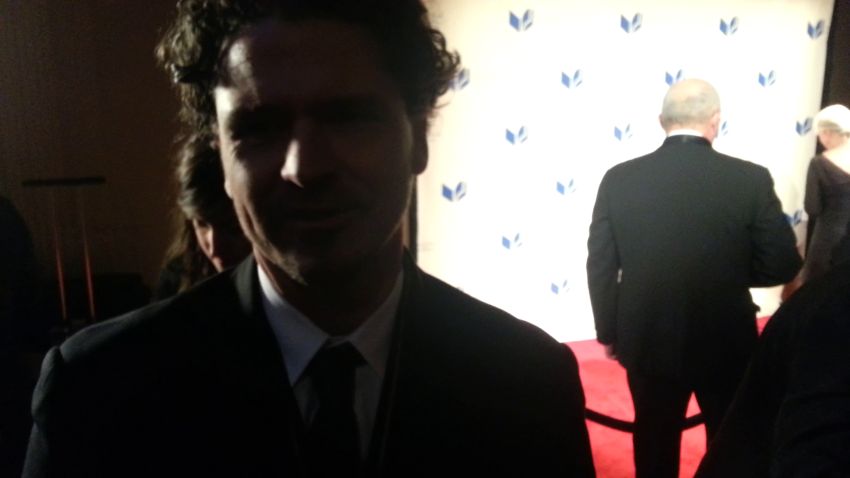
On Wednesday night, we decided to question Dave Eggers at the National Book Awards in person, where he was being feted as a finalist for his latest novel, A Hologram for the King, hoping that Eggers would break his silence and provide us with a clear-eyed statement on these serious mistakes and moral indiscretions.

But Eggers ran away at the name of “Abdulrahman Zeitoun.” The video can be seen below:

Eggers’s silence (along with that of mainstream literary outlets) is baffling. Even Norman Mailer famously declared during the Jack Abbott affair that culture is worth a little risk. If Eggers is interested in culture, should he not come to terms with his mistakes? Should he not own up to the negative impact that his book and his involvement may have had on the Zeitouns’ lives?

John Simerman’s helpful dispatches in the New Orleans Times-Picayune illustrate why staying silent or taking the rose-tinted path is a blatant and irresponsible disregard for the truth. On October 18th, Kathy Zeitoun testified in court about the abuses:

He starts beating me in the back with this tire iron. He lets go of the tire iron and starts punching me, then he started ripping the flesh from my side through my clothes.

and

He was choking me so hard I felt the pressure in my face. I thought I was going to pass out. He grabbed my face and dug his claws, his fingernails, in my face.

This is a far cry from Eggers’s glowing depiction of Abdulrahman as a tranquil hero. Eggers describes how “Zeitoun felt at peace,” with “an odd calm in his heart.” Abdulrahman’s origins as a thirteen-year-old fisherman involves a concern for quietude, where his compatriots “would whisper over the sea, telling jokes and talking about women and girls as they watched the fish rise and spin beneath them. Eggers even describes Abdulrahman telling Kathy, “Please be calm. Don’t make it worse,” while approaching a bus station.

It was Kathy’s testimony which led to Abdulrahman Zeitoun’s indictment for attempted first-degree murder and solicitation for first-degree murder during the late afternoon of November 8th. Abdulrahman has remained in jail, with the bail set at more than $1 million. A gag order has prevented Kathy and Abdulrahman’s attorney, J.C. Lawrence, from saying anything beyond their remarks in the courtroom. Eggers is certainly in a position to say something and emerge from this contretemps with some integrity, yet he wishes to pretend as if nothing terrible has gone on. At least that’s what we see on the surface. Under the seams, it’s a much different story.

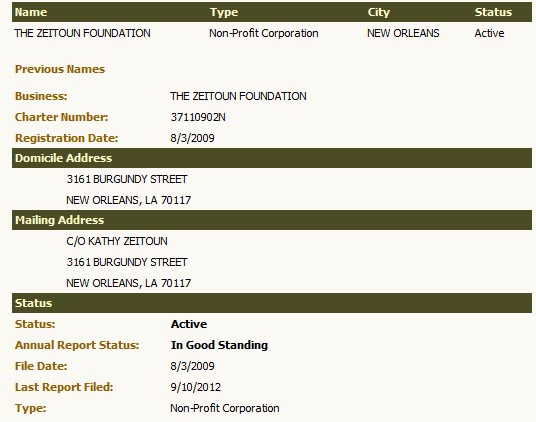
Back in August, we reported on how The Zeitoun Foundation was not being transparent about the way it disseminated funds. While The Zeitoun Foundation is now listed as “in good standing” with the Louisiana Secretary of State (as of September 10, 2012, which is when the last annual report was filed), our search through several nonprofit public databases have not unearthed any new 990s. Furthermore, there isn’t any new information about Jableh, LLC. As we noted in August, Jableh was incorporated on July 16, 2009. It listed Dave Eggers as the registered agent. The 2009 990 for The Zeitoun Foundation declared that $161,331 was due to Jableh, LLC, which exceeded the $145,476 in revenue taken in by The Zeitoun Foundation for that year ($84,044 in royalty income from the book, $50,000 in film rights, and $11,432 in “contributions, gifts, grants, and similar amounts received”). According to Eggers’s book, Jableh is where Abdulrahman Zeitoun was born and lived for a while.

In our efforts to answer these questions, Michelle Quint, the accountable director for Zeitoun, refused to return our phone calls or emails, nor did anybody at McSweeney’s. Eggers had initially released a statement with Jonathan Demme that he and the filmmaker had been “in daily contact with Kathy since the incident on July 25,” but it has since been deleted.

We also received this threatening email from attorney David J. Arrick on August 17, 2012:

Dear Mr. Champion:

The attorneys and accountants who initially set up and continually consult with the Zeitoun Foundation have been made aware of your website.

They would like to clarify that there are two components to The Zeitoun Foundation’s charitable purpose: (1) to aid in the rebuilding and social advancement of New Orleans and (2) to promote understanding between people of disparate faiths around the world, with a concentration on relations between the United States of America and the Muslim world. Therefore, not all of the organizations receiving grants from the Zeitoun Foundation are dedicated to Katrina relief projects.

They would further like to clarify that the Zeitoun Foundation does no active fundraising. The Foundation was created to disburse proceeds from the book, Zeitoun, and to bring attention to the exemplary nonprofits to which it awards grants. To date, outside donations have accounted for less than 10% of all monies disbursed by the Foundation. All other funds have come from proceeds from the book.

While it is believed that The Zeitoun Foundation has been as transparent in its operations as comparable non-profit organizations, it does intend to update the Zeitoun Foundation website in the near future, and will also update all filings deemed necessary and appropriate. The website will provide more detailed information about the grant recipients. The grant recipients are outstanding organizations and the website will share more details about the great work that they’re doing.

Sincerely,

David J Arrick
David J. Arrick, Partner
Boas & Boas LLP
101 Montgomery Street, Suite 1250
San Francisco, CA 94104
Telephone: 415-956-4444
Fax: 415-956-2158
E-mail: darrick@boascpas.com
Website: www.boascpas.com

As of November 14th, the Zeitoun Foundation website has not been updated. Nobody is talking. In two corners of the world, there are more important events going on. A man faces charges of attempted first-degree murder, with his wife still frightened for her life. Another man awaits news over whether he’ll win a prestigious book award, but he has nothing to say about the troubled couple who helped him at a pivotal stage in his career. Without them, he may not have made it inside this swank Wall Street ballroom.

11/18/2012 UPDATE: The Times-Picayune‘s John Simerman reported on November 16th that Eggers and McSweeney’s representatives have refused to answer the newspaper’s questions about Zeitoun.