The Best Fiction of 2012

There are eight million year-end lists in the naked city. Why the hell do we need another one? Well, I made every effort to keep my trap shut on this dog and pony show for many weeks, figuring that fine minds and excitable souls would ensure that the right butterflies landed in the net. But a number of novels that challenged me, knocked me in the gut, or opened my eyes to the world in new ways have been left behind by tepid tastemakers who wouldn’t know the glorious rush of literature if the late great Harry Crews ran at them with a rifle and a pack of wild dogs. So I feel it my duty as a book lover to weigh in. I read nearly two hundred books in 2012. By a stroke of good fortune, I was able to interview every author who made this list. If you would like to hear these authors in conversation, feel free to click on the links. In the meantime, let’s rock and roll.

megana1Megan Abbott, Dare Me: Before The Millions devolved into an unreadable circlejerk for risk-averse snobs, I tried to impart to these mooks why Megan Abbott was the real deal, pointing out how Abbott’s sentences employed a chewy and often operatic rhythm that was often the only way to deal with the dark edges of existence. But Abbott’s latest novel about cheerleading pushes her distinct voice further with a rich collection of wildly inventive verbs (“Everybody whoops and woohoos, jumping on the bleachers, grabbing each other around the necks like the ballers do”) that will make you wonder how you missed so much beyond the football games. She writes defiantly against the ironic or the ideal cheerleader, but her astute and enthralling observations about teens pushing themselves to their physical limits, often without parents and often with deadly adults entering their lives, left me pondering why nobody went there quite like this before. I’m very glad that Abbott is still on the case. (Bat Segundo interview with Abbott, August 2012)

Paula Bomer, 9 Months: Ayelet Waldman may have kickstarted the conversation about bad mothers a few years ago, but Bomer actually has the courage to chase maternal judgment through the pain and hilarity of its truths rather than attention-seeking pronouncements. 9 Months follows Sonia, a pregnant mother who boldly leaves her husband and even goes so far to have carnal relations with a Colin Farrell-like trucker. You could call 9 Months a Gaitskillian picaresque tale, but this doesn’t do justice to Bomer’s fierce and funny insights into how motherhood’s perceptions change from region to region, how judgment has a way of stifling a pregnant woman’s career track, and the casual cruelty of solipsistic singles who can’t understand these finer distinctions. (Bat Segundo interview with Bomer, August 2012)

cchung1Catherine Chung, Forgotten Country: This devastating and deeply visceral debut about a South Korean family fleeing to the Midwest has so many rich observations about identity, figurative ghosts, reflections you can’t escape in the existential mirror, and the pros and cons of family unity that it’s difficult to convey just how good it is. Roxane Gay suggested that the manner in which the narrator’s sister Hannah removes herself from her family “takes your breath away while it breaks your heart.” But this novel somehow manages to capture joy during these emotional moments, even while confronting cruelty, racist masks, and premonitory violence. Chung’s characters are real because we come to feel their explicit and implicit pain, the type of qualities found in nearly every family. I’m baffled by how this wonderful novel was so overlooked. (Bat Segundo interview with Chung, March 2012)

chipdelanySamuel R. Delany, Through the Valley of the Nest of Spiders: It’s easy to understand why so many timid souls couldn’t make their way through this bold, long, and ambitious book. The book bombards the reader with so much sex, sex, and more sex that the reader is forced to come to grips with this as a way of life, even if the reader doesn’t share the desire for cock cheese or coprophagia. Yet it’s a profound mistake to dismiss a book, as one vanilla urchin did, because you lack the courage to push beyond your comfort zone. Delany’s opus may seem to be a repetitive depiction of a couple fucking, but the patient and careful reader will discover a surprisingly moving book about growing older, how underground subcultures are increasingly ignored, and how history is not so much about one person’s overnight success but sum of brave gestures from strangers. (Bat Segundo interview with Delany, May 2012)

A.M. Homes, May We Be Forgiven: Years ago, when American novels were still permitted to capture everything, books like The Adventures of Augie March were conversational centerpieces that captured the imagination of popular and literary audiences alike. Yet in recent years, literature has shifted to the twee and superficial. We apparently need our books to bray loud with sheepish sentiments, such as this dreadful sample from Dave Eggers’s A Hologram from the King:

His decisions had been short sighted.
The decisions of his peers had been short sighted.
These decisions had been foolish and expedient.

When prose this unintentionally hilarious is allowed to rise to the top, it’s enough to make you wonder how the deck is stacked against the voices that really count. Especially when the rare book like A.M. Homes’s May We Be Forgiven comes along, demanding something more than unpardonable pablum. Homes was the truly ambitious American novelist this year. Her sixth novel dared to map the surrealistic nature of life with great humor and inventiveness: two paramount qualities missing from that doddering dope in San Francisco. Here’s what happens in the first few pages of the book: kitchen seduction, a bizarre murder, divorce, a man thrust into the role of surrogate parent. You read this book asking yourself how Homes can ever find a narrative trajectory for Harry Silver, whose scholarly devotion to Nixon suggests a Godwin-friendly update to Don DeLillo’s Jack Gladney. Somehow, despite Internet sex and bar mitzvahs in South Africa, May We Be Forgiven becomes a hopeful book about accepting the family and friends who come to you. It features amusing cameos from real-life figures like Lynne Tillman, Julie Nixon Eisenhower, and David Remnick. And it acknowledges its debt to Bellow with the wryly named firm of Herzog, Henderson, and March. (Bat Segundo interview with Homes, September 2012)

harikunzru2Hari Kunzru, Gods Without Men: With all due respect to Douglas Coupland, the Translit label is dodgier than New Adult. Coupland was right to celebrate Kunzru’s smart and spiritual novel for its ability to span history and geography “without changing psychic place.” But when you’re using Hollywood terms like “tentpole” to reinforce your label, there’s a good chance you’re blowing a bit of smoke up the Gray Lady’s ass to get a little attention. Still, none of this should steer readers away from this fine novel. Gods Without Men contains everything from a hilariously inept rock star to a predatory linguist whose efforts to collect Native American stories belie a sad privilege. How much of the world’s difficulties can be chalked up to abandoning one’s wonder and humility at a cross-cultural nexus point? Kunzru, to his credit, avoids a schematic answer to this question. We see how secular faith turns disastrous and back again, with an Ashtar Galactic Command acolyte transformed into a victim. Jaz and Lisa Matharu, a couple recovering from the 2008 recession and trying to contend with their missing son, form a triangulation point of sorts. It’s the reader’s duty to discover more blanks. (Two part Bat Segundo interview with Kunzru, March 2012: Part One, Part Two)

laural2Laura Lippman, And When She Was Good: “If you have to stop to consider the lie,” says protagonist Heloise Lewis, “the opportunity has passed.” With eleven Tess Mongaghan novels and seven stand-alones, it’s become all too easy to take Laura Lippman’s work for granted. But Lippman’s latest novel, which is also something of a sly riff on Philip Roth’s 1967 novel, is one of her best: an astutely observed tale of a deeply complicated and endlessly fascinating woman. By day, Heloise Lewis is a single mother who reads classic literature. But she also runs a high-end escort service. The book’s alternating chapters headlined with dates reveal Heloise in the present day and Helen, the struggling young woman who transforms into Heloise, is captured in the past. But it becomes swiftly apparent that the present informs the past, rather than the other way around. Heloise believes she is in control. She’s thought out her business and her demeanor, but we come to wonder how she allows so many people, ranging from the imprisoned Val to a prostitute who works for her, to take advantage of her. This is a very thoughtful book about the follies of trying to know or outthink everything, which applies to all quarters. Lippman also gets bonus points for including one of the most creative paper shredding contraptions I’ve ever seen in fiction. (Bat Segundo interview with Lippman, August 2012)
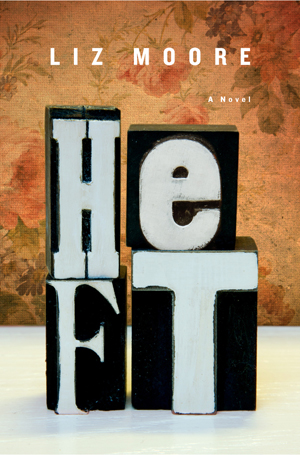
lizmooreheftLiz Moore, Heft: Last year, a research team at the University of Buffalo conducted a study with 140 undergraduates which suggested that fiction causes readers to feel more empathy towards others. Empathy seems to be getting a bad rap in fiction these days, especially among some enfants terribles who seem to believe that novels are more about slick heartless style rather than human existence. On the flip side, you have the gushing New Sincerity movement, in which people are interested in mashing irony and sincerity into a roseate sandwich. These strange tonal prohibitions on what one should or should not do in a novel drive me up the wall. If you’re spending so much of your time second-guessing how you should write, then how can ever achieve any original viewpoint? So it was with great joy and relief to discover Liz Moore’s wonderfully endearing novel early in the year about Arthur Opp, a 550 pound man who has not left his Greenwood Heights home in more than a decade and a teenager from a troubled upbringing. Heft proves, first and foremost, that caring about people has little to do with falling along an irony/sincerity axis. Moore told Jennifer Weiner that writing about Arthur let her “write sentences I would have felt self-conscious about writing.” And it (Bat Segundo interview with Moore, February 2012)
jesswalter3Jess Walter, Beautiful Ruins: “But aren’t all great quests folly? El Dorado and the Fountain of Youth and the search for intelligent life in the cosmos –- we know what’s out there. It’s what isn’t that truly compels us.” As America slogs its way out of a recession, it was a great relief to read a book hitting romance from so many angles. Walter understands that true quests aren’t necessarily measured in time and distance, but in hope. Beyond Walter’s funny descriptive details (“table-leg sideburns,” “the big lamb-shank hand of Pelle”) which mimic the larger-than-life hyphenated banter found in a Hollywood script, Walter is so good on the page that he allows a film producer to seduce us through a cliche-ridden memoir containing such dimebag philosophy as “We want what we want.” (Bat Segundo interview with Walter, July 2012)

Chris Ware, Building Stories: The box contains no instructions. The pieces range in size and can be read in any order. The characters have no names. The illustrations are beautiful. The form is paper, but that doesn’t stop Ware from reflecting on where digital technology is taking us, both in stark and in speculative terms. There is pain and pleasure and cycles and secret history. There is loneliness and togetherness. My partner and I spent an entire Saturday sifting through this box. We felt compelled to talk more about life. As the pieces were carefully unpacked, we began to treat the comics with an unanticipated reverence, even though there was no way we would never fully know the people that Ware had rendered. Building Stories is the rare prayer that grabs the lapels of the secular. It is your duty to give a damn. It is your duty to feel. (Bat Segundo interview with Ware, November 2012)

Honorable Mention:

Jami Attenberg, The Middlesteins
Brian Evenson, Immobility
Richard Ford, Canada
Nick Harkaway, Angelmaker
Katie Kitamura, Gone to the Forest
J. Robert Lennon, Familiar
Stewart O’Nan, The Odds
Nick Tosches, Me and the Devil
Karolina Waclawiak, How to Get Into the Twin Palms
Adam Wilson, Flatscreen
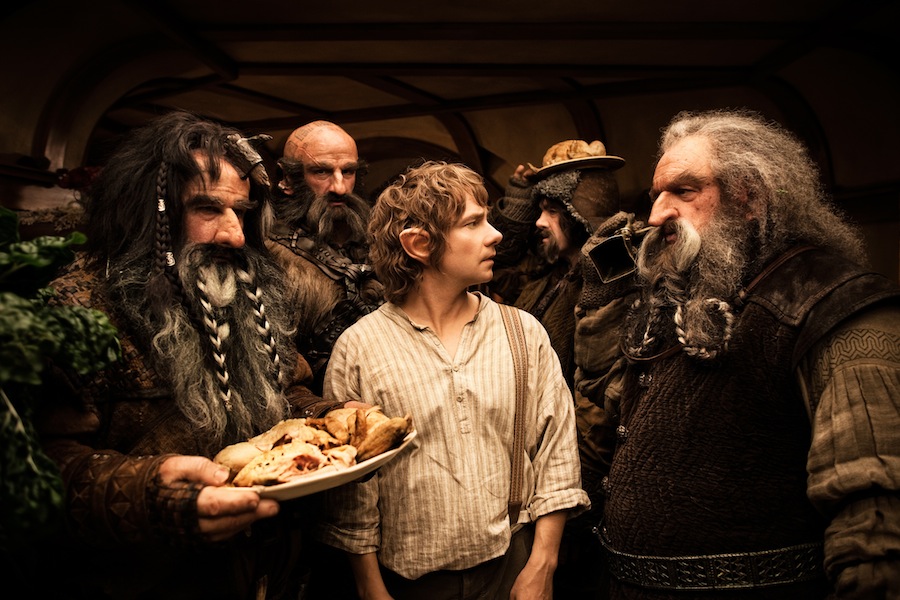

Review: The Hobbit: An Unexpected Journey (2012)

Imagine a pop-up book mating with a crisp high-def image. Throw in occasional jerky motion resembling undercranked Mack Sennett moments when actors move too much, overly defined planes along the Z axis suggesting a View-Master brightened by the heat of a thousand suns, noses and ears sometimes revealed to be pellucidly prosthetic, and overhead shots of landscapes looking more like a cut scene crunched through an overclocked Nvidia card five years from now. To my eyes, this was what 48 frames per second looked like on a fifty-foot screen. I had heard reports that one was “supposed to get used to this” after a period lasting somewhere between five and twenty minutes. Unlike other 3D films, I did not get a headache. On the flip side, I couldn’t believe in the aesthetic.

But then The Hobbit: An Unexpected Journey is “fantasy” — not the thoughtful form from the adept hands of Michael Moorcock or Mervyn Peake or Kelly Link, but the inoffensive offerings from J.R.R. Tolkien. I don’t necessarily have a problem with a fantasy which opts to swim in the shallow end of the pool. The covenant is that, if the fantasy short-changes on human scope and capitulates to escapism, then the fantasy must inspire new awe and fresh wonder.

We come into The Hobbit familiar with the Shire’s round doors and verdant pleasures from years before. We have seen Middle Earth’s eco-porn greens and Rivendell’s gables and gazebos. So why exactly should we return to the theater and hand over our hard-earned shekels if it’s more of the same? Are we here for nostalgic purposes? Do filmmaker and audience alike prefer stagnation? I didn’t mind being there and back again, but the too clean 48fps technology had the strange effect of cheapening my middling affinity for Middle Earth. Like George Lucas before him, Peter Jackson has returned to the beginning, motivated by technological tinkering and the considerable dollars he will collect from feverish and unquestioning fanboys rather than any real need to spin a good yarn. At least there is nothing here as terrible as Jar Jar Binks.

For long stretches, this first film in Peter Jackson’s new Tolkien trilogy failed to seduce. This is largely because its source material only has enough material for two films. By my calculation, it takes Jackson 168 minutes to dramatize about 82 pages of material, which seems needlessly profligate. The Hobbit is many things, but it is neither Ulysses nor Gravity’s Rainbow. There is no doubt in my mind that we will see an extended version and supplements on DVD ensuring that nobody leaves the house for the next ten years.

The film opens with a lengthy flashback distressingly close to the confusing monologue which opened David Lynch’s ill-received Dune adaptation. But why? “In a hole in the ground there lived a hobbit” is a straightforward first sentence requiring no additional mythology. But Jackson and his writers (which include Guillermo del Toro, who was originally supposed to helm this movie) feel compelled to throw in any stray flashbacks that they can to pad out this movie. I don’t wish to diminish the need for dwarf kingdoms, but there’s nothing in the film’s first hour even as remotely alluring as the Nazgûl, which provided The Fellowship of the Ring with an immediate threat to jump-start the narrative and set our heroes on an adventurous path.

Without something as big as Mordor threatening to engulf Middle Earth driving the story, Jackson’s métier as a Wagnerian filmmaker is undone by a cinematic experience that feels more like a game on rails, especially during a climactic goblin chase scene with a constantly moving godlike camera, but a paucity of closeups or medium shots. It also doesn’t help that Martin Freeman, cast as the younger Bilbo Baggins, really should have been hired ten years earlier. Having grown from the young and neurotic comic archetype into a more subdued and interesting middle-aged actor (best exemplified by his portrayal of Watson in Steven Moffatt’s Sherlock), Freeman is curiously unpersuasive in this film when he complains about wanting to be back home among his books and fellow hobbits. Ian McKellen is okay as Gandalf, but one longs for the gravelly gravitas he displayed so eminently in the last trilogy. However, I very much enjoyed Ken Stott’s fresh and feisty portrayal of Balin. But I do have a weak spot for any character with a massive bushy beard.

This lack of focus causes the first half to feel like a tenuous string of loosely connected sequences: dwarves show up at Bilbo Baggins’s hobbit hole, on Dori, on Nori, on Gloin, on Oin, on Blitzen, orcs, wargs, is Bilbo up for the journey, knowing look from Gandalf, walking, walking, orcs, hidden swords, is Bilbo up for the journey, complaints from Thorin, elves, orcs, knowing look from Gandalf, mention of arcane Middle Earth reference to appease fanboys, orcs, orcs, is Bilbo up for the journey.

You get the idea. But when the mountain trolls show up halfway into the movie, An Unexpected Journey starts to become fun for those, like me, who were fatigued by the bloodless and cutesy bullshit calculated to make this Fun for the Whole Family™. These trolls are lumbering, mumbling, ass-scratching giants who hock loogies into pots loaded with the carcasses of dwarves and elves. In other words, they’re a nice throwback to the visceral films Jackson made early in his career before going Hollywood, serving as a reminder that Jackson is at his best when he lets his inner six-year-old come out. Casting Sylvester McCoy as Radagast the Brown is also a brilliant move, for McCoy taps both his Roadshow days and the dark command he brought to his brown-coated Doctor Who incarnation to enliven the eccentric wizard who plows through terrain with a rabbit sleigh. It is also hard to go wrong with good ol’ Gollum, arguably the most enthralling CGI villain of the past fifteen years, during the highly compelling game of riddles sequence. Why hasn’t anybody created a Ball-Arnaz inspired sitcom called I Love Precious?

But An Unexpected Journey is felled by its zestless commitment to the well-trodden path. Make no mistake: this is not Pan’s Labyrinth, Labyrinth, Cocteau’s Beauty and the Beast, The Wizard of Oz, Princess Mononoke or The Princess Bride. Did we really need subtitles when the orcs don’t say anything especially interesting? Do we really need narrative digressions when the meat on the bones is so sparse? There are a few inspired ideas, such as the aforementioned trolls and a goblin stenographer traversing along a pulley cable on a chair. But if you spend years of your life working on a fantasy trilogy, shouldn’t it contain more imagination? Shouldn’t you wait as long as it takes to read the secret moon runes embedded in the map?

The Bedbug Bunk: How the New York Times Used Fear and Misinformation to Spread Public Library Hysteria

On Wednesday afternoon, the New York Times published a story written by Catherine Saint Louis claiming that public libraries were now devoting precious resources to a new threat: bedbugs nesting inside the spines of hardcover books and making their way into public libraries like Norway rats stowing away on dusty ships.

The piece, which drew understandable horror on Twitter on Thursday morning, was the seventh most emailed New York Times story by Thursday afternoon.

But Reluctant Habits has talked with many of Saint Louis’s sources and has learned that the Times article is misleading. Bedbugs are not the major threat that Saint Louis suggests they are. In fact, some of the library directors who Saint Louis spoke with have never had a bedbug epidemic at all. They were merely taking preventive measures in the wake of recent media stories.

“We actually never had an infestation,” said Mary Schubart by telephone on Wednesday evening. Schubart, the library director of the Islip Public Library, was described in the article as taking action against bedbugs “after reading about their alarming resurgence.” But the “resurgence” that Schubart was referring to was the national panic. Schubart told me that the only books believed to have bedbugs under her watch didn’t come from her library, but through interlibrary loan. If bedbugs weren’t a severe problem for Islip’s libraries, why then did Schubart react with such an over-the-top measure?

“I saw the media going crazy a year or two ago,” said Schubart, who also cited a “personal abhorrence to little legs” as one of the reasons she started buying pestilence-resistant furniture for her branches. Schubart wanted to appease an antsy staff and keep her regulars appreciative. The “quarterly” visits made by the bedbug-sniffing dogs cited in the Times article were initially “monthly.”

While Schubart doesn’t regret her vigilance, she does have small worries about how Saint Louis’s reportorial approach could result in a needless panic. “I think that the article could create some hype that isn’t necessarily called for.”

Cynthia Berner Harris, the Director of Libraries for the Wichita Public Library system, also confirmed with me on Thursday that she had bagged books “as a purely precautionary measure” after confirming bugs in a seating area. The bugs were not in the books. She said that she has had only two previous instances “where library consumers forewarned us that materials on loan to them had become infested with bedbugs.” But because of Wichita’s better-safe-than-sorry safeguards, which includes staff training and close attention to the types of chairs purchased, the bedbug situation is under control.

“Let’s not get crazed,” said Sue Feir on Thursday morning. “We were proactive.” Feir, library director at Hastings-on-Hudson, New York, was also singled out in the Times piece as someone taking a bedbug problem into her own hands and for “sending an email blast.” But she told me that none of the library materials had been affected. Only the corner of one bookshelf had a problem.

“The area most cited for furniture/bedbugs,” said Feir, “is an area of the library where people often sit, but do not handle books. Multiple chairs may have become problematic because they are moved around.”

Feir said she had never had a problem with bedbugs before, but she did suspect that institutions don’t talk about bedbugs due to embarrassment. “It is hardly a subject people bring up over coffee.”

* * *

“She called me at least three times,” said Michael Potter by telephone on Thursday morning. Potter, a professor of entomology at the University of Kentucky in Lexington, told me that he had spent three hours on the phone with Saint Louis patiently discussing the issue. “I really tried to emphasize that, while libraries should be vigilant, we must also have a dose of caution about all this.”

Yet despite the considerable minutes that Potter racked up in explicative overtime with the Times, Saint Louis opted to use only one sentence: “There’s no question in past few years there are more and more reports of bedbugs showing up in libraries.” This served in sharp contrast to a 2010 appearance Potter made on Fresh Air, where interviewer Terry Gross allowed Potter to explain late in the segment that while bedbugs remained a problem, the risk was quite low.

“I guess I get troubled when you spend an inordinate amount of time and hope that it will be an educational tool for the public. Instead, it turns out that you whip people in a frenzy.”

When I asked Potter if he had any hard stats about how likely it was to contract bedbugs from the library, he informed me, with a twinge of exasperation in his voice, that the chances were extremely slim. Worrying about bedbugs in a public library was akin to being afraid to leave the house because you might get struck by lightning.

“The odds of you picking up a bedbug from a book in a library are so low that it’s not even worth talking about,” said Potter.

So what were the reports that Potter had been referring to? It turns out that in 2011, Potter had co-authored a survey with Kenneth F. Haynes, Bob Rosenberg, and Missy Henriksen called “2011 Bugs Without Borders.” (Professor Potter has graciously allowed Reluctant Habits to recirculate the survey. The full PDF can be downloaded here.)

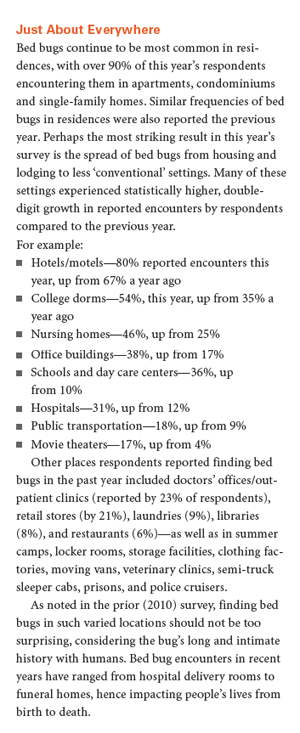
The survey reveals that while, on the whole, bedbug incidents have increased, the threat within libraries is well behind hotels, motels, college dorms, nursing homes, office buildings, public transportation, and movie theaters.

“I mean, these kinds of articles need to provide some balance in terms of this problem because we’re developing a paranoia for some people who hear these sound bytes.”

“All of the hallmarks of an epidemic can be found when there’s no disease,” said Philip Alcabes, Director of the Public Health Program at Adelphi’s Center for Health Innovation. Alcabes suggested to me that the bedbug panic corroborates with some of the concerns he expressed in his book, Dread: How Fear and Fantasy Have Fueled Epidemics.

“Bedbugs cause itching, of course, but they don’t spread any systemic illness and nobody dies from them. The key is that the problem seems to be spreading and that it stands in for — and reflects back to us — our social anxieties, our worries that the culture has somehow gone too far.”

So why would the New York Times feed reader anxieties rather than serve up the facts?

I made efforts to contact both Saint Louis and New York Times public editor Margaret Sullivan on Thursday afternoon, but neither returned my request for comment. I did, however, receive an email from Joseph Burgess, claiming that “the public editor can’t speak on behalf of The Times‘s policies.”

In the meantime, the Times article continues to make the rounds. Is there any hope for a rational consideration of the bedbug problem?

“People can’t be expected to be perfectly reasonable all the time,” said Alcabes. “In an era without witches or angels or signs in the sky, the epidemic offers a context in which some irrational behavior becomes acceptable. Which isn’t a bad deal, in some ways.”

12/7 UPDATE: Brooke Borel, author of the forthcoming book Suck: The Tale of the Bed Bug, has also responded to Saint Louis’s article. She points out that Saint Young is outright wrong in declaring that bedbugs have only just “discovered a new way to hitchhike” through books. “This is an ancient pest, and it has been doing its thing for at least thousands of years. Probably far, far longer.” She also reiterates what entomologists have been telling me over the past two days. The risk is low. “You aren’t very likely to pick up bed bugs in these types of public spaces. The bugs are far more highly concentrated in residences, where they can breed and multiply in close proximity to their food source.”

12/17 UPDATE: A commenter named Joe alerted me to this article, in which CBC News claims that bedbugs are infesting multiple branches of the Vancouver Public Library. The story is suspicious, because it relies upon the hearsay of library patron Gail Meredith conveying to the reporter that “the pest control people came to the conclusion that the only thing that was going on in my life that was likely to bring them in is my library books.” But the story doesn’t confirm this fact with the pest control people, nor does it attempt to corroborate this incident with the VPL. On Monday morning, I spoke with VPL spokesman Stephen Barrington by phone just before he was about to hit a Monday morning meeting. He said that he didn’t have his notes in front of him to spell out the details of the bedbug incidents alleged by CBC News, but that he would try to get back to me later in the afternoon to give me details. I will report any additional details I learn from Mr. Barrington.

12/21 UPDATE: There have been a number of stories circulating in Canadian news outlets about bedbugs in public libraries (including the above-referenced CBC News story). We’ve looked into these claims in a second investigative piece on Vancouver Public Library and Toronto Public Library.

Spreecast “Mistakenly Deletes” Countless Videos from Users

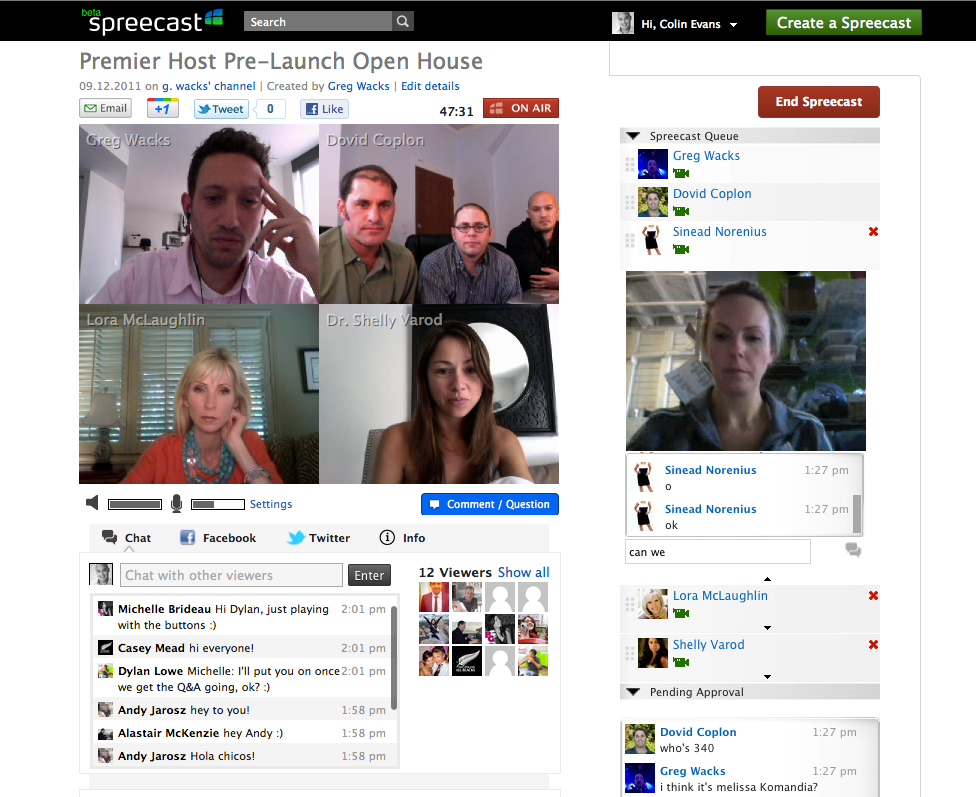
Spreecast was supposed to be the perfect social video platform. Launched as a public beta in November 10, 2011, it did not care if you signed in through Facebook or Twitter. It had raised $4 million in seed money from the likes of Viacom’s former CEO Frank Biondi and The Capital Research Group’s Gordon Crawford. In September, it found $7 million more. Young alternative poets and romantic entrepreneurs saw Spreecast making hard waves in the vast online ocean of multiuser possibilities. With the man who sold Stubhub to eBay for $310 million at the helm, what could go wrong? The videos you made would always be there. They’d have to be, wouldn’t they?

But this week, an untold number of content creators discovered that most of their videos had disappeared. They had toiled long hours to prepare for their shows. They had made new friends. And now every trace of those bright burning months had dried up in the heat of negligence.

“I think I was one of the first people to find out,” said Logistic Viewpoints‘s Adrian Gonzalez. “I submitted a customer service ticket Tuesday morning when I noticed that my video wasn’t accessible.”

On Wednesday night, Spreecast sent a mass email to some of its users:

This is Jeff Fluhr, CEO of Spreecast. I am deeply sorry to deliver this news. Recently, Spreecast made an internal error and your video files were mistakenly deleted. You will not be able to play your spreecasts created before Thursday, November 22, 2012.

Through one remarkable act of technical incompetence, Spreecast permanently destroyed countless videos from its users. It was an accident not altogether different from Caesar’s infamous stratagem against Achillas.

Historical precedent aside, why would a company with $7 million in Series A Funding not have basic data security measures in place from the beginning? While Fluhr told his users that “we have taken steps to ensure that this never happens again,” including correcting Amazon server settings and improving disaster recovery plans, he hasn’t said anything about how or why such a rookie mistake could go down on his seemingly experienced watch. Maybe the the truth is too embarrassing.

I left multiple voicemails with Fluhr and Spreecast representatives. None of them were returned. However, a public relations assistant named Nicole Brunet wrote back. “Yes,” she said, “an error was made and some video files were accidentally deleted. We thought we had backups, but it was not working properly. This is a very unfortunate situation and we are truly sorry. We have taken steps to ensure that this doesn’t happen in the future.”

But why wasn’t the backup system tested? How could a highly fallible system remain running for so long? Why wasn’t there a way for users to download their videos?

Brunet did not return my calls or followup emails.

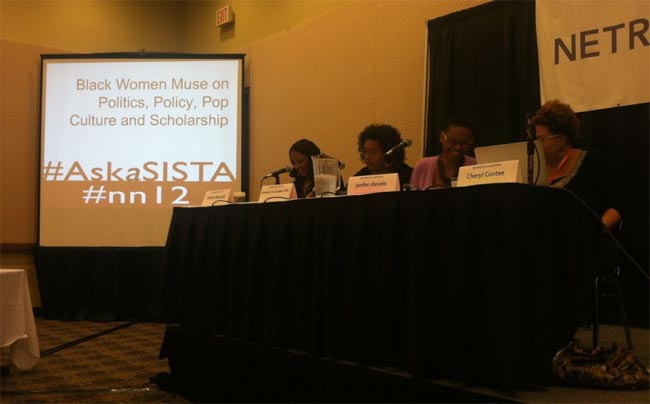
Earlier in the year, Spreecast was quite eager to talk with people and get them to use their service. I spoke by telephone with Jenifer Daniels, a communications strategist based in Charlotte, North Carolina. She had been courted by Spreecast reps at a conference. Daniels was looking for a way to get together with people more frequently than twice a year. Three to four weeks after her meeting with Spreecast, Daniels started Ask a Sista, a Spreecast which gave African-American women an opportunity to discuss politics, pop culture, and scholarship.

“In some weird way, we were both upstarts,” said Daniels. “We both knew that we were taking a chance.”

Still, Daniels believes that the Spreecast boosters were sincere. The idea was to take Ask a Sista to a bigger platform. Yet because there were so many producers on the show, she had not received Fluhr’s automated message.

“I was trying to explain this to my husband,” said Daniels. “How would you feel if you showed up to work and the last four years that you’ve been there had been erased?”

Daniels says that the decision to place her faith in Spreecast was made more on emotion. But the intent was always to take her efforts to a bigger platform.

For Stephen McDowell and Josh Spillker, proprietors of I Am Alt Lit, Spreecast represented an opportunity to have fun and mimic the success of a friend. McDowell and Spillker used the service to host the literary interview show, I Am Alt Lit Confidential. But on Thursday morning, the duo posted Fluhr’s notice on their supplemental Tumblr, I Am Not Alt Lit, along with the following sentiments:

there’s some type of feeling in my body right now, mebbe like a ‘sinking’ feeling ???

those were ‘good’ times

remember when noah ‘cancelled’ the spreecastx and ‘typed’ everything ???

remember when we had that ‘non-rapper’ on ???

remember when you found out who I AM ALT LIT ‘rlly’ was and then immediately didn’t ‘care’ anymore ???

“When I initially thought of a live, video interview series,” wrote Spilker by email, “I had thought about recording a Google hangout or a Skype conversation, and then uploading the file to YouTube. But the interactive part was key to the community. It does seem more difficult to share Spreecast videos than YouTube, but I just thought that would be part of the growing company.”

“A friend of mine named Steve Roggenbuck, who’s a poet and has kind of gained a lot of underground literary clout, started doing a Spreecast,” said McDowell by telephone on Thursday afternoon. “Illuminanti Power Hour. It was regular, a large amount of hits.” (Roggenbuck did not return our requests for comment through email and Facebook.) [SEE 11/30 UPDATE BELOW.]

“It seemed like a natural place,” said Spilker, who pointed to other literary readings and groups on Spreecast such as Daniel Alexander’s efforts. “The only other service I was familiar with was Ustream, but I had not used it extensively. I guess we should have explored a couple of other services as well.”

“I don’t know who specifically is responsible,” said McDowell. “Generally I don’t put a lot of emotional energy into expecting things that happen on the Internet to be retained for long.”

But even before this week’s disaster, McDowell did consider the need to backup his shows sometime around early November, just before his program took a brief hiatus. He made efforts to download the raw files directly through Spreecast, but there was no clear button or link available. He figured that at some point his work could be downloaded, but soon began to realize that this was impossible.

“I just have a Flash file downloading app on my browser,” said McDowell. “I was checking to see if that worked.” While the app allowed McDowell to download YouTube and Hulu videos, Spreecast had erected an intermediary interface which didn’t provide access to the Flash files on its site. Yet while McDowell says he doesn’t “feel any immediate disdain or antipathy” towards Spreecast, figuring that any emerging streaming startup is likely to go through a few scrapes, he does feel “a mild sense of loss because I did enjoy doing the shows.”

But as of late Thursday afternoon, Spreecast still hasn’t explained in detail what went wrong.

“Spreecast needs to disclose more information about what happened,” said Gonzalez, “because considering the background and experience of the team there, I find it impossible to believe.”

“It is horrific,” says a filmmaker who asked to stay anonymous. “I am completely shattered about it. My audience can never go back and watch those sessions ever again.” This filmmaker’s videos were not backed up. During a phone call with Spreecast, a representative told her that they were working on a backup feature, but that it would only be available to premium (that is, paying) customers. “Mistakes happen, but I have no clue how something of this catastrophic level can occur.”

And while Daniels says that she’s not upset enough to threaten a lawsuit, she did tell me that she’s inflexible on at least one point.

“I’ll never do a show on there again.”

11/30 7:00 AM UPDATE: This story previously reported that Roggenbuck “declined to comment” about Spreecast, because one of our sources informed us that he wasn’t sure if Roggenbuck was interested in commenting. We should have written “did not return our requests for comment” and apologize for creating that impression. As it turns out, Roggenbuck did contact us on Thursday night through Facebook, telling us that he had been in touch with a man named Greg Wacks at Spreecast. Wacks claimed to Roggenbuck that one of the engineers screwed up a line of code and that many of the Spreecast archives were deleted and that there are “changes to make sure this doesn’t happen again.” Roggenbuck elaborated on his enthusiasm for Spreecast: “i know their intentions are the best and really i love their product for 95% of things, so im willing to roll with the bugs. they are doing awesome stiff i havent seen from any similar service.” I will make efforts to get in touch with Wacks to corroborate this story.

11/30 9:45 AM UPDATE: Greg Wacks contacted me by email on Friday morning. He directed me back to Spreecast’s Nicole Brunet, who, of course, has failed to answer any of my questions in depth. Wacks has not yet corroborated his telephone call with Roggenbuck. He has also not yet offered any clarity on the issue of Spreecast engineers screwing up a line of code, along with the lingering question of how a multimillion dollar company did not have greater safeguards for its data. It remains my hope that he will stop being opaque and answer the many questions I sent him, as this investigation has revealed quite significant insights into Spreecast’s relationship with its users and its failures to preserve and archive content that are difficult to ignore.

Why the Block Button Encourages Fear and Threatens Community

[2021 UPDATE: I have since recanted this position. But I leave this essay up for any dubious historical value it may hold.]

On Monday night, I discovered quite by accident that a midlist author had blocked me on Twitter. Not unfollowed, but blocked. This had come after nearly a year and a half of mutual help and steady correspondence. In recent months, this author confided to me about his problems. I made several gestures to meet up with the author on his next trip into the city so that we could talk about this in person. I believed in his talent. I knew a few people who could help him out.

After I had interviewed the author before an audience, we pledged a get together. He didn’t respond for weeks. He had secured what he needed. Now I could be dropped. It was probably impetuous of me to conclude this, much less assume that the author was capable of responding to email or even following up on his many pledges while on the road. On the evening that the author next rode into town, the two of us exchanged hostile words through that woefully unsubtle and impulsive form of communication known as email banged out on smartphone keyboards. Neither of us came across very well. Shortly after this, the author’s wife, who had a much wiser head about the way men emote than the two foolhardy men here in question, sent a diplomatic email trying to find out what happened. I thanked her for her email and explained my frustrations, apologizing for my part in the exchange, and pledged a cooling off period. Weeks later, I discovered that the author had blocked me on Twitter. He had also blocked my longtime partner, who had no role in the dispute whatsoever.

I know that I behaved badly and the reasonable email from the author’s wife helped me arrive at that conclusion. I also recognize that nobody is under any obligation to follow anybody. But isn’t blocking over the top? Pushing the online world’s answer to the big red button is something one reserves for a cyberstalker, a full-bore troll, a spammer, or a truly dangerous individual, not a former acquaintance that you had a vitriolic spat with.

Yet the power to block people on social media over pedantic offenses has encouraged many otherwise sharp blades to push down their capacity for tolerance and ratchet up the fear. It’s a remarkably contemptuous response to the paradoxical nature of existence. For who among us hasn’t uttered rash words or muttered moronic quips? The block button is free speech’s answer to the gun-toting libertarian who holes up in his bunker, claiming that he doesn’t need government services to put out the fires or stop crime or service the highways or take out the trash or maintain the sewers. It is an ideal that sounds noble in theory, but is precipitous in practice. As Jacob Silverman argued in Slate back in August, offense or disagreement doesn’t have to be toxic.

In writing this essay, I don’t wish to make the same mistakes that New York‘s Nathan Heller did two weeks ago, approaching this complicated subject from a privileged and blinkered position. Back in May, Richard Cooper pointed out how Twitter media bigshots shut down their critics. This was followed in October by a lengthy post from Neil Bomb’d about how comedians employed their fans to bully detractors in numbers. This week, Chris Brown and his followers attacked Jenny Johnson on Twitter with deeply misogynist remarks. There are also Laurie Penny’s ongoing reports about the sexual bullying of women and girls online, the IDF’s recent aggressive use of Twitter to foment ideological conflict, and sites which pilfer pictures from social media in the name of scummy extortion.

The block button is the very instrument which has permitted these many unpleasant online conflagrations to flourish. It is a poor and inefficient mechanism that has deigned to place judgment in the hands of the users, but that has mostly encouraged our worst instincts and clearly not learned from history. It was the hideous phrase “blocked for stupidity” which attracted Cooper’s notice. Bomb’d reports that a user named MissSpidey tried to report abusive users to seek understandable redress. She became suspended from Twitter for “aggressive blocking.” Not only does the block button incite users to feel anger and retaliate when on the receiving end, but it can’t even be properly used in its native mode.

I believe that getting beyond all this will involve either extirpating the block button from our social media interfaces or resorting to more enduring human qualities that don’t require any particular software platform. As I noted back in August, it isn’t an epidemic of niceness that’s the problem, but a paucity of kindness and respect. If we can stop erecting massive edifices that get in the way of conversations and we learn from the free flow that has permitted a thousand cat videos and a million animated GIFs to bloom, there’s a chance of improving how we communicate.

* * *

Before the block button granted every individual the power to stub out any vaguely offensive viewpoint from a timeline, there were comment moderators. The comment moderator had the thankless yet invaluable duty of sifting through tens of thousands of comments each month in an online forum, flagging highly offensive or disruptive remarks that went over the line. Not only did this system create a third party that arbitrated disputes and explicated motivations in a respectful and relatively neutral tone, but it permitted users and moderators alike to strike an acceptable compromise between preserving distinct voices and perpetuating a healthy community.

Lessons from 11 years of community (my SXSW 2011 talk) from Matt Haughey on Vimeo.

In a video adapted from his 2011 SXSW talk, Metafilter founder Matt Haughey smartly outlines some vital maxims he learned during eleven successful years of community moderation. He suggests that community moderators refrain from being overprotective. “I mean, we’ve come to the conclusion,” says Haughey at the 4:15 mark, “you know, putting up barriers when necessary, only after they’ve been permissive for years and years. And I like to think of this as a concert. You know, you don’t want your security at the front, between the band and the crowd, pushing the crowd back. That’s not really what you want moderators to be. You want them to be kind of part of it. Participants in it.” Haughey also mentions in the video that the burnout emerging from constant complaints from users causes moderators to turn into bad cops, losing sight of the initial reasons why they organized the community in the first place. Haughey also says it’s helpful to give users a forum to vent and offer feedback.

But as comment moderating power has shifted from third party mediators to individual users, the distinctions that retired community moderator Elliot Guest observed between someone who deviates from the accepted norm, someone who hasn’t read the full context and who enjoys tossing out acronyms like “tl:dr,” and someone who sets out to instigate chaos for chaos’s sake have become mangled. As individual users block with their emotions, anyone even remotely belligerent becomes a troll. Negative feelings perpetuate additional negative feelings. And instead of a thriving democracy, online community deteriorates into little more than a collection of volatile city-states perpetually at war with each other.

It didn’t help when many of the Web’s rosy pioneers encouraged the block button as it became a more prominent part of online existence. In 2010, Derek Powazek wrote:

I propose that blocking people on sites like Twitter or Flickr should not be interpreted as an insult. I propose that it’s simply taking yourself out of someone else’s attention stream.

If I block you on Twitter, my tweets no longer show up in your timeline. If I block you on Flickr, my photos no longer show up on your contacts page. In these settings, this is the only way for me to remove myself from your attention.

Not an insult? With all due respect, what could be more egomaniacal than Powazek’s “one strike” policy?

If you post a tweet that bothers me for any reason, no matter how small or petty, it’s extremely likely that you’ll do it again. It’s so likely, in fact, that I’m going to save myself the annoyance and just unfollow you now. After all, you’re not on My List of People I Must Be Okay With, and I’m not on yours. I’m just choosing to have one less brief annoyance in my day.

I’m bothered by all of this, but it would never occur to me to put Powazek on the same level as George Lincoln Rockwell. That’s as preposterous as forcing some drunken lout in a bar to vanish into thin air using a Samsung Galaxy and a pair of chopsticks. It’s simply beyond the laws of real world physics, yet faith in online simulacra has us thinking we can bend the rules. Well, it didn’t work for gamification advocates like Jane McGonigal and it won’t work for social media. The human spirit is too muscular and manifold to be packed into a digital valise.

Moreover, the willingness to write off some figure who tells us something we don’t want to hear, and to do this over a mere 140 character message, is nothing less than an irrational and unhealthy fear which fails to account for the distinct possibility that there may be some positive quality contained within the petty annoyances. It is a declaration against outside-the-box thinking, representing a growing incapacity to reckon with vital human realities or topics we may need to think about.

Nobody wants to be told, for example, that the global temperature could rise by 4 degrees Celsius as early as 2060, but it’s a very real consideration that even a neoliberal organization like The World Bank has warned against. Suppose that something like this or, for those who still think climate change is a hoax, the indisputable scientific fact that the carbon atom has six electrons is a petty annoyance for someone like Powazek.

At this point, the common fantasy expressed on Facebook and Formspring of being able to block people in real life takes on a more sinister and anti-intellectual quality. It becomes no different from a creationist attempting to block Darwin from being taught in the classrooms or an NYPD sketch artist resorting to racist stereotypes because he has blocked out the possibility that a suspect who killed three Brooklyn shopkeepers is some guy with a moustache. Perhaps most perniciously, it has the result of reducing thoughtful adults to oversensitive sixth graders plugging fingers in their ears and barking “La! La! La! I can’t hear you!” at every opportunity.

I’d like to think that most people, including the author I described at the beginning and me, are better than this. Online culture is disastrous in accepting people’s faults. It encourages a scorched earth mentality with a single click. What would happen if the people we disliked were allowed in our timelines? Perhaps if other people we trusted were retweeting and referencing these debauched or hopeless souls, we might reconsider our opinion. We might come to know them better, or at least as well as online communication will allow. We might see, as we often do when hanging out with somebody in real life, that one’s time on this earth is too short to roll out the howitzer over something small or petty. Kurt Vonnegut once suggested that the most daring thing for young people to do “is to create stable communities in which the terrible disease of loneliness can be cured.” I can’t think of a more deliberate cancer to court than blocking somebody over a stupid tweet. But until someone comes up with a better idea to manage the trolls, the button remains irresistible.