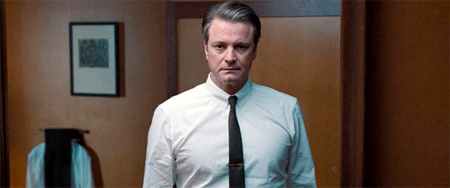
Colin Firth’s swooning fan base has long accepted the unlikely heartthrob as an endearing bumbler. Firth has often played the sensitive (and quietly sensible) romantic populating both mainstream romantic fare (the Bridget Jones films and Love Actually) and projects that are considered highbrow by way of artistic association (Pride and Prejudice‘s Mr. Darcy or Girl with a Pearl Earring‘s Vermeer). Atom Egoyan was one of the few filmmakers to scrape away at Firth’s squeaky clean archetype in the underrated Where the Truth Lies, giving Firth a raw and dark character suggesting a grittier and seedier version of The Importance of Being Earnest‘s Jack Worthing.
But none of these performances — as good as they are — has quite permitted Firth to summon up the totality of his talent. Market forces, content to give the people what they want, have consigned Firth to a curious upper middle-class ghetto. Firth’s characters often cling to a steady yet shaky authority, largely because they have occupied some station for too many years. Firth has atoned for these limitations with a smooth vocal command and an almost Mitchum-like commitment to movement, counterbalanced by a somewhat uncertain gaze. (The “I like you very much just as you are” moment in Bridget Jones’s Diary comes immediately to mind as an example of Firth doing his best to defy cliche.) But this pigeonholing hasn’t always allowed an interior glimpse. Firth has perfected the nice guy. But nice guys often have more internal demons than they’re willing to impart. It’s too bad that so many screenwriters, paid very well to adhere to formulaic conventions, fail to express this in their labor.
I have quietly hoped that some talented filmmaker would figure Firth out, or that Firth might obtain enough clout to headline some pet project, permitting those delayed demons to roil in a more complicated role. Indelible British actors often find Hollywood at some point in their careers, but this doesn’t necessarily mean that they are completely understood. (Exhibit A: Malcolm McDowell.) The people in charge are, after all, more concerned about the coffers than with human complexities. And I never would have imagined that fashion designer-turned-filmmaker Tom Ford would be the guy to push Firth to the limit.
A Single Man is one of the year’s best films. And it’s not just because Ford has given Firth a perfectly attuned role, permitting Firth to stockpile Professor George Falconer’s grief behind restrained grimaces and meticulous domestic action within a quite literal glass house. For A Single Man is also cinematically committed to George’s isolation. George’s heartbeat drowns out the soundtrack. He never quite sees a person head on. The secretary with the bobcut who gives one of George’s students his home address is filmed in slivers, and George replies, “You have such a lovely smile.”
It helps immeasurably that Ford’s working from very good source material (Christopher Isherwood’s fine novel) and that Ford is smart enough to make this his own. When George addresses his students in class, he sits before them on the desk, with three cameras cutting left, center, and right — as if George is some kind of fashion model being photographed on a platform. But to some degree, he is. His academic role is the only thing he has left after losing his partner, whose funeral he isn’t even permitted to attend (“family only”). Ford’s dramatic tactic is an eccentric yet effective perspective, reminiscent of the way that the vanilla-minded Steven Spielberg found a way to channel drug addiction through fatherhood in Minority Report
It also helps that we have been given a vision of the early 1960s that, for once, doesn’t call attention to its time period. Sam Mendes’s disgraceful adaptation of Revolutioanry Road didn’t understand that real people lived and wrestled with serious decisions. (It’s possible that Ford may have had Mendes’s American Beauty in mind with one of his other interesting visual tics. Whenever George feels something close to happiness, the gray visuals brighten up a bit. This isn’t as distracting as it sounds, and it’s more understated than Mendes’s now dated CG flowers.) The much acclaimed Mad Men understands this better, but feels the need to cram some “shocking” measure of its characters against contemporary standards. Can the characters really be defiling women like that? The more important issue is why Matthew Weiner cannot simply let these flawed characters act without the enforcement of moral judgment.
But Ford lets George live without such constructive qualms. We feel his loss. We feel his sadness. George is often kind, as we expect a Colin Firth character to be. But with grief comes a mess of forgivable solipsism in his willingness to light a man’s cigarette, bring over a bottle of liquor, or swim in the ocean to prove that youth hasn’t entirely expired. If George died right now, would he be okay? It’s a question echoing from happier days in the past, but one that the audience remains constantly aware of. The film’s commitment to George’s perspective causes us to be deeply locked within his being, but it also pulls off the difficult trick of making us sympathetic to those trying to get George back into the land of the living. This group includes a Spanish stranger and George’s best friend, Charley (Julianne Moore), who has also negotiated the line. We know this by seeing the way she lives now: aging, smoking, drinking, applying makeup, bombarding George with calls.
The film’s willingness to celebrate life, and the connective failings of single people of all stripes, propels it well beyond a one-note exercise and inures it from Weiner-style judgment. It is to Ford’s credit that he injects some humor into the morbid mix, for grief is never entirely tragic. There’s an overeager gun store owner, and some physical comedy involving a suicide and a sleeping bag. Life isn’t some “I wish I knew how to quit you” melodrama that makes us feel tolerant, liberal, and morally superior. It’s a little girl who doesn’t understand what her father means by “light in his loafers,” but who sees the possibility in a sad man sitting in a bank. A Single Man invites us to see that possibility too, both within its mise-en-scene and in the more important world before our eyes.
© 2009, Edward Champion. All rights reserved.
The movie, above all, tells the truth, and you understood that. I’ll be coming back to hear from you again. Well done. gc-
[…] that I’m too lazy to Google it. Still, let’s go with it. If Happy Tears (rather than A Single Man) is the result of such lavish self-financing, then perhaps the presentation of connective failings […]