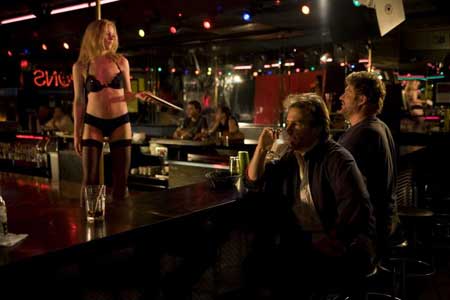
Writer-director Clark Gregg’s adaptation of Chuck Palahniuk’s 2001 novel has a number of things going for it. It has, first and foremost, the intriguing choice of Sam Rockwell cast as sex addict Victor Mancini. Rockwell plays this role as a strange amalgam of Greg Kinnear’s Bob Crane in Paul Schrader’s Auto Focus and Luke Wilson’s detached presence. His lanky mien suggests a Stan Laurel to the slightly chubby Brad William Henke’s Oliver Hardy. And while Henke here is not bad as Victor’s best friend and co-worker Denny, a chronic masturbator unafraid to lust after Victor’s mom (Angelica Houston), this comedic pair-up doesn’t quite anchor the film the way it should. Denny, like many wingmen before him, exists here mainly to pester Victor to move to “the fourth step,” or, in less Erhard-like terms, get on with his life or, as another character tells him later in the film, “to begin at the beginning.” With Victor, Denny attends support group meetings to help the pair get over their sex addiction. But Victor spends most of this time banging an anal bead enthusiast named Nico (Paz de la Heurta) in the backroom.
Rockwell’s look is certainly right. His shaggy brown hair, desperately in need of a haircut, frequently sticks up, suggesting a 1990s Northwestern slacker aesthetic. He wears shirts with gaping holes near the collar. He works a day job as a historical reenactor and, early on, declares directly to the camera, “I am the backbone of colonial America,” a postmodern possibility that Gregg never quite pursues that suggests that his addiction is a throwback to a more early and hypocritical age. Victor insists that he’s an asshole, but maintains a wide-eyed and bemused presence that seems perfectly aligned with the film’s often frustrating inability to decide whether it’s satirical or sincere.
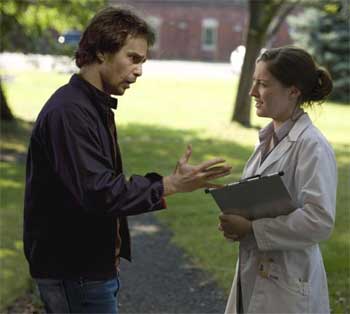 No Country for Old Men‘s Kelly Macdonald appears as Paige Marshall, whose eyes were seemingly invented for the light, but who we know, upon her character’s first step inside the mise en scene, will almost certainly become Victor’s love interest and will almost certainly never live up to Bechdel’s Rule. Which is too bad. Because the more I see of Macdonald, the more I realize how much she has it. And it will take a very intelligent film director, perhaps one with more smarts than even the formidable Coens, to give her the role that will finally catapult her into the superstardom she deserves. Her presence in this film is part of the Big Reveal, which is a substantial copout. But then if you’ve read Palahniuk’s book, you know the Big Reveal already. And Macdonald likewise know it. Her character speaks in a particularly pronounced hayseed vernacular, pronouncing “traumatic” like “TRAW-MA-TIC.” But this permits her to play Paige as if she’s on the inside of a terrible joke.
The terrible joke may very well be the fact that David Fincher was not only the first director to make a film about a Palahniuk novel, but the one to transform it into his masterpiece. One cannot view Choke without being aware of Fight Club‘s imposing shadow. Like Fincher (and screenwriter Jim Uhls), Gregg has one interesting scene that plays as nihilistic absurdism. In Fight Club, it was the moment in which Edward Norton punched himself in the face to blackmail an office manger. In Choke, it’s presented when Rockwell insists to a group of asylum inmates that he’s not a good guy, proceeds to take away a walker from an older woman and smash it against a locker. But while there is something in this scene vaguely reminiscent of Lars von Trier’s The Idiots, the scene plays like some doughty transplant from a pre-9/11 America. It works to establish Victor’s internal dilemma, but it doesn’t feel particularly contemporary.
Gregg is at his best when he avoids this dated approach to shock value for the more troubling truths of the seemingly perverse, such as one moment involving a woman who Victor seeks out for a rape fantasy involving a knife. The woman sets very specific terms, speaking less like a person with fey needs and more like a human resources manager. (The safe word is “poodle.”) There’s also an interesting exchange in which Victor confronts the boyfriend of a woman who has fallen asleep giving him a hand job. Victor urges the boyfriend to turn back and walk away. But these scenes work because of their naturalistic ironies. They present moments that are not particularly normal, but frame them as if they are normal. Even when the dialogue itself feels transplanted from some banal sitcom. And to consider again Victor’s insistence that he is “the backbone of colonial America,” this suggests an American take on the many unusual situations of this type that one finds within Francois Ozon’s early, more daring films. I have neglected to point out that Victor has worked out a scam, whereby he lodges a piece of food in his throat, chokes, and wanders around a restaurant in search of the right benefactor to perform the Heimlich. He does this to earn some pocket money to help pay for his mother’s care in a hospital. It is something that occurs quite frequently throughout this film, but these moments, which should have likewise served as nihilistic absurdism, simply did not stand out for me. Part of this may have to do with Gregg’s inability to push things far enough. Gregg does not entirely understand, as Fincher did, that this is the kind of behavior must be played out as melodramatic in order to work. There is one somewhat funny moment in which the choke confidence game backfires at a Chinese restaurant. But the moment simply doesn’t have the naturalistic irony or the nuanced play of these other scenes I have mentioned. And in a film largely concerning itself with the subject of phoniness, it seems absolutely vital for a filmmaker to get the tone absolutely right.
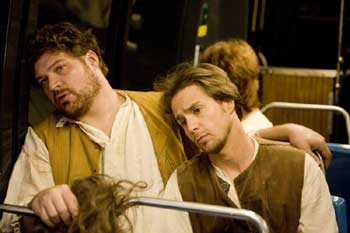 Gregg’s film does disguise New Jersey locations somewhat successfully as the Northwest. The apartments are laced with tacky wallpaper. There are many dead patches of lawn on the historical reenactment site. There are unwashed radiators, grimy kitchen surfaces, and photographs tacked carelessly to walls. But the film’s many flashbacks to the 1970s and 1980s, containing muted browns and the kind of predictable tan jackets and vests that have become something of a production design cliche, reveal that this is more kitsch than verisimilitude. More of a time capsule than a movie of the moment.
Gregg has been mostly faithful to Palahniuk’s novel. But he doesn’t quite have Fincher’s talent to properly translate Palahniuk’s cartoonish riffs on reality to the big screen. He does have Victor and Denny frequently stare at women and suddenly see them topless, and this tic even extends to an older nun. But this isn’t really pushing the envelope, much less forcing us to ponder the perceptions we keep to ourselves. His efforts to plunge into the scatological, such as a moment in which Denny drinks out of a dish and an incident late in the film involving chocolate pudding, don’t feel particularly offensive and don’t particularly unsettle us the way they did in Palahniuk’s novel. It is also a telling sign that most of the sex scenes occur with clothes on. The vulnerable nature of being naked, which should mean something in light of the film’s dialectic between love and sex, is confined to “being in the circuit” late in the film. But it feels perfectly safe. The kind of thing you’d find within some harmless Skinemax movie from the 1980s.
If a Chuck Palahniuk film adaptation cannot unsettle us, what then is the point of making it?
© 2008, Edward Champion. All rights reserved.