New Directors/New Films: Happy, Happy (2010)

[This is the second in a series of dispatches relating to the New Directors/New Films series, running between March 23, 2011 and April 3, 2011 at MOMA and the Film Society of Lincoln Center.]

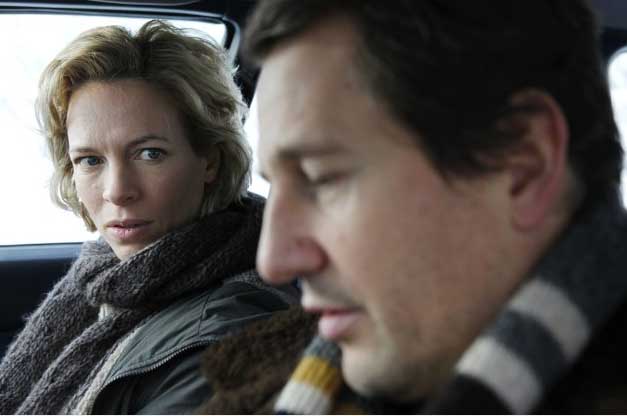
The best thing about Anne Sewitsky’s comedy, Happy, Happy, is Agnes Kittelsen, whose bright eyes bounce around with so much life that you figure she’s angling to become Norway’s answer to Amy Adams. Kittelsen plays Kaja, a thirtysomething teacher who lives in the middle of a snowy nowhere with Eirik (Joachim Rafaelsen), a laconic man who likes to leave for a week and go hunting (“go hunting,” we learn later, is a pretense and a euphemism), and Theodor (Oskar Hernaes Brandso), their son. When Theodor meets an Ethopian child his age, he initiates a game of “Slave” with him.

Based on that description, it probably seems that Kaja and Eirik are white supremacists. And based on the fact that a happy quartet of white men pops into the film every fifteen minutes to sing famous blues standards (This reminded me, for some reason, of Alan Price’s band in O Lucky Man! Let’s have more of these happy musical intrusions in cinema.), I cannot deny that I felt that the film was embracing some bizarre yet slight shadow of white privilege. My slight discomfort, however, was assuaged by the pic’s good-natured tone, which is more committed to trying out any number of comical quirks, however messy.

There are strong indications that Eirik is a closeted gay man. He hasn’t banged his wife in a year, which makes no sense, seeing as how she’s quite happy to offer him blowjobs and she’s very happy in general – even when snobby people speak down to her. Are Theodor’s casually racist reenactments the result of closeted emotions? It’s probably worth pointing out that Eirik and Theodor enjoy staring at Kaja, without saying anything, over breakfast. They continue this dreadful staring contest, against Kaja’s protests, until Kaja flees. With men this boorish around, who needs traditional family? It isn’t much of a surprise when Kaja takes an impromptu step to break this stability.

The Ethiopian child, Noa (Ram Shihab Ebedy), doesn’t talk much and, rather strangely, isn’t terribly aware of his own heritage. (It’s especially strange because Noa appears to be very fond of books. Nevertheless, the game of “Slave” does eventually encourage Noa to examine his own closeted heritage.) Noa is the adopted son of Sigve (Henrik Rafaelsen) and a fairly chilly attorney named Elisabeth (Maibritt Saerens), who have moved into the spare house across the way. Sigve and Elisabeth have vacated from the big city because Elisabeth had an affair. The two hope to rekindle their marriage. However, as I pointed out before, Kaja is fond of blowjobs. It doesn’t take a lot of know how to predict what happens next.

What does make Sewitsky’s film very interesting for a long stretch is how behavioral collision often forces perverse exuberance to emerge in this wintry wilderness. When the two couples play Norway’s answer to Cranium, during a drawing round, Eirik attempts to illustrate AIDS by drawing an incomprehensible backdrop of planes hitting buildings and two stick figures. “Two gay guys in New York,” he explains.

I enjoyed Happy, Happy quite a lot when it embraced these uncomfortable moments, which, oddly enough, emerged quite frequently when the four main characters were playing board games. When the two couples meet to play the Couples Game (a bit like The Newlywed Game, where couples demonstrate how well they know each other through questions), Sigve and Elisabeth seem to know each other very well, while Eirik and Kaja don’t. The latter couple can’t even answer the question, “What did you first love about your partner?” But Sewitsky is skillful enough to play against this expectation later in the film. Very often, Sewitsky suggests, it’s the couples who know each other too well who end up breaking their covenant.

Unfortunately, Sewitsky is less adept in portraying the aftermath. After affairs are consummated and the truth is revealed, she’s not quite sure what to do with her characters. Having crossed the threshold of what they must do to serve the narrative, these characters are left, quite literaly, to sing to the audience – however badly. Perhaps Sewitsky is asking us to remember that euphoric residue remains after a domestic cataclysm. As a cautious optimist, that’s certainly a message I can get behind. But I don’t believe this to be entirely fair to her characters.

New Directors/New Films: Margin Call (2011)

[This is the first in a series of dispatches relating to the New Directors/New Films series, running between March 23, 2011 and April 3, 2011 at MOMA and the Film Society of Lincoln Center.]

“The bank is something else than men. It happens that every man in a bank hates what the bank does, and yet the bank does it. The bank is something more than men, I tell you. It’s the monster. Men made it, but they can’t control it.” — The Grapes of Wrath

It’s easy for anyone with anything half-approaching a conscience to condemn the scummy vulpine gamblers who led us into the worst economic crisis since the Great Depression. But Margin Call, which takes place during one very dark night in 2008, has a surprisingly nuanced portrait buried beneath its zesty dramatic intrigue. Yes, it takes a certain chutzpah to live a life (as one character does) where one claims want when the after-tax take of a $2 million annual salary is gobbled up by prostitutes and restaurants and cars and clothes. Yet the men and the women of Margin Call‘s unnamed firm (which bears striking similarities to Lehman Brothers) aren’t entirely without feeling. They’re just very good at compartmentalizing their emotions, which have been perfected after many years of greasing the wheels. That reality may very well be the true horror.

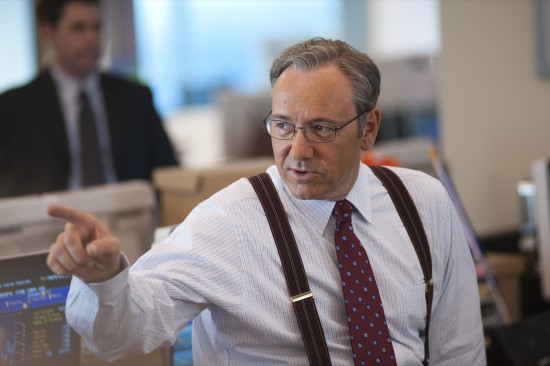
Our introduction to sales manager Sam Rogers (Kevin Spacey) is just after he’s received the news that his dog is sick. A few minutes later, he’s rallying the troops after a corporate bloodbath, saying, “80% of this floor was just sent home forever. But you were better.” He tells his salesmen that the downsized employees are “not to be thought of again.” How does he survive? One clue comes later in the film when Rogers is asked to take in some very bad news. He replies, “I don’t want to hear this. How do you think I’ve stuck around this place so long?”

But then it’s that failure to listen, that disinterest in what came before or what’s coming next, which is part of the problem. Eric Dale (Stanley Tucci) is one of the firm’s downsized casualties. He’s an analyst who we later learn helped design bridges that has saved thousands of commuter hours. And just as he’s working on some minatory projections showing serious volatility, the kind of financial Nagasaki with casualties exceeding the firm’s total value. But he isn’t even given the time to finish or explain his work. He’s escorted out of his office. And he’s informed by the icy HR people that he won’t have access to his computers again. He’s given a pamphlet (complete with the title LOOKING AHEAD and a preposterously sunny sailboat on the cover) that will provide “assistance with this transaction in your life.” And as he’s holding his banker’s box in the street, he discovers his cell phone is shut off. But just before heading from The Street to the streets, he does manage to get a flash drive with this data into the hands of the 28-year-old Peter Sullivan (Zachary Quinto), and that’s only because Peter has thought to accompany him to the elevator. Sullivan continues with Dale’s work and discovers the inevitable.

Sullivan is an analyst who, like many of his fellow employees, came to the firm for the money. He doesn’t seem as put out as his 23-year-old coworker, Seth Bregman (Penn Badgley), who can’t comprehend life without a job at the firm. (Bregman is later seen sobbing in the men’s room, an image that somehow feels worse than a stockbroker throwing himself out the window, because of the terror he must hide to show that he’s a team player.) But Sullivan does represent some missing link in the devolutionary masculine slide from ethical geek to thuggish lucre. Quinto here is terrific, playing the part with slight bites of the lower lip, rolled up shirtsleeves, and eyes that take in his increasing responsibilities with a reluctant professionalism that could, in the next decade or two, transform him into the ladder-climber wanting it all. Or maybe he’ll end up like Eric Dale: a risk management analyst let go for doing the right thing.

Margin Call features plentiful shots hinting at this blindsided mode of survival. One extraordinary moment occurs in an elevator as two executives argue over ratting each other out during the fallout, with a cleaning woman occupying the center of the frame, staring almost directly at the audience and seemingly not listening to this language. Another moment sees Sullivan and Bregman sitting in a gentleman’s club, the camera parked at a static shot quite far away, contemplating a stripper’s take home pay. Like many young men who are arrogant before their prime, they are so sure they know the numbers. And these fixed camera angles give us some sense of what they cannot see before them.

To some degree, Margin Call is working in the old school storytelling tradition that, in the wake of The Social Network, appears to be looking for a modest comeback. The film isn’t so much interested in the dry theoretical details, but it is concerned with the desperate emotions that force these people to scheme and capitulate. That ineluctable narrative decision may very well cause the picture to be declared by naive by its naysayers. But as someone who once silently observed the young and the hubristic (while also very young, which made the whole thing very odd) while working three months at Morgan Stanley, I can tell you that Margin Call is right on the money.

The graying Spacey – who is looking closer to his mentor Jack Lemmon as he gets older – forms something of a bridge between this film, Swimming with Sharks, and Glengarry Glen Ross. But his role is somewhat more understated. He’s been around the block so many times that he knows how to marshal his energy. And Spacey likewise cedes many of the scenes to Jeremy Irons, the firm’s head who shows up in a helicopter, asking the bright young analysts to explain the intricate data “as you would to a small child.” Margin Call‘s stress comes from the Nicorette chomping and rooftop smoking instead of the anxious indoor smoking, and overhead shots of New York replace Glengarry‘s cutaway shots of rattling Chicago subways.

The dialogue here isn’t just witty and wry. Care has also been taken to give Sam Rogers some grammatical gaffes. He describes “a very unique [sic] situation” when he’s asked to persuade his floor to perform the impossible and he often elides verbs such as “has” from his dialogue when speaking among the top executives. It’s almost as if Spacey came into the firm straight from high school. Or maybe he wants to appear stupid.

If the film has a liability, it may very well be Demi Moore playing the cold Sarah Robertson. Writer/director J.C. Chandor does make enlightened efforts to show that an anthracite heart isn’t limited to either of the two genders. (For example, the HR people at the beginning are all women and are all colder than the men they let go.) But the Moore character, aside from some predictable scheming, doesn’t really contribute much to the story.

Still, Margin Call is a very impressive debut from Chandor, who, if Hollywood gives him several films to flesh out his talents, may just be another Sidney Lumet in the making.

Review: Battle: Los Angeles (2011)

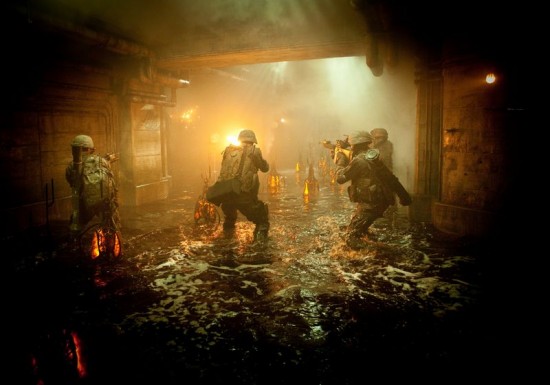
Perhaps the strangest aspect of the Battle: Los Angeles screening I attended was Danny DeVito’s presence. Danny DeVito – a supremely underrated actor and director – is just about the last name that comes to mind when I think of derivative science fiction – especially the kind of derivative science fiction that makes Roland Emmerich look like Aeschylus and Battlefield Earth look like Kitchen Sink realism. But there he was, walking out the doors just behind me and archly humming the theme song – his response to this remarkable cinematic travesty. Since Danny DeVito is a professional, and cannot speak ill of a terrible movie, I don’t wish to suggest that Danny DeVito didn’t enjoy the film. But I put forth to you that when a man of his talent reacts like this, this is probably not a sign that Battle: Los Angeles is the 2001 of our time.

What the hell was Danny DeVito doing at the screening? What the hell was I doing at the screening? I obviously can’t speak for Danny DeVito, but I suppose I was there for the cheese. Then again, the closer I get to forty, the less this answer feels legitimate. Even though I still enjoy laughing at terrible dialogue, which Battle: Los Angeles has in droves. “No promises in combat,” barks Staff Sergeant Michael Nantz (played by Aaron Eckhart as if Nantz were more of an easily ignored plastic chair rather than a flesh-and-blood character). “This is insane,” says another marine, who has not been given adequate dialogue to express what we already fucking know is insane. “I miss him….every…..day,” wails Eckhart later in the film. He may have been referring to Neil LaBute. “They ambushed us like they knew our frickin’ addresses,” says Tech Sergeant Elena Santos (played by the now officially typecast Michelle Rodriguez). Santos, by the by, is the only woman soldier here. And she’s not even an interesting soldier like Private Vasquez in James Cameron’s Aliens. (In fact, being a tech sergeant, she doesn’t even get to gun anybody down until the end.) If that gender disparity isn’t troublesome enough, consider that Nantz gets to say “fucking” while poor Santos only gets “frickin’.’ Where I come from, real women say “fuck.” Alas, this is a 21st century reality lost on writer Christopher Bertolini and director Jonathan Liebesman, who seem to have confused a relentlessly shaky camera for authenticity.

I pretty much lost it when Aaron Eckhart shouted, “Marines never quit,” in his gruff, here-for-the-paycheck bark. But, hey, I had to find my pleasure somewhere. The pleasure certainly wasn’t there in the explosions, which grew tedious, or the characters, which proved to be forgettable despite the X-Files-like captions, or the feeble explanation for the alien invasion, which involved using fuel for water, or the weak military system the alien race sets up, which involved a laughably stupid command center to generate power, or the dialogue, which only served to repeat obvious points.

Given such wretched qualities, cheese is a decidedly immature draw. I should know better at my age. But Danny DeVito is well over forty and he probably came for the cheese too. I was sitting too far away from Danny DeVito to hear if he was laughing. But when I started laughing, during a remarkably terrible and long Eckhart monologue attempting to rally the survivors, I noticed that others started laughing. Perhaps I gave a few audience members permission to laugh. Sony certainly did its best to pretend that this was a worthwhile film, being somewhat more aggressive with confiscating phones (who would pirate this piece of shit?) and even employing a warmup guy to get the audience to reply back “All right” before the screening. Since I had come to this screening as a reviewer, I felt that replying “All right” was inappropriate and not especially journalistic. Still, I can’t blame the studio for doing everything in its power to salvage a turd. On the other hand, a turd is still a turd. As turds go, Battle: Los Angeles is probably one of those turds well on its way to the sewer system by now. So it was probably an unwise decision for the filmmakers to include a plot point involving the Los Angeles sewer system, which only served to remind the audience that they were wading through shit.

Can I find one good thing to say about this failed hodgepodge of Predator, Independence Day, and Assault on Precinct 13? Well, I’ll certainly try. At one point, Nantz cuts away at an alien’s anatomy, trying to find the weak spot. My vast steadfast boredom dissipated for a few moments, and I wondered if the filmmakers would come up with something fairly creative. Maybe the aliens might have a unique digestive system. Perhaps a tentacle might emerge from the carcass and attack the humans. Perhaps the humans could morph into another form. But the only thing these hacks could come up with was a position to shoot at and weapons that were surgically attached to their bodies. And if you can’t be fucking bothered to come up with even some half-assed idea of an alien culture, then why go to the trouble of making the film in the first place?

If this movie had any real courage, it might have killed off its kid characters or shown one of the felled aliens genuinely suffering. Real war is more complicated than the simple-minded malarkey of blowing shit up. Is it too much to ask for even a small dose of All Quiet on the Western Front, Paths of Glory, or Platoon in a movie like this? These days, it is.

Jane Eyre (1990 : 2011 :: Reality : Film Adaptation)

I was a teen when I first read Jane Eyre from beginning to end. The decision to read this Charlotte Bronte classic wasn’t prompted by any authority, but sprang from personal shame. An English teacher had assigned Robert Penn Warren’s All the King’s Men, pairing me up with two other students to write a collective essay in response to the book. I didn’t read the book. It wasn’t because I didn’t try. I just couldn’t read the book. And when I went to one of their comfortable middle-class homes to huddle around one of their computers, the jig was up. I was considered an impostor, with the calumnious sigil embedded invisible on my forehead for weeks.

These two other kids were right. I am still very much an impostor. I grew up in a home sullied by blows both violent and verbal, where shrieks from other family members careened around corners and mice scurried and scratched in the walls. The garage was nothing less than a shelter for junk that my parents lacked the effrontery to throw out, and I would have to climb over all manner of bric-a-brac to get the mail (which included a clandestine Playboy subscription addressed to my name, which I read for the pictures and the articles). Embarrassed friends would telephone me, hearing screaming and saying nothing and sometimes offering their homes as momentary refuge. This made it very difficult to read or concentrate or think or feel or write.

I didn’t have a computer; just an ancient electric typewriter with a highly unreliable ribbon and jittery keys. I had learned how to type 100 words per minute in eighth grade, but the contraption made my skills useless. I would type essays on this baleful beast late at night, when the chances of shouting and interruption were slimmer, often needing an hour to hone a paragraph to make sure that the ink didn’t smudge on the liberated bond and the characters hammered to the paper properly. Even one of these very patient hours, which could only come when I was holed up in my bedroom, still required the dutiful applique of white-out (mostly stolen, not purchased; there wasn’t much money). One of my English teachers – a man named Jim Jordan fond of leaving a tally on the blackboard with my name under the heading INANE COMMENTS (he did the same thing to a nice kid named Nick Hamilton; who knows how many aspiring jesters this man tormented over the years?) and who added a horizontal slice every time I overcame my shyness, announced my associative mind, and got the classroom to laugh — decided to condemn me further when I would turn in papers labored over into the early morning. As far as he was concerned, it wasn’t the content, but the pockmarked presentation, something I couldn’t help due to the poverty of my instruments, that offended this Murphy Brown watcher’s sensibilities.

Factor in all the ruthless ribbing, and this was a tough time for me. Misery at home, misery at school. But I tried my best to see the positive side of things. One needed to develop a thick hide to survive. I figured this neoliberal teacher just hated the poor kid with the wild and crazy hair and the trenchcoat and the hat and the Looney Tunes tees (found very cheap at Marshall’s and treated with some care, given that shopping for clothes was a rare occurrence) preventing him from charming a largely middle-class group as patriarchal pedagogue. It was a wonder, years later, that I ended up finding some dodgy living as a guy who wrote about books and that any page in literature spoke to me more than anything Jim Jordan, who hated genre and hated Stephen King and rebuffed my interest in HP Lovecraft and always let the class know all this, had to say over a semester.
I felt bad about not reading Robert Penn Warren. (Years later, I read the book in its entirety.) I also felt bad when I learned that the two students, whom I thought my friends, ridiculed me to another friend, figuring that I had to be a stupid son of a bitch for not reading Warren. (This third friend defended me, in part because he was also not quite in their class bracket and had some tangible understanding of what I was going through. Vice versa. We’re still friends to this very day. Old soldiers who fought many wars together.) And so I decided to prove to myself that I could read a big book that wasn’t science fiction or fantasy. I plucked a copy of Jane Eyre from a box in another classroom and I brought it home. (I would later do the same thing with George Orwell’s 1984 and Charles Dickens’s A Tale of Two Cities, both of which I was not required to read but did.)

For obvious reasons, I could relate very much to Jane’s early plight in the Red Room and at Lowood. Psychologically abusive family members, teachers who tormented me because I didn’t fit into their suburban idyllic fantasy, feeling stupid and plain – what here wasn’t there to relate to? I had no kind teacher equivalent to Miss Temple at the time, although I would later encounter a marvelous teacher named James Wagner, who not only encouraged me to write by looking upon every essay as an opportunity for fun and mischief, but who paid attention to the prose style contained in my DNA. When my sister took Mr. Wagner’s class a few years later, he said to her, “That’s what I like about you Champions. Short and snappy sentences.”

But once Jane hit Thornfield, I began to despise her and the book. I didn’t like this Rochester fellow who was trying to control her. He reminded me of too many paternal figures who wanted to correct me rather than accept me. And I didn’t like the way that Jane (or Janet, as Rochester called her; a modest corruption of her name that Jean Rhys was to investigate further in Wide Sargasso Sea) wasn’t honest about her feelings. I didn’t like the convenient fortune that Jane encountered later in the book, which seemed a terrible contrivance, and I didn’t like the way that Jane heard Rochester’s voice and how this conveniently urged her to return to Thornfield. Life just didn’t work like this. But I read it to the end and returned the book back to the box, grateful that my fury towards the book would not have to be voiced and shot down by an English teacher who didn’t like me. However, before an eccentric drama teacher (Mr. Cody), I dismissed Jane Eyre as “a Harlequin romance.” I was very surprised when Mr. Cody replied with approbation and enthusiasm.

Still, as much as I hated the book, I have to credit Jane Eyre for giving me a reading discipline I had never known before that time. It hadn’t occurred to me to look at the novel again until there came a time later, more than twice a lifetime later.

* * *

January 10, 2011. I publicly pledge to read the top 100 novels of the 20th century, as decided upon in 1998 (about eight years after I read Jane Eyre and about thirteen years before I made the promise) by the Modern Library of America. What I don’t quite comprehend at the time is that Jean Rhys’s Wide Sargasso Sea -– a prequel to Jane Eyre -– is #94. (April 22, 2011 Interjection: Essay on Wide Sargasso Sea now here.) What I also don’t quite get is that there’s a new film adaptation of Jane Eyre set to be released on March 11, 2011.

A few weeks later, I make the connections. I receive an email from Russell Perreault (I’m on one of Random House’s mailing lists) about the movie tie-in edition. After my high school experiences, there’s no way in hell that I’m going to obtain a fresh copy of Jane Eyre on my own. Not from a bookstore or a library. Yet somehow I cannot resist. Through sheer folly and laziness, I send Perreault an email. Much to my surprise, Perreault humors me and a copy of Jane Eyre shows up in the mail days later. My fate is sealed. I can’t exactly ignore this polite gesture. I must reread the book. Who knows? Maybe my adult self will appreciate what my kid self did not.

I arrange to attend a press screening of the movie, with the idea that I’ll have the book reread before I hit the movie. (What I don’t count on is that all this industry triggers thoughts and feelings outlined in the first part of this essay.) I reread the book. I bang out the following Goodreads review:

It shouldn’t be thoughtless to condemn this terrible book, which I read for the second time in my life. The first time was in high school. I hated it then, but I read it to the end — unprovoked by any force in particular, aside from my own flowering self-discipline. I despise this book slightly less now. But I am now most anxious indeed to read Jean Rhys’s corrective prequel, which appears to be much shorter and has the temerity to condemn such terrible characters. Jane Eyre is almost smug in the end, after 600 pages of near helplessness (especially the unintentionally hilarious chapter of her asking around for food and a job: if she were truly smart, she would have contrived the damn escape over time; what does it say about this diabolical doormat that I longed for her to take up prostitution, hoping in vain that my memory of the book was wrong, but knowing the chirpy fate of this dimwitted damsel in distress, who requires an extra-strong dose of feminist enlightenment). Rochester and St. John are two male specimens whom I would not only outdrink, but out think and out act. When Rochester begs Janet to save him, an image of castrated Williamsburg hipsters beating him to a pulp entered my mind. Alas, such a deserved fate was not to be. Don’t get me started on the doddering St. John.

But of course, being very stubborn-minded, I read this damn book to the bitter end. My partner asked me to leave the room because I was talking back so violently to the book, making sounds resembling “Wah wah wah” or something like that when I had to endure pages upon pages of angst. A critic friend says that he never made it past the first half of this book and suggested that I read Wuthering Heights. He may be right, but I think I’m done with the Bronte Sisters for at least a year. I don’t care how groundbreaking this book was on the Gothic front. It’s just plain hokey. Convenient windfalls from dead relatives, hearing Rochester’s voice from afar. Contrived! So you can’t take responsibility for marrying the crazy woman in the attic? Cry me a river. Man up and deal. Don’t take out your problems on your poor servants, illegitimate children, a governess, and so forth. Hey, Rochester, didn’t you see the sign on the boat to Jamaica? YOU BROKE IT, YOU BOUGHT IT. The fact that you view humans as hairy beasts, sir, is part of the problem. Bronte’s understanding of people, even accounting for the centuries, leaves much to be desired too.

* * *
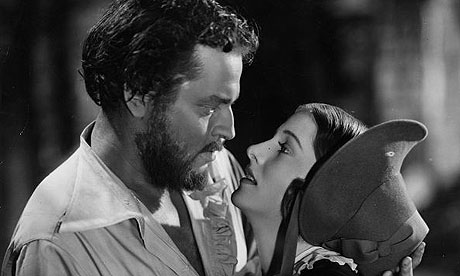
In high school, I understand that many people consider the book to be a masterpiece. And while I don’t share this viewpoint, I do find myself in high school obtaining a VHS copy of the 1943 film starring Orson Welles as Rochester and Joan Fontaine as Jane. I love every damn minute of it. Maybe it’s the melodrama. Maybe it’s the black-and-white. I am familiar then with Citizen Kane and Touch of Evil and the wine commercials and am only just starting to understand what a great cinematic genius Orson Welles was. (My friends only seem to know him from Transformers: The Movie.) There is clearly no better man who can channel Rochester’s oily charisma and convince us why Jane Eyre would fall victim to what would now be very serious sexual harassment in the workplace.

There is, in 1996, a lesser film adaptation with William Hurt in the role. And I learn that George C. Scott has also played him, although I still haven’t seen that version. In college years, I also discover that there’s a 1973 version with Michael Jayston in the part. (I know Jayston as the Valeyard in the 1986 Doctor Who serial, “Trial of a Timelord.”) I track some of these dramatic versions down (not an easy thing to do in the pre-Internet days of video stores and tape trading by mail), but I don’t tell anyone about this adaptation fixation until March 2011, when I write and publish this essay. Perhaps in my secret watching, I am trying my best to find ways of appreciating a book I don’t care for.

“My master’s colourless, olive face, square, massive brow, broad and jetty eyebrows, deep eyes, strong features, firm, grim mouth, — all energy, decision, will, — were not beautiful, according to rule; but they were more than beautiful to me; they were full of an interest, an influence that quite mastered me, — that took my feelings from my own power and fettered them in his. I had not intended to love him; the reader knows I had wrought hard to extirpate from my soul the germs of love there detected; and now, at the first renewed view of him, they spontaneously arrived, green and strong! He made me love him without looking at me.”

Why is Rochester the entry point? Is it because I’m a man? Is it because of this idea of loving someone without the object of your affection looking back at you? I don’t think so. I think it’s because I’m trying to understand why Jane would be so attracted. That’s one of the great narrative mysteries sticking at the back of my mind for years. Even if she doesn’t have much experience with men, and even if the times weren’t exactly friendly for women, it doesn’t make sense that someone brave enough to stand up to the abuses at Lowood would fall for some of Rocheter’s dull philosophy. Yet Rochester, plainly described in that above passage, is charming in these dramatic versions in a way that he isn’t charming in the book.

* * *

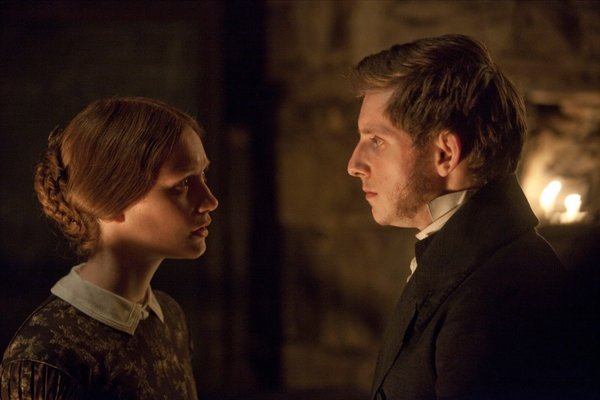
March 8, 2011. I’m in the Dolby 88 screening room. I know within a minute of first seeing Michael Fassbender in this movie that he doesn’t have what it takes to be Rochester. And it gets worse as the film goes on. He isn’t fierce enough. He doesn’t have the eyes that men like Orson Welles or Oliver Reed had; the eyes that somehow convince you to jump into an abyss before you know you’re falling. When Rochester sits in a chair, the chair has more screen presence. Poor Fassbender looks as if he’s been asked to do nothing but stare intensely at the camera. His arms and legs have pinioned by bad direction.

It doesn’t help that screenwriter Moira Buffini (responsible for Tamara Drewe) has restructured Jane Eyre so that a good portion of the St. John episode comes first (i.e., the movie begins with Jane’s escape from Thornfield, which in itself is a ballsy and interesting choice), followed by a surprising extension of the early business with the Reeds, with the Lowood stuff getting cheapened into what appears to be digital cardboard decor, which results in Rochester’s first appearance getting postponed and the narrative structure collapsing in on itself.

The “pedestal of infamy” mentioned in the book, which is a metaphor, is mentioned directly by an evil teacher in the movie. That’s how literal-minded the script is. The script also includes numerous moments where characters tell each other what they’re feeling, as if Buffini doesn’t understand that this is a visual medium. “How very French,” replies Fairfax after Adele sings a song. “You’re depressed,” says Rochester to Jane Eyre, who doesn’t look depressed. “Your eyes are full,” he also says when they’re not. “You’re blushing,” he says, when she’s not. This technique certainly worked for Lev Kuleshov, whereby Kuleshov cut a blank expression of a man with a bowl of soup (he’s hungry), a girl’s coffin (grief), and so forth – with audiences praising the blank man’s great acting. But that was almost 100 years ago and it relied on visual cues rather than oral ones. You’d think that such bad narrative dialogue would have the simple explanation of lines cribbed directly from the book. In other words, that essential exposition which works in text was simply plucked wholesale and put into the script. But that isn’t the case at all. Because none of these lines are in the book. Buffini (or some tampering studio executive) has added them. Because she (or someone) believes that the audience is a collection of morons.

There is no Miss Temple in this movie. Indeed, the movie cannot afford to offer us any nuances, anything that strays from the cliches. The red-maned Mia Wasikowska is too luminous to be so plain. The movie’s real “machine without feelings” here is cinematographer-turned-director Cary Fukunaga, who comprehends how to capture a world by lantern and candlelight, and even manages a moment of battledore and shuttlecock. But he doesn’t know that cobwebs and dust and flies often clutter up a dark and expansive mansion. Fukunaga isn’t much interested in creating visual atmosphere. He’s into fake scares through an aggressive sound mix, such as a bird flying up into the air. It doesn’t really enhance the story or the mystery or give us a reason to care.

* * *

I was an adult when I reread Jane Eyre from beginning to end, and when I realized that my feelings for the classic were just as needlessly prejudicial as the teacher’s enmity towards me. I gave it a try anyway, devoting many unknowing hours trying to reconstruct something that I had locked away in the attic of my mind. My own private Bertha was not insane and would not stay caged and would not set the place on fire. I resolved to approach Jane Eyre again in ten years, when the associations were less fresh and I was presumably more human. The next time around, I will judge it not through the prism of its dramatic iterations, but on the very novel itself. After all, wasn’t it Jane herself who said that repentance is said to be its own cure?
A Hasty Response to The Late American Novel

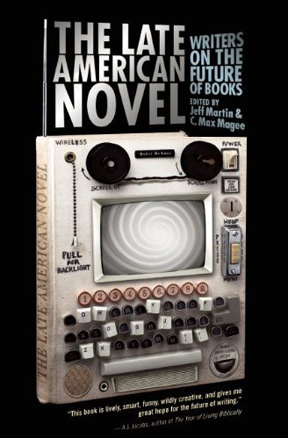
I remember reading Jeff Martin and C. Max Magee’s anthology, The Late American Novel, a few years ago when it was called Kevin Smokler’s anthology, Bookmark Now. Kevin Smokler has more followers than I do on Twitter and is paid by Chris Anderson to do something in relation to books and marketing. When I read Bookmark Now in 2005, I had a beef with Kevin Smokler. But now I do not, although Smokler doesn’t follow me on Twitter. And I don’t follow him. I do not have a beef with either Jeff Martin and C. Max Magee, but Max and I follow each other on Twitter. It may be that I am less angry now than I was in 2005, or that I like Max more in 2011 than Kevin in 2005. I feel compelled to point out that it is not 2005. I know this because I have less hair. The Late American Novel may have spoken to me six years ago, but I am not quite sure that it speaks to me in 2011. But then I have not yet opened its contents. I am about to. I will say that I do not see the Internet as a distraction or even an enhancement. It is a bit like a sex toy that I plug in from time to time. I am certain that I am not the only one that feels this way. If the Internet were to go away, I’d be perfectly happy. Because, aside from my extracurricular activities, I am surrounded by books and, if websites were to go away, you would find me in the streets disseminating pamphlets and circulars. You would find me giving speeches in obscure town halls. (Come to think of it, you may be finding me there even with the Internet. I comfortably wear the Internet as a surplice, but it is not the end all and the be all. It has yet to design the intellectual equivalent of exciting underwear.)

It remains unclear whether Jeff Martin and C. Max Magee will, in five years time, be paid by Chris Anderson (or some other dimwitted man who plagiarizes from Wikipedia and hosts conferences and edits overrated magazines and pays quirky and interesting voices a lot of money to transform into uncritical hacks in a few years) to do something in relation to books and marketing. But I don’t think they will. Jeff Martin and C. Max Magee are certainly more admirable and interesting in their 2011 pursuits than Kevin Smokler was with his 2005 pursuits. Looking at the list of contributors in The Late American Novel, there are only three names that make me want to throw the book against the wall and rage like a deranged animal for another random anthology so that I can peform the same eccentric test. And I have to say that, as anthologies go, this is a pretty decent batting average. I think there were more contributors who annoyed me in Bookmark Now.

I’m not sure I needed Thomas Allen’s “Notes on the Cover.” If you have to explain your book cover, it’s my feeling that you’re slumming it in some way. I also didn’t need Reif Larsen’s “The Crying of Page 45.” Larsen, who has littered this essay with annoying postmodernism (“Figure 3: The order of Chapters in Cortazar’s Rayeula“) didn’t get the memo that, thanks to the twee approach of McSweeney’s, pomo will be quite dormant for the foreseeable future. “I never arrived at page 45,” writes Larsen. And one longs to tell this precious writer that he’s not exactly making it easy to push beyond the third paragraph. One also wishes to tell Larsen that nostalgia is a terrible reason to read. One reads to get some sense of being alive. Or at least this reader does.

Which brings us to Marco Roth’s “The Outskirts of Progress,” with its second-person East Coast assumptions. First off, Marco, I may be skeptical, but I’m not pessimistic. Like you, I’m not a slave to technological progress. But unlike you, frequent railroad landscapes do not bore me. I also quibble with your suggestion that I am deracinated. I was just watered and taken for a walk. No knowledge is lost, if one looks hard for it. Please take more time formulating your thoughts.

The widely disseminated Davey Gates-Johnny Lethem exchange from PEN America (collected here as “A Kind of Vast Fiction”) is something one can get behind, especially in response to Gates’s idea about the “instantaneous opinion marketplace” and whether all future novels are, in some sense, historical. But then my own long-winded online presence would suggest that Gates and I are simpatico on this score. I also liked Deb Olin Unferth’s “The Book,” in which bullet points demonstrate the futility of attempting to announce the death of a medium. Elizabeth Crane humbly writes, “So I’m the last person to have any predictions about the fate of fiction in the future. Are there any original ideas anymore?” Hucksters and e-cult members: take note.

Leave it to Emily St. John Mandel to cut through the bullshit by opening her essay with this sentence: “There are certain divisions in the world that seem unnecessary to me.” Bookmark Now prided itself upon insisting quite rightly that books were still alive in a digital age. The Late American Novel insists quite rightly that we are all no longer on the same team. Yet I flit around for an essay hoping to acknowledge this fragmentation and I find Katherine Taylor offering the advice: “Don’t go back to Fresno.”

That’s a bit like referring to “flyover states.” It’s impolite.

Maybe going to Fresno might give some of us a more reasonable idea about where books are heading and what regular people are reading. The Late American Novel, while refreshingly cheerful, doesn’t quite acknowledge this. But then neither did Bookmark Now. Rudolph Delson is wrong to suggest that there isn’t pleasure in knowing about novels. That’s like saying there isn’t pleasure in knowing about people. We should know about everything. But perhaps The Late American Novel is a necessary kickstart.