In Defense of Jaume Collet-Serra

It’s been two weeks since I attended a press screening for Unknown, and I am dilatory with my dispatch. But there’s been some distinctive quality about director Jaume Collet-Serra I’ve been trying to pin down. The hope here was that a few extra days of thinking would get me closer. After all, The Stranger‘s Paul Constant informed me that he received “drunken hate mail for weeks” after he praised Orphan – a movie that I also found to be fun and stylish and needlessly maligned by a few uptight critics.

But my interest quickly got out of hand. Now that I’ve seen all of Collet-Serra’s previous films (House of Wax, Goal 2, and Orphan), and I liked them all, I’m going to put forward the brazen suggestion that Jaume Collet-Serra may be another John Frankenheimer in the making. Like Frankenheimer, Collet-Serra includes several gradients of realist acting in his movies, however half-baked and unrealistic the scripts may be, to accentuate his more tasteful visual balance. Many of the complaints against House of Wax, for example, were leveled at Paris Hilton’s one-note acting (and I suspect that her overfrequent media presence in 2005 didn’t exactly help matters), but this severely discounted Elisha Cuthbert’s more realist performance and Brian Van Holt’s melodramatic double role. These complaints also weren’t especially fair when one considers Collet-Serra’s eye for the camera.

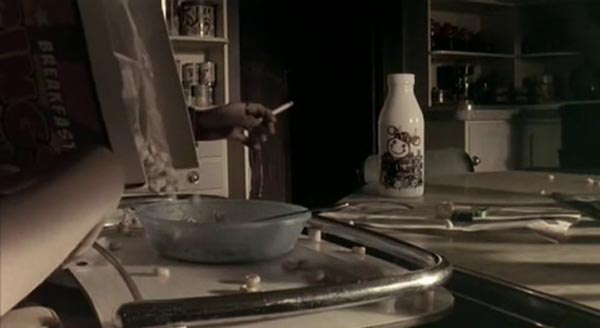
House of Wax: Certainly Collet-Serra’s background in commercials and music videos are largely responsible for this marvelous and unsettling opening sequence, in which we are introduced to a psychotic family. Notice the fine details contained within this montage. In the first shot, we see an older woman smoking her cigarette, the jasper angled askew and matching the wax bowl on the right. The table’s octagonal nature accentuates this psychology, especially since none of the hands or the cigarettes approach the table at a perpendicular angle. Then in the second shot, we see that the domestic scene is quite orderly. We see cereal poured into a bowl in a manner we might be familiar with. What’s unfamiliar here is the cigarette angled up in the air, neatly matching the arm clutching the cereal box. The milk bottle, with its smiling diagram, is also a nice touch, suggesting that some comical order or tranquility might be possible if you stick around long enough.
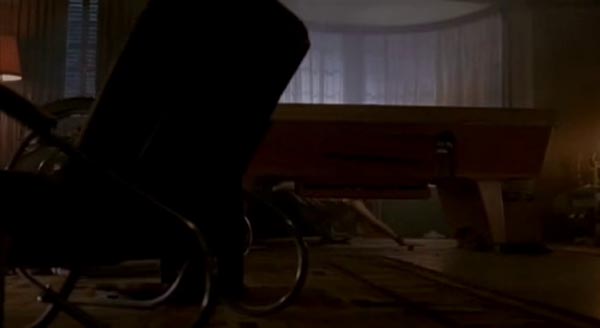
House of Wax: The camera, positioned very low, demonstrates that human life doesn’t matter much in Ambrose, the ghost town revealed to be a disturbing museum. We see a woman crawling beneath a pool table (underneath Ambrose’s “game”) in an effort to escape a mechanic who wants her to be part of this “museum.” Collet-Serra, who likes using shallow focus, makes the chair more prominent than the young woman. Even the lamp on camera left registers more than the woman.

Orphan: Believe it or not, this striking visual is a throwaway shot. Like Tony Scott, Collet-Serra has this tendency to offer a magnificent composition and cut it into a sequence for less than a second. It’s almost as if he doesn’t want people to know that he’s got the chops. Or perhaps we’re meant to investigate further with the pause button. What we see here is the Coleman family before Esther’s arrival. Daniel runs from camera left to camera right towards Max, deaf and holding a basketball. Aside from the clever way in which Collet-Serra intimates that this family is as solid as the house itself (with mom hidden behind the car and Max very slightly occluded by the column), there’s also the muted burgundy (increasingly darker) from left to right: the car’s tail light, Daniel’s hood midway, and the basketball that Max is holding.
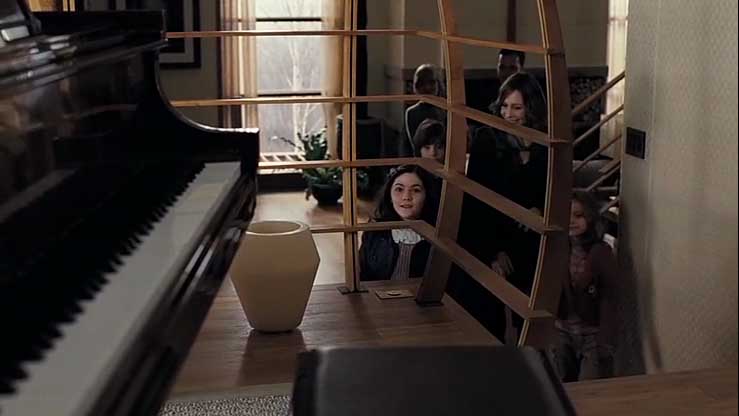
Orphan: Once Esther invades the family home, we see that, unlike the previous shot and unlike the Coleman stability, her face cannot be hidden by any architectural detail. She stares at the piano with materialistic delight. The back window tries to illuminate the situation to the Colemans (“Hey, family! You may have taken in a murderous little girl! Look around”), all clustered in the dark and too ensnared by domestic bliss to see what’s in front of them. And just as Collet-Serra placed the milk bottle on the table in the House of Wax opening sequence, we see that he’s placed an almost hexagonal vase on camera left.
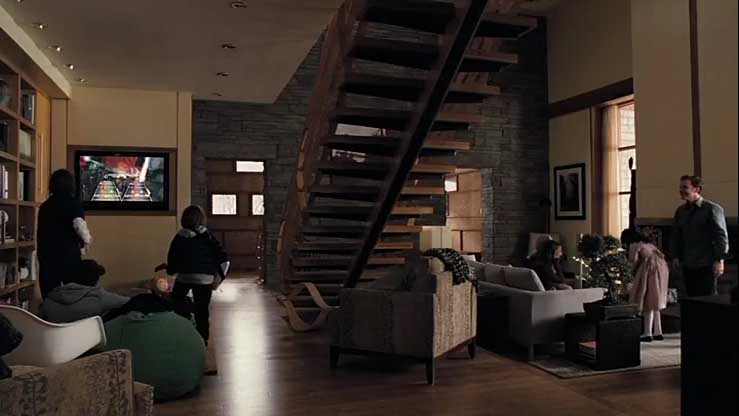
Orphan: This is one of my favorite shots in the movie. Who knew that Rock Band could portray a fragmented family? We see the boys having a grand old time tapping notes on the left. Meanwhile, the Old World girl with the old dress is inveigling her way in at the right. Again, Collet-Serra is careful to include a window near center frame, with its shaft of light trying to convey to the family that Esther is bad news. You wouldn’t know from the jagged diagonal staircase and the slightly incongruous textures that the production designer here was the same guy behind Blue Crush.

* * *

Unknown, Collet-Serra’s fourth feature film, from a screenplay by Oliver Butcher & Stephen Cornwell, based on a novel by Didier van Cauweleart, is well directed. Like Collet-Serra’s previous films, the cinematography is symmetrically stellar, its use of split focus reminiscent of early Brian DePalma (there’s one great shot where a body is being dragged away on camera right, while another body stays recumbent is on camera left) and a car chase shot with an idiosyncratic claustrophobia (many of the shots are confined inside the vehicle, but we don’t get too many driver’s perspective angles). The acting, especially by Bruno Ganz as a former Stasi man, is surprisingly realistic. The script contains an improbable series of coincidences (nearly every character is part of the conspiracy!) and a very forgiving German police force (if you carjack a taxi from an airport, I’m pretty sure the authorities aren’t just going to let you drive away). But Collet-Serra’s pacing is, for a good stretch of Unknown, so classy and so relaxing that I became more forgiving with these lapses in story logic.

Before seeing Unknown, it had never occurred to me that Liam Neeson was filling in the role once occupied by Harrison Ford. Ford, now a doddering and growling caricature of his former self, once charmed movie audiences as the forceful Everyman we could relate to. The whole “Get off my plane!” business was the point of no return for Ford. But before that, Ford was the star of The Fugitive and Frantic, playing a very believable middle-aged man on the run.

I’m certainly not the only person to have found Neeson’s recent reinvention as an action star to be somewhat peculiar. While this very tall slim actor can’t drift from his slightly Americanized Irish brogue to save his life, he has carried notable authority in Schindler’s List, Michael Collins, and Rob Roy.

But Neeson is also very good at melodrama. Most people forget that Sam Raimi made a marvelous comic book movie called Darkman starring Neeson in the title role. There’s a very fun scene in which Neeson is confronting a carnie over a pink elephant, and Neeson plays it so perfectly over-the-top: his voice grating with a gravelly bark, his face spasmodic (thanks to the limited time Darkman has wearing the “Neeson face” in daylight). While Collet-Serra doesn’t quite go off the glorious deep end the way that Raimi did in Darkman, one sees something close to this quality in Unknown, when Dr. Martin Harris is trying to persuade people that he is the genuine article.

Consider this question. Twenty years ago, if you had been told a video store clerk that Sam Raimi (director of Evil Dead 2) and Peter Jackson (director of Dead Alive) would be directing some of the most successful Hollywood movies of all time, you would have been laughed out of the store.

Unknown is enjoyable, but it does see Collet-Serra playing it a bit safe. But if Sam Raimi can serve us the gloriously vivacious jazz club scene in Spider-Man 3, then perhaps Collet-Serra’s visual panache will branch out in intriguing directions.


Review: Of Gods and Men (2010)

Xavier Beuavois’s Of Gods and Men is a film so boring that it threatened to put me to sleep at least three times during its interminable 122 minutes. I have nothing in particular against the monastic life or unexpected political collisions or trying to understand why people remain inflexible when given clear mortal consequences in resisting common sense or the Trappists or the Algerians or films that are slow and long and, yes, even boring. Indeed, the film’s premise — based on the real-life assassination of seven monks who refused to leave Tibhirine in 1996 when terrorists entered their inner sanctum — is a fascinating one.

But this film ain’t Tarkovsky or Antonioni. The problem here — and I do realize this snoozefest has won the Grand Prix, along with unchecked fellatio from the film snob brigade; knock yourselves out — may be that Beuavois has so insisted on uncompromising authenticity (even going to the trouble of basing one shot around a shaky home video), of lining up every damn narrative moment to some scrap of a fact, that there’s little wiggle room to explore any discrepancies. These people lived, for fuck’s sake. And they were braver and more committed than most of us. I’m not necessarily against such orthodox recreation of reality, but it’s often most interesting when given a new context or a new framework that permits us to feel something. When Christian Marclay asks us to rethink images of clocks, as Art Fag City’s Will Brand recently suggested, he’s asking us, in breaking his own rules, to wonder if the viewing experience is too easy. What the hell is Beuavois asking us to do? By producing such a tepid timewaster, he encouraged me to walk out at several points and read a book on the subject. Alas, it was only my own stubborn self-discipline to sit through every damn minute that compelled me to stay. I am now writing a bitter review that vitiates the noble obduracy of the Trappist monks. And I feel terrible about it. But I cannot give this film a fair pass. It feels so trite in comparison to Wisconsin or Algeria or Libya or any other clusterfuck I could get sucked down when chasing the headlines.

The problem may be that I’m a reader and many of the film people who accept this malarkey as art are often not seen holding a book. I mean, even Ann Patchett’s melodramatic novel, Bel Canto, has more going on than Of Gods and Men. Beuavois seems to have avoided any deep or insightful investigation of the kind of temperament it takes to carry on with your low-key existence as terrorists abscond with your provisions and beat up on the people you’re trying so desperately to help. That kind of moral predicament should contain some element of horror. Is that too much of a concession to conventional narrative exigencies? Perhaps. While there is certainly some resistance to the decision to stay, and there is definitely a united front on the question, if the narrative intent here is to mimic what it feels like to be bullied, then I submit to the filmmakers that, no matter how tough or committed you are to a life of avoidance, you will still feel some modest trauma or shock. It’s certainly interesting that the monks here choose ritual as a panacea.

The film does looks beautiful. Shafts of light cascade against crumbling walls in need of new paint. There’s a quiet dignity in the way these monks share a meager meal — with one remarkably indigent celebration just before the monks concede to the inevitable, Swan Lake playing in the background and tearful eyes, that achieves a cinematic poignancy I’d be hard-pressed to dismiss. And I very much liked the way Beuavois shot many of these monks with the backs of their heads to the camera, a subtle visual suggestion conveying to the audience that we may very well be invading their holy lives.

But to get to these moments, one has to sit through a squirm-inducing concatenation of slow stretches. Endless and not especially sophisticated dialogue about how a love for God replaces a love for women. And so forth.

With so much attention to ornate aesthetics, I kept wondering why I felt damn near nothing for these monks. They receive letters and visits from the concerned. But they answer that they didn’t come to Algeria for personal interest and that there remains some circumstances in which men will not carry out evil. Stubbornness is an intriguing quality to contemplate, but up to a point. These dead monks demand more than technical recreation in order for us to feel.

Review: We Are What We Are (2010)

Last March, the intrepid crew behind The Barnes & Noble Review asked me to watch an extraordinary number of cannibal movies within a very short period of time. This exercise resulted in a rather pleasant throbbing in the head, a need for lengthy perambulation after all this sensory overload, a momentary recalibration of my carnivorous intake to ensure that I could sustain my passion for carne asada after seeing so many (virtual) people eaten, and this essay, in which I revealed that a cinematic genre of apparent last resort had more going for it than some of the humorless film snobs had suggested. One of the genre’s key touchstones, Ruggero Deodato’s Cannibal Holocaust (1980), dared to balance bona-fide animal slaughter with the juicy theater of people having each other for dinner. And many of Deodato’s followers carried on in this bountiful spirit of authenticity, with film crews and fake books offering heft to all the baleful gustation. While mainstream cinema continues to remain comfortable with the removed feel of zombies, a decidedly more class-conscious approach to cannibalism in which one has to be bitten (a lack of personal responsibility? just one of the common rabble?) to give into these baser impulses, one wonders if we will see more knowing acts of cannibalism in multiplexes. Despite the fact that human beings are very often kind and noble, don’t we all have the capacity to be savage and vicious? And does not cannibalism offer us the most ideal narrative framework to oscillate between these two extremes? Is this not fun for the whole family?

Since money remains one of the dominant reasons that movies are made, the recent success of two Texas Chainsaw Massacre movies (a reboot that netted a $150 million worldwide gross) suggests this to be likely. But forget these crass men with the moneybags. Jorge Michel Grau’s We Are What We Are offers an unexpected alternative route for the cannibal movie’s future.

What’s quite interesting about this moody offering is that we see very few acts of chopping and cannibalism on screen. Some onyx bile regurgitated in the early minutes upon a shopping pavilion’s tile (and, with mordant wit, mopped up within minutes after the dead man is dragged away). A good deal of punching. (If you live among a family of cannibals and your dad has been dragging in a fresh body for a nightly ritual and you’re wondering when dad will kick the bucket so that you can be the paterfamilias, then it makes perfect sense that you would develop a few thuggish attempts at rabbit punches, testing them out on obnoxious guys who are trying to reclaim their broken watches.) Clumsy efforts to grab vagrant kids from beneath overpasses.

But cannibalism? Not until the very end.

I have to confess that I experienced some impatience in the film’s first hour, waiting eagerly for the dependable imagery of molars grinding human flesh and strings of meat being ripped from a flailing torso. The chops of the axe. The screams. All this reassures me! But I must greatly commend Grau for making me wait. It takes some serious guts to serve up a cannibal film prioritizing atmosphere over grindhouse. Grau is very good about balancing the frame, often pushing his subjects to the hard left or right (or occupying certain sectors in groups: see the above still) and leaving a dismaying blankness reflecting their empty future (and perhaps their empty bellies!). His interiors are often saturated with sickly shades of green, with a goopy Gordon Willis-like approach giving the movie a surprisingly dignified mien amidst all the dinginess.

The family business, as I intimated earlier, is the dying art of watchmaking. Dad, dead within the first few minutes, has been earning the bread by heading to a street vendor market and chomping on whores during his lunch hour. So there’s something of an Old World masculine vibe here. The film is often nebulous about how this strange system of providing for the family, of putting food on the table and so forth, works out. It’s implied that Dad has been providing fresh bodies, but are these bodies Dad’s whores? Mom seems to know about Dad’s whoring around, but she is strangely furious at her two boys for picking up the slack. The exact nature of the “ritual” is never entirely spelled out in the first hour. But when it is revealed, it’s somewhat of a predictable letdown.

Indeed, one frustrating aspect of Grau’s film is its behavioral incoherence. Grau has plenty of enticing visuals in his cinematic entrepot: a brother and a sister looking out the window, their entire forms beneath the drapes, as if protecting themselves from the unseen barbaric activities unfolding within; the ominous ticking of the clocks; the false sanctuary of a bathroom. But when it comes to synthesizing these visuals into character motivation, it often doesn’t pay off. Take, for example, a fifth-rate cop investigating a rash of disappearances and having some clue that will bring him to the family. This character is initially interesting in his drive for cash and his need to be famous, serving as a savage parallel in the “real” world to the “unreal” rituals in the family home. But when he is tempted too easily by an underage prostitute, these early impulses are flattened into your typical corrupt cop archetype. Or consider the sexual confusion of one of the sons when he ventures into a gay nightclub, initially distressed by some pickup grabbing him around the neck and making out with him. The son then attempts to corral his sexual ambiguity with his eating ambiguity, and his additional ambiguity over whether or not he has what it takes to take over as head of the family. Another fascinating parallel, right? Again, Grau throws this intrigue away by presenting this behavior, but not wishing to pursue its dimensions.

Of course, when one looks at the film’s title, this may be part of the point. Perhaps the audience is meant to reckon with bad behavior with only superficial context, thus stubbing out judgment before it can bury its barnacles into our being. But if you have the chops to present a subhuman impulse with visual nuance, why stop there? I’m definitely going to keep my eye out for Jorge Michel Grau’s work in the future. But I hope he has the courage to be more than what he thinks he is.

Review: Certifiably Jonathan (2007)

Jonathan Winters has an inviting interstate of a pure American face etched in pure pouches and clover dimples that, aside from the inevitable swelling of age, has changed very little in the past fifty years. He conveys jokes with the deceptively leisurely delivery of your grandfather telling you a tall tale. These two qualities, also shared by the great actor Walter Matthau, may have taken you far as a comedian or a light entertainment actor in the 1950s or the 1960s. But the 21st century’s less elastic notions of masculinity and comedy no longer allow for such talents to persevere.

This is a great shame. Because James David Pasternak’s flawed but fairly entertaining mockumentary Certifiably Jonathan (only just being released in New York, despite being in the can for four years) shows that the old man still has it.

The film opens with Winters sitting in a makeup chair, preparing for a talk show appearance. He asks the makeup lady how long she’s been married. “Twenty years,” she replies. “Well,” Winters improvises, “there’s no sense in getting out if you’ve been in that long. It’s a disease that doesn’t go away.”

Now if you laugh at that answer (and I certainly did), you’re probably over the age of 35 and you’re probably going to enjoy Pasternak’s little movie for what it is. While Certifiably Jonathan makes several disastrous attempts at low-rent improvisational Curb Your Enthusiasm-style scenes featuring Winters refusing to leave Jeffrey Tambor’s home, Winters golfing with Ryan Stiles, Winters with Sarah Silverman at the video store, and every member of the Arquette family who has ever worked in the acting business, it does succeed as a somewhat accidental chronicle of changes in contemporary comedy.

Winters, incidentally, was married to Eileen Schauder for 61 years (until her death in 2009). She’s seen in the film twice: young and dutiful in an archival clip and, in recent years, where she and Winters are sleeping in different rooms. “She snores,” quips Winters, who then commends the many pictures of himself in his room and the fact that they can both appreciate different Presidents this way. Much like his face, Winters’s comedy before the camera is like a familiar friend who hasn’t changed too much over the decades. His wife, on the other hand, wants the cameras to go away by the time Pasternak comes around.

The film’s “story” is about Winters trying to pursue a late-life art career. But as Winters’s website reveals, he’s actually been painting for quite some time. His art, featuring frequent coat hangers and neatly aligned bunches of blunt metaphors, has been making the rounds since the 1970s.

When the film forces Winter to be funny, it is uninteresting. Pasternak, a man who cannot carry a convincing screen moment to save his life, has this obnoxious tendency to want to “act” with Winters. And one greatly wishes that Pasternak had blown his vanity on a midlife crisis Camaro rather than taking the spotlight away from an underrated comedic legend.

What Pasternak does not understand is that Winters is simply funny, and especially funny when Certifiably Jonathan enlists old television clips. There’s one clip featuring a series of improvisations with a stick that uses the same comic science that Robin Williams famously employed with a pink scarf on Inside the Actors Studio. Both Winters and Williams are funny. But Winters came first. I can’t find the specific Winters clip Pasternak uses on YouTube, but this marvelous clip of Winters monkeying around with a pen and pencil sit should give you an idea just how much debt Williams owes Winters. At one point in the film, Winters confesses that Williams gave him an $8,000 watch as a gift. “He should,” says Winters. “He stole a lot of my material.”

Pasternak does manage to get Williams and Winters together for a number of scenes. But strangely enough, Winters has better chemistry with the tremendously underappreciated Howie Mandel when the two men are running around a Target. The footage appears to have been shot shortly before Mandel sold out to become a game show host (and who can blame him? Mandel almost quit showbiz in 2004), but Mandel squeezes his entire body into a shopping cart and is just as quick with the quips as Winters. These two men want to make each other look good. And that’s what great comedy is about.

Jonathan Winters certainly deserves a first-rate documentary. I don’t think this one entirely cuts the mustard, but better Certifiably something than nothing.

Review: The Green Hornet (2011)

A few weeks ago, Patton Oswalt wrote an essay for Wired in which he suggested that the time had come for geek culture to meet its maker. Oswalt bemoaned “Boba Fett’s helmet emblazoned on sleeveless T-shirts worn by gym douches hefting dumbbells” and the sudden hip qualities of outsider geek culture, which had previously celebrated oddball nuggets hidden in plain sight, those precious tidbits misunderstood by all except a loyal few. The time had come, Oswalt wrote, to “make the present pop culture suck, at least for a little while.”

I’m not sure if I entirely agree with Oswalt’s thesis. The idea that culture has to kill itself, rather than adopt qualities that are playfully defiant, is something of a capitulation to the free market system. But that essay made the rounds for a few very good reasons. Oswalt was really writing about the ubiquity of everything. In antediluvian pre-Internet times, that alternative ending to Army of Darkness was once only available on a Japanese laserdisc. Now you can find it on YouTube. That obscure early Yello mix? Before CD burners, you tape traded. But now it’s on YouTube too. In fact, why not just download Yello’s entire discography from a torrent?

This omnipresence allows culture to thrive. And this is the reality from which we now operate. These developments may concern you if you feel a need to remain an outsider or if you wish to identify yourself by the obscurity of your tastes. As we have seen from some of the unintentionally hilarious anti-piracy videos making the rounds, these are market concerns rather than cultural concerns. And if you’re thinking about whether you’re inside or outside, chances are that you’re already part of the problem. Such capitalistic exigencies are now actively interfering with the advancement of culture. To offer one absurd example, we now live in a world in which Peter Serafinowicz, a hilarious comedian who deserves a bigger break and who may or may not be the Peter Sellers of our time, is now forced to steal his own movies in order to appear and perform in new material.

The ideal cultural state is simply liking what you like, without hip, square, geek, or cool dictating your existence. Labels aren’t how culture evolves. It isn’t how humans live and innovate.

Vile mainstream forces will always find ways to pluck, profit, and destroy original voices. The great irony is that they’re doing all this as their big box stores collapse and mass culture as a whole is fragmenting. Gone are the days where you’d find a Bloom County strip sitting incongruously next to Family Circus or a comedy program as wonderful as Monty Python’s Flying Circus getting aired on the BBC as a fluke. The people sitting atop the coffers aren’t going to let that happen again. Because for them, it’s about the short-term, the bottom line. Play by the rules. And just maybe, maybe you might have your personal project once you ensure that the investors buy the minimum six McMansions. Of course, by then, you’ll be a soulless burnout.

So the problem with variegated subcultures, whether geek or otherwise, is actually much worse than what Oswalt suggests. Much as we don’t want to talk about how the richest 1% horde a vast majority of the wealth and are willing to profit off of your inevitable bankruptcies and foreclosures, we don’t want to talk about the way New Geek culture has been co-opted by money and power.

Geek culture before the Internet was about people who genuinely liked Dungeons & Dragons, comic books, Skinny Puppy, and other “fringe” items, but who weren’t recognized by the mainstream for their tastes. Acts that operated in such conditions were a bit like small businesses. They couldn’t always make payroll, but they operated in the spirit of truth and passion. We see this today in independent bookstores that serve the community.

Unfortunately, the men with the money discovered (much as Werner Erhard and self-help gurus exploited the emotionally sensitive back in the 1970s) that they could profit off of the geek demographic and exploit them with Bernaysian glee. And you’ll now find these profit-oriented types — who like money but don’t really like culture — attending ComicCon and E3 to poach talent and control geek spin (or hiring people to do so; the E3 Booth Babes are among the most vile and misogynist approaches). There is now a great effort to woo anyone who is perceived as a tastemaker. Someone who has a blog or a prominent Twitter following.

This is hardly a prototypical move. Back in 1993, OK Soda was a desperate effort by the Coca-Cola Company to court the Generation X demographic. Coca-Cola hired alternative cartoonists. As Charles Burns recently told Martyn Pedler in an interview: “I kind of know what they were after – but I don’t know what they were thinking. They were going for this kind of ironic humor, for the 20-something audience. Instead of having that iconic Coca-Cola logo, the can would be different every few months or so.”

But the results backfired dramatically. Nevertheless, the corporate forces become self-aware and more ambitious after that hilarious little episode.

As the Internet began its great leap forward in the mid-1990s, marketing people located “geeks” who were mostly illiterate with an online audience. Even during these We’re Not Really Living in a Recession times, movie people fly unethical hacks like Harry Knowles off to junkets. And they invade legitimate geek space on the Internet — much of it generated in an initial burst of genuine geekdom until the inevitable question of money spoils everything.

Most of these efforts to network are an extension of advertising and crass PR. B-list celebrities reply on Twitter and “friendship” becomes just another word for something left to cash in on. And, hey, while you’re at it, why not collect private data and track their tastes so that we can refine the profit machine? I mean, the fucking fools are giving it to you!

The New Geeks who are part of this despicable capitalistic food chain often never stop to think that they may just be getting used. Or if they do know that they are getting used, they welcome being in close proximity to people they revere. And that collective dynamic of geeks quietly getting together to find culture that others can’t understand becomes drastically altered. For like anybody suddenly handed the keys to the executive washroom with little explanation, they want to use this power. They don’t want to sell out; they want to buy in. And it’s often for so little.

What these New Geeks never stop to consider is that maybe their legitimate tastes might actually be used to fuck with the money men or to stand for some corresponding set of virtues that don’t involve this geek groupthink. Their previous cultural tastes, now derivative courtesy of the natural expiration dates that come with every cultural cycle, suddenly become part of a new mainstream homogeneity that exists perhaps most predominantly in endless comic book movies. Rehash after rehash after rehash.

Take Matthew Vaughn, a sleazy filmmaker who worked tremendously hard to bamboozle undiscerning movers and shakers within the online geek cluster for Kick-Ass, a self-financed movie that needed to dictate how the audience had to feel. Blast The Dickies’s “Banana Splits” when Hit-Girl begins killing people so that you can understand with the “La La Las” that it’s meant to be ironic. Have Nicolas Cage rehash his backstory in a sarcastic tone. Don’t give the audience anything close to an ambiguous or an organic moment. Because we’re trying to make a shitload of money here.

Lest I be accused by the fawning fanboys as someone who is out-of-touch with mass entertainment, compare Vaughn’s approach with Michael Davis’s marvelous action movie, Shoot ‘Em Up. Shoot ‘Em Up is tremendously enjoyable. It wallows in corny puns, a wonderfully over-the-top gunfight that takes place in coitus, and the gloriously flamboyant moment of Clive Owen spanking a mother in retaliation. These moments don’t dictate; wild associations are thrown out for the audience to interpret and enjoy. Because of this, Shoot ‘Em Up is, unlike Kick-Ass, legitimate low-class art, and I love every damn minute of it.

I won’t go as far as Roger Ebert and claim that Kick-Ass was “morally reprehensible.” That’s a reactionary stance. The fact of the matter is that Kick-Ass bored the fuck out of me. It was no different from some overwrought movie made by cokeheads. Vaughn’s film was so motivated by appearing to be clever that it lacked the courage to inhabit a nascent spirit or pursue the truly bugfuck. It was a film that preferred to pander to its audience rather than trust its subconscious. Shoot ‘Em Up, by contrast, featured ridiculous gunfights that were inspired by Rube Goldberg-like invention and simply trusted its gut. A protagonist who subsists off of carrots? Check. Paul Giamatti playing an Elmer Fudd-like antagonist who takes calls from his wife? Check. Shoot ‘Em Up‘s willingness to pursue such wild ideas is, I suspect, one of the reasons it will be remembered as fondly as John Carpenter’s Big Trouble in Little China is today. And the difference between Shoot ‘Em Up and Kick-Ass fleshes out Oswalt’s thesis. The former is a movie made from sheer passion that is hidden in plain sight; the latter is a movie that wishes to calculate its geek demographic.

* * *

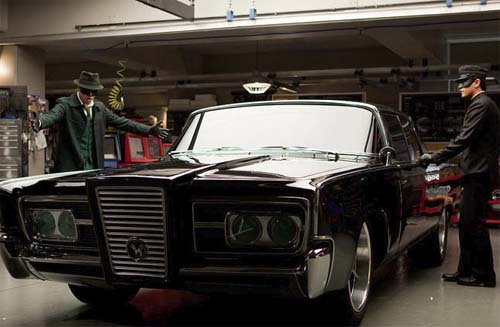
The Green Hornet is your typical New Geek superhero movie. This is a vastly vile film written by joyless twentysomething cretins. It contains few pleasures. It is deeply misogynistic and ageist in the way that it ridicules a 36-year-old woman played by Cameron Diaz for entering the job market in her “twilight.” It is also astonishingly revisionist in the way that it has altered the 28-year-old Seth Rogen, a naturally fat man who has slimmed himself down for the role. In manipulating Rogen’s innate physicality, the filmmakers have made him look a good decade older than his years. It doesn’t help that Rogen has the thespic range of a thimble. Yet it’s hard to feel much sympathy for this starving baboon. For he was one of the two hacks who wrote this piece of shit.

The Green Hornet is a movie upholding the capitalist con. The 3-D was clearly decided upon at the last minute. Aside from a bottlecap flicked into the air by Kato — a cap looking as chintzy as some penny squished through a souvenir machine — there is very little in this movie that couldn’t be confined to 2-D. It doesn’t help that Britt Reid, the man who becomes the Green Hornet, is an incredibly obnoxious and tremendously stupid character. I’m all for assholes on film. Vince Vaughn (the good Vaughn to Matthew’s evil one) has eked out an interesting career playing assholes. But if the asshole doesn’t have dimension (such as Kevin Spacey’s Buddy Ackerman in Swimming with Sharks) or if you don’t make him a funny side character (such as J.K. Simmons’s J. Jonah Jameson in the Spider-Man movies; just enough screen time to make an impact), then there’s no purpose in serving up the asshole on screen.

You know that you have a problematic movie on your hands when the most interesting scenes don’t involve the title character. Take a moment featuring an unbilled James Franco playing an emerging crystal-dealing nightclub owner trash-talking Christoph Waltz’s Chudnofsky, the movie’s main villain. Chudonfsky says to the nighclub owner, “I’ve wanted my entire life to achieve the goal to be in charge of all the crime in Los Angeles.” The nightclub owner replies that the crime world now operates upon charisma, not hard work. We see how one line announces Chudnofsky’s motivation. And Franco’s response establishes an interesting thematic question for the movie to pursue. Will Britt Reid be able to eke out a crimefighting existence through charisma or hard work? Will the movie invert or demolish this dichotomy?

The problem, of course, is that Reid has neither quality. He’s merely an obnoxious buffoon with money who has to reiterate what’s going on to the audience every time there’s an action scene (“Hey, they’re really organized,” “This is cool,” “Whoa,” and other Mathew Vaughn-like ADR dictating to the New Geek audience what is clearly happening on the screen before them; the filmmakers clearly view the audience with great contempt). So the movie immediately becomes pointless. Yes, Reid has his manservant Kato (Jay Chou) to help him out. Kato makes a coffee with a colorful swirl pattern on the top, designs cool vehicles equipped with puncturing tires and machine guns, and knows marital arts. And when Reid becomes The Green Hornet, it is Kato who does all the work. The movie is too incompetent to establish an interesting conflict between Reid and Kato. For example, if Kato is so smart and Reid is cockblocking Kato’s efforts to woo Lenore Case (the female doormat I mentioned above played by Cameron Diaz), wouldn’t the film be more interesting if Kato began exploiting Reid by getting him to do his bidding? If you’re a smart Asian man in the 21st century, there’s no real incentive to be a white boy’s bitch unless you’re getting paid or he’s getting played.

But I’ve only been discussing the crude formulaic problems. Let us be clear. Seth Rogen is an avaricious man no different from a middle-aged investment banker. He only wants your money. The Green Hornet is Seth Rogen’s subprime loan. Read the goddam agreement. He has even persuaded the great Michel Gondry to sell out. Gondry may offer Kato-Vision, but it’s hardly worth the effort. Frankly, it’s astonishing that a man who was smart enough to collaborate with Charlie Kaufman (twice!) would settle for tenth-rate material.

What Rogen and co-writer Evan Goldberg have done is take an interesting character that wowed audiences on the radio (an audio collection of the original program is available here to make your comparisons) — something fun and magical that was “hidden in plain sight” — and turned it into a lifeless and derivative movie very much designed for the New Geeks. Already, the New Geeks have scarfed down The Green Hornet like starving dogs burrowing their vanquished muzzles into open cans of Alpo. “It was charming, very funny, and worthy of repeated viewings,” writes The Beat in an uncritical, sycophantic, and embargo-breaking review that reads like someone at PW was given a big bag of cash. The New Geek hacks at Cinema Blend offer “5 Reasons You Should Be Excited About The Green Hornet,” as if there couldn’t possibly be a single reason to reject the hype.

If mainstream audiences reject The Green Hornet this weekend (as they did last summer with the more distinctive and less compromising Scott Pilgrim vs. the World), then the New Geek influence may at long last walk the death march. About fucking time. No self-respecting geek of any stripe has any business aligning herself with a sexist, racist, and patriarchal set of values. Seth Rogen is not the geek’s friend. He is a fleeting figure and slobby sellout to be thoroughly rejected. He is a loathsome “talent” hiding in plain sight.