NYFF: Oki’s Movie

[This is the third in a series of dispatches relating to the 2010 New York Film Festival.]

It’s often a wise move to distrust any movie featuring a moviemaker as the protagonist, even the ones offered by interesting directors – just as one avoids reading novels involving novelists. It’s the easiest and most cannibalistic creative decision imaginable, akin to a fresh father barraging you with buckets of baby photos. You smile politely, but after the sixth hour flicking through photo albums, you courteously explain that there’s a little more to the world. In the case of the creative artist offering the creative artist narrative dilemma, either the story has to be truly remarkable or it must offer a fresh spin. (Even Stephen King understood this with Misery.) So one approaches Hong Sang-Soo’s lackluster medley of four short films – all featuring the same three characters – with tremendous frustration, baffled as to why such a one-note offering would be selected for a world-renowned film festival. Was there a shortage in South Korean submissions? Was it Hong Sang-Soo’s brand name? (Hong has had many of his films play previous festivals.) Is there an inherent selection bias towards movies about moviemakers?

Whatever the reason (and lest this essay be misconstrued as a takedown, please note that I am not anti-Hong), it is worth pointing out that the fourth of the four films, the titular “Oki’s Movie,” does demonstrate that Hong has a gift for Eric Rohmer-like meditations and is really the only short that should have been considered. It makes no explicit mention of moviemaking, aside from the narrative suggestion that what we are witnessing is a desperate reconstruction or perhaps a young adult’s early stab at pegging the world. Told from the viewpoint of Oki (Jung Yumi), a woman who loves both an older man (Professor Song, played by Moon Sung-kuen) and a younger man (Jingu, the filmmaker character played by Jung Yumi), it offers a storyline in which Oki takes both men to Mt. Acha on differing winter days, with Oki’s voiceover indicating the difference between the two men. The older man stops to admire a wooden deer and a pavilion. The younger man whooshes right by. The older man takes Oki inside for a lunch of wine and seafood pancakes, while the younger man uncouthly slurps noodles outside. This comparative basis offers a striking perch to perceive human differences. But on the basis of the three shorts preceding this, you wouldn’t know that Hong had this kind of rumination in him.

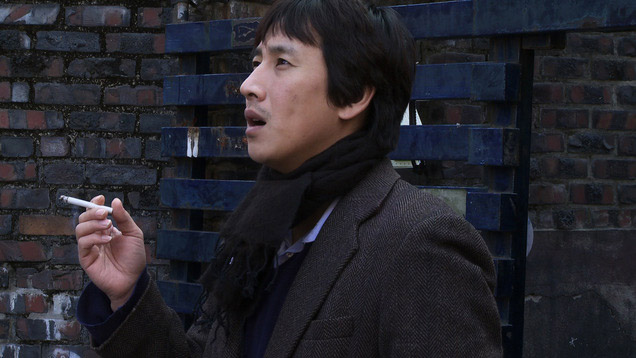
“A Day for Incantation” (the first short) follows Jingu after he has become something of a success, with a few films under his belt. Jingu is the most annoying of creative character stereotypes: the struggling artist who feels entitled to create art, but who doesn’t want to work and acts like an asshole. He lives his life drinking and smoking too much, trying desperately to get into the pants of any unmarried woman (such as one woman who takes a photo of him on the bench, who he runs away from upon learning that she is married). There is a scene in which Jingu attends a screening Q&A and an audience member accuses him of philandering and breaking a woman’s heart. But these pedestrian comedy situations, combined with the film’s visual inertia (Hong often shoots very long takes with two characters where they don’t even move), as static and as unfunny as a comic strip, makes one wonder if Hong has momentarily transformed into a Korean Jim Davis.

One doesn’t expect a student film narrative situation from a film festival selection. But that’s just what we get with the second short, “King of Kisses,” which follows Jingu’s college days, where he desperately tries to fall in love with a woman. Here, Jingu is more humble, if more spastic. His friends call him “Psycho” and it’s largely because he has a stalker’s tendency to pester Oki, claiming that he has never dated before. I saw this type of film too many times back in film school. It’s amusing enough if you happen to know the people behind the movie, but, beyond this, there’s a very good reason why this formulaic storyline stays in film school. Lonely guys with a film camera who aren’t far from twenty are hardly the best assessors of relationships. The student film feel is further bolstered by the tendency for a crisp off-camera voice reproducing the other party in a telephone conversation. Perhaps the point that Hong is making is that his characters are so ensnared with recreating life that they cannot live it – even if what we’re watching may very well be some recreation of their life experience (as suggested by the fourth short). But he offers us very little material here to care.

The third film, “After the Snowstorm,” is a little better than the first two. Professor Song awaits his two students, Jingu and Oki, after a snowstorm has hit. His students bombard him with questions about life (“Are we human beings or animals?”), for which Song, claiming himself to not be particularly wise, doesn’t have many good answers. It’s an interesting concept that doesn’t really go anywhere, even if it does set up the more thoughtful perspective of the fourth film. But at least there’s a fun moment when Song pukes up a live octopus. (Come to think of it, Hong’s tendency to zoom in on his characters is reminiscent of John Waters’s early films. But Waters had genuine wit and iconoclasm within his dialogue and the mighty Divine to deliver it. It is safe to say that not one of the three leads here has Divine’s gravitas.)

While I haven’t exactly written off Hong, these four shorts are a poor introduction for anyone unfamiliar with the man who included a behind-the-scenes hentai moment in The Day a Pig Fell Into the Well. (“Once more with feeling!” ordered the director to the actress moaning into the mike.) These Hong films don’t feel particularly subversive or, for that matter, particularly interesting. They are as shallow as the filmmaker character contained within the narrative. Let’s hope that Hong himself has avoided the same fate.
NYFF: The Autobiography of Nicolae Ceauşescu

[This is the second in a series of dispatches relating to the 2010 New York Film Festival.]

“The film we just saw,” muttered a nameless tastemaker just after the screening. “Who is it for? Romanians? Political junkies?”

“Humorless film geeks? Cultural masochists? Those who view watching paint dry as too adventurous?” I was tempted to rejoin. Some random canvassing revealed I wasn’t alone in my assessment. Even so, who was I to judge this film when my own grasp of Eastern European history was so tenuous? My knowledge of Ceauşescu was as dependable as a quadriplegic being asked to prepare a Caesar salad. (Indeed, one could stab both shaky offerings with a plastic fork. I apolgize to Romania.) But it seems to me that a movie collecting the life of a possibly clueless, possibly calculating leader prone to genocide, basking in his private personality cult, and a view of his subjects out of step from the reality of their privations (I believe Ceauşescu’s eventual assassination by Romanian revolutionaries should have been the telltale sign that something was awry on this last point) shouldn’t be so lackluster. I certainly hadn’t felt blasé about Shoah or any of the countless political documentaries with protracted running times that I had wolfed down in my twenties.

I suppose that the dry intellectuals — the so-called film dweeb crowd that certain online lunatics complain about, but who aren’t nearly as bad as paranoia elsewhere would suggest — are likely to appreciate this formalistic exercise. At three hours, this film is so oppressively long, with few pleasures laced within its Bucharest Death March, that the viewer feels very much without options, much like a citizen of Communist Romania. If this is the emotion that director Andre Ujica intended to convey, I can safely report that he has succeeded. It was only my commitment to judging the entire film that prevented me from stomping out of this snoozefest and carrying out my own private revolution with a bottle of scotch.

Let me dwell first on a few aspects I enjoyed: (1) a volleyball game, taken from what appears to be home movies, in which Ceauşescu is physically awkward and hilariously girly, recalling George Herbert Walker Bush’s wimpy image (Remember that pathetic baseball throw? Infinitely worse than Obama and the man was captain of his Yale baseball team!), (2) a ridiculous parade for some Communist triumph featuring surreal floats depicting sporting matches pushing slowly down the streets (two boxers going at it as the individuals holding the ring move forward, a volleyball game in which one team constantly paces backwards, et al.), (3) up to a certain tedious point, the repeat imagery of world leaders jetting away from airport runways, thus demonstrating how ephemeral their alliances with Ceauşescu are, (4) the occasional jarring cuts to Romanians dancing to pop music (I wish there had been more of this, but this film prefers to drag), and (5) Ceauşescu’s failed attempts at aristocratic flourishes (his awkward efforts with a sled, his unpersuasive claim that he is an intellectual, et al.).

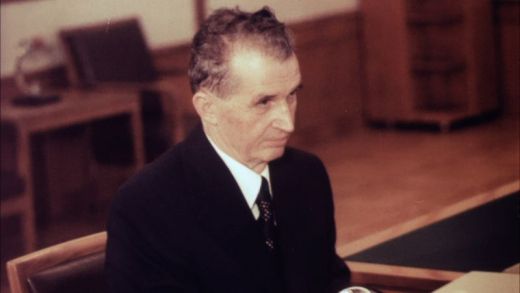
In other words, the film is, at times, an amusing counterfactual. Apparently, it truly takes Communist oppression to get filmmakers to take the piss out of their leaders, particularly when Ceauşescu – with his unbrushable childish curls protruding atop his head, his puffed up cheeks, the suit that doesn’t quite fit his chubby form, and that lower lip resembling, at times, a half-inflated condom accident – strongly resembles an assclown. (I wish some enterprising underground filmmaker would make a similar film about Bush the 43rd or Tony Blair. If the Autobiography succeeds at one thing, it demonstrates the elastic nature of contextualized found footage.) Even so, three hours of world leaders shaking hands, Ceauşescu engaging in photo ops, and Ceauşescu supervising projects that we know will fail (inter alia) does get more than a bit tedious. And the moments I’ve mentioned can only be mined after some tedious ten minute setpiece. Andre Ujica does demonstrate a certain flair for visual association (the clean and orderly buildings of Communist China compared against Communist Romania’s industrial chaos, leading one to ponder whether it’s the man, the system, or the people which causes this kind of disparity), but his film is centered more around Ceauşescu as Buffoon. Does a buffoon kill 70,000 people? I suppose that moral question depends upon how swift you are with reductionist assertions and your worldview. But this Autobiography, while not explicitly referencing Ceauşescu’s early days as a peasant, chooses to gloss over the suffering and the death. Yes, I get that Ceauşescu very much did the same thing and that the film is meant to be a vicarious expression of this. But this seems an incomplete and needlessly limiting portrait of a man who, despite his frippery, was as calculating as he was flip.

Review: Never Let Me Go (2010)

In 2005, Kazuo Ishiguro wrote a nifty science fiction novel named Never Let Me Go. Despite the fact that Ishiguro’s narrative was steeped in speculative fiction cliches (organ harvesting, parallel universes, extended human lifespan creating an underclass, the belabored philosophical inquiry over whether an artificial creation has as much of a soul as its creator, et al.), the novel was inexplicably categorized in the fiction section, leading to many uncounted stoned conversations among frustrated geeks over the question of whether twenty dollar bills had been slipped into the hands of bookstore managers. But it was more likely that Ishiguro eluded the genre ghetto, garnering that vital all-access pass awarded to certain literary titans, by way of putting together imagery and story considered graceful and/or beautiful by the cultural elite. (To cite one example, Tommy reacting to a piece of news as if the messenger was “a rare butterfly he’d come across on a fence-post.”)

The literary critics at the time, mostly unfamiliar (as always) with speculative fiction, praised the novel as if nobody had told similar stories before, or as if the “genre” was confined to certain moonlighters. The New Yorker‘s Louis Menand smugly declared that “the book belongs to the same genre as Philip Roth’s The Plot Against America, counterfactual historical fiction,” as if Harry Turtledove (or Fritz Leiber’s wonderful novel, The Big Time, for that matter) could not exist in the same bookstore. The fiery and often superficial Michiko Kakutani was even more dismissive, writing, “So subtle is Mr. Ishiguro’s depiction of this alternate world that it never feels like a cheesy set from The Twilight Zone, but rather a warped but recognizable version of our own.” (Never mind that the majority of The Twilight Zone was truly brilliant and paradigm-changing because of its commitment to writing and acting. Only a superficially bourgeois critic would condemn art purely on its aesthetic.)

And for those of us who read literary and pulp novels because we genuinely appreciated both, it was a bit embarrassing to witness all this ignorance. And let’s be honest here. Take away Ishiguro’s beauty and Never Let Me Go is little more than a rewrite of the Star Trek: The Next Generation episode, “The Measure of a Man.” At least the British Science Fiction Association had the decency to shortlist Never Let Me Go for the Arthur C. Clarke Award, where Ishiguro lost to Geoff Ryman. (A few years later, the critical elite would deliver similar plaudits towards Cormac McCarthy’s YA dystopian novel, The Road. The great irony is that Oprah Winfrey would be the one to push the book hardest. Through the populist medium of television, Winfrey’s endorsement dwarfed all the fulsome praise eked out by a handful of pedantic mice.)

Now Ishiguro’s book has made its way to the big screen, where the mass medium of cinema hopes to reframe it yet again. Never Let Me Go is hardly the first time Ishiguro has tangoed with celluloid. In 1993, there was a film version of The Remains of the Day put together by the Merchant-Ivory team, a cold and highly overrated team of collaborators who are more committed to putting audiences to sleep than producing art that pops. I have tried to watch the movie three times over the past seventeen years and was only able to make it to film’s end once without falling asleep – and this was only because I wished to respect my sexy videowatching companion, who counted herself as a Merchant-Ivory fan. Yet despite the film’s bland and soporific qualities, it was afford all sorts of award nominations. A more successful Ishiguro collaboration was Guy Maddin’s The Saddest Music in the World (2003), but one suspects its giddy qualities emerged only because Maddin and his co-writer George Toles had the decency to rewrite a hypothetical dud. I avoided 2005’s The White Countess, largely because James Ivory had directed the film and I had no desire to relive the trauma of The Remains of the Day in any form.

So when I learned that director Mark Romanek (the man behind the underrated One Hour Photo and several music videos) and hit-or-miss screenwriter Alex Garland (once a brilliant novelist) were involved with Never Let Me Go, I figured that this adaptation would be more Maddin than Ivory, that the Ishiguro cinematic stigma would be salvaged. I regret to report that this was not the case. Never Let Me Go bored me to fucking tears.

The film’s sloooooooooooooooooooooow pace, presumably intended to invite comparisons to needlessly protracted slideshows or weekend corporate retreats, is perhaps best epitomized by the following exchange (character names replaced by variables to avoid spoilers):

A: We’re going to do it.

(Unfathomably long pause before cutting to B.)

B: You’re going to apply.

(Another needlessly fucking long pause before the next line; never mind that all this would have been tightened by the line, “We’re going to apply.”)

A: Yes.

(A pregnant pause. Good Christ, Garland, you should know better than this.)

B: Good.

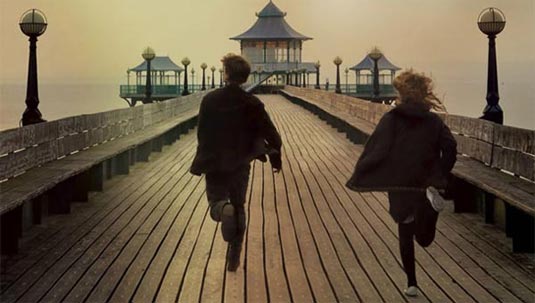
And that’s it. That’s Romanek and Garland’s idea of exposition. And we’re supposed to accept this weak narrative because the characters here, as the film telegraphs without subtlety, are sequestered from society and committed to providing organs through “donations.” (That’s not really giving anything away. If you don’t figure this out in the first twenty minutes, then you’re not paying attention.) But the atmosphere never feels particularly disturbing (as Romanek’s last feature film did, perhaps more because he had the smarts to tap into Robin Williams’s undeniably discomfiting qualities), which is odd given that Romanek has a great visual knack at conveying isolation (such as the mostly barren blue wall of an apartment or the Gordon Willis-like amber glow of a dark hospital corridor illuminated solely by the sun). Romanek gets the feel of the class structure here by framing many of his shots with the backs of heads to the camera. He gets a great performance from Carey Mulligan, who is especially good at disguising her unshakable sadness, pretending to be human with tragically feeble smiles and fine cheekbones. But scenes from the novel that should feel creepy, such as the scripted laughter at a television sitcom, feel more like obligatory than vital.

The fault here must be leveled at Alex Garland, who has clearly traded in his fiction talent for the lucre of video games and passable screenplays. It’s almost inconceivable to be reminded that Garland once had his finger firmly on the pulse of his generation. Clearly, those days are gone. Garland doesn’t seem to understand that Faulkner and Fitzgerald aren’t remembered for their Hollywood work, but the attentions they committed to the page. And Garland’s failure to evoke Ishiguro’s subtle style on screen isn’t just the indication of a screenwriter out of his depth. It’s the sad story of a burned out talent, once capable of reaching a mass audience and defying myopic critics, who doesn’t even have new novels to atone for the hackwork.

Review: Heartbreaker (2010)

The Lavender Hill Gang, Dirty Rotten Scoundrels, A Fish Called Wanda, just to name a handful. These films, balancing crime with comedy, work so well because they contained the telltale results of a very specific talent: namely, a peculiar attention to behavioral rhythm. It’s the same skill that can be observed in a mystery master like Donald E. Westlake, who could oscillate between his Dortmunder novels (light comedy) and his Parker novels (wonderfully callous and crisp page-turners!) precisely because he was so committed to portraying every motivation, every nuance, every nicety behind the gambit.

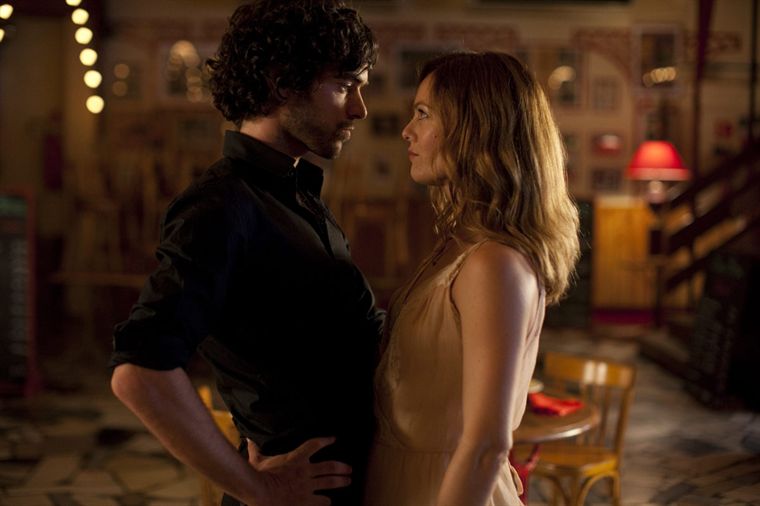
Heartbreaker — a title bearing Benatar allusions, but which I assure you is a French film — doesn’t explicitly deal with crime. But it does concern itself with a close cousin: deceit within the private sector. And even though this charming French comedy contains a rather absurd storyline (three people are privately commissioned to split up relationships; they have a 100% track record at this) and a rather absurd setting (mostly Monte Carlo), it manages to slough away these implausibilities due to its commitment to a post-Lubitsch presentation of an illusion along the lines of Westlake.

Screenwriter Laurent Zeitoun* and director Pascal Chaumeil get us interested by establishing how these three operatives work in a lengthy pre-credit sequence photographed partly from the mark’s vantage point and partly revealing the ruse. The mark here is a woman on holiday who wants to see the dunes. Her boyfriend is more preoccupied with lying by the pool and contemplating the possibility of a wet t-shirt contest. A dashing young man offers to driver her out to the dunes when layabout bf fails to fulfill his pledged transit. Said man (who we later learn is named Alex) mentions something about his dead partner. He offers “treatment” to indigenous kids, which we see to be a staged sham. Alex is romantic to the woman in ways that her present partner is not. We later understand that he recites the same lines, eliciting the same response.

Since a relationship can be essentially dissolved by several lines of code, we’re left wondering if this is some kind of bizarre cinematic conceit. Particularly since none of Alex’s women can detect the ruse. (Indeed, they remain completely understanding why he cannot enter a relationship, even after his anemic yet precise explanation.) So is it the specific turf that Alex is working? Is Alex’s Eliza-like heartbreaking some statement from the filmmakers on the folly of love or the silliness of narrative? Is his inflexible script sustained by the fact that he has two able accomplices capable of donning costumes and roles to impede upon this presentation of reality?

Whatever the reasons, we’re swiftly entertained by Alex and his petty heartbreakers. And this human interest is aided by some not bad casting. As Alex, Romain Duris is competent. But there’s the wonderfully expressive Julie Ferrier (one of the best elements in Micmacs) playing Melanie, Alex’s sister, able to infiltrate a hotel desk faster than a speeding locomotive and Francois Damiens as Marc (married to Melanie), who has been looking for the perfect assignment to try out his own problematic roles.

The films storyline hinges upon whether this trio can split up a very perfect couple in ten days. Juliette (Vanessa Paradis) is a 30 year old wine expert who is marrying Jonathan, a seemingly perfect Englishman, in ten days. (Indeed, Jonathan is so perfect that he donates his doggie bag to the trio, momentarily bedecked in sloppy apparel and confused as vagrants.) In other words, here’s another cliched case of whether an expert can succeed at his toughest assignment, with the additional cliché of Alex falling for Juliette as the job carries on and yet another additional cliché of Alex owing a considerable amount of money to the mob.

Yet I enjoyed the movie as a form of stylistic escapism. Not because of the storyline, but because – much like Micmacs – I was more interested in how the filmmakers would sustain the illusion. There is one funny scene in which Alex, pretending to be Juliette’s bodyguard, insists that he has no feeling in his leg. He claims that it’s the result of an injury. This doesn’t stop another character from stabbing his leg with a fork in order to test Alex’s resolve, leading Alex to wince off the pain. And in an effort to find some connective point with Juliette, Alex preposterously claims that he’s a fan of George Michael and Dirty Dancing (two of Juliette’s cultural interests unearthed during Alex’s research). The former is unconvincing, but the latter results in Alex learning the moves for the film’s final dance in his hotel room and the eventual recreation of said routine. I’m hardly a Dirty Dancing fan (no fault of the dearly departed Patrick Swayze, but I recall much male shouting in video stores on the subject circa 1987), but I was both amused and troubled by the idea of cultural reenactment as a method to win a woman’s heart. I mean, how sad is that? I could buy this behavior from twentysomethings. But these people are professionals in their thirties. And when one considers the deceit motivating Alex’s Swayze replay, if you’re anything like me, then you may very well be able to kickstart some ethical debate with your date for this date movie.

The film does ultimately present a less fabricated form of love (outside Marc and Melanie’s marriage), but this “genuine” presentation isn’t nearly as interesting. I kept hoping that this film would go the distance, portraying Alex as a man who sadly can’t see any option but deceit, even in his non-professional obligations. A coda more befitting its con.

* The press notes offer this oddly phrased CV-like tidbit for Zeitoun: “Visits Paramount Studios in Los Angeles and discovers the profession of screenwriter.” This leads me to wonder if folks now visiting the City of Angels now observe lavish naumachiae bankrolled by Hollywood studios, with the spectators invited upon three Spanish ships to discover unexpected vocations when they aren’t looking for escape routes leading to the West Indies.

Review: Bran Nue Dae (2009)

Bran Nue Dae ain’t quite the Aussie answer to Tommy – even if Jimmy Chi’s bouncing baby has discarded similar placentae in its nearly three decades of development. Chi, one of several Aborigines sowing his wild oats in Broome and asked to insulate his roots with Catholicism’s electrical inflexibility (see any number of texts for historical confirmation), wrote several fun and punchy tunes about living and resisting these conditions in the early 1980s. He performed the songs with his band, Knuckles. (Regrettably, VH1 still lacks the creative vision, much less the fist, to push beyond their white bread nostalgia and commission a Behind the Music segment on Knuckles. In considering Bran Nue Dae‘s roseate production history, one wonders if there was some behind-the-scenes, bottle-smashing fracas swept beneath the rug.) By decade’s end, Chi had constructed a musical around these songs, which opened in the 1990 Perth Festival and became such a national success that Chi was given the “State Living Treasure” honor by the West Australian Government in 2006. (Why my dim nation – the You Ess of Ay, perfervid in its belief that it remains numero uno – lacks the decency to afford similar titles to its cultural wunderkinds is a topic that another rabblerouser may wish to address at length.)

Thirtysomething years ago, I did not pop out of a uterus in Australia. I have yet to set foot in that magnificent continent (and, assuming anyone is foolhardy enough to give me a boatload of cash, I certainly hope to before my inevitable arm wrestling match — nay, a knuckle-twisting contest! — with the Grim Reaper!). So I feel compelled to report that, up until now, I was entirely ignorant about Jimmy Chi and Bran Nue Dae. Indeed, had you merely given me the first word, I may very well have confused you with a General Mills representative. And had not someone had the decency to send me a press invite to Rachel Perkins’s film adaptation of Chi’s musical, I may never have known about it. Clearly, there is some ancillary kismet in getting laureled State Living Treasure. (NEA, are you listening?) I must likewise confess that, having not experienced the musical, I am probably ill equipped to deliver an appropriately comparative summation of this “film by Rachel Perkins” to its native material. (It must be noted that Perkins has co-written the screenplay with Chi and the playwright Reg Cribb.)

With that disclosure out of the way, I can report that Perkins’s film is a pleasant, if somewhat clumsy adaptation. It feels like a fey Frankenstein monster composed of random components that have been cluttering up the laboratory closet a bit too long: part musical, part road movie, part coming-of-age drama, and part social satire. To some degree, watching this film is the cinematic equivalent of a yard sale where you end up unexpectedly buying a good deal of disused goods without feeling terribly guilty. (Guilt? The reverse here is true! You’re left wondering why these dusty little bibelots have been ignored for so long and you’re grateful to know that the abandoned items are now traveling to good homes. Hell, if you’re anything like me, you’re probably buying a lot of this stuff for friends and acquaintances, volunteering to varnish or paint the rattled or pockmarked after an evening of steady scotch.)

Perhaps I felt this way because the movie is set in 1969. Perhaps I was simply in the mood for a homespun movie put together by people who obviously had a lot of fun making this movie. Perhaps my recent move from one apartment to another led me to be in close kinship to the film’s peripatetic characters. A modest rundown then of things I grooved to: I very much enjoyed Perkins’s blocking tic of having actors joyously spiraling their way around reedy support beams during musical numbers. I was astonished to learn that Jessica Mauboy, who appears here as a very pleasant romantic interest, had not acted before and I was further alarmed to discover that she was a runner-up in Australian Idol. So whoever adeptly plucked the moonfaced Mauboy from an amateur pool deserves a great pat on the back, as her girl-next-door demeanor does help to atone for Rocky McKenzie’s modest limitations.

Yes, the film rests heavily on McKenzie’s shoulders. He is not quite up to the task, but he is, after all, playing an adolescent. McKenzie plays Willie, who is diffidently attracted to Rosie (the aforepraised Mauboy). He lives in Broome. He attends Catholic boarding school and contends with Father Benedictus (Geoffrey Rush), who has terrible plans to civilize his students. (The word “civilize” is not mentioned, but it may as well be. Rush delivers as usual, his performance reminiscent of a man who has spent several weeks rereading Kipling.) Willie stands up to this domineering docent (“Thou Shalt Not Starve Either” is Willie’s rejoinder to the prohibition placed upon Benedictus’s arsenal of Coke and Cherry Ripe bars; said snack munitions used to woo stray strangers into doing Benedictus’s bidding) through the medium of an amusing song. Soon he escapes and is on the road, and on the lam from Benedictus. Willie meets up with his Uncle Tadpole in the streets. (Yes, it’s one of those problematic coincidental run-ins. But this movie is based on a musical.) Tadpole takes the rest of Willie’s money and spends it on booze. Vaguely guilt-ridden about this, he agrees to take Willie back to Broome.

The film’s early efforts to establish Tadpole as a paternal figure (the experienced older man guiding the shy stripling) aren’t terribly successful – in part because of the contrived run-in that I mildly kvetched about in a parenthetical statement, with some understanding of the developmental Cuisinart this movie no doubt girded through. But when this dynamic duo encounters two hippies traveling through the outback in a VW bus, the film likewise hits the gas. For the two manage to take advantage of their starry-eyed sentiments to hitch a ride back home. Conflict ensues, along with the unanticipated run-ins one expects from a road movie. Aboriginal football teams, bad Chinese restaurants, an older woman fond of drink who tries to make it with Willie under a tree with inflated condoms and is chased away by her jealous man just before consummation. All photographed with splashy bright hues and directed with a sanguine disposition.

Of course, with so many characters and subplots thrown into this madcap gumbo, the film’s final moments are as cluttered as the fifth act of Cymbeline (of course, if George Bernard Shaw were to rise from the grave to rewrite Bran Nue Dae, he would be rightly labeled an imperialist). But if I’m going to nitpick a film that mostly works a pleasant diversion, I may as well spend my time condemning a bowl of jellybeans.