Review: The September Issue (2009)

septissues

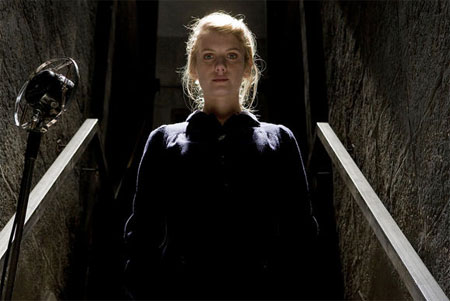
“People are frightened of fashion,” explains the frosty Anna Wintour at the beginning of The September Issue, a documentary concerning itself with the behind-the-scenes assembly of Vogue‘s September 2007 issue. I agree with Wintour. It’s not the fashion that frightens me, but the people who feel compelled to live for nothing but fashion.

Take editor-at-large Andre Leon Talley, a man so hopelessly flamboyant and fussy with his sartorial sensibilities that he cannot be bothered to wear a T-shirt and shorts on the tennis court. Why is he on the tennis court to begin with? Wintour suggested that he get some exercise. Listen to the great dictator. She might end up dancing with your globe.

After seeing this film, I think it’s safe to say that I’d sooner place my head into an open oven with a Zippo than work for Vogue. This is a world run by vicious capitalists in which beauty is prepackaged with all the warmth of a malfunctioning Twinkie machine. An editor can slave for hours to find the perfect colors or a striking look reminiscent of a noir movie, only for Wintour to come in and throw out a $50,000 photo shoot on an aesthetic whim. Young designers like the bright-eyed Thakoon arrive slightly terrified of Wintour, but all too eager to supplicate for photo ops and other forms of commercial whoredom.

What is Wintour’s excuse? Why does this devil wear Prada? Her daughter, Bee Shaffer, quietly explains that she has no interest in getting into the fashion world. And in the film’s only unguarded moment with Wintour, she confesses that her family finds her vocation “amusing.” (Wintour’s brother, Patrick, is a long-time political editor.) This is not someone to be frightened of. This is someone to pity. If you can’t hold your head high after decades in the fashion world, then what’s the point of the work?

“Don’t be too nice,” says creative director Grace Coddington to the young editor Edward Enninful. “Even to me. Honestly, you’ll lose.” Enninful is later seen clutching a giant cup of Jamba Juice to get through the day, and I began to grow concerned over whether he was eating anything. Until I realized he wasn’t even drinking a real smoothie.

In fact, even accounting for the 300 hours of footage here whacked down into two, these people don’t seem to eat. “Stop at Starbuck’s please,” barks the thin-framed Wintour to her driver. Bottles of Fiji water are everywhere, guzzled down in lieu of a hearty meal and never enjoyed with other people. There is one moment in which Coddington pecks at a salad in a plastic container, but it’s only because she’s upset at another one of her meticulously arranged shoots being disposed of. You’ve got to be hungry for the work. You’ve also got to be hungry.

Coddington is the most interesting figure in this film. She’s the only editor at Vogue who still personally dresses the models. She’s also the only person in this film who uses older photographers as reference points. “It hard to go on the next thing,” says Coddington, when asked about so much of her work being thrown out. But she’s had the tenacity to stick it out with Vogue for forty years, just as long as Wintour. She seems tough enough to duke it out with Wintour over an artistic decision. Unfortunately, she’s not the one here with executive privilege. Hence, the sad salad-eating scene. “If the magazine doesn’t sell, I don’t have a job,” she says late in the film.

But to be perfectly fair, Vogue is still capable of some creative spontaneity. With numerous pages to fill at the eleventh hour, this documentary’s photographer, Bob Richman, is recruited to stand in for a shoot, jumping up and down for the camera’s lens to match a model’s gaze. It’s one of the most vibrant photos in the issue. Coddington, to her credit, asks the people not to Photoshop Richman’s paunch.

Sleazy editor after sleazy editor insists that the September 2007 issue of Vogue is “the biggest in our history.” But this is Vogue‘s history, not America’s. Is this really a sustainable fantasy? $50,000 of work thrown out? That’s a good annual salary for an editor who can do great things. Vogue can’t be entirely discounted, but this documentary does show that many things have gone horribly wrong. While I’m not necessarily in favor of seeing the magazine industry fold into oblivion, this film certainly fed my anarchist impulses. Fashion shouldn’t be this cartoonish. Is this the fault of the filmmakers? Were there unused shots of Wintour being human? I certainly hope so. But whatever the film’s oversights, perhaps some of the film’s subjects might be inspired by the depiction to remember the impulse of being alive. If they have souls left. Perhaps Conde Nast’s current financial woes are a self-correcting prophecy.

Review: Inglourious Basterds (2009)

basterds

The important thing to understand about Quentin Tarantino is that, as an artist, he has no interest in real life. (Mr. Tarantino’s excellent Crate and Barrel adventure from 2004 does not help his cause, but perhaps there is a reasonable explanation.) Several dour and dense critics, most over the age of 50, cannot see this clear truth before them and have been spending the past few weeks willing their collective blood pressure to rise because they cannot pigeonhole Inglourious Basterds into that neat higher category they desire. (One wonders whether the late Don Edmonds, who gave us the first two Ilsa films, would have faced similar reception in the mid-seventies had he possessed Tarantino’s allure.)

I’ll get to these mostly humorless critics later. They include the normally astute Jonathan Rosenbaum (not this time), Daniel Mendelsohn (who is closer in his assessment, but, not nearly close enough), and the characteristically pompous Ed Gonzalez (who doesn’t seem to ken that Tarantino’s talkathons are part of the point).

The important thing to understand is that Tarantino has never been real. This is the man who didn’t see the humanity in Kirk Blatz’s Reservoir Dogs improvisation. (Blatz played a cop and blurted out the line, “Don’t burn me. I’ve got a kid.” Michael Madsen then told Tarantino, “Quentin, I cannot fucking touch him after he says that to me.” Tarantino’s response? “No, no, I think it’s great. I think it’s wonderful. It brings a whole new element to it.”) This is a man who introduces a kid into the Bride’s domestic brawl with Vernita in Kill Bill Vol. 1 for similar reasons. Character development? Oh, hell no. The kid brings a whole new element. And in Death Proof, when Stuntman Mike is asked why he spends so many hours drinking club soda and lime in a bar, Stuntman Mike says, “A bar offers all kind of things other than alcohol. Women. Nacho grande platters. The fellowships of fascinating individuals like Warren here.” Stuntman Mike turns out to be a psychotic. And it’s easy for any person with a remote understanding of life to see why, given this superficial explanation.

But one should not blame Tarantino for all this. He has, after all, been trying to tell us this for quite some time. Here’s Tarantino in an Entertainment Weekly interview for Kill Bill, Vol. 2:

But one thing that was semi-annoying to me in reading a couple of the reviews for ”Vol. 1” was, ”Oh, this is a very wild technique and style is cranked up and the technique has gone up, but it’s a clear retreat from ‘Jackie Brown,’ and the growing maturity was in there.” ”Clear retreat” says I’m running away from what I did in ”Jackie Brown.” I’ve done it. I don’t have to prove that I can do a [mature character study], all right? And after ”Vol. 1” I don’t have to prove that I can do a good action scene.

Maturity? Leave that for the elder statesmen. Tarantino has done it already. No need to repeat it. So what does Tarantino have to prove exactly? And why does filmmaking have to involve “proving” anything? We expect such claims from a high school jock, not a man in his forties. Maybe it’s because the critical and commercial audiences have expected Tarantino to be real, in the same way that they want Santa Claus, the Easter Bunny, and world peace to be real. Or perhaps Tarantino’s films prove so intoxicating that we really want them to be real. It’s a testament to Hollywood’s failings that Tarantino’s grab bag of cinematic references and outright theft (see Scorsese’s American Boy and Ringo Lam’s City on Fire just for starters) have managed to seem real, particularly for those who cannot see the real before them.

But if Inglourious Basterds were real, then why would we accept Adolf Hitler, Joseph Goebbels, Henrich Himmler, and Martin Bormann hanging around 1944 Paris for a film premiere? Innumerable history books refute this. Why would we accept Lt. Aldo’s Apachesque hunger for Nazi scalps? Or his ridiculously inept effort to impersonate an Italian late in the film? This is a movie that presents Goebbels, sitting with a woman who is not his usual French interpreter. The scene itself equires no additional explanation. It is abundantly clear to any thinking mind that this woman is his fuck buddy. And yet Tarantino feels compelled to insert a quick scene of Goebbels schtupping her. Why? Because this film, contrary to all the high-minded talk, isn’t really about the Holocaust. It is more about America’s cathartic response to violence. There’s no need for the Goebbels scene, but we wouldn’t mind seeing it. After all, when our bloodthirst rises, we won’t remember. And what does this say about us?

There’s no need for a long scene in which the thwacks of one vigilante’s baseball bat carry on at an absurd length — to the point where a histrionic Jeffrey Wells, who clearly has his cardiologist on speed dial, called it “one of the most disgusting violent scenes I’ve ever sat through in my entire life.” More disgusting than the Saw movies? We only hear the sounds. “Morally disgusting, I mean.” Oh. But how?

The vigilante in question, known as the “Bear Jew” by none other than Hitler himself, is played by Eli Roth, known predominantly for helming the Hostel movies, which some have described as “torture porn.” But I don’t think his casting is an accident. This is, after all, a movie in which one Frenchwoman says, a few years before the Cannes Film Festival and Cahiers du cinéma have been established, “I’m French. We respect directors in our country.”

But Tarantino can’t be respected in America. Jonathan Rosenbaum ridicules the film’s title, lambasting it with sics and many other charges, but doesn’t remember that Tarantino’s debut, Reservoir Dogs, bastardized the title of Au Revoir Les Enfants. Rosenbaum suggests that Tarantino’s film is “morally akin to Holocaust denial” and doesn’t understand why Jews are giving Tarantino a free ride for this apparent travesty. Maybe Rosenbaum hasn’t lived a second-generation life of nagging and incessant reminders about the Holocaust. (It’s worth noting Lawrence Bender’s reaction to the script. He called it “a fucking Jewish wet dream.”)

Door #2 reveals Daniel Mendelsohn, a critic so lost in the classics that he can’t familiarize himself with the rampant exploitation film violence of the past four decades. Mendelsohn fixates on the scalping as “post-modern fun,” and reveals his true cathartic cards. Mendelsohn just loves seeing the scalped Nazis, thus proving Tarantino’s point — that we are all equal at the cinema. Mendelsohn is smart enough to determine that Basterds is not real life, but he sees this more as a problem than a possibility. Mendelsohn is also wise enough to pinpoint “the visceral pleasure of revenge,” but isn’t willing to come to terms with his own clear pleasure in seeing the Nazis tortured. Here is a high mind who has fallen into Tarantino’s trap, clearly reveling in the violence. One can see Lt. Aldo recruiting Mendelsohn, had he been born only a few decades earlier, and Mendelsohn capitulating his civilized and critical perch for the “fun” of revenge.

This is not, as Mendelsohn suggests, Tarantino’s “taste for vengeful violence,” but the audience’s. If you find the film’s violence fun or cathartic, you will likely wilt into Tarantino’s snare. But is this really so bad as pretending that you don’t have it in for somebody? Perhaps this is where the virtues of catharsis might be found.

Various film people have been raving about Christoph Waltz as Col. Hans Landa, and with good reason. He offers the most compelling performance in this film, and Tarantino has made him the focus of our rage. Here is a man who asks permission to enter a home but who, like Stuntman Mike’s eating habits, will wolf down a strudel without pausing to taste the meal. (When this occurs, and a Jewish woman disguised as French is forced to eat the strudel, Tarantino lingers through closeups on the cream being served atop the strudel, insinuating a kashrut violation.) Is it so wrong to cheer on the despicable Landa’s inevitable fate (comparable as it is to our blind acceptance of waterboarding)? Or are we complicit, as the film suggests later, in approving of the inevitably real results of our cinematic catharsis?

When the four major Nazis attending the cinematic premiere arrive, Tarantino is quick to highlight their names with optical arrows pointing to their location. Here they are! suggests the underlying semiotics. Do you want me to kill them for you later on in the film? If you have a problem with such underlying autocratic flourishes, this film is probably not for you. But if you are a regular filmgoer, then you might wish to consider these questions anyway.

Since Tarantino has spent a lifetime insisting that cinema may very well be the only focal point that he can start from, I found Basterds‘s candor refreshing and I was able, at long last, to accept a Quentin Tarantino film for what it was. Ed Gonzalez, whose review lede reads like a Philip K. Dick protagonist contemplating the paranoia around him, sadly could not, despite his four star rating (which I suspect I agree with). If you’re determined to see everything as “an allusion” or “a pose,” rather than accepting the visceral discomfort before you, then this film is not for you. Which is not to discount Tarantino’s hubris. A film that dares to call into question our cathartic response is arrogant by its very nature. But if we’re so content to feel outrage about whether a film may or may not be exploiting us, one wonders why we’re so determined to put such energies into the duplicities of narrative rather than the more salient (and fixable) cons before us in the real world. If you tell a lie big enough and keep repeating it, people may eventually come around to believing it. Especially in cinema. Tarantino has told a big lie. And if the town hall lunatics believe that Obama is Hitler, then I suspect that even our most nimble critical minds will have similar thoughts about Tarantino’s vision. For those of us who have accepted (and enjoyed) exploitation films all along, revisiting this source may prove a strange panacea. And if this anodyne lasts beyond our immediate epoch, then it will be Tarantino who has the last laugh. And for this grand illusion, he may rightly deserve the spoils.

Review: Taxidermia (2006)

taxidermia

I don’t know if I would go so far as to call György Pálfi our next Fellini (circa late 1960s), our next Pasolini, or even some predictable filmmaker going out of his way to offend us — even if the visual cues for his most recent film suggests all this. But he does have talent. And Taxidermia, which finally gets a limited and long overdue American release this Friday, is certainly not for weak stomachs or limited-minded men who cloak their shallow prejudicial insights inside the sheltered caverns of higher education. The distinguished critic sitting behind me, not the type to sit through a Saw installment, made numerous sounds of disgust. I kept slouching downward in my seat so that the remnants of some half-digested lunch wouldn’t hit me unexpectedly in the back of my head. But thankfully the critic was civilized.

The New York people may not get this film. But then again, they might. For my own part, I feel inclined to applaud it. For there is a regurgitation-heavy eating contest here that makes the “Lardass” scene in Stand By Me look as innocuous as a Disney film. Two men, having just finished shoving spoonfuls of some disgusting stew in their mouth, are now regurgitating their stomachs out of view of the audience. They then begin discussing a woman they’re trying to impress in the audience, all the while puking their guts into a bucket. When they return back to the competition, Pálfi’s camera sweeps through the crowd with an unexpected excitement. I was both disgusted and galvanized by this, and it is a rare film indeed that can dislodge two entirely differing feelings like this at the same time. And this audacious emotional combo made the Hollywood movie I saw afterward seem notably limp by comparison.

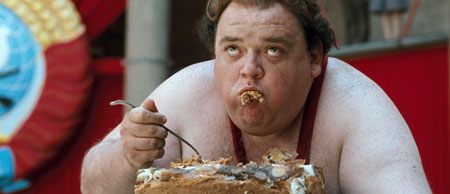
But Taxidermia isn’t just a film of scatological shock value. If you’re willing to give this film a chance (and, again, I hesitate to recommend this to those of flaccid constitutions), it offers some inventive visual ideas. A joyful man pisses fire. A camera circles across a floor containing a bathtub, revealing yet another matching bathtub, which houses any number of strange sights in its cavity (an animal carcass, a recently born infant, et al.). An act of bestiality has the violated animal transforming into various women. An enormous man — that champion eater, pictured above, a few decades later — sits permanently in an apartment with endless boxes of chocolate bars. There are giant cats he keeps in a cage and that he keeps big by having his son — a taxidermist — constantly feed them butter. Should I mention the ejaculation mass that shoots into a starscape? Or the creepy pederast we discover in the landscape of a pop-up book? Or, for that matter, the cock (penis) that gets pecked by another cock (animal)?

If such sights trouble you, you should probably blame Lajos Parti Nagy, whose short stories provided the source material for Pálfi to go crazy here. And while the last ten minutes of the film does feature some minor torture porn and the results, on the whole, don’t always work, I doubt very highly that I will see another film in which two champion eaters are enlisted to eat caviar on a boat to celebrate the 20th anniversary of Communist liberation. The film can be cartoonish at times. (Gergely Trócsányi’s shouting as the champion eater grows a bit tedious, but he is replaced by another actor in the next installment. I should probably point out that this film is also a three-part multi-generational epic.) But it’s easily one of the more alive films I’ve seen in a while.

Review: Lorna’s Silence (2009)

lorna

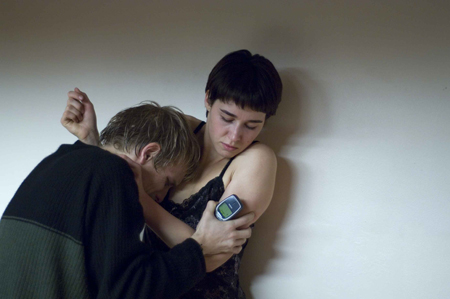
What follows are the notes I took during Lorna’s Silence, which opens in limited release this Friday:

Shuffling of notes under window. Pan up to woman. Counting. 340. Appointment. A loan. Will be Belgian soon. Against yellow wall at beginning. Green. Red counter. Blue. Talking. Telecom. Hair. Roommate. One euro ten. Close the curtains. Moving the bed. Told him no. (No cards.) Turn the music down. Music. Not so bad. Hide her. Hold on. Lorna — calls in the night.

Have to be up at six. Not going. Quit. Look in. Must resist. An addict. Cloudy. A mess. He’s quitting.

A cop. Give him. Will police pursue it? Just when you leave Belgium.

Buscopan.

Does bell ring?

Drug dealer. Buscopan for cramps. Selfishness. Paid to marry. Not divorce. Number 3. Phone calls. Water. Selfishness vs. selfishness. Cloudy Moreau. Two days. Going down stairs. Will somebody take care of me? Computer address.

Returning stuff when done. Bug. Blinds in hospital. Divorce. No. We picked a date to avoid divorce. Sokol — the Russian. If he DJs now, it’ll be weird. Couple behind dating. Need to be a widow. Sokol — kissing him. Race to set. Will she fuck him? Almost 20,000 in the account. Wait for the Russian. Banker with addresses. Walking around. Tea held with both hands. Turning a light off.

Hitting arms against doorway. Bruises. Police. Her arms. Not enough for a fast-track divorce. Bruising — self-inflicted. Junkie and thief. “I’ve never hit a woman.” Playing of cards. Five stacks. Bridge? He didn’t turn violent.

Parking lot. Cars. You don’t go to the cops. First deal with the Russians. Lorna I know. Guy at the station. Sokol beard shaved. Cleaners. Getting the divorce. Making dinner. Celebrate getting out. Her getting out. Fabio — waiting. Russian won’t wait. Two weeks after divorce.

Taxi cab driver. Paid 5,000. Red pants. Red jeans. Russian agrees. Real violence. Stripping down. Sex. Naked crying. Attempt at play. Finally emotion.

Running after him. In love? I’d handle the dirty clothes. Funeral costs. WTF? See him one last time. Real? Yellow walls. Sure you won’t stay? Running away. CO player. Thank me instead. Extra cont.

Heroin dealer. Duped him from buying it. Was that action part of the deal? Money nothing. Cleaning woman. See her at moments. At work. Drinking. Selling money.

A junkie prefers drugs to life. Three rooms and a garden. Yellow tables. With Russians. Long take. A carton of cigarettes in Moscow. Snack bar. Garden — even trees. Second floor bedroom. Wants money. Hides the money. Pregnant — saw this coming. Havent’ eaten, low blood pressure. Same as hour. Account for baby. Pregnancy. Miscarriage. Not pregnant. Too late to accept it. X-ray. Leopard shirt. The loan. 7,000 Euros. Stay. Need to set. Don’t be hard. With cock. We’ll keep running. Cabin in the woods. Talking to herself. I won’t let you die. Disappointing myth.

Review: Pleasure at Her Majesty’s (1976) and The Secret Policeman’s Ball (1979)

secretpoliceman

You know that cultural journalism is in a sorry state when only four people show up for a screening, and not a single dead soul (save for myself, still chortling with pulse) has the courage to laugh at legendary comedy material or get excited by consummate performers tinkering with sketches like tetchy scientists.

I was in a darkened theater for a film called Pleasure at Her Majesty’s, part of The Secret Policeman’s Film Festival, which kicks off this Friday at the Lincoln Center. The Festival even includes, for those cineastes saddled with an equine constitution, a full screening of the 660 minute film, A Conspiracy of Hope — essentially Amnesty International’s 1986 answer to Live Aid, but probably not up there with The Rolling Stones Rock and Roll Circus. Despite the hopeful title, you won’t find Freddie Mercury wowing at Wembley. This screening seems to be a wild gamble on the Film Society’s part. For who out there in New York is really interested in 23-year-old footage of Jackson Browne and Bryan Adams? (Then again.)

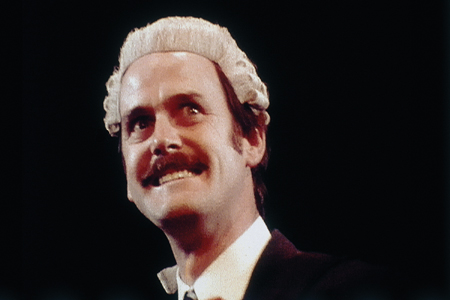
The common assumption is that, if an esteemed film society is holding something called The Secret Policeman’s Film Festival, you should probably check out the main film. But I’m here to tell you that you can probably skip the primary offering. The true can’t-miss movie here is Pleasure at Her Majesty’s, which features some fascinating behind-the-scenes footage of, among many geniuses, the Monty Python troupe (sans Eric Idle) rethinking the Courtroom Sketch. We see the Python team trying to pinpoint why the sketch doesn’t entirely work. They make changes. They argue. And even after they have performed the sketch later in the film and have received laughs, John Cleese walks off-stage and remains unconvinced that it worked with the audience.

This is fascinating if you’re interested in dramatic rhythm. And it isn’t just Python here. Deep division among the Beyond the Fringe performers is intimated in a conversation with Alan Bennett and Terry Jones, both seemingly unaware of the camera. “I could never do anything you do,” says a wan-faced Bennett. “The atmosphere with you is different. You don’t seem competitive in the way we were.” And we begin to wonder if Beyond the Fringe’s anti-authoritarian comedy was motivated by internal strife. At what social cost does one break new ground?

The Secret Policeman’s Ball, which doesn’t permit us these interesting peeks behind the curtain and features more music in the place of many comedy sketches, remains an enjoyable if badly dated film. The Amnesty organizers began changing the formula. And the contrast can be seen in the choices. Pleasure has Neil Innes’s delightful “Protest Song.” Policeman gives us Tom Robinson’s “Glad to Be Gay”: brave at the time, but precisely the kind of sanctimonious fury that Innes was satirizing.

In Policeman, Peter Cooks’s sendup of the Jeremy Thrope 1979 trial is funny, but only if you know all the scandalous details. It is indeed ironic that the very sketch Cook wrote in response to criticisms that the Amnesty shows contained nothing more than regurgitated material has secured its own time capsule. And the less said about Billy Connolly, the better.

On the other hand, one of Policeman‘s highlights is a wild and wonderful performance from a pre-Doctor Who Sylvester McCoy. McCoy hammers a four inch nail into his nose and attempts to dodge a toy train approaching his testicles with a fork while he remains chained to a chair. The late David Rappaport is even involved. McCoy’s antics, which involve jumping atop audience heads while wearing a kilt, are almost unthinkable today. McCoy — and Rowan Atkinson, who appears in an early version of his Schoolmaster sketch — presents the kind of free-wheeling comic anarchy no longer welcomed in our sanitized corporate atmosphere, where uncourageous Establishment types like John Hodgman stand before an audience, tell them the “clever” niceties they like to hear, and fail to challenge their assumptions. (Stephen Colbert, on the other hand, had stones.)

But Policeman stands in the shadow of Pleasure. Unlike Policeman, which features “slight direction by John Cleese,” Pleasure really permits us to see just how brilliant Cleese is on stage. A filmed version of a stage show limits itself by necessity to subjective camera angles, but the sheer authoritative energy that Cleese brings to the Dead Parrot sketch (with the line “This is your nine o’clock alarm call” added when he beats the parrot) is a marvel to behold.

Pleasure‘s vérité format permits us to witness a strange old boy’s world where John Cleese is seen with a McDonald’s cup of coffee in one hand and a cigarette in the other, and everybody is fiercely competitive. There’s one moment in which Jonathan Miller and Barry Humphries puff nervously on their smokes and bitch about who’s the oldest. Small wonder that it took a high-energy legend like Miller to corral these guys together.

But the lack of women in both films, aside from Eleanor Bron and Carol Cleveland, is unsettling. A few decades (and a few more Policeman films) later, women are now finally permitted to be funny, even when Christopher Hitchens declares that they aren’t. It’s just too bad that comedy remains shoehorned by the cobblers who wish to keep talent running inside the track. The Policeman films document a bygone era in which you could get crazy for a good cause. Perhaps it’s still possible today, if some innovator with deep pockets conjures up some charitable comedy that’s feral and progressive and inclusive.