Zach Cregger and Trevor Moore are part of a comedy group called The Whitest Kids U’ Know [sic], a television show presently airing on the IFC Channel. One of their more popular sketches, the unimaginatively named “Slow Jerk,” can be viewed on YouTube. 4.8 million people have watched this tired retread of the Austin Powers phallic silhouette/camera placement gags, with many apparently finding it funny. But the difference between “Slow Jerk” and Austin Powers sketches is that the latter found creative methods of playing with perception. What the camera or the characters viewed wasn’t necessarily the truth. And it didn’t really matter that Austin’s naked stretching was implausible. Because there existed a pleasant choreography that made the joke worthwhile. Artistry was attached to Austin’s unseen member in the positioning, and audiences laughed accordingly.
The same, however, cannot be said of the “Slow Jerk” sketch. We see two men engaging in banal office banter. One man makes a casual masturbation gesture and says, “Just joking.” Then the other man attempts the same gesture in slow motion. But when one compares this to the Austin Powers sketches, what artistry is there? The obvious joke is that such locker room banter is happening around the water cooler. The imaginary dick is needlessly large. But just about any simpleton capable of curving his hand and stroking it up and down can perform the same gesture. So it’s hardly advancing comedy.
Presumably, the “Slow Jerk” sketch caught on because many YouTube viewers needed a quick chuckle while trapped in a grim office job. If only they could get away with that and not be charged with sexual harassment. Another sketch, “Cubicle Boss,” uses this same phony populism as its basis. A boss asks his employee if he fucked his girlfriend, threatening to fire him if he doesn’t reveal the private info. Then the two draw images of what they did the previous night on a whiteboard. (In a telling sign of this show’s lack of originality, the boss rips off Dr. Evil’s “Zip it!” during the sketch.) Again, we have a case where forbidden office behavior is “funny” in the context of a stolen moment on the clock. Because the sullen office worker watching this could likewise draw stick figures and a giant cock on a white board if only he were allowed. But is this really funny outside the workplace? In four minutes, does the “Cubicle Boss” sketch come close to the amount of artistry and comedy information contained within a minute of one episode of The Office? I’m certainly capable of appreciating a well-deployed lowbrow joke as much as anyone, but is there anything in this dialogue to distinguish the joke? Is there anything ridiculously class-conscious here, such as Mel Brooks’s “Oh, piss-boy!” from History of the World: Part I?
One must therefore ask if the “comedy” that The Whitest Kids U’ Know perform is any different from a group of high schoolers joshing around after gym class. If we remove the social restrictions of office behavior, could not any of us mime jerking off to our cubemates or drawing crude figures on a white board? And without that ability to offer that unusual juxtaposition in Austin Powers or Mel Brooks, isn’t such a comic stance insulting to the millions of people who have watched these sketches?
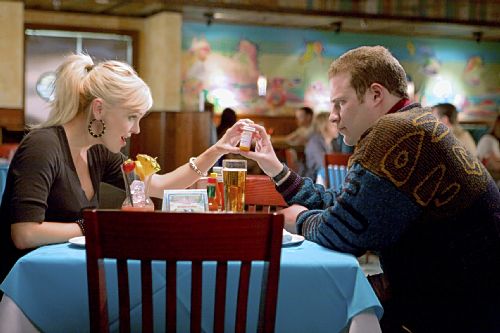
But none of the Whitest Kids‘s comedic deficiencies can possibly compare to the worthless material contained within Miss March, a film written, directed, and starring Cregger and Moore. Make no mistake: This is a vile and condescending piece of shit. You would get more laughs spending 90 minutes strangling an animal. It is a film so mind-numbingly atrocious that nothing would delight me more than to lead a glum and exhausted team of vigilantes in a dutiful lynching of these talentless cretins. And if Trevor Moore does not win a Razzie for Worst Actor, I may be forced to approach the Golden Raspberry Award Foundation in person. (More on this anon.)
The film offers racist stereotypes and rampant misogyny. It is artless and witless and stupid. Laugh at the overweight Spanish-speaking nurse named Juanita because she’s overweight and she speaks Spanish. Titter over a rap song because it repeats the phrase “Suck my dick while I fuck that ass” ad nauseam. (Wouldn’t this have been funny if there had been some escalation, with the sexuality becoming progressively stranger as the lyrics went on?) Smile at the two Russian lesbians who pick up our heroes and ask them to drive them to Los Angeles so that they can screw in the back of the car the entire time. For this setup, Cregger and Moore merely gape open their mouths the entire time while one of the women inserts a beer bottle in the back seat. And we’re supposed to find this funny. But what if the two men gradually grew more uncomfortable by all the sexual activity? What if their wildest fantasy (two women getting it on) led them to be disappointed and yet they pretended to be turned on in true macho camaraderie? With such a basic escalation, there might have been enough irony and conflict to sustain an amusing comic scene. But Cregger and Moore don’t have the brains to think about such basics. They think so little of their audience that they can’t be bothered to think themselves.
This is a movie that hasn’t a clue about the way the real world works. Even if one identifies Miss March as a male wish fulfillment fantasy, good entertainment needs to have some entry point. But Miss March occupies a paralogical realm in which you can casually flip through a stroke mag in a gas station (instead of asking for one behind the counter) and CDs can still be purchased up at Tower Records. (Never mind that the Tower chain collapsed three years ago, leaving one to wonder if this script had been rotting in a drawer for at least six years.) A woman opens an uncommonly large window on a bus, strips for one of the two protagonists, the bus bumps over something, and the woman is then sucked out the window. We’re supposed to find this funny because it’s “outrageous.” But anyone with an IQ over 75 will see the setup coming well in advance. And there are unanswered questions. What if the woman was killed? And why doesn’t anybody ask about her? Would not any of these points have provided more conflict and unpredictability for the narrative?
Another gag sees Cregger suffering from atrophy (days after he has awoken from a four-year coma) while trying to pump gas. You’d think that this would be a fine opportunity for Cregger to demonstrate his physical comedy chops. Alas, he has none. And the filmmakers know this. For they have Cregger wearing a hospital gown that is blown up by a preternatural gust. We see his ass. Some other people at the gas station see his dick. He’s naked. Ha ha. But what Cregger and Moore don’t understand is that random comic nudity along these lines must have some context. We laugh at the waiter’s buttcheeks in The Naked Gun (ripped from the “Sit on My Face” performance seen in Monty Python’s Live at the Hollywood Bowl) because we don’t expect to see it when he turns around. The waiter serves a role of service and propriety, and, when his ass shows, we see wild impropriety.
But, of course, Cregger and Moore, a pair so incompetent that any wretched soul sitting through this turkey may actually pine for Pauly Shore’s cinematic oeuvre, prefer gormless and badly conceived comedy. It is offensive not because it shocks (it doesn’t), but because it isn’t funny or artful. It is a film thoroughly against the human condition. It is stupidity writ large on a forty-foot screen. At the Playboy Mansion, a dog pisses into a playmate’s drink and she prefers this cocktail to the ones at the party. (Would any human in such an upscale context possess such a palate?) This is a film that thinks it’s edgy, but it is too cowardly to reveal any prominent anatomy in a Playboy centerfold. This is a film that steals the art direction from the motel room in Planes, Trains, and Automobiles and attempts to pass it off as its own. This is a film so amateurish that one can actually see Raquel Alessi reading from cue cards when she juts her head out the window in an early scene. (The same, alas, applies to Hugh Hefner, who shows up in the end. Did he appear in this film because of his recent financial difficulties?) There isn’t even a compelling visual component to this. Most of the scenes are static long takes, with the actors (if one can, indeed, call this talentless cast “actors”) in TV-friendly camera placement.
There’s one promising idea involving vengeful firemen who are chasing our heroes in firetrucks with axes. I had hoped that the firemen might transform into modern-day Vikings, perhaps revealing a secret society of feral marauders. But the firemen are one-dimensional. We’re supposed to find them funny because they throw axes at a station wagon. I wanted to throw axes right back at the filmmakers for their inept cinematic execution. I guarantee that my aim would be more accurate because this film is so very, very bad.
I can report that I did laugh once during an early scene at a party, in which a bald muscular man wearing an orange shirt is randomly smashing his fist through glass cabinets. This was funny, only because I was exceptionally curious about this man. Who was he? Why was he there? Why is he committed to such gleeful violence? But I must conclude that this side character was a serendipitous aberration.
The promising comic actor Craig Robinson (Darryl from The Office) plays a rapper named Horsedick.MPEG. A tired joke involves Robinson constantly barking “Dot MPEG!” whenever another character refers to him as merely “Horsedick,” and this should give you a sense of how criminally the man’s talents are used.
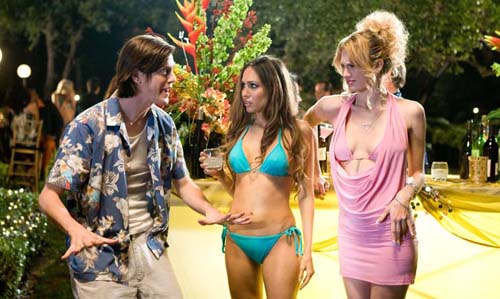
And I haven’t even begun to tell you about Trevor Moore’s horrible performance. His character has been given an epileptic girlfriend, and perhaps this is a subconscious clue to the audience that his thespic ineptitude may indeed cause you to have a seizure yourself. Both actor and character are without appeal. Cregger and Moore are such condescending pricks that they believe that their audience hasn’t seen any movie older than five years. To this end, Moore’s character has been styled as an Ace Ventura knockoff. Like Jim Carrey’s character, he dons a Hawaiian shirt, an unruly shock of hair, and bulging eyes. Carrey, however, is an actor who has remained engaged in comic exuberance, even when he doesn’t have decent material. Moore, by contrast, does not have an expressive face, an ability to understand what’s happening in the scene, or a talent of any kind.
To get a true sense of the worthless specimen that Trevor Moore is, why not listen to his answer from this Orlando Sentinel video interview? Here he is, quoted verbatim, in a question asked about performance:
I mean, I think, you by and large, everyone kind of just writes their own characters for the most part. Like you end up just, sort of, you know, uh, I mean, it’s kind of a way that the group works troupe-wise. Um, I mean, everyone helps pitch in lines for everything. But you kind of formulate your own characters from those part. [sic] And it just kind of, you know? Uh, like with this movie, we never really sat down and we’re like we’re going to do this guy, we’re going to do this guy. We just kind of, you know, right up, uh, I’m going to go over here and do this and then, you know, and I’ll do this. Oh, you just kind of. It’s sort of how we work.
Keep in mind that this answer comes after Moore has been on the road doing publicity at 38 colleges for five weeks. Keep in mind that this stunning insight comes after this 28-year-old man — not a teenager — has been asked a variation of the same question over and over again. That this inarticulate answer, even accounting for the fatigue that sets in after heavy promotion, is the best rejoinder he can come up with should tell you everything you need to know about how inept and unqualified he is at his craft. It should spell out quite clearly that this guy is as dumb and as valuable to our culture as a commonplace rock. Indeed, he would be better suited chopping up rocks in a quarry.
I do not know if audiences will flock to this film in the same way that they rushed to Paul Blart: Mall Cop. And I do not think there is anything I can say that will prevent people from reveling in this cinematic fatuity. Miss March is, to say the least, a great disservice to popular comedy. It is a movie that left me so dispirited that I was required to walk about forty blocks in order to restore my faith in humankind. If an extraterrestrial species were to see Miss March and conclude that this was the kind of “art” that humanity was capable of, they’d surely nuke our planet from orbit ten times over.