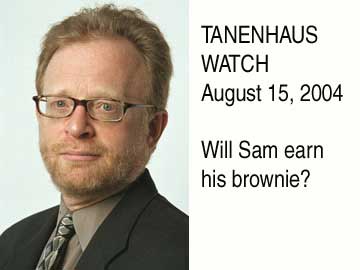
We’ll give Tanenhaus half a brownie point this week because it’s close to Xmas. This week’s NYTBR is a big mixed bag. We advise against the continued employment of Joe “I Never Met A Subject I Didn’t Hate” Queenan (along with the end of silly photo captions such as “Johnny Unitas of the Colts” asuming that educated folks aren’t familiar with football legend-team associations). But we dug the Truman Capote profile, which combined biography, light critical consensus and some naughty bits into a hot essay by the always excellent Daniel Mendelsohn.
However, Laura Miller needs to get out of the house more. We take pride in our dirty minds, pointing out that sexual suggestion and naughty jokes come with most of our book recommendations (some over the course of our lives, in flagrante delicto), while recommending that intercourse itself is best performed rather than endlessly talked about.
© 2004, DrMabuse. All rights reserved.
Ah ! I was lulled into a false sense of hope that perhaps the times are changing at the NYTBR, but when I got my print edition today found the picture not quite as rosy as you suggest. I count 4 each full-length reviews, with one of the non-fiction ones (by Hitchens) a multiple-book one — so while the fiction covergae is a bit more in depth, it’s still more non-fiction books that get the fuller coverage (6 vs. 4). Throw in the fact that this week’s “Books in Brief”-section is devoted to six non-fiction titles, and the balance doesn’t look quite as impressive any more.
Other observation: the two reviews by women are, of course, of the fiction titles — the weaker sex obviously can’t be trusted with the serious stuff (i.e. non-fiction), of course. (Amazingly, last week’s issue didn’t have a single full-length review written by a woman, even of a mere fiction title).
One brownie-crumb I would give Tanenhaus: the review of Mark Axelrod’s “Borges’ Travel, Hemingway Garage” is in the Non-fiction-“Books in Brief” coverage. This volume is vaguely grounded in reality (authentic photographs, real people), but was published by FC2 (that’s Fiction Collective Two), with “Literature/Fiction” as the genre description on the back-cover, and a note that “Some of these fictions have appeared” elsewhere previously at the beginning of the book. But apparently Tanenhaus even has trouble accepting actual works of fiction for what they are — or is embarrassed to review them as such.
Looking forward to next week’s T-Watch.
This is a great service!
In addition to counting how many reviews are written by women, what about considering number of books by women? I am especially disturbed by the almost complete lack of non-fiction books by women in the last couple months…