The Bat Segundo Show: Edie Meidav II

Edie Meidav appeared on The Bat Segundo Show #402. She previously appeared on The Bat Segundo Show #51 in a tag-team interview with Scott Esposito. She is most recently the author of Lola, California.

Condition of Mr. Segundo: Been all around this great big world.

Author: Edie Meidav

Subjects Discussed: Returning to old neighborhoods, whether or not the first-person perspective as the most authentic method to get the reader to believe in the account, carryover between Emile in Crawl Space and Vic Mahler in Lola, California, how a third-person novel is like a panopticon, the immensity of motherhood, the chasm in American fiction between the female perspective and male-dominated, idea-centric fiction, postgender fiction, narrative stripteases, fiction as the act of omission, Freud’s dream categories, being aware of the reader’s patience, writing the equivalent of three books for every book, rewarding the reader, short chapters, failed attempts at a 250 page novel, putting the essential into a novel, Peter Orner’s The Second Coming of Mavala Shikongo, Laura Mulvey’s “Visual Pleasure and Narrative Cinema” (PDF), Eros and Thanatos driving a novel, people who read Dan Brown during a commercial break, 21st century reader expectations, Hemingway’s A Moveable Feast, writing about a place when you’re not in it, views of California within and without, Jerry Brown’s assault on California parks, living writers capable of writing a “California novel,” Aimee Bender, TC Boyle, Dana Spiotta, identities in California, “Daughter of California,” needlessly psychoanalytical readings, whether a prison cell can be written as a “uniquely Californian” one, overcrowded prisons, writers who are fascinated by twins, considering robots, the secret language of boys, tactile forms of enlightenment, enlightenment found by embracing one’s origins, false ideals and physical healing, burrito metaphors, using “she lied” instead of “she said,” readers who expect the truth, the courtroom trial as a dramatic device, whether it’s inevitable for an author to repeat herself, and overly modular attempts to explain the novel.

EXCERPT FROM SHOW:

Correspondent: I want to ask about the dramatic appeal of the trial. There was a trial in the last book [Crawl Space]. And there’s a trial in this book. Sort of. What of the trial? It’s the ultimate way to force a character to become contrite with what he has done in ultimate sin. But I don’t know. I look at you now and I see a possible courtroom junkie quality. What of courtroom trials? Do you think that today’s novels and dramatizations seem to have moved away from this basic justice? Why trials?

Meidav: Well, that’s interesting. I mean, in a way, I hear what you’re saying. You’re saying, “Am I kind of creating a hysterical version of what is actually occurring?” It could be an ethical confrontation rather than something that confronts one of the institutions of society. Not being somebody who has spent a lot of time in any way linked to the law, I think I like playing — and maybe I’ll try and tone it down in the next book — but I like playing with society’s institutions. The prisons, the courtroom; in this book, there’s also a sanitarium.

Correspondent: Yes, of course.

Meidav: You know the spa? I think it interests me especially when you have such an ectoplasmic subject as California. It’s interesting to have a hard-edged setting in which somebody comes into a dark mirror moment. That said, one of my favorite scenes in literature is in Madame Bovary — to go back to Flaubert. I love this scene — and this is kind of a societal institution too — where you have a kind of village marketplace like a pig contest. A very agricultural contest taking place. And up above, you have the two lovers having this intimate scene. And it’s interspersed with this judging of the pigs. And I love that interweaving of the very small personal against the bigger habitual unseen eye of society. So maybe that’s an answer.

Correspondent: Or maybe it’s a way of turning something that is seemingly individual or personal into something that has the resonance of history. If you align a personal strength or failing with an institution, suddenly, yes, there is the societal impression! There is this sense that everything we do will matter more if it’s being judged by a jury. (laughs)

Meidav: That said, I also do deeply believe in this Wordsworth idea that in the meanest flower, a universal wind blows. So I’m hearing it. I’m thinking, “Okay, maybe in the next book, I’m going to avoid all big scenes.”

Correspondent: No!

Meidav: I’m going to keep it smaller.

Correspondent: No.

Meidav: More personal. But, you know, maybe I’m starting to lean on that as a crutch.

Correspondent: I don’t know though. I mean, you’re going to inherently repeat certain elements over several books.

Meidav: True.

Correspondent: But approaching it from a different angle, it’s going to become fresh. There’s one really great early moment where the girls are stealing slices of pizza from a parlor that, if you think about it and if you want to reduce it down to its basic essence, well, it’s common shoplifting. It’s a common theft. But because of the way you describe it, it actually means something and it resonates. And I don’t know if avoiding, say, a trial or avoiding a specific element in a future book is really an honest approach if you’re writing fiction.

Meidav: That’s true.

Correspondent: Do you think?

Meidav: Yeah, right. Because when you said that, I suddenly had this view of fiction like the mosquito eye with all its little parts. You rotate it. The element needs something different. So perhaps.

Correspondent: On the other hand, you have to be extremely reliant upon the subconscious in order to write fiction. You have to completely capitulate to the muse, so to speak, and not be aware of conscious repetition. Conscious things you may have been employing in previous books and the like. What do you do to deal with this? Do you think that the whole enormous operation of honing a book pretty much negates any concern for “Oh, I’ve done this before” or “Oh my god, Ed has noticed this from a previous book” or something like this? I mean, to what degree should it even matter?

Meidav: Do you think it’s a truism that most writes essentially write and rewrite the same book over and over and just get better at it? Until they are not better?

Correspondent: To some degree, I believe that. And it all depends on the voice. And it all depends on the ambition. I mean, some writers write the same book if you boil it down to its basic elements — even though every book will be different. I think once you strive to not do that, and I think the best way to counter that is to simply approach something perhaps as you have. An enormous mosaic of institutions with which to splay the typical into something that is a little more distinct. You think?

Meidav: You know, it’s possible. I was just thinking. You know, there are certain writers I admire. I’m thinking of Saul Bellow or others who work against this societal backdrop. Or J.M. Coetzee. But there’s a way that, even if their elements are identifiably repeated, each book they are really in a different timbre. And this is also true in a way of Alice Munro! Even though her turf is a different turf. We’re sitting in this restaurant maybe two blocks away from where, years ago, I interviewed this woman who each year — her name was Linda Montano, she was a performance artist. Each year, she would wear a different color. And that was her art. And she would have someone see her to bring out different energies. And it’s probably a question of focus. One probably brings the same understanding to what literature is meant to do to each novel. But I was trying to use Linda Montano’s words — a different shock — for this book.

Correspondent: Or maybe it’s that ambition that causes difference. I mean, okay, I love PG Wodehouse like you wouldn’t believe. But he does have a tendency to repeat some of his basic elements. But you know what? At the same time, I don’t care. Because it’s just very delightful. His sentences are so rhythmic. There’s a great sense of fun. There’s a great sense of quirkiness. Same thing goes for a lot of comic novelists. John P. Marquand, the great undersung guy who won the Pulitzer and now nobody reads. Or Donleavy, for example, who I read for the first time this year — The Ginger Man was incredible. And then I read his next book and said, “Wait, this is the same thing as the last one.”

Meidav: You know what I’m thinking as you’re talking? Maybe each author over his or her lifetime is creating rules of counterpoint. And within that, there’s greater potential tension. In other words, if you know the furniture is there, maybe you can create different kind of energy, a heightened energy, once you’ve established this is the furniture of my craft.

Correspondent: So do you think it’s a matter of every author creating as many furniture options as possible so there’s the illusion that the author is not repeating herself?

Meidav: Yeah, possibly. Possibly. I mean, that sounds so modular.

Correspondent: (laughs) Yeah, I know. It doesn’t work that way.

Meidav: (laughs) Right.

Correspondent: It’s not like a desktop theme or anything.

The Bat Segundo Show #402: Edie Meidav II (Download MP3)
This text will be replaced

The Bat Segundo Show: James Marsh

James Marsh appeared on The Bat Segundo Show #401. He is most recently the director of Project Nim, which opens in theaters on July 8, 2011.

Condition of Mr. Segundo: Pondering unethical experiments that might slide by today’s authorities.

Guest: James Marsh

Subjects Discussed: States of exhaustion, Project Nim’s purported origins of the 1970s hippie residue, scientific ethics and Columbia code of conduct, attempts to teach a chimpanzee to use sign language, Professor Herb Terrace, the transgressive aspects of ripping an animal from his mother, Skinner, Harry Harlow’s experiments, Terrace’s efforts to seek media coverage, Nim Chimpsky’s attacks on grad students, Terrace’s concerns for insurance issues over harm and suffering to students, Washoe, a filmmaker’s obligation to history, contending with demands from studio executives, when Marsh recreates moments in a documentary, dramatic reconstructions, murdering poodles, the inherent danger in cutting too much, audience imagination and the dangers of being too literal, balancing the needs of individual perspective and audience reaction, having ongoing debates while editing a documentary, some of the qualities that cause a documentary filmmaker to become prickly, the potential conflict of interest of obtaining film clips from the very subjects you’re interviewing, having sexual feelings for a chimp, being faithful to the honest confessions of documentary subjects, viewing documentary subjects as actors, earning trust as a filmmaker, Philippe Petit, whether discomfort is required in the questioning process, asking a question in ten different ways, trying to get a scientist to reveal he committed an affair, why people should trust James Marsh, the moral implications on Catfish, the possibilities that Catfish is a fake documentary, and phony indignation.

EXCERPT FROM SHOW:

Correspondent: You don’t bring up the Washoe project. Allen and Beatrix Gardner and Herb Terrace had a huge rivalry going on at the time. And it’s almost like East Coast/West Coast, Biggie/Tupac…

Marsh: Well, there’s another film to be made about all that stuff. There’s quite a few PBS type documentaries that get into the whole language experiments that Washoe, the Gardners, and that whole debate. That would be a film about science, a film about ideas. And our film is a drama about a chimpanzee and people. So I was aware of that context and many people spoke about it in the course of our interviews. But I thought it was going to be a blind alley for me as a filmmaker to get into that too much. It may be an oversight on my part. But that’s a different film. If you want to go see that film, someone else can make that. That’s not my film.

Correspondent: But don’t you think you have an obligation to present, to some degree, the history…

Marsh: No.

Correspondent: Of all of these animal language…

Marsh: Why?

Correspondent: Why? Because Washoe ended up having 350 words she “learned” of sign language. You can just do a brief mention.

Marsh: Well, you see, here’s my feeling about that. It’s that a brief mention is not good enough. That’s when you’re playing with it. If you’re just trying to flirt with something and say, “Well, I can mention Chomsky and I can mention Washoe and the Gardners.” You may know about that. But my brother watching the film won’t know anything about that. So I’m not trying to be — I’m being a little defensive here. But that wasn’t the film I wanted to make. That’s a different kind of film. And that film? Go online. Nova has done that film. Washoe, the fucking dolphins — you know, the Gardners, signs. But the bottom line is that the experiment failed. And that chimps do not learn language. So I can get caught up in this whole discussion about who was right and who was wrong, and who learned the most words. That’s not a story. That’s a discussion about the practice of science and the nature of these experiments. And so I wanted to focus on a dramatic story as opposed to the issues and the context. And, of course, someone like yourself, who is very….who is familiar with this stuff, probably feels a bit cheated. Because I don’t explain and give you the context you are sort of dimly aware of or know a little bit about. But that’s a very conscious choice on my part. Not to get caught up in things you can’t really fully explain and will, I think, be a sort of sideshow to what I think my interest in the story, which is my interest in the drama of it and the life story of this chimpanzee. Now if you’re a Nim, what does he fucking care about Washoe and dolphins and the Gardners? He isn’t going to know nothing about these things. So I’m trying to put you. You know, his life story is where I’m focused here. Not so much on this whole fascinating internexual climate that you’re aware of and the film doesn’t really get into.

Correspondent: To go ahead and correct your impression that I felt cheated, what I’m actually talking about here is how you as a documentary filmmaker make the choice to not include Washoe. Is it really a consideration of “Oh, well here’s a rabbit hole that will create a three hour film”?

Marsh: Yeah. Or where is my interest in this story? Where do I think the narrative is in this story? As opposed to — I think you could cram the film with reference points to other experiments and to other thinkers and linguists. And on and on. But that isn’t the film that I think would work for me as a filmmaker, or the one I’m interested in making. And so to distill my view into I want to tell you the story of this from the point of view of the chimpanzee, who would have no awareness of the other chimpanzee lab experiments and no interest in them either, I think.

Correspondent: So to some degree, it sounds to me that when you make a film — especially one that deals with science as opposed to, say, an event that numerous people see such as Man on Wire — your problem, I suppose, is that you’re enslaved to narrative to some degree. Is that safe to say?

Marsh: Well, that’s my interest in narrative. I guess I’m a little prickly about this. Because there’s quite a lot of pressure around the making of the film of this sort. Explaining to people. “Give me more context. Give me more science. Show me the scientific debate here.” And so I’m prickly about it because it caused me a lot of trouble as I was filming it, getting these comments from people — executives involved with the film — that they wanted more of this stuff. And they’re saying, “Well, I want a narrator for the film.” And I began to get quite pissed off about this. Because it wasn’t the kind of film that I was making, nor did I say that I was going to make this film. I was making the story of Nim the chimp. And films tend to not deal with ideas terribly well. It’s not what films are good at doing. I mean, some films do it extraordinarily well. But it’s not what they’re best for. I think film is best as a medium for storytelling. And so that’s where my interest is in this particular story again.

The Bat Segundo Show #401: James Marsh (Download MP3)

This text will be replaced

Midnight’s Children (Modern Library #90)

(This is the eleventh entry in the The Modern Library Reading Challenge, an ambitious project to read the entire Modern Library from #100 to #1. Previous entry: Tobacco Road)

It is somehow appropriate to announce, on the 235th anniversary of my nation announcing its independence from Great Britain, my independence from Salman Rushdie. Midnight’s Children is Rushdie’s allegorical novel about India declaring its independence from Great Britain. My announcement is buttressed by the fact that Rushdie himself is British and presently living in the city I happen to live in, albeit in a less interesting borough than mine.

Ultimately, one must separate the art from the artist. Patricia Highsmith preferred the company of animals to people, and was cruel to many. Norman Mailer stabbed his wife. Knut Hamsun sent Goebbels his Nobel Prize as a gift and called Hitler “a prophet of the gospel of justice for all nations” after his death. Yet in Rushdie’s case, it has been difficult to draw the distinction, in large part because Rushdie himself is (a) a study in contradictions and (b) not yet dead. The man has sometimes proved so humorless that, when Insulted by Authors‘s Bill Ryan approached him for an insult, the good-natured literary enthusiast received this response from Sir Salman: “Well, why would you want to bring more insults on yourself?” And this seemed a needless extension of Rushdie’s efforts to enforce his will upon others. A few years ago, Rushdie caused Terry Eagleton to partially recant for taking him to task for his neoliberal imperialism. There have been lawsuits. On the other hand, Rushdie did support online criticism much earlier than one would expect from an apparent windbag.

* * *

When I was 22, I read Midnight’s Children for the first time. I was seduced, like many young and impressionable readers, by the language. I also liked Shame and Haroun and the Sea of Stories. I thought The Satanic Verses to be a sensationalistic exercise. The infamous book had earned Rushdie a fatwā, resulting in many years of hiding (with a £10 million tab to UK taxpayers for protecting him over a decade) and a bizarre exchange of letters between Rushdie, John le Carré, and Christopher Hitchens over free speech. Then I read The Moor’s Last Sigh and was greatly underwhelmed. I had the sense that Rushdie’s big mammoth books were less about engaging the reader’s interest and more about forcing the reader to submit. Where was the Rushdie who had charmed in the earlier books?

Still, I decided to give the man another chance. I read Shalimar the Clown and discovered a remarkably ho-hum book despite the promising title. I had observed Rushdie at a few literary events I had attended, seeing a man who appeared to be in love with himself. Since Rushdie wasn’t going away anytime soon, I figured the best thing to do would be to ignore the guy. Let the man stay busy with his half-assed involvement with politics and the film world. Let him have fun persuading supermodels and actresses decades his junior to hop into bed with him. It’s a free country. I didn’t need Rushdie.

So I had thought myself done with the man. It had not occurred to me that Rushdie would pop up like some zombie surprise when I threw down the gauntlet back in January.

* * *

Ultimately one must separate the art from the artist. And I cannot deny, in my thirties, that Midnight’s Children is a stylistically accomplished novel. If you know nothing about Rushdie and you are young and in need of patois, it will almost certainly fulfill a need. It is adept in stringing the reader along. Chapters begin with bold bursts of storytelling: “To tell the truth, I lied about Shiva’s death” and “No! — but I must.” So in Saleem Sinai, you have an unreliable narrator who is lying and twisting and inventing and rambling, but always giving you more. And by bringing in such side characters as the Brass Monkey begging, “Come on, Saleem; nobody’s listening, what did you do? Tell tell tell!” and in deftly deploying dependable tricks such as swapped babies and secret basements and political intrigue and creepy soldiers at tables and convenient coincidences, Rushdie’s gargantuan story reminds the reader that not only is this a story, but it’s a story familiar with story. There are indeed very few places in the book where I wasn’t aware that what I was reading was a story.

But Rushdie is not a writer who I enjoy reading now.

Perhaps it is because life is more than story. Or maybe I have reached a point where story is no longer enough to satisfy me in a novel. I confess that I had to take three twelve mile walks, dutifully flipping and sweating into the pages in the humidity, in order to finish this book. And even then, this eccentric form of self-discipline was countered by the many dogs, kids, and people who I talked with along the way — all of whom proved more worthy of my time and more interesting than Midnight’s Children.

The issue is not India’s marvelous history. Before rereading Midnight’s Children, I decided to read an enormous book (Ramachandra Guha’s India After Gandhi), which outlined the great nation’s vivid history in remarkably clear and quite interesting detail. I figured that knowing more about Nehru and Indira and Sanjay — to say nothing of the Kashmir conflict, the battles with China over Tibet, and the wars with Pakistan — would give me additional insight and interest into Rushdie’s carpet bag. And yes indeed! I became very excited to step right up and enter Rushdie’s rollercoaster.

Until I realized the lack of tensility in the track.

The issue is not my mixed feelings about magical realism. I should probably confess that, while I’m almost always game for fantasy and speculative fiction and Murakami’s surreality, magical realism has felt like a cheat to me. Yet in revisiting the Midnight’s Children Conference, Saleem Sinai’s nose, and his ability to clamber inside other people’s heads, I found these portrayals justifiable because Rushdie remained fairly fluid with his allegory.

The issue is not complexity. Even now, when I read Joyce or Faulkner or Gaddis, I still have a good time doing so. I delight over the sentences and the jokes and the obscure words and the convoluted plots and the complex character relationships revealing more human insight, and I still feel very much alive on the second or third or fourth read. (Since some of these titles are contained on the Modern Library list, I look forward to experiencing this life again!)

Rather, the issue is Saleem/Salman’s desperate need to be liked, to smother the reader into a participatory role rather than that of a peer or a fellow adventurer seeking mystery and ambiguity. Back in 1981, Rushdie’s hey presto smashing mingling mixing form of writing was fresh and innovative: a defiant assertion from a wily wordsmith sticking up for his needlessly neglected home turf.

But thirty years later?

* * *

Statement Posited in Recent Weeks to Random Smart Literary People in Empirical Attempt to Determine Rushdie’s Current Stature: “I’m reading Midnight’s Children.”

Literary Person #1: “Oh, that’s great.” (Begrudging tone, recalling something distasteful — as if one is supposed to like the book rather than genuinely like it. Efforts to press Literary Person #1 on subject prove fruitless.)

Literary Person #2: “I read that in my early 20s.” (It’s the opening paragraph she likes, although she agrees with me that Lolita‘s opening is better. Have you reread it?) “No.” (Would you?) “No.”

Literary Person #3: “Oh….Rushdie.” (Do you like him?) “…” (Do you know him?) “…” (What’s wrong with Rushdie?) “Let’s just say I’d rather read Naipaul.” (You and me both.)

* * *

Indagating further:

independent: adj. 1. not influenced or controlled by others in matters of opinion, conduct, etc; thinking or acting for oneself: an independent thinker 2. not subject to another’s authority or jurisdiction; autonomous; free: an independent businessman.

What type of person initially read Midnight’s Children? Let’s slide the lectern to our man Rushdie:

“The people who like the book most are young. That’s obviously a simplification, but it’s interesting that very large numbers of the people who came to meet me or hear my talks were very young. They were all Saleem’s generation or younger. And I like that. I felt that it was right that the people who were the essential subjects in the book had taken it for themselves and made it their own. Endless numbers of people, not just in Bombay, would come up to me and say, ‘You shouldn’t have written this book. We know all this stuff. We could have written this book.’ And I thought that was an extraordinary thing for a writer to be told — much the biggest compliment anyone has ever paid me. The older generation, I suspect, were often shocked by it.” — Rushdie in conversation with Una Chaudhuri (interview conducted 1983, published in 1990 in Turnstile 2.1)

* * *

In 2011, I am neither especially old nor especially young. I was born in the state of California…once upon a time. No, that won’t do. There’s no getting away from the book.

I was not especially shocked by Midnight’s Children: not even with the book’s admirable depiction of forced sterilizations. But the assault upon the magicians ghetto near the end felt very much like an author desperately needing to justify his novel’s importance:

…standing in the chaos of the slum clearance programme, I was shown once again that the ruling dynasty of India had learned how to replicate itself; but then there was no time to think, the numberless labia-lips and lanky-beauties were seizing magicians and old beggars, people were being dragged towards the vans, and now a rumor spread through the colony of magicians: “they are doing nasbandi — sterilization is being performed!”

Note the way that Saleem telegraphs this horror to the reader without subtlety. Instead of letting the dreadful action speak for itself, Rushdie feels the need to frame it through “the ruling dynasty of India.” The prose here begs (pardon the crass pun) for a rhythmic juxtaposition between “labia-lips and lanky-beauties” and “magicians and old beggars,” but aside from the visual dashes and a few alliterative Ls in the first phrase, we have commonplace discordance. Is this an occupational hazard of communicating through a mishmash Mother India tongue? Saleem is capable enough to joke of a “djinn-soaked evening,” but why the explicit explanation for nasbandi? (Later Rushdie novels are, in fact, less literal than Midnight’s Children. But it is interesting to me that the Rushdie novel that is most celebrated is the one most cemented in explanation.)

* * *

Indagating further:

Rushdie’s early copywriting teaches him to condense. “Midnight’s Children may be long, but I don’t think it’s overwritten.” (The Sunday Times, October 25, 1981)

Rushdie establishes his vocational conditions on his own terms. “There are quite a lot of writers too who do advertising part-time. They both use it for the same reasons, a means to an end. I used to work never more than two days a week in advertising. Those two days would finance the other five. It’s very difficult for a completely unknown writer with no private means to find five-sevenths of his week entirely free for his own writing. In that sense, it was very useful. But it was also good to get out of it.” (Debonair Reviews, February 1982)

* * *

In Midnight’s Children, Saleem declares “…in autobiography, as in all literature, what actually happened is less important than what the author can manage to persuade his audience to believe.” Rushdie has denied that Midnight’s Children is a historical novel in numerous interviews. Is belief the only quality that remains? Aadam Aziz, Saleem’s grandfather, is separated from his friends by “this belief of theirs that he was somehow the invention of their ancestors.” And yet belief related to birth is both problematic and ugly, as when Saleem states his “belief that Pavarti-the-witch became pregnant in order to invalidate my only defense against marrying her.” Then there is India’s “national longing for form” — “perhaps simply an expression of our deep belief that forms lie hidden within reality.” The midnight children do eventually lose belief in the very mechanism Saleem creates for them.

So if belief in Midnight’s Children cannot be tied to history, cannot be tied to people both real and imagined, and cannot be manifested even in the positive events that Saleem describes in hindsight (even the ones that result in betrayal), why then should we believe in Saleem? Why should we believe in Rushdie?

It seems to me that what I have been protesting through this essay — admittedly in the manner of an easily distracted tap dancer who longs for another ballroom — is not so much the idea of a novel reframing intricate history in a quirky and robust manner (which Midnight’s Children does quite well at times), but the troubling notion of Saleem (and by extension Salman) refusing to believe or burrow into belief.

In a 1996 interview, The Critical Quarterly‘s Colin McCabe asked Rushdie about the idea of creating a version of Islamic culture that could be inherited without belief. Rushdie replied (in part), “I felt that I had inherited the culture without the belief, and that the stories belonged to me as well. And because they belonged to me they were mine to use, in, if you like, my way.”

So if Rushdie sees culture, both religious and secular, as mere mechanical strata to pluck and claim as his own, then perhaps I’m objecting to his inherent insensitivity: his brazen ownership of other people’s ideas without recognizable deference to the originators. But in claiming ideas so totally in Midnight’s Children (an admittedly admirable performance), I don’t think he leaves nearly enough for the reader.

Next Up: Henry Green’s Loving!

The Bat Segundo: Aimee Bender II

Aimee Bender appeared on The Bat Segundo Show #400. She Bender is most recently the author of The Particular Sadness of Lemon Cake and previously appeared on The Bat Segundo Show #16.

Condition of Mr. Segundo: Feeling his inner cake and eating it too.

Author: Aimee Bender

Subjects Discussed: Fantasy and magical realism being contingent upon reader belief, domestic realism and fantasy, The Particular Sadness of Lemon Cake as a Los Angeles novel, foodies, apartment complexes in Southern California, high school reunions, sustaining fairytale magic in a longer work, how a shift in an author’s temperament affects a writing project over several years, positive pessimism, parallels between writing process and psychotherapy, Adam Phillips and boredom, the fine line between attention and concentration, staying put, believing in the details, Ursula K. Le Guin’s “Plausibility in Fantasy,” Murakami’s Kafka on the Shore, writers whose complete works you can’t read all at once, author doubt and faulty fiction premises, Kafka, early attempts and restarts on Particular Sadness, the dangers of ranting, the relationship between empathy and fantasy, reverse engineering the human relationship with food, Rose’s early form as an older man on the make for soup, MFK Fisher, the materialistic impulses of Rose’s parents, bottom-feeding consumerism and garage sales, the consumer as an eater of another kind, qualitative precision vs. quantitative precision, mathematics and fantasy, people who love making food, Cafe Gratitude, feeling simultaneously appreciative and cynical about hippie ideologies, grandmothers who send strange packages, Edward Hopper, fatalistic determinism, Hemingway’s iceberg theory, the visual advantages of not using quotes, Bender’s experience with chairs, the McSweeney’s logo, whether Hopper’s paintings are truly lonely, “The Lighthouse at Two Lights,” artists who don’t enjoy being photographed, whether movies are destroying imagination, shorter attention spans, memorizing poetry, Wallace Stevens, Don Marquis’s Archy and Mehitabel, Kay Ryan, students who can’t remember the questions they are about to ask, and whether or not the United States is presently suffering from a short attention span epidemic.

EXCERPT FROM SHOW:

Correspondent: We were just joking about this being a few years since we last talked. This leads me to ask: I know you to be an optimist, both in your previous books and in our previous conversation, which was quite jocular. But with this book, I almost get the sense that you’re exploring this positive pessimism with the Rose perspective. And I’m curious how much that may play into this. The idea of exploring a perspective that’s just a little different from your own. Or perhaps I have misjudged you and you have been a closet pessimist the entire time!

Bender: Well, both! I think I’m both. So it’s both exploring a point of view that’s different from my own. But of course, for any of it to ring true, it has to ring true to me in some way as well. So I think that there’s something of that balance of seeing things cynically and seeing things hopefully. Depending on the day. Will it end in a different spot? But I guess I did feel really focused in this book maybe, in particular, about what would be burdensome for that character. And also what would be burdensome for the brother. And maybe the tone again of the magical quality about her and her brother feeling different. Like hers feeling dark and his feeling darker. I somehow think of them as triangles feeding into each other. Hers is the smaller shape and his is the darker shape in some way.

Correspondent: But what do you do if you’re trying to channel this positive pessimism and you’re in an absolutely peppy mood that day? Because I think that of all your books, this is tonally very, very specific. And so what do you do to maintain that tone? Especially since it’s several years of trying to get this right.

Bender: Exactly. Well, I have this kind of system that has worked for me so far, which is to write a couple hours in the morning. And the rule — a friend of mine from grad school named Phil Hayes said if you write what you’re interested in writing each day, writing will have life in it. Which is great. It seemed simple on the surface advice, but I think it’s pretty deep. Because the idea that each day, you can generate whatever is happening on that day — it means that on the optimistic days, I probably wasn’t working on that book. But the thing is getting a good work day in feels very optimistic and hopeful, even if the work itself is kind of dour and sad and bleak. A good work day feels so good no matter what. So there’s kind of a contrast there already. But let’s say I’m in a really upbeat mood and I just can’t get into the sadness of the book. Then I would work on a short story. So it was all very mood governed. But I think once there was enough material to work with, it didn’t feel sad to work on. It felt like explorative.

Correspondent: Well, that’s interesting. Because I’ve always wanted to talk with you about the two hour session.

Bender: Right.

Correspondent: Which sounds almost like expansive psychotherapy.

Bender: I’ve wondered about that. I think that’s a bit of a model. Yeah. (laughs)

Correspondent: But I understand, and I just want to get this totally clarified, you sit on the couch.

Bender: Chair.

Correspondent: You want to channel your mind into boredom.

Bender: Right.

Correspondent: And I’m curious about this. It seems to me a more reasonable answer to, say, Jonathan Franzen blocking all sunlight from the room, which I think is really quite intense. I mean, I understand the need.

Bender: And I think he has headphones.

Correspondent: Exactly. Earplugs.

Bender: Yeah.

Correspondent: There are bats that fly in his cave. I don’t know.

Bender: Right. (laughs)

Correspondent: But the point is that your level of trying to remove yourself from distraction seems infinitely more reasonable. You’re in this fixed location. How do you will yourself into filtering these ideas? Or if you’re in a situation where you have so many ideas, so much information, so many emotions that you’re writing, that you just need to sit still in order to just access it during that two hour period?

Bender: Yeah. I think you said it in an interesting way. “Channeling myself into boredom.” But it’s not. The boredom happens.

Correspondent: (laughs) Oh come on.

Bender: The boredom does not need to be channeled. You know, there are those people who say, “I never feel bored.” I’m definitely not one of those people. So in some way, for me, it feels like a dance between boredom and concentration. And I think my concentration can feel thin. So the idea is blocking out the amount of time so that I’m going to try to concentrate. But I don’t know that I will. And inevitably I get bored. And then hopefully on the other side of boredom is something. There’s this great quote by Adam Phillips, who is a British psychoanalyst. He talks about boredom as a waiting space and as this interim place for a kid where it’s not something to be filled or plugged in. It’s something actually to sit through. And that’s often where a kid will get really creative. And they’ll be like, “Okay, I’m bored. Now I’ve created this land under the kitchen sink.” Whatever.

Correspondent: I use the term “channeling” or “willing yourself” into this concentrated focus. Is it a variation of the Flaubert maxim “Be calm and orderly in your life so you can be violent and original in your work”?

Bender: There is something to that. I do believe very strongly that structure helps creativity and boundaries in that it is like a therapy hour. The boundaries of a time, a creative space where I can go to someplace that is potentially revolting to me and leave. And knowing that I will leave. There’s something very helpful about that. But still, it’s not even that I can focus myself into concentration. It’s just that the only rule I really have is that I have to stay put. And then they’ll be many, many bad days.

Correspondent: So if you stay put, you can confront any emotion. It’s like running the gauntlet here.

Bender: I think that if you stay put, stuff comes up. I think eventually stuff will bubble up and there will be things to write about. But it’s not as if I bravely have the sword in hand and I’m rushing forward into the forest.

Correspondent: (laughs)

Bender: I’m sitting there feeling like I want to get up. I want to get up. I want to get up. And the only weapon I have is stay put.

Correspondent: Got it. Is it a matter of ADD or distraction? Or what?

Bender: It’s not ADD. But I just do feel easily distracted. There are other writers who will say, “I need time to relax. And then get into it. And then I take eight hours. And then I get lost in the world. And I feel all my characters.” And I don’t have that at all. Maybe I’ll get lost into it for ten minutes. And that’s thrilling. But I get a lot done.

Correspondent: Oh, I see.

Bender: So it will be ten minutes. Boom. Productive. And then space out.

Correspondent: Ninety minutes of thinking, thirty minutes of writing. Something like that?

Bender: Yeah. And looking at old files. And rereading, rereading.

The Bat Segundo Show #400: Aimee Bender II (Download MP3)

This text will be replaced

The Bat Segundo Show: Janet Reitman

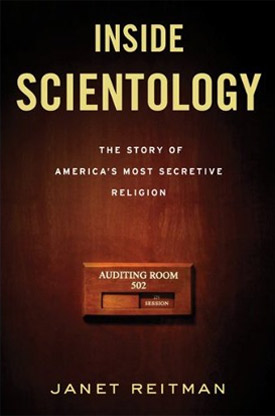
Janet Reitman appeared on The Bat Segundo Show #399. She is most recently the author of Inside Scientology.

Condition of Mr. Segundo: Always on the run.

Author: Janet Reitman

Subjects Discussed: Scientology and cults, the way Scientology works, Orthodox Judaism, Michael Sklar, tax-exempt religions, the religious elements used to form Scientology, esoteric religious movements in early 20th century Los Angeles, L. Ron Hubbard’s design as “a matter of practical business,” Hubbard’s connection with Jack Parsons, Aleister Crowley, tapping into what people are looking for, Hubbard’s migratory lifestyle, finding respect for L. Ron Hubbard, Scientology and materialism, the financial worth of exclusive knowledge, how Reitman managed to obtain access to the Church of Scientology’s inner sanctum, how fact-checking can be used to generate journalistic access, personal phone calls from Tom Cruise, Rolling Stone‘s editorial reaction to the Church of Scientology, Lawrence Wright’s New Yorker profile, efforts to remain objective about the Church of Scientology, the Church’s tendency to bury its critics in paper and lawsuits, the Church’s battle against the IRS, efforts to determine why the IRS abandoned its fight against the Church of Scientology, Operation Snow White, David Miscavige’s persuasive abilities, top officials at the IRS being harassed, missing cats and dogs, anonymous sources, L. Ron Hubbard’s “cure for homosexuality,” the Church of Scientology’s support for Proposition 8, attempts to determine if the Church remains homophobic, Paul Haggis quitting the Church over gay marriage, comparisons between the Church of Scientology and the Mormon Church, Scientology’s regular purging of its top officials, David Miscavige’s good points, Cathy Lee Crosby, Narconon, Scientology’s involvement with the New York Rescue Workers Detoxification Project, Nancy Cartwright, scant political oversight of “drug rehabilitation programs,” the death of Lisa McPherson, Joan Wood’s amended cause of death for McPherson, the Church using its financial resources to hire top forensic investigators in the McPherson case, discussing the underlying facts of the McPherson case, charges that the Church destroyed evidence in the McPherson case, Scientologist couples being split apart, various waivers, easily replaced Sea Org workers, behavior tolerated by Miscavige, strategic alliances between the Church of Scientology and other religions, efforts to expand the Church in the Internet age, the Church targeting the African-American community, money coming in from celebrities and normal people, offshoot groups from Scientology, and Scientology’s ethical code.

EXCERPT FROM SHOW:

Correspondent: You write that Scientology “was not a ‘cult’ insofar as it did not require separation from mainstream society — though it encouraged its acolytes to ‘disconnect’ from those who were critical of Scientology.” Now sociologist Howard Becker’s idea of a cult generally emphasizes the private nature of personal beliefs or a group of people that isn’t especially organized. Given how private and sequestered Scientologists are about their beliefs, I’m wondering. If you took away the organization, could you call them a cult? How is Scientology not a cult?

Reitman; I don’t like to use the word “cult.” Because I find that as soon as you use that word, it immediately stigmatizes a group and also marginalizes them. And it also delegitimizes them and takes them less seriously. The reader, the listener, will immediately say, “Oh yeah. Whatever.” Right? So one of the reasons I don’t use that word is because in order for me to write a book about them, I have to take them very seriously. And they are legitimized in our country as a religion. Now we could have a five hour argument over whether or not various other religions are cults. And we could have pros and cons on each side of that argument.

Correspondent: Well, why can’t you be a cult and a religion?

Reitman: You probably can be. I’m not a cult expert. But what I say about Scientology in the book and what I believe is that, at its innermost core, it is a completely, totalistic, all-encompassing organization that demands absolute 100% adherence to the rules and to the leadership of David Miscavige, the head of the Church. And it was also like that with L. Ron Hubbard when L. Ron Hubbard was the head of the Church. But there are stratums of the way Scientology works. I’m not a cult expert. So I’m not really qualified to answer a lot of questions about cults. But one of the points about Scientology is that in the outermost level of your dedication, which is where a lot of the celebrities are, to them, to those people, it is not a cult. It’s either a religion or a process of self-help or a bunch of techniques that help their lives. And that’s the way it begins for them. Now I think that’s the way it begins for lots of other believers of other totalistic groups, right? But you can be in Scientology for twenty or thirty years and remain on that outside periphery. Somehow there are people who have remained in that strata. Most people do not. Most people enter further in. And the further in you go, the more controlling it is. But I think the main point is that, whether it is a “cult” or not, in our country, it’s legitimized as a religion. They are given tax exempt status. They’re recognized. They have more protections than the Orthodox Jews in certain regards. Scientologist parents can write off their children’s education, for example. There was a very famous case recently [Michael Sklar] of an Orthodox Jewish family that attempted to do the same thing. It went all the way up to the Supreme Court. They claimed the exact same protections as the Scientologists did. And theirs was knocked down.

Correspondent: Internally, you can’t call them a “cult.” But externally, by virtue of their tax exempt status, you can or cannot call them a “cult”?

Reitman: I don’t think that it really makes a difference whether or not they’re a “cult.” Do you know what they are? They’re a global corporation. That’s what they are. And they have all the dysfunction of any gigantic global powerful corporation. And that’s how I look at them. I tend to look at them that way. They have religious components absolutely. If you believe in them, that’s great for you. I’m not going to judge their beliefs. I don’t judge their beliefs. My book is about their practices, their organization, their impact, their influence on people who have subscribed to them and bought, literally bought, into Scientology. Because you can’t just do Scientology. You have to purchase Scientology. They’re a very commercially driven spiritual enterprise. That’s what they are.

Correspondent: I’ll get to Scientology in a minute. But just from a philosophical standpoint, because it is a business proposition, this does away with the “cult” nomen?

Reitman: I’m not going to comment on whether or not they’re a “cult.” It’s not interesting to me.

Correspondent: No problem. In your original Rolling Stone piece, you wrote that Scientology was “rooted in elements of Buddhism, Hinduism and a number of Western philosophies, including aspects of Christianity.” Yet you note in the book that L. Ron Hubbard wrote in this 1953 letter that he incorporated the religious angle as “a matter of practical business.” In the interests of staying objective, what specifically qualities of Scientology a unique religion? I mean, how much of this hodgepodge you identify in the Rolling Stone article was designed as “a matter of practical business?”

Reitman: I don’t think any of it was designed as “a matter of practical business” originally. I mean, I think that L. Ron Hubbard grew up in the ’20s. He was born in 1911. He essentially grew up, so to speak, into the ’20s and the ’30s during the Depression. He was a young man in the Depression. And he found himself in Los Angeles after World War II. And Los Angeles, during that period of the mid to late ’30s and the ’40s (and also the ’20s), was this booming religious ground, where all kinds of weird offshoot faiths, new faiths and offshoots of Christianity as well, were then really popular. And one of those areas was the Western esoteric tradition that he found himself getting to know very well through this association he had with Jack Parsons, who was a famous astrophysicist and secret wizard. Follower of Aleister Crowley. It’s one of everybody’s favorite stories: L. Ron Hubbard’s association with Jack Parsons. But I think that he took those aspects of esoteric thought, which were things like secret knowledge, ascending the ranks to gain more and more knowledge. And that was very common in L.A. It wasn’t just through Crowley. The Rosicrucians had a big church. There were lots of societies that were based on that kind of tradition. The sort of alternative, new-agey stuff that was really popular in the early 20th century and then became popular again towards the end of the 20th century. And I think that Hubbard was a guy who was really interested in philosophy and was interested in power. And he took probably some of the best parts, as well as some of the dysfunctional parts in terms of Freudian thoughts that Freud had discarded years earlier. But he took a wide variety of ideas. He manufactured them in a way that made them palatable to people who were not well-educated. That’s very important to know. People who did Scientology were very middle-class. They weren’t uneducated people. Some of them were extremely well-educated. But they were, for the most part, very average, mainstream in that this was religion or this was self-help or psychiatry, or an alternative to psychiatry for the masses. And at the time, these things were very exclusive. You couldn’t do psychiatry for example. You couldn’t go to a psychiatrist unless you had a tremendous amount of money to pay for a psychiatrist. There were only a few psychiatrists even in the United States practicing.

Corresepondent: Or you lived in New York. (laughs)

Reitman: You had to live in New York. You had to live in Los Angeles. Seriously. Maybe Chicago. Or in Washington. Maybe three or four cities in this country. His philosophy — his Dianetics philosophy — clearly tapped into something people were looking for. And Scientology, which was the offshoot of Dianetics, did as well. And the reason that it had this religious component was that people began to experience these past life recall moments, where they would be in these trances that you got into when you were doing these auditing sessions. And they would, all of a sudden, be thrown back to some previous life. This was spiritual to L. Ron Hubbard. It was spiritual to the people that were doing it. Whether or not they saw it as religious is very different than spiritual. It was spiritual to them. He then thought, “Hey, I can package spirituality and make it religion. And I can get a tax deduction. Or I can avoid having to deal with the U.S. government.” He was extremely paranoid of the government. It was a big deal. And remember this was during the Cold War.

Correspondent: And always on the move.

Reitman: Always.

The Bat Segundo Show #399: Janet Reitman (Download MP3)

This text will be replaced