Just as I promised you, the man I voted for became President. Am suffering from major sleep withdrawal, recovering from last night’s bourbon, and contending with other assorted developments. Will have something long and unexpected to say about all this a bit later. Tracking political developments on Twitter. Literary news will return here sooner than you think.
Author / Edward Champion
02138 — What Might Have Been
The aborted inaugural issue of 02138‘s relaunch is now available online. If you’re curious about what might have been, there are contributions from Armond White, Stacy Sullivan, and Kimberly Thorpe. You can likewise read the lengthy books column I wrote, which includes reviews of Philip Hensher’s The Northern Clemency, Benjamin Parzybok’s Couch, Michael Davis’s Street Gang: The Complete History of Sesame Street, and Robert G. Kaiser’s So Damn Much Money.
The Bat Segundo Show: David Rees
Just in time for Election Day! David Rees appeared on The Bat Segundo Show #248. Rees is most recently the author of Get Your War On: The Definitive Account of the War on Terror: 2001-2008.
Condition of Mr. Segundo: Struggling to cast his vote.
Author: David Rees
Subjects Discussed: [List forthcoming]
EXCERPT FROM SHOW:
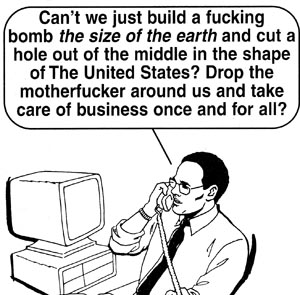
Correspondent: I wanted to also ask about the use of white space, and often the lack of white space, with some of the panels that have this extraordinarily long rant that one of the characters is conducting versus using the clip art and shifting it to the right hard edge of the panel or the left hard edge of the panel, or what not. What is your criteria in terms of white space and filling up the panel? Is it contingent upon the words you have to deliver for any particular strip?
Rees: You probably don’t know this, but the U.S. government allots all political cartoonists a given amount of white space in a year, and a lot of budgetary issues. If you don’t use your white space in a year, you don’t get it back the following year. There’s no rollover white space.
Correspondent: Yeah, yeah, it’s the appropriations and the earmarks I’ve heard.
Rees: So you have to really challenge yourself every year to use just enough white space, so that they’ll give you more white space next year. You have to submit this form. A white space form. Form JKL-202. And you submit this form. And they will give you more white space. And so as a political cartoonist — I mean, if you’re registered with the government, which I am, which all political cartoonists are supposed to be, if you find yourself at the end of the year that you haven’t used enough white space, then you go on a big rant. So there isn’t much white space around. You know what I mean?
Correspondent: Sure. Sure.
Rees: Because you don’t want to go over your limit immediately. Because you’ll be penalized.
Correspondent: But with all the “fucks” within the rant, that can be very problematic. I know you’ve gotten into trouble based off of that. Because of the specific requirements of this act.
Rees: Right. You’re referring to the Left Wing Political Cartoonists Profanity Allotment Act of 2003?
Correspondent: Yeah, yeah, I am. The number of “fucks” are quite frenetic. Exactly.
Rees: Well, I trade on the gray market. I trade — you know, cap and trade with carbon emissions? They set up the same thing for cartoonists, where you get a given amount of profanity. Fuck, goddam, asshole, shit, cocksucker, bitch, all that stuff. And then if you want to use more, you buy a set on the International Profanity Market. You buy a certain amount from other cartoonists.
Correspondent: They come in 200 units, I think.
Rees: Right. Well, it’s 200 syllables. You don’t actually buy the profanity by the word. You buy it by the syllable. So “motherfucker” is four syllables. You can use those four syllables to deploy one “motherfucker” or four “asses.” So I usually just buy them from cartoonists like Bil Keane, who does The Family Circus. He never uses his allotment. In a year, he never says “fuck” in The Family Circus more than ten times. So I will buy him out usually at the beginning of the year, so that I have enough to get me through a season.
BSS #248: David Rees (Download MP3)
Listen: Play in new window | Download
The Bat Segundo Show: David Heatley
David Heatley appeared on The Bat Segundo Show #247. Heatley is most recently the author of My Brain is Hanging Upside Down.
Condition of Mr. Segundo: On the waiting list for a brain transplant.
Author: David Heatley
Subjects Discussed: Surreal dream comics, the Ramones, memory and associations, Francois Truffaut looking at an old school photo and remembering all the names of his fellow students over an entire day, the deficits of memory, training your brain with a journal, apologetic footnotes to family members, the ten year rule, protecting careers and trying to be considerate with memoir, pink bars covering penises, flinching from the pornographic narrative, “Family History” as a hip-hop montage, why four Ns are good for the UNNNNH, using an all-red palette for extreme emotions, David Rees, the muted color scheme of “Sex History,” the 48 panel setup, Dave Berg’s “The Lighter Side,” shifting from squiggly panel lines to precise lines, the feelings that a ruler conjures, being traumatized into preferring memoir, imagination at the expense of reality, documenting a life without a sense of style, shifting dreams into narrative, being the dutiful client to the therapist, the influence of therapy upon Heatley’s comics, larger intentions, cliche in personal comics, Heatley depicting himself sobbing, Heatley’s ideal reader, Aline Kominsky-Crumb and Julie Doucet as influences, Doucet’s dream comics and castration, digesting a narrative involving dog fucking, retouching through computers, revealing biographical truth, Heatley’s angry father, depicting personal use of racist language, shared common experience with the reader, and being too concerned with being unique.
EXCERPT FROM SHOW:
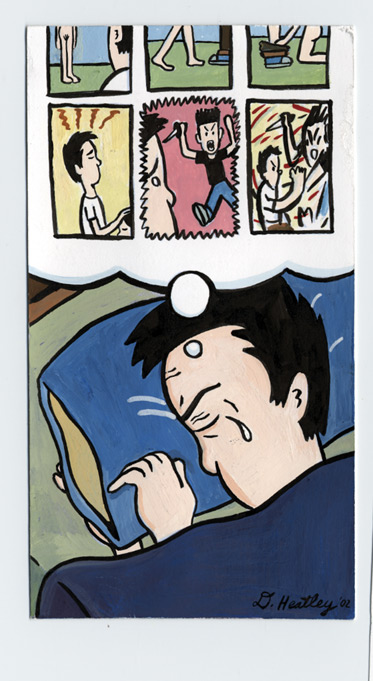
Correspondent: I wanted to also talk with you about your “Family History” strip. I mean, it’s probably the closest thing in this collection to a hip-hop montage. You have, of course, the many births with the common images. A mother — one of your ancestors — giving birth with the “UNNNNH!” And you have a marriage with the “I do.” The swathed baby who is being held up by the white hands. And the like. I wanted to ask why repetitive images, or a hip-hop montage, seemed the best way to approach your own particular past.
Heatley: It’s funny. I never would have — that phrase “hip-hop montage” is strange to me. But it also rings true. So, yeah, thanks for that. You know, the repetitive thing is about — once I had my own baby, it was a realization that every single person that’s been born in my family history was this baby at one point. And every mother of that baby grunted in the hospital, and pushed it out. So it’s sort of honoring all these faceless women who have been lost. And it’s also — I think that strip is about, if you take any one of those babies, you can make a book this long about them. And so I’m just one of the babies in that book. And here’s my entire story. And I do it with my daughter at the end. Instead of doing one panel for her life, I wind up doing four pages, focusing on that day. So you could do that for any of those babies too. You could focus in on what was happening that day when they were born.
Correspondent: How did you settle upon the four Ns for the “UNNNNH?”
Heatley: (laughs)
Correspondent: I’m really curious. I mean, did you try out three? Did you try out five?
Heatley: I did, yeah.
Correspondent: Did that just look right? Four Ns really cut that particular verisimilitude?
Heatley: (laughs) Yeah, it did. You know, it’s like poetry. It felt right.
Correspondent: (laughs)
Heatley: That’s a great question though. Four Ns. I didn’t even know they were consistent.
Correspondent: Because it’s four Ns in almost every….I mean, we could dig it out right here. It’s four Ns almost every single time.
BSS #247: David Heatley (Download MP3)
Listen: Play in new window | Download
I Voted
The New York voting machine is a wonderfully antediluvian monstrosity. It consists of a giant and sprawling white board depicting all known candidates for all open offices — divided in tabular form by party, including the Socialist Workers Party — with a gigantic red lever that, upon sliding quite powerfully to the left, makes you feel as if you’ve put in an order from an Automat menu. Alas, I did not receive a days-old sandwich in a triangular plastic carton. But I was offered a donut. I’ve never been offered a donut while standing in line to vote. So this was certainly a plus.
I informed a chatty but amicable gentleman behind me that there was free ice cream at Ben & Jerry’s and free coffee at Starbuck’s. He thought I wasn’t serious. I told him that I was very serious, and that I was known to temporarily change my dietary habits on Election Day. I told him that I was prone to screaming at 2 AM in the streets while the results came in. Yes, I said, I am a very serious voter. So serious that I will drink the blood of a rat if it will give me extra energy to vote.
He tried to tell me who he was going to vote for, and I told him that this was unethical and that I would make a citizen’s arrest if he continued. He concealed his partisan button and insinuated that he was wearing underwear that included the name of his candidate. I told him that I approved of his right to run around the streets of New York wearing underwear, or indeed nothing at all. We should all experience the fantastic sensation of a gust of wind drifting up our ass crack. But I would still make a citizen’s arrest if he was wearing political underwear within 100 feet of the polling place. He told me that this wouldn’t be a problem, and we then carried on a conversation about the typography of the Dunkin Donuts logo.
I did manage to place my vote. On the way out, I asked one of the election workers if she required a tip. She pointed me to the exit door and told me to get out — thus cementing in my mind the idea of the polling place as a harried diner. I feel very happy about my decision, but I’m still wondering if I should go back to the polling place and ask for a sandwich.
I’m quite happy that I voted. But I am finding that I am experiencing severe proposition withdrawal. You see, back in California, I was accustomed to a considerable number of local and state propositions on the ballot: anywhere from twenty to fifty. If you couldn’t get another person to agree on a candidate, you could always find some middle ground through one of the crazy props. But in New York, I only had one proposition to vote for: a middling measure on veterans benefits. There was nothing on the ballot for gay rights, nothing that involved naming a sewage treatment plant after George Bush. Presumably, either current government policy or the lack of space on the voting machine’s big board hinders numerous proposition options from presenting themselves to the public. I had not anticipated the sacrifice of my propositions upon moving to New York. I don’t know if there’s much I can do to make up for the missing propositions other than to make impassioned pleas at government meetings.
But I did research all the candidates. And I did vote. Barring a major scandal or the almost total capitulation of the public’s senses, the man I voted for will likely be our next President.
The time has come to drink and wait it all out. This will be something of a nailbiter.