Posts by Edward Champion

Edward Champion is the Managing Editor of Reluctant Habits.

Interview with Tobias Wolff

This week, The Bat Segundo Show will cross the 200 episode barrier. A future program will feature a conversation with the writer Tobias Wolff, whose most recent book, Our Story Begins, is a short story collection containing previously collected tales — including the classics “Bullet in the Brain” and “Hunters in the Snow” — and more recent offerings like “A White Bible,” a gripping narrative that takes the notion of entitlement to task, but leaves judgment to the reader. In the New York Times Book Review*, Liesl Schillinger wrote, “To read a story is to sink into the soft seat of your grandfather’s strong, modest old Buick and let yourself be carried through an America of small towns, small joys, small struggles and small despairs — a landscape so familiar as to be invisible, the landscape of homeland.” Wolff’s stories are certainly a place to recognize readily identifiable qualities, but what makes him a fabulous writer is the way in which these quotidian moments are charged with import without coming across as overtly portentous.
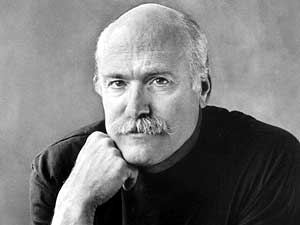
I got the chance to talk with Wolff last week when he was in New York. He was a confident figure beating a bad cold. And while he was interested in how readers interpreted his stories, he had no desire to offer explanations. But I did pry further. And I was able to unfurl some of the science Wolff brings to his tales. What follows is a partial transcript of our conversation.

Correspondent: This idea of first-person narration that is somewhat removed — maybe this is more of a classical sense of the short story, in the sense that today, contemporary short stories are, as you point out, more of a gushing therapy session. Maybe that’s what we’re talking about.

Wolff: Well, I don’t know. Again, when I think, for example, of Philip Roth’s first-person narrators, they are interested in the world at least as much as they are interested in themselves and interested in other people. And that shows up in the narration. It would be a pretty boring story that was so — if I could put it this way — narcissistically defined if you didn’t get a sense of the world beyond the narrator or of other people beyond it. I would think that, unless it was deliberately taking on the pathology of narcissism, it would be a deficiency of the story. Some stories, of course — some first-person stories — rely on a very heavy colloquial. And that may be something that you’re noticing with some of the stories. Like the one I just quoted from, “Next Door,” is quite colloquial. In other stories, you get the sense that the narrator is telling the story not in the immediate moment of the story, but perhaps from a distance. Which also would give you a wider vision of the circumstances and the people involved. And also perhaps a more articulate voice. A more capacious voice. So it isn’t just a Catcher in the Rye, moment-by-moment narration, but something that would open up a little more in the way of Philip Roth or William Trevor. The way their first person stories work.

Correspondent: I’m wondering if it’s something similar to Nabokov’s idea — that he had to know the lay of the land before he could write any particular novel or short story or what not. Maybe this is your concern.

Wolff: Well, by the time I write the last draft of a story, which — well, when Nabokov wrote his first drafts, they were like the last drafts of anybody else’s. By the time I write the last draft of the story, I certainly do know more than I can ever tell about my characters’ situations. So you’re just seeing a part of it.

Correspondent: I wanted to ask about the very subtle use of symbols throughout these stories. They are essentially straightforward realism. But you have, for example, in “A White Bible,” the attention to Frontage Road. You have the light shutting off at the end of “Say Yes.” And also, I really love the tule fog at the end of “The Rich Brother.” So these are really symbolic. But also, at the same time, they come from this realism. And I should also observe that, particularly with these endings, these symbols pop up often when you have a concise story.

Wolff: Well, they’re not symbols in the way that a high school English teacher teaches symbols. They are features of the story that a reader can probably sense some consequence without being able to define it. Yeah, at the end of “A Rich Brother,” Pete’s in a bit of a fog. But it’s also a very real fog. If you drive through that valley in California — the Central Valley, that time of night — you’re going to be in a fog. So what symbolism there is simply what life itself gives us. I mean, we actually navigate our lives by symbols. That is, by the outward signs that lead us in one direction or the other. Nature is filled with these things. And, of course, writers make use of them.

Correspondent: Well, in terms of endings, I think also of “Powder” and “Say Yes,” which have endings before the endings. In the sense that we think it’s going to end at a particular point, but, in fact, it ends before that point. And we are then forced to speculate upon where these characters are going. I mean, again, this supports the theory I’m throwing out at you that these concise stories have more going on or the action needs to be stopped at intervals.

Wolff: Well, the ending of a story, I think, contains all that the reader needs to have an intuition of how the story might continue. And they shouldn’t necessarily spell those things out, as some readers do. Tolstoy, for example, writes short stories as if they were novels. But to make a contrast, Chekhov draws enough of an arc that you imaginatively complete the circle yourself. You’re given all you need to do that. And my own practice as a short story writer has tended to gravitate toward that. One of the things I like about the story form is how much it can imply. Not as a kind of guessing game or some cute riddle you’re playing on the reader, but in the way that situations in life imply other situations. I mean, we actually, in our daily lives, become quite adept at intuition, at teasing out implications of present situations in order to get a sense of how the future might unfold. When we go out with a girl on the first time, we’re doing that. We have our first week at a new job, we’re doing that. We meet a new friend. We’re just constantly in these. It’s a very natural and emotional exercise that we do. And I try to find a way of expressing that in the forms of my stories. I don’t close things down because they aren’t closed down in life. The way that Tolstoy closes things down is that he has his characters die at the end. And that is a pretty neat way to do it. But they’re not going anywhere then. I love his stories, but they aren’t the kind of stories that I write.

* — One must point to good fiction coverage in Tanenhaus’s rag from time to time, with the unrealistic hope that such plaudits will correct unpardonable oversights elsewhere.

Anders in the Flesh

Tobias Wolff’s short story, “Bullet to the Brain” concerns Anders, a critic so removed from the joys and pleasures of life that he is reduced to niggling over every ontological detail. Because of this, reality trumps his existence. The story is unspeakably tragic in its final paragraphs, as we learn that there are pleasures that Anders is incapable of remembering. I don’t know if Lee Siegel has ever read this tale, but his embarrassing appearance at the New York Public Library on Thursday night revealed a sad sack so detached from life that I could not help but empathize, even as he tried to bait me by declaring to the crowd that I wasn’t a writer.

Siegel was there to talk about Against the Machine, a book so ineptly argued that the Washington Monthly‘s Kevin Drum was forced to abandon his review, but not without offering his notes. He was joined by Nicholson Baker and Heidi Julavits. But Siegel dominated the conversation, refusing to let even the moderator Paul Holdengraber, who tried to be as gracious and as patient as he could, finish his questions. Seigel’s entitlement was evident in one petulant exchange late in the talk.

“It’s my goddam book,” pouted Siegel.

“It’s my goddam conversation,” retorted Holdengraber.

It should be observed that Siegel is 50 years old.

When the talk was done, I congratulated Julavits for being “part of the supporting cast.”

Another anti-Internet crusader, Andrew Keen, is at least aware that his tirades are something of an act. But Siegel really seems to believe that the Internet is worse than cancer, poverty, and war combined. A true thinker actually considers an adverse viewpoint or is willing to consider that he might be wrong. Siegel, by contrast, refused to accept Nicholson Baker’s examples of items from the Web that depicted art and beauty. “How can I respond to that?” he barked. When the remarkably patient Holdengraber, casually tossing around references to philosophers, attempted to ask Siegel if there was anything good about the Internet, Siegel merely said that he liked email and Amazon, and that everything else was the morass. (There is a certain hypocrisy here in Siegel’s affinity for Amazon, considering that he rails against the Internet as a commerce-driven medium.) Holdengraber tried to frame this question many times and Siegel grew agitated, insisting that he had already addressed the issue. But I must ask: what kind of human being could not find one shred of joy within billions of offerings?

Only a person thoroughly removed from linguistic pleasures would quibble with the semantics of “assclown.” It was a surprise to me to see Siegel taking umbrage with the term. “Assclown is a really funny word, though,” grinned Nicholson Baker, who did his best to try and get through to the pigheaded Siegel. But it quickly became apparent that Siegel would not be moved and I watched with some sadness as the cheery, ruddy-faced Baker shifted to profound and silent empathy for this lost soul.

Lee Siegel belongs to that miserable genus of people who defecate upon any pleasure, tear up any moment of beauty, and who cannot locate the capacity to understand another person’s thoughts or feelings. You’ve probably met a few in your time. And like them, Siegel’s a lesson on how not to live. During the Q&A session, the good Levi Asher tried to engage Siegel in a gracious manner, pointing out that the New Republic hostilities might have been troubling because they at long last revealed what his readers really thought of him. A woman attempted to respond to his points in a fair-minded manner. But Siegel would have none of this. Unable to argue competently, he proceeded to dismiss specific terms and thoughtful angles that others presented. Siegel seemed unaware that such an attitude often causes setbacks.

Spiegel spewed out more straw men than a scarecrow population on a three hundred acre pumpkin patch. At one point, Baker suggested that Siegel once had a fascination with the Internet, pointing out that he had written many articles for Slate.

“That’s a fine conceit,” responded Siegel. “That’s one of the things that makes you a great novelist. Your negative capability.”

“Negative capability? What does that mean?” asked a baffled Holdengraber.

Where Baker hinted at the fun of all of us becoming filterers because of the Internet, Siegel snapped, “I don’t need more filtering.” Ever the hypocrite, Siegel said that the Internet was laden with false personas, but bristled when asked about the sprezzatura incident. He bemoaned being called “asshole,” “douchebag,” “fucktard,” and “shithole” on the New Republic. Being called a pedophile was the last straw. (Never mind that Siegel once called James Kincaid a pedophile.) “They all had it in for me,” cried Siegel. He wanted to give them a taste of their own medicine.

“No,” said Baker, “you cannot overlap.” Baker pointed out that Siegel using the third person while pretending not to be himself went beyond the boundaries of acceptability.

Unable to offer anything of substance, Siegel then began employing inept humor. “My BlackBerry is hooked up to my heart with wires, and to my testicles. I’m on Amazon all the time, and when my numbers go up, I get an erection.”

Siegel had a few supporters in the crowd, but there was, for the most part, an uncomfortable silence after this witless barb, as if they had just observed David Brent dancing.

I now find myself staring at my many notes and feeling extremely sad. Should I tell you about Siegel’s casual racism directed at Indian call centers? Should I tell you about the way that Siegel dismissed Baker’s praise for notpretty.com, a now defunct blog written by an overweight woman trying to make sense of her place in the world, by wondering why anyone would trouble with such pedantic thoughts? Should I trouble you with Siegel’s condemnation of 2 Girls 1 Cup, which he declared the ultimate reductio ad absurdum of the Internet? (And what makes Siegel the final arbiter of what people find interesting? What gives him the right to judge?)

All this nastiness from Siegel overshadowed Baker’s sense of wonder at the photos taken by a tethered camera or Heidi Julavits’s giddy confession of looking up diseases on the Internet to abate her hypochondria. Spiegel’s spite spoiled what should have been an evening of meaningful discussion.

Siegel frequently suggested that criticism of the Internet is a good thing. I think it is too. But when you openly rail against the Web using only a few bad examples without offering a single example of anything that’s good, it’s a fallacy of insufficient statistics. It isn’t a logical position.

I’m tempted to damn Siegel on these pages. But that would involve feeding the very bitterness that Siegel thrives on. So instead, I’ll simply declare Siegel a sad and incurable Anders. A man who might one day find his assumptive illogic greeted by a far less forgiving thug and who will never remember the joys that made him a writer in the first place.

[4/16 UPDATE: In a related story, Portfolio’s Jeff Bercovici reports that Lee Siegel is terrified of talking to anybody who even remotely criticizes him. Furthermore, the Bookscan number for Against the Machine, as of yesterday, is a mere 3,038 copies.]

Interim

Reports on the Mailer tribute at Carnegie Hall, the Baker/Julavits/Siegel talk* at the New York Public Library, and a review of the documentary Young@Heart are forthcoming. In the meantime, there are interviews to conduct, panels to attend, deadlines to meet, and taxes to finalize. But there will also be more Segundo podcasts as well. So bear with me while I catch up on the backlog.

In the meantime, as others have noted, please support Tayari Jones’s efforts to provide funds for the Dunbar Village rape victims.

I’ll have more later. A lot more later.

* — To give you a small taste, in one of many of his straw man arguments, Lee Siegel informed the crowd that I wasn’t a writer because I had written the line “Edmund Wilson is a douchebag.” To be clear on this, I wrote “the man was a bit of a douchebag” and offered an argument supporting why I felt this to be the case. Nevertheless, I will inform the editors who hire me on a professional basis that Lee Siegel has insisted that I am not a writer and that they should begin calling me something else. Perhaps something along the lines of “intellectual nigger” because I also happen to write for the blogging medium.

David Kipen: A True American

In 2007, the French Ministry of Culture had an annual budget of €3.18 billion. (To give you some sense of how this fits into the grand scheme of things, France’s national budget in 2005 was €288.8 billion. So that’s roughly around 1% of the national budget.) While the National Endowment of the Arts budget is at its highest mark since 1995, the NEA budget as a whole amounts to $144.7 million. A mere €91.94 million to France’s €3.18 billion.

A few more things to consider: Irish writers live tax free. In Cuba, art school is free and artists often earn a better living than many other professions. The German public arts funding model permits the nation to have 23 times more full-time symphonies per capita and 28 times more full-time opera houses than America. Last year, Italy raised its annual arts funding to $573 million — an annual budget more than three times that of the NEA. Japan’s Agency for Cultural Affairs, unlike the NEA’s site, explains why it’s important to build a society that values culture on its front page and had an annual budget of 100.6 billion yen for 2006. (For those playing at home, that’s a little under a billion in American dollars.)

As an American, this embarrasses me. It’s bad enough that we’re the only industrialized nation without socialized medicine. It’s terrible that this nation, when stacked against others, is especially shameful on parental leave. But one would think that the “richest country in the world” would be somewhat capable of doling out a few dollars more to artists. Because, as anybody who works full-time in the arts knows, this is hardly a lucrative occupation.

Of course, there are grants. But the ones that the NEA does mete out must fall under “general standards of decency” — a coded phrase for “play it safe if you want to work full-time as a subsidized artist.” That’s hardly the democratic thinking one expects from a federal republic that frequently misinforms its citizens about its purported democratic values.

On Wednesday night, shortly after attending the big Mailer tribute at Carnegie Hall (a lengthy report of this will follow), I entered the appropriately named Commerce Building for a reception devoted to the NEA’s latest title in its Big Read campaign. There were few people there under the age of forty. David Kipen stood before the crowd, preaching to the converted about the current crisis in literature.

I listened to Kipen talk. He described his apparent frustration with the San Francisco Chronicle failing to hire another full-time book critic to replace him, conveying the reality of newspaper book sections facing serious cuts, and suggesting that the Big Read campaign was intended as a partial answer to the Reading at Risk hysteria.

When the talk was over, I approached Kipen. He was stunned to see me — in part because he still thought that I was in San Francisco. He thought that I was Kevin Smokler, a man who had collected many essays in his book, Bookmark Now, ably pinpointing the folderol behind the Reading at Risk hysteria and observing that reading was quite alive in many corners.

“I’ve got an idea that will kill two birds with one stone,” I said. “Something that addresses what you were talking about.”

“People were actually paying attention?” said Kipen, apparently astonished that anyone would take what he had to say seriously. This seemed a surprising attitude from a “Director of Literature.”

I asked Kipen if he really believed that reading was dead. He confessed that the Reading at Risk report was more of a “diagnostic.”

I then begin to outline to him a very simple idea. If newspapers were dying and reading was “at risk,” why not have the NEA sponsor an online book site that would function very much like the WPA Federal Writers Project? A place where emerging critics hustling from newspaper to newspaper could find a place to hone their thoughts about literature. A place that could subsidize current print critics, litbloggers, literary podcasters, and other parties. Something that would involve hard editing and encouragement. Essays that were just as committed to novels in translation, small presses, genre, and the like as they were the latest volume from John Updike. Not only would such a site be a training ground for emerging critics, but it would also be a place for freelancers to go when the newspaper markets dried up. Why not put the money in the hands of the impassioned and the thoughtful? After all, if they have the ability to get people thinking about reading, doesn’t this make more sense than spending money on a program in which the NEA deems one book — in this case, The Maltese Falcon — that everybody needs to read?

(To give you a sense of how little this idea would cost, $104,000 could pay for five reviews a week, 52 weeks a year, with each writer paid $400 per piece. Given this math, I’m wondered how much it had cost Kipen to rent out the Commerce Building and to pay for hotels, flights, food and drink. $10,000 maybe? Kill ten social functions along these lines and give the money to writers.)
Kipen attempted to brush this idea off, presumably because this sounded somewhat Communist. But I wouldn’t let him get away. In Kipen’s defense, I should also point out that I was quite effusive about all this. And this vivacity on my part tends to frighten some people. But since Kipen was likewise an animated person, I figured he could take it. Little did I realize that, over four years, Kipen had transformed, espousing the kind of muleheaded resistance to fresh and lively literary coverage that Frank Wilson once alluded to about management. Kipen had become a company man.

He had no real clue about what was happening on the Internet. (He still believed that John Freeman was President of the NBCC. But he intimated that there had been a few talks. I’m wondering, however, if Freeman’s efforts had encountered similar resistance.) I told Kipen a few things that I had accomplished with The Bat Segundo Show. Nearly 200 conversations, with more in the can. Emails from people who told me that I had transformed their commutes from plodding sessions with FM radio DJs playing lousy music into intelligent and entertaining talk that made them alive. I told him that a number of people had also emailed me about the Jeffrey Ford interview, pointing out that they hadn’t heard of Ford before and that, because of the interview, they were planning on checking out his work. I also told him about an interview I had scheduled with another author who was coming through New York. I had learned that this author didn’t have any additional interviews lined up except for me. The publisher had likewise dumped this incredible novel into the market as a paperback original. This was a considerable injustice that something like a NEA-sponsored program could correct.

“You’ve got something against paperback originals?” said Kipen, desperately trying to change the subject, his interest more in canapes than concepts.

I told him that I didn’t. I told him that he knew very well what the reality was. And that he was in the position of doing something about this in the NEA. Grants had helped the likes of Sherman Alexie. Why not help others? There needed to be more podcasts, more writing, more places for the literary. More places that could help starving writers so that they wouldn’t have to turn to day labor or temp work. The whole thing could be kickstarted on comparatively little cash. It could be initiated by the NEA.

Kipen was more fascinated by a drifting salver.

He showed somewhat more interest in a woman, who was not forthright about identifying herself to me. This woman declared that she was on a board of directors for an “online book review” project with Eric Banks and Nan Talese. This, of course, has been in the works since November and is highly suspect — given that Talese insisted that “the best book reviews are the ones in People magazine and Entertainment Weekly.” I don’t want to be a snob about magazines for the vox populi, but how exactly does this emphasis take into account the quality reviews frequently found in Bookforum or the New York Review of Books? There was also one major ethical conundrum: this venture would be subsidized by publishers. But what review space would there be for publishers who weren’t sponsoring the site? And would such a cozy relationship encourage more favorable reviews?

I told this woman that, contrary to her “innovation,” there was, in fact, an online book review already. It was known as the litblogosphere. There was Dan Green and the Quarterly Conversation. I told her that there were essays on my site five days a week (or thereabouts) and that everything was edited. Apparently, I grabbed her attention. I was out of cards. So I wrote my email address on the back of Kipen’s business card.

The fact that this woman showed more attention about the future of literature than the NEA’s Director of Literature suggests that the NEA is in serious trouble. It can’t be an accident that private interests are more intrigued than those governmental agencies purportedly set up to provide for the public. Kipen can bitch all he wants about the decline of the book review. But if he truly believes that “the indicator species for American daily journalism is the book review,” I certainly don’t see the NEA offering any kind of alternative, much less listening to people who have ideas.

So unless David Kipen can demonstrate that he’s less interested in dictating to the public what they need to read and more interested in helping those who are effectively getting people excited about books, I must believe him to be an unsuitable representative for promoting literature in this country. Then again, given the penurious support this nation gives to the arts, I’d say that Kipen is as American as apple pie.

[4/14/08 UPDATE: Clarifying the extent of this venture, Eric Banks has emailed me: “I’m not sure who the woman was who approached you at the Good Reads event, but there is no ‘board of directors’ for the review that Nan and I have at various times discussed. The way you outlined the funding for such a review is not correct — and what I have to stress as well is that this is at this point no more than a theoretical idea (guess that’s slightly redundant, but you know what I mean) that Nan and I have talked about. At one point we did speak to the AAP about some sort of advertising commitment on its part (and that was for collective support), but that would have been under the auspices of Bookforum–it would have been proposed as an expansion of bookforum.com and was intended precisely to allow Bookforum to cover more books than it is able to do given the size and frequency of the review.” I will, as time permits, conduct some additional investigations about this “theoretical idea.”]

Old-Time Music

Rock ‘n’ roll is here to stay this morning
Rock ‘n’ roll is here to stay
Old-time music never went away this morning

—Bubba George Stringband, Ithaca, NY

You see them on street corners and bars, sometimes in the corners of restaurants. Fiddle and banjo players. They congregate in alleyways and parking lots; they come together in houses, apartments, behind barns, next to railroad tracks, all across America, a network of steel strings squealing and thumping. You can see the lines of cars along the side of the road, hear the din through the windows, and if you like what you hear, once you step inside, it’s almost impossible to get back out. You don’t want to.

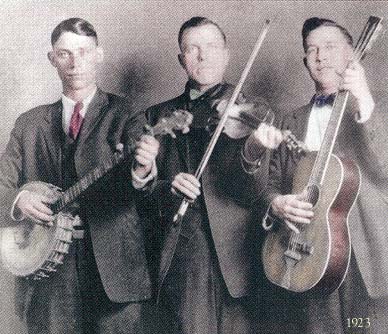
It must have happened something like this: Somewhere in the early nineteenth-century American South, a sharecropper from the British Isles, a fiddle hanging from his hand, sat down with a West African slave holding a banjo, and they hammered out a sound from the fiddle’s drive and the banjo’s shuffle that nobody had ever quite heard before, desperate and joyful, the sound of parties and arson, two ways to burn down a house. It’s unclear exactly how it spread, but it was all over Appalachia by the 1920s, when Okeh Records put the label of “old-time music” on their recordings of scratchy fiddles and stabbing banjos, howling singers already fifty years out of date from the hot new jazz 78s Okeh was cutting. But it was a stubborn thing; it survived for decades, spawned bluegrass and country, sending out those kids to get on the radio while it stayed in living rooms, porches, dance halls, parties in the woods. It made Pete and the rest of the Seegers, it made the folk revival, but it also made Bob Dylan, Bruce Springsteen, and all the purveyors of the roots rock and alt-country that followed, the ones tapping into the Old Weird America of last card games and murders by the river. It made all of these things but stayed itself, our country’s ecstatic and violent pulse.

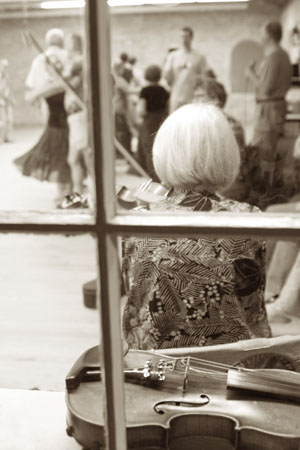
Growing up in Ithaca, New York, I heard old-time music a lot, saw it played, danced for hours to it. As a boy who liked to shake it, I was drawn to its energy and menace, the dark, hypnotic beat the bands could set up and let spin for hours. I watched the musicians start up a tune and get possessed by it, their bodies contorting, their eyes rolling back in their heads. I wanted what they had, I wanted to go where they were going. But as a budding musician, I was terrified of it. I had taken classical violin lessons since I was four, but when I watched fiddle players, I couldn’t comprehend how what I was seeing could produce what I was hearing; I didn’t even understand how they started the tune, when they knew to sing, when they knew to stop. It looked like telepathy. So for a couple of years I didn’t even try to play it. I played in orchestras, played trombone in a reggae band. Went to a lot of ska shows. But at last, in college, a friend of mine started playing banjo and needed a fiddle player, and I decided to give it a try. I took a couple of lessons from Judy Hyman. Went to a couple of festivals and a lot of jams. Got a banjo. Got my ass kicked around a lot; two hours into a long, loud session, my fingers were bleeding, my throat ragged with shouting, and the muscles in my arms were begging me to stop. I woke up the next morning with my voice gone, sometimes a bandage or two on my hands. But by my mid-20s, I was a good fiddle and banjo player. I could play for hours on end, drive the groove, get people to move.

The music, however, seemed to be dying. The actual old-timers, the ones who had taught the hippies how to do it in the 1970s, were actually dying, one after the other. On my first visit to a festival down south in 1997, I seemed to be one of about five musicians under the age of thirty. Old-time music had seen a big comeback with the folk revival—people my parents’ age—but from where I stood, it seemed like that might be the end of it, for reasons I couldn’t fathom. Nathaniel Rowan, a fiddle and banjo player, saw the same thing; we gravitated toward each other immediately, two moths to a dwindling flame, in New York City in 1998. I learned to really play the banjo on a park bench, with him playing fiddle and two punk kids cheering us on. Just about everyone else in the scene was decades our senior. Rocking players, full of energy, some of them could party us into the ground. But who would be playing the music in twenty years? Old-time had survived for 150 years already, but maybe we were it.

We’re not it any more. Old-time has always been everywhere, a skin stretched across the continent, but lately it seems like that skin is getting thicker. In New York, more people in their thirties age showed up, good players: Thomas Bailey, Rhys Jones and Christina Wheeler. They’d been playing for years already and sounded like it. But it was more than just people moving around, coming to the city. “In the last five years, I’ve noticed that it’s younger and younger,” Nathaniel says. “It seemed like suddenly it was really cool to play banjos and ukuleles—maybe because of O Brother Where Art Thou, but it seemed kind of punk rock, too.” Joe “joebass” DeJarnette of the Wiyos has been out to Portland, OR recently, where he says “the scene is these young punk kids. They live in these sheds and get their food from dumpsters and play old-time music. A bunch of kids from the West Coast are moving to North Carolina to be closer to the music and the culture. And there’s this back-to-the-woods thing that goes right with it.”

Musically, old-time is indestructible, a big, fat groove. You can bring anything to it and it survives—maybe because, like most genres of music, it was never pure, always a hybrid. It began as an American thing, the collision of Europe with the slaves of Africa with the ghosts of the native tribes that the Europeans destroyed and displaced. Over time, the people who played it—both those who grew up with it and those who found it later in life—brought to it the accents and inflections of other styles of music: parlor music, jazz, the blues. Today is no different, with people playing it like punk, like funk. Like Afro-beat, like smoked-out reggae. Like rock ‘n’ roll. Or they play it straight, no chaser. Any way they do it, it’s groovy.

Mr. DeJarnette lays it down thusly: “Old-time is one of the few kinds of music you can play without dealing with the music industry in any way, shape, or form.” All of the source recordings are public domain, but you really learn to play it—as I did, and everyone I know did—from person to person, at jam sessions, house parties, festivals. And the more you play, the more you meet people, and the more fun you have. To play old-time is to find yourself partying on a Wednesday, grooving in someone’s kitchen for ten hours, and all you need to start is a crappy instrument and the will to rock.

And Clifftop, the festival on the round peak of an isolated hill in West Virginia, has exploded into a ten-day, twenty-four-hour city of joy. It’s a sprawl of tents and campers, tarps and bungee cord, kitchens made from card tables and Coleman stoves, couches hauled out of vans. A place called Camp America. And there’s music all the time. It’s there in the morning when you wake up, it’s there in the hot afternoons; it’s there when the rain flows all around you and hammers on the tarps and roofs of cars. And at night, the warm glow from the thousands of lamps and lanterns lights the trees from below, and the music buzzes all around you like a million insects. If you walk around, you’ll see a campsite decked out to look like a Paris café, a gypsy jazz trio bouncing in the corner while a couple dances in the gravel. You’ll see a giant Cajun dance party under a carnival tent. Hillbillies rocking like they did a century ago. A dense ring of young hippies in the dark, heads bobbing, playing until their hands bleed and screaming out the lyrics over the din in their ears. But you won’t walk around that much. Sooner or later, you’ll find yourself in a circle of your own, with people you can’t recognize in the dark, two hours into a six-hour jam, and you’ll pull your grooves from the crickets in the trees, from the music all around you, from your fingers, which can’t stop moving, and you’ll remember everything all over again, why you’re there and how you started, all the jams and the faces of everyone you’ve played with in between. Why you started playing the music in the first place, and how the music will still be there long after you’re gone.