Posts by Edward Champion

Edward Champion is the Managing Editor of Reluctant Habits.

Bizarro Fiction: An Interview with Patrick Wensink

Bizarro fiction, an exciting genre devoted to “high weirdness” and a sense of fun, has eluded the frightened editors humorlessly holding the keys to their fragile literary castles. But it remains very much a prolific force, written and read by people who still possess a sense of glee about books and taken up by the good folks at Eraserhead Press, which has published such titles as Ass Goblins of Auschwitz, Shatnerquake, and Rampaging Fuckers of Everything on the Crazy Shitting Planet of the Vomit Atmosphere.

I had intended to investigate this phenomenon in depth. But Patrick Wensink, author of Sex Dungeon for Sale!, beat me to the punch, sending me his book of short stories, making me laugh, and graciously consenting to a suitably bizarro interview by email.

There seems to be this false belief that the world can be united by Coca-Cola (think Haskell Wexler selling out with that dreadful 1971 commercial) or other consumerist impulses. Practitioners of bizarro fiction, such as yourself, are more committed to the idea of literature as fun. How then can bizarro fiction change the world or resist these marketing forces? How might your own fiction change the world? Is the re-appropriation of culture part of the answer? Aren’t you essentially giving into these crass marketing forces by subverting them?

Haskell Wexler directed a Coke commercial? Medium Cool is one of my favorite movies. That doesn’t make me want a can of Coke, but now I’m curious as all hell to see this.

I think that’s a great point, that Bizarro Fiction like Sex Dungeon for Sale! attempts to bring fun into literature. I personally take a lot of care and effort into making sure I’m not just cracking jokes all the time, but wrapping the humor in stories that can also be appreciated as good writing. Eraserhead has a great history of providing surprises and fun with its books, whether its a story told from the perspective of a man being eaten by a bear, a book where all of William Shatner’s television and movie roles come to life or, with my book, where you get an optimistic real estate agent trying to sell a home with a sex dungeon. Hopefully readers are finding something they can’t get anywhere else and hopefully they come back for a second helping.

The editorial note at the beginning of the book suggests that if you don’t sell enough books through Eraserhead Press, you will never be published by them again. This seems an extraordinarily harsh proviso. Has Kevin L. Donihe, to the best of your knowledge, raped a close friend or killed an animal? Please provide suitable evidence for your answer.

Kevin Donihe is from Tennessee, so the chances that he’s killed an animal are ridiculously high. I think everyone from that state has a little Davy Crockett magic in their blood.

I don’t think Eraserhead’s approach to new authors is harsh. I think it’s a great idea, since the book industry is so harsh toward unpublished writers anyway. Eraserhead’s thinking isn’t unlike a father telling his son he needs to get good grades or he can’t borrow the car. Eraserhead has a big, fast, strangely-colored car with a roomy back seat, and I’d like to use it for a date next Friday, if possible.

“My Son Thinks He’s French” ends on a moment of transformation and incest. When did you first notice pubic hair? And do you find early puberty to be a greater threat against our national welfare than poverty and the disparity between the rich and the poor? Additionally, why didn’t this story include the word “freedom” within its prose?

Tough question. In addition to ending on a note of transformation and, possibly, incest, I think that “My Son Thinks He’s French” also ends on a laugh. But I suppose that depends on your opinions of transformation and incest.

I was actually just having a conversation about when I first noticed the short and curlies. By my estimate, it was sometime between my 10th and 30th birthdays.

You hit the nail on the head. “My Son Thinks He’s French” features no use of the word “freedom”. This is my little way of locking arms with the French people. I was recently in France, they make the best pastries in the world, how can anyone not approve? Does the congressional cafeteria still call its ‘taters “Freedom Fries”? I can’t get behind that, though I would support changing the name of Larry Bird’s hometown to “Freedom Lick, Indiana”, because, let’s face it, Indiana can use all the razz-ma-tazz it can get.

In “Wash, Rinse, Repeat,” Carl Dumford has “his words smear[ing] into long strings of vowels.” Yet his dialogue includes numerous consonants. How do you account for this discrepancy? And how does one apply two-ply to everyday vernacular?

Damn it! Somebody is getting fired. As you know, Ed, writing short stories for an independent publishing house is one of the most lucrative professions in America. It’s right up there with being a Fortune 500 CEO or one of those kids in High School Musical. So, this lifestyle allows me to employ an army of researchers, fact-checkers, copy editors, personal assistants and manicurists. Checking out discrepancies like this one is somebody’s job around here at Wentastic Enterprises and it sure as hell isn’t mine. Heads will roll, I promise.

I was alarmed by your use of boldface in “Chicken Soup for the Kidnapper’s Soul” and “Donor 322.” How do you soothe readers who might be alarmed by your energetic text formatting?

Bold type is a natural part of life, folks. Just like pubic hair, it’s not something we can hide our children from forever. People should not be ashamed of their use of boldface. By employing this popular writing technique I am coming out and encouraging others to follow my lead. I’m the Neil Armstrong of boldface type! Change your Facebook status, ladies and gentlemen, let everybody know you use boldface type and are not ashamed.

In “Donor 322,” you write, “Vomit surges across my body in waves.” This might be interpreted one of two ways: either unseen specialists are regurgitating upon the protagonist, possibly suffusing his body with the fresh chunks of last night’s dinner, or the vomit in question has adopted a sound wave pattern. Did you consult any oceanographers for this sentence? Are you a musical man? Are there nefarious individuals in Louisville, KY committed to the first proposition?

I don’t know about other people, but I went to college. And while I was there, I drank a lot of beer. And many times, after drinking this beer, I saw vomit do things I never imagined possible. I like to think that line is up for interpretation, depending on how much beer the reader drank in college.

In “Jesus Toast,” I sense a great deal of hostility towards post-structuralist types who wish to see patterns that do not exist. Have you been recently victimized by savage deconstructionists? Is this story your way of expressing a desire to organize a vigilante mob to tar and feather overzealous academics?

Before Sex Dungeon for Sale! was published I was rejected by over ten MFA programs. This made me very bitter for a long time. So, yes, there is a subliminal message buried in “Jesus Toast” that is encouraging people to tar and feather academia. If you hold it up to a mirror, you’ll also find an application form to have me tar and feather the academic of your choice for the low, low price of $19.95+tax.

When I read “Pandemic Jones,” Paul Reiser’s voice entered my head. I looked around, wondering if Resier was standing next to me, pounding away at Helen Hunt and Staci Keanan and screaming at Larry David to provide the anal plug. But he was not there. And I didn’t know how my pants had been unbuttoned. Have you had any direct communications with Mr. Resier? Have you had any sexual fantasies involving Mr. Reiser? By naming a pharmaceutical company after Mr. Reiser, do you feel that Mr. Reiser’s failure to engage with the American public in a dangerous way has been corrected?

Once, a few Christmases ago, I was feeling benevolent and gave my army of researchers, fact-checkers, copy editors, assistants and manicurists the day off. This forced me to actually do my own research for once. And you know what I found out? People love Paul Reiser. He’s the American equivalent of David Hasselhoff in Germany. According to the numbers I crunched that evening, if I added 132% more Reiser into my writing, Sex Dungeon for Sale! would spread like Swine Flu. America loves its Reiser, I’m just providing a public service.

“Me and Gerardo Down by the Schoolyard” offers a reasonable explanation for the disappearance of EMF and Jesus Jones. But how did you arrive at the economic value for doo-rags?

Wentastic Enterprises holds the patent for a machine that calculates the economic worth of doo-rags. It takes a snapshot of fluctuating factors, such as the price of cotton used for doo-rag production, the popularity of motorcycle gangs, astrological location of doo-rag friendly planets and how many bald dudes are trying to hide their scalp from the sun. Additionally, the recent Olympic medal victories of doo-rag enthusiast Apollo Anton Ohno has caused this machine to start working overtime. Expect a full report in the final quarter of 2010.

Has your wife taken a shine to Javier?

She has. I have the black eye to prove it.

Jonah Lehrer: A Malcolm Gladwell for the Mind

As the terrible news of Andrew Koenig’s suicide and Michael Blosil leaping to his death, both after long depressive bouts, emerged over the weekend, the New York Times Sunday Magazine had aided and abetted Jonah Lehrer’s continued slide into unhelpful Gladwellian generalizations by publishing his sloppy and insensitive article claiming that depression really isn’t that bad. Lehrer, an alleged bright young thing who found his own tipping point with How We Decide, appears to have cadged nuanced examples from such thoughtful books as Kay Redfield Jamison’s Touched with Fire and Daniel L. Schachter’s The Seven Sins of Memory, proving quite eager to cherrypick tendentious bits for a facile sudoku puzzle, or perhaps print’s answer to a “fair and balanced” FOX News segment, rather than a thoughtful consideration.

Lehrer attempts to establish a precedent with Charles Darwin’s mental health: a troubling task, given that the great evolutionist kicked the bucket around 130 years ago and, thus, didn’t exactly have the benefit of psychiatric professionals watching over his bunk, much less a DSM-IV manual. Lehrer suggests that the “fits” and “uncomfortable palpitation of the heart” that Darwin referenced in his letters represented depression. While it’s difficult to diagnose a mental condition in such a postmortem manner, John Bowlby’s helpful book, Charles Darwin: A New Life, has collected various efforts to pinpoint what Darwin was suffering from. And Bowlby’s results tell a different story. Darwin, who was very careful to consult the top medical authorities of his time, described his “uncomfortable palpitation” in a letter to J.S. Henslow on September 1837, when he was hard at work making sense of his data after the Beagle had landed back. In 1974, Sir George Pickering made an analysis of Darwin’s symptoms from these shards and attributed this state to Da Costa’s Syndrome, more commonly known as hyperventillation. Da Costa’s is most certainly unpleasant, but it is not depression. Dorland’s Medical Dictionary describes Da Costa’s as “a manifestation of an anxiety disorder, with the physical symptoms being a reaction to something perceived to be dangerous or otherwise a threat to the person, causing autonomic responses or hyperventilation.” (Emphasis added.) This diagnosis was backed up, as Bowlby notes, by Sir Hedley Atkins and Professor A.W. Woodruff.

Later in his book, Bowbly suggests that Darwin may have suffered from fairly severe depression during the months of April and September 1865 — which corroborates the “hysterical crying” that Lehrer eagerly collects and that Darwin conveyed to his doctor. But where Bowbly is careful to note that the “hysterical crying” leading to depression is a speculation based merely on a phrase and an anecdote conveyed by Darwin’s son, Leonard, Lehrer conflates both Darwin’s “hysterical crying” and Bowlby’s other non-depression examples into depression. Furthermore, Lehrer fails to note that the reason that Darwin was “not able to do anything one day out of three” (as he noted in a letter to Joseph Dalton Hooker on March 28, 1849) was because, as Darwin noted, his father had died the previous November. (Lehrer does note Darwin’s grief following the death of his ten-year-old daughter and proudly observes that the DSM manual specifies that the diagnosis of grief-related depressive disorder “is grief caused by bereavement, as long as the grief doesn’t last longer than two months.” But David H. Barlow’s Anxiety and Its Disorders cites a 1989 study*, which points out that “it is not uncommon for some individuals to grieve for a year or longer” and observes that some people may need longer than two months to escape severe incapacitating grief. A major depressive disorder may not necessarily be the result after two months of grief. In other words, the human mind is not necessarily an Easy-Bake oven.)

The basis for Lehrer’s thesis — that Darwin conquered the totality of his apparent “depression” to “succeed in science” and that his “depression” was “a clarifying force, focusing the mind on its most essential problems” — is predicated on a willful misreading of the primary sources, one that apparently eluded the indolent army of Times fact checkers, who only had to consult Bowlby’s more equitable analysis. This was irresponsible assembly from Lehrer: bad and inappropriate badinage intended to back up a sensational headline and convey Darwin as a falsely triumphant poster boy for severe depression. But depression is a deadly disorder, a condition that requires a less specious summary.

Lehrer later cites David Foster Wallace’s short story, “The Depressed Person,” as a qualifying example for how the depressive mind remains in a “recursive loop of woe.” One may find comparisons between DFW’s real depression and the details contained in the story. But the story, written in third person and loaded with clinical details, might also be read as something which depicts the regular world’s failure to comprehend inner torment. Prescriptive analysis may very well apply to patterns of behavior, but fiction is an altogether different measure.

It is doubtful that DFW ever intended his story to be some smoking gun for lazy cognitive science, as Lehrer insists that it is, when Lehrer declares that those with “ruminative tendencies” are more likely to be depressed. Daniel L. Schachter’s The Seven Sins of Memory, a book that Lehrer appears to have relied upon for the Susan Nolen-Hoeksema example, pointed out that people “who focus obsessively on their current negative moods and past negative events, are at a special risk for becoming trapped in such destructive self-perpetuating cycles.” But what of those who are ruminating after a positive mood or after positive events? The danger of using a phrase like “ruminative tendencies” is that it discounts Nolen-Hoeksema’s clear distinction between dysphoric subjects inclined to ruminate (and feel worse) and “nondysphoric subjects [who] would show no effects of either the rumination or distraction inductions on their moods.” Perhaps by warning his readership of “ruminative tendencies,” Lehrer is encouraging them not to ruminate and therefore become mildly depressed about Lehrer’s dim findings. Lehrer is right, however, about the Loma Prieta earthquake data (also found in the Schachter book). But his failure to distinguish between the dysphoric and nondysphoric perpetuates a convenient generalization rather than an article hoping to contend with conditional realities.

Near the end of his piece, Lehrer confesses that the criticisms against the analytic-rumination hypothesis are often responded to “by acknowledging that depression is a vast continuum, a catch-all term for a spectrum of symptoms.” Well, if only he had told us this at the head of the article before leading us down a rabbit hole. He later writes, “It’s too soon to judge the analytic-rumination hypothesis.” Well, it wasn’t too soon to speculate on Darwin’s letters (not all the result of depression) or David Foster Wallace’s inner psychological state, as reflected through a story.

Lehrer also brings up Joe Forgas’s experiments at a Sydney stationery store, whereby Forgas hoped to get his subjects to remember trinkets. He played different music to match the weather. Wet weather made the subjects sad, and the sadness made the subjects more attentive. But in a Financial Times article written by Stephen Pincock, Forgas was careful to note “that any benefits that he has found apply only to the passing mood or emotion of sadness, rather than the devastating illness that is severe, clinical depression.” Once again, Lehrer neglects to mention this scientific proviso, leading readers to conclude that Forgas’s results are more related to depression.

It’s also important to note that the Paul Andrews study Lehrer relies on, which drew an interesting correlation between negative mood and improved analysis, defines “depressive affect” as “an emotion characterized by negative effect and low arousal.” This is a fundamentally different metric from outright depression, which Andrews’s study is clear to specify. But Lehrer confuses the two terms and retreats back to his clumsy Darwin metaphor of “embrac[ing] the tonic of despair.”

I don’t doubt that Lehrer wished to point out how depressive affect, or modest negative feelings, need not translate into a crippling existence. But his distressing conflation of “depressive affect” and “depression,” and his insistence that even a modest negative feeling might be categorized as depression, may very well suggest to readers that hard-case depressives in serious need of care and treatment might do without these essential long-term remedies. As someone who has offered assistance to friends living with this very real condition, I find Lehrer’s willingness to lump every sad behavioral pattern into “depression” truly shocking. I’m also greatly concerned that the New York Times — the ostensible paper of record — has failed to fact-check the selected studies, thus misleading readers into believing that depression is always a “clarifying force.” Depression, as Andrews attempted to convey to Lehrer, is “a very delicate subject.” Andrew did not wish to say anything reckless for the record. It’s just too bad that Lehrer did.

* Jacobs, Hansen, Berkman, Kasi & Ostfield (1989). Depressions of bereavement. Comprehensive Psychiatry, 30(3), 218-224

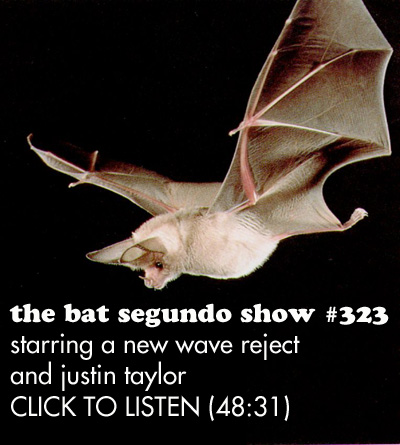
The Bat Segundo Show: Justin Taylor

Justin Taylor recently appeared on The Bat Segundo Show #323. Mr. Taylor is most recently the author of Everything Here is the Best Thing Ever.

Condition of Mr. Segundo: Fearful of sanguine book titles.

Guest: Justin Taylor

Subjects Discussed: Not naming protagonists until well into the stories, dissatisfaction with formality, how characters reveal themselves, gender confusion within “Weekend Away,” Taylor’s aversion to “bright neon signs” within narrative, the dangers of being too specific, similes, concluding lines and addressing the reader, the final line of “Jewels Flashing in the Night of Time,” Donald Barthelme and Taylor’s veer from the phantasmagorical, Sleeping Fish and 5_Trope, Shelley Jackson, the Gordon Lish school of writers, Gary Lutz’s “experimental” nature, Taylor’s concern for hair, describing Florida primarily through the weather, the helpfulness of knowing a place before writing a story, boundaries and possibilities within limitations, age declarations at the beginnings of stories, the difficulties of getting all the numbers worked out within “The New Life,” the important of precise age, research that comes after writing a story, eliding the coordinates of a Planned Parenthood, 1960s counterculture, the Grateful Dead, distrust of pithy maxims and prescriptive text, and believing in aspects of a story.

EXCERPT FROM SHOW:

Correspondent: I wanted to go back to the hair. I had alluded to that earlier. It could just be me, but you do have a concern for hair. It’s often quite specific, as I suggested. You begin “Amber at the Window in Hurricane Season” by describing her pushing “a blond lock behind her ear, stray hairs glancing off a steel row of studs.” In “In My Heart I Am Already Gone,” you describe how Vicky “cuts her own bangs, a ragged diagonal like the torn hem of a nightgown.” In “Weekend Away,” the hitchhiker has “black, messy hair mostly covering his ears.” In “What Was Once All Yours,” Cass has hairy forearms. I’m curious about this hair. And also we haven’t alluded to the cat as well. Is it more of a protective element? You know, these characters are often barren against the elements, so to speak. And I’m curious about this. You are a hair man, I have to say.

Taylor: (laughs)

Correspondent: Or are you the President of the Hair Club for Men? I don’t know.

Taylor: I can’t really answer for that. I mean, every writer has certain concerns or tics that they might not even be aware of. I asked a similar question to David Berman once. I got to interview him for The Brooklyn Rail. And I was asking him this question about water. I said, “You know, American Water.” And there’s this line in Actual Air. “All water is classic water.” I had, I don’t know, two or three other examples. And I finally just asked myself, “So what’s the deal with all the water?” And he said, “You know, nobody’s ever asked me that before.” And he really didn’t have an answer. And then he told this story about mowing his lawn on a hot day. Which I think was supposed to exemplify that water is — water’s nice. And, you know, I don’t know. Hair is nice, I guess. I don’t know why. Because it’s mostly haircuts, hairstyles. I don’t know why I notice. Those are like what I’m visualizing with a character that appears or seems to be worth mentioning rather than eye color or height or anything else. I don’t know.

When I was a kid, I never liked getting haircuts. I still don’t like getting haircuts actually. I always feel like I don’t have a good haircut. Like everybody else has the style that they’re supposed to have. And mine always feels a little off. I feel like I’m impersonating.

Correspondent: Not one satisfactory haircut in your life?

Taylor: I’ve had some decent haircuts. But it was like a very early — it was when I was a really little kid. It would get long and I would be worried that I would look like a girl. And they would take me to get my hair cut. And then after it was cut, I would see myself in the mirror and I wouldn’t even recognize myself. And I would really lose it. And that doesn’t happen so much anymore. I’ve learned to recognize myself.

Correspondent: With more confidence, more confidence in hair and haircuts.

Taylor: There’s only so old you can be crying at a barbershop.

Correspondent: I’ve seen very older men cry at barbershops.

Taylor: (laughs) In any case, the answer is “I don’t know.”

The Bat Segundo Show #323: Justin Taylor (Download MP3)

This text will be replaced