First off, I want to thank all of the people who have written with their concerns and kind words about The Bat Segundo Show. I have received messages from listeners all over the world — including France, Sweden, Japan, and Norway. I was also extremely honored by Colin Marshall’s kind writeup at The Sound of Young America blog — especially humbling, given that I’ve greatly enjoyed both Sound and The Marketplace of Ideas — and Carolyn Kellogg’s post at The Los Angeles Times. This has all stunned me. The upshot is that, while my stats have reflected a solid audience of roughly 5,000 to 10,000 listeners per show, it appears that more of you may be listening to this show than I’ve realized. I’ve learned from some of you that podcasts downloaded from this site have recirculated. MP3s have been burned onto CDs for road trips. Files have been swapped onto other computers and MP3 players.
Because of this, I believe we are in the position to not only set a major precedent for a web-based radio program, but at a juncture where we can ensure that these interviews keep on going.
Here is what we have done. There have been talks with a number of parties about how we can sustain Segundo. And we’ve come up with a few ideas. We intend to carry out a three-prong plan that, if successful, will keep the show running through the end of the year at a rate of eight shows per month. Should this plan work, I believe that we can make Segundo self-sustaining, increasing both the program’s frequency and its range.
But before I reveal the details of our campaign, I have some news. There have been a few conversations with radio stations about distributing Segundo. While talks remain ongoing with a few of these outlets, I’m happy to report that, on August 2008, Litstation will be airing the first 230 installments on a nightly basis over the next year. The show will air at midnight. Some of the shows — meaning those that run over an hour — will be slightly modified to fit programming needs. But they will more or less be airing as they originally appeared here. Shortly after I finish with this project, I’m also going to be splitting the shows up into 28:30 blocks. The idea here is to have syndication packages ready for both one hour and half-hour formats so that the show can be distributed in many forms. If you are a radio program director interested in distributing Segundo (the perks include custom intros for your station and a few other frills), please email me and I’ll be happy to discuss the details.
However, I believe that the Web is Segundo’s predominant home. It is the Web that I plan to prioritize first. The biggest problem in getting public radio interested in Segundo is the show’s rather eccentric format. And I believe that the show’s strengths will be better served if Segundo remains fun, passionate, informed, and slightly idiosyncratic. In other words, on the Web.
I’ve also made a few cosmetic changes to the Bat Segundo site so that it’s a little less cluttery and easier for you to subscribe via iTunes.
I have set up a few more interviews for August, ensuring that eight shows will be aired this month. This should take us up to Show #234 before the end of the month. In an effort to keep the Segundo schedule more consistent, I will be putting up at least one new show every Friday, with the week’s second show (or, in some cases, a third show) appearing at some random point in the week.
I am currently in the financial position of keeping Segundo going through the end of August and through a good chunk of September. My operating costs essentially entail enough money for me to pay my rent, keep up the hosting costs, and a few other comparatively meager expenses. (Pedantic expenses such as ConEd and the like.) Over the past year, I have made enough freelancing money each month to keep Segundo going. I still intend to carry on freelancing as much as I can and as long as the editors will have me. But I also realize that, because of recent newspaper developments, it is no longer tenable for me to rely on this shaky income. I am not too proud to take up a full-time job. But if I do become employed on a full-time basis, I will not have the time I need to produce these shows with the same frequency and quality that I have in the past. There was a point when I was putting out Segundo while also working a full-time job. But to do this, I nearly drove myself insane. There were far too many nights in which I would stay up mastering until 4 AM or so, finish a podcast, and then wake up a few hours later to go to work. These considerable demands have become greater over the past year. As the show’s demands upon my life have increased, I do not believe that sleeping three hours a night is a tenable scenario. Each podcast now involves some twenty to twenty-five hours of work, and often considerably more. This time goes into reading, research, booking, production, post-production, et al.
For those who have full-time jobs and compare my creative life to that of a bum’s, I assure you that I am not a loafer. I have continued to work 90 to 100 hour weeks as a freelancer and a podcaster, frequently starting my day at around 6:00 AM and ending it sometime in the evening hours. This is hard work and I do my best to keep things as fresh and vibrant as I can. Some friends have informed me that I live a rather preternatural existence. But I also realize that I am not entitled to this existence and I hope that the product of my considerable labor will permit me to carry on doing this. While I can certainly see Segundo continuing as an intermittent series of specials, I feel that this program is important enough to warrant its continued rate of production. Judging by your emails and support, I believe that you feel similarly.
So here’s the plan:
1. Sponsorship. Because Segundo reaches a very specific niche audience, and because nearly every existing survey I have consulted concludes that listeners don’t mind a 15-second advertisement before a podcast, we plan on initiating an unobtrusive form of advertising along these lines. At the beginning of each program, we’ll feature a quick 15-second audio advertisement. Like old time radio, each program will feature a sole sponsor. For less than the price of a business card advertisement running for a week in the Brooklyn Paper, you’ll get a reasonably priced form of radio advertising that (a) singles out a more targeted demographic, (b) doesn’t have to compete with other advertisements to grab the listener’s attention, (c) permits your product or service to stand out in a way that is unlike any other, (d) treats the audience intelligently and respectfully by not overstaying its welcome, and (e) gives you radio advertising that you don’t have to pay a $2,000 minimum for (believe it or not, that’s the standard cost for a local radio station advertising bundle).
Here’s a look at some advertising rates with other podcasts.
Blogger & Podcaster: $450 for a 30 second ad. (Claimed audience: 20,000)
Blog Talk Radio: $350 per 15 seconds. (Claimed audience: 5,000)
Colorado Hockey Insider: $200 per show. (Claimed audience: 9,000)
Geek News Central: $1,000 per show for 30 to 45 second ad. (Claimed audience: 18,000)
Small Business Podcast: $500 per show to be mentioned in the podcast. (Claimed audience: 3,500)
A Very Spatial Podcast: $250 per show, 10-15 seconds. (Claimed audience: 1,500)
After looking at these figures (and it’s worth noting that all of these podcasts, to my knowledge, were able to obtain advertising at the rates they offered), we concluded that $350 per show would be a very fair market rate to start out with. We took some of the excellent advice and honesty given by podcaster Michael W. Geoghegan about operating as an independent podcaster and set to work on a media kit.
We’ve now prepared a media kit that offers a program overview and includes many details about sponsorship. If you’re interested in setting up the deal, feel free to check it out. You can contact me if you have any questions.
If you’re an advertising agency or a third-party individual who would like to set up advertising for us, I should note that we’re offering a 25% commission. (The standard commission rate given to ad agencies is 15%. And in light of what they do to support big magazines and the comparatively picayune amount we are asking for, I have decided to up the percentage. If you can get one client to sponsor a month of Segundo, that’s $600 that goes directly to you when the deal goes through. If you can do that in about four hours of time, then that’s $150/hour.) However, a few volunteers will be approaching potential advertisers in a very pro-active manner during the next few months. Our goal is to get five of the eight programs set up for sponsorship during August. If we can do this, and maintain a sufficient momentum, then we’ll keep on doing this. And we’ll report on the progress of this experiment as it happens.
There is one stipulation. Because Segundo is a program that strives to maintain its journalistic integrity, we will not be accepting advertising from publishers. We want to avoid anything that resembles a conflict of interest. (Historically, the shows have gone out of their way to include an eclectic mix of publishers, both large and small.) Segundo is what it is because it remains fairly autonomous. And we’re hoping that we can keep things this way. This is not to say that we’re ruling out companies that provide study guides, notebooks, or fancy pens, or those who host book fairs and trade shows, et al. But we do want to run the most ethical ship we can under the circumstances. And, besides, one mistake made by newspaper advertising departments has involved the failure to consider that book people do indeed go to restaurants, shop, travel, et al. We’re going to try and atone for this mistake. And we’re also going to reach out to smaller companies.
I should also point out that, unlike radio, we’re also open to individuals who wish to pay for a crazed message. And if you’ve been having trouble getting a particular kind of ad on television and radio because these networks and stations have cold feet, well then, why not try podcasting?
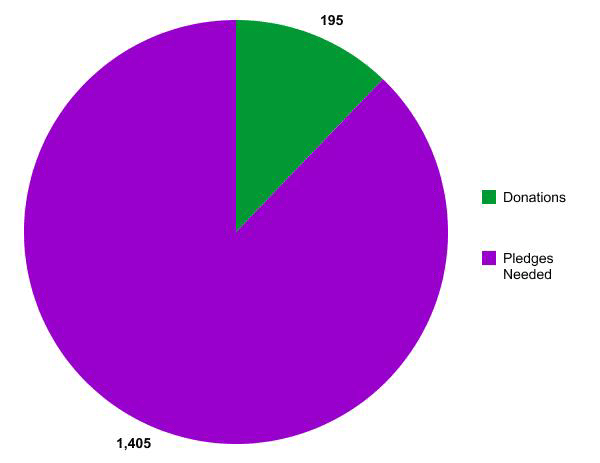
2. Donations. Of course, we realize that it may take a good month or two to set up advertising. We’re under no illusions that any of this will work. So we will simultaneously be launching a new pledge drive in August for a sum of $1,600. Should we obtain this modest sum in the next three weeks, this will permit us to stay alive during the next month and conduct numerous interviews in September and early October with many important authors in the fall. We’ll also be placing some of this money into a low-cost marketing campaign that we’ll be carrying out in August and September to increase the show’s audience. I can’t yet tell you the details of this marketing yet, but I can say that no podcaster has tried what we’re doing and we believe that it will be successful enough to increase our audience. This audience increase, in turn, will make us more attractive to sponsors. (After we carry out this marketing, in the interests of total transparency, I will report on its degree of success.)
Like our pledge drive from last year, if you contribute $10, we’ll send you a chapbook which contains a special message from Bat Segundo, an excerpt from Humanity Unlimited (my novel in progress), and an excerpt from Wrestling an Alligator (a play I wrote and directed a few years ago). If you’ve already received a chapbook and you choose to contribute again, we’ll be sending a supplemental chapbook that contains an excerpt from a noir novel that is also in progress.
If you’ve enjoyed Segundo over the years and you’d like to see us continue, feel free to donate.
I should also point out that the conflict of interest clause also involves donations. If you are an author and I eventually do interview you, then I’ll have to return the money. (In full transparency, we had one author who contributed last time. But we avoided a conflict in ethics by having somebody else interview this author.)
Now because our previous posts on the near demise of Segundo have resulted in a few donations, we’ll be including them in this $1,600 figure. Fair is fair. So the tally that we now have to beat is:
In the event that donations and sponsorship don’t yield the results, this brings us to Point #3.
3. Reading Fundraiser: I’ve contacted a few authors who have generously offered to give up some of their time for a Segundo fundraiser sometime in the fall. We’re currently looking around for possible venues. (If you have any ideas, again, please email me.) But what we have in mind is a reading fundraiser that would be hosted by Bat Segundo. (As our most recent podcast has made clear, Mr. Segundo was not, contrary to the events depicted in Show #199, shot to death.) Those attending would pay an entrance fee. But if the authors reading at this fundraiser aren’t enough of a draw, we’ll also be handing out CDs, which will contain a selection of the best Segundo episodes (along with a bonus or two that isn’t available online). In addition, should we find a sponsor who is willing to underwrite this event, we could waive the entrance fee and simply hand out the CDs.
We should have more on this fundraiser once we’ve managed to organize.
I realize that this is an elaborate plan that will require a good deal of hard effort. But I firmly believe that together, we might be able to do something quite amazing.
As my advertising rates indicate, I’m sure as hell not doing this for the money. My aim with Segundo has been simply to attempt something a little smarter than other radio shows who talk with authors.
I am being as transparent as I can with you because I do recognize that we’re trying to do something here for community. We’re trying to do something here for democracy. We’re trying to do something here for integrity.
This experiment may work. It may not. But it’s certainly worth a shot. And however it turns out, I’ll keep you posted on our efforts.
Thank you again for listening. And thank you for supporting us.
MEDIA KIT:
Bat Segundo Media Kit
 Correspondent: I’m wondering though if there has ever been an instance in your comic career, in which an editor has come to you and said, “Hey, Peter, the sales for this particular title are flagging. What can we do to raise things up?” Has this ever an influence?
 Correspondent: But not every man, Faye, is going to sit down and slap thousands of dollars wanting to get laid like this.