The Bat Segundo Show: Mary Robinette Kowal

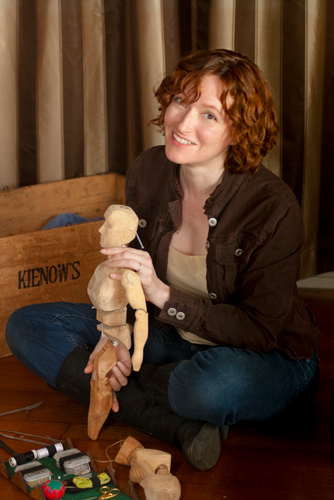
Mary Robinette Kowal appeared on The Bat Segundo Show #356. Ms. Kowal is most recently the author of Shades of Milk and Honey.

Condition of Mr. Segundo: Confusing magic with milkshakes.

Author: Mary Robinette Kowal

Subjects Discussed: [List forthcoming]

EXCERPT FROM SHOW:

Correspondent: I wanted to start with the specific language in this book. The specific Jane Austen template that you laid out. You took great care to mimic Jane Austen’s particular spellings. You used chuse with a U instead of choose with double O. Shew instead of show. Surprize and teaze spelled with a Z. But on the other hand, you didn’t, for example, hyphenate today. And things along those lines. And nuncheon! Jane Austen never used nuncheon!

Kowal: That’s not true. She used it twice.

Correspondent: When? And where?

Kowal: She used it in Lady Susan and Sense and Sensibility.

Correspondent: Ah, okay. Well, in any event, the hard choices of vocabulary. I wanted to first of all start with how this came about. Why go ahead and emulate this language? Was the idea here to create a series of limitations with which to approach a long-form novel? What came first here?

Kowal: I thought that language reflects society very closely. The reason I wound up using some of her spellings, it’s really an affectation. I am trying to pretend that this is something that could have been written then. I deviated from her spellings in places where I thought it would be confusing. In places where I didn’t feel the word was going to appear often enough for a reader to get used to it. An example of a word that was confusing was that she spelled stayed – like stayed at home – S-T-A-I-D.

Correspondent: That’s right.

Kowal: Which is a different word now. The word sofa appears, I think, once in the novel. And she spelled it S-O-P-H-A. And there’s not actually a reason to stop people. I actually thought that they were going to make me change all of the spellings. But I guess you can think of it as dressing up in Regency clothes, but remembering of course that it’s still going to a costume party.

Correspondent: By “they,” are you referring to Liz Gorinsky?

Kowal: Yes.

Correspondent: Or the copy editors?

Kowal: Well, Liz Gorinsky. The production department. I thought that someone in the editing line was going to say, “Hey, we need to change that.” The copy editor, once we had decided with Liz and marketing to keep the spellings — and we did lift out some of them – then I gave the copy editor a style sheet that said, “These are the correctly misspelled words. Please do not change them.”

Correspondent: Which words didn’t make the cut? I’m curious.

Kowal: Sopha. Staid. All of the to-days and to-morrows.

Correspondent: Oh! So those were originally spelled that way in your original draft.

Kowal: Yeah.

Correspondent: Okay. Wow.

Kowal: I can’t remember what some of the others were. But I did a find/replace. I can’t remember where I found it, but I found a Jane Austen spelling list. And I went through and did a find/replace on everything. And then they went back and undid that. So it’s funny. There’s a couple of places. I know that there’s at least one chuse that we missed and it’s still spelled with two Os. But you know.

Correspondent: Well, goodbye to that, I suppose.

Kowal: You know. Second edition.

Correspondent: Well, this is interesting. Because I’m wondering if it took you several practice tries to write in this particular meticulous style.

Kowal: I would read a chapter of Jane Austen and then write a chapter of Jane Austen. So I was reading Persuasion while I was writing this. And one of the things I picked up from the puppetry is that I frequently have to mimic somebody else’s style. So once I decided to do this, I sat down and started reading Austen. And then the reason that I was writing right after finishing reading a chapter was because I knew that the language would stick and the rhythms would stick. But I don’t really think I did a practice run.

Photo: Annaliese Moyer

The Bat Segundo Show #356: Mary Robinette Kowal (Download MP3)

This text will be replaced

The Bat Segundo Show: Prince of Broadway & Adam Langer II

Sean Baker, Darren Dean, and Adam Langer all appeared on The Bat Segundo Show #354.

Sean Baker is the director and co-writer (among other things) of Prince of Broadway. Darren Dean is the producer and co-writer of that same film.

Adam Langer is most recently the author of Thieves of Manhattan. He previously appeared on The Bat Segundo Show #175.

Condition of Mr. Segundo: Searching for princes and publishing insiders.

Guests: Sean Baker and Darren Dean, and Adam Langer

Subjects Discussed: [List forthcoming]

EXCERPTS FROM SHOW:

Correspondent: Because this was a low-budget operation, I have to say that there had to be at least one moment where it was guerrilla shooting.

Baker: Oh yeah.

Correspondent: Could you talk about this? I mean, how much of this was sneaked….

Baker: Do you want to talk about it?

Correspondent: Can you talk about it?

Baker: I don’t know if we can talk about this.

Dean: (laughs)

Correspondent: You can hint at it.

Baker: The fight scene.

Dean: Yeah, we can talk about it.

Baker: I think so.

Dean: We had permits for everything. Which fight scene? The first fight scene or the second fight scene?

Baker: No, the second fight scene.

Dean: We had permits for everything. And we just ran up against the wall. And at the very, very end, we were like, “Oh my god! We forgot this fight scene!”

Baker: Yeah.

Dean: But we shot in the parking lot. We got up that day and we said, “Well, we need to shoot this scene.” Our permits were gone.

Baker: We ran out of insurance that morning.

Correspondent: Wow.

Dean: Everything was gone. This was the last scene we had to shoot or one of the last scenes we had to shoot. And we got up. We went to Prince. And we said, “Here’s $10. Or $15. For each guy you can find. Tell them we need them for twenty minutes. There’s going to be a fight. And meet us at that garage over there.” I went over to the gate of the garage, talked to the guy who was working the garage. I gave him twenty bucks. I said, “We’re going to be here shooting for fifteen minutes and then we’re out.” Shot the scene and literally took off. And that was it.

Baker: That was the one point where we just had to resort to that. Because we were running out of money. We ran out of insurance. And to get the film completed, it took those drastic measures.

* * *

Correspondent: John McNally at the San Francisco Chronicle called you a “publishing insider.”

Langer: Oh yeah.

Correspondent: And I’m wondering why he thought this. This is a book, after all, that has the rather implausible idea of US News & World Report having a books editor. I thought that was rather absurd, I have to say. If you’re a “publishing insider,” that should have been the big tipoff.

Langer: Yeah, I know US News & World Report. But that’s also from the perspective of someone who doesn’t know a hell of a lot about the book industry. The guy who identifies himself as a US News & World Report guy. But publishing insider? I mean, I don’t know. I write books. So I’m inside publishing that way. I’ve never had a job in publishing. I worked as an editor for a book magazine. I don’t know. If you’re a sportswriter, are you inside the sports world? Maybe. I don’t know.

Correspondent: It could very well be that the literary world, or the publishing world, has only so many cliches or is so diaphanous in its subject matter that anyone could, by way of delving into it, could become a publishing insider.

Langer: Yes. Guilty as charged. But I never really thought of myself that way. And I wish I had a few more editorial jobs to give myself a little more streetcred in that regard.

Correspondent: Well, going back to the names of people you brought up, did you have to go through Legal to get permission in house? Was anything considered to be defamatory in any capacity?

Langer: No. Not everything is defamatory in the book necessarily. I mean, I really didn’t want to slag individual people in the book. But at the same time, I wanted it to be taking place in the real publishing world. So I didn’t want anything in there fictional. I mean, if someone’s at a party, I wanted people who would be at these parties intermingling with fictional characters. In the same way I like to talk about how you have Bob Hoskins in Who Framed Roger Rabbit? But you also have Jessica Rabbit running around. So I like the intermingling of cartoonish and reality. But I had no desire or interest in ragging on anybody specific in publishing. And anyone who is libeled in the book is fictional, I would say.

The Bat Segundo Show #354: Prince of Broadway & Adam Langer II (Download MP3)

This text will be replaced

The Bat Segundo Show: Daniele Thompson

Daniele Thompson appeared on The Bat Segundo Show #353. Ms. Thompson is most recently the co-writer and director of Change of Plans — a movie that opens in theaters on August 27, 2010.

Condition of Mr. Segundo: Confusing his code with his plans.

Guest: Daniele Thopmson

Subjects Discussed: [List forthcoming]

EXCERPT FROM SHOW:

Correspondent: I wanted to start off about confinement and physical space. In Jet Lag, you have two characters who are predominantly occupying a hotel room. In Avenue Montaigne, you have a broader physical space with the cultural world. And in this [Change of Plans], you have, of course, the dinner party. Eleven characters. It’s the ultimate locked room mystery of life. So my question to you is whether you pursue this confinement as a way to generate dramatic conflict. Or whether this reflects more a concern with the home truths that come out with this human relationship with physical space.

Thompson: Well, we’re dealing with the question of time and space in all fiction!

Correspondent: Yes!

Thompson: It’s true that it’s a challenge to have eleven people in the same place one night, and then again one night a year after not in the same place. I don’t want to give out all the…(laughs)

Correspondent: Sure. But we’re talking predominantly the first dinner party.

Thompson: Right. It seemed that it was the ideal frame for the original idea for the film. The original idea for the film — my original ideas are usually very tiny. They’re like little seeds. And then we have to work on it for weeks, and sometimes months, to find out whether that seed is going to give out some kind of flower or tree or whatever.

Correspondent: Or transform in this case to a baroque redwood.

Thompson: Exactly. So the original idea was fascinating by the fact that when we meet friends in the evening, our friends and ourselves are not the same people in the afternoon. The afternoon or the day or whatever. Because I thought we all have few choices in life. Waking up in the morning and going to work is not a choice. It’s an obligation. 7:00, 6:00, 8:00 in France is later than in America. You can make a decision of not going out to dinner. You have that choice. You can call in sick. I have a headache. I have a problem. So if you do go out, the politeness — the least thing you can do is bring something of yourself. The more sunny side of yourself. And that’s what people do. And therefore people lie. People pretend. And the lovely thing about it, and this is why it’s kind of an apology. It’s an aspect of life that I think is very important in social life. You believe it in yourself. It makes you feel better. You have a sort of entr’acte. An intermission in your own life where you have laughed and told funny jokes, and pretended that everything is going well with your couple and your children and your work. And I thought it was a very funny idea to make the audience aware of what these people’s lives were really going on in the afternoon and then see what happens at night.

The Bat Segundo Show #353: Daniele Thompson (Download MP3)

This text will be replaced

The Bat Segundo Show: Gary Shteyngart II

Gary Shteyngart appeared on The Bat Segundo Show #352. Mr. Shteyngart is most recently the author of Super Sad True Love Story. He previously appeared on The Bat Segundo Show #121 and was ambushed by a Noah Weinberg type earlier in the year.

Condition of Mr. Segundo: Too old and too much of a hack for Conde Nast’s cryogenic chambers.

Author: Gary Shteyngart

Subjects Discussed: [List forthcoming]

EXCERPT FROM SHOW:

Correspondent: You’ve probably seen this video of this 11-year-old who’s being cyberbullied by 4chan. Did you hear about this? She’s going by the name of Slaughter. And there’s a video where her dad is shouting in the background. And it’s truly horrifying. Surely, I think people would still value their privacy to some degree. Or they would say, “This is going way over the line.” Harassing people. Providing every bit of personal information. I mean, that’s got to trump any seduction by technology.

Shtyengart: Who knows? Things happen so quickly. Our values are changing so quickly. I mean, one of the things that this book doesn’t state, but maybe believes, is that change is okay. Change is going to happen. The end of slavery was good. Racism, anti-Semitism, homophobia — the dilution of all these things in states outside of Arizona. That’s good. But change happens quicker than we’re able to accommodate it. Because we are really flesh and bone and certain whatevers going on in our heads. But there’s only so much we can do. And when we’re addicted to constant change that’s changing at a breakneck speed, what happens when the change overruns us and begins to condition this group mind that we have brought together? It begins to condition us more than we condition the group mind. That can be very depressing. I mean, going back to the television people — when television was revealed — there was a similar worry. But what this does is a little more insidious. It takes away our privacy, for one thing. But it also deputizes all of us to be writers, filmmakers, musicians. Which sounds lovely and democratic. But when a book ceases to become a book, when a book becomes a Kindle application, when it become a file — how different is it in the mind of somebody from any other file that you get? Sitting there at your workstation — if you’re a white-collar worker — all you do all day long is receive bits and bits of information. And in some ways, you begin to privilege these bits of information. But in another way, one email is as good as another. It’s all just coming at you. Streaming at you. You go home. What’s the last thing you want to do? The last thing you want to do is pick up a hard brick like the one I’m holding right now, open it, and begin to read linear text for 330 pages. It’s the last thing you want to do. Who the hell would want to do it? And I think that because America is such a market economy, there’s still a real love of storytelling. That’s why you look at something like The Wire, The Sopranos, Mad Men. You know, what they’ve done is they’ve very cleverly — and they’ve talked about this — they’ve repurposed fiction — the way it used to exist between covers — in a way that can be transmitted inside an eyeball, in a way that satisfies our craving for storytelling. But without all the added benefits that you get from a book.

Correspondent: Hmmm. Well, I don’t know about that. I mean, to some degree, by having jokes and by writing an entertaining book — which I think this is an entertaining book…

Shteyngart: Thank you.

Correspondent: …you are kind of contributing towards this entertainment-oriented storytelling.

Shteyngart: That’s right.

Correspondent: What makes you different, eh?

Shteyngart: Well, you hit the nail on the head with your big hammer. I still believe that fiction is a form of entertainment. In my crazy world, which may not exist, I’m still hearing about a book that I have to read. And I’m getting out of bed. And I’m running to the bookstore. And I’m buying it. In the way that people run to the cineplex. I’m excited. And that’s what I want fiction to do. If it doesn’t entertain me, then it’s work. When I was researching parts of this book, I had to read a lot of books that were not entertaining. And they were work. What worries me is the academization of literature. When it becomes just an academic pursuit, where we sit around, we create serious works that are then discussed by serious people in serious settings, and the entertainment value is nil. And we become a small tiny society that’s obsessed with things. In other words, we become where poetry is today. Utterly irrelevant. Beyond a certain beautiful wonderful circle of people. And the poetry hasn’t gotten any worse. The poetry’s great. And the fiction hasn’t gotten any worse. Some of it is amazing. But the way we approach these things has become too serious.

Correspondent: Well, to what degree should books be work? I mean, I’d hate to live in a world in which Ulysses was banned simply because it was considered to be too much work. I find it a very marvelous journey to just sift into all those crazy phrases and all that language. But it doesn’t feel like work to me. And I don’t think it feels like work to everybody. And we still have Bloomsday and all that.

Shteyngart: I’m not talking about Ulysses. I’m talking about self-important crap.

Correspondent: Like what?

Shteyngart: Well, I’m not going to say.

Correspondent: Ha ha! Very convenient.

Shteyngart: Very convenient. I’m not going to say. Madame Bovary. Talk about a page-turner. I can’t put that thing down. I read it all the time. Jesus Christ, and there’s still part of me that thinks, “Don’t do it. Don’t do it, Madame B. Stay away from that schmuck.” Because it’s so damn involving. It’s brilliant. It’s funny as hell. You know, the apothecary. There’s so many elements in it that are working. It’s perfectly researched. The language is just right. It doesn’t — I suppose it could be considered work. But it’s not any more work than one needs to do in order to gain the maximum enjoyment and understanding of these characters.

Correspondent: Yeah. But isn’t there some sort of compromise? Aren’t you trading something away for this happy medium? Are we talking essentially to some degree about approaching books and literature as if it’s a middlebrow medium?

Shteyngart: Oh what does it mean? Middlebrow, lowbrow, highbrow. These brows. I raise my brow at those brows.

Correspondent: Very bromidic

Shteyngart: The whole bromidic stuff is nonsense. What makes Jeffrey Eugenides or Franzen’s works — what makes them stay in our minds? They use whatever language they want. If they need to deploy highfalutin language, they’ll do it. If they need to use street slang, they’ll do that. The range is always there. And you try to capture a world. A place and time you try and capture as best as you can with the best people who you can deploy. The best characters you can deploy doing them. And to do that, you need to care about these people. Maybe I failed. But I certainly have tried with Lenny and Eunice more so than with anyone else. I’ve tried to live inside their skin. I’ve tried to make myself feel the love that they both have toward each other in this very difficult world. And you know, that doesn’t sound highbrow. But to me, it’s the most important thing I can do with my art.

(Image: Morbinear)

The Bat Segundo Show #352: Gary Shteyngart II (Download MP3)

This text will be replaced

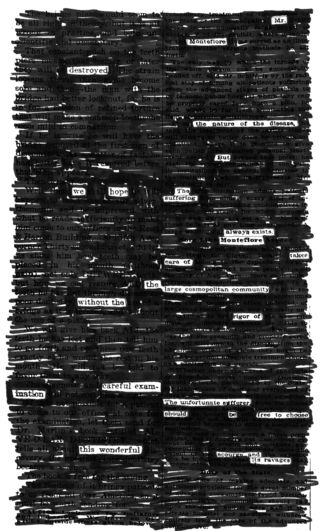
Interview Whiteout with Austin Kleon

Austin Kleon is the author of Newspaper Blackout.

By permanently altering the original newspaper articles, how do you feel that you’re respecting the original authors? Why do you feel that this material is fair game for artistic appropriation?

I could tell you a big story about how I’m respecting the original newspaper writers by rescuing their ephemeral work from lining the trash bin or wrapping fish and turning it into something permanent, something poetic, something eternal…but that would be a huge load of bullshit. Truthfully, I’m a writer that was having trouble finding my own words, and decided to borrow words from the medium that produces millions of them every day and delivers them to my doorstep.

If I were to try to justify it, I’d say that what I’m doing is no different than what writers have done forever. They borrow words from the language, and they rearrange them into a unique order.

I truly love newspapers. I grew up with newspapers. My parents didn’t sit around reading novels, but we subscribed to two daily newspapers. My father-in-law, one of the best writers I know, has worked for a newspaper in Cleveland for over 25 years, and my uncle worked for a newspaper for twenty years before he decided to become a preacher. (A good career move on his part.)

I’ve resisted developing an iPhone or iPad Newspaper Blackout app because I think there is magic in feeling the newsprint in your hand and the words disappearing under that marker line. (I experimented with making poems on the iPad, but I returned mine back after a week.) I think the more that writing is made into a physical process, the better it is. The more writing is something you make with your hands, the more satisfying it is for me. Same goes for books. I like holding on to something.

Were there any legal hurdles from Harper Perennial with regard to fair use? (I’m assuming this is one of the reasons why you couldn’t use photos.) Did the original articles or the typography — that is, the material beneath the blackout — have to be altered in any way aside from the black marker? Also, did you photocopy any of the articles for “drafts” of your poems? What practice did you do? Can you offer an example or two on how you stumbled onto specific word patterns?

The lawyers took a look at the project and gave it the green light before we even signed a deal.

I stopped using photos a while back when I realized that using complete photos would move the poems out of the realm of fair use. (Occasionally I’ll use a little sliver or a crop of a photograph, like in this poem, “In A Honky Tonk In Texas.”)

What’s interesting to me is that I think legal constraints actually lead to better poems.

There are basically four factors that determine fair use: 1) how transformative it is, or “purpose and character” of the use; 2) the nature of the copyrighted work (usually if it’s non-fiction or fiction); 3) the “amount and substantiality of the portion taken”; 4) the “effect of the use upon the potential market.”

So some of my own rules are actually based on these factors: 1) I try to transform the text into a poem that doesn’t resemble the original subject matter of the article, or if it does, it parodies or reverses it; 2) I only black out newspaper articles; 3) I usually take less than a sentence or a phrase at a time and black out way, way more than I keep. When it comes to number 4, I probably have a positive (if tiny) effect on their market, by giving people another reason to buy newspapers!

What you see in the book are actual scans of the marker on newsprint. I didn’t do any photocopying to practice or create a first draft, although, there were some poems where I wish I had. (Permanent marker leads to all kinds of accidents.)

The book was made in a six-month period from June – December 2008. I cut up newspapers into little paperback-sized clippings, and kept the clippings all in a folder, and on the bus ride to and from work , and in the basement of my office on my lunch break, I’d pull out a clipping and get to work.

I wish I could show you or explain how these things happen, but usually I just see an anchor word or an anchor phrase that grabs my attention, and I just work out from that, slowly. (Here’s a time-lapse video of me doing one that might give you an idea of how it works.)

In some cases, we can see that you’re running low on ink (such as the poem on Page 39) as you’re slashing through the newspaper. To what degree did such practical ink conditions affect the form of the poem? (I ask because the Page 39 poem also begins with the phrase “Gasoline is running out,” thus mimicking the ink problem.) Additionally, were there specific “low ink” markers you kept nearby for specific textures or looks?

I wish I was that smart, but in fact, it was just a matter of whether the marker I had in my bag was low or not. I went through a few dozen markers making the book. It’s funny how the ones where the marker doesn’t completely cover everything look way more interesting. I resisted touching them up when I got back home because I liked the way they looked.

I read an article in The Believer about the history of the permanent marker, and was shocked to find out that government censors, back when they still used markers, would use red or brown markers, so you could still see the text that was redacted, then they’d run the redacted documents through a photocopier set on high contrast, which is what gives them that stark black and white look. After I read that, I toy ed with the idea of doing all my blackouts from now on in red ink…

The poem on Page 50, for example, certainly could not look the way that it does without physical contact with the article. On the other hand, I’m naturally quite suspicious about the arrows on Page 60, which were surely aided by scanning and digital retouching to get the precise look of the arrows. To what degree did you rely on digital enhancement for these poems? Were there any specific ground rules that you established along these lines?

There was actually little digital manipulation involved. When I scanned the poems into the computer I set the contrast way high (like a photocopier) so they got that high-contrast look, and then I cleaned up some of the leftover words around the black marker on the edges. In a few very rare instances, I would use Photoshop to fix a screw up where I accidentally marked over a letter. (Only to reveal a letter that had been blacked out, not to put in a letter where it wasn’t before.)

The arrows were made on the original newsprint with a ballpoint pen and the white space from the lines in between the words.

All the poems became image files, which, when they were sent to the publisher, had the added benefit of being incredibly hard to edit — in fact, aside from my editor pointing out a few weak poems, there wasn’t much editing done to the poems in the book at all.

There are actually typos on pages 50 and 84. Each page contains duplicate words, which can easily be fixed with a marker. (I’ve turned this into a shtick at book signings: “Would you like me to fix your typos?”)

Speaking of the little boxes that form thin flowchart lines leading from one word to another (there’s a very nice series of dashed boxes on Page 111 or, even more impressively, on Page 113), how did you arrive at the specific length and width for these little etchings? Did you ever consider using a portion of a letter to help create or nudge a shape?

All those little lines were constrained by the white space in between the words of the article. I honestly didn’t plan them out too much.

When you are highlighting a clustered phrase, such as “detectives gathered at the scene of a mystery” on Page 62, isn’t this a little too easy? Should not the reader’s eye be trained not to find the obvious patterns within an article, but the not so obvious ones?

I try to make it as easy to read as possible. I don’t want to have people struggling to make sense of the poem because they’re not sure in what order the poem is supposed to be read. I get a lot of poem submissions from folks on the Newspaper Blackout Tumblr, and sometimes I have to really stare at a poem to figure out how it’s supposed to be worded. It can be frustrating. And frustrating readers is the last thing I want to do.

On the other hand, I do like that the form can make people slow down and think about the language. My wife is a speed reader, and she finds it incredibly difficult to read these things, because it forces her to slow down and really focus on one word at a time.

Capitalized letters and only letters often serve as crutches (see Page 146) for you to get a poem out of what I presume was difficult material. But I’m wondering if you worked in a deliberately counterintuitive manner for some of these articles (i.e., did you see an obvious poem and deny yourself the pleasure because it was “too easy”).

I never deny myself the pleasure of an easy poem! Nine times out of ten, I’m usually tearing my hair out when I do these things, so when an easy one appears before me, I take it, because I know the next one won’t be so easy.