The Journalist and the Murderer (Modern Library Nonfiction #97)

(This is the fourth entry in The Modern Library Nonfiction Challenge, an ambitious project to read and write about the Modern Library Nonfiction books from #100 to #1. There is also The Modern Library Reading Challenge, a fiction-based counterpart to this list. Previous entry: The Taming of Chance.)
mlnf97One of the mistakes often made by those who immerse themselves in Janet Malcolm’s The Journalist and the Murderer is believing that MacDonald’s guilt or innocence is what matters most. But Malcolm is really exploring how journalistic opportunity and impetuous judgment can lead any figure to be roundly condemned in the court of public opinion. Malcolm’s book was written before the Internet blew apart much of the edifice separating advertising and editorial with native advertising and sponsored articles, but this ongoing ethical dilemma matters ever more in our age of social media and citizen journalism, especially when Spike Lee impulsively tweets the wrong address of George Zimmerman (and gets sued because of the resultant harassment) and The New York Post publishes a front page cover of two innocent men (also resulting in a lawsuit) because Reddit happened to believe they were responsible for the 2013 Boston Marathon bombing.

Yet it is important to approach anything concerning the Jeffrey MacDonald murder case with caution. It has caused at least one documentary filmmaker to go slightly mad. It is an evidential involution that can ensnare even the most disciplined mind, a permanently gravid geyser gushing out books and arguments and arguments about books, with more holes within the relentlessly regenerating mass than the finest mound of Jarlsberg. But here are the underlying facts:

On February 17, 1970, Jeffrey MacDonald reported a stabbing to the military police. Four officers found MacDonald’s wife Colette, and their two children, Kimberley and Kristen, all dead in their respective bedrooms. MacDonald went to trial and was found guilty of one count of first-degree murder and two counts of second-degree murder. He was sentenced to three life sentences. Only two months before this conviction, MacDonald hired the journalist Joe McGinniss — the author of The Selling of a President 1968, then looking for a comeback — to write a book about the case, under the theory that any money generated by MacDonald’s percentage could be used to sprout a defense fund. MacDonald placed total trust in McGinniss, opening the locks to all his papers and letting him stay in his condominium. McGinniss’s book, Fatal Vision, was published in the spring of 1983. It was a bestseller and spawned a popular television miniseries, largely because MacDonald was portrayed as a narcissist and a sociopath, fitting the entertainment needs of a bloodthirsty public. MacDonald didn’t know the full extent of this depiction. Indeed, as he was sitting in jail, McGinniss refused to send him a galley or an advance copy. (“At no time was there ever any understanding that you would be given an advance look at the book six months prior to publication,” wrote McGinniss to MacDonald on February 16, 1983. “As Joe Wambuagh told you in 1975, with him you would not even see a copy before it was published. Same with me. Same with any principled and responsible author.” Malcolm copiously chronicles the “principled and responsible” conduct of McGinniss quite well, which includes speaking with MacDonald in misleading and ingratiating tones, often pretending to be a friend — anything to get MacDonald to talk.)
wallacemacdonald

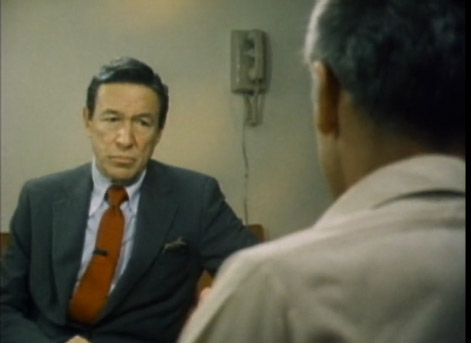
On 60 Minutes, roughly around the book’s publication, Mike Wallace revealed to MacDonald what McGinniss was up to:

Mike Wallace (narrating): Even government prosecutors couldn’t come up with a motive or an explanation of how a man like MacDonald could have committed so brutal a crime. But Joe McGinniss thinks he’s found the key. New evidence he discovered after the trial. Evidence he has never discussed with MacDonald. A hitherto unrevealed account by the doctor himself of his activities in the period just before the murders.

Joe McGinniss: In his own handwriting, in notes prepared for his own attorneys, he goes into great detail about his consumption of a drug called Eskatrol, which is no longer on the market. It was voluntarily withdrawn in 1980 because of dangerous side effects. Among the side effects of this drug are, when taken to excess by susceptible individuals, temporary psychosis, often manifested as a rage reaction. Here we have somebody under enormous pressure and he’s taking enough of this Eskatrol, enough amphetamines, so that by his own account, he’s lost 15 pounds in the three weeks leading up to the murders.

eskatrolnoteWallace: Now wait. According to the note which I’ve seen, three to five Eskatrol he has taken. We don’t know if he’s taken it over a period of several weeks or if he’s taken three to five Eskatrol a day or a week or a month.

McGinniss: We do know that if you take three to five Eskatrol over a month, you’re not going to lose 15 pounds in doing so.

Jeffrey MacDonald: I never stated that to anyone and I did not in fact lose fifteen pounds. I also wasn’t taking Eskatrol.

Wallace (reading MacDonald’s note): “We ate dinner together at 5:45 PM. It is possible I had one diet pill at this time. I do not remember and do not think I had one. But it is possible. I had lost 12 to 15 pounds in the prior three to four weeks in the process, using three to five capsules of Eskatrol Spansule. I was also…”

MacDonald: Three to five capsules for the three weeks.

Wallace: According to this.

MacDonald: Right.

Wallace: According to this.

MacDonald: And that’s a possibility.

Wallace: Then why would you put down here that…that there was even a possibility?

MacDonald: These are notes given to an attorney, who has told me to bare my soul as to any possibility so we could always be prepared. So I…

Wallace: Mhm. But you’ve already told me that you didn’t lose 15 pounds in the three weeks prior…

MacDonald: I don’t think that I did.

Wallace: It’s in your notes. “I had lost 12-15 lbs. in the prior 3-4 weeks, in the process using 3-5 capsules of Eskatrol Spansules.” That’s speed. And compazine. To counteract the excitability of speed. “I was losing weight because I was working out with a boxing team and the coach told me to lose weight.” — 60 Minutes

One of McGinniss’s exclusive contentions was that MacDonald had murdered his family because he was high on Eskatrol. Or, as he wrote in Fatal Vision:

It is also fact that if Jeffrey MacDonald were taking three to five Eskatrol Spansules daily, he would have been consuming 75 mg. of dextroamphetamine — more than enough to precipitate an amphetamine psychosis.

Note the phrasing. Even though McGinniss does not know for a fact whether or not MacDonald took three to five Eskatrol (and MacDonald himself is also uncertain: both MacDonald and McGinniss prevaricate enough to summon the justifiably hot and bothered mesh of Mike Wallace’s grilling), he establishes the possibility as factual — even though it is pure speculation. The prognostication becomes a varnished truth, one that wishes to prop up McGinniss’s melodramatic thesis.

* * *

Malcolm was sued for libel by Jeffrey Masson over her depiction of him in her book, In the Freud Archives. In The Journalist and the Murderer, she has called upon all journalists to feel “some compunction about the exploitative character of the journalist-subject relationship,” yet claims that her own separate lawsuit was not the driving force in the book’s afterword. Yet even Malcolm, a patient and painstaking practitioner, could not get every detail of MacDonald’s appearance on 60 Minutes right:

As Mike Wallace — who had received an advance copy of Fatal Vision without difficulty or a lecture — read out loud to MacDonald passages in which he was portrayed as a psychopathic killer, the camera recorded his look of shock and utter discomposure.

Wallace was reading MacDonald’s own notes to his attorney back to him, not McGinniss’s book. These were not McGinniss’s passages in which MacDonald was “portrayed as a psychopathic killer,” but passages from MacDonald’s own words that attempted to establish his Eskatrol use. Did Malcolm have a transcript of the 60 Minutes segment now readily available online in 1990? Or is it possible that MacDonald’s notes to his attorney had fused so perfectly with McGinnis’s book that the two became indistinguishable?

This raises important questions over whether any journalist can ever get the facts entirely right, no matter how fair-minded the intentions. It is one thing to be the hero of one’s own story, but it is quite another to know that, even if she believes herself to be morally or factually in the clear, the journalist is doomed to twist the truth to serve her purposes.

It obviously helps to be transparent about one’s bias. At one point in The Journalist and the Murderer, Malcolm is forthright enough to confess that she is struck by MacDonald’s physical grace as he breaks off pieces of tiny powdered sugar doughnuts. This is the kind of observational detail often inserted in lengthy celebrity profiles to “humanize” a Hollywood actor uttering the same calcified boilerplate rattled off to every roundtable junketeer. But if such a flourish is fluid enough to apply to MacDonald, we are left to wonder how Malcolm’s personal connection interferes with her purported journalistic objectivity. In the same paragraph, Malcolm neatly notes the casual abuse MacDonald received in his mailbox after McGinniss’s book was published — in particular a married couple who read Fatal Vision while on vacation who took the time to write a hateful letter while sunbathing at the Sheraton Waikiki Hotel. This casual cruelty illustrates how the reader can be just as complicit as the opportunistic journo in perpetuating an incomplete or slanted portrait.

The important conundrum that Malcolm imparts in her short and magnificently complicated volume is why we bother to read or write journalism at all if we know the game is rigged. The thorny morality can extend to biography (Malcolm’s The Silent Woman is another excellent book which sets forth the inherent and surprisingly cyclical bias in writing about Sylvia Plath). And even when the seasoned journalist is aware of ethical discrepancies, the judgmental pangs will still crop up. In “A Girl of the Zeitgeist” (contained in the marvelous collection, Forty-One False Starts), Malcolm confessed her own disappointment in how Ingrid Sischy failed to live up to her preconceptions as a bold and modern woman. Malcolm’s tendentiousness may very well be as incorrigible as McGinnis’s, but is it more forgivable because she’s open about it?

* * *

It can be difficult for Janet Malcolm’s most arduous advocates to detect the fine grains of empathy carefully lining the crisp and meticulous forms of her svelte and careful arguments, which are almost always sanded against venal opportunists. Malcolm’s responsive opponents, which have recently included Esquire‘s Tom Junod, Errol Morris, and other middling men who are inexplicably intimidated by women who are smarter, have attempted to paint Malcolm as a hypocrite, an opportunist, and a self-loathing harpy of the first order. Junod wrote that “it’s clear to anyone who reads her work that very few journalists are animated by malice than Janet Malcolm” and described her work as “a self-hater whose work has managed to speak for the self-hatred” of journalism. Yet Junod cannot cite any examples of this self-hate and malice, save for the purported Henry Youngman-like sting of her one liners (Malcolm is not James Wolcott; she is considerably more thoughtful and interesting) and for pointing out, in Iphigenia in Forest Hills, how trials “offer unique opportunities for journalistic heartlessness,” failing to observe how Malcolm pointed out how words or evidence lifted out of context could be used to condemn or besmirch the innocent until proven guilty (and owning up to her own biases and her desire to interfere).

Malcolm is not as relentless as her generational peer Renata Adler, but she is just as refreshingly formidable. She is as thorough with her positions and almost as misunderstood. She has made many prominent enemies for her controversial positions — even fighting a ten year trial against Jeffrey Masson over the authenticity of his quotations (dismissed initially by a federal judge in California on the grounds that there was an absence of malice). Adler was ousted from The New Yorker, but Malcolm was not. In the last few years, both have rightfully found renewed attention for their years among a new generation.

One origin for the anti-Malcolm assault is John Taylor’s 1989 New York Magazine article, “Holier than Thou,” which is perhaps singularly responsible for making it mandatory for any mention of The Journalist and the Murderer to include its infamous opening line: “Every journalist who is not too stupid or too full of himself to notice what is going on knows that what he does is morally indefensible.” Taylor excoriated Malcolm for betraying McGinniss as a subject, dredged up the Masson claims, and claimed that Malcolm used Masson much as McGinniss had used MacDonald. It does not occur to Taylor that Malcolm herself may be thoroughly familiar with what went down and that the two lengthy articles which became The Journalist and the Murderer might indeed be an attempt to reckon with the events that caused the fracas:

Madame Bovary, c’est moi,” Flaubert said of his famous character. The characters of nonfiction, no less than those of fiction, derive from the writer’s most idiosyncratic desires and deepest anxieties; they are what the writer wishes he was and worries that he is. Masson, c’est moi.

Similarly, Evan Hughes had difficulty grappling with this idea, caviling over the “bizarre stance” of Malcolm not wanting to be “oppressed by the mountain of documents that formed in my office.” He falsely infers that Malcolm has claimed that “it is pointless to learn the facts to try to get to the bottom of a crime,” not parsing Malcolm’s clear distinction between evidence and the journalist’s ineluctable need to realize characters on the page. No matter how faithfully the journalist sticks with the facts, a journalistic subject becomes a character because the narrative exigencies demand it. Errol Morris can find Malcolm’s stance “disturbing and problematic” as much as he likes, but he is the one who violated the journalistic taboo of paying subjects for his 2008 film, Standard Operating Procedure, without full disclosure. One of Morris’s documentary subjects, Joyce McKinney, claimed that she was tricked into giving an interview for what became Tabloid, alleging that one of Morris’s co-producers broke into her home with a release form. Years before Morris proved triumphant in an appellate court, he tweeted:

The notion of something “unvarnished” attached to a personal account may have originated with Shakespeare:

And therefore little shall I grace my cause
In speaking for myself. Yet, by your gracious patience,
I will a round unvarnished tale deliver
Of my whole course of love. What drugs, what charms,
What conjuration and what mighty magic—
For such proceeding I am charged withal—
I won his daughter.
Othello, Act 1, Scene 3

Othello hoped that in telling “a round unvarnished tale,” he would be able to come clean with Brabantio over why he had eloped with the senator’s daughter Desdemona. He wishes to be straightforward. It’s an extremely honorable and heartfelt gesture that has us very much believing in Othello’s eloquence. Othello was very lucky not to be speaking with a journalist, who surely would have used his words against him.

Next Up: Truman Capote’s In Cold Blood!

The Taming of Chance (Modern Library Nonfiction #98)

(This is the third entry in The Modern Library Nonfiction Challenge, an ambitious project to read and write about the Modern Library Nonfiction books from #100 to #1. There is also The Modern Library Reading Challenge, a fiction-based counterpart to this list. Previous entry: Operating Instructions.)

mlnf98In the bustling beginnings of the twentieth century, the ferociously independent mind who forever altered the way in which we look at the universe was living in poverty.* His name was Charles Sanders Peirce and he’d anticipated Heisenberg’s uncertainty principle by a few decades. In 1892, Peirce examined what he called the doctrine of necessity, which held that every single fact of the universe was determined by law. Because before Peirce came along, there were several social scientists who were determined to find laws in everything — whether it be an explanation for why you parted your hair at a certain angle with a comb, felt disgust towards specific members of the boy band One Direction, or ran into an old friend at a restaurant one hundred miles away from where you both live. Peirce declared that absolute chance — that is, spontaneity or anything we cannot predict before an event, such as the many fish that pelted upon the heads of puzzled citizens in Shasta County, California on a January night in 1903 — is a fundamental part of the universe. He concluded that even the careful rules discovered by scientists only come about because, to paraphrase Autolycus from A Winter’s Tale, although humans are not always naturally honest, chance sometimes makes them so.

The story of how Peirce’s brave stance was summoned from the roiling industry of men with abaci and rulers is adeptly set forth in Ian Hacking’s The Taming of Chance, a pleasantly head-tingling volume that I was compelled to read twice to ken the fine particulars. It’s difficult to articulate how revolutionary this idea was at the time, especially since we now live in an epoch in which much of existence feels preordained by statistics. We have witnessed Nate Silver’s demographic models anticipate election results and, as chronicled in Moneyball, player performance analysis has shifted the way in which professional baseball teams select their roster and steer their lineup into the playoffs, adding a strange computational taint that feels as squirmy as performance enhancing drugs.

But there was a time in human history in which chance was considered a superstition of the vulgar, even as Leibniz, seeing that a number of very smart people were beginning to chatter quite a bit about probability, argued that the true measure of a Prussian state resided in how you tallied the population. Leibniz figured that if Prussia had a central statistic office, it would not only be possible to gauge the nation’s power but perhaps lead to certain laws and theories about the way these resources worked.

This was obviously an idea that appealed to chin-stroking men in power. One does not rule an empire without keeping the possibility of expansion whirling in the mind. It didn’t take long for statistics offices to open and enthusiasts to start counting heads in faraway places. (Indeed, much like the early days of computers, the opening innovations originated from amateurs and enthusiasts.) These early statisticians logged births, deaths, social status, the number of able-bodied men who might be able to take up weapons in a violent conflict, and many other categories suggested by Leibniz (and others that weren’t). And they didn’t just count in Prussia. In 1799, Sir John Sinclair published a 21 volume Statistical Account of Scotland that undoubtedly broke the backs of many of the poor working stiffs who were forced to carry these heavy tomes to the guys determined to count it all. Some of the counters became quite obsessive in their efforts. Hacking reports that Sinclair, in particular, became so sinister in his efforts to get each minister of the Church of Scotland to provide a detailed congregation schedule that he began making threats shrouded in a jocose tone. Perhaps the early counters needed wild-eyed dogged advocates like Sinclair to establish an extremely thorough baseline.

The practice of heavy-duty counting resulted, as Hacking puts it, in a bona-fide “avalanche of numbers.” Yet the intersection of politics and statistics created considerable fracas. Hacking describes the bickering and backbiting that went down in Prussia. What was a statistical office? Should we let the obsessive amateurs run it? Despite all the raging egos, bountiful volumes of data were published. And because there was a great deal of paper being shuffled around, cities were compelled by an altogether different doctrine of necessity to establish central statistical hubs. During the 1860s, statistical administrations were set up in Berlin, New York, Stockholm, Vienna, Rome, Leipzig, Frankfurt-am-Main, and many others. But from these central offices emerged a East/West statistics turf war, with France and England playing the role of Biggie on the West and Prussia as Tupac on the East. The West believed that a combination of individual competition and natural welfare best served society, while the East created the welfare state to solve these problems. And these attitudes, which Hacking is good enough to confess as caricaturish even as he illustrates a large and quite important point, affected the way in which statistics were perceived. If you believe in a welfare state, you’re probably not going to see laws forged from the printed numbers. Because numbers are all about individual action. And if you believe in the Hobbesian notion of free will, you’re going to look for statistical laws in the criminal numbers, because laws are formed by individuals. This created new notions of statistical fatalism. It’s worth observing that science at the time was also expected to account for morality.

Unusual experiments ensued. What, for example, could the chest circumference of a Scotsman tell us about the stability of the universe? (Yes, the measurement of Scottish chests was seriously considered by a Belgian guy named Adolphe Quetelet, who was trying to work out theories about the average man. When we get to Stephen Jay Gould’s The Mismeasure of Man several years from now, #21 in the Modern Library Nonfiction canon, I shall explore more pernicious measurement ideas promulgated as “science.” Stay tuned!) More nefariously, if you could chart the frequency of how often the working classes called in sick, perhaps you could establish laws to determine who was shirking duty, track the unruly elements, and punish the agitators interfering with the natural law. (As we saw with William Lamb Melbourne’s story, the British government was quite keen to crack down on trade unions during the 1830s. So just imagine what a rabid ideologue armed with a set of corrupted and unproven “laws” could do. In fact, we don’t even have to jump that far back in time. Aside from the obvious Hollerith punch card example, one need only observe the flawed radicalization model presently used by the FBI and the DHS to crack down on Muslim “extremists.” Arun Kundnani’s recent book, The Muslims Are Coming, examines this issue further. And a future Bat Segundo episode featuring Kundnani will discuss this dangerous approach at length.)

Throughout all these efforts to establish laws from numbers (Newton’s law of gravity had inspired a league of scientists to seek a value for this new G constant, a process that took more than a century), Charles Babbage, Johann Christian Poggendorf, and many others began publishing tables of constants. It is one thing to publish atomic weights. It is quite another to measure the height, weight, pulse, and breath of humans by gender and ethnicity (along with animals). The latter constant sets are clearly not as objective as Babbage would like to believe. And yet the universe does adhere to certain undeniable principles, especially when you have a large data set.

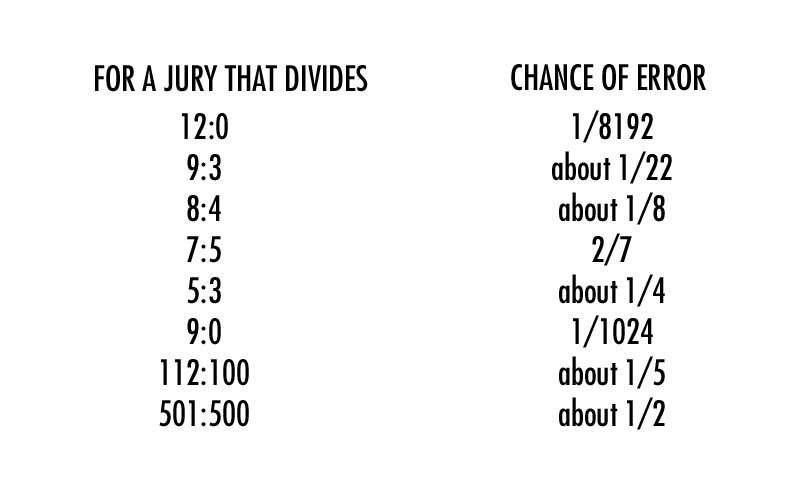
It took juries for mathematicians to understand how to reconcile large numbers with probability theory. In 1808, Pierre-Simon Laplace became extremely concerned with the French jury system. At the time, twelve-member juries convicted an accused citizen by a simple majority. He calculated that a seven-to-five majority had a chance of error of one in three. The French code had adopted the unusual method of creating a higher court of five judges to step in if there was a disagreement with a majority verdict in the lower court. In other words, if the majority of the judges in the higher court agreed with the minority of jurors in the lower court that an accused person should be acquitted, then the accused person would be acquitted. Well, this complicated system bothered Laplace. Accused men often faced execution in the French courts. So if there was a substantial chance of error, then the system needed to be reformed. Laplace began to consider juries composed of different sizes and verdicts ranging from total majority (12:0) to partial majority (9:3, 8:4), and he computed the following odds (which I have reproduced from a very helpful table in Hacking’s book):

hacking-juryerror

The problems here become self-evident. You can’t have 1,001 people on a jury arguing over the fate of one man. On the other hand, you can’t have a 2/7 chance of error with a jury of twelve. (One of Laplace’s ideas was a 144 member jury delivering a 90:54 verdict. This involved a 1/773 chance of error. But that’s nowhere nearly as extreme as a Russian mathematician named M.V. Ostrogradsky, who wasted much ink arguing that a 212:200 majority was more reliable than a 12:0 verdict. Remember all this the next time you receive a jury duty notice. Had some of Laplace’s understandable concerns been more seriously considered, there’s a small chance that societies could have adopted larger juries in the interest of a fair trial.)

French law eventually changed the minimum conviction from 7:5 to 8:4. But it turned out that there was a better method to allow for a majority jury verdict. It was a principle that extended beyond mere frequency and juror reliability, taking into account Bernoulli’s ideas on drawing black and white balls from an urn to determine a probability value. It was called the law of large numbers. And the great thing is that you can observe this principle in action through a very simple experiment.

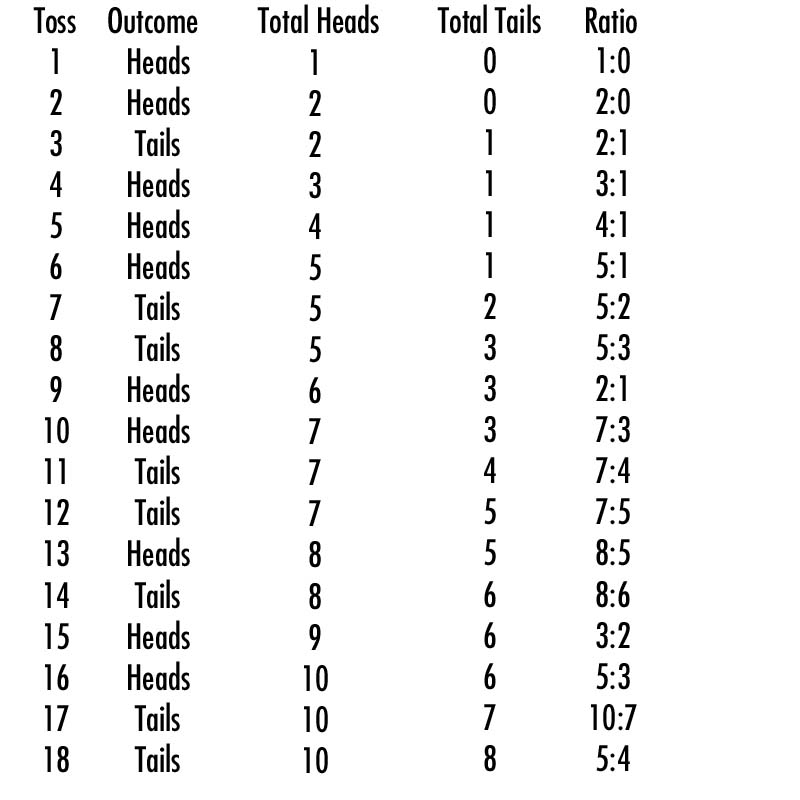
Here’s a way of seeing the law of large numbers in action. Take a quarter and flip it. Write down whether the results are heads or tails. Do it again. Keep doing this and keep a running tally of how many times the outcome is heads and how many times the coin comes up tails. For readers who are too lazy to try this at home, I’ve prepared a video and a table of my coin toss results:

edcointoss

The probability of a coin toss is 1:1. On average, the coin will turn up heads 50% of the time and tails 50% of the time. As you can see, while my early tosses leaned heavily towards heads, by the time I had reached the eighteenth toss, the law of large numbers ensured that my results skewed closer to 1:1 (in this case, 5:4) as I continued to toss the coin. Had I continued to toss the coin, I would have come closer to 1:1 with every toss.

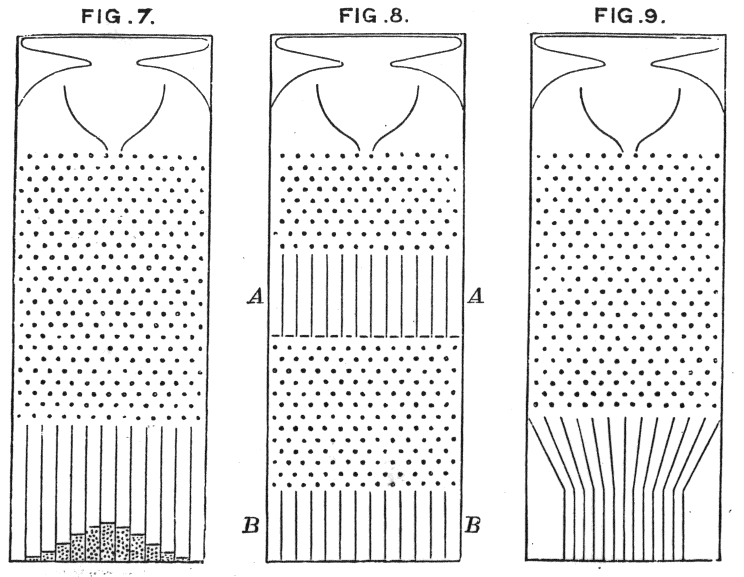
galtonbox

The law of large numbers offered the solution to Laplace’s predicament. It also accounts for the mysterious picture at the head of this essay. That image is a working replica of a Galton box (also known as a quincunx). (If you’re ever in Boston, go to the Museum of Science and you can see a very large working replica of a Galton box in action.) Sir Francis Galton needed a very visual method of showing off the central limit theorem. So he designed a box, not unlike a pachinko machine, in which beans are dropped from the top and work their way down through a series of wooden pins, which cause them to fall along a random path. Most of the beans land in the center. Drop more beans and you will see a natural bell curve form, illustrating the law of large numbers and the central limit theorem.

Despite all this, there was still the matter of statistical fatalism to iron out, along with an understandable distrust of statistics among artists and the general population, which went well beyond Disraeli’s infamous “There are three kinds of lies: lies, damned lies, and statistics” quote. Hacking is a rigorous enough scholar to reveal how Dickens, Dostoevsky, and Balzac were skeptical of utilitarian statistics. Balzac, in particular, delved into “conjugal statistics” in his Physiology of Marriage to deduce the number of virtuous women. They had every reason to be, given how heavily philosophers leaned on determinism. (See also William James’s “The Dilemma of Determinism.”) A German philosopher named Ernst Cassirer was a big determinism booster, pinpointing its beginnings in 1872. Hacking challenges Cassierer by pointing out that determinism incorporated the doctrine of necessity earlier in the 1850s, an important distinction in returning back to Peirce’s idea of absolute chance.

I’ve been forced to elide a number of vital contributors to probability and some French investigations into suicide in an attempt to convey Hacking’s intricate narrative. But the one word that made Perice’s contributions so necessary was “normality.” This was the true danger of statistical ideas being applied to the moral sciences. When “normality” became the ideal, it was greatly desirable to extirpate anything “abnormal” or “aberrant” from the grand human garden, even though certain crime rates were indeed quite normal. We see similar zero tolerance measures practiced today by certain regressive members of law enforcement or, more recently, New York Mayor Bill de Blasio’s impossible pledge to rid New York City of all traffic deaths by 2024. As the law of large numbers and Galton’s box observed, some statistics are inevitable. Yet it was also important for Peirce to deny the doctrine of necessity. Again, without chance, Peirce pointed out that we could not have had all these laws in the first place.

It was strangely comforting to learn that, despite all the nineteenth century innovations in mathematics and probability, chance remains very much a part of life. Yet when one begins to consider stock market algorithms (and the concomitant flash crashes), as well as our collective willingness to impart voluminous personal data to social media companies who are sharing these numbers with other data brokers, I cannot help but ponder whether we are willfully submitting to another “law of large numbers.” Chance may favor the prepared mind, as Pasteur once said. So why court predictability?

* Peirce’s attempts to secure academic employment and financial succor were thwarted by a Canadian scientist named Simon Newcomb. (A good overview of the correspondence between the two men can be found at the immensely helpful “Perice Gateway” website.)

Next Up: Janet Malcolm’s The Journalist and the Murderer!

Operating Instructions (Modern Library Nonfiction #99)

(This is the second entry in The Modern Library Nonfiction Challenge, an ambitious project to read and write about the Modern Library Nonfiction books from #100 to #1. There is also The Modern Library Reading Challenge, a fiction-based counterpart to this list. Previous entry: Melbourne.)

mlnf99It is easy to forget, as brave women document their battles with cancer and callous columnists bully them for their candor, that our online confessional age didn’t exist twenty years ago. I suspect this collective amnesia is one of the reasons why Anne Lamott’s Operating Instructions — almost an urtext for mommy blogs and much of the chick lit that followed — has been needlessly neglected by snobbish highbrow types, even when hungry young writers rushed to claim transgressive land in the Oklahoma LiveJournal Run of 2006.

Lamott’s book, which is a series of honed journal entries penned from the birth of her son Sam to his first birthday, was ignored by the New York Times Book Review upon its release in 1993 (although Ruth Reichl interviewed her for the Home & Garden section after the book, labeled “an eccentric baby manual” by Reichl, became a bestseller). Since then, aside from its distinguished inclusion on the Modern Library list, it has not registered a blip among those who profess to reach upward. Yet if we can accept Karl Ove Knausgaard’s honesty about fatherhood in the second volume of his extraordinary autobiographical novel, My Struggle, why then do we not honor Anne Lamott? It is true that, like Woody Allen in late career, Lamott has put out a few too many titles. It is also true that she attracts a large reading audience, a sin as unpardonable to hoity-toity gasbags as a man of the hoi polloi leaving the toilet seat up. Much as the strengths of Jennifer Weiner’s fiction are often dwarfed by her quest for superfluous respect, Anne Lamott’s acumen for sculpting the familiar through smart and lively prose doesn’t always get the credit it deserves.

Operating Instructions — with its breezy pace, its populist humor, and its naked sincerity — feels at first to be a well-honed machine guaranteed to attract a crowd of likeminded readers. But once you start looking under the hood, you begin to understand how careful Lamott is with what she doesn’t reveal. It begins with the new baby’s name. We are informed that Samuel John Stephen Lamott’s name has been forged from Lamott’s brothers, John and Steve. But where does the name Samuel come from? And why is Lamott determined to see Sams everywhere? (A one-armed Sam, the son of a friend named Sam, et al.) There are murky details about Sam’s father, who flits in and out of the narrative like some sinister figure with a twirling moustache. He is six foot four and two hundred pounds. He is in his mid-fifties, an older man who Lamott had a fling with. We learn later in the book that he “filed court papers today saying that we never fucked and that he therefore cannot be the father.” Even so, what’s his side of the story?

This leaves Lamott, struggling for cash and succor, raising Sam on her own with a dependable “pit crew” of friends. Yet one is fascinated not only by Lamott’s unshakable belief that she will remain a single parent for the rest of her natural life (“there is nothing I can do or say that will change the fact that his father chooses not to be his father. I can’t give him a dad, I can’t give him a nuclear family”), but by how the absence of this unnamed father causes her to dwell on her own father’s final days.

Lamott’s father was a writer who “died right as I crossed the threshold into publication.” His brain cancer was so bad that he could barely function in his final days. Lamott describes leaving her father in the car with a candy bar as she hits the bank. Her father escapes the car, becoming a “crazy old man pass[ing] by, his face smeared with chocolate, his blue jeans hanging down in back so you could see at least two inches of his butt, like a little boy’s.” It is a horrifying image of a man Lamott looked up to regressing into childhood before the grave, leaving one to wonder if this has ravaged Lamott’s view of men — especially since she repeatedly chides the apparent male relish of peeing standing up — and what idea of manhood she will pass along to her growing boy.

Part of me loves and respects men so desperately, and part of me thinks they are so embarrassingly incompetent at life and in love. You have to teach them the very basics of emotional literacy. You have to teach them how to be there for you, and part of me feels tender toward them and gentle, and part of me is so afraid of them, afraid of any more violation. I want to clean out some of these wounds, though, with my therapist, so Sam doesn’t get poisoned by all my fear and anger.

This is an astonishing confession for a book that also has Lamott tending to Sam’s colic, describing the wonders of Sam’s first sounds and movement, and basking in the joys of a human soul emerging in rapid increments. Motherhood has long been compared to war, to the point where vital discussions about work-family balance have inspired their own “mommy wars.” Operating Instructions features allusions to heroes, Nagasaki, Vietnam, and other language typically muttered by priapic military historians. Yet Lamott’s take also reveals a feeling that has become somewhat dangerous to express in an era of mansplaining, Lulu hashtags, and vapid declarations of “the end of men.” Men are indeed embarrassing, but are they an ineluctable part of motherhood? It is interesting that Lamott broaches this question long after Sam’s father has become a forgettable presence in the book. And yet months later, Lamott is more grateful for the inherited attributes of the “better donor” in “the police lineup of my ex-boyfriends”:

He’s definitely got his daddy’s thick, straight hair, and, God, am I grateful for that. It means he won’t have to deal with hat hair as he goes through life.

Throughout all this, Lamott continues to take in Sam. He is at first “just a baby,” some human vehicle that has just left the garage of Lamott’s belly:

The doctor looked at the baby’s heartbeat on the monitor and said dully, “The baby’s flat,” and I immediately assumed it meant he was dead or at least retarded from lack of oxygen. I don’t think a woman would say anything like that to a mother. “Flat?” I said incredulously. “Flat?” Then he explained that this meant the baby was in a sleep cycle.

But as Sam occupies a larger space in Lamott’s life, there is an innate ecstasy in the way she describes his presence. Sam is “a breathtaking collection of arms and knees,” “unbelievably pretty, with long, thin, Christlike feet,” and “an angel today…all eyes and thick dark hair.” We’re all familiar with the way that new parents gush about their babies, yet Lamott is surprisingly judicious in tightening the pipe valve. Even as she declares the inevitable epithets of frustration (“Go back to sleep, you little shit”) and trivializes Sam (“I thought it would be more like getting a cat”), Sam’s beauty is formidable enough to spill elsewhere, such as this description of a mountain near Bolinas:

So we were driving over the montain, and on our side it was blue and sunny, but as soon as we crested, I could see the thickest blanket of fog I’ve ever seen, so thick it was quilted with the setting sun shining upward from underneath it, and it shimmered with reds and roses, and above were radiant golden peach colors. I am not exaggerating this. I haven’t seen a sky so stunning and bejeweled and shimmering with sunset colors and white lights since the last time I took LSD, ten years ago.

Being a mother may be akin to a heightened narcotic experience, but that doesn’t have to stop you from feeling.

* * *

I suggested earlier that Operating Instructions serves as a precursor to the mommyblog, but this doesn’t just extend to the time-stamp. There is something about setting down crisp observations while the baby is napping that inspires an especially talented writer to find imaginative similes, especially in commonplace activities which those who are not mothers willfully ignore or take for granted. Compare Lamott and Dooce‘s Heather Armstrong (perhaps the best-known of the mommy bloggers) as they describe contending with a breast pump:

“You feel plugged into a medieval milking machine that turns your poor little gumdrop nipples into purple slugs with the texture of rhinoceros hide.” — Anne Lamott, 1993

“I end up lying on my back completely awake as my breasts harden like freshly poured cement baking in the afternoon sun.” — Dooce, February 23, 2004

Armstrong has sedulously avoided invoking Lamott’s name in more than a decade of blogging, but, in both cases, we see just enough imagery squirted into the experience for the reader to feel the struggle. Both Lamott and Armstrong have rightly earned a large readership for describing ordinary situations in slightly surreal (and often profane) terms. (Both writers are also marked in ways by religion. Lamott came to Christianity after a wild life that involved alcoholism. Armstrong escaped Mormonism, eluding to a period as an “unemployed drunk” before meeting her husband, who she subsequently divorced.)

Next Up: Ian Hacking’s The Taming of Chance!

The Modern Library Nonfiction Challenge

mlnfindexJust under three years ago, I began the Modern Library Reading Challenge. It was an ambitious alternative to a spate of eccentric reading challenges then making the rounds. These included such gallant reading missions as the Chunkster, the Three Card Monte/Three Sisters Bronte, the Read All of Shakespeare While Blindfolded Challenge, and the Solzhenitsyn Russian Roulette Challenge. It took a fairly eccentric person to place the literary embouchure ever so nobly to one’s lips and fire off a fusillade of eupohonic Prince Pless bliss into the trenchant air. But I was game.

In my case, the idea was to write at least 1,000 words on each title after reading it. The hope was to fill in significant reading gaps while also cutting an idiosyncratic course across the great works of 20th century literature, with other intrepid readers walking along with me.

Over the next twenty-three months, I steadily worked my way through twenty-three works of fiction. Some of the books were easy to find. Some required elaborate trips to exotic bookstores in far-off states. When I checked out related critical texts and biographies from the New York Public Library, I was often informed by the good librarians at the Mid-Manhattan branch that I was the first soul to take these tomes home in sixteen years. This surprised me. New York was a city with eight million people. Surely there had to be more curiosity seekers investigating these authors. But I discovered that some of these prominent authors had been severely neglected. When I got to The Old Wives’ Tale, Arnold Bennett was so overlooked that I appeared to be the first person to upload a photo of reasonable resolution (which I had taken from a public domain image published in a biography) onto the Internet.

There were other surprises. I became an Iris Murdoch obsessive. I was finally able to overcome my youthful indiscretions and appreciate The Adventures of Augie March as the masterpiece that it was. My mixed feelings on Brideshead Revisited proved controversial in some circles and caused at least one academic to condemn me. On the other hand, I also sparked an online friendship with Stephen Wood, who was also working his way through the Mighty 100, and was put into contact with an extremely small yet determined group of enthusiasts making similar reading attempts in various corners of the world.

Yet when I told some people about my project, it was considered strange or sinister. When I mentioned the Modern Library Reading Challenge to a much older writer, she was stunned that anyone my age go to the trouble of Lawrence Durrell. (And she liked Durrell!) Her quizzical look led me to wonder if she was going to send me to some shady authority to administer a second opinion.

One of the project’s appeals was its methodical approach: I was determined to read all the books from #100 to #1. This not only provided a healthy discipline, but it ensured that I wouldn’t push the least desired books to the end. Much as life provides you with mostly happy and sometimes unpleasant tasks to fulfill as they arrive, I felt that my reading needed to maintain a similar commitment. This strategy also created a vicarious trajectory for others to follow.

Everything was going well. Very well indeed. Henry Green. Jean Rhys. The pleasant surprise of The Ginger Man. With these authors, how could it not go well? I was poised to read to the finish line. I was zooming my Triumph TR6 down a hilly two-lane highway with a full tank of gas. Cranking loud music. Not a care in the world.

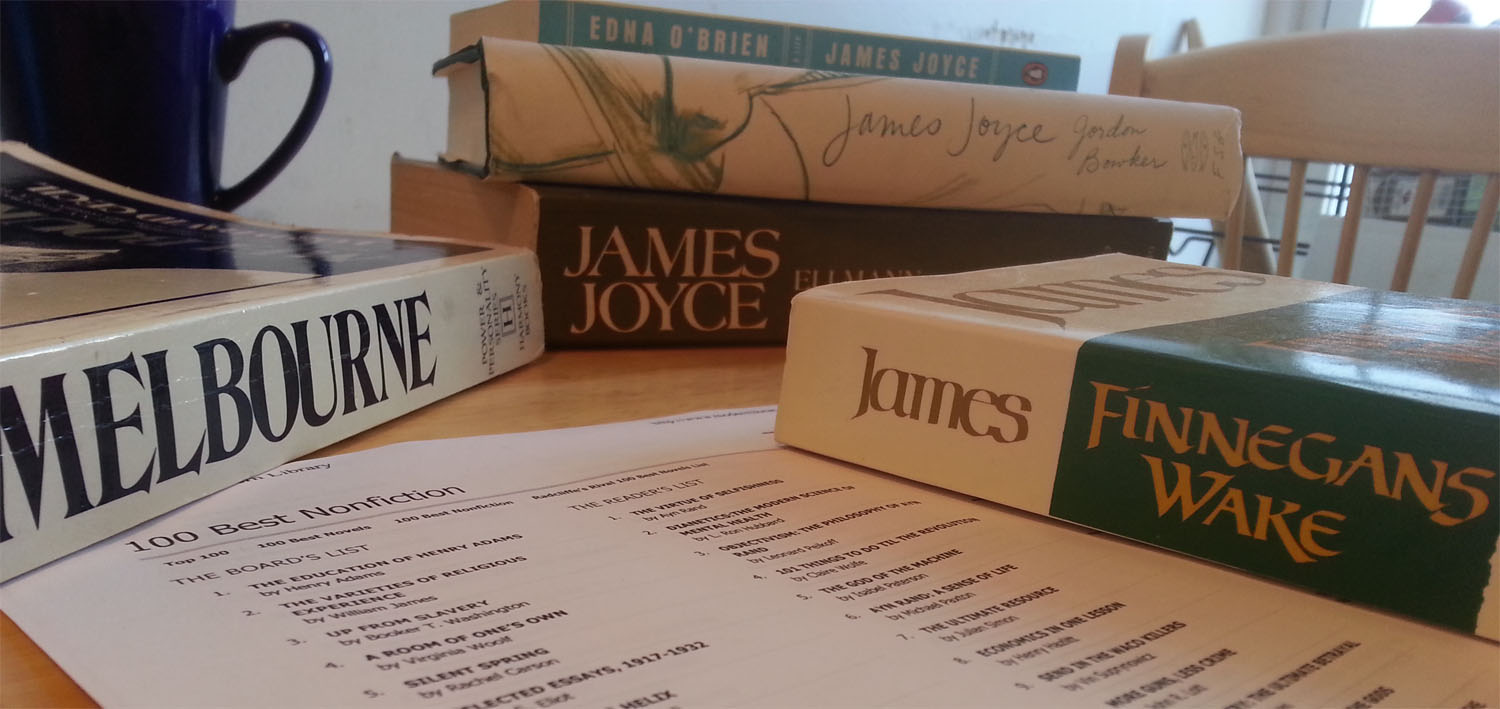
And then I hit Finnegans Wake.

To call Finnegans Wake “difficult” is a woefully insufficient description. This is a book that requires developing an ineluctably Talmudic approach. But I am not easily fazed. Finnegans Wake is truly a book of grand lexical riches, even if I remain permanently stalled within the voluble tendrils of its first 50 pages. I have every intention of making my way through Finnegans Wake. I have reread Dubliners, A Portrait of the Artist as a Young Man, and Ulysses. I have consulted numerous reference texts. I have even listened to all 176 episodes of Frank Delaney’s excellent podcast, Re: Joyce. These have all been pleasant experiences, but I am still not sure if any of this significantly contributes to my understanding of Finnegans Wake. However, when you do something difficult, it is often best to remain somewhat clueless. If you become more aware of how “impossible” something may be, then you may not see it through to the end. Joyce remains the Everest of English literature. I am determined to scale the peak, even if I’m not entirely sure how reliable my gear is.

The regrettable Finnegans Wake business has also meant that the Modern Library Reading Challenge has been stuck on pause. It has been eleven months since I published a new Modern Library installment on these pages. And while I have certainly stayed busy during this time (I have made a documentary about Gary Shteyngart’s blurbs, attempted to fund a national walk that I intend to fulfill one day, canceled and brought back The Bat Segundo Show, and created a new thematic radio program, among other industries), I have long felt that persistent progress — that is, an efflorescent commitment to a regular fount of new material — is the best way to stay in shape and keep any project alive.

I have also had a growing desire to read more nonfiction, especially as the world revealed itself to be a truly maddening and perilous place as the reading challenge unfolded. Some have sought to keep their heads planted beneath the ground like quavering ostriches about all this. There are far too many adults I know, now well in their thirties, who remain distressingly committed to the “La la la I can’t hear you!” school of taking in bad news. But I feel that understanding how historical and social cycles (Vico, natch) cause human souls to saunter down dark and treacherous roads also allows us to comprehend certain truths about our present age. To carry on in the world without a sense of history, without even a cursory understanding of ideas and theories that have been attempted or considered before, is to remain a rotten vegetable during the more important moments of life.

It turns out that the Modern Library has another list of one hundred titles devoted to nonfiction. And the nonfiction list is, to my great surprise, more closely aligned to the fiction list than I anticipated.

In 1998, the Washington Post‘s David Streitfeld revealed that the Modern Library fiction list was plagued by modest scandal. The ten august Modern Library board members behind the fiction list had no knowledge over who had voted for what, why the books were ranked the way they were, or how the list had been composed, with many of the rankings more perfunctory than anyone knew. Brave New World, for example, had muscled its way up to #5, but only because many of the judges believed that it needed to be somewhere on the list.

So when the Modern Library gang devoted its attention to a nonfiction list, it was, as Salon‘s Craig Offman reported, determined not to repeat many of the same mistakes. University of Chicago statistics professor Albert Mandansky was signed on to ensure a more dutiful ranking progress. Younger authors and more women were included among the board. Mandansky went to the trouble of creating a computer algorithm so that there could be no ties. But the new iron fist approach offered some drawbacks. There was a new rule that an author could only have one title on the list, which meant that Edmund Wilson’s To the Finland Station didn’t make the cut. And when the top choice was announced — The Education of Henry Adams — the crowd stayed silent. It was rumored that one board member scandalously played with his dentures as the titles were called.

Perhaps the Modern Library’s second great experiment reveals the unavoidable pointlessness behind these lists. As novelist Richard Powers recently observed in a National Book Critics Circle post, “The reading experiences I value most are the ones that shake me out of my easy aesthetic preferences and make the favorites game feel like a talent show in the Iroquois Theater just before the fire. Give me the not-yet likable, the unhousebroken, something that is going to throw my tastes in a tizzy and make my self-protecting Tops of the Pops slink away in shame.”

On the other hand, if it takes anywhere from five to ten years to get through a hundred titles, then the reader is inured to this problem. Today’s favorites may be tomorrow’s dogs, and yesterday’s lackluster choices may be tomorrow’s crown jewels. As the Modern Library reader grows older, there’s nearly a built-in guarantee that these preordained tastes will become passe at some point. (To wit: Lord David Cecil’s Melbourne, the first book I will be reading for this new challenge, is now out of print.)

So I have decided to take up the second challenge, reading the nonfiction list from #100 to #1. Modern Library Nonfiction Challenge titles shall flow from these pages as I slowly make my way through Finnegans Wake during the first challenge. Hopefully, once the disparity between the two challenges has been worked out, I will eventually make steady progress on the fiction and nonfiction fronts. But the nonfiction challenge won’t be a walk in the park either. It has its own Finnegans Wake at #23. I am certain that Principia Mathematica will come close to destroying my brain. But as I said three years ago, I plan to read forever or die trying.

To prevent confusion for longtime readers, the fiction challenge will be separated from the nonfiction challenge by color. Fiction titles shall carry on in red. Nonfiction titles will be in gold.

I’ve started to read Melbourne and I’m hoping to have the first Modern Library Nonfiction Challenge essay up before the end of the month. This page, much like the fiction list, will serve as an index. I will add the links and the dates as I read the books. I hope that these efforts will inspire more readers to take up the challenge. (And if you do end up reading along, don’t be a stranger!)

Now let’s get this party started. Here are the titles:

100. Melbourne, Lord David Cecil (December 27, 2013)
99. Operating Instructions, Anne Lamott (January 14, 2014)
98. The Taming of Chance, Ian Hacking (March 23, 2014)
97. The Journalist and the Murderer, Janet Malcolm (July 17, 2014)
96. In Cold Blood, Truman Capote (November 11, 2015)
95. The Promise of American Life, Herbert Croly (January 21, 2016)
94. The Contours of American History, William Appleman Williams (February 7, 2016)
93. The American Political Tradition, Richard Hofstadter (February 18, 2016)
92. The Power Broker, Robert A. Caro (May 11, 2016)
91. Shadow and Act, Ralph Ellison (November 3, 2016)
90. The Golden Bough, James George Frazer (13 volumes, Third Edition) (November 14, 2016)
89. Pilgrim at Tinker Creek, Annie Dillard (November 23, 2016)
88. Six Easy Pieces, Richard P. Feynman (November 30, 2016)
87. A Mathematician’s Apology, G.H. Hardy (December 3, 2016)
86. This Boy’s Life, Tobias Wolff (June 15, 2017)
85. West with the Night, Beryl Markham (August 21, 2017)
84. A Bright Shining Lie, Neil Sheehan (December 6, 2017)
83. Vermeer, Lawrence Gowing (February 22, 2018)
82. The Strange Death of Liberal England, George Dangerfield (September 16, 2018)
81. The Face of Battle, John Keegan (December 26, 2018)
80. Studies in Iconology, Erwin Panofsky (January 23, 2019)
79. The Rise of Theodore Roosevelt, Edmund Morris (February 20, 2019)
78. Why We Can’t Wait, Martin Luther King Jr. (February 28, 2019)
77. Battle Cry of Freedom, James M. McPherson (September 11, 2020)
76. The City in History, Lewis Mumford (September 12, 2020)
75. The Great War and Modern Memory, Paul Fussell (March 3, 2022)
74. Florence Nightingale, Cecil Woodham-Smith (June 14, 2022)
73. James Joyce, Richard Ellmann (December 22, 2023)
72. The Gnostic Gospels, Elaine Pagels (March 16, 2024)
71. The Rise of the West, William H. McNeill (April 10, 2026)
70. The Strange Career of Jim Crow, C. Vann Woodward (April 23, 2026)
69. The Structure of Scientific Revolutions, Thomas S. Kuhn
68. The Gate of Heavenly Peace, Jonathan D. Spence
67. A Preface to Morals, Walter Lippmann
66. Religion and the Rise of Capitalism, R.H. Tawney
65. The Art of Memory, Frances A. Yates
64. The Open Society and Its Enemies, Karl Popper
63. The Sweet Science, A.J. Liebling
62. The House of Morgan, Ron Chernow
61. Cadillac Desert, Marc Reisner
60. In the American Grain, William Carlos Williams
59. Jefferson and His Time, Dumas Malone (6 volumes)
58. Out of Africa, Isak Dinesen
57. The Second World War, Winston Churchill (6 volumes)
56. The Liberal Imagination, Lionel Trilling
55. Darkness Visible, William Styron
54. Working, Studs Terkel
53. Eminent Victorians, Lytton Strachey
52. The Right Stuff, Tom Wolfe
51. The Autobiography of Malcolm X, Alex Haley and Malcolm X
50. Samuel Johnson, Walter Jackson Bate
49. Patriotic Gore, Edmund Wilson
48. The Great Bridge, David McCullough
47. Present at the Creation, Dean Acheson
46. The Affluent Society, John Kenneth Galbraith
45. A Study of History, Arnold J. Toynbee (12 volumes)**
44. Children of Crisis, Robert Coles (5 volumes)
43. The Autobiography of Mark Twain, Mark Twain (3 volumes)
42. Homage to Catalonia, George Orwell
41. Goodbye to All That, Robert Graves
40. Science and Civilization in China, Joseph Needham (5 volumes, abridged)*
39. Autobiographies, W.B. Yeats
38. Black Lamb and Gray Falcon, Rebecca West
37. The Making of the Atomic Bomb, Richard Rhodes
36. The Age of Jackson, Arthur Schlesinger, Jr.
35. Ideas and Opinions, Albert Einstein
34. On Growth and Form, D’Arcy Thompson
33. Philosophy and Civilization, John Dewey
32. Principia Ethica, G.E. Moore
31. The Souls of Black Folk, W.E.B. Du Bois
30. The Making of the English Working Class, E.P. Thompson
29. Art and Illusion, Ernest H. Gombrich
28. A Theory of Justice, John Rawls
27. The Ants, Bert Hoelldobler and Edward O. Wilson
26. The Art of the Soluble, Peter B. Medawar
25. The Mirror and the Lamp, Meyer Howard Abrams
24. The Mismeasure of Man, Stephen Jay Gould
23. Principia Mathematica, Alfred North Whitehead and Bertrand Russell (3 volumes)
22. An American Dilemma, Gunnar Myrdal
21. The Elements of Style, William Strunk and E.B. White
20. The Autobiography of Alice B. Toklas, Gertrude Stein
19. Notes of a Native Son, James Baldwin
18. The Nature and Destiny of Man, Reinhold Niebuhr
17. The Proper Story of Mankind, Isaiah Berlin
16. The Guns of August, Barbara Tuchman
15. The Civil War, Shelby Foote (Three volumes: Fort Sumter to Perryville, Fredericksburg to Meridian, Red River to Appomattox)
14. Aspects of the Novel, E.M. Forster
13. Black Boy, Richard Wright
12. The Frontier in American History, Frederick Jackson Turner
11. The Lives of a Cell, Lewis Thomas
10. The General Theory of Employment, Interest, and Money, John Maynard Keynes
9. The American Language, H.L. Mencken
8. Speak, Memory, Vladimir Nabokov
7. The Double Helix, James D. Watson
6. Selected Essays, 1917-1932, T.S. Eliot
5. Silent Spring, Rachel Carson
4. A Room of One’s Own, Virginia Woolf
3. Up from Slavery, Booker T. Washington
2. The Varieties of Religious Experience, William James
1. The Education of Henry Adams, Henry Adams

* December 15, 2018 Update: While I am striving to read the unabridged versions of all works for this project, upon further reflection, I’ve realized that the cost of obtaining the full 27 volume set of Needham’s opus is well beyond my price range. Each volume ranges from $40 to $200, in part due to the extortionate pricing of Cambridge University Press, a publisher that has proven deaf to my inquiries about obtaining a review copy. This effectively makes this purchase equal to the price of a used car. In addition, it is rather insane for any reader, even one who possesses my ridiculous ambitions, to devote some 8,000 pages to one author. I have reluctantly opted to substitute the five volume Shorter Science and Civilisation in China when I get to this particular essay. As of now, I do have the unabridged The Golden Bough under my belt. And I will spring for the unabridged Toynbee. I hope readers following along can forgive me for cutting corners on one entry. But I do want to complete this project before I depart this earth. And pragmatically speaking, this is the only way to do it.

** August 3, 2022 Update: Four years ago, it was possible to get a copy of the full twelve volume set of Toynbee for under $200. But in a testament to how rapidly these books are going out of print, getting a copy of the full set has become increasingly difficult to find. I may have to tackle the abridged version, with great reluctance.