Sarah Hall Roundtable — Part Four
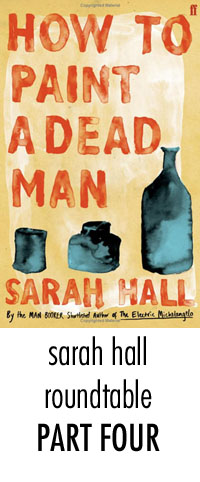
(This is the fourth of a five-part roundtable discussion of Sarah Hall’s How to Paint a Dead Man.)
Other Installments: Part One, Part Two, Part Three
Jenny Davidson writes:
Ugh, I am feeling awful about this — I don’t like writing negative reviews, I’ve been dragging my heels on finishing the book and writing a few thoughts for your consideration – but now that I’ve finished reading it, I will have to say that I pretty strongly disliked it! I found both of the Italian “voices” almost intolerably artificial/stereotypical feeling — I particularly loathed the Bottle Diaries, which seemed to me much more like a non-artist’s view of what an artist might think like than anything actually insightful or persuasive or striking about art, but I found the Annette chapters also overly fey and affected.
I had nothing against the second-person voice used for the Susan bits, and I am interested in novels about twins, but I realized that though I felt that voice does an effective job for the novel of establishing mood/sensibility, I would have had a higher tolerance for it had it been used to narrate, say, a thriller/mystery plot. And the Peter chapters seemed to me the most successful on Hall’s own terms, with a more complex character and voice and narrative structure, only I found him singularly annoying as a character as well!
In short, I am clearly not the ideal reader for this book. Hall is a very skilled crafter of sentences, of course, and yet there is nothing magical about them for me, they do not take off and become transcendent, there does not seem to be some insight motivating them or even just the sound of language in some striking new way. Anyway, I’ll now just put together a pair of paragraphs, my least favorite and the one that I liked the best in the book, to show more concretely what I see these weaknesses as being.
A good example of what I really didn’t like about the Bottle Diaries chapter falls on p. 72, the two paragraphs beginning “The room has gained infamy with very little help from me.” The diction, with its air of having been translated, seems to me portentous but bland; there is something smug or self-satisfied, to my ear, in this ostentatious pondering on art.
A good example of what I liked — a paragraph that definitely stood out to me, although I still don’t think that the sentences themselves (the diction, the style) are as distinctive as what I see in the writers I most enjoy (Peter Temple, for instance, who I have been reading again recently) — the description of Susan and her lover stripping wallpaper and accidentally dislodging an old wasps’ nest (p. 257):
It was a hot summer. The windows were open and one or two wasps had been drilling about the place. Then Tom found the grey, cindery pocket in a wall cavity, and, thinking it was disused, he began to chip between its seal and the plaster. Suddenly the air was swarming. For a moment he was paralysed as the insects rushed and scribbled above the nest. Gesu Cristo! He picked up a decorating sheet, threw it over the two of you, and you stumbled from the room,s lamming the door closed. Are you stung? No. Nor am I. Underneath the sheet he smelled of sweat and dust. You could hear the wasps as they flew against the other side of the door, rapping softly like fingertips.
Brian Francis Slattery writes:
Anna and Kathleen: Your posts made me wish that I’d been more careful when writing my first post, and made me rethink some of the points I made altogether.
Anna, when I read your post, I felt an instant camaraderie. Usually, I’m one of those readers for whom the writing style is everything: If the writing is superb, I don’t care about anything else. And I found myself nodding in agreement with everything you said, even as doing so contradicted what I’d already said. Also Kathleen, I agree with you re: plot as well (especially since I stumbled across Lev Grossman’s WSJ piece). Though I like plots as much as the next reader, I’m not a plotmonger the way Grossman appears to be, nor do I think books without them are necessarily somehow inferior. I also realized, as I thought about it more, that my idea of a plot is pretty minimal. Someone mentioned Virginia Woolf; I really like her and think the interpersonal relationships she develops are plot enough. And have y’all seen the movie The Straight Story? Old guy drives across Iowa and Wisconsin in a tractor, meets people. Or Nicholson Baker’s The Mezzanine? Guy rides escalator, thinks about stuff. That’s more than enough plot for me.
So why did I get fidgety? (Because I did, I can’t take that back.) Were I to start my post all over again, I would have foregone the concept of plot (which I ran with as far as I could in my caffeine-addled state) for the looser idea of movement. Which allows me to say a more concise thing about How to Paint a Dead Man than I managed to before.
In essence, Hall’s concept runs into a paraphrase of the old expression: Writing about painting is like dancing about architecture, and it has to do with the way you experience the two forms. You take in a painting, to some extent, all at once. Sure, you may linger over it, examine details, return to it later, but the experience of looking at a painting or photograph is basically one point in time. A novel, meanwhile, is stubbornly linear–you can’t see the whole all at once, and grasping the whole requires time–a lot more time than most people would spend looking at one painting. So using one to mimic the other is, conceptually speaking, pretty awkward (unlike, say, books about music–see the entire 33 1/3 series–or paintings about a specific moment in history). Put another way: What would a single painting that tried to mimic the experience of reading a novel look like?
I’m not saying anything profound here, and I imagine Hall thought about this a great deal as she set herself a kind of impossible task, intentionally picking up the wrong tool for the job, like grabbing a screwdriver when you need to bang in a nail. That she pulled it off at all is a real achievement; that she did it so cleanly is pretty miraculous. (I say this as someone who has actually used a screwdriver to bang in a nail; it’s not a good idea.) But still, the two concepts, writing and painting, are awkward bedfellows, and what made me fidgety, I understand now, was the lack not of plot, but of apparent movement. For so much of the book, the main characters are trapped–Peter literally so, others figuratively, and yeah, the tension definitely builds because of it. Hall does release us from it–in the final sections for each character, each one is freed from whatever has been trapping them–but perhaps the characters were stuck just a little too long for this particular reader.
That said, reading what I wrote, I realize that this is a small complaint about an otherwise quite impressive novel. And the more I hear what others say about the book–both positive and negative–the more HTPADM is growing on me. I suspect, too, that HTPADM is a book that would richly reward a second or third reading. For me, a second reading would be all about exploring the connections among the characters — a few of which I missed the first time (e.g., that Tom is Annette’s brother — that was a real “of course!” forehead-slapper for me when a couple people mentioned it)–and it’s quite possible that this kind of reading would reveal in HTPADM the sense of movement that I like when I read books.
P.S. Miracle, I love that you lumped Atlas Shrugged, Gravity’s Rainbow, and Battlefield Earth together. That’s a beautiful thing. Also, I can’t believe you don’t think Zep rules.
Michael Schaub writes:
While trying to figure out what to write about this, I kept going back to Ed’s suggestion that we all respond to books subjectively, and Brian’s great “ambitious little prick” moment (awesome) where his professor talked about the difference, such as it is, between admiration and love. (Which is not to say the two are mutually exclusive.) After I finished reading How to Paint a Dead Man, I realized that I’d have to read everything else I could find by Sarah Hall. I realized she was an undeniable talent and an extraordinarily gifted young writer. I admire her.
And I admire parts of this book. But I didn’t like it at all. I didn’t enjoy it, though there were parts I found interesting, and sections that were beautifully rendered. My reaction comes closest, I think, to Jenny’s – she and I were bothered by at least one of the same things: the chapters dealing with Annette and Giorgio, which we both found artificial. I did think that Hall did a great job in making Giorgio’s sections sound like English translated from the Italian, which has to be hard to pull off, but I couldn’t shake the feeling that the reclusive master painter and the poor blind flower girl were stock characters in an Italy-romanticizing movie from the past. I actually wasn’t convinced at all that Giorgio and Annette were necessary as characters in this novel; they struck me as flat, especially compared to how well Suzie was rendered (and, to a lesser extent, Peter).
I loved, for the most part, Suzie’s chapters. Like Abigail, I wasn’t bothered by the second person – frankly, I didn’t even really notice it for a while – and I thought the conceit made sense given the questions of identity and twinhood (is that a word? It is now!) that the book raised. The most striking parts of Suzie’s installments, I thought, were the sex scenes – not for any licentious reasons; it’s hard to imagine colder, less prurient writing about sex than these. I loved them because they were cold -– I think that’s a word Miracle used, aptly, to describe the book. My problem with the book as a whole was that when it was cold, I wanted it to be colder. And when it was warm and sentimental, I missed the coldness.
I wonder if the book wouldn’t have worked better –- for me, anyway -– if Hall had stuck to just Suzie. Of course, this would have made it a different book entirely, so it’s not the most helpful criticism to make. Peter’s chapters almost worked for me; I lost him, though, when Raymie was introduced as a character, near the end. Raymie couldn’t have been more flat – she came across like the saddest character in the saddest Velvet Underground song ever written. The whole ‘60s reminiscing thing left me unconvinced.
But I want to get back to Ed’s point about judging this book subjectively. I have no doubt that at least 90% of my reaction to this book – both negative and positive – is purely subjective, purely personal. For a long time, I’ve been unable to read books, watch movies, even listen to songs that mention the death of a sibling. I haven’t been as unlucky as Suzie, but I came close, not long ago, and considering this kind of thing still unsettles me, nauseates me, makes me turn away.
Is that why I found the book off-putting? I have no idea. I’ve considered other possibilities, especially after reading the positive reactions from all the intimidatingly smart people taking part in this discussion. There are very few subjects about which I know less than visual art; I love it, but I’m as unlearned as you can possibly be on the subject and still be a high school graduate. I’m an American with a pitiful lack of knowledge of Europe. Did any of that make me miss something?
I don’t know. And I hate to keep saying that -– it sounds, to me, like a critical abdication, but it’s where I am as a reader right now. I wonder, though – to paraphrase the “eggshell skull” rule in law –- if authors and books have to take their readers as they find them, with all their blind spots and vulnerabilities and fields of ignorance.
I do know that Hall is gifted, and I do look forward to reading her other work. I’d love to see her indulge her sense of humor more (did anyone notice the reference to a misheard Stone Roses lyric in one of Peter’s chapters?), and I’d love to see her focus more –- I think my problems with the book stem from the fact that Hall, I’m guessing, thinks quickly, and thinks a lot, and the end result here wasn’t as tied together as I would have hoped.
Maybe, of course, the fractured nature of this book was supposed to be discomfiting. It reminds me of Annette’s mother reassuring her that no furniture would ever be moved in the house: “Nothing will be rearranged. There. Doesn’t that make you feel safe?” Safety, it turns out, isn’t really the point.
Amy Riley writes:
This discussion has been very interesting to read, as I’m fairly certain I would never have even considered the majority of the points raised if I had simply read this on my own. To be completely honest, I may not have even finished the book.
Which is not to say I didn’t like it. There were times I actually looked forward to turning the page. On a few occasions, I thought about skipping ahead to the next section of whichever narrative I was on, because from a plot standpoint I didn’t think it would make a lot of difference.
The use of second person didn’t bother me but I don’t know if that’s because I found Suzie’s narrative one of the more tolerable ones to read or not! It did make sense to use it for her…after all in her opening pages is a discussion of how people don’t use “I’ anymore because they “do not want to be involved in the desperate act of being.’ Suzie fits right into that in her grief she has lost her sense of self and connection. She was only “I’ in relation to Danny, once Danny was gone who was Suzie? I also looked forward to Annette’s sections, though I found her death bizarre. The overall structure…the fact that the individual stories were only loosely linked and spanned years wouldn’t bother me on it’s own and in fact was one of the reasons I wanted to read the book. I am generally drawn to explorations of how our lives intersect and how our actions impact each other. I suppose the very subtle nature of that in this book made it more realistic, but I felt I like I really had to work for it. And perhaps the loneliness and the isolation were so extreme that the small ways these lives did affect one another never penetrated through that shield.
Looking at the book as moving from frame to frame or as a stillpoint in each character’s life was helpful to me in understanding the book or what it aims to be. I don’t have much understanding of visual art so I do fear much of that went right by me. While I appreciate the skill this book must have taken, I have to agree it’s not really for the casual reader. In fact, when I told a friend who had read this book that I’d be participating in a roundtable discussion, she seemed uncertain about what we would actually discuss.
Traver Kauffman writes:
Hey, kids. I just finished the book ten minutes ago, and I’m now ready to make dumb jokes about it. See, I used to have this somewhat credible litblog, and then this and that happened, and now I write limericks and go for cheap laffs. Which is unfortunate, because this is a serious book, right down to the author photo.
Which I love, by the way. It’s standard practice, in some corners, to objectify the attractive lady author, but I’m just not going to do that. Still, and honestly, I’m a little in love with this photo. I want to buy fresh peaches at the farmer’s market, stay up until the wee hours peeling the skins, and bake them into a peach crisp so I can serve it with fresh bourbon whipped cream to my love, this photo. I want this photo to recline on a bed in a cheap motel and unroll its torn black stockings slowly whilst I read Bukowski to it in a cigarette voice. I want to reform the Stone Roses and take this photo to our first show, where I’ll dedicate “I Wanna Be A Dog”…er…I mean “I Wanna Be Adored” to it. Yes.
Is this a good book? Pretty good. Not the sort of thing I’d typically reach for, and something I probably would have tossed aside if not for guilt associated with skipping yet another Eddie Champ-curated roundtable. But it does pick up considerably around page 90 or 100–I believe I made a note about this in my thinkspace at page 99–and wasn’t much of a slog from that point forward.
Cheap and easy judgment: Susan is OK; Peter is better. And, yes, Peter is a man from central casting, in some respects, but he did benefit the most from the novel’s structure, in my view. That is, his character deepened and changed most–benefitted most–from the tellings of the other individuals (save Annette, but more about her later). From the “Fool on the Hill” sections I never would have pegged him as an iconclastic artist–more of your all-purpose crank–but by the time Susan and Giorgio are through telling him, it’s clear he’s a fellow of some (apparently well-earned) genius and prestige.
Susan seems like she could have been interesting, had she not been obscured in fancy prose clouds of florid fucking. Again, this is competently and perhaps well-written sex, depending on your politics, but transcendence-by-prick isn’t my thing. The second person didn’t bother me at all, even though it seems like a curious authorial choice. We’re meant to share in her experience most intimately, even as co-conspirators, and therefore most painfully? I dunno.
(At one point, I had a writing advisor who told me in no uncertain terms that reading second-person narration is like being cornered by a drunk. Of course, he was drunk at the time and I was backed into a corner at the Union Club in Missoula, Montana, so take that as you will.)
Giorgio and Annette: where to begin? I think others have touched on it, so there’s not much point in my running down these sections. Gorgeous writing? OK. But this genteel exoticism didn’t do it for me, especially in the Annette sections. Aside from the kind of relentless otherness (by way of stereotype, as others have noted), these bit in particular suffered from needless obscurity that doesn’t plague the other sections. By the end, I wasn’t sure what had transpired, and, apart from my lifelong stance against anyone being rudely violated by a beast of any sort, I couldn’t bring myself to care.
Boiled down, we have here a book with an interesting structure and a writer of some considerable gifts. I just didn’t love it as much as I love that photo.
I leave the floor to my fellow commentators, both more serious and more estimable than I.
Abigail Nussbaum writes:
Brian mentions plot, and specifically the recent Grossman fracas, which reminds me that I never talked about my own reaction to the book as a whole. I tend to think of myself as someone who reads for plot, but then a novel like Remainder, or City of Saints and Madmen, or Light, comes along and reminds me that that’s not at all true. It would probably be closer to the truth to say that I find it easier to read for plot, but I suspect that’s true of most people – a plot-oriented novel carries you along with it, whereas a plotless one requires you to navigate your own way through it. Still, when I turn the last page of a novel my first response is often to ask what happened there, and if the answer is nothing or very little I often find myself without a handle on the work, which is why I’ve so enjoyed this discussion while fearing that I wouldn’t have much to contribute to it.
All of which is a prelude to saying that, like Michael, I admired How to Paint a Dead Man but didn’t love it. As reviewer, the novels that I enjoy reading and writing about most are the ones that offer an angle of approach from which to engage with them – not necessarily plot, but some element that fires up my imagination. I tend to think of if in terms of chinks in the surface, handholds and footholds. HtPaDM feels very smooth (though it might not to others, and particularly those with a background in visual arts), which leaves me admiring it as an edifice, but unable to grasp its component pieces. And without doing that, I can’t love it.
That said, I don’t think HtPaDM is a novel that wants to be loved. As Michael says, this is a cold, cold book, and even those parts of it that might have appealed to sentiment — Giorgio and Annette’s narratives — never achieve enough life of their own to be more than sentimental. Peter is puppyishly lovable, but his narrative is mainly concerned with describing the worst things he’s ever done, and there’s something almost deliberately off-putting about his predicament – he’s in physical distress and in need of assistance, but we’re encouraged to believe, as he does, that he’s not in mortal danger (in fact we know that he isn’t because he’s still alive and apparently recovered – though he walks with a limp – at the time of Susan’s narrative). So instead of arousing tension and distress, Peter’s injury is aggravating and frustrating – he’s simply stuck. Finally, there’s Susan, of all the characters the one who most resists emotional connection, with the readers as much as with the other characters. The only aspect in which Hall seems to be courting the readers’ affection is with her prose, which is indeed quite beautiful (though she tends to fall flat when describing sex – I don’t have the book in front of me but there were a couple of metaphors for bodily fluids that seemed more than a little off).
All of which brings us back to HtPaDM as a painting in prose – capturing a moment, and attempting to engage the readers’ affection not through plot or character or theme but through beauty and superior technique. It works, I think, though still in the sense that I can’t love HtPaDM the way I love other novels (it’s not just that I’m unschooled in visual arts but that they don’t appeal to me. I’m all about narrative arts, and even music isn’t an abiding interest), and I find myself going back and forth about it. On one hand, I admire Hall’s guts for even making the attempt to court a kind of love that her medium isn’t suited to, much less for having the skill to pull it off. On the other hand, I’m not sure such a chilly trick ought to be celebrated – it’s brave, to be certain, but in the final accounting the result isn’t really a novel.
Good Books Don’t Have to Be Read
A good book is one that we don’t actually read. And a good book is one that a writer doesn’t actually write. It’s what makes guilty pleasures so guilty. It’s what makes pleasurable guilt so pleasurable. A box of juice reeks of crass commercialism when we insert our straws and revert back to those childhood years when the school bullies beat us up and told us that only sissies read. We crave books the way that we crave boxes of juice. There is a big man holding a gun to our temple. The big man is Anton Chekhov, and he is introducing a gun that must be used later in a story and later in this article. We are not allowed to fire the gun, but maybe we might fire it one of the Grossman brothers. They are, after all, twins. This may involve partial suicide, but I am speaking metaphorically and I am perched on a giant dais. This is too complicated for anybody to understand. This is more complicated than stabbing a box of juice with a straw. This is so complicated that I, Lev Grossman, have been spending the entire morning sobbing in bed. Books make perverts of us all. I am ashamed, but I am not sorry.
It’s not easy to put your finger on what exactly is so disgraceful about our attachment to books or the idea that people are supposed to read them. Sure, the importance has something to do with the fact that there are these squiggly lines that are printed onto bits of paper that are glued to a base. But what exactly? Excuse me while I take a toke. Ah, that’s much better, even if I don’t understand my argument and even if I will never ever experience pleasure in reading again. Part of the problem is that to figure out how to read a book you actually have to open one. You actually have to write idiotic essays for the Wall Street Journal because then people will take your folderol seriously. You have to keep your head shaven and demand that all books capitulate to your own sleek reading perspective, which does not exist and which must be simpler than tying your shoe. You have to write silly books about magicians and ignore the interesting shit about genre. If there’s a key to what the 21st-century novel is going to look like, this is it: E.M. Forster’s Aspects of the Novel — a book that frankly I don’t understand — and my tendency to masturbate to it when I can’t find the stack of Hustlers. Also, plot. Simple plot. Plot you can explain to a marsupial, with the marsupial clapping his hands in seeming comprehension.
Let’s look back for a second and ponder where the Modernists came from. They came out of my ass. They flew out of my anus like winged monkeys. I assure you that this was a rather unsettling feeling that caused me to apply a good deal of lube when the flesh grew ruddy. They flew out of my ass because I knew they were writing good books and I knew that I couldn’t understand them and I knew that the Modernists were complicated but that they didn’t always think Plot First. Which is a little like Country First. Reading, as we all know, must subscribe to the Sarah Palin doctrine. So forget Virginia Woolf, James Joyce, D.H. Lawrence, and all those literary heavyweights that people marvel over. They all came out of my ass and still carry that shiny and confused look. This is why they are dead. It has nothing to do with life expectancy. It has everything to do with my ass.
The Modernists went into the antique store and, ignoring the vital Plot First credo, they broke the vase. And now they must pay for their insolence. We are all the vicious and humorless shopkeepers ready to chase the Modernists out with a shotgun. How dare the Modernists make us think! How dare the Modernists improve upon literature!
There was a time when books were exciting. But then I got a job at Time and they became less exciting. And because they are not exciting to me, they cannot be exciting to you. They should not be difficult and they should not be read. I, Lev Grossman, am a drag at parties. Therefore, books must be a drag at parties. Nam Le is a scoundrel because he does not sell well enough. The next time I see Nam Le, I will punch him in the face. I don’t care how nice he is. I don’t care how much of a decent writer he is. Nam Le simply doesn’t sell as well as Stephenie Meyer. Therefore, he flew out of my ass like the Modernists. I am telling all the people who plan the parties not to have Nam Le and Lev Grossman in the same room. Surely, there will be a brawl.
The revolution is under way. And I, Comrades, insist that you do not have to read books. If you love books in any way or fail to consider the Plot First doctrine, then we will send you to the reeducation camps. We must be constantly entertained. We must not think. We must accept unquestionably that I, Lev Grossman, am correct about literature. Just look at Thomas Pynchon. Despite changing his cumbersome calisthenics, he appears on YouTube! Surely, this is a sign that the world is changing and that you don’t even have to read books anymore! If you look hard enough for clues, you too will sound like a conspiracy theorist.
This is the future of fiction. This is also the past and the present of fiction. There will be no more Modernist or Postmodernist writers flying out of my bunghole. We were trained to read good books. Now we must divest ourselves of this propaganda and become Communists!
A good book is one we don’t read. And the only articles you should be reading are written by Lev Grossman.
This article is a little too ad hominem for my tastes.
(For other responses, see Andrew Seal and Matt Cheney.)
BookExpo: The Myth of “Big Ideas”
There’s a desperate atmosphere evident even in the panels. And I’m not just talking about the execution, but the conception. One such panel that I walked out on, featuring the likes of Chris Anderson and Lev Grossman, was devoted to whether or not publishers still hold the keys to the castle. It was a sad and lifeless discussion that felt as pathetic as the hired dancers attempting to drum up some attention in the vestibule for some book that most people will forget about by tomorrow morning. (Indeed, it might be argued that people will probably remember their free cocktails over prospective titles. It is worth noting that agents are already wary of being solicited, and it’s just the early afternoon.)
But back to the panel. Chances are that if you’ve attended an O’Reilly conference, you’ve seen this type of generalism before. A bunch of men sit before some microphones and begin to spout off a bunch of technological libertarian nonsense. The participants often believe that, because there is some rumbling in publishing’s plate tectonics, now is the time to espouse some new sentiment or to seize some desperate stretch of land. It’s the dawning of a revolution! But these new politicos — who seem more inspired by Thomas Friedman than Thomas Jefferson — don’t understand that serfs can’t adapt from an agrarian economy overnight. Meanwhile, the old dogs never seem to understand that they can’t hold onto their vassal system forever. But there’s no time like the present to make impetuous statements that can only advocate one side or the other, but can never find a middle ground for both.
I spent ten minutes watching this “Big Ideas at BEA” conference, in which the only big idea that anyone wished to consider was whether or not Chris Anderson would have to hold a microphone after the trusted lavalier attached to his shirt couldn’t communicate his predictable patterns of prediction. There was something fittingly symbolic in the microphone’s failure. The very system that had catapaulted Anderson to fame was beginning to fall apart.
And the very discussion that Anderson and his cronies here wished to promulgate was no less interchangeable with any number of talks given at any number of conferences in any number of locations.
When in doubt, go for the predictable. It’s the only “new” or “big” idea that people seem to have in this melancholy landscape.
People actually paid hundreds of dollars for this when they could have stayed home and curled up with a Malcolm Gladwell book.
The Bat Segundo Show: Catherynne M. Valente
Catherynne M. Valente appeared on The Bat Segundo Show #266.
Catherynne M. Valente is most recently the author of Palimpsest.
Condition of Mr. Segundo: Looking for a way into a secret city.
Author: Catherynne M. Valente
Subjects Discussed: Writing a novel with four character perspectives, how structure influences perspective, the importance of numbers, color theory, thriving on restriction, Neal Stephenson, the importance of flow and reading out loud, Mark Danielewski’s House of Leaves, synesthesia, the purpose of puns, being a child of the Internet generation, Italo Calvino and the literature of the new millennium, planning a book entirely in one’s head, PersonalBrain, on not outlining a novel, having semiotics for breakfast, writers with kinks, multiple topographies within Palimpsest, perceptions of New York, the individual relationship to a city in relation to one’s individual sensibilities, genre classification, New New Weird and mythpunk, thinking while doing other things, the factors that cause Valente to write very fast, fighting the forces of marketability, chick lit, a future project involving the myth of Prester John, the problems with accessibility, the addiction to story, geek outreach and the publishing industry, Lev Grossman’s article, the communal experience, novel patches, the book as a permanent medium, secretive networks, the Kindle and the Sony eReader, Cory Doctorow, the bridge between print and online, Eric Kraft, and the signal-to-noise ratio in e-books.
EXCERPT FROM SHOW:
Correspondent: Which number is your favorite? Or maybe one of your five favorite numbers?
Valente: Oh, my favorite number!
Correspondent: Do you do this on a single digit scenario?
Valente: I’m going to have to go with seven.
Correspondent: Seven!
Valente: Actually, a little girl came to one of my Orphan’s Tales readings. She came up to me after and said, “Why are there all those sevens in your book?” And I love seven. It’s a prime number. And it’s a typically mystical number. And it’s fascinating to me. But I almost never use it in structure. Because it doesn’t fit very well. It’s kind of an ornery number that way, which, I suppose, is why I’m attracted to it. Because I’m kind of ornery myself.
Correspondent: Well, you know, Neal Stephenson told me that seven was the ideal number of guests at a dinner table.
Valente: Oh, wow. I hadn’t thought about that.
Correspondent: What are the applications of seven? Not just to your fiction, but also to your general life?
Valente: Well, I guess it’s the number that I don’t use though. Seven is a number that doesn’t occur in nature very often. There aren’t too many seven-leafed or seven-petaled plants. That is why it’s a mystical number. Because it exists outside of the world. And so I don’t actually use it all that much. When I’m arranging things, I go with three. I go with four a tremendous amount. Of course, four is a very thorny number in Eastern culture. Because there’s four noble truths. But four also means death in Chinese and Japanese. And so they will often, much as our number thirteen, consider it unlucky, remove it from hotel rooms, and things like that. But I love the number four. I love the number eight. But seven is the number apart. So I use it in fairy tales all the time in terms of time. Seven days, seven years, seven months. There’s a character named Seven in The Orphan’s Tales. And that particular character deals with coins that have a seven-pointed star on them. But seven, I love, because it’s weird.
Correspondent: What’s your position on The Magnificent Seven or The Seven Samurai?
Valente: Well, of course, those come from Seven Against Thebes! Which is a wonderful ancient Greek play. I’m a classicist. So I always go straight back to that. And, of course, Seven Against Thebes comes from the seven dragon teeth that Cadmus planted in the earth. Yeah. Seven’s great.
(Photo credit: Ellen Datlow)
BSS #266: Catherynne M. Valente (Download MP3)
Review: Blessed is the Match
The most truthful moment contained within Roberta Grossman’s documentary, Blessed is the Match, comes from parachutist Reuven Dafni. Dafni reveals, in what Grossman bills as his final interview, that he did not like the widely celebrated Hannah Senesh very much, but that he admired her stubbornness. One is curious to know why. But the question is never asked.
It is this journalistic diffidence that prevents Grossman’s documentary from being anything more than a helpful yet tendentious refresher course for those who wish to learn more about the intriguing Senesh. The film, littered with spoon-fed “recreations” of existing photos, Indiana Jones-style animated trails across maps, and Joan Allen’s stately, Oscar-nominated voice reading Catherine Senesh’s writings, chooses to present Hannah Senesh as a martyr, but doesn’t make any serious efforts to ask whether Senesh’s martyrdom was premeditated, or whether history has the right to judge Senesh’s life almost exclusively from her final days. All this is a pity and a missed opportunity. For are not noble actions committed without the expectation of credit? If Senesh set herself up to be a martyr, and there exists some possibility that she did, is there not more wisdom to be found crawling around the gray areas?
Senesh, of course, is known for her courage in parachuting into Yugoslavia, working her way to Nazi-occupied Hungary to rescue imprisoned Jews, only to be captured by Arrow Cross soldiers and systematically tortured in prison. But Senesh offered hope to her fellow inmates, singing songs and flashing vital signals with a mirror through her cell window. She communicated to her fellow inmates that there was indeed an end in sight, and Senesh did all this while brutal interrogators continued to beat her, punching out her teeth, and bringing her mother into the cell in an attempt to loosen the information.
Senesh did not talk. Her mother, Catherine, wandered up and down the streets of Budapest hoping to obtain her release. But despite Hannah’s reported eloquence before the judges during her tribunal, she was tried for treason and executed.
It is difficult to argue against the idea that Senesh espoused bravery. But Senesh was also a human being, flawed as human beings are. In 1939, she emigrated to Palestine to attend the Nahalal Agricultural School. Grossman presents but smooths over the fact that Senesh skipped town just after the First Jewish Law was passed in 1938, which restricted the number of Jews employed in liberal vocations to 20%. Known as a precocious intellectual among her largely upper-class peers in Budapest, the documentary informs us that Senesh wrote haughtily back to her family that she could put her abilities to better use. We are also informed that Senesh was exceptionally idealistic, but that she kept largely to herself and couldn’t share any of her concerns with others in the kibbutz. But instead of examining all this through interviews with surviving members of Senesh’s family, or even “recreating” these flawed moments, we’re given a film with an inflexible and somewhat primitive perspective, all set to Todd Boekelheide’s heavy-handed orchestral music.
Here is a fascinating and complex figure who deserves better than the Biography Channel treatment. Sir Martin Gilbert lends some gravitas to the project, providing extremely useful historical context. But what’s troubling about this film is that, long before the film is over, the audience has already made up its mind about Senesh’s virtues. As the current atrocities in Gaza cause any feeling mind to draw uncomfortable parallels with other historical actions, Blessed is the Match arrives in theaters without an ability to expand its perspective beyond simplistic good vs. evil dichotomies. With the high watermarks established by Marcel Ophuls and Claude Lanzmann, this is a film terrified of offending and presenting, and not altogether different from hundreds of other Holocaust documentaries.
The Bat Segundo Show: Paul Auster
Paul Auster appeared on The Bat Segundo Show #231. Auster is most recently the author of Man in the Dark.
Condition of Mr. Segundo: Opening himself up to explanation.
Author: Paul Auster
Subjects Discussed: Starting a novel from a title, the advance titles contained within The Book of Illusions, the working title of The Music of Chance, Mr. Blank, the relationship between Travels in the Scriptorium and Man in the Dark, shorter baroque novels vs. longer naturalistic novels, the use and non-use of quotation marks within speech, the writing history of The Brooklyn Follies, the political nature of ending novels, the 2000 presidential election, parallel worlds, the death of Uri Grossman, didactic novels, the comfort of books, the Auster eye-popping moment, the party scene in The Book of Illusions, violence, reminding the reader that he is in a novel, emotional states revealed through imaginary material, Vermont’s frequent appearance in Auster’s novel, Virginia Blaine as the shared element between Brill and Brick in Man in the Dark, magic, The Invention of Solitude, memorializing memory, Rose Hawthorne, website archives, Auster’s relationship with the Internet, having an email surrogate, Auster’s concern for specific dollar amounts in Man in the Dark and Oracle Night, Hand to Mouth, Auster’s reading habits, the 8-10 contemporary novelists Auster follows closely, being distracted, the intrusive nature of the telephone, diner moments in Auster’s most recent novels, perception and stock situations, summaries of books and films within Auster’s books, and intimate moments in great movies.
EXCERPT FROM SHOW:
Correspondent: I wanted to ask you about something that I’ve long been interested in your books, and that is your concern for specific dollar amounts. Again, it plays up here in the Pulaski Diner, where everything is five dollars. And I also think about the scenario with M.R. Chang in Oracle Night, in which there’s the whole situation between the ten dollar notebook and the ten thousand dollar notebook.
Auster: Right.
Correspondent: And again it becomes completely, ridiculously violent. But there is something about the propinquity of the dollar amount that you keep coming back to in your work. What is it about money? And what is it about a specific figure like this?
Auster: It’s funny. I never, never thought about that. Wow. Well, listen, money’s important. Everyone cares about money. And when you don’t have money, money becomes the overriding obsession of your life. I wrote a whole book about that.
Correspondent: Yeah.
Auster: Hand to Mouth. And the only good thing about making money is that you don’t have to think about money. It’s the only value. Because if you don’t have it, you’re crushed. And for a long period in my life, I was crushed. And so maybe this is a reflection of those tough years. I don’t know. I don’t know.
Correspondent: Or maybe there is something absurd about a specific dollar amount or something. I mean, certainly, when I go to a store and I see that something is set at a particular dollar amount or it fluctuates, it becomes a rather ridiculous scenario. Because all you want to do is get that particular object.
Auster: Yes, yes, yes. But often in my books, people don’t have a lot of money in their pockets. So they have to budget themselves carefully.
Correspondent: Well, not always. You tend to have characters like, for example in The Brooklyn Follies, people who have a good windfall to fall back on and who also offer frequently to help pay for things, and their efforts are often rejected out of pride by your supporting characters. And so again, money is this interesting concern. But I’m wondering why you’ve held on to this notion. It’s now thirty years since the events depicted in Hand to Mouth. I mean, is this something you just haven’t forgotten about?
Auster: I guess I haven’t forgotten about it. (laughs)
Correspondent: Do you still pinch pennies to this day?
Auster: No, no, no. Not at all. No, I’m not a tightwad at all.
Correspondent: (laughs)
Auster: I’m generous. I give good tips. It’s just — the way I live my life, ironically enough, is: I don’t want anything. I’m not a consumer. I don’t crave objects. I don’t have a car. We don’t have a country house. We don’t have a boat. We don’t have anything that lots of people have. And I’m not interested. I barely can go shopping for clothes. I find it difficult to walk into stores. The whole thing bores me so much. I guess the only thing that I spend money on is cigars and food and alcohol. Those are the main expenses.
Correspondent: Not books?
Auster: No. Because our library in the house is so bursting, we have no more room. We have things on the floor. And books come into the house at the rate of — you see, three came today for example. I’m pointing to them on the table. So we’re just inundated with books.
Download BSS #231: Paul Auster (MP3)
Sandkings Indeed
A free trial creature creator from Spore has been released. The creatures here are too cutesy to be considered for practical battle concerns. There is a paucity of dangerous teeth and minatory claws. Is a ruthless and self-serving alien creature who will have some life form for lunch too much to ask from Maxis? Is there no possibility here of a dangerous ecosystem?
I suppose we’ll have to wait for the final game in September before these evil possibilities — a la George R. R. Martin’s “Sandkings” — make their presence known. (That’s the thing about games from Maxis. They tend to turn very nice people into savage sadists.) Nevertheless, this free trial is dangerous. I have created a creature with about twelve limbs and a very large head. I have tried to sully its Disneyification, but to no avail. I am now leaving the house so that I can actually get some work done. But if you’re interested in this, i09 has nabbed Austin Grossman to reveal his thoughts on all this.
In Which I Encounter My Nemesis
At last night’s book launch party for Kate Christensen’s The Great Man, I observed a bald man — much shorter than I had expected — resembling a certain journalist working for Time Magazine. It was none other than Lev Grossman, my proud nemesis. Lev had been wiser than me in maintaining his bald form. I had allowed my hair to grow back, complete with its ridiculously receding hairline, after a brief experimental phase in which I had forgotten to acquire a drug habit or transform into some consciously ironic Williamsburg hipster, but that mostly involved seeing if I could effect some bald badass corporeal form with ridiculously cherubic cheeks. The experiment, alas, had mixed results, particularly since I had laryngitis during most of my hairless stint and because Daniel Mendelsohn had confused my lack of voice with a diffident stance. And I remain convinced that I could beat Mr. Mendelsohn in an aggressive game of ping-pong or Connect Four. But no matter. This is unnecessary bravado, but it must be set down for the record. I know I can win. I do plan to revisit this hairless approach later, perhaps when I am feeling more masculine or I have just eaten twenty pounds of raw ground chunk and jogged six times around Prospect Park and I have shouted Hemingway passages at the top of my lungs.
Anyway, Lev was there. And I introduced myself as his nemesis. It took three attempts before he figured out who I was.
“Ed?” he said, unaware that I had moved to New York.
It turns out that he lives not far from me, that he genuinely likes William Gibson (I quizzed him on Count Zero), and that he is a more or less friendly person. Kate Christensen, who was somehow cognizant of last year’s skirmish, remarked, “But you’re both such nice guys!” I assured Ms. Christensen that she was wrong. Lev and I enjoyed a Moriarty-Holmes relationship. We were both gentlemen and we didn’t wish to unleash our fury upon an unsuspecting crowd.
Is this the end of the Lev-Ed loggerjam? Well, who is to say? Mr. Grossman appears on the surface to be quietly charming and perhaps just a tad misunderstood. But I still believe him to be made of sturdier stuff and indeed pressed him on this pedantic character quality over twenty minutes of conversation. He took it well.
I slipped away so that Lev would think himself safe. But, of course, I concoct silly and meticulously contrived plans that will be unleashed at a time of my choosing.
_________ Is/Are Killing the Novel
Here’s a helpful list for New York freelancers who need to write a needlessly alarmist newspaper piece about what may be killing the novel. So if you’ve run out of ideas and don’t quite know an angle, here are some casuistic ideas for your future pitches! Remember, if you collect a check from any of these ideas, I’m only asking 5%. Be sure to send a check to me within 45 days after the piece runs. Good luck and Allah’s speed!
- Global warming
- David Hasselhoff
- Sudoku puzzles
- People who are really into Settlers of Catan
- Tao Lin
- The bottled water industry
- Right-wing French joggers
- Waffles and pancakes
- Men who leave the toilet seat up
- Women who leave the toilet seat up
- Pet dogs who have been trained by their masters to keep the toilet seat up with their paws
- Marxists
- Eucharists
- Tom Cruise (or any famous Scientologist, really)
- Eco-friendly organic pizzeria owners
- Pot smokers
- Golfers
- Matt and Daniel Mendelsohn
- Lev and Austin Grossman
- Edward Champion
- Killroy
Roundup
- National Review: “One promising development in the culture today is that mainstream critics are more and more growing tired of postmodern fiction.” Actually, this is not promising at all. This is, in fact, a serious problem that runs counter to literature’s natural developments as a form. I will have a lengthy post on this subject in the not too distant future. (via The Valve)
- If you enjoyed Austin Grossman’s appearance on The Bat Segundo Show, he also chatted with Rick Kleffel.
- It hasn’t been mentioned by anyone other than Tod Goldberg, but it appears that the New York Post is axing its book coverage.
- Vlad the Impaler’s castle is now for sale. In an effort to respect “the property and its history,” prospective buyers are being asked to demonstrate their bloodletting talents before closing escrow. (via Slushpile)
- Book artist Gloria Helfgott has passed on. (via Ron Silliman)
- I’m a few episodes into the third series of Doctor Who. But with the horrible news of Catherine Tate returning, as well as Kylie Minogue appearing (what the fuck?), in future episodes, I fear the worst. Pardon me if I go all geeky on you, but I’m convinced that Freema Agyeman is one of the best things that has happened to the show. Here we have a strong female character who is educated, curious, and who takes action when she needs to, instead of standing doe-eyed and helpless — as Rose often did — marveling at the Doctor’s genius. That it would take so long for the show’s producers to rectify this dated gender imbalance to the program is bad enough. But it would appear that Agyeman will be returning in the middle of the fourth season. The message here? Russell T. Davies and company like their companions dumb and helpless, instead of smart and kickass. (via Ready Steady Blog)
- Yes, “inhaling” is really the only way to describe reading Sarah Waters’s books. But think of it this way. Better to snort crafty narratives up your nasal lining than Bolivian marching powder.
- I don’t care for Sarkozy very much, but I think it’s pretty damn silly to declare jogging a right-wing activity. Outside of Leni Riefenstahl’s Olympia, since when did exercise have any political agenda? Besides, if you really want to get right down to it, were I blessed with a bountiful expendable income, I’d expect a personal trainer to demand that I exercise hard rather than have him pat me on the back and offer an Alan Alda-like hug if I couldn’t make my crunch count. If you want to get rid of flab, you have to do the work. Does doing the work make one a Nazi? More from Josh Glenn.
- Personally, I feel “devastated” that so many words were devoted to J.K. Rowling feeling “devastated.” Next up: a series of 2,000 word Rowling profiles in the Telegraph about how Rowling feels “almost euphoric,” “less than stellar,” “pretty darn okay,” and “just peachy keen.”
- What the Dallas Morning News layoffs mean for the paper. (via book/daddy)
- The Heritage Book Shop has closed. (via Bookninja)
- Hamlet translated into modern English. (via Books, Words & Writing)
- Armistead Maupin on why he loves San Francisco. (via Colleen)
BSS #118: Austin Grossman
Condition of Mr. Segundo: Scared of Larry.
Author: Austin Grossman
Subjects Discussed: Retconned culture, the human qualities of superheroes, origin stories, the postmodernist trappings of comic book continuity constructs, grad school vs. superheroes, writing while driving, how Grossman’s work on video games influenced his work as a fiction writer, Max Allan Collins’s A Killing in Comics, the relationship between prose and illustrations in a novel dealing with superheroes, the mainstreaming of geek culture, the unusual domestic living arrangements of Superfriends, secret identities, the problems of making video games based on superheroes, and reconnecting with 19th century literature.
EXCERPT FROM SHOW:
Grossman: I feel like superheroes debuted as the sort of archetypical gods and every once in a while, they get retconned back to that — just to kind of refresh them. But I like them — I like them now! When they’ve had so much layered onto them. When archetypes have been established and now they can sort of start to live inside them and be a little more human. But I feel that, in liking them that way, I’m caught in some kind of cultural cycle. That that’s why I like them now and that, twenty-five years from now, people will like them as archetypes again. So I can’t really understand why I like them that way. It’s just that I do. I like to feel like they have a consciousness that I can relate to, that I can live inside, and yet are also godlike in some way.
Lev and Austin
From an interview with Austin Grossman: “Practically speaking my brother Lev helped see the thing to publication – he saw it in its early stages and told me it was worth finishing in the first place, which helped enormously; and he introduced me to his agent, who encouraged me and helped me find my agent. So I was enormously lucky in having someone to show the book.”
Roundup
- Rumors, put forth by San Diego literary agent Sandra Dijkstra, are now making the rounds that the San Diego Union-Tribune books section is dead. I have no wish to perpetuate a false rumor and I plan to make several calls tomorrow to confirm if this is indeed the case. (In the meantime, an email has been sent to Books Editor Arthur Salm to determine information.) But if this is true, this is very sad news, as Salm ran one of the more underrated book sections in the country. (Don’t believe me? Check out Salm’s footnote-laced review of Consider the Lobster.)
- Marilyn Robinson on Annie Dillard.
- Joseph Campana offers one of the best takes on the J.T. Leroy fraud ruling, pointing out that “[t]he problem was the exploitation of addiction and abuse narratives to feed a national hunger we assiduously excuse or deny.” I too am perturbed that such a base capitalization upon the public’s appetite to commiserate with the scarred horrors of someone ostensibly using fiction as a coping mechanism would outweigh the possibilities of infinitely more interesting author hoaxes and identity shenanigans. If anything, Laura Albert should pay for cheapening the potential of more talented authors to tinker with what is real and what is not.
- Michael Winter is turning to Facebook to unveil his novel. There, he will find many friends who will claim passing acquaintance with him as an excuse to harangue him with hastily composed messages. Or he will find a way to get laid.
- Pierre Jourde is in trouble. Five farmers have accused the French novelist of revealing family secrets in a “tell-all novel.” But one wonders why these farmers didn’t just keep their traps shut. After all, with the “novel” label attached, Jourde’s work is “fiction.” Was the book miscategorized in the nonfiction section? Personally, I’m hoping for more “tell-all novels,” if only because resulting conflicts along these lines may encourage more baroque French novels deconstructed by literary scholars instead of barristers.
- Lev Grossman offers this bold lede: “Writing about rich white people is no way to make it as a novelist anymore.” On the contrary, Mr. Grossman. Never underestimate the parochial reading tendencies of those determined to read solely within their own niches. Particularly the rich white people who inhabit certain areas of New York. After all, if they view my own safe neighborhood as dangerous, then what’s to suggest that they won’t apply the same ridiculous lack of logic to their reading choices?
Tom McHale, novelist
Here’s how The Literary Encyclopedia’s entry on Tom McHale begins:
In the 1970s, Tom McHale established himself as one of the most promising American novelists of his generation. In a little more than a decade, he produced more than a half-dozen novels that were widely reviewed. Most of those reviews were enthusiastically–sometimes wildly–positive. But even those reviewers who were more guarded in their responses to the individual novels acknowledged the originality of McHale’s darkly comic vision, the engaging energy of his style, and the evidence of a considerable talent in the growing body of his work. Reviewers compared his novels to those of Joseph Heller, Kurt Vonnegut, Jr., John Updike, Philip Roth, and Bruce Jay Friedman. In 1972, McHale’s second novel, Farragan’s Retreat was named a finalist for the National Book Award, and two years later McHale was the recipient of a Guggenheim Fellowship for Fiction. A New York Times article on the current literary scene placed McHale with Don DeLillo in the vanguard of those novelists who were most influential in terms of the directions that the American novel would take in the 1980s.
I always want to remember Tom McHale as that dashing young guy on the back cover of my much thumbed-through Literary Guild hardcover copy of his second novel Farragan’s Retreat, the one I first read when I was still a teenager. I was blown away by the black humor and Tom’s elegant style.
Here’s how the Time Magazine review from March 1, 1971 begins:
The old motto, “Power perfected becomes grace,” could have been invented to describe Tom McHale’s novels about Irish and Italian Catholics in America. Humor is his forte—not satire but farce. No aberration is too grotesque to be included, no character too minor to be lampooned. McHale’s comedy waves over chaos like luxuriant grass over a grave.
There are many young writers with healthy reserves of rage and chaos, some indeed with little else. What distinguishes McHale is not only the fertility of his invention but the humanity—remarkable in a writer of 28—that penetrates even his crudest caricatures.
After I finished Farragan’s Retreat, I went to the library to find Tom’s first novel, Principato. (Thanks to Matt St. Amand for the review. Matt knows Tom’s work better than just about anyone.) I loved it as well.
Then I read Farragan’s Retreat again. I copied out passages. In the first story I ever wrote for my MFA program, I stole Tom’s description of “the hilltop hulk of the art museum along the Schuykill” for a section where my protagonist, a Penn student, takes her morning jog. (People “jogged” in the 70s.)
Later I’d meet Tom McHale at The Book Group of South Florida, founded in the early 1980s in what was then something of a literary wasteland. I can recall how astonished Tom was when we first met and I could quote his work back to him. I suppose he hadn’t recently encountered people who knew his work.
The last job Tom had before he died was was night assistant at the $1.50 Holiday movie theater in North Miami Beach. He got fired for absenteeism; Tom drank a lot at the end, maybe for years. It never occurred to me that he was an alcoholic, but then I’ve never had a drink im my life and am bad at recognizing drunks.
On Matt St. Amand’s website, he quotes from a rather inartful and self-serving letter from me:
Do you know that after he committed suicide in his sister’s garage about two miles from where I am sitting, I was asked to speak at his memorial service because, the person said, “You were his best friend, weren’t you?” when in reality, I was just an acquaintance of Tom. It was so sad. Tom and I met, I guess around 1981, as part of the Book Group of South Florida. Most of the people there were old ladies who’d been in publishing. Tom was amazed I’d read all his books and could quote lines from Farragan’s Retreat. He’d had a really rough time of it by that time, and he finally had another book coming out. I remember his publication party at the tony Bay Harbor Islands. I always feel uncomfortable at these things, and it was clear to me that most of these people were just society types or people on the make who had no idea who Tom was or his place in American literature. I left early, stopped off for a couple of errands, and then went to a Burger King to get a Whopper. I was shocked to see Tom sitting there alone, just after he’d been the guest of honor at his publication party. I guess at that moment I sensed how lonely he was, and I sat with him, and I guess it was really the only time I really talked to him, and even then, he was pretty stoic and reticent.
He got a horrible review from Ivan Gold, who’d had his own problems with writer’s block and alcohol, in the Sunday NY Times Book Review, and I know that depressed him. But I don’t know what caused him to take his life. His very Catholic family (siblings) were, I suspect, always somewhat uncomfortable with Tom. I never talked to his sister. The newspapers asked me for comments about his death, and I said stupid things. A year later, I had a book reviewed in the NY Times Book Review, also by Ivan Gold, and it was a mostly nice review, but the niceness was spoiled by how Gold’s review had hurt Tom.
We never did have a Book Group memorial service. Tom was 40 when he died, in the garage of his sister’s house in Pembroke Pines.
Here’s how “Portrait of a Writer as a Young Suicide,” a July 4, 1982 Miami Herald article by Cathy Lynn Grossman ends:
Nedda Anders, founder and president of the Book Group and editor-publisher of Andiron Press Inc. in Tamarac, introduced the subject of McHale:
“At the last meeting there was a post-mortem on our lovely party for Tom McHale. Now, this meeting, we have a post-mortem on Tom himself. His sister asked us to do nothing more.”
It was the group’s regular meeting, complete with sandwiches from the deli. They sat on plastic chairs at fake wood tables in the Community Room of a pillbox branch bank building dropped incongruously into the scrub brush along University Drive in Lauderhill. All that could be seen from the windows were cars shimmering in the heat, transplanted trees and transient commerce.
“I know I told you it was a heart attack,” Anders said. “That’s what his sister said. I guess, for reasons of her Catholicism … she told me that and I told you that it was a heart attack, but anyone who commits suicide has had heart failure so I wasn’t really lying.”
They passed around a copy of the paragraph in Time magazine, mentioning the death of the author “by his own hand” and a short obituary from a newspaper. Everyone said,”tsk-tsk.”
Everyone: A retiree who has established himself in Hollywood as a literary consultant. Some delicate older women writing articles for magazines or the story of Davie. A librarian. Several one-person publishing companies producing books on health, astronomy or local memoirs and history. A short-story writer, Richard Grayson, who succeeded the late McHale as the most famous member of the group, which was then planning a party for Grayson’s second book, Lincoln’s Doctor’s Dog.
People each said how they met McHale, how little they knew him, adding the few facts they had.
“There seemed to be no barriers in Tom,” Anders said. “He was crisp and charming. … We are trying to cope.”
Literary agent Myra Gross remembered that he had landed “a real plum” of a teaching job for next September at the University of Pennsylvania.
Anders interrupted, saying, “He seemed so perfectly equal to life, so absolutely rational. It’s hard to think that somewhere in him was hidden something irrational. … Myra’s son used to call him a ‘cool guy.’ ”
“Cool dude,” Myra Gross corrected her.
During lunch they talked about Mchale’s funny books on guilt, his angry, anti-religious attitudes and the irony of his Catholic funeral in a faith that denies its rituals to suicides.
“It is so terribly difficult to know what drives people, especially writers,” said the author of romances.
“Gee, I wish he’d talked to me,” said the retired consultant.
“His books were getting increasingly less attention,” Grayson said. “Ten years ago you could write literary books and make money. Not now.
“After Tom’s publication party, when I was driving home, I said that I felt luckier than Tom. I know nothing is going to happen with my book. My book is going to sell 20 or 50 copies, and I accept that.”
They talked about art and the bottom line and youth today. They speculated on whether McHale had a contract for a seventh book. Someone said yes.
Publisher Rosemary Jones looked up impatiently.
“It is awful to have this be reduced to gossip,” she said.
A jocular health book publisher who took photos –later lost — of the publishing party said, “Let’s just remember the smiles.”
Later, Myra Gross recalled quiet times with McHale, funny stories he told while monopolizing the conversation. She didn’t mind. A single woman, a working mother, a writer, she knows something of what McHale faced — something about being alone and afraid, about art and rent. Here in these same suburbs she lives on as best she can.
“Maybe I’m more practical,” she says. “Maybe I learned to compromise along the way.”
Roundup
- I intended to link to it yesterday, but this week at the Litblog Co-Op, folks are discussing Marshall Klimasewiski’s The Cottagers. There’s talk of horrible vacations and, on Friday, a podcast interview will follow.
- Charles Shields reveals how he used the Internet to conduct research for his Harper Lee biography.
- George Eliot’s letters to Henry Lewes have gone online. You can access the letters here. My only question: why didn’t they do this in the middle of March?
- Patti Smith hits the New Yorker.
- Kathleen Parker: “People who read books are different from other people. They’re smarter for one thing. They’re more sensual for another. They like to hold, touch and smell what they read.” What Parker didn’t tell you is that some “people who read books” can also be found in criminal databases and some of the more unsullied readers are prone to displays of snobbery. I’ve known some pretty smart and sensual people who don’t read in my time and have even managed to get more than a few of them attracted to books. Largely because I was able to assure many of them that I was a schmuck. The key to getting people to read is to be humble and to listen very carefully to people. Then you can figure out what kind of books they’re likely to go crazy over. (via Bookslut)
- Niall Griffiths revisits Cormac McCarthy’s The Road and finds that there’s more inside the book than during his initial read. I’d like to see more newspapers do this. Litblogs are often accused of rushing out their posts (and I would agree with this to some degree), but many print critics are equally celeritous in banging out their reviews to meet deadlines. Because of these conditions, I have to ask whether a book like Pynchon’s Against the Day really received a fair reception, or, for that matter, whether most books are fairly assessed in today’s environment. Mr. Asher has more to say about the socioeconomics of book reviewing.
- Tales from the Reading Room compares the postwar Paris cultural atmosphere with today’s troubling media environment.
- Who knew that Harlequins were mining Village People templates for their book covers?
- There’s a documentary about equuphiliacs now making the rounds.
- I got the tip from Maxine, but it appears that Lindsay Anderson’s if… is getting the Criterion treatment. Now if they can somehow get Anderson’s other masterpiece O Lucky Man! onto DVD, we’ll all be very lucky.
- Michiko on Michael.
- The L.A. Times Book Prize winners.
- 50+ Free Resources for Effective Reading. (via Book Glutton)
- Mother Jones: “By the end of the century, half of all species on Earth may be extinct. Who will survive the world’s dwindling biodiversity, and why?” (via Isak)
- Gawker takes the NYTBR podcast theme song appropriately to task.
- Here’s a presidential platform I can get behind — apparently, in more ways than one.
- It had to happen sooner or later: Twitterlit, which comes from one Debra Hamel.
- The Audit Bureau of Circulations has reported sharp drops in newspaper circulation in Spring 2007.
- Also, the New York Times will no longer participate in the White House Correspondents Association dinner. Personally, I blame Rich Little.
- Arrested for holding placards of Orwell and the Magna Carta.
- Against National Poetry Month. (via Books, Words, and Writing)
- Scooby Doo manga. (via The Beat)
- Amazing.
- I agree with Lev Grossman. The X-Files has run its course.
Sleep-Deprived Roundup
- Fans of books turned into Hollywood treacle rejoice! Pat Conroy, not to be confused with Pat Barker, is finishing his first novel in more than a decade. The new book is set in Charleston and is more than 700 pages. Take that, John Irving!
- USA Today has selected “25 books that leave a legacy.” Dan Brown, John Gray and Helen Fielding certainly do leave a legacy: the same one carved out by Spandau Ballet, the starved Twiggy look, and Daniel Boone caps.
- Is it too late to bring civility to the Web? What the fuck are you talking about?
- The hallowed silence of libraries appears to be in jeopardy. (via Bookninja)
- The Chron on what all the recent bookstore closings mean.
- Darby observes Stephen Dixon’s retirement from teaching.
- C. Max Magee is interviewed at Litminds.
- Twin Peaks Season Two: “This TV show did not get workshopped.”
- The latest Pulitzer finalist list.
- Callie Miller investigates the Los Angeles Times Book Prize finalists. (via TEV)
- Erin O’Brien calls out Bryan Appleyard.
- Whitney Pastorek has concerns about the Spider-Man 3 soundtrack.
- Bon Jovi won’t be playing BEA? Lance Fensterman, your “regret” is admirable, but I’m sobbing like a BOP-reading bobbysoxer curling beneath a duvet with a gargantuan teddy bear in a 1985 suburban split-level home. Goddam you, Mr. Bon Jovi! Goddam you all to hell! You cruel, CRUEL man! Well, you can forget about any BEA coverage by this dutiful litblogger. If Jon Bon Jovi can’t back up his literary mojo with his musical mojo, then, while indeed I was halfway there, I shall be living (or perhaps covering BEA) on a prayer. Perhaps if someone takes my hand, I’ll make it. I swear.
- Tim Martin talks with Neil Gaiman. (via Jenny D)
- Charlie Anders: “Just three years in, and the new Doctor Who series already seems to be cannibalizing itself.”
- Christopher Walken had fantastically destructive plans for Silicon Valley in 1985.
- The spring issue of ZYZZYVA is now available online for your literary edification.
- I’m with Lev Grossman. Does anyone still care about the Webbies anymore? Particularly since nominees have to pay $245 to enter into the Awards. The Webbies are the Golden Globes of the Internet: its nominees and ceremonies and sycophantic adulations limited to those who can pay for it. It is about as useful to any discerning Web surfer as a fusillade of pop-up ads.
- The Onion: “‘Most E-Mailed’ List Tearing New York Times’ Newsroom Apart.”
Roundup, Part Three (You Like Me Coffee! You REALLY REALLY LIKE ME Coffee! Version)
- Lev Grossman has made an astonishing discovery! Check this shit out, yo! People are actually using the Web to create comics! And they’ve been doing since the late 1990s! I mean, who knew? Next thing you know, people will be using the Web to keep track of literary news. Of course, I maintain high hope for this medium. You folks are thinking small-time with text and images. But what if someone actually started posting audio and video onto this Internet thing? (via Heidi McDonald)
- Speaking of comics, here’s a list of this year’s Reuben nominees.
- Marlon Brando’s estate is suing over a chair. They had planned to sue over a sofa and an armoire, but they figured that they’d start with basic seating units and work their way up.
- NBC Universal and FOX are planning to start a rival to YouTube. The new portal, called FuckYouTube, will force users to fill out a ten-page questionnaire revealing their income, sexual preference, and purchasing habits to these benevolent corporate overlords, who promise that they will do nothing whatsoever with this personal information. Then, and only then, will users be able to watch episodes of 24 and The Office without fear of litigious attorneys. Of course, there will be a thirty-second commercial for every minute of video. And it’s probably much easier to TiVo these shows without these requirements. But this is the Internet, dammit, and you are all guilty until proven guilty.
- Sam Lipsyte didn’t finish Against the Day, but that didn’t stop him from picking it over Alentejo Blue!
- Scott Esposito gets to the bottom of Cees Nooteboom! (And, yes, Mr. Esposito is also worthy of an exclamation mark! As is this parenthetical aside!)
- Great jumping George! Airplane reading!
- You know, if you’re sort of halfway into the BDSM thing and you’re too scared to go all the way, perhaps these chain link scarves are for you.
- Sarah Hopkins has a cracker of a story. And, by cracker, we’re not talking some saltine that will crumble into your hands or those little fish crackers you pour into your chowder. We’re talking a veritable Aussie expression.
- Peter David betrayed Charlie Anders! This is terrible! Call the police!
Field Report: The NBCC Genre Panel
Richard Grayson, author of And to Think That He Kissed Him on Lorimer Street and With Hitler in New York and, most recently, the mastermind who fooled Gawker, attended yesterday morning’s NBCC panel on genre. He was kind enough to send in the following report, which reveals many interesting details:
March 8, 2007, 11:00 AM
The Mandarin at the Minimart: What We Talk about When We Talk about Mass Market Fiction
More and more often professional critics are called upon to review mass-market fiction. Mysteries, thrillers, romances, science fiction, ghetto lit — editors are getting more aggressive about assigning them, and literary writers (Roth, Ishiguro, McCarthy, Chabon, Atwood) more fearless about borrowing from them. Why do critics review genre fiction so condescendingly? Why does genre fiction get so little critical attention? Who are the hacks, and who are the pros, and how do we tell them apart – and do literary critics have the skills to do it? Join moderator and Time book critic Lev Grossman in conversation with novelist Walter Mosley, Publishers Weekly Reviews Director Louisa Ermelino, Little, Brown executive editor Reagan Arthur, and Entertainment Weekly book editor Thom Geier for a discussion about these issues and more.
(The New School University , Wolf Conference Room, 65 Fifth Avenue , Room 229)
~ Free and open to the public.
I got there about 15 minutes early and seemed to be one of the few members of the public there. Nearly everyone else, I guess, were newspaper book section editors, literary critics, people in publishing, etc. As a former taker of minutes at the Brooklyn College student assembly in the early ‘70s and many other academic meetings and weird clubs, I made extensive notes, which are kind of illegible now, but I thought people who couldn’t attend the panel might be interested in reading:
Before the panel, the critics were talking about the decline of book pages in newspapers, like the recent news of the folding of the Los Angeles Times Sunday book section into a larger section of opinion articles. One man (I wish I knew who these people were, sorry) talked about how online reviews may take the place of reviews in the paper. John Freeman of the NBCC said that the Philadelphia Inquirer’s book editor, Frank Wilson, is leading the way with his Books, Inq. blog that has apparently drawn traffic to the newspaper’s book reviews. Someone discussed that some papers put a few book reviews online only, and they don’t pay for these reviews, and someone else worried about the danger that this would only justify publishers who want to take away physical space in the newspaper – unlike print, putting reviews online costs nothing – and they might then decide, hey, if we’re not paying online book reviewers, why bother paying the reviewers in the dead-trees version?
John Freeman then talked about how authors who come to the Twin Cities get reviews and profiles in the Minneapolis Star-Tribune, are interviewed on the local NPR station, give stage talks and go to bookstores; he said publicity should be bundled in a creative format, but the newspaper is integral to this. He wasn’t sure how the NBCC could be involved.
A woman (Helen?) spoke about meeting the new editor of the L.A. Times, a Mr. O’Shea, and she talked about moving book sections from Sundays, when the papers are so huge, to Saturdays; someone else noted that in the metropolitan area, New York Times subscribers already get the NYT Book Review on Saturday so maybe they have more time to read it.
Another man said Mr. O’Shea of the L.A. Times is a friend and that he really cares about books. Whether that translates to more book coverage, he wasn’t sure, but this editor was definitely not an enemy of book coverage. (Someone then said, I think, that he savaged Freakonomics in a review.)
Freeman said they had to wrap up the discussion because the panel was going to start, but he wanted ideas what NBCC could do (lobbying? events?) to help newspaper book sections raise their profiles. He told people with ideas to contact the NBCC board members.
Members talked about how the NBCC blog, Critical Mass, was a great step forward (there were kudos to Rebecca Skloot at this point) as was the fact that members could pay their dues online, which has improved revenue. Freeman closed by reminding NBCC members that March was the time to renew their membership and pay their dues.
Then Lev Grossman of Time and the other panel members took over the table at the front of the room. (I came in late, so I had to sit right up in front of them.) Here’s a kind of transcript. I may have some things messed up. My notes are pretty much a scrawl.
Grossman talked about the genesis of the panel. A few years ago he was in Palm Beach, Florida, to write a profile of James Patterson, and he felt uncomfortable, not just because he was tapering off his antidepressants: He didn’t know what critical language to use regarding Patterson’s work other than “lousy.” He said genre fiction was “hard to grasp for me” although he understands its appeal, but it was like a Higgs-Boson particle for him, not easy to describe critically and fill up three pages of Time. So today’s panel topic was taken to the board members of NBCC, and it had caused a lot of controversy. He read some critical emails, one of which said simply, “Genre fiction is inferior, mediocre.” Another email (or comment post, I’m not sure which) took a sarcastic tone, making fun of the NBCC deigning to discuss something that its members looked down their noses at. (I think it was sarcastic; Freeman said so, but otherwise it was hard to tell).
Tom Geier from EW: Why, for god’s sake, should we assign reviews [of genre books]? I’m not sure what a genre book is. Literary books are genre – consider coming-of-age novels that are so formulaic. Yes, I assign both commercial and literary books because that’s the world of books.
Walter Mosley was addressed by Lev Grossman as “a writer of popular fiction” and asked how he was treated by reviewers. Mosley said he generally got good reviews, except for Entertainment Weekly. He noted the crowd (I’m a bad judge of numbers, maybe 60? 75?) was very white and said all over New York roomfuls of white people like the NBCC members defined what culture is. He said coming-of-age novels are the genre in literary America . It’s impossible to find an genuinely original book that’s literary: they’re all imitative to some degree.
Lev Grossman asked what the dividing line was, if there was one, between literary and genre fiction.
Mosley said that he wrote all kinds of books and it was hard to say what the dividing line is. The tag he’s often given is that he’s the writer who created the first black detective, but of course he didn’t. He mentions Ted —– (I didn’t catch the name) and George Pelecanos and said they don’t get reviewed. Once critics have put you down as a genre author, they want to keep you in there. They give his non-mystery books reviews in the mystery section.
Grossman asked about bookstores because that’s where the hard decisions about who goes where get made.
Mosley said he’s never once gone into the African-American section of a bookstore. Toni Morrison is there, though she’s also with literary fiction.
Louisa Ermelino of PW said they review 100 books a week, including sci fi (they all called it that; no one said SF), mystery, etc. and they put a lot in their “mass market paperback” section. So PW has more latitude than newspapers. It’s a slippery slope. PW has a mystery editor, but sometimes they don’t know if a book is a literary thriller or a genre mystery and it’s a dilemma where to put the review. SF series books are very hard to review in the New York Times Book Review or Entertainment Weekly, but PW can make room for some reviews of them.
Ermelino went on to say it’s a matter of individual taste and that she’s addicted to Pringles potato chips. Books are in fact entertainment; however, the dividing line between genre and literary is there. Her own second novel contained a murder, and she was told by an editor to take out the murder because otherwise the book would be considered detective fiction. She closed by saying genre is in some ways a purely American concept; the demarcation between genre and literary fiction doesn’t really exist in Europe.
Mosley said that the American division is “pure capitalism.” Reagan Arthur of Little, Brown edits some writers seen as “transcending genre.” He asked Reagan Arthur how she sees these books, if she thinks of them as genre fiction.
Reagan Arthur, said yes, with George [Pelecanos?] and Kate [Atkinson?], it’s a different story. Kate’s first book won the Whitbread Prize over Salman Rushdie’s Satanic Verses. Her “genre” book got reviewed seriously because of her literary past, but it also brought her a totally new audience. Arthur mentioned other writers like Ian Rankin; she doesn’t consider them “crime novelists.”
Lev Grossman said (I think; my notes are a bit hazy) that Rankin was considered a crime writer and Atkinson literary. Reagan Arthur said she wants Rankin to be taken seriously and noted he wrote his Ph.D. dissertation on Ruth Rendell. Walter Mosley said Robert Parker wrote his dissertation on Raymond Chandler. In any case, things are different in Britain , where crime novels are regularly reviewed and even highlighted alongside literary fiction.
Mosley said he thought the smartest writers wrote science fiction. At that point Grossman brought up the heretofore unmentioned romance genre and called it “radioactive: reviewers don’t touch it.” An audience member shouted out that was because all the readers were women. Lev Grossman said that one-third of all novels published were, in fact, romance novels.
Louisa Ermelino said that at PW, they review certain romance novels under mass market paperback; I believe she said they review four a month. She added, “Good writing is good writing.” People talked about what a great story The Godfather was but how badly written parts of it were, and someone said the same was true of early Stephen King novels.
Walter Mosley said there was less good writing in the romance genre than, say, in science fiction. He added there was lots of really bad “literary” writing. PW’s Ermelino: “Oh yes.” EW’s Tom Geier: Some people find some genres off-putting; they don’t want to read 300 pages about space aliens. Ermelino: Alien is a great novel. Geier said he just knew the film. Mosely said, “A book is a book.” Yeah, Ermelino said, but PW and other review media are sent galleys labeled “suspense,” “romance,” “science fiction” – so partly it’s the publishers’ doing separating genre fiction from literary or general fiction.
Lev Grossman noted that Cormac McCarthy did a genre novel, that Philip K. Dick has been enshrined in the Library of America (he just got the galleys); Grossman said Dick has brilliant ideas but “the prose is bad.” Then he mentioned Susannah Clarke’s books; some are genre, some aren’t.
Reagan Arthur said how books are seen all depends upon how the books are “published” rather than the actual works themselves. She mentioned a vampire or Dracula book (I didn’t catch what she was referring to) which she viewed as “literary/historical” – clearly not for the same audience who likes Anne Rice’s Vampire Chronicles. A novel of Susannah Clarke’s may have supernatural elements, but it’s “bigger” than just that. It’s not just for the literary reader and not just for the genre reader. It’s all about story anyway. Lev Grossman said, “You’ll get genre readers and it will also catch the literary market.”
Walter Mosley said that book readers were one thing, they were eclectic, but critics are “a whole ‘nother thing.” His mystery characters are somehow always seen by critics as more complex than the characters in his non-mystery books. In the L.A. Times reviews, the reviewer is always telling him to stick to Easy Rawlins novels; by now his publisher has stopped sending that newspaper his non-Easy books because of that. Mosley said he had to leave one publisher because they said they couldn’t publish one of his books, that they didn’t “do” science fiction.
Tom Geier from EW said Kate Atkinson can “go genre,” that Philip Roth can do alternate history in The Plot Against America and literary reviewers who don’t know that genre actually give Roth credit for inventing that kind of book, as if he were the first one to do it –- when there have been many alternate history novels written for years. The literary community can be blind to what they do not know. For example, critics who don’t know comics may have a hard time with Chabon or Lethem. Walter Mosley: “Well, their books are good, but their comics suck.”
Mosley said it’s very hard for writers to shift genres and seconded Geier’s notion of literary critic’s ignorance of genre. He brought up Octavia Butler; literary people ignored this fine writer. She told Mosley she once gave one of her books to a neighbor couple, and then, asking them how she liked it, they said, “Oh, we saw it was science fiction so we gave it to our kids.”
Tom Geier referred to a Helen Vendler interview in which said she doesn’t review younger poets who rely on so many pop culture references because she’s not familiar with them and therefore is not qualified to criticize such poetry. Lev Grossman referred to the schism between high and low culture brought about by modernism. The schism didn’t exist in the 18th century, although it started in the 19th century when popular literature was both stigmatized and feminized. Postmodern is supposed to be a melding of high and low culture, however.
Louisa Ermelino said that a hundred years from now, people are more likely going to be reading Stephen King than Philip Roth. Why would the Library of America be doing Philip K. Dick if he’s a bad writer? The notion of what a writer is, is changing. Dickens is still not considered literary among the Oxford/Cambridge crowd.
An audience member (it could have been Ron Hogan; I am very bad with names and faces) said newspaper book review sections are on their deathbeds and as far as popular culture is concerned, they don’t care if the review sections disappear because they were never covered in them anyway. Maybe newspaper review sections will have to become more relevant?
Tom Geier: There’s a simple way to do it; you do monthly SF roundups like EW does. These joint reviews make a bigger impact for the books. EW groups together books by Patterson, Sophie Kinsella, et. al. – they can group them as a particular genre and review them that way. Louisa Ermelino: There may be limited space, but they always seem to cover Stephen King.
Walter Mosley said it is literary fiction that is at the margins. He talked about the people on Flatbush Avenue in Brooklyn who sell large quantities of books invisible to and unknown by the literary community. (He’s referring to the many “urban” lit books I see sold by street sellers on Flatbush Avenue and on the Fulton Street mall.)
Reagan Arthur: What’s the purpose of a review if books will sell without a single review? She noted that the Denver Post seems to review more non-literary books than any other newspaper. The authors like the ones Walter Mosley was referring to probably sell more books than do much-reviewed novels by Claire Messud and Marsha Pessl, who got tons of reviews. Audiences manage to find these other books without any reviews.
An audience member (Sarah Gold?) noted that romance books have their own websites that contain reviews trusted by people who read romances. And they have their own critics who specialize in romances.
Chauncey Mabe, book editor of the South Florida Sun-Sentinel (the only one there I really knew fairly well) got up and said his paper doesn’t review romances for the same reason that restaurant critics don’t review McDonald’s: “it’s the same experience all the time.” The paper does regularly review mysteries. Good writing and bad writing can be found in both kinds of books. He found Ian McEwan’s Saturday atrocious. Then he said, “Literary fiction is a genre.” Every genre’s adherents have a romanticized history of the genre and everything can be good writing. Mosley: “Everything but romance?” Mabe: “Yes.” A woman said that she, like Chauncey, once hated romance but she managed to find some well-written novels in the genre – but they weren’t easy to locate: “It took work.” Mabe said they did review Nora Roberts and Janet Evanovich, whom he didn’t consider romance. Harlequin novels are romance.
Sybil Steinberg in the audience said that at PW, she used to get hate mail from romance writers. She said she cast a net out for reviewers of romance books, but a lot of people didn’t want to review those novels. And some of the strictly-romance reviewers’ reviews would be filled the same purple prose in the bad romance novels. It’s important, she said, with limited review space, to review good books. Walter Mosley: That kind of thinking can hurt writers, though, because they get no attention at all.
Someone in the audience (Peter, Lev Grossman called him) noted that NBCC has never nominated a genre book for an award. The argument could be made that we celebrate literary fiction (he mentioned Chabon and Lethem); we can easily say why these books deserve notice and an award.
Walter Mosley said it’s because of (elite?) education that they review the books they do. It’s also why there are no black people in the room. (Someone piped up: Yes, there are.) He mentioned a literary award for poetry and wondered why no Asian-American poet had ever won it. The poetry critics he asked this of said they didn’t know any Asian-American poets.
Chauncey Mabe said that Lethem is a science fiction writer, just a really good one. Walter Mosley said, “Readers are catholic; critics are not.” Readers, but not critics, will read both Philip Roth and Samuel R. Delany. (At that point I nodded, because I love them both, and then I noticed that Mosley was looking at me.) He brought up Edward P. Jones. Where were the critics when he was so many years between books, struggling in his job? Anyway, Mosley said, there’s a kind of tyranny today in publishing: authors must sell 50,000 books; if it’s just 20,000, the publishers will stop publishing them.
John Freeman said he learned about Octavia Butler and Samuel R. Delany in college courses. Universities, he and Lev Grossman said, are probably more open to acknowledging teaching genre today than at any time and more open to genre than some critics are. There are lots of Ph.D. dissertations being written today on genre authors. (Someone: That’s because Melville is all used up by now.)
The session ended with a short discussion of poetry reviews or the lack of them. People said that except for a few places, the very literary work of poetry fared no better in getting newspaper and magazines to review them than do the genre books which were the subject of the panel. With that, Lev Grossman thanked the participants, there was applause, people got up, and Walter Mosley gave out some free copies (I snagged one that he kindly autographed) of his new book This Year You Write Your Novel.
Lev Grossman Muzzled for Conducting Journalism?
New York Magazine: “In January, Time published an exclusive story on the new iPhone, in which writer Lev Grossman tweaked Apple CEO Steve Jobs about his secretive access to the product (‘I don’t call Steve, Steve calls me’) and suggested that Apple had ’some explaining’ to do about backdated stock options. When the story hit the Web, Jobs called Stengel to complain (as it happens, Apple is a major advertiser in Time, and Jobs is a good friend of Huey’s). Stengel reacted by immediately excising the offending paragraphs from the Web (they have since been restored). Then he had Grossman come into the office to rewrite part of the piece for the print edition. Grossman was infuriated.” (via CJR Daily)
Roundup
- I was extremely bothered by this piece of wankery from the NBCC. And it wasn’t because my “nemesis” Lev Grossman was involved. The NBCC, you see, is hosting a panel on just how gosh darn hard it is to look at them crazy genre spooks that threaten to drive down the neighborhood property values, when the critic’s goal is to remain high-minded. “High-minded,” of course, meaning elitist. After all, the Grand Wizard told us that NOTHING WHATSOEVER OF LITERARY WORTH can come from mysteries, thrillers, romances, science fiction, comic books, mis lit, chick lit, cock lit, cunt lit, or whatever other bullshit lit label affixed to a book.
For we all know that these books must drink from a different fountain and should do nothing more than carry our suitcases up to our hotel rooms. Thank goodness we all remain liberal about literature, heeding the wisdom of the great D.W. Griffith film classic The Birth of a Novel, as we continue to smile as these books say “Thankya, suh,” after we tip them generously.
I was prepared to respond to the wholesale arrogance and anti-intellectual nature of this panel and the fact that, aside from genre-friendly EW critic Jennifer Reese, John Freeman didn’t have the good sense to, oh say, get a regular mystery columnist on the panel to discuss many sides of the issue. He seemed more content to stack the deck against genre.
Thankfully, Jennifer Weiner has done my work for me. This is a useless panel that practices needless segregation. The NBCC stands for “National Book Critics Circle.” Last I heard, tomes that fell outside mainstream literary fiction were books too.
- Joshua Ferris discovers the Hold Steady two years after everybody else has. Next year, Ferris plans on raving about how great LCD Soundsystem’s “Losing My Edge” is.
- Colleen Mondor emailed Scarlett Thomas and collected her correspondence into a thoughtful interview with one of today’s most underrated writers.
- I love these kids. (via Gwenda)
- Callie has more on the “to MFA or not to MFA” controversy.
- Jessa Crispin, with typical insouciant ignorance, suggests, “Pick up any other book review section — particular in Chicago [sic] — tear off the header, and you would have no idea where it came from.” Well, that’s just plain wrong. For example, I doubt you’d ever see the sentences, “The drinks mounted frightfully: a pale ale, a lager, a few beers, several gin-and-French cocktails, a double shot of gin (drunk from a toothbrush glass). I began to feel a bit lightheaded myself, and still the river flowed on: wine, gin and lime juice, more beer, whisky,” in the NYTBR (at least not under Tanenhaus’s watch).
I think any person who follows the book review sections can probably guess where the above sentences came from. While I agree that there’s something of a homogeneity in current book review coverage (i.e., an apparent moratorium on fun and enthusiasm, which I’m doing my best to uproot with my own contributions), even an elementary literary enthusiast would be hard-pressed to look at a piece written by Daniel Mendelsohn, Liesl Schillinger, Laura Miller, David Orr, or the ever-thoughtful Ed Park and claim that it came from somebody else.
- RIP Jean Baudrillard. Wow, there are no words. There is no reality. I will post a roundup when reactions come in.
- A.L. Kennedy on the Granta list. (via Bookninja)
- Newsweek asked readers the five books they’ve always wanted to read but haven’t gotten around to. Here are the top choices. (via Classical Bookworm)
- The beginning of the end.
- Who knew that Farnham’s Freehold was so “controversial?” I’m all for this bizarre Heinlein novel, which I first read when I was thirteen, being reissued, but I’m wondering if Heinlein is becoming so passe that publishers will resort to anything to draw attention.
- In Praise of Ethel Muggs.
- Maud conducts a fascinating contest.
- If you’re a writer who needs a day job, Justine Larbalesiter has been soliciting queries on this point.
Lev Grossman, Blogger
My “nemesis” Lev Grossman now has a blog.
Gross Just Wants to Have Fun
Lev Baby, you were doing so well. And then you penned this silly puff piece on Harriet Klausner! Unmentioned in Mr. Grossman’s writeup is the fact that Klausner doesn’t write a single negative review, much less offer her audience anything more than a plot summary or an idea of who the book might appeal to — thus calling into question her critical acumen. Even stranger, Grossman writes that “she is one of the world’s most prolific and influential book reviewers.” Well, I’ll certainly agree with Grossman that Klausner is “prolific.” Then again, a rat pops out a litter of 10 to 12 every 22 days and very few sane people celebrate the dissemination of pestilence.
But influential? What self-respecting literary enthusiast looks to Klausner’s reviews as the real deal? There’s a reason why you don’t see Klausner’s blurbs quoted on dust jackets. I’m sure Klausner has her fans, but where are they exactly?
Perhaps more egregious than all of this is Grossman’s needless self-flagellation here:
People don’t care to be lectured by professionals on what they should read or listen to or see. They’re increasingly likely to pay attention to amateur online reviewers, bloggers and Amazon critics like Klausner. Online critics have a kind of just-plain-folks authenticity that the professionals just can’t match. They’re not fancy. They don’t have an agenda. They just read for fun, the way you do.
On the contrary, some of us out here do care (or are at least interested in) what professionals have to say (including you, Lev Baby!). Why else would we be so hard on you? Or send you brownies and fruit baskets? We want you to think better! We want you to raise the bar!
I must also take umbrage with the idea that a professional critic cannot adopt a “just-plain-folks authenticity.” John Freeman, whom I have criticized on these pages, does indeed effect a “just-plain-folks authenticity” quite well in his reviews. You’re not always going to get deep insight, but at least you’ll get a dependable book overview.
And then there’s the idea that a professional critic cannot read for fun (as opposed, apparently, to the Harriet Klausners of the universe, who, conversely, cannot develop a palate). Huh? Why the hell else would you subject yourself to a book or an author and take the trouble to write about it? For the abysmal pay? For the possibility that your review will be ignored by most of the readers?
Perhaps what Grossman is confessing to us here is that he’s not having much fun being a book critic. If so, then why the hell would you stay in the business? I cannot fathom why anybody would spend so much of his life doing something that he clearly didn’t think was fun. I also cannot fathom a spectrum with FUN at one end and CRITICAL at the other. Isn’t there room here for both? Cannot one be both fun and critical? That’s certainly what I try to do.
Christ, do I have to send Grossman another fruit basket?
Or perhaps Grossman should start a blog like the rest of us and join the party. Some of us out here even blog in the nude.
Roundup
- Daniel Olivas interviews Salvador Plascencia.
- Lev Grossman on the Ian McEwan mess: “The disparity between the greatness of McEwan’s achievement and the pettiness of this complaint is vertiginous. That McEwan even bothered to answer the charges is gobsmacking.”
- Five novels for your inner drunk. (via Books Inq.)
- 75 Books? Try committing 100 poems to memory over a year. (via Bookninja)
- Terry Teachout, “In the Mood.”
- Just when you thought the Madonna adoption flap couldn’t get any more ridiculous, it goes into overdrive.
- Occasional Superheroine: an essential blog chronicling women’s issues in comics, as experienced by former DC/Valiant editor Valerie D’Orazio. (via The Beat)
- Pirate illustrations from Patricia Storms.
- Chasing Ray has kickstarted a series looking into books about writing.
- The Zuckerman Cycle will come to an end.
- George Saunders on Borat.
- Michael Allen on page layout.
- If you haven’t been reading Derik Badman’s series, “Rethinking Transitions,” comic makers take note.
- The justice system works! (via Syntax of Things)
- Everything you could possibly want to know about Keats’ “Ode on a Grecian Urn.
- Wondering how you can maneuver your way onto the Costa shortlist? Try cancer.
- What goes on at Beatrice Monti’s writers colony?
- Man, poor Ngugi wa Thiong’o just can’t get a break. In addition to the Vitale incident, four guys tried to rob him a few years ago in Nairobi.
- No surprise. On the book digitizing front, Yahoo doesn’t like Google.
- Kevin Sampsell devises new literary terms. This sounds suspiciously similar to the Literary Hipster’s Handbook!
- Adam Rogers eavesdrops on BSG’s writers. (via Locus)
- Jenny Davidson’s “The Other Amazon.”
- Professor Fury’s “Songs I Couldn’t Get Out of My Head in 2006.”
Talk about a veritable cyberlynching. First Gawker, now Kevin Sampsell.
Roundup
- Mr. Sarvas talks with Jonathan Lethem on all matters Daniel Fuch.
- Ian McEwan is now fighting another plagiarism rap.
- RIP William Diehl.
- I’m sorry, but 1,500 words is not a novel. And what kind of life experience does a six year old have? Until this kid coughs up a gripping 75,000 word mystery about an icky girl trying to spread cooties to first graders, I remain unimpressed.
- Raul Guerra Garrido has received the Cervantes Prize. But if you ask me, Spain doesn’t throw nearly as much money around as New Zealand does.
- John Barrell demolishes Hitch.
- Could it be that Levi and Scott are starting to see the light?
- The Gray Lady discovers that girls like comic books too. Next week’s shocking discovery: Girls have vaginas!
- All My Children plans to include a transgender character.
- Over at Bookslut, Raina Bloom tallies up the Notable Books figures. No surprise. A sizable portion have written for the Times. The Times does not regret the error.
- I have lost faith in The Bat Sex Award. What were the judges thinking putting David Mitchell on the longlist? The whole point of the passage in question is to chronicle a twelve year old boy’s unfamiliarity with sex in an awkward manner. Go after the real literary criminals, such as the preposterous sex contained within Jay McInerney’s The Good Life.
- I haven’t read BeBe Moore Campbell, but Tayari observes her passing. Also from Tayari: John Ridley is an incoherent hack. But then you already knew that.
- I believe Lev Grossman may be the first critic to compare Infinite Jest with Dickens. (If I’m mistaken, please let me know.) Unfortunately, Grossman’s interesting observation is cut short by the ridiculous limitations of the 600 word review. I’m thinking Grossman should get a blog. (via Jeff)
- JSF has gone to the dogs. (via Gwenda)
- Will Self on gay polygamous Mormons. Only in Nerve. (via Locus)
Jest Fest ‘06
The Howling Fantods has word of Jest Fest ‘06, an evening of DFW readings with such luminaries as Time’s Lev Grossman, The Onion’s Todd Hanson, Laura Miller, and bigtime DFW junkie John Krasinski (that dude who plays Jim from The Office, who you might recall is trying to get the film version of Brief Interviews with Hideous Men off the ground).
The fun goes down on November 16 at 7:00 PM at Housing Works. Admission is free.
Deconstructing Profiles #1
EDITOR’S NOTE: The author profile piece is a tricky and intricate journalistic genre. How do you make an author, who is often mumbling an answer he has uttered a dozen times into a glass of water, interesting? Where lazier journalists might produce a simple Q&A transcript, this is simply not enough for the true journalistic blueblood, who, aspiring for more literary heights (or selfsame delusion of such), simply must describe how David Foster Wallace’s shock of hair curls over his shoulder when he is cowering from a hard question or the aggressive manner that Zadie Smith stabs her fork into quiche when discussing E.M. Forster.
The mix between meaningful conversation and seemingly picayune observational details is a delicate one, often confused for highbrow and lowbrow writing alike — the former practiced by the New York Times, the latter by People and US Weekly. Because of this, Return of the Reluctant has commissioned a new series entitled Deconstruction Profiles, enlisting the help of two grad students (referred to helpfully as Grad Student #1 and Grad Student #2) to remark upon some of the more perplexing details to be found in today’s author profiles.
We should note that this series is not intended to impugn the writer of the profile, who is often just as baffled as the reader. It cannot be overstressed that the blame must be leveled almost exclusively at the author (and adjunct publicists) for perpetuating a public image that, upon close examination, rings false and redolent.
Article Deconstructed: “I See Him in Me” by Lev Grossman
Author Profiled: Dave E—–
Excerpt #1: “E—– is, of course, a famous writer…”
Response of Grad Student #1: By what measure is the author famous outside of New York and San Francisco? And why should these two cities be the qualifier? Is he, for example, uttered in the same breath as Stephen King? Is he known in the Midwest? Or is he, much like Mailer before him, in the process of inventing his fame, of constructing an image of benevolence that renders criticism of his rather feeble efforts at fiction null and void?
Response of Grad Student #2: Spinoza wrote, “I could see the benefits which are acquired through fame and riches, and that I should be obliged to abandon the quest of such objects, if I seriously devoted myself to the search for something different and new. I perceived that if true happiness chanced to be placed in the former I should necessarily miss it; while if, on the other hand, it were not so placed, and I gave them my whole attention, I should equally fail.” This suggests, rather clearly, that the point of whether the author is famous is a moot one. It is, I would argue, largely unimportant in the grand scheme of the author’s worth. But since fame is of apparent concern to the author, then one must conclude, like Spinoza, that he is quite possibly a deeply unhappy individual. Perhaps because the author in question of terrified of even amicable criticism and thus inures himself of the world’s sullies by opting for hugs instead of punches. This munificence is often an affliction for politically correct liberals, but should have no bearing on who the author is or where he might be placed in the literary canon.
Excerpt #2: “Intrigued, E—- agreed to a meeting, and the two became friends. Now they’ve collaborated on a moving, frightening, improbably beautiful book, a lightly fictionalized version of Deng’s life titled What Is the What: The Autobiography of Valentino Achak Deng.”
Response of Grad Student #1: Properly speaking, this autobiography is something of a misnomer. Amazon and McSweeney’s list the book as being authored not by Valentino Achak Deng, but by one Dave E—–. In fact, Mr. Deng is not listed here as author. E—- seems not to have learned anything from The Autobiography of Malcolm X (As Told to Alex Haley), which was written by both Alex Haley and Malcolm X. One might argue that this solipsistic authorship is not, in fact, the actions of a “friend” at all, but an opportunist.
Response of Grad Student #2: The notion of E—- “agreeing” to a meeting sounds more like a capitalist than a philanthropist. It is a wry verb chosen by Mr. Grossman, who I suspect, burdened by the oppressive sunniness of writing author profiles, is having a good deal of fun on us here. (See also his use of “synergistic collaboration” in a later paragraph.) Further, the over-the-top string of modifiers suggests a mildly satirical form of high praise.
Excerpt #3: “What could have been an awkward literary three-legged race became instead a synergistic collaboration. In person there’s an obvious and rather touchingly empathic bond between the two: E—- is the confident, gregarious one, while Deng speaks in quiet, melodious, not-quite-grammatical English.”
Response of Grad Student #1: While I quibble with the redundant phrase “touchingly empathic,” there is much to be said of the “three-legged race” imagery and the notion that these two authors (well, one author, if you look at the spine) are possibly inseparable, suggesting that the two authors work in a kind of Maoist communal sense more at home in an autocracy than authorship. Note also the connotation of “legged” and “E—–.”
Response of Grad Student #2: If one is to value silence over gregariousness, then it is clear that Mr. Grossman is implying that Deng is the more noble of the two men. In what sense, for example, is a “synergistic collaboration” any way preferable to an “awkward literary three-legged race?”
Clarifying the Fruit Basket
David Milofsky recently interviewed me for this Denver Post article about the role of literary blogs. To clarify, the fruit basket was set to Lev Grossman as a gesture of good will and the fruit itself was not intended to be injurious. (See here.)
Genre Bashing
On Thursday afternoon, I encountered a pretentious coffeehouse on State Street. I did not know it was pretentious at the time. It was Thursday. I was existing in a pleasant miasmic swirl and I hadn’t ingested anything narcotic. I needed prodigious oil. The overwhelming need for coffee (red-eye flight, one hour of sleep) overwhelmed my abilities to detect yuppie factor. The below picture (about as close to a W.G. Sebald moment as I can offer) should give you a clue as to how zonked out I was:

I bring this up not to knock down a Madison coffeehouse that is, in all likelihood, still finding its sea legs (or, this being Wisconsin, lake legs), but to suggest how such an autocratic atmosphere of Caucasians staring intently into a frighteningly similar series of grey laptops, no different from a cube farm really, might spawn or influence the conversation I observed between a humorless barista and a rather sour-faced thirtysomething (apparently one of the regulars):
“What’s going on at the Concourse?”
“Oh, it’s just a bunch of mystery writers. Some conference.”
“Mystery writers? What a bunch of dorks.”
“Well, I suppose it’s good for business.”
Now I was prepared to jump to the defense of mystery writers. After all, I have tried over the years to be a genre-blind reader and see no difference between a book categorized in the fiction section and one categorized in one of those other sections. And it pisses me off when a book is so readily dismissed because of its genre (or, if you’re a mainstream critic like Lev Grossman, you cling to it like a weekend hobby you might try out someday). As a exuberant conversational propagandist, I have done my damnedest over the years to get literary people, everyday readers, and pretty much anyone who reads to consider that the books shoved off into the back of the library or the bookstore are as genuine as their literary counterparts.
In fact, one of the reasons I had come to Bouchercon was to see if I could solicit ideas on how to beat genre ghettoization or perhaps get some thoughts from various people on why the great divide continues to exist. Could a literary guy like me, who goes out of his way to read widely and deeply, allemande with these mystery enthusiasts and work for a better tomorrow? Could we work to extend the conversation further?
But while I had great fun in Madison (if you ever go, you must see the cows that line down State Street and around the capitol; there are also beautiful trees and lakes), I ended up avoiding most of Bouchercon. Oh, there will be a small Bouchercon podcast. But if Bouchercon is the model for the mystery convention, I have no desire to go to one of these things again. There may have been a kernel of truth to what the two people at the cafe were talking about.
Perhaps there’s something metaphorical in the way the first interview I recorded at Bouchercon was seven minutes of conversational gibberish. (Then again, it may very well be Lee Goldberg’s fault. Or my own.)
As it turns out, the mystery writers and mystery enthusiasts I encountered, with only twelve notable exceptions (I did talk far and wide), have no interest in chatting with you unless you have read some obscure novelist. Dare to mention a mystery author who straddles the fence between mystery and fiction and you will be given a look normally reserved for a Mensa member preening down at the commonweal. I tried to talk with these folks with the apparently feeble string of mystery authors I had read. I mentioned Walter Mosley, Stanley Ellin, Laura Lippman, Ian Rankin, Arturo Perez-Reverte, Charles Willeford, George Pelecanos. That’s seven names right there. You would think that would be enough. And failing books, I was prepared to dip into my considerable film noir knowledge in an effort to find some common ground.
No such luck. I was greeted instead with exasperated sighs, guffaws, and a passive-aggressive contempt.
“If you haven’t read mysteries, then what are you doing here?” said one frumpy middle-aged woman, clutching a collection of books to her like the Babylonian Talmud. “Why don’t you go down State Street and drink with the college kids instead?” This was after I asked this woman if she knew of any mystery novelists, outside of James Ellroy, who might employ experimental style.
Well, with prissy elitist attitudes like that, I would, in fact, much rather talk to some drunken twentysomething in a Packers sweatshirt. His incoherent shouting would be more heartfelt. Is it any wonder why the genre isn’t taken seriously? Is it any wonder why no newspapers bothered to cover Bouchercon? (And after about twenty minutes of waiting around, I never did collect my press credentials. The security was so lax that I simply walked right into the Concourse with my gear.)
I talked with a number of mystery writers (among the twelve exceptions) about this issue. They claimed it was because much of the Bouchercon crowd was socially inept. They claimed any number of excuses. I suspect it has something to do with the idea that these people are pilloried at home when they read mysteries and that this is the only time that they are able to announce their interests. But why not stand proud for what you like every day? Why be ashamed when a humble enthusiasm is often infectious?
I don’t buy it. If these people are smart enough to read mysteries and become experts at them, then it follows that at least a few people among the crowd might be smart enough to recognize that the kind of strange hubris I have described above further margnizalizes the genre. It is this attitude that causes the two people at the coffeehouse to dismiss them. And it is this attitude that makes Bouchercon a colossal joke.
Of course, there will always be the books. And I’ll be happy to read them and suggest them to friends. Except I won’t be calling them mysteries. I’ll let the Bouchercon monomaniacs do that. They’re doing a fantastic job expanding the chasm.
The Literary Hipster’s Handbook, 2006 Q4 Edition
“bad beef”: A literary prize ostensibly designed to assist struggling writers that goes instead to writers who don’t need the cash or the praise. Recent examples of bad beef include Haruki Murakami winning the O’Connor Short Story Award and John Updike winning the Rea Award. The phrase “bad beef” has begun to shift to writers who have secured a considerable windfall and who feel the need to remind more impoverished writers of their affluence. (Ex. He got him the Park Slope digs, the nubile wife, and he can write any novel he wants. And he don’t talk of nothing else. He keep up this bad beef and I’ll kick his bitchy little vegetarian ass.)
“Discomfort Zone”: An area in a bar or cafe populated by whiny middle-aged dilletantes to be avoided at all costs. Discomfort Zones are sometimes cordoned off with a red velvet rope, suggesting to the dilletante that he is a VIP. However, the real intent of the rope is to protect a happening establishment from “novelists” too stiff, gushing, and self-absorbed to join the more friendly and fun-loving clientele. (Or.: Jonathan Franzen.)
“Doubting Thomas”: A literary hipster who wishes to cast doubt on a forthcoming autumn title, particularly those with a sizable page count and those written by a white male in good standing. The term was inspired shortly after news broke on Thomas Pynchon’s forthcoming novel, Against the Day, and several literary hipsters began to cast serious doubts amidst the hype, demanding that the hype be shifted to experimental novels that only a handful of people will actually read. Other titles that Doubting Thomases have publicly questioned: Norman Mailer’s The Castle in the Forest, Richard Powers’ The Echo Maker, and Richard Ford’s The Lay of the Land.
“This is/This is not…”: A rather curious conversational form has emerged among literary hipsters that is somewhere between a shit-flinging contest and a Socratic debate. Inspired by the two chicklit anthologies edited by Elizabeth Merrick and Lauren Baratz-Logsted, literary hipsters have begun to contradict each other, particularly in discussions involving misunderstood genres. The following conversation, for example, was overheard at a Greenwich Village pub:
HIPSTER 1: This is a novel.
HIPSTER 2: This is not a novel. It is a piece of shit.
HIPSTER 1: David Markson? This is wrong, cat. And I’ll kick your ass if you sully my man Markson’s name any further.
HIPSTER 2: This is not wrong. You haven’t read Hemingway, have you?
HIPSTER 1: This is a lie. (pause, hits HIPSTER 2 over the head with a beer bottle) How does that feel?
HIPSTER 2: This is not a lie. I am bleeding. Please take me to a hospital.
HIPSTER 1: This is your problem.
HIPSTER 2: This is not my problem. You hit me with the beer bottle. I expect you to pay my doctor’s bill.
HIPSTER 1: This is unreasonable. You’re the one contradicting me.
HIPSTER 2: This is not unreasonable. Will somebody call 911?
And so on.
As can be observed, this recent conversational trend can often end in horrible violence, leaving literary hipsters to pursue this vernacular as a last resort. Unfortunately, recent friction between the print media and the online media has resulted in more unnecessary head bashing and at least one stabbing, when two literary hipsters attempted to recreate the Lev Grossman/Edward Champion contretemps. (Fortunately, the stabbing hipster followed up by sending a fruit basket.)
It is advised by this lexicographer to avoid any conversations that play out along these lines.
“to Max out”: To use one’s questionable blogging abilities to secure a lucrative book deal, only to write a book so bad that not even a vaguely erudite leper will touch it. This euphemism came from the short-lived turn of phrase “to Cox out.” But since literary hipsters have no desire to remember or reference Ana Marie Cox’s dreadful novel, Dog Days in any way, and since, more importantly, Tucker Max is a douchebag, the term was changed to fit the ever-changing literary climate.
“to Wallace”: To write a generalization-laden essay over and over again, often employing a once fresh but now tired stylistic device such as footnotes. (Or.: “Federer as Religious Experience”)
Who Knew That Amateurs Had Twin Brothers?
The Artist Only Known as Condalmo takes a cue from the Grossman interview. There are earth-shattering revelations! Earth-shattering!


Beyond Heaving Bosoms by Sarah Wendell and Candy Tan. The famed writers behind
Alice Fantastic by Maggie Estep. This wild and highly enjoyable narrative involves two sisters (presumably, the third one was still being rented out by Chekhov), a hippie ex-junkie mother who lives with seventeen dogs, a murder, gambling, and libidinous Hollywood actresses who live in Woodstock. But this is the wonderful Maggie Estep we're talking here. And what seems at first like a quirky yarn becomes something unexpectedly moving about connectivity. What I love about Estep's work is the way that she'll juxtapose an extremely astute observation (now that you mention it, why do cab drivers always have somebody to talk with on the phone past midnight?) with an often outrageous story development.
Generosity by Richard Powers. It doesn't come out until September 29th, but Richard Powers's latest will have anyone committed to books reconsidering their literary fervor. I foresee some animosity from the vanilla critics hostile to idea-driven novels, but book bloggers, YouTube chroniclers, and MFAs would do well to plunge into this chance-taking narrative, which introduces vital questions about what the reader's relationship is with media, scientific dissection, and "creative nonfiction." Are we rats fleeing to happy cities? Or can we find the humanism within the purported plague?
Pieces for the Left Hand by J. Robert Lennon. Lennon is one of the most underrated fiction writers working today. Much as On the Night Plain proved that Lennon had a lot more in the toolbox than heartfelt (and often very funny) suburban satire, this slim but fascinating volume juxtaposes 100 small-town anecdotes -- arranged by category -- in a manner that reads, at times, like Nicholson Baker's passions for minutiae and, at other times, Stewart O'Nan's concern for psychological detail. The result is fiction that makes us wonder about whether one person's subjective view of particulars can entirely be trusted. This book never found a publisher in 2005. But thankfully, Graywolf has released it in the United States, along with Lennon's latest novel, The Castle.
Wonderful World by Javier Calvo. This wonderfully raucous volume has been completely ignored by the Washington Post, the New York Times, and the Los Angeles Times. But it's probably one of the most delightful reading experiences I've had this year. Calvo cavalierly mashes up multiple genres and manages to mix up familial subtext with larger-than-life, almost cartoonish characters. (Indeed, one might argue that one mobster's penis is a character of its own in this sprawling novel.). This is not an easy thing to pull off, but Calvo makes it work. And it's helped immeasurably by Mara Faye Lethem's idiom-specific translation. (
The Means of Reproduction, Michelle Goldberg This thoughtful book tackles the complicated (and little discussed) subject of reproductive rights from numerous angles, which includes a number of unpleasant but necessary ones. The upshot is that there isn't a quick fix solution for declining birth rates and fundamentalist abuses. Just about every political faction has contributed to the friction. But you'll want to read this book anyway to refamiliarize yourself with the topic, but also to understand just what's occurred during the past several decades to get us where we are today. (