Solipsism is for Cowards. Go for Full-Fledged Hubris.

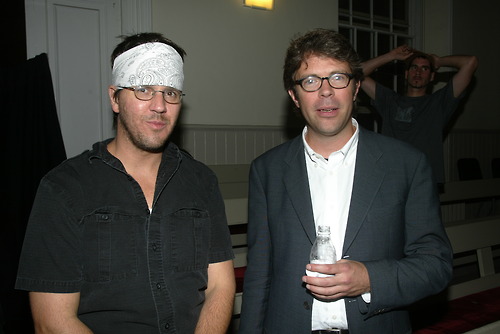
A couple of weeks ago, I replaced my 51-year-old Ego with a much more powerful Post-Dave Died of Boredom Hubris. Needless to say, I was impressed with how far my haughtiness had advanced in three years. But it wasn’t enough to have been on the cover of Time Magazine. Because I had been wrongfully denied every major award (Pulitzer, National Book Award, NBCC) for my latest novel, it became necessarily to diminish my friend’s vastly superior talent by writing a self-serving essay about him in The New Yorker and by delivering a commencement speech here at Kenyon — the very same locale that my friend had delivered a poignant and deeply humanist speech six years earlier.

I was infatuated with my new device. My Hubris was so big that I knew I wouldn’t die from boredom. I could undermine anyone I wanted — the women whose love for writing (and reading) I had destroyed; my troubled writer friend who had committed suicide; even the very audience I speak before now. After all, you’ll believe just about everything I have to say without question. Yet like Keith Gessen’s All the Sad Young Literary Men, you all make me want to be young and miserable again. I’d been similarly infatuated with the old device, of course. I’d authored a volume of essays called How to Be Alone, in which I wrote, without irony, “What I really want from a sidewalk is that people see me and let themselves be seen, but even this modest ideal is thwarted by cell-phone users and their unwelcome privacy. They say things like, ‘Should we have couscous with that?’ and ‘I’m on my way to Blockbuster.'” The nerve of these troglodytes! Why didn’t they look up from their cell phones and bask in my Franzenness? Toward the end of its run, I had some doubts about my Ego’s efficacy (and that’s Ego, not Egan; if I catch you with a copy of A Visit from the Goon Squad in your hands, I will write a 3,000 word essay about how much I despise you), until I’d finally had to admit that I’d outgrown the relationship. I now required levels of pomposity and navel gazing that rivaled the size of a massive continent on an undiscovered planet, but that general readers might interpret as meaningful.

Do I need to point out that my relationship with humanity was entirely one-sided? That I don’t really give a flying fuck about whether anything I say may be wrong or misguided or inconsiderate or socially clueless or needlessly reductionist (especially since I’m essentially cannibalizing the best bits from Dave’s 2005 speech)? Let me point it out anyway.

Let me further point out how the word “sexy” is almost never used to describe late-model Franzen androids; and how the extremely selfish things that we can do now with these gadgets — like impelling people to believe that superficial speeches such as this one possess profound insight into The Way We Live (the way I had once looked to Paula Fox’s fiction as how-to manuals) — would have looked to everyday people like the actions of a self-serving and inconsiderate asshole finding himself at the opposing end of a fist were he to say such words and pull such shit in a bar.

Let me toss out the idea that I would not be here, and I would not have sold as many books as I have, were it not for the very vagaries of the media system and the markets I detest. But I will condemn these anyway, even though an adorable video of a cat mother hugging her baby — “liked” by more than 100,000 people in a mere two days — willfully demonstrates that people are willing to feel something online outside the capitalist nexus.

It may seem a bit hypocritical and short-sighted for me to suggest, finally, that the world of techno-consumerism is therefore troubled by real love. But I saw this movie Catfish the other night and needed to cleanse myself the next morning with a hearty dose of birdwatching, a hobby I valued above all else because it attracted so many people with Asperger’s and everyone had the decency not to talk. Anwway, techno-consumerism represents everything I loathe about the Internet, and I feel far too comfortable cleaving to my inflexibly prejudicial perceptions to change my mind.

You can all supply your own favorite, most nauseating examples of the commodification of love. But I won’t listen to them. Because the only thing I care about are my examples.

I will also complain about Facebook, despite the fact that if you wanted to read my last New Yorker essay you were forced to become “a fan” of The New Yorker. Perhaps my limitless enmity for Facebook has something to do with this. But I shall not be transparent with you. It is clear that you did not love The New Yorker or me. You heard that this piece was making the rounds, became a fan because it was the only option outside of rightfully coughing up the subscription or newsstand money, and I learned later that some of you hated it. I now declare you all soulless consumer scum.

The big risk here, of course, is rejection. We can handle being disliked now and then, because there’s such an infinitely great number of people who will buy our books. Even some of the happy little people who watch Oprah and who I now can’t slander because I decided to appear on her show and because I enjoy taking the money. The prospect of pain is generally compensated by that of financial gain. It’s best to avoid a serious consideration of these morally conflicted issues (I am, after all, a passive aggressive) and seek out illusory targets. Besides, don’t false dichotomies go over well before a college crowd?

When I was in college, I was angry and I remained angry. But then a funny thing happened. Somebody told me that people wouldn’t listen to me if I was angry. So I pretended not to be angry and strive now to be thoughtful, even though thinking about my speech for about five minutes will reveal the sad deficiencies under the hood. And here’s where a curious paradox emerged. My anger and pain and fear only increased when I discovered wild birds. I learned to pretend that I didn’t feel this way about people. I fooled myself into thinking that people only relate to each other in terms of competition, even though I’m telling you from the dais that it’s all about love. And it became easier to live with my anger and pain and fear because I shifted the burden to lower life forms rather than live with feeble souls who talked on their cell phones on the sidewalk. I am Jonathan Franzen. I shouldn’t have to live with anybody other than an extremely limited set fulfilling my ridiculous and entirely unreasonable criteria for Being a Good Human. On this point, I am worse than Woody Allen.

When you stay in your room in the Upper East Side, as I did for many years, you eventually write speeches such as this one. And when you put yourself in front of real people, there’s a very real danger that you think you know what you’re talking about.

And who knows what might happen to you then?

P.S. Please buy my books. And whatever you do, don’t click the “Like” button below this adaptation from a commencement speech. It is important to understand that some actions are consumerist and cowardly, and some are not when they benefit me.
BEA 2011: Seven Years of Google Books

Seven Years of Google Books: The Next Chapter
Presenter: James Crawford, Engineering Director, Google Books

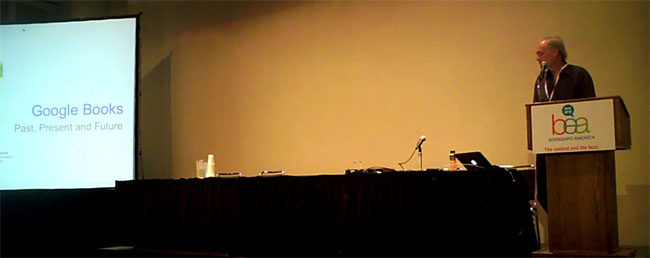
On Thursday morning, a crowd of forty, sprouting into about seventy as the aspirin and hangover cures kicked in, listened to a engineer with a Spartan mien. Like many crunchers from Mountain View, James Crawford had the warmth and physique of an Eames lounge chair. He liked to explain things. He was confident he knew all the answers. He did, after all, work at Google.

“Google’s mission was and continues to be to organize information and make it accessible,” said Crawford early in his run. There were many sentences phrased like that. Had I known Crawford was going to speak like this, I would never have imbibed so much gratis scotch the night before.

The sense I got was that Crawford had delivered this speech many times. He ran down the stats. More than 15 million books had been scanned. That’s over 5 billion pages and 2 trillion words in 478 languages (including three books in Klingon, 82 titles in Kalaallisut, and none in Kutenal), with the earliest going back to 1473. Library partners include Stanford and the University of Michigan.

“For a lot of these books, we can simply chop off the spine and scan the pages.” For a moment, I feared that Crawford was some digital Robespierre who had recently discovered the guillotine. But I was reassured when Crawford pointed out that Google was “required to scan nondestructively.” Thank goodness for libraries and their preservation policies. To accomplish this scanning, Google holds the books down with cradles. The images are then put “through fairly sophisticated series of image algorithms,” with the curve of the pages flattened through software. Every word on the page is indexed. There is also a system of ranking algorithms to ensure, for example, that the right Hamlet rises to the top.

Crawford pointed out a “cluster problem” with the metadata. If you go to the Library of Congress, The Fellowship of the Ring (listed this way in Books in Print) will be listed as “Lord of the Rings, Vol. 1.” And J.R.R. Tolkien will be listed as “John Ronald Reuel Tolkien.”

But the biggest problem was, by far, digital rights. There are three million books in the public domain: those published before 1928. “So they’re not exactly the latest and greatest pageturners,” said Crawford, who revealed himself with such statements to be more interested in digitizing books rather than reading them. Less than a million books have clear ownership. Two and a half million books are available though partnership programs with publishers. “And then there’s all the rest in the middle: out of print but under copyright.”

The Google eBookstore, launched in December, aims to fix some of these problems. “We view the ebook as a thing you purchased,” said Crawford. “Once you’ve bought it, we feel you should read it on any device.” But what about the device known as the printed book? Crawford didn’t mention this. He was on a roll.

“We have the only really serious web reader in the business,” boasted Crawford. And it suddenly occurred to me that Crawford was referring to these Google tools as “an ebook ecosystem.” This seemed a bit Napoleonic to me, almost like insisting that one automobile plant was singlehandedly responsible for the car industry.

Crawford also brought up Google Cloud Sync, which collected a surprising amount of personal information. “We have in the cloud both the content of the book and we store the databases of what people have bought and what pages you are reading on.” In other words, if you shop at Google, they know all the books that you’ve bought. Crawford didn’t specify the degree to which this information is shared to other vendors. But he did point out that retailers had much of this intel at their disposal.

I was also troubled by Google’s tendency to dictate to the market what it wanted. “We want to help the independent bookstores do well in the digital age and not be hurt by digital.” Now I happen to share Google’s view that bringing in independent bookstores into its eBookstore is one method of preserving independent business. On the other hand, why should Google decide what’s right? Isn’t that the job of the FTC or an antitrust legislator? And what’s not to suggest that the Google eBookstore could prove harmful towards independent bookstores? On Tuesday, Tom Turvey — another Google Books representative — had said that he had “some of his best engineers working” on the experience of replicating a bookstore. Google may say that they are trying to help the indies now. But what’s to stop them from changing their policy if the books market shifts direction? This affiliate program for this is presently invitation only, but there are plans to open it up.

Crawford also revealed how libraries, faced with limited budgets, had relied on Google’s viewer for electronic versions of books. “They can take our viewer and put it on their website.” I don’t think it occurred to many in the crowd that commingling public and private resources may not necessarily be the most ethical solution. Wasn’t it vaguely predatory? Such questions had led the European Union to develop Europeana.

Crawford pointed out that many books published in the 16th and the 17th century were now available through Google in full color. But I was dubious when he said, “You can see them as if you’re the librarian.” Until we are able to touch these tomes, this statement will never be true. When Crawford brought up L. Frank Baum’s The Wonderful Wizard of Oz, observing “there are all these chapters that didn’t make it into the movie,” it was evident that he was on boilerplate and had not tailored his speech too much for the publishing crowd.

Google had recently signed an agreement with Hachette to work together on out-of-print titles in France. This would be the model for further uplift contracts. Google had also been experimenting with maps for books. Crawford brought up this interactive map for Around the World in Eighty Days. Google Books has also been used to chart how irregular verbs turn regular over time (e.g., “spoilt” transforming into “spoiled”) and, of course, the infamous Ngram Viewer, in which you can (for example) compare “The United States is” against “The United States are” over the course of time. But Crawford was disingenuous when he suggested that the dropoff of books referencing the start of a decade (as seen through the Ngram viewer) demonstrated “scientifically” that memories are getting shorter. Before making such a statement, one must account for the number of books published over the years, the speed of life in 1900 vs. the speed of life in subsequent decades, and any number of independent variables. Unfortunately, that kind of rigorous consideration isn’t always compatible with a slick Powerpoint presentation that must be delivered in nanoseconds.

Crawford also had a rather naive faith in international titles. One of his slides championed how “cross-boarder [sic] sales increased access to content,” but didn’t account for the territorial restrictions that Andrew Savikas and Evan Schnittman duked it out over on Tuesday. “As long as the publisher has worldwide rights,” said Crawford, “they should be able to move around the world.” Right. As long as I wake up tomorrow with wings on my back, I’ll be able to fly. In other words, that qualifier was a big if. If this was the type of vision that Google Books was promulgating, I wondered if Crawford’s work was clunkier and less state of the art than he realized.

BEA 2011: Deadbeat Dorchester Coughs Up Funds for Booth, Won’t Provide Answers

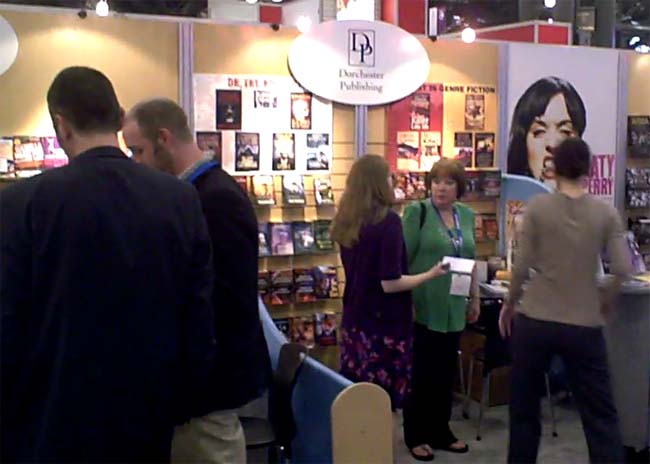
Dorchester Publishing, a company whose track record is so scandalous (refusing to pay authors after years, refusing to abide by contracts, selling ebook titles it doesn’t have the rights to) that it has inspired a boycott, was spotted with a booth at BookExpo America. (See picture above. Booth #4549.)

Many publishing insiders I talked with were surprised that Dorchester had the guts to show up, but expressed a reluctance to confront them on the floor for their negligence — largely because the company, demonstrating its commitment to cowardice, was hiding behind young assistants who were hawking their products. It reminded me of the way very young and very inexperienced soldiers take bullets in the battlefield.

Fortunately, on Thursday morning, I spotted an older woman.

“Who’s in charge here?” I said.

Hannah Wolfson, Marketing and Promotions Coordinator for Dorchester, identified herself and demonstrated the extremely limited nature of her vocabulary.

Why hasn’t Dorchester paid its authors, some of whom have been waiting for years?

“No comment.”

How did you cough up the several thousands of dollars for this booth when that money could have gone to paying off an author? (According to BookExpo America, the bare minimum booth size (100 square feet) costs $3,960.)

“No comment.”

Do you have any comment beyond “no comment”?

Silence.

Okay, how about this? Do you believe Dorchester to be a deadbeat?

“No.”

No elaboration.

I was then told told that Dorchester is maintaining its commitment to paying its authors. I was given no specifics on how this commitment would be upheld.

What about your vendor LibreDigital? You can’t pay them. So they won’t remove ebook titles that Dorchester doesn’t own? (Because authors are struggling, it’s difficult for them to mobilize on the class action front and uphold their rights.)

“No comment.”

“You’re not going to get much beyond ‘no comment,'” said one of the young assistants.

Wolfson than claimed that Robert Anthony, the Dorchester CEO, would be there “this afternoon.”

What time?

“He’ll be here this afternoon.”

As of early Thursday afternoon (with only two more hours to go), Mr. Anthony has not been seen on the Jacob Javits floor. So it looks like Dorchester’s team are liars as well as deadbeats. When a CEO and his minions lack the guts to offer direct answers to vital questions, chances are that they aren’t part of a serious business.

BEA 2011: Interview with Book Country’s Colleen Lindsay

Correspondent: Okay, so I am here with Colleen Lindsay, who has something called Book Country. Which may in fact be a realm or may be something else. Why don’t you tell us about it?

Colleen Lindsay: Let’s see. Book Country is an online writers workshop for writers of genre fiction. Specifically science fiction, fantasy, romance, and thriller.

Correspondent: Well, what can it possibly do for writers and editors and fanboys?

Lindsay: Oooo, fanboys. Fanboys probably will not find a date on Book Country. But they can post their writing on there. What Book Country is for – it’s a safe place for writers to upload portions of their manuscript. Any kind of fiction that they’re writing, as long as it falls into one of our genres. So they can upload flash fiction, short fiction, novellas, short stories, partial chapters, full chapters, full manuscripts. And they can get feedback from their peers. So they’re going to get peer reviewed by other writers. There are industry professionals on there. Agents and editors. Some of them who are there under their own names. Some of whom are incognito. Because they’re also there as writers. And we’re forming a cool little community up there where we’re getting really supportive and constructive feedback.

Correspondent: Well, let me ask you something. Why is the feedback for Book Country better than an MFA workshop or a serious editor who’s going to devote her time really looking over a manuscript? What are the advantages here? Why would someone do this?

Lindsay: It costs zero dollars. (laughs)

Correspondent: Aha! So because you’re willing to give it away, it’s somehow better? You’re going for the free/cheap/discount culture approach?

Lindsay: What we’re hoping to do here is – this is for people who maybe don’t live as close to a metropolitan community as some other writers. If you live in a major metropolitan area, it’s really easy to find a writers community or writers groups. Critique groups, classees, writers conferences. But sometimes if you live out in the middle of nowhere – in the middle of Ohio, in the middle of Dakota – you don’t have access to all of these things. And it would be nice to find a place online where you could get feedback, build community, get support, and hopefully learn to be a better writer. One of the things that we are offering on here – Danielle and I both have many, many years of publishing experience. And we’re on there. We’re hands on all the time. We’re reading things. We’re answering questions in the discussions board. We’re having some published writers in there who are also giving feedback. So they’ve been very helpful. And we see it as a way for some published writers to pay it forward. So that’s one thing that we’re hoping some writers will use. We’re hoping it will be useful for people out in the middle of nowhere.

Correspondent: What makes Book Country different from what Richard Nash is doing with Red Lemonade? Have you actually been in contact with him? Because he also has a community online where people can put their manscripts up and critique them as well. It seems to me that there’s a strange schism because you’re going more genre and Richard Nash is going more literary. Have you considered some sort of collaboration? Have you talked with each other? Have you considered working with each other?

Lindsay: We’ve actually been in contact with Richard and with other communities like figment.com and Wattpad. I think that there’s room for a lot of these different communities. I think that what Richard is doing is, as you said, very different. We are focused on genre fiction, which is not his forte. Although he does have a good track record with some speculative fiction. I think he’s really gearing towards the literary writer, which is something that we don’t have on our site. Also the feedback is a little bit different. With Richard’s site, you can actually go into a manuscript and annotate it by leaving comments. So it’s a different kind of commenting system. Not better, not worse. Just different. Actually, his annotation system on Red Lemonade is really cool. I love playing with it. On our site, it’s more people upload a chapter, you give critique on a particular chapter. You give critiques based on overall feedback. And then the writer who uploads gets to pick two different criteria that they feel they need the most help with. So we give them different criteria to choose from: POV, plot, dialogue, pacing, character development, continuity, setting. And the writer can say, “Well, my character development isn’t great. I can use some help with that.” So they can ask for specific areas of feedback. One thing I wanted to say. I think there’s room for writers to belong to more than one of these communities. Because I think that it’s always good to build more community. And it can’t hurt to get different feedback than the feedback that you’re getting.

BEA 2011 — Michael Moore

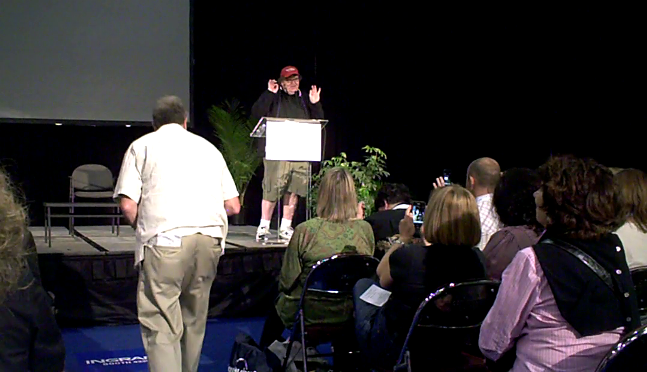
A somewhat trashed Michael Moore arrived ten minutes late for his Wednesday morning “signature event” (“a unique new opportunity here,” according to the man who introduced him, who also declared that Moore “forces us to react”) at BookExpo America. Moore, dressed in a red baseball cap and green cargo shorts, began his presentation by offering tepid yet crowd-pleasing quips about the Republicans cutting the Veterans Administration, eliminating traffic lights, and getting rid of kittens.

“Enough picking on them,” said Moore. “They’ve got a rough road ahead of them.” He then continued with a lot of football metaphors for the audience, which didn’t really look like sports enthusiasts. “I was saying last night, you know, they caught this great pass back in November and they started running in the opposite direction back on the football field away from their goal!”

It appeared that Moore didn’t quite understand the type of audience that comes to BEA.

“I assume most of you work in bookstores?” uptalked Moore. “The librarians are here?” When a handful of teachers responded to his Catskills act, he replied, “Some teachers? Oh great. Of course teachers are to blame for everything. All the money that they’re taking from us.”

Then having secured a low-key audience, Moore announced his new book, Here Comes Trouble: Stories From My Life, due out in September. The book, a collection of two dozen short stories (“but they’re all nonfiction”), chronicles Moore’s life before Roger & Me.

“There’s a short story about getting lost inside the Capitol building at eleven years old,” said Moore. “I didn’t see the sign that said SENATORS ONLY.” A man reading a newspaper — who turned out to be Robert Kennedy — helped Moore find his parents that day.

Another story involves Moore asking his parents if he could leave home at fourteen. “I said I wanted to be a priest. So I went to the seminary at fourteen years old.” Moore explained that the story allowed him to investigate his Catholicism.

“There’s a whole bunch of things like that,” said Moore. “I found myself present at a terrorist incident in the 1980s.” That incident allowed Moore to “write about what it’s like to actually be present at one of those terrorist incidents and live.”

The book, continued Moore with his masterful aw-shucks put on, “explains how I got to be where I got.” Yet he never explained how any of his stories, which also concern how he hired many ex-Navy SEALS for his security detail, would be of value to someone who was unemployed or trying to pay off a subprime loan. Moore reported that the stories were “interesting and wild. Some are funny and not so funny.”

Moore than read an excerpt from his book (and most of his presentation time was devoted to this). The excerpt recreated his infamous night at the 2003 Academy Awards. “It’s weird,” said Moore in the middle of reading. “It’s the first time I’ve read those words out loud since that night.”

Moore’s excerpt revealed that Moore was convinced that he had let everybody down. “I ruined their night and I suddenly sunk into a pit of despair,” read Moore. But there was more than a hint of self-aggrandizement in his excerpt. “People stepped away from me for fear that their picture would be taken.” This correspondent had to wonder if other people considered Moore to be as important as he clearly thought himself to be. Moore noted that film studio executive Sherry Lansing came up to him and said, “It hurts now. Someday you’ll be right. I’m so proud of you.” Moore’s excerpt revealed that he “believed they were right. I got to listen to more boos over the next 24 hours. Going through the hotel. Walking through the airport.”

But Moore’s excerpt was disingenuous. Because he failed to observe that when you say something outrageous and/or contrarian before a large crowd, they’re not exactly going to welcome you in open arms. When he returned home from the Oscars ceremony, he saw signs tacked up on his property.

“It was time to call in the Navy SEALS,” Moore read with typical subtlety. Moore explained that he had hired a security group composed of former SEALS, that he had been assaulted and people had tried to assault him, and that one person had tried to blow up his house. “The SEALS basically saved me and kept me alive.”

Kept Moore alive? Moore has certainly said and filmed many brave and provocative moments in his career. But I wasn’t quite sold on his pity act. Perhaps there’s an additional moment in his forthcoming book in which he comes to terms with the fact that he’s a loudmouth. But that pivotal introspection and unapologetic acceptance of his nature seemed to be missing.

This discrepancy proved especially troubling when Moore painted two of his enemies as obsequious types seeking an apology. One guy who called him a “shithead” allegedly recanted. “I told him that we had more in common than not. Eventually I got a smile from him.” Another man working the boom mike on The Tonight Show approached Moore shortly after his guest appearance. He had apparently yelled “Asshole” at the Oscars. According to Moore, this man had tears in his eyes and said, “I never thought I’d see you again. I can’t believe I’d get the chance to apologize to you.” “You did nothing wrong,” replied Moore. “You believed your President. You’re supposed to believe your President. If we can’t expect that as the minimum in office, then we’re doomed.”

To turn Moore’s logic around, if we can’t expect the filmmaker to consider that there may be problems with his approach and that not all of humanity will bow in sycophantic deference, then perhaps his book project is a doomed prospect for anybody who disagrees with his politics or his methods.

When he finished reading, there was a loud applause.

“That was really cool,” said Moore. “I got to do this for the first time.” Moore didn’t thank the crowd.