The Bat Segundo Show: Eduardo Porter

Eduardo Porter appeared on The Bat Segundo Show #381. He is most recently the author of The Price of Everything.

Condition of Mr. Segundo: Shopping for a new religion.

Author: Eduardo Porter

Subjects Discussed: Faith and the Pascalian wager, whether or not Americans perceive faith in fair prices, the idea of a price embodying the making of a thing, Marx and labor, how our understanding of prices is a function of transaction, worker exploitation, Dan Ariely and behavioral economics, “buying a sense of our own goodness,” tipping in Japan, Porter being needlessly concerned with the price of a Los Angeles condo he sold years earlier, new economic frontiers without speculative bubbles, Robert C. Wright and predicting bubbles, Keynesian beauty contests, orange juice and the weather, derivatives and probability, the inability to separate legitimate bubbles with sham bubbles, subprimes and low interest rates, John Rawls and society maximizing the well-being of the least fortunate, the extension of the Bush tax cuts for the wealthy, ephemeral jobs and speculative bubbles, unfair income redistribution and prices, diversity and labor, William Julius Wilson, Sir Nicholas Stern’s idea of the wealth of the individual remaining steady throughout the years vs. human life as priceless, the 9/11 Commission and Kenneth Feinberg’s compensation discrepancy, anti-egalitarianism, competing subjective viewpoints about the price of a life, economic consequences that emerge from changing a speed limit, the value of a person toiling in a maquiladora vs. the value of Clive Owen, connections between pricing and elitism, time and the value of human life, France’s price on Haiti, and the colonialist implications of price.

EXCERPT FROM SHOW:

Porter: In the mid-1990s, a study by the Intergovernmental Panel on Climate Change tried to come up with an early estimate of the economic impact of global warming. And to do this, it used some of these estimates of the value of life. And it decided that the value of life in poor countries was $150,000 and in rich countries $1.5 million. Now you can imagine that didn’t go down very well at an international meeting with rich and poor countries. I mean, this was a rebellion. “What do you mean?” So if rising seas are going to wipe out Bangladesh, it’s cheap. But if something is going to happen in Switzerland, then we really have to worry. So ultimately, at the end of the day, they came to a political compromise. And they redid this, valuing everybody at $1 million.

Correspondent: But on the other hand, for the sake of argument, if you have some central authority making such an insensitive statement — that a person born in one country is worth less than someone born in an industrialized nation — wouldn’t that open up the fact that we’re all living within unseen disparities? That the value of someone toiling right now in a maquiladora or an export processing zone is, we all know, worth less than the life of President Obama. Or the life of actor Clive Owen, who is probably worth more than either of us ever will be.

Porter: Well, yes. This is a manifestation of the inequities in life. That it’s just a replication after death of a very unequal distribution of opportunities and rewards. That’s true.

Correspondent: Well then. If pricing essentially confirms that, it’s almost as if pricing confirms an Ortega y Gasset-like notion of elitism. That really what we’re denying in denying these crude and cold and insensitive prices is denying the inherent elitist nature of the capitalist system that we live by in this purported democracy that you, in the book, actually uphold.

Porter: I would say that that’s essentially correct. I mean, capitalism is not an equal society. And I don’t think it can work as an equal society. Disparities are what steer resources to be allocated into one place or another. Pay differentials lead people to take one choice rather than another. To move into one job or another. To get one type of education or another. So the idea that everybody must be paid equal is, I don’t think, functional. It does not function within a capitalistic society. If you’re asking for my opinion on the ultimate — I don’t want to use the word “justice.” If you’re asking for my opinion on whether this is an ideal way to live, I would tell you no. But it’s because of the depth of the disparity. Not because of its existence. I will agree that disparities will exist. I have a problem with the size of them.

Correspondent: You mention Bangladesh earlier. And this is in relation to climate change. William Nordhaus’s idea that in estimating future damages, we need to use a rate that reflects the productivity of long-term investments. Then of course, you’ve got Sir Nicholas Stern’s idea: “The welfare of a person hundreds of years from now is worth the same as as the welfare of someone alive today.” And of course, not everybody can agree on that either. Now we’re adding time to this. Even more problems. If you were to look at the history of Haiti, you see France in 1825 — they don’t wish to recognize Haiti’s sovereignty unless Haiti paid them 150 million gold francs. Haiti, of course, couldn’t pay back the money until 1947. And they had to take up long-term interest loans.

Porter: That’s incredible.

Correspondent: This is the ultimate in a big joke about price. Haiti wanted to be recognized as a nation and they have to pay this considerable amount of money. So this leads me to wonder if price — I seem to think, particularly after this conversation — is a huge mess that creates ever more problems about other viewpoints, other peoples, and simply existing. The more we think about the way money is attached to an individual person, the more we realize that certain systematic norms cause the person to be trivial. I think that’s rather sad.

Porter: The thing is that here we’re moving between senses of price that are really kind of unrelated. The purchase of Haiti’s independence, I think, has very little to do with capitalism. It has more to do with colonialism.

Correspondent: Capitalism could be argued as a strand.

Porter: But this deal could have been made outside of a capitalistic society. This deal is not a function of capitalism. It is a function of the fact that one country controlled another and would not relinquish it unless getting something in return. And in fact, this has been a characteristic of colonialism way back into pre-capitalistic times. I wonder whether you’re not attributing too much significance to the idea of price as an ultimate driver of things that functions throughout history. And always in the same way. It seems to me that when you’re talking about the price of Haiti or the price of gas or the price of milk, the processes that you’re describing, with which you arrive at this ultimate variable of price, are totally different. And the transactions that are involved are totally different. And so yes, they’re all prices of course. But I’m not sure that they’re comparable. They seem a little bit like apples to oranges.

Correspondent: Even though price has a serious consequence upon a human life in some capacity, you’re saying that it’s best to look at price in terms of who sets the price and the consequence? I think I’m looking at it consequentially and you’re looking at it from a causist standpoint.

Porter: Well, yeah. But consequentially. Let’s say clothes have enormous consequences. Lack of clothes have enormous consequences. The fact that having or not having the appropriate clothes for the appropriate weather is consequential. I’m not sure that that allows me to go any further in trying to tell me anything about the dynamic underlying clothes or the goodness of clothes. They are consequential. Sure.

The Bat Segundo Show #381: Eduardo Porter (Download MP3)

This text will be replaced

Review: We Are What We Are (2010)

Last March, the intrepid crew behind The Barnes & Noble Review asked me to watch an extraordinary number of cannibal movies within a very short period of time. This exercise resulted in a rather pleasant throbbing in the head, a need for lengthy perambulation after all this sensory overload, a momentary recalibration of my carnivorous intake to ensure that I could sustain my passion for carne asada after seeing so many (virtual) people eaten, and this essay, in which I revealed that a cinematic genre of apparent last resort had more going for it than some of the humorless film snobs had suggested. One of the genre’s key touchstones, Ruggero Deodato’s Cannibal Holocaust (1980), dared to balance bona-fide animal slaughter with the juicy theater of people having each other for dinner. And many of Deodato’s followers carried on in this bountiful spirit of authenticity, with film crews and fake books offering heft to all the baleful gustation. While mainstream cinema continues to remain comfortable with the removed feel of zombies, a decidedly more class-conscious approach to cannibalism in which one has to be bitten (a lack of personal responsibility? just one of the common rabble?) to give into these baser impulses, one wonders if we will see more knowing acts of cannibalism in multiplexes. Despite the fact that human beings are very often kind and noble, don’t we all have the capacity to be savage and vicious? And does not cannibalism offer us the most ideal narrative framework to oscillate between these two extremes? Is this not fun for the whole family?

Since money remains one of the dominant reasons that movies are made, the recent success of two Texas Chainsaw Massacre movies (a reboot that netted a $150 million worldwide gross) suggests this to be likely. But forget these crass men with the moneybags. Jorge Michel Grau’s We Are What We Are offers an unexpected alternative route for the cannibal movie’s future.

What’s quite interesting about this moody offering is that we see very few acts of chopping and cannibalism on screen. Some onyx bile regurgitated in the early minutes upon a shopping pavilion’s tile (and, with mordant wit, mopped up within minutes after the dead man is dragged away). A good deal of punching. (If you live among a family of cannibals and your dad has been dragging in a fresh body for a nightly ritual and you’re wondering when dad will kick the bucket so that you can be the paterfamilias, then it makes perfect sense that you would develop a few thuggish attempts at rabbit punches, testing them out on obnoxious guys who are trying to reclaim their broken watches.) Clumsy efforts to grab vagrant kids from beneath overpasses.

But cannibalism? Not until the very end.

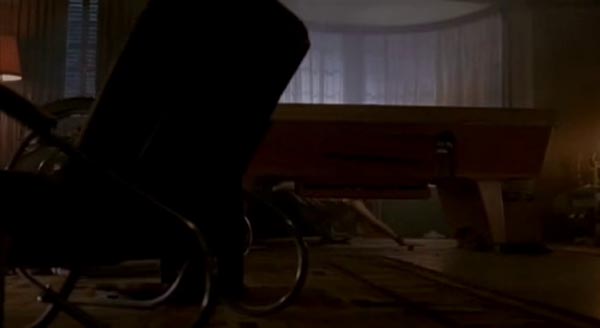
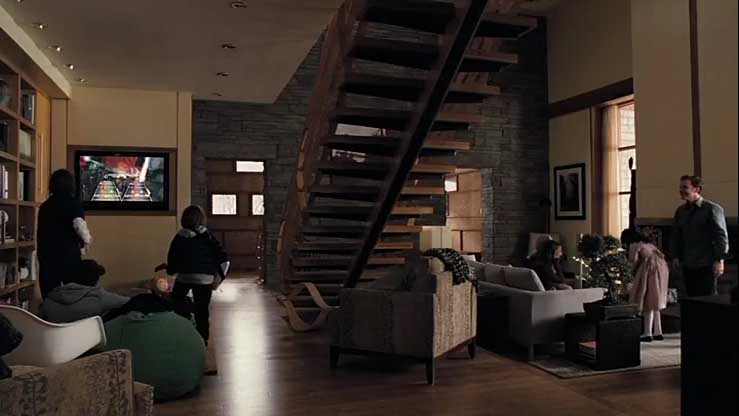
I have to confess that I experienced some impatience in the film’s first hour, waiting eagerly for the dependable imagery of molars grinding human flesh and strings of meat being ripped from a flailing torso. The chops of the axe. The screams. All this reassures me! But I must greatly commend Grau for making me wait. It takes some serious guts to serve up a cannibal film prioritizing atmosphere over grindhouse. Grau is very good about balancing the frame, often pushing his subjects to the hard left or right (or occupying certain sectors in groups: see the above still) and leaving a dismaying blankness reflecting their empty future (and perhaps their empty bellies!). His interiors are often saturated with sickly shades of green, with a goopy Gordon Willis-like approach giving the movie a surprisingly dignified mien amidst all the dinginess.

The family business, as I intimated earlier, is the dying art of watchmaking. Dad, dead within the first few minutes, has been earning the bread by heading to a street vendor market and chomping on whores during his lunch hour. So there’s something of an Old World masculine vibe here. The film is often nebulous about how this strange system of providing for the family, of putting food on the table and so forth, works out. It’s implied that Dad has been providing fresh bodies, but are these bodies Dad’s whores? Mom seems to know about Dad’s whoring around, but she is strangely furious at her two boys for picking up the slack. The exact nature of the “ritual” is never entirely spelled out in the first hour. But when it is revealed, it’s somewhat of a predictable letdown.

Indeed, one frustrating aspect of Grau’s film is its behavioral incoherence. Grau has plenty of enticing visuals in his cinematic entrepot: a brother and a sister looking out the window, their entire forms beneath the drapes, as if protecting themselves from the unseen barbaric activities unfolding within; the ominous ticking of the clocks; the false sanctuary of a bathroom. But when it comes to synthesizing these visuals into character motivation, it often doesn’t pay off. Take, for example, a fifth-rate cop investigating a rash of disappearances and having some clue that will bring him to the family. This character is initially interesting in his drive for cash and his need to be famous, serving as a savage parallel in the “real” world to the “unreal” rituals in the family home. But when he is tempted too easily by an underage prostitute, these early impulses are flattened into your typical corrupt cop archetype. Or consider the sexual confusion of one of the sons when he ventures into a gay nightclub, initially distressed by some pickup grabbing him around the neck and making out with him. The son then attempts to corral his sexual ambiguity with his eating ambiguity, and his additional ambiguity over whether or not he has what it takes to take over as head of the family. Another fascinating parallel, right? Again, Grau throws this intrigue away by presenting this behavior, but not wishing to pursue its dimensions.

Of course, when one looks at the film’s title, this may be part of the point. Perhaps the audience is meant to reckon with bad behavior with only superficial context, thus stubbing out judgment before it can bury its barnacles into our being. But if you have the chops to present a subhuman impulse with visual nuance, why stop there? I’m definitely going to keep my eye out for Jorge Michel Grau’s work in the future. But I hope he has the courage to be more than what he thinks he is.

The Bat Segundo Show: Toby Ball

Toby Ball appeared on The Bat Segundo Show #380. He is most recently the author of The Vaults.

Condition of Mr. Segundo: Spilling green ink all over the public records.

Author: Toby Ball

Subjects Discussed: The descriptive connection between sound and voice, Ball’s background in teaching, envisioning a scene before writing it, devising a 1935 parallel universe, alternative forms of photography, prethinking information technology, children who intrude upon the conversation and ask about the microphones, telling an old-fashioned pulp yarn, the Berlin Document Center, the Nora chapters as placeholders within The Vaults, the frantic qualities of pulp literature, characters locked in location, Hard Case Crime, Nicholson Baker’s Room Temperature, detecting another person’s typing from observing the strokes, keylogging, Suge Knight as inspiration, the Anti-Subversive Unit inspired by 9/11 propaganda, designing a three book arc, Philip K. Dick’s The Man in the High Castle, marijuana cigarettes, Hearst and the criminalization of marijuana, mentioning alternative countries (Poland, et al.) instead of the key players in World War II, the city as physical space, ideological information, character life that comes from specific limitations in vernacular, turning a preexisting rumor into narrative fodder, working at Congressional Quarterly, Red Henry’s mistress reading Nietzsche, and tight consequential corners.

EXCERPT FROM SHOW:

Correspondent: It is interesting how the voice — somebody’s voice — tends to be imposing. More so than the bigness of Big Henry and the like. It’s very interesting to me that sound seems to be the linchpin. Particularly because the technology in this book is rather interesting. I mean, here we are roughly around 1935. A little parallel universe. And we don’t really have motion pictures. We have some possible version of photography with the replacement system that comes in the Vaults. And that’s why it is very interesting to me why sound is such an important quality. It’s almost as if sound in your world matters more than image to a large degree.

Ball: That’s an interesting idea. And I think a lot of the book is about information. Both the information that is overt and then there’s a certain amount of information that has to be gleaned from other pieces of information. And I think that the idea that people can assert powers in ways other than the physical or through violence or through having political power or whatever sometimes comes through. Certainly with your ability to dominate things vocally. Maybe not even verbally. You don’t have to necessarily have a great way with words. But if you can take up more space around you than the other person to serve as an alpha male thing, I guess.

Correspondent: Well, did you prethink any of the technology in the book? Or for that matter any of the history? We do have allusions to the Great War. We also have the Birthday Party Massacre, which is both a funny and a grisly idea. And it makes me wonder whether you had any masterplan for this alternative history or you were inventing things and filling in the gaps as you went along?

Ball: Well, what I was most interested in, I think, was how do you organize information. And because of that, it had to be before a certain period. Say the 1960s. And moving it back to the ’30s and combining it with these ideas we have about the ’20s and ’30s gangs, and things like that, I think that that was the first step in doing it. But I also wanted to create a complicated and…

[Two children walk up to the table and start staring intently at the microphones.]

Child #1: Where did you get that?

Correspondent: Well, hi.

Ball: Hi.

Correspondent: There’s a…

Ball: The microphones?

Correspondent: Yes, the microphones. You can get these microphones at just about any audio place. We have a child here who’s decided to…(laughs). Hi. What’s your name?

Child #2: (more aggressively) Where’d you get that?

Correspondent: Well, we got these through — I got these through an audio supplier. So.

Ball: Pretty cool.

Correspondent: But anyway, you were saying?

Ball: Well…

Correspondent: We have an audience. (laughs)

Ball: We have an audience of two. So from there, while I kind of wrote and sort of developed some more things I was interested in writing about, I think that’s where things kind of move on. What’s the importance of having accurate information? What’s the value of that? What can you get by taking discreet facts? And simply by organizing them, by insuring their purity, how does that in itself become information? And to try and combine that with — you know, I think there’s a certain fun aspect to the ’20s and ’30s. Where you can get this noir-y feel abut things. To a certain extent, the book has to be fun too. You have to want to read it, and the atmosphere, and things like that. Does that kind of answer your question?

Correspondent: It sort of does. I think what I’m also kind of curious about — since you are talking about information as a starting point, when did you drift off this focus on information and more into just telling a good old-fashioned pulp yarn?

Child #1: (still enraptured by microphones) Do those really work?

Correspondent: Yes, they do.

Ball: Yup, they work.

The Bat Segundo Show #380: Toby Ball (Download MP3)

This text will be replaced

Review: Certifiably Jonathan (2007)

Jonathan Winters has an inviting interstate of a pure American face etched in pure pouches and clover dimples that, aside from the inevitable swelling of age, has changed very little in the past fifty years. He conveys jokes with the deceptively leisurely delivery of your grandfather telling you a tall tale. These two qualities, also shared by the great actor Walter Matthau, may have taken you far as a comedian or a light entertainment actor in the 1950s or the 1960s. But the 21st century’s less elastic notions of masculinity and comedy no longer allow for such talents to persevere.

This is a great shame. Because James David Pasternak’s flawed but fairly entertaining mockumentary Certifiably Jonathan (only just being released in New York, despite being in the can for four years) shows that the old man still has it.

The film opens with Winters sitting in a makeup chair, preparing for a talk show appearance. He asks the makeup lady how long she’s been married. “Twenty years,” she replies. “Well,” Winters improvises, “there’s no sense in getting out if you’ve been in that long. It’s a disease that doesn’t go away.”

Now if you laugh at that answer (and I certainly did), you’re probably over the age of 35 and you’re probably going to enjoy Pasternak’s little movie for what it is. While Certifiably Jonathan makes several disastrous attempts at low-rent improvisational Curb Your Enthusiasm-style scenes featuring Winters refusing to leave Jeffrey Tambor’s home, Winters golfing with Ryan Stiles, Winters with Sarah Silverman at the video store, and every member of the Arquette family who has ever worked in the acting business, it does succeed as a somewhat accidental chronicle of changes in contemporary comedy.

Winters, incidentally, was married to Eileen Schauder for 61 years (until her death in 2009). She’s seen in the film twice: young and dutiful in an archival clip and, in recent years, where she and Winters are sleeping in different rooms. “She snores,” quips Winters, who then commends the many pictures of himself in his room and the fact that they can both appreciate different Presidents this way. Much like his face, Winters’s comedy before the camera is like a familiar friend who hasn’t changed too much over the decades. His wife, on the other hand, wants the cameras to go away by the time Pasternak comes around.

The film’s “story” is about Winters trying to pursue a late-life art career. But as Winters’s website reveals, he’s actually been painting for quite some time. His art, featuring frequent coat hangers and neatly aligned bunches of blunt metaphors, has been making the rounds since the 1970s.

When the film forces Winter to be funny, it is uninteresting. Pasternak, a man who cannot carry a convincing screen moment to save his life, has this obnoxious tendency to want to “act” with Winters. And one greatly wishes that Pasternak had blown his vanity on a midlife crisis Camaro rather than taking the spotlight away from an underrated comedic legend.

What Pasternak does not understand is that Winters is simply funny, and especially funny when Certifiably Jonathan enlists old television clips. There’s one clip featuring a series of improvisations with a stick that uses the same comic science that Robin Williams famously employed with a pink scarf on Inside the Actors Studio. Both Winters and Williams are funny. But Winters came first. I can’t find the specific Winters clip Pasternak uses on YouTube, but this marvelous clip of Winters monkeying around with a pen and pencil sit should give you an idea just how much debt Williams owes Winters. At one point in the film, Winters confesses that Williams gave him an $8,000 watch as a gift. “He should,” says Winters. “He stole a lot of my material.”

Pasternak does manage to get Williams and Winters together for a number of scenes. But strangely enough, Winters has better chemistry with the tremendously underappreciated Howie Mandel when the two men are running around a Target. The footage appears to have been shot shortly before Mandel sold out to become a game show host (and who can blame him? Mandel almost quit showbiz in 2004), but Mandel squeezes his entire body into a shopping cart and is just as quick with the quips as Winters. These two men want to make each other look good. And that’s what great comedy is about.

Jonathan Winters certainly deserves a first-rate documentary. I don’t think this one entirely cuts the mustard, but better Certifiably something than nothing.

The Bat Segundo Show: Karen Russell

Karen Russell appeared on The Bat Segundo Show #379. She is most recently the author of Swamplandia!

Condition of Mr. Segundo: Wrestling alligators that the mean men left in his motel room.

Author: Karen Russell

Subjects Discussed: How “Ava Wrestles the Alligator” transformed into Swamplandia!, origin stories of characters, expanding and embroidering, the tradition of underworld stories, Dante’s percolating possibilities, heroic kids and their totem animals, the River Styx, the Seven Remaining Houses in Stiltsville, bookmobiles as boats, Kiwi as autodidact versus Ava as experiential learner, siblings as id, ego, and the superego, torturing characters, the risks of diverging from the established text, how Russell arranges her ideas, dealing with the constant froth of ideas, the way that time and space relates to the body, writerly tics, the dangers of the word “limn,” the many alligators named Seth, characters who share names close to the writers Louis Auchincloss and Emily Barton, the health benefits associated with not looking back, sentences ending with exclamation marks, child neglect and the places where protective services can’t reach, the early introductions to Sesame Street, grief and denial, “printing the legend,” the amusement park competition between Swamplandia! and World of Darkness, Adventureland, the scarcity of quirky plots, optimistic delusions and the dangers of uncritical faith, belief in the dead as a fantasy, managing opposing fantastical virtues while finding parallels between Ava and Kiwi, the naivete of employing Max Weber’s values in the contemporary world, egotism and genius, including blanks within sentences, knowing the “music” of your own home phone number, facing the blank page, working with Jordan Pavlin, pop culture in Pavlin-edited novels, and fighting for expletives.

EXCERPT FROM SHOW:

Russell: The sprawl. This mimetic mangrove sprawl! I really got carried away with that place. I loved that setting and could see it so clearly. I wanted to just expand and embroider in a way. My agent and editor suggested that I do some serious paring down to what ends up being the dramatic action with Ava and Ossie. And then that just did not seem the plateau to keep those sisters on. I ended up feeling very frightened for Ossie and Ava, and disturbed about both sisters. And I think at a certain point I decided it was going to be an underworld story. I thought it was going to be this underworld Odyssey. There’s a nice tradition to work in there. (laughs)

Correspondent: Certainly.

Russell: That’s not copyrighted by Persephone.

Correspondent: No lawyers involved.

Russell: (laughs) Yeah, right. Don’t tell the Greeks.

Correspondent: Well, on the other hand, by explicitly referencing the River Styx — as you do about 150, maybe 200 pages into the book — I said to myself as I was reading this, “Oh, why did she have to go ahead and do that?” Because it’s nice to have the reader infer, “Oh!”

Russell: To trust.

Correspondent: “A River Styx-like metaphor.” I’m wondering if, in relying upon a myth like that, there is a danger in being too explicit. On the other hand, a reader can infer almost a Huck Finn-style situation as well.

Russell: Right.

Correspondent: What of this conundrum?

Russell: I really didn’t want it to be a one-to-one correspondence with any one of those stories. Although I’m sure they’re just in our bloodstream. Huck Finn and, as you say, the Odyssey. Dante. I think all of that was definitely percolating. But I think it’s dangerous to say, “Right. This is going to be Hamlet. But in the voice of a parrot!” Any way it reads just as that very direct correspondence.

Correspondent: Yeah. But at some point the decision was made to reference the River Styx.

Russell: Yeah. Well, my thinking there was that Ava, this child, is so glutted on those exact stories. Both the Yearling kinds of tales about heroic kids and their totem animals or whatever, and also the older myths. These older fairy tales. So the River Styx would be something from The Spiritualist Telegraph, which is a book that her sister has found on this wrecked Library Boat. That the kids are autodidacts. They are home-schooled on this island and they go to this wrecked Library Boat to get this magpie view of the reality outside their island. So they do have these piecemeal references coming in. And so much of her vision of the world is by analogy. It’s through the lens of these fairy tales and myths that he’s reading. I didn’t want people — but I do think it’s a danger. I wouldn’t want anyone to think that I’m doing in the octave of the swamp.

Correspondent: Sure.

Russell: Hades.

Correspondent: Well, there is definitely a Stilsville. There’s seven remaining homes. I’m wondering if there was actually a Library Boat system similar to the Bookmobiles. I didn’t get a chance to actually delve into this. I was trying to look around. Because that really captured my imagination.

Russell: No! Wouldn’t that be great?

Correspondent: It would be fantastic!

Russell: What a great idea!

Correspondent: It would make complete sense in an archipelago.

Russell: I’m saying. Get some government funding. I think it would be so wonderful. And I ended up excising a lot of material about in the Library Boat.

Correspondent: Really?

Russell: That didn’t belong. But I thought just because I’m a nerdy bookworm, my god, that would have been my paradise. If there was a wrecked ship full of books. No librarians to nose around what you were reading. You could just take and go. And I love the idea that people would come and leave books. Which, you know, is the system that exists. But there would just be a book with a constantly evolving library.

Correspondent: Add Borges on top of that. Then you’ve got a really interesting idea. (laughs)

Russell: Oh yeah. Get Borges to captain that boat. Seriously.

Correspondent: Well, we got in a bit of a flurry here from the original trajectory. But Kiwi. I’m curious how Kiwi came to life in this. Because he starts off being a side character. And then he becomes, well, this is the other side of the story. And as we pointed out earlier, he’s not in the original story [“Ava Wrestles an Alligator”].

Russell: Right.

Correspondent: Why Kiwi above anybody else? Or rather above Ossie, who just disappears entirely? Because it is interesting that Kiwi is more of an autodidact where Ava is more of an experiential learner.

Russell: That’s beautiful.

Correspondent: And I’m curious about how this came into being.

Russell: Oh, I’m so glad that she reads that way to you. I was thinking the two sisters — you have Ossie, who is the book’s unconscious. I mean, she is totally merged with her idea of herself. This clairvoyant psychic experience. She goes way off the deep end into the occult. And then Ava, I think she’s on a plateau where she hasn’t really committed to any one way of seeing. She’s seduced by this world of the ghosts. But I wanted her to be one more voice, one more force. I almost wanted to think of these three siblings as the superego, the ego, the unconscious almost. Because Kiwi is this hyperarticulate. Self-identifies as a genius. Knows lots of big words, but mispronounces them.

Correspondent: Now, now. Schematic though.

Russell: Thinks meningitis is a compliment. Right. So he has this idea of himself as a really literate, really astute reader. An adult reader of the world. So he is, in many cases, a voice of reason. And I think Ava toggles between these two views. She’s got her brother, her older brother, who’s more rooted in reality. Informed by the mainland. Albeit, also at the same time, stunted and naive. Because he’s grown up on this island forty miles away from the mainland. And then she has this sister, who is this frightening lost character. Sort of deranged character. I don’t know if that answers your question. But I wanted Kiwi because the book really needs a character to work in a more comic register.

Correspondent: To torture. As you did.

Russell: Well, I do in fact torture him?

Correspondent: Yeah.

Russell: Well, I don’t think that I torture him. I think that I just put him in a situation among mainland teenagers and then watch what unfolds.

The Bat Segundo Show #379: Karen Russell (Download MP3)

This text will be replaced