The Bat Segundo Show: Isabel Wilkerson

Isabel Wilkerson appeared on The Bat Segundo Show #366. Ms. Wilkerson is most recently the author of The Warmth of Other Suns.

Condition of Mr. Segundo: Warming up to fascinating history.

Author: Isabel Wilkerson

Subjects Discussed: [List forthcoming]

EXCERPT FROM SHOW:

Correspondent: I wanted to ask about one of the key pieces of conflict relating to the Great Migration that fascinated me. You pointed out that the old timers — meaning the African-Americans who had lived in the northern territory before the Great Migration — were harder on the influx of new African-American migrants moving into the northern areas than almost anybody else. The Chicago Defender has this list of dos and don’ts. The endless articles about what you’re supposed to do as a new migrant. I’m curious. Based on your research, to what degree did this conflict — what effect did this have on the progress that came later in the 1960s? Did this deter efforts at unity? You kind of get into it the book. But I wanted to see if your research led to other areas here.

Wilkerson: I think that it was generally a low-grade competition rivalry — and maybe resentment — that really grew out of fear. It grew out of an insecurity. Because the people who were already there in the North were small in number. They had been pioneers from way back. And they finally established themselves in these often hostile and alienating cities. And their rival of basically country cousins in huge waves to the big cities obviously raised questions for them about what was going to happen to them. What was going to happen to this perfectly balanced, well-honed alchemy that they created with the majority of the people in these big cities. And they felt embarrassed by them. They felt shame. They felt resentment. And they often didn’t want to be around them. I must point out though that, while they were most likely to be resentful of them, and to maybe be sneeringly judgmental of them, they were not the ones who were actually hurting them physically in the same way that others were. I mean, when they moved out into other neighborhoods, when they arrived in these big cities, that was when they might be firebombed. Because they were going into a neighborhood where they were not welcome. So the people who were there, there was more a sort of insider resentment and fear that’s very different. But actually, it’s just as painful to the people who were arriving. Because the people who were arriving were like people arriving from any far away place to a new land that they hoped would be better. And they felt very hurt by that. Very hurt. And it actually limited their ability to move about. They couldn’t join certain churches. So it was an in-group stratification that is kind of an inside baseball thing, but kind of human nature. It’s about survival.

Correspondent: It also seems to me to be about class divide. And that’s one aspect of 20th century black history that we really don’t discuss. Going back to the original question of whether an internal class struggle like this, I mean, did it really have a serious deterrent upon advancement?

Wilkerson: I think it did in the beginning stages. You know, while the people were new and untutored into the ways of the North, the people, they were pretty much rejected and not welcome. Over time, like any immigrant group that’s ever come in — and they were immigrants in the true sense of the word. Because they were born in the United States. They were American citizens. They went to another region in order to realize the rights that they were born to. They essentially acted as any immigrant would. And so they went to the people who were there. And they found that it was difficult to make that adjustment. But once they did make the adjustment, they in turn would become as sneeringly judgmental as the people coming behind them. That’s just the way human beings think.

Correspondent: The retrousse noses.

Wilkerson: Yeah, that’s right. Ultimately though, larger forces would intrude. And as a group, they found themselves all hemmed in by the larger economy that didn’t really want to have them. And I wouldn’t say that it impeded progress to that degree. There were rivalries in every group. I think that it certainly didn’t help. It was very disheartening for people who just arrived. It is. Because you’re rejected by your own people. It’s very painful.

Correspondent: Instead of having a polarization effect. To really fight a lot of the racism that was going down. The firebombing and the Cicero riots.

Wilkerson: Exactly.

Correspondent: Well, this is very interesting. Because you cite this 1965 census survey, in which it was revealed that a lot of the migrants moving in had more education — equal sometimes, but often more education — than the native white Northeners.

Wilkerson: Exactly. Which is astounding. I mean, when I saw that, it was just hard to believe. But part of this is remembering the era that we’re talking about. We’re talking about an era in which many of the people were children of the Depression. And many of them had had hard lives, no matter where they were. Many of them were the children or actual immigrants from other places. So the early part of the 20th century was not a time of great enlightenment overall, unfortunately. So life was hard for everybody. But how ironic, actually, that the people who came up in this Great Migration were actually slightly better educated when it came to the numbers. Now that doesn’t mean that we’re not getting the quality. Because the quality of education in the South was markedly unequal clearly. But they had put in the time. They had gone as far as they could. And then they left finally for hopefully a better life in the North and the West. But it’s interesting that the mythology and the misconceptions about these people. Once I began to discover them, I found that that became a big focus of the work that I hadn’t anticipated.

The Bat Segundo Show #366: Isabel Wilkerson (Download MP3)

This text will be replaced

The Bat Segundo Show: Tom McCarthy II

Tom McCarthy appeared on The Bat Segundo Show #365. He is most recently the author of C. He previously appeared on The Bat Segundo Show #154 and The Bat Segundo Show #155.

Condition of Mr. Segundo: Considering the vital associations between the third letter and the need to sweat.

Author: Tom McCarthy

Subjects Discussed: [List forthcoming]

EXCERPT FROM SHOW:

Correspondent: Tom, how are you doing?

McCarthy: I’m fine. How nice to see you again.

Correspondent: Yes, how nice to see you too. I’ve been advised by you to ask not how you feel.

McCarthy: (laughs)

Correspondent: So now I’m wondering, by asking you how you’re doing, if I’ve betrayed what I’ve just said.

McCarthy: No, no, no. I’m doing a brisk —

Correspondent: Okay.

McCarthy: Briskly.

Correspondent: So we can have at least one bit of small talk. That’s acceptable.

McCarthy: Yeah. (laughs)

Correspondent: Okay. Serge says late in the book that the newspaper headlines have a nice alliterative ring.

McCarthy: Oh yeah. Beaulac bludgeons Mr. Block, bludgeoned in blue Beaulac.

Correspondent: Yes. Similarly, this book — it’s safe to say — that it could be read as a game of monkey see, monkey do. Ecce homo. Insert your bad pun of choice. In a word, there are numerous words beginning with — actually, not in a word, but in several words — there are numerous words that begin with the letter C. Carapace…

McCarthy: Cocaine, cyanide.

Correspondent: Copper, cable, control. You name it. The four parts are named after C. So this leads me to wonder. At what point did this come into being during the course of writing? And I’m wondering if there was a maximum C word count that you established during the course of writing this book. Just to start off here.

McCarthy: It came pretty early. Because the genesis of the book — well, there were several geneses.

Correspondent: Genesii?

McCarthy: Genesii. But one of them was thinking about Carter and Carnarvon, who dug up Tutankhamun. And I knew that a kind of hybrid of those two historical figures was going to be part of — I mean, Serge is a composite of several things. But that’s kind of one part or two parts of it. And so as a marker, I just used the letter C. I said, “Well, Carnarvon. Carter. Let’s just call them C for now.” And it was stuck. I liked the single letter title. It made me think of Sesame Street. You know, how every episode is brought to you by the letter.

Correspondent: C is for cookie.

McCarthy: C is for cookie, right.

Correspondent: But there isn’t a cookie in this.

McCarthy: No, there’s no…there’s no.

Correspondent: You do have cunt at one point.

McCarthy: (laughs) Yeah, that’s true. There was lots of Cs going on. I mean, the caul. With a U. Of the Wolfman. That was where it originally came from. Although quite a few critics later have pointed out that Copperfield — another C.

Correspondent: The Jennifer Egan review.

McCarthy: Yes, of course. And several others. And other people who have pointed out that, when he’s born, not only does he have a caul. But there is a copper being brought to make a transmission field. And I shouldn’t not take credit for it. Because it’s brilliant. But I wasn’t actually thinking of it at the time.

Correspondent: Well, maybe we can establish how much of the riffing on C was subconscious and how much of it was planned.

McCarthy: Yeah. I mean, that’s the thing. I think of it like pinball. You put a certain number of balls up. And then you hope they’re going to hit some buffers. And maybe, if you’re lucky, you may go into multiple modes. When there’s like three of them all going around the ramps and going crazy. But you’re not going to control every collision and every which lighting up of each little mushroom buffer at which point. So yeah, there were some very deliberate throwings out of different Cs. And not just Cs. A whole change in association along different mutating phonemes that’s really what the book is. More than characterization or whatever.

Correspondent: It was your own little bubbling chemical equation, essentially. With lots of Cs.

McCarthy: Yeah, kind of. Exactly. But you know the really exciting thing was when I remembered C as the chemical sign for carbon. Which is the basic element of all life. And it has a kind of proximity to writing, right? White, black. Carbon paper. CCs. Carbon copies.

Correspondent: BCCs.

McCarthy: A BCC and all this kind of stuff. It just seemed right. It started off as a marker and then it became the main thing.

Correspondent: The carbon association then came late in this act of writing.

McCarthy: No, it came early. But not at the outset. I didn’t start out thinking, “Oh, it’s all going to come down to the sign for chemical carbon.” I hadn’t even remembered that C was the chemical sign for carbon. I never did chemistry in school.

Correspondent: And then, of course, the third novel, C.

McCarthy: Yup. And already D figures in the new one. And the next one as well.

The Bat Segundo Show #365: Tom McCarthy II (Download MP3)

This text will be replaced

Review: The Next Three Days (2010)

A Paul Haggis movie inevitably makes you feel like a well-trained parrot who has recently learned to squawk, “Hey hey, ho ho, intolerance has got to go!” Instead of the stale cracker offered as reward, one is asked to sit dutifully through the end credits.

In attempting to understand Paul Haggis’s position in the film world, I’m considering the time-honored Monet chestnut: “People discuss my art and pretend to understand as if it were necessary to understand, when it’s simply necessary to love.” But Paul Haggis’s movies — all containing lack of logic, stock archetypes, and soupy storylines — are altogether too easy to understand. These movies are about as challenging as inking in a TV Guide crossword puzzle. But even the best stupid movies give us very good reasons to love them. By contrast, when The Next Three Days features an early moment (not in Pour Elle, the template for Haggis’s remake) with privileged scum making reductionist statements about gender to prove how “authentic” Haggis is in getting “real” people, it becomes almost effortless not to love it.

The Haggis apologists rebut with Casino Royale and Letters from Iwo Jima (and sometimes the overrated In the Valley of Elah) when presented with the perfectly reasonable observation that the Oscar-winning Crash, with its tawdry caricatures spouting racist sentiments like loutish anchormen reciting whatever is on the Teleprompter (instead of, say, communicating the origin point of a character’s deeply developed atavism through performance), was last decade’s answer to Guess Who’s Coming to Dinner. Haggis may very well be the Stanley Kramer of our time. Like Kramer, he is without subtlety. Like Kramer, his work will not date well. Like Kramer, he preaches to the converted. But there’s something more invidious about Haggis — something that goes beyond Kramer’s redolent earnestness — that I need to pinpoint here.

Casino Royale‘s “gritty” reboot was applied to a well-known and entirely fantastical archetype. Should Haggis really be commended for such ostensible authenticity? James Bond is enjoyable, but he is hardly a Doestoevsky character. (One can likewise make a similar claim about Christopher Nolan’s Batman films. Indeed, Jonathan Lethem did, writing in 2008 that he “couldn’t shake the sense that a morbid incoherence was the movie’s real takeaway, chaotic form its ultimate content.”) Letters from Iwo Jima is rightly considered to be a historical corrective to The Greatest Generation. But might not its cheap flips of the coin be similarly styled “morbid incoherence?” (It’s telling that screenwriter Iris Yamashita was able to interpret Haggis’s cornball situations in another language. American audiences, in turn, get these subtitles for lines that were adjusted from whatever vile banter Haggis brought to the table.) We see World War II from the Japanese side and we’re supposed to believe that the film is down with it because American soldiers incinerate the Japanese with a flamethrower. But what makes this narrative exercise any different from the old Twilight Zone episode, “A Quality of Mercy,” which uses the battleside switcheroo for the purposes of conceptual speculative fiction?

Haggis’s scripts are proud liberal exercises that make me profoundly ashamed to be a progressive. Real progressives don’t wave their fingers at their audience. They don’t bully people into enlightenment or self-awareness. Hell, good people of any political temperament don’t do this. They actually listen to people. They encourage. They plant clues. Accordingly, Haggis’s appropriation of genre tropes for movies that are condescending with their apparent “insight” into humanity makes me profoundly ashamed to be a moviegoer. It isn’t often that I’m so severely disappointed by a film. What the hell. I may as well go a few steps further and suggest that Paul Haggis has no business being declared a realist, a decent filmmaker, or even a worthy screenwriter. He’s using so many old inversion tricks that his films can never competently reflect the real world. When even the critics who like his movies — such as Moveiline‘s Stephanie Zacharek — feel compelled to point out that Haggis “doesn’t seem to know how to establish real couplehood closeness without equating it with hot, unfettered sex,” one detects an “artist” who is hardly curious about people and who is more interested in feeling superior when he sketches the kind of crude character doodles that would get him roundly bitchslapped at an MFA workshop or a bar. Or as Rolling Stone‘s Peter Travers succinctly noted, “It’s damn hard to enjoy a thriller when you don’t, won’t, can’t believe a word of it.”

The Next Three Days is a remake of Pour Elle — a French film that did have a rather unbelievable storyline about a high school teacher trying to spring his wrongfully accused wife from jail. But Pour Elle managed to transcend its melodrama by imbuing its characters with passionate qualities, by making their struggles interesting to us. The Next Three Days is, rather curiously, without such vim and vigor. Pour Elle had the decency to give us carnal intensity from the get-go. With a few simple moments of visual lust established in the beginning, we could understand immediately why Julien Auclert (John Brennan in the remake) would do anything to rescue Lisa (Lara in the remake). But in the Haggis universe, John and Lara have to ask if their kid is asleep before opting to fuck each other blue. And this safe and hackneyed stance, calculated to appeal to unadventurous suburban audiences, is deeply offensive to me as an American. Because the ostensibly straitlaced are, let’s face it, more screwed up than they are willing to admit. But aside from this practical consideration, wouldn’t it be more interesting to have the Brennans screw each other ravenously with their kid awake? With their kid queasily aware at an early age (like many) of how intense his parents are fucking? How’s that for a family dynamic? If Haggis had the balls to play things out like this, then we’d have a far more interesting film. But that ain’t the way Haggis rolls. When it comes to sex, he’s nearly as virginal in his approach as Spielberg. One wonders if Haggis has ever had the guts to live a little on the wild side.

The Next Three Days is also too damn long. A good thirty minutes have been appended to Haggis’s adaption. But why? Pour Elle cut straight to the chase. After Lisa gets arrested, our next shot of her is in prison. Her son Oscar spurns his kisses when he comes to visit with Julien. Lisa asks about some girl from the parking lot. Julien informs his wife that a detective has been looking into this, but it’s been three years. This is near perfect narrative economy that permits us to fill in the gaps. Why would you want to mess with it?

Alas, Paul Haggis has. He’s adjusted a scene with an attorney (played in this remake by Daniel Stern; the attorney was a woman in the original), where John fires him when he reveals the insurmountable evidence against Lara. But in Pour Elle, Julien was more stoic. He is told by his attorney that he has to accept that his wife Lisa is in prison. And he walks away, without any tantrum. Now since we’ve seen Julien in wild lust with his wife earlier in the film, this makes us wonder if Julien’s energy is going to spill somewhere else. It provides a narrative tension that naturally connects with Pour Elle‘s cinematic momentum. But in the Haggis version, John is a passive guy prone to occasional outbursts that are more the result of convoluted plot advancement. In other words, where French writer-director Fred Cavaye was careful to alter his rhythm in relation to his characters, Haggis treats his characters more like automatons who must capitulate to a gilded template of Hollywood cliches.

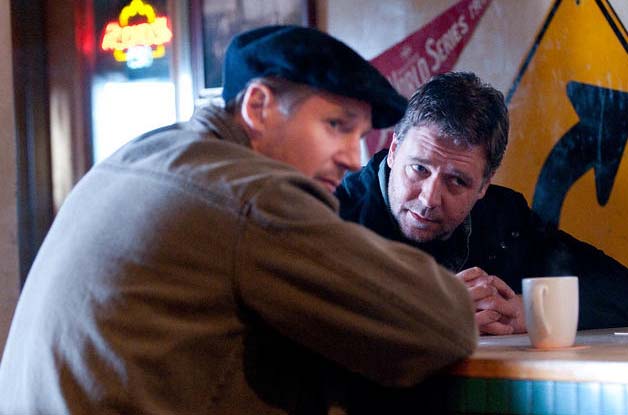
For example, why would you meet with a man in a bar (played by Liam Neeson, who adopts one of the most unpersuasive Brooklyn dialects I’ve ever heard from an actor), one who has escaped from several prisons, while other people sit very close by, and ask him about his methods? In Pour Elle, Julien meets this guy at a racetrack, with the camera establishing a reasonable crowd buffer with which to safely discuss the verboten topic. Furthermore, Julien asks Pasquet, this prison escape expert, if he can tape the conversation. Pasquet replies, “No, it’s not valid evidence.” So we immediately understand that Pasquet is a seasoned expert and we know why he would meet in public like this. Furthermore, the setting, which involves people blowing money on the horses, is one in which some guy giving cash to another isn’t going to draw much attention. Not so with Haggis’s bar, in which the dissemination of cash is likely to be more flagrant. Julien also offers the pretext that he wishes to “teach” Pasquet’s book. There’s no pretext at all with Haggis’s John.

There is also something unpardonably stupid about a movie in which a man breaks into a truck delivering supplies to a prison and the parking lot, rather remarkably, doesn’t include a single security camera or a guard. John even snaps photos with his iPhone (uh, ever heard of GPS tracking?) of documents he’ll need to forge. But given how shaky the light can be on an iPhone camera, how can he be expected to nab a decent image to forge the documents? Furthermore, if you’re going to learn how to forge a document for a prison escape, why would you attend a community college class on Photoshop and draw attention to yourself? Wouldn’t you learn it on your own? When John learns how to make a bump key, he does so by consulting YouTube videos. Does this guy even clear his browser cache? Is Haggis even understand how Google tracks its users? Cutting a bump key isn’t a skill that Alton Brown can teach you overnight.

I haven’t even discussed The Next Three Days‘s laughable attempts at streetcred. To offer just one example, John asks around the Pittsburgh underworld, trying to obtain fake passports. When he finds his first prospect, the bar John enters is as harmless and boisterous as a sports bar. (By contrast, in Pour Elle, the bar that Julien enters was committed to a silent intensity, letting the audience fill in the blanks about the possible danger.)

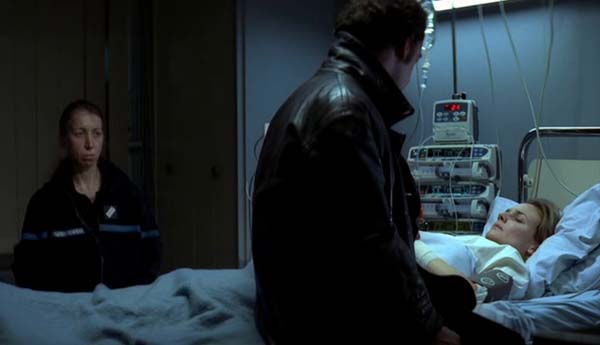
But it isn’t just these basic behavioral issues that Haggis has failed to parse from the original. He also hasn’t learned how the little visual details made Pour Elle work. In the above still, we see a police officer giving Julien a dirty look (on the left half of the frame) in the hospital room when he visits his wife after a suicide attempt (the moment captured on the right half of the frame). This visual bifurcation establishes the two separate worlds that the law and Julien’s predicament are going to be operating in. It’s a nifty psychological nudge to the viewer. Yet we don’t get anything this sly from Haggis. Then again, Haggis is not a man known for his visual chops.

Because I’ve been so hard on Haggis, I’ll give the man some small credit for casting Lennie James as a detective. James has proven to be quite watchable in everything. But even the confident expertise he establishes with his presence is undermined by the shoddy material.

The bottom line is that The Next Three Days gives its actors very little to do (the dependable Elizabeth Banks, in particular, is woefully underserved) and tries the audience’s patience. I can highly recommend the French original, but I cannot in good conscience declare Paul Haggis to be anything close to an essential filmmaker for our times.

The 2010 National Book Awards

4:10 PM: I just got back from interviewing a National Book Awards nominee for a future installment of The Bat Segundo Show. Now I have about an hour to shave the five days of stubble off my face and the top of my skull and find something nice to wear before hitting Wall Street. At least three friends have informed me that adopting a clean-shaven approach is the only way that the National Book Foundation will let me penetrate the inner sanctum, although this esteemed organization has been nice enough to grant me (perhaps unwisely) press credentials. I sat out the National Book Awards last year. Ended up getting sucked in through Twitter. People thought I was there. And I guess it comes down to this. Just when I thought I was out, they pulled me back in. Every November, I’m the Regis Philbin of the literary scene. Or maybe the Fred Willard.

This year, there will be two places to find me: this page and my Twitter account. I have just eaten a very large burrito to ensure that I will have a ridiculous amount of energy for the floor. If someone gives me drinks, I’m sure there will be additional craziness. Charging the batteries for my sound equipment. Charging the netbook. Charging the jet black fire of my soul.

6:29 PM: There was a fashion emergency at Atlantic Mall that required the swift purchase of a shirt after the other one decided to commit a unique self-immolation. But I am now ensconced at the press table. Cal Reid from Publishers Weekly is to my left. There is a thick rope separating the press area from the fancy tables. The rope is not the kind you use for jumping, nor for hanging a man. Although I suspect that if some author gets better tonight, there’s always the prospect for eccentric violence. You don’t see kids playing with this kind of rope. It’s the kind of rope that tells a man that he’s not so good to sip gimlets or snort blow. I don’t anticipate seeing gimlets and blow tonight. But maybe there will be some debauchery in the restrooms or off-premises. Will investigate if there’s time.

7:06 PM: Fiction judge Samuel R. Delany and nonfiction judge Jennifer Michael Hecht are both staying mum about whether there were any heated deliberations or exclusions. Delany did not venture an opinion to me in relation to Franzen’s Freedom, which, rather notoriously, was kept off the list. Hecht told me that the judges weren’t allowed to attend last night’s readings. And while, like Delany, she stayed mum on the politics, she did tell me that the process was surprisingly civil. The one thing they both agreed upon: lots of reading.

7:22 PM: Audio interview with Samuel R. Delaney.

National Book Awards 2010 — Samuel Delany (Download MP3)

This text will be replaced

7:34 PM: Audio interview with Jennifer Michael Hecht (nonfiction judge).

National Book Awards 2010 — Jennifer Michael Hecht (Download MP3)

This text will be replaced

7:41 PM: Audio interview with Patti Smith.

National Book Awards 2010 — Patti Smith (Download MP3)

This text will be replaced

8:12 PM: Andy Borowitz is a perfectly respectable fifth-rate Vegas entertainer. I keep looking around for relatives in Hawaiian shirts. There was a very lame act about Best Subtitle in a book. The material here is, well, can you trust a guy who can’t tie his bowtie? Elmo has just shown up. That should tell you everything.

8:19 PM: Have just asked two other press people about this, but it is apparently important enough for me to report that Elmo is voiced by a black man.

8:41 PM: Tom Wolfe is presently delivering one of the most rambling speeches I have ever heard. And that includes the crazy shit my great grandmother said after a stroke.

8:52 PM: I’ve timed Tom Wolfe’s long-winded speech at around 25 minutes. People are now relieved to be eating dinner.

9:15 PM: Yes, it’s true. People are still eating dinner. No awards yet. Now I’ve covered a few of these National Book Awards ceremonies and I can tell you this is par for the course. The journalists are now talking with each other. I think that, aside from the award announcements, I will save my energies for the tweets.

9:44 PM: The Young People’s Literature Award goes to Kathryn Erskine’s Mockingbird (Philomel).

9:50 PM: The Poetry Award “by unanimous vote” goes to Terrance Hayes’s Lighthead (Penguin).

9:59 PM: Patti Smith wins Nonfiction! In her speech: “There is nothing more beautiful in our material world than the book.”

10:05 PM: In a surprise victory, Jaimy Gordon takes the Fiction Award for Lord of Misrule.

Review: Morning Glory (2010)

It doesn’t matter if some generous groomsman (or bridesmaid) has plied me with good scotch or not. It doesn’t matter if the DJ or the band has the musical taste of a humorless military historian who blasts nothing more than John Phillip Sousa. If you encounter me at a wedding, chances are that you will find me dancing. There seems to be no better way to celebrate the union of two than putting two feet together. Very often, I will have no clue as to how I began dancing. Sometimes it will start with a trip to the men’s room. Upon relieving myself and washing my hands, I will often return with some terpsichorean fervor that astonishes the other wedding guests. I will dance with anybody. Grandmothers. Kids. Other men. I have been known to corrupt small children with some of my more libidinous moves, whereby I swing an invisible lasso around another man’s neck and proceed to rope him in, concluding my cowboy allemande with a rakish leer which suggests that I will be taking my partner to an indecent location. I have seen kids reproduce these moves.

What does any of this have to do with Morning Glory? Well, somewhere within this watered down Broadcast News knockoff is a mild audience-friendly satire screaming to cut the rug. Last week, with Due Date, we saw how director Todd Phillips and his co-writers managed to update the Planes, Trains, and Automobiles template into an enjoyable comedy that still had the smarts to include some dark observations about our present age. Morning Glory – with its egotistical anchors, its rider-mandated fruit platters, and its accidental caption beneath Jimmy Carter’s photograph – has a few promising steps. But it is too often that stiff partner that lacks the courage to get up and go, to take more than a few perfunctory chances. It is a movie in desperate need of some hip-shaking and a hip flask.

Rachel McAdams plays Becky Fuller, a television producer who foolishly believes that the Protestant work ethic still applies in the television industry. She longs for some higher rung because she has toiled for many years (sans boyfriend, sans many friends aside from her co-workers) as an assistant producer on the morning show, Good Morning, New Jersey. The big boss asks her in for a big meeting. And Becky thinks that she’ll at last land that promotion. Wearing a YES, I ACCEPT tee beneath her clothes, Becky is shitcanned instead. She then spends the early portion of the movie trying to land a job, with her chirpy go-go energy lacking Holly Hunter’s can-do spunk in Broadcast News. It’s really more of a fey merge between Hunter and a mid-1990s Renee Zellweger. Becky is so desperate to be liked that she is very often channeling the needy qualities contained within Aline Brosh McKenna’s script.

She somehow talks her way into a job as executive producer at Daybreak, a network morning show in last place. Becky must endure dull segments about weather vanes, sleazy reporters who wish to take photos of her feet, and a staff that expects Becky to fall through the revolving door. Certainly, the audience is inclined to sympathize with the Daybreak staff. McAdams’s relentless peppiness is, at times, a liability to our willingness to believe in the movie. One does not occupy a top perch in the media world without giving a few orders to ice the unruly subordinates. And while Becky does deliver at least one such ruthless move, we’re never entirely convinced that she has the organizational chops to keep this show together.

Becky places her faith in the aptly named Mike Pomeroy (Harrison Ford), a respected journalist with Pulitzers and Emmies in his closet who lost some vital television spot some years ago. Alas, he’s referred to as “the third worst person in the world” among some former co-workers. Still under contract to the network, Becky installs Pomeroy as Daybreak co-host. The big joke here is that Pomeroy would rather use words like “abrogate” on air or report on serious news stories rather than remark on Easter bunnies. While there’s some late stage conflict between Ford and McAdams, the comedy is hindered by Ford’s terrible performance. He shamelessly overacts in his part: widening his eyes, pointing his index finger, and barking his lines with a sad “Get off my plane!” gusto that transforms a chief character into a regrettable cartoon. It’s sad to remember that Ford was once an actor capable of great control in Frantic, Witness, and The Mosquito Coast. (On a positive note, I can report that Diane Keaton is wonderfully controlled, as always, as the grumpy host who has been on the show too long.)

The movie is most effective when it drifts away from its obvious inspiration. When McKenna and director Roger Michell comprehends that Rachel McAdams is not Holly Hunter, that Harrison Ford is not Jack Nicholson, that Patrick Wilson (McAdams’s love interest, whose receding hairline and look resembles William Hurt in 1987) is not William Hurt, and the guy with the half-grown facial hair playing McAdams’s producer who I’m too lazy to look up on IMDB is not Albert Brooks. (Sorry, guy with the half-grown facial hair playing McAdams’s producer. I had to turn around this review fast.) James L. Brooks certainly never needed a live camera capturing a reporter screaming while he rides a rollercoaster or howling in pain when getting a tattoo buzzed into his flesh. But our present epoch of reality television and YouTube does requires such moments.

It’s too bad that this promising satirical thrust couldn’t extend to the rest of the film. There are worse films than Morning Glory out there. But McKenna and Michell don’t seem to know that there was this writer named Ben Hecht and this director named Howard Hawks, and these actors named Cary Grant and Rosalind Russell, and this talent all came together and created an indelible comedy, with the dialogue gunning at a .45 Thompson’s pace. They can’t recall that we remember that film so well seventy years later because Hawks had the wisdom to swap gender roles from the original source (the play The Front Page), with Hawks agonizing over the casting. I have to wonder: Who will remember Morning Glory seventy years from now? What might have happened if McKenna and Michell had the courage to defy their straitlaced obligations and dance?