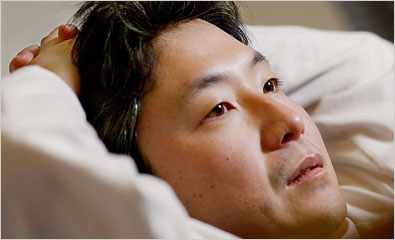
Chang-Rae Lee appeared on The Bat Segundo Show #327. Mr. Lee is most recently the author of The Surrendered
Listen: Play in new window | Download
Condition of Mr. Segundo: Searching for the middle-ground between “beat” and “sweet.”
Author: Chang-Rae Lee
Subjects Discussed: The similarities and differences between writing in first-person vs. third-person, the advantages of sitting in the god’s seat, infinite choices within sentences, the difficulties in pursuing the “inner life” on the page, becoming imbued by character consciousness, feeling obliterated when writing about the ravages of war, Brian Evenson, Lee’s ongoing fascination with violence, pursuing time and space within sentences, contending with false starts, agonizing over sentences, Lee’s perfectionism in relation to revision and line editing, the reasons behind the two year publishing delay for The Surrendered, the problems with possessing a hard work ethic and producing slow, writing the first chapter in a swift period of time, distrusting prose results, the difficulty of final chapters, writing as a medium for thinking and character development, character names and historical references, the Battle of Solferino, Hector as a Jean-Henri Dunant type, Hector’s creative origins as a guy from Southwest Texas, the town of Iliad, New York, Hector’s design as an immortal, the double-edged sword of persistence, the influence of Cheever and Updike, and the need to mature (as a writer and as a person) before tackling a serious story.
EXCERPT FROM SHOW:
 Lee: I’ve always been very conscious of language. It might seem silly of me to say, given all of the things that have happened in my books. I’m not terribly interested in plot. (laughs) I mean, I enjoy it. But I find, for me, the real action in drama is in the play of the sentences and in the play of the words. That’s what draws me through the story too. I mean, in some ways, unless I hear the sentence, I don’t understand what it really means. And even back in school, when I was writing a lot more essays, I would always try to craft it so that it felt like something and it sounded like something to me, rather than just said something. And particularly vis-à-vis the scenes of violence, I wanted — I think in this book and in A Gesture Life — I tried to think to myself, “What was the most, in some ways, unlikely way to describe this?” With perhaps spare and beautiful language that would add a layer of a different kind of horror to the moment. Just the contrast between how not lovely, but how handsome everything seemed and normal, given what was happening.
Correspondent: Well, that’s interesting. It also makes me ask whether you could ever possibly stop work in the middle of a sentence or whether this would actually drive you insane over the course of a day.
Lee: No, no. I can never do that. That’s my problem as a writer. I work the sentences so long. And even the very plain ones that probably don’t seem to anyone to be worth it. (laughs)
Correspondent: A five-word sentence? (laughs)
Lee: (laughs) I work them and work them until each one satisfies certain requirements and follows up the last sentence, and fulfills and promises something about the next one. You know, it’s not a great way to write in some ways. Because at the end of a paragraph, I often feel, “Okay, this is a pretty good paragraph.” But sometimes that paragraph is completely useless. Because it’s irrelevant or it’s not quite looking at the right thing.
Correspondent: Well, let’s expand this to chapter units. These are rather lengthy chapters. And so this also makes me wonder when you knew the chapter was done, if you’re constantly working and crafting these sentences.
Lee: Well, let me tell you. I threw away chapters. I threw away many chapters. They do get done. But often they’re just irrelevant. And this has been my mode in all my novels. (laughs) And it’s a maddening, frustrating mode. Because I do tend to write chapters that are a little bit longer. It just appeals to me somehow. The rhythm that I get in having a little full narrative in each chapter. A fully detailed scene. And again, for me, they’re all like little tiny books.
Correspondent: Well, this also leads me to ask quite naturally, there has to be an advantage in tossing away a chapter. Because you didn’t get it this time. But you may have had a rough idea of what worked. And you know that you can possibly recapture those particular elements and try again and get it right. Or does the process work like that for you?
Lee: No, no. It definitely helps. I mean, the second time around, you’re much more aware. You have to get over the excruciating pain of having thrown away that chapter and feeling as if there were good parts of it, but that I probably can’t use anymore. Because the whole thing for me is — again, the whole chapter has to feel that it has a certain kind of rhetorical orchestration. And even a musical orchestration, for me at least, that I hear. And maybe it’s because I grew up writing poetry first. And, in some ways, I was raised by poets as I was learning the craft. And I’m still learning. But I’ve always been attuned to meter and a certain kind of stressing and a certain kind of musicality.
Correspondent: So you cannibalize essentially with the subconscious. With these second attempts. Is that how you might put it? You throw it away. You don’t look at it again. The false starts.
Lee: I’ll sometimes look at them. But again, it’s painful to look at them. Because in and of themselves, they seem okay. And that’s what I tell my writing students. It’s not a matter of writing well ultimately. I mean, that’s not the only matter, right? It has to fulfill all the things that you’ve been writing to up to that moment and connect up in a mysterious way, in an ineffable way, with what you’ve laid down and what you might lay down. So I don’t know. Sometimes I feel as if maybe that’s the way I have to do it. I have to write every novel four times. Not four different novels. But in the process of it. Just kind of work it and work it and work it. And I’m a slow writer too. I’m pretty methodical. I’m not the sort of writer who can jam out 2,000 words and then go back and fix them and be happy with it. So it’s coalmining. (laughs)
(Image: Daniel Hulshizer)
The Bat Segundo Show #327: Chang-Raee Lee (Download MP3)
This text will be replaced
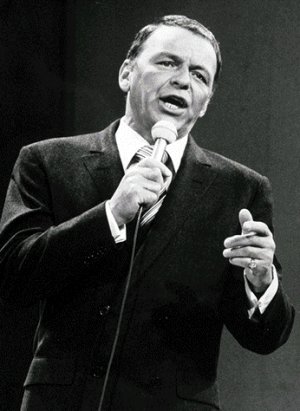 Facing considerable indifference shortly after the announcement of has-been Barbra Streisand as a headliner, Reed Exhibitions announced that they had disinterred Frank Sinatra’s corpse to replace Streisand as BookExpo America’s opening night act.