The Bat Segundo Show: Andrea Peyser

Andrea Peyser appeared on The Bat Segundo Show #272.

Andrea Peyser is most recently the author of Celebutards.

segundo272

[PROGRAM NOTE: At the 22 minute mark, while the conversation concerned itself with the dangers of generalization, a woman, who was sitting at a table located a good seventy-five feet away from them, gave Ms. Peyser and Our Young, Roving Correspondent a note. The note read: CAN YOU PLEASE TALK QUIETER? Now it should be observed that, while the conversation was animated, the two talkers did keep their volume level to a reasonable decibel level. Indeed, many folks sitting adjacently to these two appeared to be interested in the conversation. (This has been known to happen from time to time, since these conversations are recorded in public places. Indeed, there are a few amicable people working at one Midtown cafe who have urged Our Correspondent to come back because these conversations are apparently quite odd and intriguing to them. It also helps that we tip well.) It should also be noted that the woman with the note had congregated with a group of peers for a discussion that deployed such strange terms as “synergy,” “collaboration,” and “market forces,” and that this group talked at a level far exceeded all other conversations occurring in the cafe. We note all this for several reasons: (a) to explain to the listener yet another odd and unusual moment in the history of this program, (b) to point to the problematic lack of distinction between workplace and social gathering point in our present epoch, and (c) to demonstrate that strange forms of passive-aggressive behavior remain troublesomely alive and well.]

Condition of Mr. Segundo: Pursuing the unexpected qualities.

Author: Andrea Peyser

Subjects Discussed: Why celebrities cannot be ignored, “anti-American” sentiment, Sean Penn’s trips to other countries, whether or not Alec Baldwin is entitled to privacy, photographers and paparazzi, the limits of the media, whether hypocrisy is a valid description of celebrity, First Amendment rights, Martin Sheen’s 9/11 remarks, being invited to be honorary mayor, rudimentary viewpoints and free thinking, Nancy Pelosi’s importance, whether it’s possible for Peyser to agree with Al Sharpton, Munich and Black September, the problems of holding an artist’s statement on the same level as the art, Steven Spielberg’s remarks about Israel, the problems with generalizing about Mumia Abu-Jamal’s followers, being friends with Rosie O’Donnell and O’Donnell’s betrayal, on not taking the high road, celebrities of virtue, Bruce Springsteen, old Hollywood vs. the present publicity machine, on being vituperative in the New York Post column, quibbling with the infamous Heath Ledger column, “knowing” the celebrity from a snippet view, whether or not Peyser is happy, giving into the readership, and a few positive things that Peyser can say about the entertainment industry.

EXCERPT FROM SHOW:

peyserCorrespondent: You deem Alec Baldwin a celebutard partly because of the infamous voicemail to his daughter. But I’m wondering if it really is fair, given what you’ve just discussed in relation with Sean Penn and his political sentiments, to take something that was never intended for the public and put it up there with something that is actually in the public record. I mean, is it really fair to deem someone a celebutard for their private actions like this?

Peyser: Well, private actions. He left a voicemail. Any idiot knows that anything you say on a cell phone, anything you email and voicemail, it’s out there. He was in the middle of a custody battle. He was threatening his daughter. To come over to California and straighten you out. It got into the public eye and he got furious because of that too. He blamed others for his own actions. That’s also a common thread in celebutardism. When Barbra Streisand, for example, is caught being really, really stupid, she blames other people for her own stupidity. So in the case of Alec Baldwin, he did something really stupid — actually dangerous — and he blamed someone else.

Correspondent: But if it were not Alec Baldwin, someone could leave that voicemail and it may not have been disseminated out into the media like this. Just as, for example, you mention George Clooney and his anger and fury towards a photographer shooting a picture of him above the men’s stall. You’re saying to me that if a photographer came up to you while you were doing your business that you wouldn’t have any particular problem with that?

Peyser: No.

Correspondent: It’s out there to be disseminated?

Peyser: I wish George Clooney would make up his mind. One day, he’s fighting against the stalerkazzi, as he’s called them. As other celebrities have called them. People who stalked Princess Diana. Of course, the courts found that she was killed not because of the paparazzi, but because of her drunk driver. But anyway, he made a very big deal about that. People could be seeing it as censorship. Whatever. But then he turned around and he decided that I am going to back off. And that is censorship. And it’s okay. Say whatever you want about me. So I wish he’d make up his mind really.

Correspondent: Well, he is expressing understandable anger at a photographer shooting a picture of him above the stall. If someone did that to me, I would probably also be quite upset. I’m sure you would too.

Peyser: Yeah.

Correspondent: I’m wondering if it’s fair to hold him accountable for that particular understandable reaction and use this in the broader painting of who he is in relation to all of his other actions.

Peyser: Well, that was in Australia, first of all. He’s giving a picture of the media. The media. I love that word. I’m not shooting George Clooney naked. I really don’t care. But that was in Australia. He got the thing suppressed. He threatened a lawsuit. And I wish he’d now be quiet. And now he’s decided that the media has to be left alone. Which one is it? Are they killing Princess Diana? Or are they okay? Which one is it?

Correspondent: But do you believe that a celebrity is entitled to some level of privacy? Is it really fair to constantly — I mean, you’re living a life as a celebrity. You’re having all these photographers, reporters, paparazzi, you name it, invade your particular personal space. So understandably, your particular lines in interviews and the like are going to be subject to more scrutiny. And so this makes me wonder whether it’s actually fair to attack them.

Peyser: What I really love is how somebody — like, take Madonna, for example. Way back when, she was creating things that would attract media attention. She was desperate for media attention. And now that she’s a huge star, she’s the most controlling person who exists as far as interviews go. So why can they run to me and say, “Please, pay attention. Pay attention.” They do everything including taking their clothes off in public to get us to write about them. To take their pictures. And then when they reach a point of fame and fortune, it no longer exists. I don’t know. Actually, I would say that the media is dreadfully controlled by celebrities. I don’t think it’s as much of a free-for-all as you’re suggesting. I think there are armies of publicists out there who really control the image.

Correspondent: I certainly agree with you about that. You make many interesting points about Tom Cruise and Michael Moore certainly.

Peyser: Yes, that’s very…

Correspondent: I would never interview them because of these particular controls. But nonetheless, look at what happened with the Christian Bale outburst. This was remixed in a very fun way on YouTube. And suddenly things did get out. But the question is whether it’s entirely fair. I mean, I understand what you’re saying. Which is that the media — one needs it to advance in one’s career. But simultaneously, is there a particular point when the media should back off? Should they be probing and taking pictures of children and the like? And that sort of thing?

Peyser: Well, you know, personally, I have never done that. I don’t go after somebody’s children. Not without permission. But you know, I don’t know. Michael Jackson goes out in public with his children in veils. I would say that he’s attracting more attention to them then if he had just gone out in public with children with their faces showing. But I don’t personally condone using children. But I think that a lot of celebrities put them out there. Put them out there to attract attention.

Correspondent: Even if they’re doing their shopping, for example. And the children happen to be along. And then the paparazzi come. I mean, see, this is where we get into — I’m trying to just clarify where you’re coming from here.

Peyser: See, once again, this is a very small thing. I make the point. And I do this in the cases where the celebrity is obnoxious in the control. Of pointing out that at one point in their career, when they were very young, they would do anything for attention. Now I have never stalked anyone. Everything I get is from above-board sources. So I’m not speaking for myself. I’m talking about the hypocrites. The celebrities who use the media and then have no use for it once they’re famous and rich.

BSS #272: Andrea Peyser (Download MP3)

This text will be replaced

The Bat Segundo Show: Tony Stone

Tony Stone appeared on The Bat Segundo Show #271.

Tony Stone is the director, writer, producer, editor, and actor of Severed Ways, a film about Vikings that opens in limited release on March 13, 2009.

segundo271

Condition of Mr. Segundo: Unsure of whether he wants to be a Viking or not.

Guest: Tony Stone

Subjects Discussed: The many crew positions that Tony Stone worked, music clearance people who keep weapons under their beds, making a film with seven chapters, how a two week shoot went on for three years, not getting the visuals right the first time, motivations for handheld camera work, accepting art as it is, “Greedo shoots first,” contemporary slang transposed into Viking talk, A Knight’s Tale, how far filmmakers can go in “modernizing” historical settings, the ethics of killing chickens on screen, Ingmar Bergman’s Shame, helpful ways of agitating both vegetarians and meat eaters through cinema, filming a defecation scene, the appropriate constituency of shit for a beautiful shot, Charles Leland’s Algonquin Legends, abstaining from profiling the Abenaki religion, paganism, anarchy, and secular humanism.

EXCERPT FROM SHOW:

tstoneCorrespondent: “This fish is pretty killer.” Well, “killer,” as I understand it, is a recent modifier in the English language.
Stone: Yes, it is.

Correspondent: And I don’t think necessarily that the Vikings were using this or that the Nordic tongue had any answer to “killer.” So why the modernization of etymology here? Is this an inroad point along the lines of the Viking headbanger who likewise appears in this?

Stone: Yeah. It’s that. But it’s also that a lot of the times, you’d watch any period piece or historical film, whether it’s Romans or barbarians or whatever else, they’re speaking in semi-Shakespearean accents in their Old British. It doesn’t really make any sense. And everything’s very formal. There’s no reason why, a thousand years ago, they weren’t just as casual as us and they had their own vernacular. So this is using a piece of dialogue — like “This fish is killer” — is basically more of an accurate translation in my mind. Because you’re taking whatever their vernacular was and putting it into our vernacular. So you understand the tone and the vibe of what they’re actually saying. So I actually find there’s more accuracy in it. And we’ve just been so beaten down by the traditional Hollywood stupidity of how I’m dealing with history in films. So that sort of explains why I wanted it there. And of course, the film is trying to bridge the past and the present. And so it’s maing these characters have mannerisms that maybe the dude walking down the street has. Or whatever else. It’s trying to just not have it be this distant, far off, separate thing. It’s trying to make it more current and now. And it is with us.

Correspondent: But on the flip side, there is a certain point where it becomes ridiculous; i.e., A Knight’s Tale, for example. In which you have the Nike swoosh in the Middle Ages. Do you remember this film?

Stone: Yeah, I do. I do.

Correspondent: I mean, it was totally ridiculous. It was fun. But at the same time, one does not look to this for verisimilitude.

Stone: “The Boys Are Back In Town.” Yeah.

Correspondent: So the question is: how far can you go with this?

Stone: Yeah, that’s interesting. A Knight’s Tale. I forgot about that. It’s been a while. But yeah. They use modern music.

Correspondent: “We Will Rock You.” Yeah.

Stone: Then there’s that amazing part where they’re going back to London. And the Thin Lizzy song comes in. “The Boys Are Back In Town.” (laughs) It’s very incredible.

Correspondent: I mean, if we’re talking about Hollywood stupidity, I’m wondering how…

Stone: Yeah. Obviously, there is a level of absurdness to it. I’m not going to deny it. But I think the film is sort of rebellious in a way. It’s trying to set up a dialogue. I don’t know. But in a way, like I’m saying, it’s sort of modernizing the Viking. Making him a current character. Making him more similar to somebody maybe you know is the idea. I’m just getting away from that wall that’s usually put up in terms of dealing with historical material.

BSS #271: Tony Stone (Download MP3)

This text will be replaced

Miss March (2009)

missmarch

Zach Cregger and Trevor Moore are part of a comedy group called The Whitest Kids U’ Know [sic], a television show presently airing on the IFC Channel. One of their more popular sketches, the unimaginatively named “Slow Jerk,” can be viewed on YouTube. 4.8 million people have watched this tired retread of the Austin Powers phallic silhouette/camera placement gags, with many apparently finding it funny. But the difference between “Slow Jerk” and Austin Powers sketches is that the latter found creative methods of playing with perception. What the camera or the characters viewed wasn’t necessarily the truth. And it didn’t really matter that Austin’s naked stretching was implausible. Because there existed a pleasant choreography that made the joke worthwhile. Artistry was attached to Austin’s unseen member in the positioning, and audiences laughed accordingly.

The same, however, cannot be said of the “Slow Jerk” sketch. We see two men engaging in banal office banter. One man makes a casual masturbation gesture and says, “Just joking.” Then the other man attempts the same gesture in slow motion. But when one compares this to the Austin Powers sketches, what artistry is there? The obvious joke is that such locker room banter is happening around the water cooler. The imaginary dick is needlessly large. But just about any simpleton capable of curving his hand and stroking it up and down can perform the same gesture. So it’s hardly advancing comedy.

Presumably, the “Slow Jerk” sketch caught on because many YouTube viewers needed a quick chuckle while trapped in a grim office job. If only they could get away with that and not be charged with sexual harassment. Another sketch, “Cubicle Boss,” uses this same phony populism as its basis. A boss asks his employee if he fucked his girlfriend, threatening to fire him if he doesn’t reveal the private info. Then the two draw images of what they did the previous night on a whiteboard. (In a telling sign of this show’s lack of originality, the boss rips off Dr. Evil’s “Zip it!” during the sketch.) Again, we have a case where forbidden office behavior is “funny” in the context of a stolen moment on the clock. Because the sullen office worker watching this could likewise draw stick figures and a giant cock on a white board if only he were allowed. But is this really funny outside the workplace? In four minutes, does the “Cubicle Boss” sketch come close to the amount of artistry and comedy information contained within a minute of one episode of The Office? I’m certainly capable of appreciating a well-deployed lowbrow joke as much as anyone, but is there anything in this dialogue to distinguish the joke? Is there anything ridiculously class-conscious here, such as Mel Brooks’s “Oh, piss-boy!” from History of the World: Part I?

One must therefore ask if the “comedy” that The Whitest Kids U’ Know perform is any different from a group of high schoolers joshing around after gym class. If we remove the social restrictions of office behavior, could not any of us mime jerking off to our cubemates or drawing crude figures on a white board? And without that ability to offer that unusual juxtaposition in Austin Powers or Mel Brooks, isn’t such a comic stance insulting to the millions of people who have watched these sketches?

But none of the Whitest Kids‘s comedic deficiencies can possibly compare to the worthless material contained within Miss March, a film written, directed, and starring Cregger and Moore. Make no mistake: This is a vile and condescending piece of shit. You would get more laughs spending 90 minutes strangling an animal. It is a film so mind-numbingly atrocious that nothing would delight me more than to lead a glum and exhausted team of vigilantes in a dutiful lynching of these talentless cretins. And if Trevor Moore does not win a Razzie for Worst Actor, I may be forced to approach the Golden Raspberry Award Foundation in person. (More on this anon.)

The film offers racist stereotypes and rampant misogyny. It is artless and witless and stupid. Laugh at the overweight Spanish-speaking nurse named Juanita because she’s overweight and she speaks Spanish. Titter over a rap song because it repeats the phrase “Suck my dick while I fuck that ass” ad nauseam. (Wouldn’t this have been funny if there had been some escalation, with the sexuality becoming progressively stranger as the lyrics went on?) Smile at the two Russian lesbians who pick up our heroes and ask them to drive them to Los Angeles so that they can screw in the back of the car the entire time. For this setup, Cregger and Moore merely gape open their mouths the entire time while one of the women inserts a beer bottle in the back seat. And we’re supposed to find this funny. But what if the two men gradually grew more uncomfortable by all the sexual activity? What if their wildest fantasy (two women getting it on) led them to be disappointed and yet they pretended to be turned on in true macho camaraderie? With such a basic escalation, there might have been enough irony and conflict to sustain an amusing comic scene. But Cregger and Moore don’t have the brains to think about such basics. They think so little of their audience that they can’t be bothered to think themselves.

This is a movie that hasn’t a clue about the way the real world works. Even if one identifies Miss March as a male wish fulfillment fantasy, good entertainment needs to have some entry point. But Miss March occupies a paralogical realm in which you can casually flip through a stroke mag in a gas station (instead of asking for one behind the counter) and CDs can still be purchased up at Tower Records. (Never mind that the Tower chain collapsed three years ago, leaving one to wonder if this script had been rotting in a drawer for at least six years.) A woman opens an uncommonly large window on a bus, strips for one of the two protagonists, the bus bumps over something, and the woman is then sucked out the window. We’re supposed to find this funny because it’s “outrageous.” But anyone with an IQ over 75 will see the setup coming well in advance. And there are unanswered questions. What if the woman was killed? And why doesn’t anybody ask about her? Would not any of these points have provided more conflict and unpredictability for the narrative?

Another gag sees Cregger suffering from atrophy (days after he has awoken from a four-year coma) while trying to pump gas. You’d think that this would be a fine opportunity for Cregger to demonstrate his physical comedy chops. Alas, he has none. And the filmmakers know this. For they have Cregger wearing a hospital gown that is blown up by a preternatural gust. We see his ass. Some other people at the gas station see his dick. He’s naked. Ha ha. But what Cregger and Moore don’t understand is that random comic nudity along these lines must have some context. We laugh at the waiter’s buttcheeks in The Naked Gun (ripped from the “Sit on My Face” performance seen in Monty Python’s Live at the Hollywood Bowl) because we don’t expect to see it when he turns around. The waiter serves a role of service and propriety, and, when his ass shows, we see wild impropriety.

But, of course, Cregger and Moore, a pair so incompetent that any wretched soul sitting through this turkey may actually pine for Pauly Shore’s cinematic oeuvre, prefer gormless and badly conceived comedy. It is offensive not because it shocks (it doesn’t), but because it isn’t funny or artful. It is a film thoroughly against the human condition. It is stupidity writ large on a forty-foot screen. At the Playboy Mansion, a dog pisses into a playmate’s drink and she prefers this cocktail to the ones at the party. (Would any human in such an upscale context possess such a palate?) This is a film that thinks it’s edgy, but it is too cowardly to reveal any prominent anatomy in a Playboy centerfold. This is a film that steals the art direction from the motel room in Planes, Trains, and Automobiles and attempts to pass it off as its own. This is a film so amateurish that one can actually see Raquel Alessi reading from cue cards when she juts her head out the window in an early scene. (The same, alas, applies to Hugh Hefner, who shows up in the end. Did he appear in this film because of his recent financial difficulties?) There isn’t even a compelling visual component to this. Most of the scenes are static long takes, with the actors (if one can, indeed, call this talentless cast “actors”) in TV-friendly camera placement.

There’s one promising idea involving vengeful firemen who are chasing our heroes in firetrucks with axes. I had hoped that the firemen might transform into modern-day Vikings, perhaps revealing a secret society of feral marauders. But the firemen are one-dimensional. We’re supposed to find them funny because they throw axes at a station wagon. I wanted to throw axes right back at the filmmakers for their inept cinematic execution. I guarantee that my aim would be more accurate because this film is so very, very bad.

I can report that I did laugh once during an early scene at a party, in which a bald muscular man wearing an orange shirt is randomly smashing his fist through glass cabinets. This was funny, only because I was exceptionally curious about this man. Who was he? Why was he there? Why is he committed to such gleeful violence? But I must conclude that this side character was a serendipitous aberration.

The promising comic actor Craig Robinson (Darryl from The Office) plays a rapper named Horsedick.MPEG. A tired joke involves Robinson constantly barking “Dot MPEG!” whenever another character refers to him as merely “Horsedick,” and this should give you a sense of how criminally the man’s talents are used.

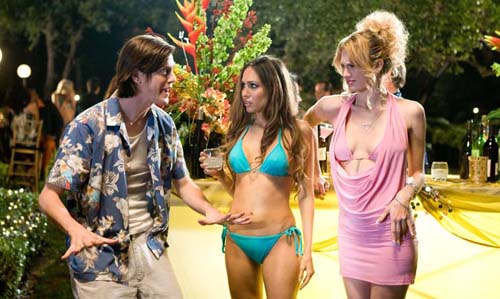
And I haven’t even begun to tell you about Trevor Moore’s horrible performance. His character has been given an epileptic girlfriend, and perhaps this is a subconscious clue to the audience that his thespic ineptitude may indeed cause you to have a seizure yourself. Both actor and character are without appeal. Cregger and Moore are such condescending pricks that they believe that their audience hasn’t seen any movie older than five years. To this end, Moore’s character has been styled as an Ace Ventura knockoff. Like Jim Carrey’s character, he dons a Hawaiian shirt, an unruly shock of hair, and bulging eyes. Carrey, however, is an actor who has remained engaged in comic exuberance, even when he doesn’t have decent material. Moore, by contrast, does not have an expressive face, an ability to understand what’s happening in the scene, or a talent of any kind.

To get a true sense of the worthless specimen that Trevor Moore is, why not listen to his answer from this Orlando Sentinel video interview? Here he is, quoted verbatim, in a question asked about performance:

I mean, I think, you by and large, everyone kind of just writes their own characters for the most part. Like you end up just, sort of, you know, uh, I mean, it’s kind of a way that the group works troupe-wise. Um, I mean, everyone helps pitch in lines for everything. But you kind of formulate your own characters from those part. [sic] And it just kind of, you know? Uh, like with this movie, we never really sat down and we’re like we’re going to do this guy, we’re going to do this guy. We just kind of, you know, right up, uh, I’m going to go over here and do this and then, you know, and I’ll do this. Oh, you just kind of. It’s sort of how we work.

Keep in mind that this answer comes after Moore has been on the road doing publicity at 38 colleges for five weeks. Keep in mind that this stunning insight comes after this 28-year-old man — not a teenager — has been asked a variation of the same question over and over again. That this inarticulate answer, even accounting for the fatigue that sets in after heavy promotion, is the best rejoinder he can come up with should tell you everything you need to know about how inept and unqualified he is at his craft. It should spell out quite clearly that this guy is as dumb and as valuable to our culture as a commonplace rock. Indeed, he would be better suited chopping up rocks in a quarry.

I do not know if audiences will flock to this film in the same way that they rushed to Paul Blart: Mall Cop. And I do not think there is anything I can say that will prevent people from reveling in this cinematic fatuity. Miss March is, to say the least, a great disservice to popular comedy. It is a movie that left me so dispirited that I was required to walk about forty blocks in order to restore my faith in humankind. If an extraterrestrial species were to see Miss March and conclude that this was the kind of “art” that humanity was capable of, they’d surely nuke our planet from orbit ten times over.

Recession Recipes: Veggie Corn Chowder

In an effort to encourage folks to whip up some decent eats during this economic downturn, here’s an improvised recipe for vegetable corn chowder. It will probably set you back about eight bucks or so at the market (assuming you already have flour, butter, and olive oil in the kitchen, like most folks). But this will feed about four people. It goes down well with corn bread and Heineken. And the wonderful thing about this chowder is that it’s quite filling. Deceptively so.

First off, you’ll need to make yourself some fresh vegetable stock. Because trust me on this. The chowder will matter more if you have really kickass vegetable stock. You can alternatively use water. But that’s not really much fun. So here’s a quick rundown of how to make the stock. If you’re a lazy bastard, you can skip all this. But I have a sense that you’re going to want to go the distance. Because good chowder is worth it. And since you’re going to so much trouble here to make veggie corn chowder from scratch, what’s wrong with another hour devoted to the stock?

Stock ingredients: One onion, three stalks of celery, three bigass carrots (I mean, you need circumference here), ten cloves of garlic (or one big bulb), ten or so peppercorns, a bay leaf, and water (of course!).

1. Chop up all the produce. Now the segments should be substantially sized. Because keep in mind that you’re essentially filtering the flavor of the vegetables when you’re cooking this sucker. So you don’t want to chop the produce into crazed little bits. (If, like me, you love chopping shit up with knives, well, you can save your mad dicing skills for the chowder, which we’ll get to in a minute.) That goes for the garlic too. You should just be using the stripped cloves. You’re going to want carrots of about an inch or so in thickness. And you’ll only really need to halve the onions. Anyway, throw all this into a big pot (probably the same pot you’ll be using later for the chowder). Then throw in the peppercorns (could be ten, could be fifteen, don’t stress over it) and the bay leaf.

2. Fill it all up with water. You’re going to want all the vegetables to be under the agua. Once you’ve done that, fire up the burner. Once this all boils, let it simmer. Then let it sit for about an hour. Try not to go too much beyond an hour. I mean, if you’ve got a DVD you need to watch while the stock is doing its thing, make sure it’s an episode of The Wire or something (assuming you can confine your viewing experience to one episode at a time). Not some two hour movie. Because if you let the stock go beyond this, you’re going to have stock that isn’t optimal for the chowder.

3. Alright! It’s been an hour. You’ve been uplifted by some important television episode from David Simon. You’re angry at the world, probably less so than David Simon. Or maybe you’re just enthralled. Anyway, whatever your emotional state, you’re now ready to drain your stock! Now if you’ve made noodles, this is essentially noodles in reverse, in that you’re disposing of the veggies and keeping the water, which as its glorious yellowish green tint will indicate, has transformed into stock! Now be careful. You’re going to want to preserve as much of the stock as you can. Don’t beat yourself up if you spill any of this into the sink. Just make sure you get at least a cup or two of this stuff into a measuring cup or a Tupperware bowl or something.

4. Seal the stock. Refrigerate. Voila! You’re ready to make some kickass veggie corn chowder tomorrow. But you’re going to need to make sure this refrigerates for at least a few hours. Ideally, you should probably make the veggie stock the night before. And keep this in mind. If you have no intention of using the stock this week, you should probably put it into the freezer. It lasts a week in a fridge and about a month in a freezer.

Okay, so now we’re onto the corn chowder.

First off, here’s what you’re going to need.

— Two potatoes (peel and dice into small bits)
— Three or four bigass carrots (peeled and chopped; now don’t go crazy like you did with the stock; you need about 1/3 inch chunks here)
— One onion (diced into very small parts; go with a Spanish onion if you can, but I must warn you; Spanish onions are a pain in the ass in the tears department; nevertheless, they give the chowder the kind of pep that a regular yellow or white onion can’t quite do; so it’s worth crying over)
— Two thirds of a yellow bell pepper (chopped and diced)
— Three stalks of broccoli (chopped; try cutting these into thin slivers or florets; be wary of the stems; they are sometimes a pain in the ass)
— Three cloves of garlic (chopped, pressed, or what have you)
— A little bit of red bell pepper (you’ll want to grate this)
— Your veggie stock or, for the lazy bastards, water
— Some flour (about a tablespoon or two; you can eyeball this)
— 2 cups of milk (you’ll want to heat this up; it’s okay if you pop it in the microwave for about two minutes)
— Some butter and olive oil
— A can of corn kernels (or, if you’re really hard-core and you’re in a place where corn is cheap and in-season, you can use about two or three fresh ears and scrape off the kernels after you boil it)
— Fresh cilantro (okay, if you need to save money, if you’ve got some ground cilantro in your spice rack and it’s between the $2 they sometimes charge for fresh cilantro and getting fresh veggies for the stock, I’d opt for the veggies; really, you need good stock to make this work)

Now that seems like a lot of work. But once you have everything prepped, this will all get done in about an hour.

1. So you’ve got your big pot. You’re going to want to put in a dab (roughly half a tablespoon) of butter and the same amount of olive oil. Make sure you get the entire bottom of the pot coated with this wonderful concoction. Because you’re going to be zipping around later.

2. Into the pot: the potatoes, the onions, the garlic, the carrots, the ground bell pepper, the diced yellow bell pepper. Saute all this for about five minutes or so. (Don’t worry about the hardness of the potatoes. Because when you add everything else, they will cook quite marvelously.)

3. Stir in the flour after you’ve sauteed this vegetable mix well. (Don’t worry. We’re about to get to the corn and broccoli. Hold your horses.)

4. Here’s the part where you’ll need to have some care. You’re going to gradually add the warm milk and the stock (or water). Do this in increments. A little milk, a little stock, stir. Don’t go crazy because you’re going to get some bumps if you throw it all in at once. Keep doing this until you’ve exhausted all the milk. Now you’ll likely have leftover stock. Here’s the thing. If you’re a stickler for thickness, your chowder’s going to appear thicker than it really is. So you’re going to want to have a thicker chowder here while you’re letting all this boil. But be sure to use all the milk! Or else you won’t have a decent chowder!

5. Stir everything around. Keep doing this until it comes to a boil. Again, the constituency of the chowder is the most important. So you’re going to want to make sure you stir this.

6. While the chowder is congealing, add the salt, pepper, and the cilantro and stir it in.

7. When the chowder boils, reduce to low heat. You can let this simmer for about 30 minutes. And while you’re waiting, make some fresh corn bread if you like.

While the chowder is simmering, be sure to stir it every so often. You’ll then start to see what I was talking about in Step 4. The chowder is thinner than you expected. But it’s thick enough because it should be coming together.

Voila! Vegetable corn chowder! And it’s also very good for a potluck.

Now if you’re eating alone, I wouldn’t recommend this recipe. Because it is a lot of chowder. Unless you’re the sort who enjoys eating the same thing four nights in a row. But it’s not bad for a couple who likes leftovers the next day. And if you have two kids, I think that they’re likely to go crazy over this chowder with some corn bread. Certainly I have witnessed a few extraordinary reactions to this chowder. It is quite healthy. And if you’re a carnivorous type wooing a vegetarian, well, I assure you that this is a hearty enough chowder to fill your stomach.

A Call For Plenitude

It is a happy necessity which obliges wisdom to do good, whereas indifference with regard to good and evil would indicate a lack of goodness or of wisdom. And besides, the indifference which would keep the will in a perfect equipoise would itself be a chimera, as has been already shown: it would offend against the great principle of the determinant reason. — Leibniz, Theodicy

In recent weeks, I have observed undeserved burdens heaped on too many good souls. The Duane Reade clerk (one of two jobs she holds) too exhausted to lumber any faster beneath the register. The woman in her early forties juggling compact and BlackBerry, as if both were stray capsules from the same big bottle of panacea, while her heels clack with staccato desperation against the sidewalk, The sour middle-aged man sitting alone on the subway staring at a flimsy severance check and wondering what the hell he’s going to tell his family.

When I ask the kind Best Buy employee why she’s carefully examining the twenty dollar bill I hand over, she apologizes and tells me that there’s been a steady uptick in counterfeit bills. I’m genuinely surprised and I assure her that I’m no crook. “More shoplifting too?” I ask. She whispers yes. Her eyes dart nervously to her slim and nervous manager, whose eyes survey the floor like two surplus security cameras. I wave hello, but it’s no good. Every customer’s a suspect. It’s a good thing I’m just buying something expendable.

I’ve seen my trusty neighborhood bodega go under. The guy running the place couldn’t make his rent. But he understood that others were in similar straits and he cut his customer base some slack. “You pay me next time,” he said to a mother who couldn’t scrounge up the change for a dozen eggs. He paid all right. Never mind that she kept coming back.

There have been jittery emails from friends. Crushed voices over the phone carrying strains of reluctant endurance. Confessions of fatigue. They wonder if now is the time to take chances. We’re all getting by and we can’t imagine taking vacations. Instead of hanging out the whole day, how about a few hours after that job fair? Not that there’s a chance in hell of getting anything, but the savings won’t last forever. Yes, she lost her job too and I’m trying to cheer her up. You’re not expected to work overtime, but if you don’t, they’ll bring it up in your next performance review. Yeah, they’re having more performance reviews. You should see the applications fluttering in at Starbuck’s. Got any leads? Do you know anyone who has work?

Jobs being cut. Pay being slashed. Benefits lost. And everyone must work harder. Without rest. Until the unseen hunters stop shooting at the ailing beast that all of us have to bear on our backs.

But we’re not allowed to talk about any of this. To bring up the fortitude it takes to carry on is an indicator of weakness or defeat. A blot on our record. An arrogant man by the name of Rick Santelli blames it all on bad behavior. Even the latest chapters in the history books must be written by the winners. And those with the bulging wallets, those callous solipsists who kvetch of the difficulties of living in New York on less than $500K, hope that their spastic hand-waving ensures that the ink stays permanent.

So our faces become grimmer. Our hair grays faster. And we begin turning on each other like savage animals corralled in a cage. We search for any insouciance to lift our souring dispositions.

None of this is acceptable.

If fingers can cling resolutely to a cliff, the soul can easily extend beyond a mere Babbitt. We’ve reached a point in which we must take chances and throw ourselves into the wild briny patches of innovation. But why accept a world in which free thinking is replaced by a sad search for cues from someone who people think has a clue? Why believe that any one person is right all the time? Why celebrate a culture of entitlement and honor those who feel obliged to their spoils?

Tangible happiness expressed and received. A smile to a stranger. Five minutes to listen. Efforts to establish common ground. The burying of hatchets. A fey risk.

Are the most qualified people necessarily the best? And are the apparent dunces truly the worst? Must we cling to our groups and our clubs and our coteries? Or is there an epiphany to be found in the new and unpredictable?

The present conditions demand a blend of perfection and incuriousity that is incompatible with the human condition. To be human is to screw up and to seek out, to dust one’s self off the ground and try again and encourage others to do the same. Are we to get out of our present mess by playing it safe? Why limit the possibilities?