“I’ve known enough old bores to want not to be one of them.” — Garrison Keillor
You’re not wanting hard enough, Garrison.
(via Jacket Copy)
“I’ve known enough old bores to want not to be one of them.” — Garrison Keillor
You’re not wanting hard enough, Garrison.
(via Jacket Copy)

Alec Foege appeared on The Bat Segundo Show #246. Foege is most recently the author of Right of the Dial.
Condition of Mr. Segundo: Defying the maker of rules and dealing with fools.
Author: Alec Foege
Subjects Discussed: WINZ switching to Air America because of Fahrenheit 9/11‘s success, Jesse Jackson and Keep Hope Alive, profitability vs. integrity, Clear Channel’s Republican viewpoint, conservative talk radio and profitability, Rush Limbaugh, Clear Channel executives as better money managers, the Mays family approaching radio from a profit standpoint, the apolitical realities of financial mismanagement, voice tracking as a cost-cutting measure, the public radio bailout, pre-scripted radio conversation and the lack of spontaneity, Clear Channel’s Walmart approach to radio, the decline in radio advertising courtesy of the economic downturn, Clear Channel selling off stations in 2008 to survive, the self-correcting market impulse, how radio caused a San Francisco Franz Ferdinand concert with only a few hundred people showed up, Girl Talk and the Internet as an alternative marketing device, the few slots on radio playlists, Gnarls Barkley and Internet-based rock stars, Nine Inch Nails, Radiohead, and the “pay what you what” mentality, satellite radio, the online advantages of local radio, payola, record labels paying radio stations, free market opportunities opened up by the Telecommunications Act of 1996, Howard Stern on David Letterman, Clear Channel buying Inside Radio and thus buying criticism, the FCC, and the future of radio.
EXCERPT FROM SHOW:
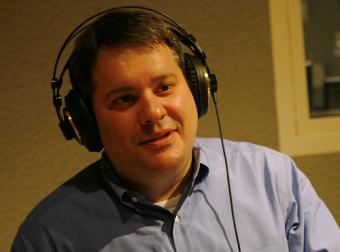 Correspondent: I wanted to ask you about the subject of payola, which comes up multiple times in this book. Eliot Spitzer is, of course, unfortunately now out of the game. But he did do some good things, such as investigating the relationship between the promoters and the radio conglomerates. One of the most condemning documents revealing Clear Channel’s “pay for play” policy was when an email from Sony’s Epic label basically asked, “What do I have to do to get Audioslave on WKSS this week? Whatever you can dream up, I can make it happen.” Now there was extraordinary payola in all these instances. Sometimes as much as $400,000. But if you are a promoter, you are always going to have to deal with payola on some level. Whether it’s a fruit basket. Whether it’s a free CD. I mean, what is the maximum level of what we might call payola? Inarguably, I bought you this coffee that you’re enjoying right now. So are you perhaps — is this payola? I don’t know.
Foege: Well, it’s good that you just disclosed it.
Correspondent: Yes!
Foege: That’s a step in the right direction. And I guess I didn’t explicitly state that I wouldn’t talk with you if you didn’t buy me a cup of coffee. And I did offer to pay for the cup of coffee as well. You know, the funny thing about payola is that it’s existed since the beginning of radio. I mean, radio has traditionally been a pretty dirty business. It was before Clear Channel existed. It continues to be. A lot of people in the business that I spoke to said payola always exists in some form. Every once in a while, it emerges into the public sphere. And somebody like Eliot Spitzer comes along and tries to have some effect on it. But for whatever reason, people trend back to their bad habits again. And the corruption begins again. The interesting thing about payola is that I think, particularly in the modern era, it’s had a very insidious effect on radio. Because one could argue that it’s not good for radio stations and radio companies. Sure, there are payments involved. But as Clear Channel was wont to argue, when it was sort of caught up in all this, even with the large sums that you mentioned, if you look at the total revenue that Clear Channel now brings in, those are hardly numbers that would matter to them overall.
But the insidiousness comes in the fact that, first of all, ostensibly radio stations are attracting listeners with songs and music that they want to hear. Of course, payola tips that scale and simply has people at record labels paying to get particular artists and songs on the air, whether people want to hear them or not. Or whether there’s any criteria other than the payment to get them on. So arguably, you could say that radio stations can lose listeners if they’re embroiled in payola. And it’s just crappy music that nobody likes. Which certainly has come up in the past.
The other thing is, obviously, payola hurts artists. And in combination with all the other tactics that Clear Channel employed, as it got larger, to cut costs and to streamline their overall operation, payola was yet another part of the equation that essentially cut out most emerging artists. Because how could they compete against songs that were simply on the air because people were getting paid off.
The only interesting thing about this is that payola is a very difficult crime to explain to the average person. Because, of course, some variations on what payola is exist in different kinds of venues. A classic example is when you walk into a supermarket, and you see a big pile of Rice Krispies up at the front of the row.
Correspondent: Yeah. Co-op.
Foege: Few people realize that Kellogg’s paid to have that stack put there. And that also happens to not be illegal. The reason that it’s illegal when it comes to radio is because radio, through the FCC, has a federal mandate. The airwaves are owned by the public. So this is a corruption of the public’s airwaves when these payments are made. And so that’s where the crime is involved. Because there’s an acknowledgment there that mass media, because of its power and influence, is different from boxes of Rice Krispies at the supermarket.
BSS #246: Alec Foege (Download MP3)
Listen: Play in new window | Download

Studs Terkel is dead. And the radio world as we now know it has been permanently altered.
When I heard the news, I felt a horrible lump within me bunch up and plummet to the floor. I had been talking up Terkel only yesterday, openly contemplating to friends whether today’s podcasters and staid NPR types — who seemed narrowly concerned only with those caught within their fifteen minutes of fame — would even come close to Terkel’s deep and wide-ranging interest in people of all types. The only guy among my generation who has come close to Terkel is possibly Benjamen Walker, whose excellent Theory of Everything program is now sadly defunct. And over the past few months, I’d likewise been pondering whether I had an obligation to expand the range of my own program to include more people outside the cultural world.
Terkel demonstrated with his great journalistic genius that everybody had a hell of a story, that everyone was part of history, and that with enough curiosity, you could find the insight in damn near anyone.
He documented working people in a way that nobody on radio has been able to come close to in the past several decades. He provided an invaluable history of the Great Depression. One could listen to any of Terkel’s interviews and feel immediately humbled, almost insignificant by comparison. He brought so much life to the interviewing form, unfurling so many unexpected details in his subjects. The train hopper who described the way in which he packed hot dogs into his clothes to avoid starvation. The behavioral specifics devised and brought about by existing within an epoch.
Anybody interested in people would do well to revisit Terkel at length. This was a man who changed the rules of oral history. This was a man whose prolific professionalism simply asked us to look deep inside ourselves, and see the people around us. And I don’t know if we’ll see the likes of him again for some time. But his passing signifies that we all have to do much better.
(Image: Robert Birnbaum)

Neal Stephenson appeared on The Bat Segundo Show #245. Stephenson is most recently the author of Anathem. It is not known whether or not he “likes cake a lot.”
Condition of Mr. Segundo: He likes cake a lot.
Author: Neal Stephenson
Subjects Discussed: Seven as the ideal number of guests for dinner, William Gibson, the shift from the near future to the past, Cryptonomicon and the Baroque Cycle, science fiction about the alternative present, the various manners in which one interprets information as forms of discipline, Kurt Godel’s life at the Institute for Advanced Study, Platonism, Edmund Husserl, the Kantian influence in Anathem, units of measurement, Gene Wolfe, the use of “runcible,” using very old words to avoid the high tech feel, “aut” and auto-da-fe, devising quasi-Latin lingo, Riddley Walker, learning new words as an essential part of the experience of literature, considering the general reader, devising a script that went through the entire text to determine how many words were invented, concocting an intuitive vernacular, cognitive philosophy concerning the fly, the bat, and the worm inspired by Husserl, reader accessibility, My Dinner with Andre, the danger of getting caught up in an invented world, the snowscape journey as a side quest, finding humor in unexpected places, Ras as the anti-Enoch Root, Robert Heinlein’s YA novels, Ras’s perception of music, music and mathematics, literal and figurative meanings, Max Tegmark’s The Mathematical Universe, creating a metaverse and happy accidents, being “family-based” and types of relationships within the Avout, Laura Miller’s suggestion that Anathem is “a campus novel,” use of the first-person, narrative constraints, criticism about women as nurturers, female characters, and the risk of writing books about ideas.
EXCERPT FROM SHOW:
 Correspondent: Going back to the idea of the general reader, or the common reader — whatever we want to call the audience here — the philosophical proposition involving the fly, the bat, and the worm expressing basic cognitive abilities, and how cognitive abilities come together so that humans are a higher form of animal than other animals, this was a very clear way of expressing this particular concept of individual senses. And I’m wondering if this was something that you concocted. Or that you took from Kant. Because I actually tried to find a philosophical precedent for this as well.
Stephenson: It’s more from [Edmund] Husserl. So Husserl was an amazing guy who could just sit in his office and look at a copper ashtray, and then write at great length about all of the processes that went on in his mind when he was perceiving that ashtray, and recognizing it from one moment to the next as being the same object. And so he’s got a number of lengthy books about this, which, as you can imagine, are pretty hard to read. So the content of the dialogue, or the parable you mention — the fly, the bat, and the worm — really comes from him. But it’s me trying to write a somewhat more accessible version of similar ideas.
Correspondent: So you really wanted to be accessible in some sense, it seems to me.
Stephenson: In some sense, yeah.
Correspondent: Well, what sense exactly?
Stephenson: (laughs) Well…
Correspondent: If the reader doesn’t matter and, at the same time, there’s this accessibility here, it seems…what’s the real story? (laughs)
Stephenson: Oh no. The reader matters. The criterion is very simple. It’s got to be a good yarn. If it’s not a good yarn, then the whole enterprise fails. So I think that to have a good yarn, you’ve got to have characters that people are interested in. And they’ve got to get into situations that make for a good story. It’s okay to stop the action and have them sit down and have an interesting conversation. You know, for some reason, I always go back to the movie, My Dinner with Andre, which is a long movie consisting of two guys just sitting there talking with each other. But it’s a completely engaging and fascinating movie. That’s kind of an existence proof that you can build a good yarn that consists largely of people just having conversations. And so that was kind of my guiding — that was my guideline, I guess you could say, for trying to work that material in.
BSS #245: Neal Stephenson (Download MP3)
Listen: Play in new window | Download