Obama Begins the Sellout Phase of His Campaign

It started earlier this week when Barack Obama became the first presidential candidate to forgo public money. It continued yesterday when Barack Obama pledged support for the FISA “compromise” bill, which grants telecom companies immunity for past offenses of illegal wiretapping, and issued this appalling statement. With Senator Harry Reid flip-flopping over his “total opposition to immunity” to save Obama’s ass, it is becoming quite apparent that the Democrats are once again content to take on the instincts of frightened little animals. And it’s a pity that all this comes immediately after Dennis Kucinich’s efforts to move impeachment articles through the House Judiciary Committee. Obama’s Clintonian spin on the telecom bill represents the acts of a pusillanimous opportunist. The rest of us, pining for the integrity that led us to Obama in the first place, feel sick to our stomachs.

Meanwhile, Senator Russ Feingold, one of the few Democrats demonstrating some capacity for outrage, has called FISA “not a compromise. It is a capitulation.” One might say the same of Obama’s recent decisions.

[UPDATE: Some additional context from BLCKDGRD.]

The Bat Segundo Show: Sarah Hall

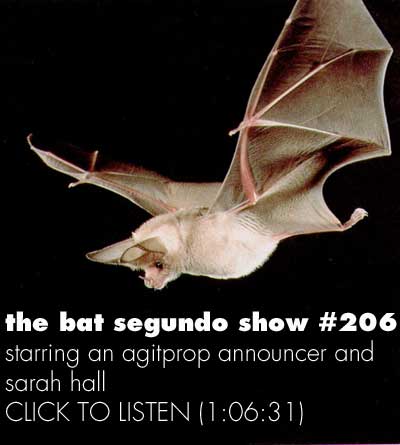
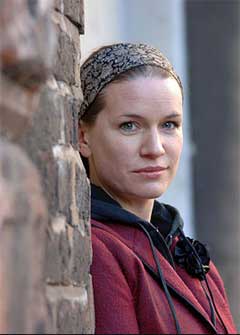
Sarah Hall appeared on The Bat Segundo Show #206. Hall is most recently the author of Daughters of the North (published in the UK as The Carhullan Army). My essay on Sarah Hall can be found at the B&N Review.

Condition of the Show: Remaining optimistic about a dystopian future.

Author: Sarah Hall

Subjects Discussed: Daughters of the North vs. The Carhullan Army, writing books that aren’t set in the present day, concern for environmental details, the comforts of familiar territory, catastrophe knocking everything to the past, the wandering impulse within British dystopian novels, Rupert Thomson, Anthony Burgess’s The Wanting Seed, the tension between town and country, literary conversations and outdoing Margaret Atwood’s sense of terror, overcoming perceptions associated with women writers, Samantha Power’s castigation, being overly scrutinized, presentation of the author, the authenticity of testimony, writing a pageturner vs. a leisurely literary novel, being more selective with sentences, writing within confining environments, switching to first person, the origins of the Nixon surname, characters with reddened faces, rural words, Brave New World, names that echo across history, the origins of Rith, schools and buildings that shut down after centuries, Ursula K. Le Guin’s “The Ones Who Walk Away from Omelas,” the dog box and the military training that inspired it, a microutopia within a macrodystopia, nitpicking the apathy within Daughters of the North, the possibilities of revolt and verisimilitude, manipulating the reader and gray areas, violence that occurs offstage, women and violence, bumps on heads, the beauty of corporeal flaws and dilapidated environments, how society transforms the body, To Kill a Mockingbird, Robert C. O’Brien’s Z for Zachariah, sudden relationships and getting to the naughty bits, pornography, the risks of thinking on the page, and romance.

EXCERPT FROM SHOW:

Hall: I think familiar territory is always of comfort to a writer. I find the North of England, where I’m from, fascinating. It’s a very dramatic landscape. It’s kind of a Wordsworth country. So you’ve got the Romantic sense on one hand. And then you’ve got the strange past battling with the future. I suppose Hardy did this to an extent as well. You pick a territory. And even if it’s rural, you have human beings working within that arena. So human drama is going to arise out of those interactions. And I’ve always felt, even though the settings are sometimes quite remote and underpopulated in my fiction, there’s enough going on. You can explore ideas of civilization, breakdown of civilization, human emotional dramas. All the rest of that. But I think what’s interesting with Daughters of the North is — even though we’re casting ahead maybe thirty, forty years from now — and I think British science fiction and speculative fiction does this a lot — there’s this idea of play. When catastrophe happens, everything is knocked back to the past. And so here is what you’re left with. Day of the Triffids. This strange science fiction going on. But at the same time, everybody’s going down to the pub like they always have.

Why There Will Be No Roundup at the Stroke of Midnight

The roundup could have occurred. But since I have become reliant upon Bloglines for my influx of information and since I have attempted to be somewhat neat in the way I organize my many feeds through this process, this attempt at organization has resulted in my downfall. I intended to merely click the boxed plus box to expand the Books section of my feeds, but I somehow clicked the word “Books” instead, resulting in Bloglines opening every single goddam one of the hundred or so feeds that I rely upon in the framed window.

Bloglines does not have an undo function for this.

Thus, any new information I receive from the blogosphere will have to wait until time has passed.

I suppose I could mark everything as new. But I am too lazy to do this. And I would have to systematically do this for each blog.

I suppose I could switch to Google Reader. But since there is no Bloglines export, this will involve work. I am also too lazy to do this.

Thus, because of a foolish misclick and laziness on my part, there shall be no roundup at the stroke of midnight. I am sure there are interesting stories, blog posts, and other assorted information I missed.

My dog also ate my homework.

A relative is dead.

I believe I may have come down with something, but you will not hear it in my voice.

I’ve had a personal emergency. (I’ve used this excuse before and when I have arrived at work the next day, I remain silent and appear morose, maintaining a very serious expression. The idea here is to suggest by this appearance that something serious and possibly life-threatening has happened and, if co-workers pry, you can let loose a casual detail. Some perfunctory detail about a fistfight with the fuzz. Some blur about hundreds of dollars gone. As excuses to miss work go, this one is probably the best and the least subject to question.)

My dog drank from the poisoned tap water.

He tried to molest me while installing cable.

I had a severe operation at the hospital. Don’t worry. It won’t affect the health insurance rates.

There is a loud beeping in my head. (I like this excuse better than “I have a migraine,” which is strangely unconvincing even when it is true.)

They shot up the guy next door and the police are holding me for questioning.

I anticipate oversleeping by about eight hours.

Bloglines has a bullshit interface.

[UPDATE: Okay, some initial experiments have begun with Google Reader. Have managed to export from Bloglines. Thanks to the commenters!]
The Bat Segundo Show: Errol Morris

Errol Morris appeared on The Bat Segundo Show (#205). Morris is most recently the director of Standard Operating Procedure. (There is also an accompanying book written by Philip Gourevitch.)

Guest: Errol Morris

Subjects Discussed: Susan Sontag’s “Regarding the Torture of Others,” the American cycle of photographing physical abuse, finding out what we’re looking at before drawing conclusions, the differences between a still image and a moving image, reenactments, guiding the viewer’s ability to map reality, Comte de LautrĂ©amont, misinterpreting Crimean War photographs, the milkshake toss in The Thin Blue Line, basing an illustrated montage on a line from an interview, Sabrina Harman’s thumbs-up gesture, Harman and the Cheshire cat, Paul Ekman, perceiving the bad apples, what makes Morris angry, little guys taking the blame, Morris’s fondness for pariahs, extending understanding, whether flying subjects into Cambridge creates truth, Shoah, and Werner Herzog.

EXCERPT FROM SHOW:

Correspondent: I actually want to bring up your most recent article for the New York Times, in which you delineated the difference between a single image and a moving image, in the sense that a moving image involves trying to create a map of reality. Because you’re not paying consistent attention to the actual moving image. But here you are with a film that has reenactments as well as interviews. And so I’m wondering: to what degree do you guide the viewer’s sense of mapping reality? Or is this a kind of cinematic device that is similar to, say, for example, the writings of LautrĂ©amont in which he has this narrator who guides the reader and this is your effort to help out the viewer through the reenactments and through the juxtaposition and through the editing?

Morris: I think it’s both. I’ve never been compared to LautrĂ©amont before. Here’s what I would say. There’s a movie. A movie is a movie. But you can also ask what is behind the movie. Was my intention to investigate the story? Was it my intention to find out new things? It’s self-serving of me to say so, but I would say yes! I mean, what’s the idea here? The idea is there is this set of photographs. They’ve been shown all around the world. Hundreds of millions of people have seen these photographs. I don’t think that’s an exaggeration. But do we really know what we’re looking at? Has anyone talked to the people who took the photographs? What actually was going on in the photographs? I’ll give you an example. One picture that Susan Sontag remarks on is the picture of Sabrina Harman with her thumbs up. Smiling. The body of an Iraqi prisoner. Al-Jamadi. A lynching? I would say yes. But who is responsible? You look at the picture and you think, Ugh! It’s the woman in the picture. The smile! The thumbs up! She’s the culprit. She’s implicated. We come to find out. Wrong! Wrong! So this is an ongoing problem that I have with how photographs are interpreted in general.