Nikil Saval (The Bat Segundo Show #544)

Nikil Saval is the author of Cubed and an editor at n+1.

Author: Nikil Saval

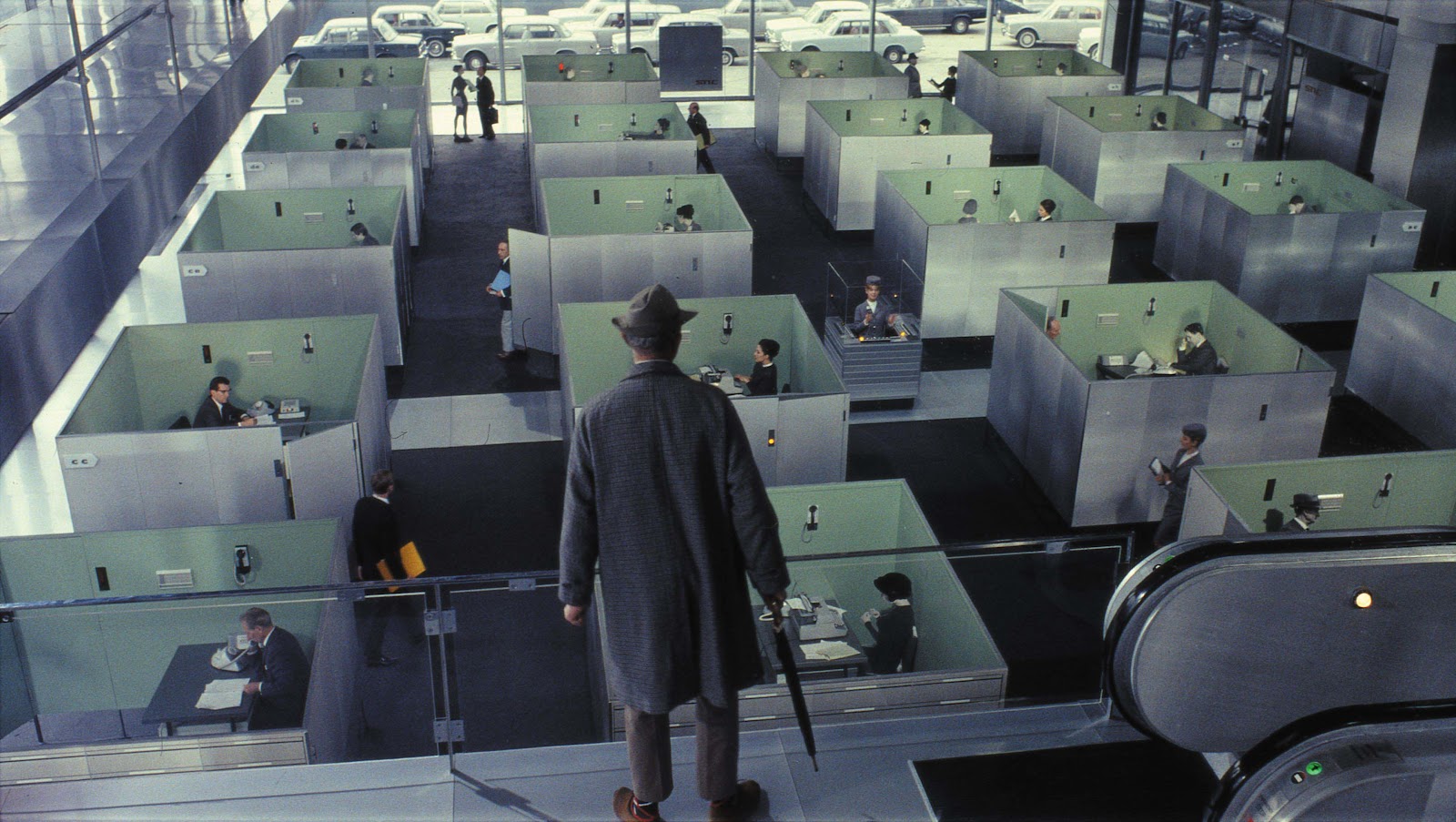
Subjects Discussed: Karen Nussbaum and the Nine to Five movement, 9 to 5 as the template for the office comedy, whether the office workplace is permanently stacked against the worker (and attempts to find hope), the beginnings of human resources, the Hawthorne effect, efforts to control workers through close supervision, attention to light and the beginnings of office architecture, the National Labor Relations Act, attempts to organize office workers in the 1930s, anti-immigrant sentiments and racism among white collar workers, unions and white collar workers, why workers feel empowered when they have nothing, the rise of freelancing culture, Richard Greenwald, how office work creates the illusion of giving the worker mastery over his fate, the Bürolandschaft ideal, Robert Propst, Action Office, the historical beginnings of the cubicle, attempts to track down the guy who first closed partitions into the cubicle, Norbert Wiener and cybernetics, King Vidor’s The Crowd, Jacques Tati’s Play Time, futile attempts to photograph “action” in offices, sitting up and standing down, healthy activities in the workplace, Propst’s failed three wall ideal, Herman Miller propaganda and Action Office possibilities, when George Nelson was jilted from the office furniture plans, how changes in the broader culture influenced changes in office culture, managers pulled from offices and deposited in cubes, Barry Lyndon, the impact of mass layoffs, the recession of the 1980s and its impact on white collar culture, when the cubicle became associated with transience, the lack of privacy in the workplace, why European countries revolted against office layout while Americans stayed silent, Frederick Taylor and Taylorism, Taylorism’s rise and fall and second rise, Louis Brandeis’s popularization of Taylorism through “scientific management” (used in his argument of the Eastern Rate Case of 1910), Taylorized families, Harry Braverman, the beginnings of human resources, Taylorism vs. eugenics, Stephen Jay Gould’s The Mismeasure of Man, Douglas McGregor’s The Human Side of Enterprise as an anti-Taylorist tract, Andy Grove’s Only the Paranoid Survive as a return to Taylorism, Robert Waterman’s In Search of Excellence, perpetuating familial attitudes in the workplace, advertising and irony (and parallels to Taylorism), Taylorism vs. Taylor in Planet of the Apes, Frank Lloyd Wright’s Larkin Building, natural light and the early forms of air conditioning, surveillance by overseers that is perpetuated in workplace architecture, zombie-like accountants, the ethical question of happy workers, the beginnings of glass buildings, Le Corbusier and urban planning, the Lever House, when glass curtains won over Lewis Mumford, Vico cycles, how offices may be returning to their original counting house forms, the Sony Tower’s transformation from work units to residential units in the next few years, the question of workplace architecture becoming an ineluctable and oppressive threat on the way we live, mistaken impressions of Marxism spouted by philosophers, companies spending less on office space, developments in living space and workspace, laptops in cafes, freelancers and co-working facilities, the upward presumptions of clerks, and how once stable labor conditions have become a fantasy.

EXCERPT FROM SHOW:

Correspondent: We are, in fact, talking in an office. So I’m not sure what that does to this conversation. But we’ll, I suppose, make amends.

Saval: I know. Well, at least it’s a private office and not a cubicle. Because that could be a…

Correspondent: Or an open office for that matter.

Saval: Or an open office. God.

Correspondent: Well, let’s get right into it. Back in the late 1970s, Jane Fonda met Karen Nussbaum, a remarkable figure who organized women clerical workers in this Nine to Five movement. And Fonda and a screenwriter spent an entire evening talking with 40 office workers. This became the basis for the wildly popular movie 9 to 5, which arguably set the template, comic wise, for Office Space, The Office, and, of course, most recently Silicon Valley. As you point out in the book, some of the proposed remedies at the end of that film — plants, rearranged desks, flextime, day care at work — they actually reflect what’s know as the Bürolandschaft ideal. And we’ll get to that in a bit. But, you know, this has me wondering if there is something permanently broken about the office. Is it possible that any attempt to remedy it or improve it is almost this kind of neoliberal trap? What hopes do we have for the worker? Or is the deck permanently stacked against her?

Saval: (laughs)

Correspondent: Just to start off here.

Saval: So softball.

Correspondent: It was such a wonderfully bleak book that I had to have a vivaciously bleak opener.

Saval: Gosh. I wish I could just say, “No no no. The story’s happy. It has a happy ending.” You know, I don’t really mean to say that the workplace is permanently broken. I guess I do want to say that the kind of repeated — as you pointed out, there’s a repeated attempt to make work better, usually through design but also through other kind of arrangements in the workplace. Architecturally and what have you. And a lot of these go wrong. And some of them go spectacularly wrong; the most famous being the office cubicle. And I think the point there is not just that the office seems to be broken, but that there is some sense of an idea of how work might be better and there is an idea of somehow you might be able to organize it better, somehow work might be more free, workers might have more control over their work. Things like that. And usually these are sort of fatally disabled by — I mean, it’s not always the case, but usually, roughly, it’s a presumption that these designers or planners know what’s best for an office worker. And there’s usually something imposed on an office worker. Or there’s a plan that starts out really well and then when it’s replicated ad nauseam, it goes wrong or it doesn’t even strike at the heart of what’s wrong at work and they try to design a way things are more fundamental to the issue of the workplace.

Correspondent: But as you also point out in the book, there is this brief moment for the worker — and perhaps it’s an illusional one or a delusional one — where you have a situation when suddenly there is care about what the worker thinks and how the worker can behave, as opposed to how the worker should behave. And I’ll get into Mr. [Frederick] Taylor in a bit. But what accounted for that particular moment, which was roughly around 1929 and up through about the 1950s, before yet another ideologue came in and had ideas about what to do for the worker and for the workplace?

Saval: Well, yeah, that’s, I guess you could call it, the human relations movement. That was the idea that…

Correspondent: That’s the 1960s of the office. (laughs)

Saval: Exactly.

Correspondent: That’s the hippie idealism, I suppose. That period.

Saval: Yeah. And it comes out of a lot of different sources. And one was just the office, but it was also the workplace. It took hold on factory floors as well. And the idea was just that workers needed to be in corporations that somehow ostensibly cared for them. It came out of what was known as the Hawthorne experiments, which are a famous social science experiment where they tried in the Hawthorne Works to experiment with different lighting levels and to see how this affected the way people worked. And what they realized was that actually there wasn’t a direct connection. It wasn’t that the light got better and workers worked better or got worse and workers worked better. It was just that when workers thought they were being watched — at least this was the conclusion — they felt like the company cared about them. And therefore they worked better. And so, especially at a time — this was not so true in the ’20s, but certainly in the ’30s this was true — when there were union movements, when there were the high points of the American labor movement, corporations and companies just felt that things were not going their way and they did not want unions in their workplaces. And so they thought, “Well, we just need to become more familial. We need to care more. We need to manage more lightly. We need to think of our workers’ psychology, not just their efficiency and their productivity.” And I think this results in all kinds of changes in the workplace. I sort of argue that even the architecture of the workplace somehow reflects this desire to make work better, to make workers feel more at home. Maybe with the mid-century corporation, I think I suggest that with things like the Lever House, the Seagram Building, the attention to light and to design and the explosion of design at that time in the workplace — even the idea that a workplace interior should be thoroughly planned and designed — I think reflects this attempt to make workers happy.

Correspondent: Do you think that many of the behavioral psychologists and these people who were looking into lighting were thinking very much about unions? I mean, we often forget from our — well, to get into the decline of labor in the 21st century is another can of worms, but we often forget from our vantage point now how much pull labor had in the early 20th century. And I’m wondering, in the attempt to determine how workers were feeling, how much was that a presence? How much was that a motivation? Or was it simply just innate curiosity? Or the kind of touchy-feely vibe we were implying earlier?

Saval: You know, certainly with industrial workplaces, it was definitely, absolutely a fear. Partly because union organizing, it just spiked, especially after the passage of the Wagner Act, the National Labor Relations Act. With the office, I don’t think there was a huge worry about it. I did some, to me, very fascinating but probably to other people very tedious archival work where I looked into the proceedings of the International Association of Office Managers, or rather I think it’s the National Association, and there’s a point in the ’30s when they really express worries about this and they think, “Well, it’s really taken a hold on factories and even some offices are starting to unionize.” And there actually is, more than there used to be, in certain publishing houses. The New Republic organizes at the time, with something affiliated with the Communist Party. And so you have people talking about how the last redoubt of capitalism, the place where individualism thrives. The office. Even this is under threat. And so we really need it. I mean, once this goes, I think there’s a little bit of a sense that — and again it was not so widespread, but they were definitely afraid, I think.

Correspondent: Well, you do in fact quote the possibly apocryphal Samuel Gompers line, “Show me two white collar workers on a picket line and I’ll organize the entire working class.” Why didn’t office workers latch onto labor? You suggest that there is this assumption that their talents and their skills could in fact give them an independent shot. And I suppose, I guess we see the natural offshoots of this kind of libertarian impulse with some of the tech entrepreneurs that came later. But I’m wondering. Why couldn’t there be some sort of confluence here? Because it seems to me that everybody here had the same interests in mind.

Saval: Yeah. This is sort of the central contradiction of the white collar workplace. I mean, it’s just that there is, on the one hand, you have this ideal of this perfect meritocracy, that certainly the managers talk about this in their association, that you can rise — and this was true in the early antebellum offices especially. And it made more sense then. If you were a clerk, you would become the partner of that firm. And that lasted even past the point that that was true. When some offices became much larger, business became bigger and there were only so many places at the top and many more places at the bottom. So it was just less and less likely.

Correspondent: Toil long enough at the firm and you will ascend to heaven when you’re dead.

Saval: (laughs) Right.

Correspondent: It’s a very familiar promise.

Saval: Right. Exactly. So the way that persists is partly that there’s just a lot of — that it makes sense. It was true for some people. And that had some effect. It made people think that it was true in the office. There’s something about the prestige and status of white collar work that has made it different from blue collar work, especially in the U.S. politically. It just seems like it’s cleaner. The work often required a high command of English. So when there were a lot of high waves of immigration into the United States, there weren’t a lot of immigrants working in white collar workplaces. So there was a kind of homogeneity. And then, of course, also it was very male up to a point. And then when women entered the office, they often entered into the steno pool, a typing pool, to jobs that didn’t have high levels of prestige so that men could feel themselves above in a way, could still feel like they were middle class even when they maybe weren’t. And the other thing — and I talk about this a little bit in a chapter about the skyscrapers — was that there were not a lot of appeals on the part of unions or political parties in the U.S. to white collar workers. It was not clear how to organize them.

Correspondent: It was not clear how to get through to them.

Saval: Yeah. Exactly. The whole model was predicated on industrial organizing. And this doesn’t mean that it didn’t work in a number of cases, a can of worms which I don’t deal with which is the public sector. Because I think it’s a different animal. Can of worms. Animal. Anyway.

Correspondent: Let’s mix as many metaphors as you like. (laughs) But this leads me to wonder. Why couldn’t these very dedicated labor unions get through to the white collar worker? I mean, they had — and again I cannot understate this — they had incredible power at the time.

Saval: Right.

Correspondent: How could they not actually have the communication skills or the fortitude or even the ability to massage their message? Why couldn’t they get through? I mean, they did try. There’s an AFL magazine article you quote, addressed to the white collar workers, where essentially the author says, “Hey. Look after yourselves. You want to think about the future.” But it seems to me that they needed to go further. I mean, what was the disconnect here?

Saval: You know, it just seems like a number of things. One was just the persistence of the idea that upward mobility was a given. And in periods where there are high levels, it’s mainly growth. I think of times like the 1920s, even when inequality widens, union influence starts to dip after a kind of high point in the late 1910s. And then in the ’30s, the union influence in the office increases. Because white collar unemployment becomes a real thing. But then it dips again in the ’50s and then it starts to spike up in the ’70s. And then actually in the ’80s, when things really actually go wrong for a little bit.

Correspondent: With Reagan and the air traffic controllers.

Saval: Yeah. And then it hasn’t really — I mean, you would think that and you would think now in the last four years that it would increase. I feel like I’ve read of isolated cases. But it’s not a trend. There’s a union organizer who I quote, writing in Harper’s in the ’50s — he’s an anonymous organizer — about why white collar workers can’t be organized. And he seems to think that there’s a way in which white collar workers see themselves, even though they are exploited. He says they are the most exploited workers in a certain way. But they see themselves as possessing certain skills, whereas an assembly line worker will talk about the industry that he works in. “I work in the auto industry.” Whereas a white collar worker will refer to his or her profession. “I’m a stenographer” or “I’m a typist.” “I’m a bookkeeper.” And that way of talking indicates that you’re able to move. That you have a skill that other people prize. And I don’t know if that’s a sufficient reason for people not to organize. But it sort of means that you need to talk about different things. And it’s not always the case. People do organize. It has happened. But this was his reason anyway.

Correspondent: In other words, with this particular notion, the suggestion is that one had a kind of linguistic independent identity. One had a label to hold as his own, whereas the organized worker would relate to an industry. This leads me to wonder why that notion of independence was, number one, so appealing to the worker and, number two, why they didn’t see, especially after toiling for many decades and not getting anywhere, that it was all a sham.

Saval: Yeah. It remains a sort of intractable question. But the notion of independence is powerful. And you even see that now in the rise of freelancing or contract work, which I do not want to attribute that too much to people choosing to do that all the time. I mean, there is a lot of it.

Correspondent: The sexiness of having to go ahead and pay for your own health care. Having to look for pennies under the couch. It’s just such a remarkably romantic ideal, isn’t it?

Saval: It’s so freeing. It’s liberating. But on the other hand, there are people who choose to do it. And what they’re seeking is a certain kind of freedom and autonomy over their work.

(Loops for this program provided by Martin Minor, MaxJC, danke, ozzi, 40a, ebaby8119, and Dokfraktal. )

The Bat Segundo Show #544: Nikil Saval (Download MP3)

This text will be replaced

Evie Wyld (The Bat Segundo Show #543)

Evie Wyld is most recently the author of All the Birds, Singing.

Author: Evie Wyld

Subjects Discussed: The Call of the Wild as workplace novel, the stability of work in wild environments, physical labor and working in bookstores, coming from a family with a farming background, the engineering mindset, the virtues of being a messy writer, the interest in what we hold back, having to write moments that aren’t revealed to the reader, the dangers of creative pride, how to organize a messy 60,000 words on a floor using scissors and tape, structure and certainty, hating your book, attempts to write linearly and literally, the virtues of an innate rebellious streak, when flashbacks become integral to structure, the many insects within Wyld’s fiction, how horror films are more willing to dramatize the relationship between humans and animals, Jeffrey Lockwood’s The Infested Mind, entomophobia and Western culture, why sharks are misunderstood, Australian insects, Holiday Cigarettes, the autonomy of smoking, attempts to find control over your environment, kangaroos hit by utility trucks, appreciating life by confronting death, why kangaroos are mutinous, dogs vs. kangaroos, animals and social projection, sheep, when kangaroos stop being cute, pet kangaroos, when giving a character a job is the hardest part of fiction, sheep shearing pubs, farming pubs, sheep integrity, Ernest Hemingway, Robert De Niro and Method writing, imagination vs. process writing, getting bogged down in research, notes and memory, characters with palindromic names, bidirectional retreats to the past, how to get around writing boring scenes, romantic notions of writer’s block, why it’s important to write drivel, thinking on the page, despising the manuscript and knowing the moment when it needs to be plucked away, happy nightmares, families of solitary figures, eccentric exercise regimens, the back as a footstool, sheep killing as an ambiguous mystery, the Pulp Fiction briefcase, the appeal of monsters, the pros and cons of setting up reader expectations with a mystery, Stephen King’s It, disappointing endings, why seeing the monster isn’t relevant in storytelling, narrative entitlement, how novelists contend with increasing reader distractions, Arnold Schwarzenegger, the Venn diagram of genre and literary fiction, the advantages of working as a bookseller, Richard Flanagan’s The Narrow Road to the Deep North, Wyld confronting her dead father’s records in the bookstore database, having a healthy suspicion of lists in a BuzzFeed age, Keith Richards’s Life, and the benefits of accidents and coincidences.

EXCERPT FROM SHOW:

Correspondent: I had a rather strange way of entering this rather raucous novel. About three years ago, another critic Matthew Battles and I, we were having this online conversation about The Call of the Wild. And we were both arguing that Jack London’s great novel was actually a workplace novel. Because Buck, he’s forced to contend with the aggressive cubemate, like Spitz, and essentially he has to find individualism and this independent work ethic over the course of his journey. Your book happens to involve two dogs — one of them actually named Dog — and Jake has to learn sheep shearing and driving skills during her journey. Why do you think work became such a dominant part of this novel’s fixation in your efforts to contend with these rather feral environments, both in Australia and in England?

Wyld: Well, I think work is a way of normalizing yourself. It’s a way of getting yourself away from the stuff that’s actually happening in your life. A way of processing it. So I think for Jake, handling sheep is very much who she is. She expresses herself through wrestling with sheep and trying to keep them alive. And she tries to kind of make amends for some of the things in her life by working really, really hard and working very hard at looking after these sheep, trying to keep them alive, failing a lot of the time.

Correspondent: Why do you think it’s tied so much into the idea of existing in this kind of wild environment? That’s the real question. Why work is the defining quality of a naturalistic environment.

Wyld: I think it keeps you sane in some sense. I mean, I certainly find. that lives in the wilds of Peckham, where I am in London, I work very, very hard in the bookshop and I work very hard at writing novels. And I think it’s something to do with, as long as you’re working hard, you feel you’re existing in a way that is worthwhile, in a way that you feel like — sometimes you can feel like you’re very transient and that you’re slightly floating above the earth and you’re not really experiencing anything. And you find that if you actually do something physical to kind of make your mark on the earth, then it has a calming effect, I find.

Correspondent: Do you feel that there’s any difference between working in the wild of a bookstore and working in the rather saner, urban environment of sheep shearing?

Wyld: I think probably a fair amount of difference. I think I really admire physical work. I would love to…

Correspondent: How much physical work have you done?

Wyld: Well, I’ve done absolutely no sheep shearing. I don’t know how physical bookselling is. I lift the books.

Correspondent: It is pretty physical. I mean…

Wyld: Stacking shelves.

Correspondent: Stacking.

Wyld: Dusting. The whole lot.

Correspondent: Moving shelves for author events.

Wyld: Wrestling the odd shoplifter to the ground. That sort of thing. But, yeah, I think my mother’s family are Australian and they’re farmers. So it’s always been something that I have looked on with envy and amazement, really. This amazing, quite masculine work. Actually growing stuff. Actually keeping something alive.

Correspondent: Why didn’t you decide to enter the farming racket?

Wyld: Not sure I’m that talented, to be honest. My Australian family aren’t big readers or big intellectual kind of thinkers. But somehow they’re some of the most intelligent people. They can look at a broken tractor and they can fix it. And I find that incredible. And I don’t have that skill. I don’t have the maths, I think, mainly.

Correspondent: The sort of engineering brain to look upon some casual thing to fix and then you’ll be able to find a solution through a MacGyver situation by putting it back together.

Wyld: Put some oil on it. (laughs)

Correspondent: Yeah. Exactly. Well, the novel here is built on a series of alternating chapters. It’s almost this two-lane highway. You have this forward motion in the present and you also have these backwards chapters that depict Jake’s past. I’m wondering how this structure emerged, first and foremost. But how much of Jake’s background did you plan out in advance or come to know in the act of writing? Just to start off here.

Wyld: Well, I’m a very messy writer.

Correspondent: You need structure.

Wyld: Yeah. I tend to start in the middle and kind of work outwards.

Correspondent: Okay. So you just write all over the place.

Wyld: I just write all over the place and then I get to a point where I’ve written a certain amount of words. And I try and find what the story is, what the arc of the story is. So mostly for me the writing process involves getting to know the character. And for me, that involves their childhood, their family. It doesn’t always enter into the story in the end. But it’s central to me that I can’t understand who someone is unless I know about them before the sort of now of the book. So I’d written about 60,000 words. About a third of the book. Maybe half the book. And then I just realized that I was enjoying her as a character and I was enjoying her life in Australia and in the UK. But it was lacking tension. And there was just something really to be gained by folding it over on itself. And I’m a big fan of playing around with structure, only in terms of furthering the story, only in terms of not just for fun but because it’s so exciting to me when you have two objects that shouldn’t go next to each other and they create a third feeling.

Correspondent: Yeah. Did you find that your sense of Jake deepened when you had this structure in place? That you knew here even more intimately than you could ever possibly anticipate knowing?

Wyld: Yeah. I think so. I think there’s something about somebody who is trying very hard not to think about something that appeals to me and that makes me feel that they’re much more human.

Correspondent: It allows you to get outside of your own head.

Wyld: Exactly.

Correspondent: Because you’re sort of a cerebral person and you need something who isn’t a cerebral person to escape to.

Wyld: Yeah. I think there’s definitely something to be said for the things we hold back. I think they’re more interesting than the things we say a lot of the time.

(Loops for this program provided by danke, ozzi, and 40a. )

The Bat Segundo Show #543: Evie Wyld (Download MP3)

This text will be replaced

Yiyun Li (The Bat Segundo Show #542)

Yiyun Li is most recently the author of Kinder Than Solitude. She previously appeared on The Bat Segundo Show #323.

Author: Yiyun Li

Subjects Discussed: Moving on, sustaining characters who inhabit their own mystery while an overarching mystery exists to tantalize the reader, judgment of characters and simultaneous mystery, Edward Jones, working out every details of a story in advance, forethought and structure, the original two structures of Kinder Than Solitude, creating a structure alternating between the past and the present, thinking about a project for two years before writing, William Burroughs’s Naked Lunch, time as a collage structure, photographs as a marker of identity, not really knowing what the characters look like in Kinder Than Solitude, why Li didn’t visually describe her characters, being an internal writer and reader, writing from inside the characters, Ian Rankin not describing Rebus over the course of more than twenty novels, Patricia Highsmith, Joan Schenkar’s The Talented Miss Highsmith, Tom Ripley’s manipulative nature, the dangers of general comments, problems when literary fiction describes objects in consummate detail instead of emotions, freedom and the courage to write about a character’s soul, Chinese Catholics who practiced in secret, priests executed as counterrevolutionaries in Communist-controlled China, underground faith and literary relationships, inevitable bifurcation in exploring an absolute, having to ask the question of whether a sentence is true before setting it down, questioning yourself in everything you do, the allure of family (and the impulse to run away from it), the mantras and maxims that flow through Kinder Than Solitude, coating truth in wise and optimistic sayings, the beauty and sharp internal emotions contained within Elizabeth Bowen’s The Death of the Heart, subtlety and shock in relation to internal character examination, poison as a passive-aggressive form of murder, poison as a muse, Li’s accordion skills (and other revelations), the current American accordion player crisis, “I find your lack of faith disturbing” in Star Wars, when any idea (such as “bok choy”) can be sandwiched into political ideology, notions of planned economy in 1989 China, the personal and the politically being ineluctably intertwined, exploring prohibitions on American political fiction (also discussed in Dinaw Mengestu interview), James Alan McPherson‘s “Elbow Room,” contemplating why Americans are being more careful in discussing the uncomfortable, how the need to belong often overshadows the need to talk, Communist propaganda vs. digital pressures, extraordinary conversations in Europe, considering what forms of storytelling can encourage people to talk about important issues, William Trevor, the intertwined spirit and freedom of Southern literature, Carson McCullers, the flexibility of literary heritage, notions of New South writing, regional assignation as an overstated tag of literature, establishing liminal space through place to explore flexibility in time, despair without geography, feelings and time as key qualities of fiction, writing love letters to cities, James Joyce having to go to Trieste to write about Dublin, and whether place needs to be dead in order to make it alive on the page.

EXCERPT FROM SHOW:

Correspondent: There’s this point in the book where Moran says to Joseph, “Moving on? That’s an American thing I don’t believe in.” And then there’s this moment late in the book where one American is utterly devastated by what she learns about one of the characters. I’ll try not to give it away. All of the inferences she made are essentially thrown back into her face. And I think this novel dramatizes belief culture in very interesting ways. I’m wondering. How is belief formed or reified by a national instinct, whether it is American or Chinese? And how do you think the migratory impulse of “moving on” causes us to believe in people in very harmful ways? How does this affect you as a novelist? Someone who is asking the reader to believe in lies. Just to start off here.

Li: Right. You know, it’s interesting. Because I always say “moving on” is an American concept. The reason I said that was that, right after 9/11, I was so impressed. By the two months after 9/11. All the newspapers were talking about “moving on.” Americans should move on. And for me, that was quite incredible. Because I did not understand what “moving on” meant and that concept.

Correspondent: This is your introduction to “moving on.”

Li: Yes. And so it stuck with me. And of course, Moran borrowed that concept or Moran said “moving on” after 9/11. People talked about moving on. But the national belief, it’s interesting because I think this Western concept of “moving on,” you know, there’s always a second chance. There are always more opportunities in front of you if you just get over this hurdle. Now it’s becoming more an Asian thing. Only in the past maybe three or four years. If you look at not only China but Southeast Asia, Malaysia, Singapore, all these countries start to believe in moving on. We’re not going to stay in any moment. We’re just going to catch this wave of being.

Correspondent: You left out North Korea. (laughs)

Li: (laughs) Oh no. They can’t. So to me, that’s interesting. Because that’s a belief that, as people are migrating from East to the West, ideas are migrating from the West to the East. And, of course, people coming to America are returning to Asia. So there are these waves of ideas. So now, if you look at Chinese or other Asian countries, “moving on” is a big thing. You know, we’re not going to get stuck in a Cultural Revolution. We’re not going to get stuck in Tienanmen Square. We’re just going to move on to be rich.

Correspondent: But the thing about moving on, I mean, it’s used in two senses. You allude to this American impulse of, yes, well we can move on and have a second chance and start our life over. But there’s also this idea of moving on as if we have no sense of the past. That we have no collective memory or even individual memory. And I’m wondering, if it’s increasingly becoming a way to identify the East and the West, is it essentially a flawed notion? Or is it a notion that one should essentially adopt and then discard? Because we get dangerously close into believing in illusion?

Li: Right. I would feel suspicious of any belief and, again, as you said, moving on really requires us to say we’re going to box this kind of memory. We’re going to put them away so we can do something else. And, of course, as a novelist or as a writer, you always feel suspicious when those things happen. Because you’re manipulating memories. You’re manipulating time.

Correspondent: You’re manipulating readers.

Li: Yes.

Correspondent: So in a sense, you become an ideologue as well.

Li: Exactly. So I would say that anytime anyone says, “Let’s move on” or “Let’s look at history all the time,” I would become suspicious. Because both ways are ways to manipulate readers or characters.

Correspondent: So it’s almost as if you have to dramatize belief culture to be an honest novelist. Would you say that’s the case?

Li: Well, I would say it’s to question that belief culture. And I think when you question, there are many ways to question. To dramatize is one way to question. I mean, you can write essays. I can write nonfiction to question these things, but, as a fiction writer, I think I question the belief culture more than dramatizing it.

Correspondent: How do you think fiction allows the reader to question belief culture more than nonfiction? Or perhaps in a way that nonfiction can’t possibly do?

Li: I think they do different things. For instance, I’m not an experienced nonfiction writer. I do write nonfiction.

Correspondent: You can approach this question from the reader and the writer viewpoint too.

Li: I think for me the most important thing to ask as a fiction writer is you don’t judge your characters. So if they’re flawed in their belief culture, you let them be in that culture and do all the things so that the readers can come to their own conclusions. In nonfiction, I feel that a writer needs to take a stand probably more than a fiction writer.

(Photo: Karin Higgins)

(Loops for this program provided by danke, ozzi, decibel, michiel56, and OzoneOfficial. )

The Bat Segundo Show #542: Yiyun Li II (Download MP3)

This text will be replaced

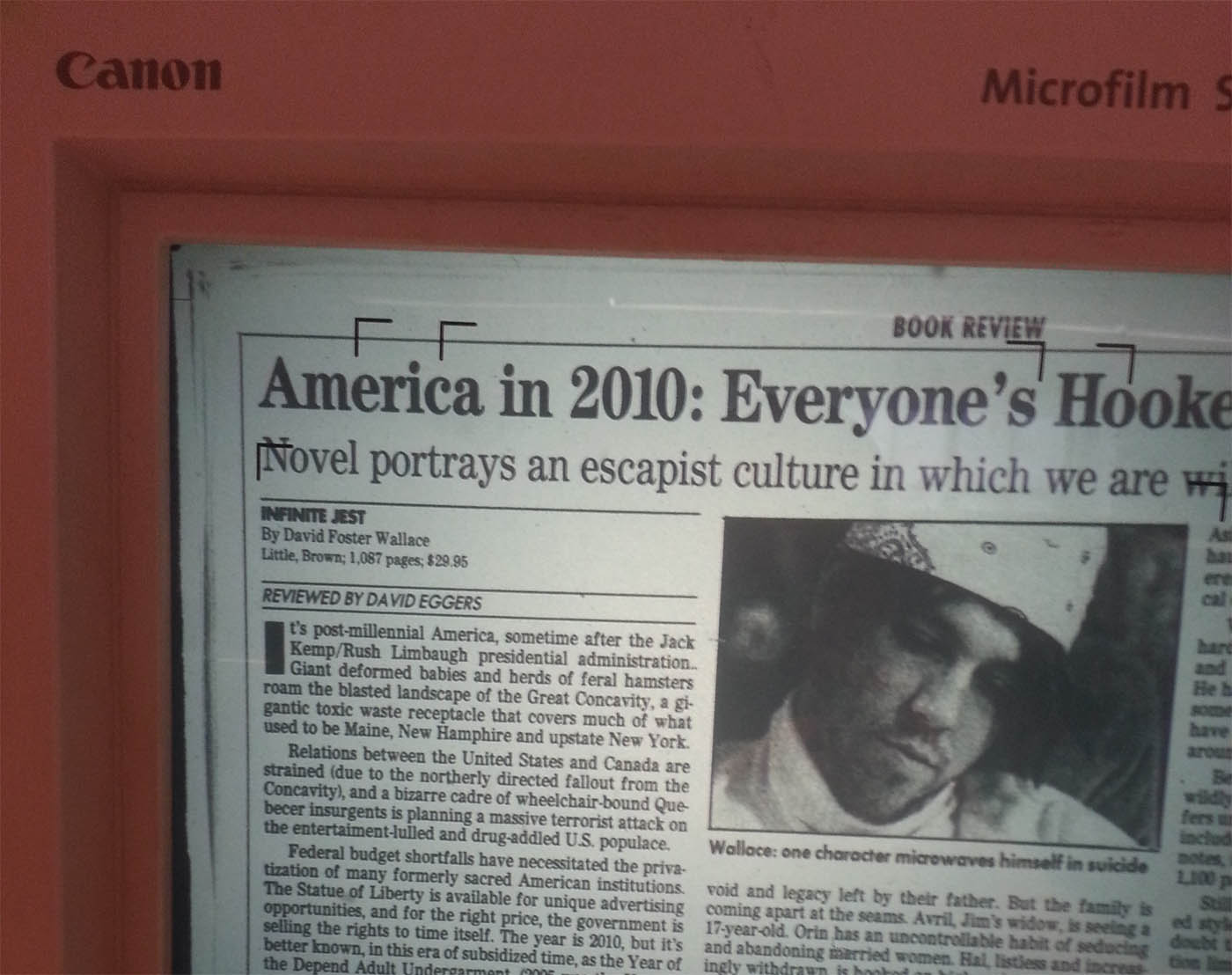
The Infinite Jest Review That Dave Eggers Doesn’t Want You To Read

In 2006, Little Brown published a 10th anniversary edition of David Foster Wallace’s Infinite Jest that featured a foreword by Dave Eggers. Eggers’s introduction observed that Infinite Jest was “1,067 pages long and there is not one lazy sentence. The book is drum-tight and relentlessly smart and, though it does not wear its heart on its sleeve, its deeply felt and incredibly moving.” There was one significant problem with this assessment. It did not match, much less acknowledge, a review that Eggers had written for The San Francisco Chronicle on February 11, 1996, which claimed just the opposite:

Besides frequently losing itself in superfluous and wildly tangential flights of lexical diarrhea, the book suffers under the sheer burden of its incredible length.

Before Eggers was running away at the name “Abdulrahman Zeitoun” rather than attempt adulthood by owning up to the fact that he had turned a man who had ruthlessly assaulted his wife into a hero without acknowledging the darker truth and created a shadowy cash-distributing company called “Jableh LLC” within the intricate framework of an ostensibly philanthropic nonprofit, Eggers was busy trying to hide any nasty writing, or even the insinuation of such, that had come quite naturally from his mind. Eggers has refused to discuss any of this with anyone. Because even at the age of 44, this grown man remains a timid and irresponsible bumpkin who would rather pretend that his writing didn’t harm an innocent woman or whitewash the truth. He has evaded multiple efforts for comment on anything serious, speaking only through a ramshackle army of publicists and lawyers when he’s not attempting to tarnish or derail anyone who he considers “extreme” or not “straightforward.” (Just ask Neal Pollack.)

And he has succeeded in burying his original Infinite Jest review, quite possibly the apotheosis of his risk-averse and coldly vanilla taste. It was originally sussed out in 2006 by the vivacious contributors to the Wallace-l mailing list and further reviewed by the dearly lamented litblog Rake’s Progress. It has not been available in full online. Until now.

What follows is Dave Eggers’s complete review of Infinite Jest as it originally appeared in The San Francisco Chronicle:

AMERICA IN 2010: EVERYONE’S HOOKED ON SOMETHING
Novel portrays an escapist culture in which we are willing to die for pleasure

INFINITE JEST
by David Foster Wallace
Little, Brown; 1,087 pages $29.95

REVIEWED BY DAVE EGGERS

It’s post-millennial America, sometime after the Jack Kemp/Rush Limbaugh presidential administration. Giant deformed babies and herds of feral hamsters roam the blasted landscape of the Great Concavity, a gigantic toxic waste receptacle that covers much of what used to be Maine, New Hampshire, and upstate New York.

Relations between the United States and Canada are strained (due to the northerly directed fallout from the Concavity), and a bizarre cadre of wheelchair-bound Quebecer insurgents is planning a massive terrorist attack on the entertainment-lulled and drug-addled U.S. populace.

Federal budget shortfalls have necessitated the privatization of many formerly sacred American institutions. The Statue of Liberty is available for unique advertising opportunities, and for the right price, the government is selling the rights to time itself. The year is 2010, but it’s better known, in this era of subsidized time, as the Year of the Depend Undergarment. (2005 was the Year of the Trial-Size Dove Bar.)

Such is the provocative backdrop of David Foster Wallace’s brilliant, fat, and frustrating second novel, “Infinite Jest.” Science fiction it’s not. Though set against an epic landscape of environmental toxicity and corporate insinuation, at its core the book is an intimate and bleak portrait of the human fallout caused by a weak-willed country interested only in pleasing itself. Exploring the lives of those enslaved by TV, drugs, alcohol and emotional dependence, Wallace paints a picture, one character at a time, of the decline of a culture paralyzed by its need for escape and its willingness to die in the pursuit of happiness.

Like his earlier novel, “The Broom of the System,” “Infinite Jest” revolves around a peculiar and brilliant family. The Incandenzas are proprietors of the posh Enfield Tennis Academy, a combination athlete factory and elite academic high school. Jim Incandenza, the eccentric and hard-drinking Academy founder and family patriarch, has, after failing in his attempt to make it as a filmmaker, recently killed himself by sticking his head in a microwave.

His three sons — Orin, a celebrated punter for a pro football team; Mario, who has a birth defect and a heart of gold; and Hal, a linguistic genius and nationally ranked junior tennis player — struggle to come to grips with the void and legacy left by their father. But the family is coming apart at the seams. Avril, Jim’s widow, is seeing a 17-year-old. Orin has an uncontrollable habit of seducing and abandoning married woman. Hal, listless and increasingly withdrawn, is hooked on high-resign marijuana.

But the Incandenzas are the most normal in Wallace’s parade of physically and psychologically crippled characters. Down the hill from the Academy is Ennet House, a halfway house for recovering addicts. There resides a menagerie of people trying to start over: Don Gately, an ex-con who started drinking vodka at age 10 and is struggling through Alcoholics Anonymous; Joelle van Dyne, who starred in many of Jim Incandenza’s obscure films and who recently attempt to freebase herself to death; and Randy Lenz, a cocaine abuser who likes to set cats on fire. In stunning and brutal detail, Wallace shows how these characters attempt to soothe, through one substance or another, the wounds of their horrible childhoods.

Meanwhile, the Canadian terrorists, in their plans to bring the United States to its knees, are attempting to track down a mysterious and lethal video cartridge so entertaining that it’s rumored to render audiences forever catatonic. Its origin is eventually traced to Jim Incandenza, and all those close to him become subjects of investigation and pursuit. As the many story lines merge, the rebels get closer to what they hope will become the cinematic equivalent of the neutron bomb.

But the book is more about David Foster Wallace than anything else. It’s an extravagantly self-indulgent novel, and, page by page, it’s often difficult to navigate. Sentences run as long as 800 words. Paragraph breaks are rare. Aside from being incredibly verbose, Wallace has an exhausting penchant for jargon, nicknames and obscure references, particularly about things highly technical, medical or drug-related.

When people talk, they “interface.” When they think hard, they “wrack their RAM.” Things like tennis matches and math problems are described in excruciating detail. He has a fussy way with his adjectives and adverbs, while some — such as “ghastly,” which is used much too often — have that disingenuous feel that renders the narrative around them impotent.

Besides frequently losing itself in superfluous and wildly tangential flights of lexical diarrhea, the book suffers under the sheer burden of its incredibly length. (That includes the 96 pages of only sporadically worthwhile endnotes, including one that clocks in at 17 pages.) At almost 1,100 pages, it feels more like 3,000.

Still, if you can come to terms with his dense and labored style, the rewards are often tremendous. There’s no doubt that Wallace’s talent is immense and his imagination limitless. When he backs off and gives his narrative some breathing room, he emerges as a consistently innovative, sensitive and intelligent writer. In particular, while inhabiting the tortured, drowning minds of the addicts, he is devastating. Too often, however, “Infinite Jest” buckles under the weight of its own excess.

Of course, it seems as if that’s the sort of criticism Wallace expected. There’s a lot of the author in the frustrated film maker Jim Incandenza, who in his work had very little interest in telling a story, opting to experiment with handmade lenses and innovative lighting effect. Jim scorned pedestrian narratives and parodied established genres; he held his audiences in almost utter contempt, refusing to pander to their need for easily palatable entertainment. Finally he succumbed, making what he considered the perfect entertainment. Then he killed himself.

“Infinite Jest” also ends abruptly, leaving as many questions unanswered as does Jim’s suicide. Like his alter ego’s experimental films, the book seems like an exercise in what one gifted artist can produce without the hindrance of an editor. Subsequently, it’s also an exercise in whether or not such a work can sustain a reader’s interest for more than 1,000 pages and thus find an audience outside academia. Wallace’s take on that can be found in the book’s apt title: It’s an endless joke on somebody.

David Eggers is an editor of Might Magazine in San Francisco.

What Will Become of Uninformed Muttonheads Who Promulgate Misinformation on Slate About Public Libraries?

On April 22, 2014, Slate published a long, intellectually reprehensible, and dangerously ignorant article written by Michael Agresta, a self-described “writer and critic” who is such a condescending simpleton that he once compared Lena Dunham’s artistic growth with “a kid playing with this incredible new toy.” The true child is Agresta, who has opined on the state of public libraries with the consummate acumen of a competitive eater who lacks time to taste the hot dogs he stuffs down his gargantuan maw in his rush to hog the questionable spotlight. To say that Agresta gets public libraries very wrong is an understatement. It is like saying that Brad Paisley does not understand racism or Jenny McCarthy does not understand science. For this puffed up little Fauntleroy willfully insinuates, through the hack’s lazy technique of Googling one solitary link to support each foggy point emerging from the dim mist of an addled mind, that public libraries don’t have much of a shot at evolving in a digital age, even as he fails to pore through the considerable journalistic ink revealing what they’ve accomplished already and how many of these digitally inclusive achievements are rooted in principles more than a century old.

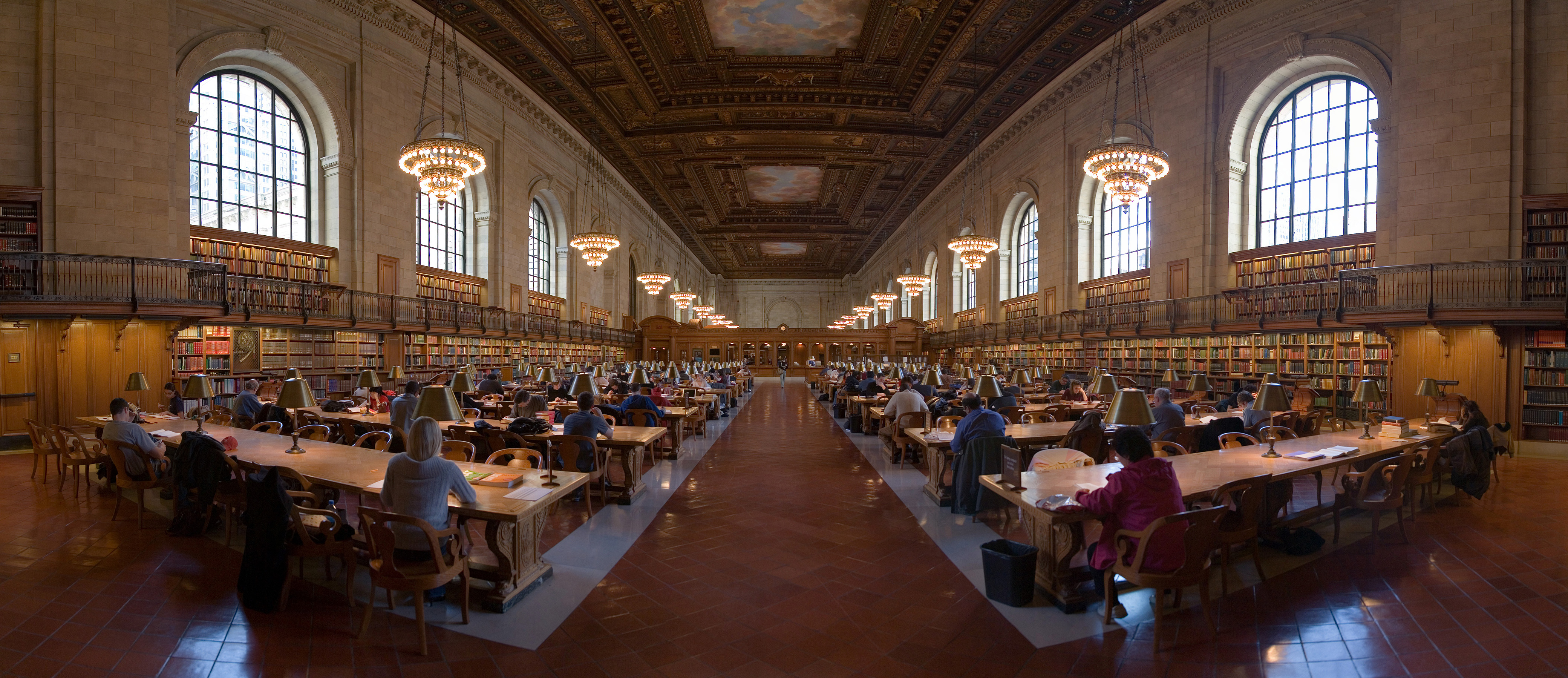
SudokuAgresta points to the NYPL’s present Central Library Plan (see my previous reporting), which threatens to shutter the Mid-Manhattan and SIBL branches while uprooting the main branch’s unprecedented research division in the Rose Reading Room, as something which would merely invite physical collapse. What he fails to consider is how shifting the research collection from beneath the main library to a New Jersey storage facility will cause considerable delays when any member of the public requests a special item (to say nothing of how the new architectural plan hopes to accommodate a heightened influx of visitors; all this was chronicled by The New York Times in 2012 but don’t count on Michael “I’ve Got a Slate Sudoku Puzzle to Fill In” Agresta for due diligence). He wrongly and smugly assumes, without bothering to look up the facts or talk with any public officials, that a library without books “seems almost inevitable,” even when the actual facts reveal regular people checking out physical books at the NYPL more than ever before: total circulation at 87 branches has risen 44% since 2008. This is because Agresta is not a journalist. He is a prevaricating muttonhead, little more than a dimebag propagandist, writing tendentious pablum that, like most of the rubbish published in Slate’s godforsaken cesspool, contributes to cultural dialogue much as rats enhance apartments.

alaWhile Agresta is right to point to (without citing it) the ALA’s 2011-2012 Public Library Funding & Technology Access Study’s alarming statistic that more than 40% of states have reported decreased public library support three years in a row, he hasn’t thought to contact the ALA to determine if this trend has continued. By contrast, it took me all of two minutes to contact the ALA’s Office for Research and Statistics. I got the current statistics 90 minutes later from a very helpful man named R. Norman Rose. It turns out that, in FY 2013, states reported that they were having an easier time soliciting funds for public libraries. Rose was good enough to inform me that the new report will be up on Monday. Agresta mischaracterizes the Pennsylvania Senate vote in which the Free Library of Philadelphia came close to shuttering. Active mobilization from the public — more than 2,000 letters directed at state legislators — prevented the so-called “Doomsday” Plan C from being enacted. In other words, the library is far from dead in America. A very active public is preserving it from hostile political forces and any dispatches about its future need to take this activism into account. Agresta then points to 200 public libraries shutting down in the United Kingdom without pointing to the far more interesting problem: nobody seems to know how many public libraries in the United States have closed.

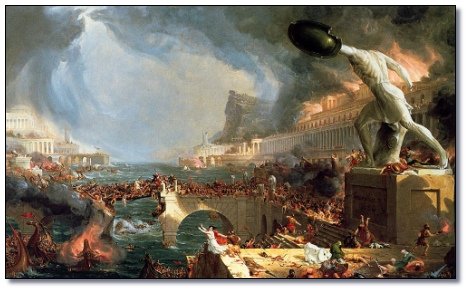
loaburnFrom such dubious figures and distorted facts, Agresta concludes that we are apparently living in an “era to turn its back on libraries,” and he has the effrontery to pull the librarian’s answer to Godwin’s Law out of his chintzy pauper’s hat: the burning of the Library of Alexandria. After shuffling various apocryphal versions of the centuries-old story behind the conflagration like a lonely salesman playing solitaire in a motel room, Agresta then makes the reductionist conclusion that “even the smallest device with a Web browser now promises access to a reserve of knowledge vast and varied enough to rival that of Alexandria.” This is the foolish statement of a blinkered man who has never set foot in special collections, much less considered how books published only a few decades ago can quickly go out of print, often without a digital backup. As someone who sifted through invaluable special collections papers that nobody had touched in two decades only last week, I find Agresta’s conclusion risible. Agresta also doesn’t seem to understand that paper ages and that librarians exact tremendous care to keep invaluable archives preserved. (As scholar Sarah Churchwell informed me in an interview in February, Princeton has kept its F. Scott Fitzgerald papers so tightly sealed that not even the most fastidious historians are allowed to touch its pages.) And while digitization certainly helps when the original source isn’t available (and can often reinvigorate existing collections much as the NYPL Lab’s Menus and Map Warper pages do), not every piece of paper is going to get digitized. Libraries thrive when print and digital systems come together. The mistake by arrivistes like Agresta is when foolish rhetoric is trotted out in lieu of the facts:

If the current digital explosion throws off a few sparks, and a few vestigial elements of libraries, like their paper books and their bricks-and-mortar buildings, are consigned to flames, should we be concerned? Isn’t it a net gain?

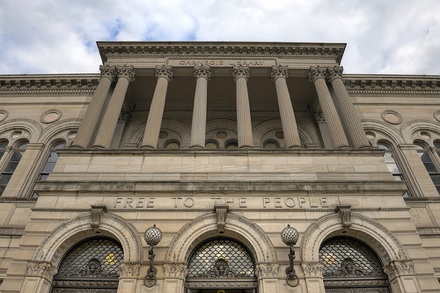
carnegiepittAgresta then attempts to paint the Carnegie libraries as “the backbone of the American public library system” without pointing to one vital impetus behind the Scotsman’s philanthropy: Carnegie wanted libraries to be the most striking structures in small communities from both an architectural and communal standpoint. Early Carnegie libraries, such as the Free Library of Braddock, had recreational facilities and billiard tables on the first floor. As David Nasaw describes in his biography of Carnegie, Carnegie wanted these libraries to be perfect. The Pittsburgh library alone set aside space for a natural history museum, an art gallery, and a music hall, and involved one of the largest nationwide architectural contests of its time, involving 102 entries from 96 architects in 28 cities. Agresta’s boorish suggestion that libraries resembling strip malls are a continuation of Carnegie’s grand ideals is not only incorrect but an act of vulgar complacency, especially when this foolhardy Slate scribe has the audacity to suggest that “design benefits were ancillary, of course, to the fundamental purpose of the Carnegie libraries.” Further, one can see the communal legacy of Carnegie’s library in Houston today, with its cooking classes, toddler yoga, Photoshop classes, and afternoon movies. In other words, libraries have been “experimenting” with “maker spaces” for more than a century, not recently as Agresta claims. Agresta’s suggestion that wondrous projects highlighted by the Library as Incubator Project are a response to digital perils is quickly eradicated once one visits the Project’s About page. While digital collections are highlighted (as they naturally would in any library in 2014), the Project’s primary purpose is to encourage collaboration between libraries and artists. But that doesn’t stop Agresta from ending his paragraph with this preposterous zinger, parroting the “eloquent” Caitlin Moran:

It’s easy to imagine how a local institution built on these sorts of programs could continue to serve as hospital of the soul and theme park of the imagination long after all the paper books have been cleared away.

Even when Digital Public Library of America founder Dan Cohen tells Agresta, “We love the idea of making a connection between the digital and physical realm,” Agresta fails to ken the DPLA’s purpose, as clearly delineated on its About page. The DPLA’s chief goal isn’t to replace the physical library with the digital one. It is to provide digitized materials to other libraries in a valiant attempt to “educate, inform, and empower anyone in current and future generations.” There is nothing within this mission statement which suggests, as Agresta puts it, a “revamped” set of library ideals for the digital age. But don’t tell that to Agresta, who saves one of his most officious insults for the hardworking librarians who are an unspeakably invaluable part of what keeps libraries going.

Agresta waxes priapic about “book-fetching robots” at the Hunt Library that are similar to the ones “used by companies like Walmart at distribution centers,” as if Walmart was the more ideal model for libraries than the beautiful Beaux Arts edifices carefully considered by Carnegie. But for all of the BookBot’s organizational virtues, the sterile stacks aren’t allowed to be touched by humans, which means that any accidental discoveries must be performed through Virtual Browse.

As the above video demonstrates, with Virtual Browse, you can’t just pick a random book off of these shelves and flip through it. Instead, you have to do so through cold and clinical clicks through a web interface. Moreover, the BookBot is, at $4.5 million, a colossal waste of money, especially since it only returns about 800 books per day — the same work that two full-time students can do. Wouldn’t that money have been better spent on books or programs or top-notch librarians?

When high-tech systems this costly and this inefficient represent the professed future, and when Agresta cannot be arsed to do the math, Agresta’s suggestion that books are “making a quiet last stand” is both ignorant and laughable. And yet in presenting such a partial, incomplete, and uninformed tableau of the current library situation, especially in relation to the Central Library Plan, Agresta’s disgraceful article willfully twists the truth about a very important battle for communal public space into a presumed defeat. This is vile and irresponsible journalism that deserves nothing less than contempt. Michal Agresta should never be allowed to write a longform article on any subject again and the dimwitted editor who signed off on this unvetted and prepossessed drivel should be mercilessly flogged in the court of public opinion just outside the Columbia Journalism Review offices.