Ben Tarnoff (The Bat Segundo Show #541)

Ben Tarnoff is most recently the author of The Bohemians.

Author: Ben Tarnoff

Subjects Discussed: Why 1860s California was especially well suited to literary movements, draft riots, Thomas Starr King, how Atlantic Monthly editor James Fields interacted with numerous emerging writers, the New England influence vs. the need to rebel, Charles Stoddard, rustic towns vs. cities battling each other in California over poetic merit, Bret Harte’s aesthetic tastes, how Harte transformed from critic to short story pioneer, how Mark Twain used the door-to-door subscription model to popularize The Innocents Abroad, the influence of the railroads upon what people read, Twain’s inability to command literary respect in America during his time, Twain’s popularity in England, the disreputable qualities of Twain’s appearance, Twain’s drawl, William Dean Howells, the Eastern literary establishment’s regressive assessment of Western style, how Twain used the lecture circuit to generate vital income, early standup comics in America, Artemus Ward the first standup comic in America, New York’s emergence as a media capital in the late 19th century, the development of Twain’s iconoclasm, present day interpretations of Twain as a cuddly avuncular type, Twain’s explosive temperament, Twain’s failed attempts at suicide, how original literary movements can spring from a unique location, present day Brooklyn writers who play it safe, how Twain’s lecture persona allowed him to escape becoming a newspaper hack, Twain vs. Ed Koch as meeter-and-greeter in the streets, the Bret Harte/Mark Twain friendship and feud, Bret Harte’s creative decline upon leaving California, Margaret Duckett’s Mark Twain and Bret Harte, the mysterious inciting incident in 1877 that set Twain off on Harte, Twain’s difficulties in getting his early short story collections published, the death of irony throughout American history, disparaging reports of Anna Griswold Harte (and attempts to find positive qualities about her), how much Bret Harte is responsible for Anna’s alleged sullenness, Bret Harte’s arrogance, Harte’s abandonment of his family, Harte’s aristocratic airs, Harte’s insistence upon a cab when arriving on the East Coast, Bret Harte’s hipster-like sideburns, “Ah Sin,” Twain and Harte perpetuating racist Chinese stereotypes, Twain selling out his principles, yellowface and the Cloud Atlas movie, Twain’s unremitting vengeance against Bret Harte, Twain’s obsessive detail in depicting his grudges, Twain’s tremendous rage and his tremendous love, Twain blaming himself for the death of his son Langdon, parallels between Charles Stoddard and Walt Whitman, Stoddard’s need for approval, Stoddard seeking autographs, Stoddard’s retreat to Hawaii, attempts to determine how much transgressive behavior there was in San Francisco during the late 19th century, Bret Harte rebuffing his literary friends when he moved to the East Coast, Ina Coolbrith as the first woman poet laureate in the United States in 1911, Coolbrith’s “When the Grass Shall Cover Me,” the crushing domestic responsibilities faced by Coolbrith (and stalling Coolbrith’s literary career), grueling library hours in the late 19th century, Stoddard’s South-Sea Idyls, Harte’s remarkably swift dissolution, Harte’s inability to take root in the East, Ambrose Bierce, whether Bierce arrived too late on the scene, pulp writers who lived at the Monkey Block in the early 20th century, Fritz Leiber’s Our Lady in Darkness, and whether any literary movement today can recapture the risk-taking feel of the Bohemians.

EXCERPT FROM SHOW:

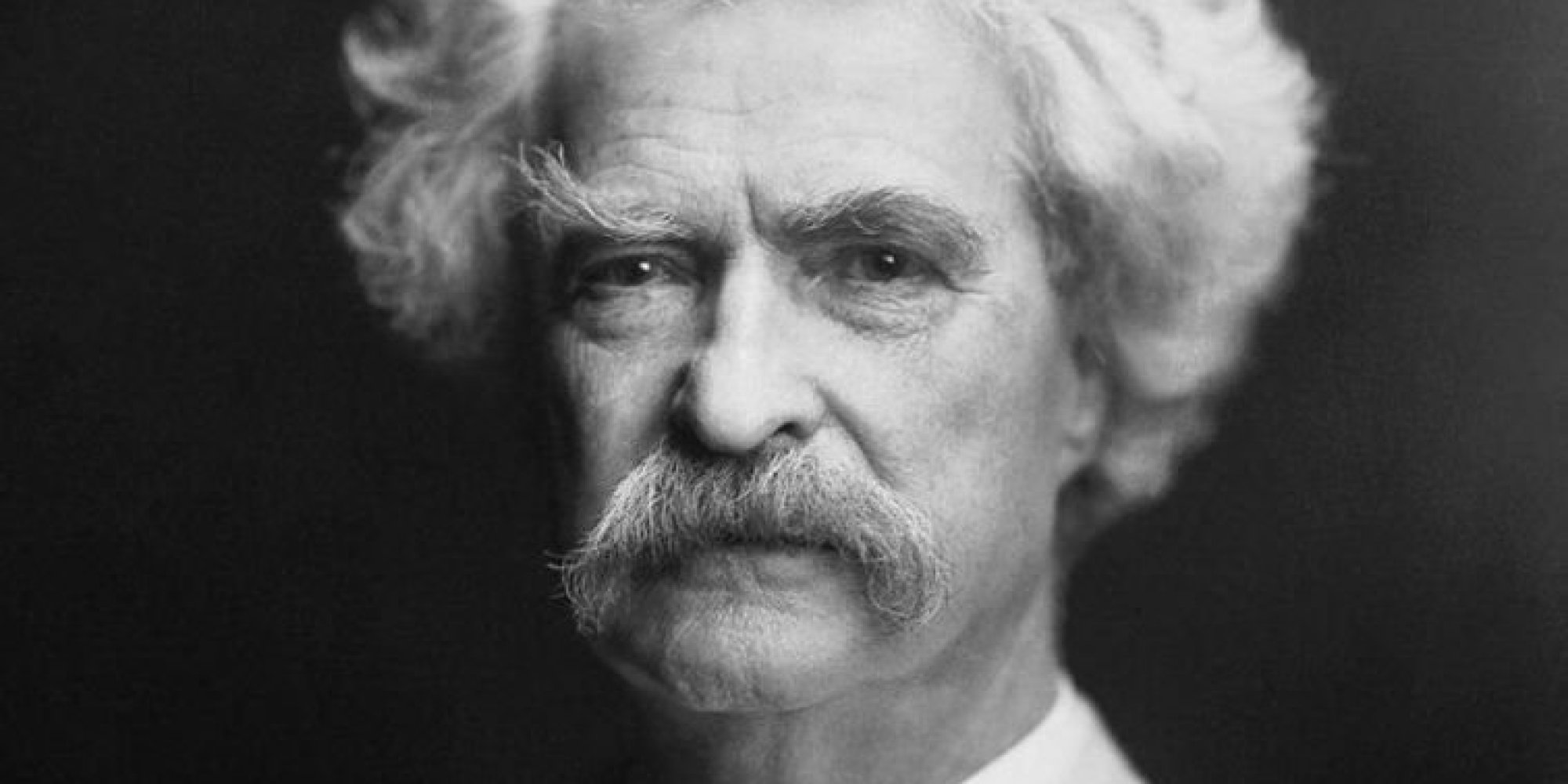
Correspondent: Mark Twain and Bret Harte seem to be the big stars of this book. But what do you think it was about this particular area at this particular time that created this particular literature?

Tarnoff: Well, San Francisco in the 1860s has a lot of advantages for a writer. It’s peaceful. The Civil War never comes to California. So there’s no fighting on the coast and there’s no draft. Because Lincoln never applies the draft west of Iowa and Kansas.

Correspondent: And no draft riots.

Tarnoff: Right. Exactly. No draft riots. So it’s peaceful. It’s a great place to wait out the war. It’s very rich. Because it’s the industrial, commercial, and financial center of the region. So the massive amount of wealth that’s being generated in the City finances a range of literary papers. And it’s also very urban. It’s got about 100,000 people in the 1860s and that makes it by far the biggest city in the region, really the biggest city west of St. Louis. And that population is pretty cosmopolitan. Because of the legacy of the gold rush, you have people there from China, from South America, from all different countries in Europe. And I think that all of those are important factors behind producing the literary moment.

Correspondent: And for a while, speaking of St. Louis, it had the largest building west of St. Louis with City Hall.

Tarnoff: That’s right.

Correspondent: For a while. Until it got — I can’t remember which building it was that actually uprooted it. But it was a city of great progress and great buildings. I wanted to start off also by getting into the preacher Thomas Starr King. He’s this figure I have wanted to talk about forever. Because I have read, I’m sure as you have, the Kevin Starr books. The wonderful California Dream series. I’m grateful that your book has allowed me a chance to talk about him here. You know, it has always seemed to me that without King, you could not have had the literary culture that emerged. Because he was this really odd figure. He promoted New England writers. So he was kind of an establishment guy. But at the same time, he’s also the guy who introduces Bret Harte to James Fields, the Atlantic editor, in January 1862. Charles Stoddard — this wonderful poet — also held King up in great esteem. So he’s almost this insider/outsider figure who seems to corral the many literary strands of San Francisco that are burgeoning during this time and forming this new kind of movement that you identify as a Bohemian movement. So I’m wondering. What is your take on Thomas Starr King? Do you think that San Francisco would have been San Francisco if it had not been for that? And do you think that when The Overland Monthly appeared, that this was kind of the replacement for Thomas Starr King? Because at that point he had passed away. What of this?

Tarnoff: Well, Thomas Starr King is a fantastic figure. I think he really is a forgotten founding father of California. He’s so foundational politically, culturally, as you point out from the literary scene. He’s a fantastic mentor figure. You mentioned Charles Stoddard. There’s a scene in my book where Stoddard has just published his first poems in a big literary paper. He’s extremely shy and nervous. And Thomas Starr King comes to the bookshop where he works and tells him personally how much he loved his poems. So he’s a guy with a really personal touch and really cultivates these writers and offers them criticism. He’s an important figure from the point of view from the point of view of the Civil War as well, which is I think how he’s better known today. Because he travels throughout the state during the first year or two of the Civil War and preaches the importance of California staying in the Union. Which it probably would have stayed in anyway. But King is certainly a very persuasive champion of the Union and of abolition.

Correspondent: Yeah. But in terms of his literary contributions, I mean, he was again, like I was suggesting with this last question, this guy who was there to rebel against and this guy to garner favor with so you could actually get into some of the outlets. How did that work? Am I perhaps overreaching with my estimation of King as this great mirror that Twain, Harte, and all these other people looked at in order to find their own voices? To find their own particular perch to break into San Francisco journalism, literature, and all that?

Tarnoff: Well, I think he builds a link between the Eastern literary establishment and San Francisco. You mentioned his introduction of Harte to James Fields, the editor of The Atlantic Monthly. He also is friends with Longfellow and Emerson and all these literary lions who are really the most famous writers in the country at that point. And he gives these wonderful lectures on American literature in San Francisco. So he absolutely is a link between the East and the West. But he’s also someone to rebel against. I mean, he’s the father figure. You’re also trying to kill your father. And a lot of these guys — particularly Harte — you see him strain from that New England mold. Thomas Starr King sadly dies in 1864 young and prematurely. And in the coming years, Harte really develops his own style, which I think contrasts pretty sharply with those New England influences.

Correspondent: So what was essentially taken from King and even the New England influence? What made this particular area of the country the natural place to establish new voice, original voice, a rebellious voice, an iconoclastic voice?

Tarnoff: Well, Thomas Starr King has this great phrase in one of his sermons where he tells Californians they need to build Yosemites in the soul. And his point there, I think, is that they’ve been blessed with this majestic epic monumental landscape. This incredible natural beauty. And they need to create a culture and a literature, an intellectual scene, that’s commensurate with that great beauty. And the Bohemian scene really takes that advice seriously. And the West, I think, is such a fertile place for a new type of literature to develop. Which really does deviate from the path that King himself had hoped it would take. I mean, he wants California to follow closely in the footsteps of New England. He has a letter where he says California must be Northernized thoroughly by Atlantic Monthlies, by schools, by lecture halls. But the scene that he mentors after his death really takes things in a different direction, but I think makes good on his command to build Yosemites in the soul.

Correspondent: Well, it’s interesting how we’re talking about the variegated territories of California. Because Bret Harte would edit this poetry anthology and get into serious trouble. Because some of the rustic towns didn’t like the fact that they weren’t included. And he was flummoxed with all sorts of poetry entries for this thing. And he ended up choosing a lot of poems that dealt in the metropolises. So there was this rivalry and Harte was accused of being this florid sellout by some of the rustic towns. You point out in the book that actually the metropolises and the rustic towns and the mining settlements and all that had actually far more in common than they actually realized. So what accounts for this fractiousness and territorial temperament? Fractiousness in literary voices and literary temperament?

Tarnoff: Well, California’s a place where everyone wants to be a writer.

Correspondent: Like Brooklyn today!

Tarnoff: Right. Exactly. It’s like Brooklyn in 2014. But poetry in particular has a real prestige. Poets are pop stars. Poems are read at every public gathering. You need poetry in the public sphere all the time. And so all of these Californians — people who live in the countryside, people who live in the city — all think of themselves as a poet. So when Bret Harte is tasked with putting together a representative anthology of California poetry in 1865, he is overwhelmed with submissions and has a lot of fairly sarcastic, disparaging things to say about the quality of those submissions and ends up producing this fairly small volume with mostly his friends, like Charles Stoddard and Ina Coolbrith. And this ignites a kind of literary war between the city and the country. But as you point out, the distinction between the city and the country is not actually that great. I mean, the California countryside in terms of the mining and the farming operations is itself pretty heavily industrialized. We’ve got big economies of scale, a lot of heavy machinery. Places like Virginia City, in Nevada, where Mark Twain is for a few years, are highly urbanized areas. So the notion that it’s these kind of he-men in the frontier vs. the effete Bohemians in the city, it’s not totally accurate representation.

Correspondent: Well, in this sense, you’re essentially saying that the sphere of influence in both rustic town and big city is essentially homogeneous. That people are perhaps being inspired from the same physical things? I mean, what of literary tastes? What of the way that people express themselves? I mean, isn’t there an argument to be made that maybe these guys were right?

Tarnoff: Well, there’s certainly a distinction in terms of literary taste. I mean, I think both camps are living fairly urban industrialized lives. But they certainly have very different opinions about what constitutes good poetry. And Harte in particular, who is the editor of the volume, shies away from topics that he feels are too pastoral. That have too much of a certain type of California flavor, which he associates with the amateur poets. And he writes a parody of what one of those poems would look like in The Californian, which he edits. But Harte really wants to push California literature in general to a more metropolitan, to a more Bohemian, to a more sophisticated level and is very dismissive of what he feels is the kind of amateurish literary karaoke quality of some of the countryside poets.

Correspondent: Well, what is that sophisticated nature that Harte is demanding? What are we talking about? Are we just talking about endless poems devoted to being in the middle of nowhere? Essentially that’s what he’s railing against? He’s asking California to take itself more seriously, to write about civil, social, political topics? What are we talking about here?

Tarnoff: Well, the problem with Harte in these years — the mid 1860s — is he’s very good at being a critic. He’s very good at lambasting the quality of California literature, at its climate, at its boosters and philistines and capitalists. But he’s not great at producing good literature of his own. And that comes a little bit later in the decade when he starts to write these wonderful short stories. “The Luck of Roaring Camp” being the best known. And it’s not until that moment that I think he really makes good on his earlier promise to redeem California literature.

Correspondent: So he’s essentially quibbling with what he doesn’t like in order to find out what he does like and what he can actually build from the ashes he demonizes, so to speak.

Tarnoff: Exactly. He’s definitely in a more critical phase at that moment.

(Loops for this program provided by Martin Minor and nilooy. Also, Kai Engel’s “Chant of Night Blades” and Kevin MacLeod’s “Ghost Dance” through Free Music Archive.)

The Bat Segundo Show #541: Ben Tarnoff(Download MP3)
This text will be replaced

Islamophobia, Extremism, and the War on Terror: Arun Kundnani (The Bat Segundo Show #540)

Arun Kundnani is most recently the author of The Muslims Are Coming.

Author: Arun Kundnani

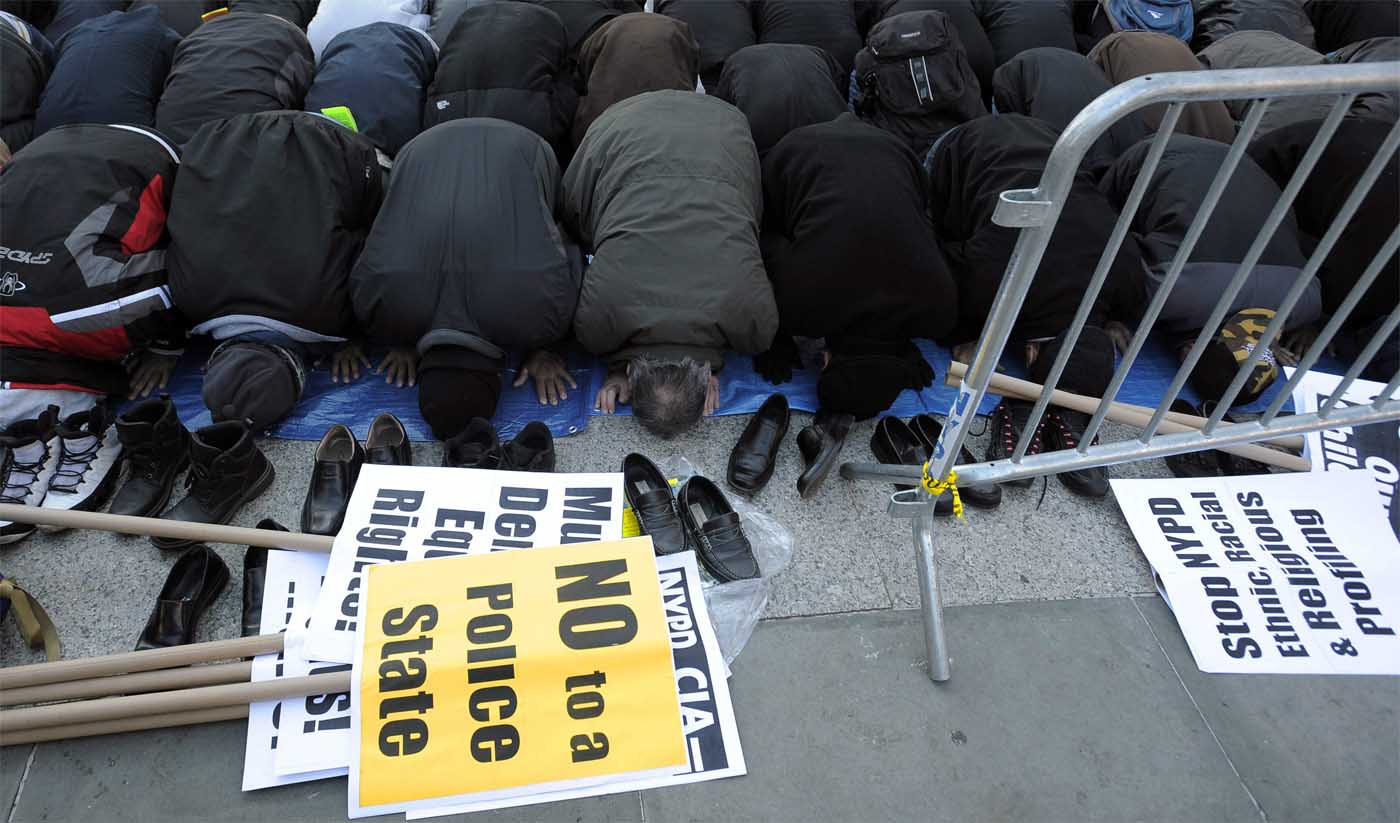
Subjects Discussed: How Islamophobia came to be, how the Obama Administration has continued an Islamophobic policy, the good Muslim and bad Muslim framework, Bernard Lewis’s “The Roots of Muslim Rage” as one of the key foundational Islamophobic texts, bogus terrorist studies that reinforce counterterrorism studies within the national security apparatus, flawed FBI radicalization models, how philosophical academics are making ideology virulent, Faisal Shahzad’s attempts to bomb Times Square, the Boston Marathon bombing, the NYPD’s “Radicalization in the West” study used to justify its Muslim surveillance efforts, Minority Report, zero tolerance, whether society or specific individuals should be blamed for Islamophobia, societal culpability in policy changes, changing the conversation about terrorism, the need to get out of 9/11’s shadows to address present realities, why Muslims who make any political statement are categorized as terrorists, fear in the Muslim community, Edward Snowden, how surveillance affects specific communities, the death of Fred Phelps, whether some over-the-top extremism is necessary to galvanize a civil rights movement, Martin Luther King’s “Letter from a Birmingham Jail,” when notable figures for justice embrace extremist labels, the queer movement, Malcolm X, the sudden transformation of Muslims into the “enemy” after 9/11, class distinctions and Islamophobia, the Prevent program adopted in the UK, New Labour’s culpability in misidentifying Muslims as “radical,” the Salafi movement, failed efforts to promote a counterextremism narrative, Homeland‘s Nick Brody and the inability of contemporary narratives to allow for a Muslim character to have a political voice that isn’t extremist, the vicious campaign to paint All-American Muslim as propaganda and the conservative effort to shut the show down, the Somali population in the Twin Cities, the al-Shabaab ring in Minneapolis, Congressman Peter King’s Islamophobic statements about mosques, when attempts to preserve constitutional rights are reframed as “noncooperation,” Operation Rhino, St. Paul’s AIMCOP program funded by a $670,000 DHS grant, law enforcement tenor dictated by power and money, the arrest of Najibullah Zazi, hyperbolic clampdowns on Islamic communities after an attempted plot is thwarted, financial incentives by local police departments to continue flawed counterterrorism strategies to receive federal grant money, fusion centers, why so much of surveillance and prosecution rationale is rooted in Muslim stereotypes, what can be done with the wasted resources, the Muslim Brotherhood’s fluctuating status as movement and terrorist organization by U.S. authorities, Mohamed Morsi, whether or not Western nations can view organizations in subtle terms, comparisons between the Cold War and ongoing American foreign policy ideas about Islam, the Egyptian revolution, the sharia conspiracy theory adopted by neoconservative Islamophobes that Islamic terrorism is the beginning of a hidden jihad, why Islamophobes like Robert Spencer and Frank Gaffney are able to infiltrate the mainstream, conspiracy theories and racist discourse, the English Defence League, Islamophobia promulgated by David Cameron, the lack of self-awareness among far-right groups, how Islamophobic groups have adopted the media strategies of the Left, neo-Nazis who rebrand themselves, positive developments, New York Muslims protesting NYPD surveillance programs, and how the generation of young Muslims can change present intolerance.

EXCERPT FROM SHOW:

Correspondent: So let’s go ahead and start off with why Islamophobia exists. The first and most obvious question is why any political strand of Islam, any vocal element that objects to an attack has come to be associated with terrorism. So I have to ask. Why has this continued twelve and a half years after September 11th? Why are all Muslims roped up into this misleading category?

Kundnani: One of the interesting things I think is that we had that early period in the War on Terror under the Bush years where we had this quite intense narrative of a clash of civilizations between Islam and the West. And Obama came in, trying to have a different kind of analysis. And actually what’s interesting is that the kind of popular Islamophobia in the media, the amount of racist violence against Muslims in the United States, it all went up under Obama. So in my analysis, what’s going on here is, as well as the kind of neoconservative narrative of a clash of civilizations, we also need to think about the liberal Islamophobia that’s been much more powerful under the Obama administration over the last few years.

Correspondent: What do you think the ultimate appeal of the Obama trigger effect here is for Islamophobia? Why have liberals fanned the flames here, do you think? Is it just a misunderstanding of policy? I can get into this further later on in this, but I wanted to get a general idea here.

Kundnani: I think, at root, what’s going on here is a kind of flawed analysis of what the causes of terrorism are. There’s a liberal analysis that says, basically, that some kind of religious extremism causes terrorism. And therefore you need to intervene in Muslim populations to make sure that people have the right interpretation of Islam. That’s actually the kind of basic analysis that we’ve had in this kind of later period of the War on Terror. Which means that you’re associating some interpretation of Islam with terrorism, right? And then from that flows all kinds of other things. So, for example, then you get the idea of the good Muslim and the bad Muslim, right? Because the bad Muslim is the one who interprets the religion in the wrong ways. So you want to put Muslims under surveillance to check that they have the right interpretation of their religion, etcetera, right? So I think a lot of what we’ve seen under Obama flows from that fundamental analysis, which actually doesn’t stand up to scrutiny.

Correspondent: If it’s so flawed and it does not stand up to scrutiny, why then does it continue to perpetuate?

Kundnani: Well, one of the reasons is because from the liberal point of view, it seems like a better way of doing things than the kind of neoconservative clash of civilizations model, right? It has certain practical benefits from the point of view of managing this issue, right? This kind of fraught issue with all this fear ground up in the popular mind. So it enables you to say, “Well, you know, we’re partnering with Muslim communities to tackle extremism” and so forth. That sounds quite nice. That sounds quite effective. Even though the basic assumptions behind it don’t stand up to scrutiny.

Correspondent: You identify two strains of thinking about Islamic extremism in your book. The culturalists, who believe that Muslim communities are incapable of adapting to modern life because their Islamic culture essentially is extreme and is therefore incompatible, which leads to extremism. Then you have the reformists, who look not to Islamic teachings but ideologues who reinterpret Islam for violent and nefarious purposes. How could one article — Bernard Lewis’s “The Roots of Muslim Rage” in 1990 — be so prominently responsible for the development of these two ideas? Why do they continue to endure? Why do they continue to be so compelling? I mean, it seems to me that there are so many arguments against them. Yet these two ideological strains continue.

Kundnani: Right. Intellectually, the argument has been discredited time and time again. And so the reason that these ideas continue to circulate has nothing to do with their intellectual merit. But it’s more about the political convenience of those ideas. So we find it much easier to think about why people want to direct violence against our society. We find it much easier to answer that question by saying it’s their culture rather than, at least in part, our politics. And so I think because it’s uncomfortable for us to think about what the alternative to these narratives would be — the alternative to these narratives which involve us thinking about our foreign policy and the political effects of that in creating contexts within which terrorism becomes more likely — it’s much easier, rather than having that difficult conversation, it’s much easier to say it’s their culture, right? Or it’s not their culture, but it’s a minority who have adopted this ideology of extremism and that’s what causing it.

Correspondent: But we’ve had twenty years of this strain in both British and American society. Surely that’s enough time for people to perhaps call it into question or to actually think about it more sophisticatedly. And I’m wondering why — I keep going to the question “Why?” But I am trying to get something a little more specific over why this is still of appeal.

Kundnani: Some of the answers to that are about the ways in which it’s been institutionalized in various settings, right? So for example, since 9/11, we’ve had terrorism studies departments created with government funding in the United States and in Britain. And those terrorism studies departments have a set of incentives in terms of the funding and so forth to produce certain kinds of knowledge that serve the interests of the national security apparatus. So they will tend to avoid asking deeper questions about what lies behind violence, what is the politics of that, and instead try and deliver policy solutions that have embedded within them all kinds of assumptions about what they call radicalization. So that kind of institutionalizes these ways of thinking in a whole set of academic departments. Then you have these ways of thinking being institutionalized in the national security agencies. The FBI, for example, has a radicalization model. It’s an analysis of how someone goes from being an ordinary person to becoming a terrorist. Embedded within that is these same ideas of some kind of religious ideology driving it. The New York Police Department does the same thing. So all these ways of thinking are not just kind of free-floating in some kind of intellectual depaint. They are embedded in policy and practice in institutions.

Correspondent: Would you say that academics have essentially been influencing this interpretation for the last twenty years? I mean, there was a strain of articles recently about academics complaining about how they don’t actually get through to the masses. But this would seem to suggest that they are in a very nefarious way.

Kundnani: Absolutely. If you’re an academic and you want to be influential in government policy, be an academic in terrorism studies. Because that’s where you’re in and out of government departments. But what you have to give up is actually quite a large degree of scholarly independence. Because you’re effectively serving the intellectual needs of the government rather than any kind of idea of an objective independent study of what causes terrorism. That doesn’t really happen. So I think academics have been influential. Both the terrorism studies academics and the other ones — like Bernard Lewis and Samuel Huntington — some of those folks who are more on the philosophical level and geopolitical level who are thinking about these issues.

Correspondent: So if you get a philosophical academic, it could essentially activate a strain of virulent ideology.

Kundnani: Absolutely. Ultimately, all our kind of different forms of racism and so forth have some kind of intellectual history. They go back to people who innovate, who come up with new ways of being racist in an intellectual setting. And then that filters down to the streets over time. That’s how racism originates.

Correspondent: Sure. So you point to a time in the United States when this nation was considered more tolerant and inclusive towards Muslims. Immune from Muslim radicalization because of the apparent belief that a free market society was better at absorbing Muslims. That changed in 2009. There were a number of violent incidents that were believed to be associated with Islam, including Faisal Shahzad’s failed efforts to detonate a car bomb in Times Square. You point to a 2010 Bipartisan Policy Center report which concluded that the American melting pot had not provided protection against Muslim radicalization. Why were the government, the pundits, and the policy people so willing to change their tune in so short a time? Because that seems to me also a big part of this problem as well.

Kundnani: Right. So something interesting happens in the first few years of the Obama Administration, where you find that you do have one or two attempted terrorist plots that were serious plots, like the attempted car bombing in Times Square by Faisal Shahzad and one or two others. You also have a set of developments that happen in the FBI, where they’re starting to change how they do counterterrorism and becoming much more pro-active in sting operations, in bringing charges to some of the material support for terrorism, which involves criminalizing people’s ideological expressive activities rather than actual terrorist plots. So those kinds of things from the FBI drive up the numbers in terms of the kind of annual statistics on a number of attempted terrorist acts.

Correspondent: Drive up the numbers exactly how?

Kundnani: Well, because one of the things that we’ve seen is the FBI doing something when they have someone who seems to have what they would call an extremist ideology. Put informants in that person’s life and use these tactics of trying to pressurizing that person into being involved in an imaginary plot that would probably not have been something that they would have been predisposed to were it not for the FBI coming in and creating that environment around that person’s life. And this is something that the RAND Corporation has a very good phrase to describe. They call it “lubricating that person’s decision making” through government intervention. So I think the FBI started to put a lot more resources in doing those kinds of operations. Then the numbers come up. So it looks like we’ve got this objective increase in attempted terrorist plots, but actually it’s at least to a large degree the result of a change in FBI strategy around that time.

Correspondent: So you’re saying that the FBI essentially was cooking the books to get higher crime statistics. Is that what you’re basically saying?

Kundnani: Well, in effect, that’s what happened. I’m not sure that it’s some kind of conspiracy by senior leaders in the FBI to…

Correspondent: It’s a policy change.

Kundnani: It’s a policy change. And obviously you can see an incentive structure there where the FBI, as a result of doing that, seems like it’s a very efficient counterterrorism organization. Because it’s got all these terrorist plots happening in the United States and every single one of them is getting a conviction and that looks good on the annual report to Congress. What you won’t know unless you look in more detail is the fact that most of those plots are ones that the FBI itself has invented.

Correspondent: I’d like to get into the fine details of the radicalization model that the FBI was using in just a bit, but I want to actually ask did they essentially have this policy change before they had the radicalization model? What does your research suggest here?

Kudnani: The radicalization model goes back to the early years after 9/11. The policy shift, I mean, we don’t know what caused it. It may be that there had been a number of changes in legislation that came through in that period and it may be that new options were created for that. It may be that if you look at the data for terrorism convictions around that time, sort of 2008 and 2009, a big chunk of the people who were getting prosecuted is Somali Americans, who are traveling to Somalia to fight with al-Shabaab, which is designated a terrorist organization shortly before that moment. And so therefore, traveling over there becomes a felonious act. So that also becomes another of these kind of scare scenarios around that time, that maybe we’re going to have a huge problem of American Somalis going off to fight for al-Shabaab and coming back and committing acts of violence here, which actually never happened.

Correspondent: I will get into the Somali situation in just a sec, but I want to actually unpack the radicalization model a bit. You cite this 2006 memo from the Counterterrorism Division which suggests anger, watching inflammatory speeches online, an individual identifying with an extremist cause, Internet interaction with extremist elements, and acceptance of radical ideology, and eventually terrorism. What is the academic basis for this model? You also mention this 2007 NYPD study called “Radicalization in the West” that adopted a simplified version of models that were adopted by Quentin Wiktorowicz and Marc Sageman. What has made these specific ideas stick? Why hasn’t law enforcement passed a wider research net before adopting these models? Why are these radicalization models in place? They seem to me to be more like a sudoku puzzle.

Kudnani: Right. I mean, these radicalization models have come from — you mentioned the two key people here, Marc Sageman and Quentin Wiktorowicz, both of whom have a history within the intelligence world as well as in the academic world. They kind of cross those divisions. I think the reason those models have been used to the exclusion of any other kind of analysis and the reason that they’ve stuck is because they do something very important for the FBI and the NYPD — at least at first glance, which is they give them a tool for prediction.

Correspondent: Precog. Minority Report.

Kundnani: Right. This is Minority Report. It’s a way of saying, “We have a way of knowing who’s going to be a terrorist tomorrow. Even though they’re not a terrorist today.” And so having that claim to predictive power is what lies beneath the appeal of these studies.

Correspondent: And the problem with this is that they wake up from the amniotic fluid and instead of crying “Murder!” they say “Muslims!” So that’s problematic.

Kundnani: And they don’t stand up in terms of having that predictive capability. And that’s kind of obvious when you think it through. It would be ridiculous to think that someone growing a beard, which is one of the indicators, is a predictor of someone on the way to becoming a terrorist. Or someone wearing traditional Islamic clothing or joining a pro-Muslim social group. These are the various things that these studies talk about. So they don’t have this predictive power. But because they’re perceived as doing so, they become very important in these institutional settings and enforcement agencies.

Correspondent: Perceived by who?

Kundnani: By law enforcement agencies and by policy makers in DC. So the FBI has been instructed by the federal government since very soon after 9/11 to adopt what is called a preemptive approach to counterterrorism, right? Which means don’t wait until someone’s committing a crime. Go back to some point before that person’s committed a crime and arrest them there or intervene in their lives there. So from the point of view of the FBI, there’s a dilemma there. How on earth do you criminalize someone who hasn’t committed a crime yet but you think may do in the future? You have to have some kind of analytic way of predicting behavior. And so that’s the dilemma for them.

Correspondent: But if it’s a corrupted analytical model, surely there’s someone inside the FBI or even the NYPD who is basically saying, “You know, this doesn’t really cut mustard. We’re actually only doing this to get our numbers up.” Were you able to uncover…

Kundnani: I spent a bit of time interviewing a number of different FBI agents who work in counterterrorism and I put that question to them as well. And their answer was, “Well, if you think this radicalization model doesn’t work,” which they were open to that possibility that it doesn’t stand up in terms of its academic merits, “then give us another model that will do the same job.”

Correspondent: So they just need some kind of model.

Kundnani: Yeah. Because they’ve been told you need to predict. You can’t just go on what someone’s done. You need to go on what they’re about to do. That’s how counterterrorism works in the United States post-9/11. So for them, it’s not an option to say, “Okay, let’s just focus on who is actively involved in preparing a terrorist plot, who’s inciting terrorism, and who’s financing terrorism.” That would be my argument. What we should be doing here is focusing on that. And that gives us enough to be getting onward and has the advantage that we don’t widen our search to this kind of vague notion of ideology, which gets messy and uses up our hard-earned resources on things that we shouldn’t be worried about. Now that is not an option for the FBI. Because that’s what we as a society have told them that we don’t want. We don’t want them to wait. We want them to be preemptive.

Correspondent: We as a society? I mean, that seems really amorphous. Isn’t there some specific person who we can identify and say, “That is the person who caused this requirement, that the FBI…”

Kundnani: I don’t think so.

Correspondent: Really?

Kundnani: I think if you look at — for example, early on in the Obama Administration, there was the so-called underwear bomber. And if you talk to people in the Obama Administration, they will talk about that being a very scary moment for them because they felt for a moment, in the aftermath of that attempted attack, they lost the narrative. They were very much on the defensive. And for a moment, they thought, “We’re going to have this thing hanging over us that we weren’t tough enough on terrorism and we almost let this guy through.” And then they basically made the decision thereafter that we can’t allow that to happen again. Because if that hangs over us, we lose the political capital to do all the other things we want to do. So even if you convince people in the Obama Administration to do things a different way, they would say, “Our hands are tied by what society expects of us.” The fear in society around these things. The fact that we have now created a society in which it’s not enough to say we will minimize the risk of terrorism.

Correspondent: You have the zero tolerance thing.

Kundnani: Right. What society expects is absolutely no terrorist attacks of any kind at all and do everything possible with unlimited resources to deal with this problem. Even though we’ve had the Boston Marathon last year, dozens of people in jail, and three people killed. But we have 15,000 murders every year in the United States. So in terms of an objective assessment of the amount of harm that counterterrorism does to U.S. society, it would not be our top priority. But it has become our top priority. Half of the FBI’s budget is dedicated to counterterrorism.

Correspondent: But I don’t know if that’s really — that’s an answer that just doesn’t sit well with me. The idea that society is the one to blame when you’re using a flawed radicalization model to enforce counterterrorism, which actually isn’t true based off of some of the findings in your book, and you’re reinforcing stereotypes and you’re also disseminating further fear into the American clime, it seems to me that you’re the one responsible for generating the way that people react, that is this very society that people point to…

Kundnani: Sure. Sure.

Correspondent: I mean, I’m asking for some….there needs to be some person. Some kind of element here.

Kundnani: I think there’s all kinds of different agencies and individuals that are culpable here. No doubt. From the top down. From Obama, the leadership at the FBI, the whole national security apparatus. All of these different agencies and individuals are bound up in a set of practices that are causing great harm to our fellow citizens in the United States. But I would also say it’s a little bit too easy just to stop there. I would say we have all kind of got sucked into this culture of counterterrorism. The word “radicalization” is not just a word that you see in academic studies and police reports. It’s the word that is now in our everyday language, in how we talk about terrorism. We didn’t need the word “radicalization” fifteen years ago to talk about terrorism. But now it’s the normal way that we do it. So, for me, it’s a little bit too neat to pin the blame on government agencies. We need to acknowledge that there’s a cultural change we need in society more widely.

(Loops for this program provided by Martin Minor, danke, DesignedImpression, Blueeskies, and drkcarnivalninja.)

The Bat Segundo Show #540: Islamophobia, Extremism, and the War on Terror: Arun Kundnani (Download MP3)

This text will be replaced

Dinaw Mengestu (The Bat Segundo Show #539)

Dinaw Mengestu is most recently the author of All Our Names.

Author: Dinaw Mengestu

Subjects Discussed: Writing from a woman’s perspective for the first time, V.S. Naipaul’s A Bend in the River, delving into the perspective of revolutionary turmoil, Mengestu’s American perspective, how journalism helped Mengestu to pursue more serious areas in literature, “soft” fiction vs. revolutionary realities, working with alternating chapters to create narrative collusion, the shame of being impoverished, sustaining an existence on lies, the effects of trauma, when novelists writing about the other avoid abrasive fictional perspectives in the interest of attracting readers, quiet introverts in fiction, why Mengestu hasn’t written about noisier immigrants, aesthetic sensibilities, loud vs. quiet characters, imagining trauma, Mengestu’s experience of writing about characters who felt trauma before he was born, the appeal of characters who experience extreme forms of political crisis, ventriloquist-style novelists and humanism, Saul Bellow’s The Adventures of Augie March, exuberant characters, being tagged with the “immigrant fiction” label, deliberately keeping time and space murky in All Our Names vs. the close attention to Logan Circle in The Beautiful Things That Heaven Bears, the timelessness of discrimination, emotions summoned through general descriptive specifications, resisting the urge of writing a novel set in an unnamed country, the problems with naming too many things, the limitations of looking at events through a historical prism, unspoken American prohibitions against political fiction, politics in fiction without didacticism, European encouragement of political fiction, constraints imposed on American fiction, creating an artistic space within fiction, Mengestu’s sense of aesthetic value, arguments that books make for ways of seeing, living with hand-me-downs, how Mengestu’s characters express emotions through giving gifts, materials used to express emotional connection to other people, Emily Dickinson, monuments of America, holding onto emotion in a narrative using objects, when the personal and the political overlap, personal maps vs. political maps, having an internal map of someone you love, concrete political realities, the fluidity of love and how political realities shape it, Helen’s relationship to her parents, the rigidity of place, rituals shared by couples, relationships and silence, situations in life when words are less valuable than intimacy, language provoked from silence, silence as the ineffable pain of not knowing how to communicate, how to measure silence, the mysterious character of David, Edward Snowden, writing in a proto-surveillance state about people who watch other people, Michiko Kakutani’s review, Evelyn Waugh, Brideshead Revisited, A Handful of Dust, Rilke, what contemporary fiction does with the brazen perspectives of colonial literature, working against Naipaul, Joseph Conrad, Lord Jim and the “great game,” Tayeb Salih’s Season of Migration to the North, wrestling with postcolonialism, Ngugi wa Thiong’o’s idea that there are no postcolonial errors, finding an aesthetic balance in a sentence, being a slow writer to find rhythm, and the benefits of memorizing poetry.

EXCERPT FROM SHOW:

Correspondent: This novel does something new that we haven’t seen from you. It’s the first of your novels to feature the first-person perspective from a woman, one of two alternative perspectives in this book. The other is a man named Isaac, or I’m going to use term “Not Isaac.” (laughs)

Mengestu: Yes.

Correspondent: Because there is an Isaac and a Not Isaac. And it’s also the first to really depict this Naipaulian tableau of what seems at first to be an unnamed African country in revolutionary turmoil, almost a response to the allusion you made to A Bend in the River in the first book, The Beautiful Things That Heaven Bears and also the lies that Jonas is spinning in How to Read the Air. So I’m wondering why it took you three novels before you could write partially from the perspective of a woman and also from this position of revolutionary turmoil. I mean, I’m curious how the first two novels led you to this particular point. Because I read all three of your novels and I thought this was a fascinating evolution.

Mengestu: Yeah. I think that was almost perfect. One of the best readings I’ve ever had of all three books. They are very closely intertwined. And if anything, even though this is the last book of the three to have been written, in some ways it actually precedes the other two. This was the book that actually precedes the revolutions that make the characters in the first novel and in the second novel flee. And so I wanted to go back to what I thought would be an earlier moment in history. A point that would say this is actually that very elusive, optimistic period just after independence when things seemed like they might turn out great in many African nations and then they didn’t. And the other thing was that after writing the first few novels, I realized there’s another part of me that I’d never really had a chance to explore in fiction, which was to write from the point of view of an American. Because I’m also, I think, deeply American and I grew up in the Midwest after leaving Ethiopia. And so Helen’s voice, I think, is partly a product of that. My novels oftentimes have been categorized in terms of immigrant fiction. To some degree, this is also perhaps a subconscious response to that idea, to say, Well, look, it’s not. Those categories are very limited and don’t actually say that much. And, in fact, here’s a way of seeing that narratives such as this are more than just immigrant friction and that immigrant narratives are very much a part of an American tableau. And you can’t micromanage them or faction them off into ethnic or political categories like that. And so Helen’s voice, I think, is my response to that. She is an American woman. She’s in many ways more intimate to me than the characters of Isaac are.

Correspondent: So Helen. It’s interesting that it takes a woman for you to say, “I’m an American too!”

Mengestu: (laughs) Yeah.

Correspondent: Was it easy? She’s a young American. She’s still trying to figure out how people work and how relationships work and where one’s place is in the universe. And I’m wondering why a woman’s voice was the best way for you to really show to yourself and show to the world that you were, in fact, an American as well.

Mengestu: You know, it’s definitely because I wanted Isaac to have a relationship with someone. So the novel, when I first began it, I never knew that it would necessarily have a part in the United States when I first started writing it. I was very much concerned about trying to capture this period in Africa’s history. I thought it would be about a group of friends in postcolonial Africa on a college campus. And then as those voices started to converge around the characters Isaac and Not Isaac, I began to realize, well, of course, inevitably there was going to be a second half that took place in America. And inevitably you’re drawn to the most complex relationships and the relationship between a couple that’s almost always the most complex. You know, friends are, of course, complex. But I wanted a love story as well in this story. And, of course, if we have Isaac and I had created Helen to follow almost immediately afterwards. And in some ways, you know, I’m not — I never really had any anxiety about her gender. In some ways, she emerged into the story as quickly as the voice of Isaac did. And so as soon as I had Isaac coming into America, I realized Helen was the one to witness him first. She was the first person to see him enter this landscape and to acknowledge him and to become close to him and to kind of help create a sense of home for him. So, yeah, she just was immediate and necessary.

Correspondent: And just to delineate to our listeners, who are probably listening to this turmoil and wondering what’s going on, there is an Isaac that is in the Helen chapters and there is an Isaac and what we’re calling a Not Isaac guy who goes by several names ranging from the Professor to a number of other noms in the other thing in these alternating series of chapters. I want to go back to the first question about looking straight into the face of revolutionary turmoil. This book seems to me to be the one that is the clearest. It’s not doing so through any kind of lying. It’s not doing so through any kind of anecdotal family episode or anything like that. It’s trying to stare at it in the face and, at the same time, doing so where the names themselves are not explicit. They’re more common noun than proper noun. And I’m wondering why it took you three novels just to really look at that in the face and confront it like that.

Mengestu: I think some of it was gaining more experience as a journalist.

Correspondent: Journalism helped.

Mengestu: It really did. And I never actually thought of myself as having that much of a dialogue between what I do as a journalist and what I do as a novelist. So my first novel touches briefly on the revolutionary politics of Ethiopia. But never having experienced those politics, I had to imagine a character who had experienced them at a very young age and then left the country. In my second novel, the characters are basically inventing those stories of revolutionary Africa because they were born in America. Now, having traveled through Darfur and the Eastern Congo and Uganda, and having met revolutionary leaders and having seen first-hand the effects of these small-scale and sometimes very large-scale conflicts, they all left a deep profound impression on my mind. And some of those impressions worked their way into the second novel. But I don’t think I had enough time to really sit with those images with a while, to really kind of let them become a part of my imagination. So by the time this novel began, I knew the terrain intimately. I knew the consequences of those conflicts. And perhaps more importantly, I felt like I knew how to create characters who could be responsible for violence, but were not strictly evil men. That to me seemed really important. I’ve met a lot of men who I knew were perpetrators of the violence, but at the same time you realize that to describe them or to limit their characters to only horrific terms denies their complexity. And so I felt finally mature enough and able enough to create characters who were responsible for violence, who witnessed violence, who are perpetrators of violence, and yet at the same time are more than just violent men.

Correspondent: Do you find though that having confronted so many revolutions and so much violence in your journalism that fiction is somehow cheapened? That anything you can contribute from the American vantage point is somehow sanded down? Because you do have a great subtlety with much of the prose, which is not to say that there aren’t things exploding not necessarily politically, but also personally. How do you reckon with the intensity of something like that? Or do you feel that fiction naturally needs to be a little softer in the presentation of these human nuances?

Mengestu: I actually feel that fiction does a better job for me. I think that what you can do as a journalist in the very limited space and time that you have to write one story is that you can tally up the consequences in a very linear fashion. But I think in order to have readers actually experience that level of violence on a scale that doesn’t feel purely remote to them, I think that’s one of the things that fiction can do. In writing this novel and having these oscillating chapters between Helen’s voice and Isaac’s voice, part of the intent was definitely to see what happens when you place these two narratives next to each other side by side. If it isn’t possible to see them as not wholly distinct stories or wholly distinct experiences, but actually narratives that are in constant collusion and constant discourse, the experiences of someone in Africa don’t necessarily seem that remote from the experiences of a white woman in middle America. And that in fact these characters, especially when you reduce it down to the scale of individual characters, so that Isaac becomes the embodiment to some degree of that violence and he takes that violence and brings it to America. And it’s relived, reimagined, when it’s passed onto Helen. And it seems to me that fiction is the space that allows us to do that. Imagining these characters, I thought that I could actually get into their lives in ways that I never could when I was writing journalism. I could imagine the men that I’d met in greater detail and give them, I think, a greater level of emotions than they would ever have given me as a journalist.

(Loops for this program provided by reed1415, tendeir0, and nilooy. Some music provided by Vio/Mire through Free Music Archive.)

The Bat Segundo Show #539: Dinaw Mengestu (Download MP3)

This text will be replaced

The Taming of Chance (Modern Library Nonfiction #98)

(This is the third entry in The Modern Library Nonfiction Challenge, an ambitious project to read and write about the Modern Library Nonfiction books from #100 to #1. There is also The Modern Library Reading Challenge, a fiction-based counterpart to this list. Previous entry: Operating Instructions.)

mlnf98In the bustling beginnings of the twentieth century, the ferociously independent mind who forever altered the way in which we look at the universe was living in poverty.* His name was Charles Sanders Peirce and he’d anticipated Heisenberg’s uncertainty principle by a few decades. In 1892, Peirce examined what he called the doctrine of necessity, which held that every single fact of the universe was determined by law. Because before Peirce came along, there were several social scientists who were determined to find laws in everything — whether it be an explanation for why you parted your hair at a certain angle with a comb, felt disgust towards specific members of the boy band One Direction, or ran into an old friend at a restaurant one hundred miles away from where you both live. Peirce declared that absolute chance — that is, spontaneity or anything we cannot predict before an event, such as the many fish that pelted upon the heads of puzzled citizens in Shasta County, California on a January night in 1903 — is a fundamental part of the universe. He concluded that even the careful rules discovered by scientists only come about because, to paraphrase Autolycus from A Winter’s Tale, although humans are not always naturally honest, chance sometimes makes them so.

The story of how Peirce’s brave stance was summoned from the roiling industry of men with abaci and rulers is adeptly set forth in Ian Hacking’s The Taming of Chance, a pleasantly head-tingling volume that I was compelled to read twice to ken the fine particulars. It’s difficult to articulate how revolutionary this idea was at the time, especially since we now live in an epoch in which much of existence feels preordained by statistics. We have witnessed Nate Silver’s demographic models anticipate election results and, as chronicled in Moneyball, player performance analysis has shifted the way in which professional baseball teams select their roster and steer their lineup into the playoffs, adding a strange computational taint that feels as squirmy as performance enhancing drugs.

But there was a time in human history in which chance was considered a superstition of the vulgar, even as Leibniz, seeing that a number of very smart people were beginning to chatter quite a bit about probability, argued that the true measure of a Prussian state resided in how you tallied the population. Leibniz figured that if Prussia had a central statistic office, it would not only be possible to gauge the nation’s power but perhaps lead to certain laws and theories about the way these resources worked.

This was obviously an idea that appealed to chin-stroking men in power. One does not rule an empire without keeping the possibility of expansion whirling in the mind. It didn’t take long for statistics offices to open and enthusiasts to start counting heads in faraway places. (Indeed, much like the early days of computers, the opening innovations originated from amateurs and enthusiasts.) These early statisticians logged births, deaths, social status, the number of able-bodied men who might be able to take up weapons in a violent conflict, and many other categories suggested by Leibniz (and others that weren’t). And they didn’t just count in Prussia. In 1799, Sir John Sinclair published a 21 volume Statistical Account of Scotland that undoubtedly broke the backs of many of the poor working stiffs who were forced to carry these heavy tomes to the guys determined to count it all. Some of the counters became quite obsessive in their efforts. Hacking reports that Sinclair, in particular, became so sinister in his efforts to get each minister of the Church of Scotland to provide a detailed congregation schedule that he began making threats shrouded in a jocose tone. Perhaps the early counters needed wild-eyed dogged advocates like Sinclair to establish an extremely thorough baseline.

The practice of heavy-duty counting resulted, as Hacking puts it, in a bona-fide “avalanche of numbers.” Yet the intersection of politics and statistics created considerable fracas. Hacking describes the bickering and backbiting that went down in Prussia. What was a statistical office? Should we let the obsessive amateurs run it? Despite all the raging egos, bountiful volumes of data were published. And because there was a great deal of paper being shuffled around, cities were compelled by an altogether different doctrine of necessity to establish central statistical hubs. During the 1860s, statistical administrations were set up in Berlin, New York, Stockholm, Vienna, Rome, Leipzig, Frankfurt-am-Main, and many others. But from these central offices emerged a East/West statistics turf war, with France and England playing the role of Biggie on the West and Prussia as Tupac on the East. The West believed that a combination of individual competition and natural welfare best served society, while the East created the welfare state to solve these problems. And these attitudes, which Hacking is good enough to confess as caricaturish even as he illustrates a large and quite important point, affected the way in which statistics were perceived. If you believe in a welfare state, you’re probably not going to see laws forged from the printed numbers. Because numbers are all about individual action. And if you believe in the Hobbesian notion of free will, you’re going to look for statistical laws in the criminal numbers, because laws are formed by individuals. This created new notions of statistical fatalism. It’s worth observing that science at the time was also expected to account for morality.

Unusual experiments ensued. What, for example, could the chest circumference of a Scotsman tell us about the stability of the universe? (Yes, the measurement of Scottish chests was seriously considered by a Belgian guy named Adolphe Quetelet, who was trying to work out theories about the average man. When we get to Stephen Jay Gould’s The Mismeasure of Man several years from now, #21 in the Modern Library Nonfiction canon, I shall explore more pernicious measurement ideas promulgated as “science.” Stay tuned!) More nefariously, if you could chart the frequency of how often the working classes called in sick, perhaps you could establish laws to determine who was shirking duty, track the unruly elements, and punish the agitators interfering with the natural law. (As we saw with William Lamb Melbourne’s story, the British government was quite keen to crack down on trade unions during the 1830s. So just imagine what a rabid ideologue armed with a set of corrupted and unproven “laws” could do. In fact, we don’t even have to jump that far back in time. Aside from the obvious Hollerith punch card example, one need only observe the flawed radicalization model presently used by the FBI and the DHS to crack down on Muslim “extremists.” Arun Kundnani’s recent book, The Muslims Are Coming, examines this issue further. And a future Bat Segundo episode featuring Kundnani will discuss this dangerous approach at length.)

Throughout all these efforts to establish laws from numbers (Newton’s law of gravity had inspired a league of scientists to seek a value for this new G constant, a process that took more than a century), Charles Babbage, Johann Christian Poggendorf, and many others began publishing tables of constants. It is one thing to publish atomic weights. It is quite another to measure the height, weight, pulse, and breath of humans by gender and ethnicity (along with animals). The latter constant sets are clearly not as objective as Babbage would like to believe. And yet the universe does adhere to certain undeniable principles, especially when you have a large data set.

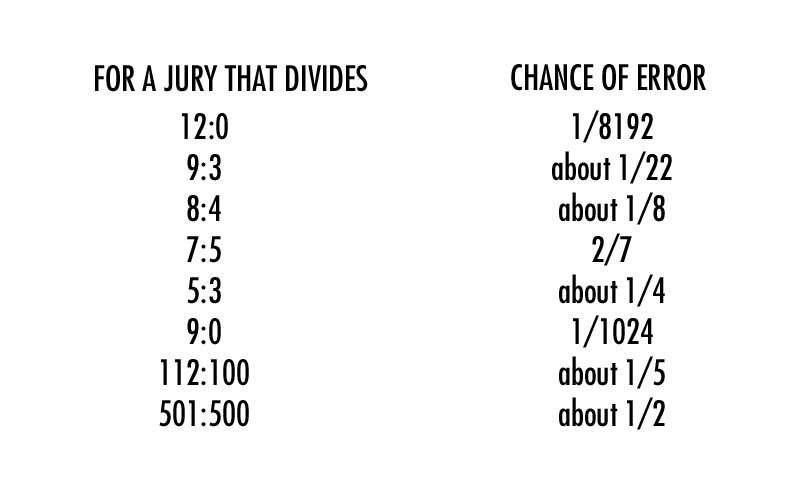
It took juries for mathematicians to understand how to reconcile large numbers with probability theory. In 1808, Pierre-Simon Laplace became extremely concerned with the French jury system. At the time, twelve-member juries convicted an accused citizen by a simple majority. He calculated that a seven-to-five majority had a chance of error of one in three. The French code had adopted the unusual method of creating a higher court of five judges to step in if there was a disagreement with a majority verdict in the lower court. In other words, if the majority of the judges in the higher court agreed with the minority of jurors in the lower court that an accused person should be acquitted, then the accused person would be acquitted. Well, this complicated system bothered Laplace. Accused men often faced execution in the French courts. So if there was a substantial chance of error, then the system needed to be reformed. Laplace began to consider juries composed of different sizes and verdicts ranging from total majority (12:0) to partial majority (9:3, 8:4), and he computed the following odds (which I have reproduced from a very helpful table in Hacking’s book):

hacking-juryerror

The problems here become self-evident. You can’t have 1,001 people on a jury arguing over the fate of one man. On the other hand, you can’t have a 2/7 chance of error with a jury of twelve. (One of Laplace’s ideas was a 144 member jury delivering a 90:54 verdict. This involved a 1/773 chance of error. But that’s nowhere nearly as extreme as a Russian mathematician named M.V. Ostrogradsky, who wasted much ink arguing that a 212:200 majority was more reliable than a 12:0 verdict. Remember all this the next time you receive a jury duty notice. Had some of Laplace’s understandable concerns been more seriously considered, there’s a small chance that societies could have adopted larger juries in the interest of a fair trial.)

French law eventually changed the minimum conviction from 7:5 to 8:4. But it turned out that there was a better method to allow for a majority jury verdict. It was a principle that extended beyond mere frequency and juror reliability, taking into account Bernoulli’s ideas on drawing black and white balls from an urn to determine a probability value. It was called the law of large numbers. And the great thing is that you can observe this principle in action through a very simple experiment.

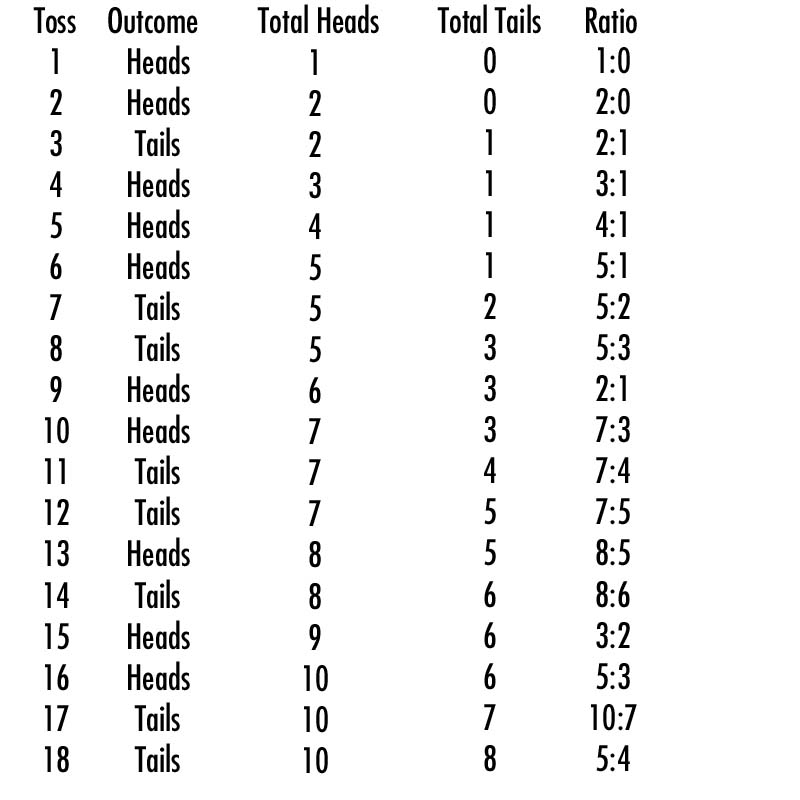
Here’s a way of seeing the law of large numbers in action. Take a quarter and flip it. Write down whether the results are heads or tails. Do it again. Keep doing this and keep a running tally of how many times the outcome is heads and how many times the coin comes up tails. For readers who are too lazy to try this at home, I’ve prepared a video and a table of my coin toss results:

edcointoss

The probability of a coin toss is 1:1. On average, the coin will turn up heads 50% of the time and tails 50% of the time. As you can see, while my early tosses leaned heavily towards heads, by the time I had reached the eighteenth toss, the law of large numbers ensured that my results skewed closer to 1:1 (in this case, 5:4) as I continued to toss the coin. Had I continued to toss the coin, I would have come closer to 1:1 with every toss.

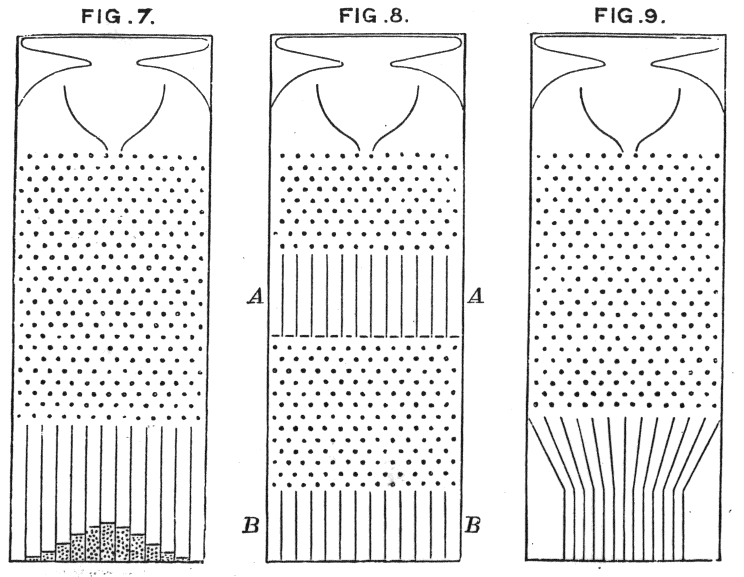
galtonbox

The law of large numbers offered the solution to Laplace’s predicament. It also accounts for the mysterious picture at the head of this essay. That image is a working replica of a Galton box (also known as a quincunx). (If you’re ever in Boston, go to the Museum of Science and you can see a very large working replica of a Galton box in action.) Sir Francis Galton needed a very visual method of showing off the central limit theorem. So he designed a box, not unlike a pachinko machine, in which beans are dropped from the top and work their way down through a series of wooden pins, which cause them to fall along a random path. Most of the beans land in the center. Drop more beans and you will see a natural bell curve form, illustrating the law of large numbers and the central limit theorem.

Despite all this, there was still the matter of statistical fatalism to iron out, along with an understandable distrust of statistics among artists and the general population, which went well beyond Disraeli’s infamous “There are three kinds of lies: lies, damned lies, and statistics” quote. Hacking is a rigorous enough scholar to reveal how Dickens, Dostoevsky, and Balzac were skeptical of utilitarian statistics. Balzac, in particular, delved into “conjugal statistics” in his Physiology of Marriage to deduce the number of virtuous women. They had every reason to be, given how heavily philosophers leaned on determinism. (See also William James’s “The Dilemma of Determinism.”) A German philosopher named Ernst Cassirer was a big determinism booster, pinpointing its beginnings in 1872. Hacking challenges Cassierer by pointing out that determinism incorporated the doctrine of necessity earlier in the 1850s, an important distinction in returning back to Peirce’s idea of absolute chance.

I’ve been forced to elide a number of vital contributors to probability and some French investigations into suicide in an attempt to convey Hacking’s intricate narrative. But the one word that made Perice’s contributions so necessary was “normality.” This was the true danger of statistical ideas being applied to the moral sciences. When “normality” became the ideal, it was greatly desirable to extirpate anything “abnormal” or “aberrant” from the grand human garden, even though certain crime rates were indeed quite normal. We see similar zero tolerance measures practiced today by certain regressive members of law enforcement or, more recently, New York Mayor Bill de Blasio’s impossible pledge to rid New York City of all traffic deaths by 2024. As the law of large numbers and Galton’s box observed, some statistics are inevitable. Yet it was also important for Peirce to deny the doctrine of necessity. Again, without chance, Peirce pointed out that we could not have had all these laws in the first place.

It was strangely comforting to learn that, despite all the nineteenth century innovations in mathematics and probability, chance remains very much a part of life. Yet when one begins to consider stock market algorithms (and the concomitant flash crashes), as well as our collective willingness to impart voluminous personal data to social media companies who are sharing these numbers with other data brokers, I cannot help but ponder whether we are willfully submitting to another “law of large numbers.” Chance may favor the prepared mind, as Pasteur once said. So why court predictability?

* Peirce’s attempts to secure academic employment and financial succor were thwarted by a Canadian scientist named Simon Newcomb. (A good overview of the correspondence between the two men can be found at the immensely helpful “Perice Gateway” website.)

Next Up: Janet Malcolm’s The Journalist and the Murderer!

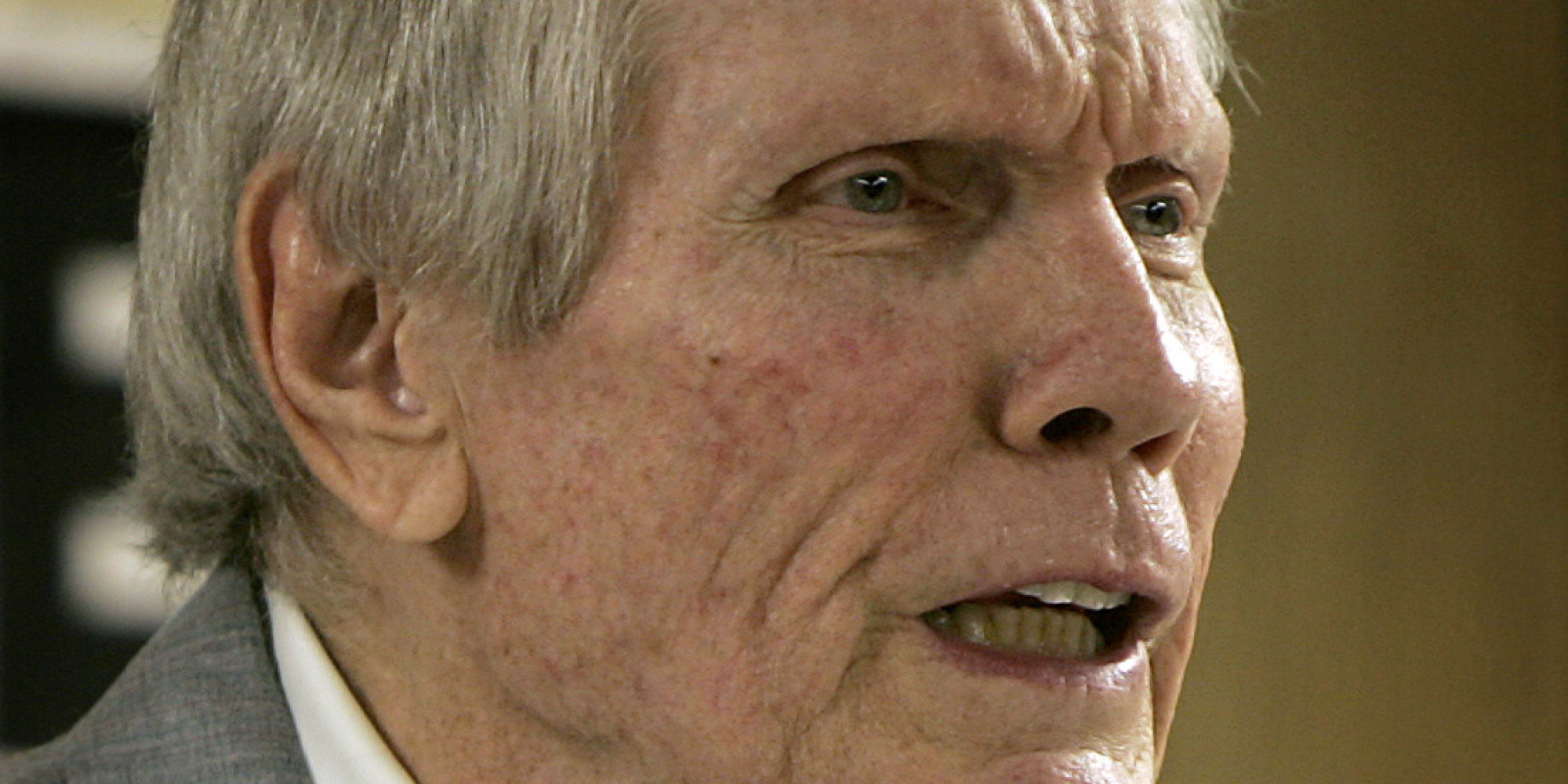
Fred Phelps, Hateful Homophobic Monster, Dead at 84

Fred Phelps is dead at 84. He claimed to be working on behalf of a religious deity, but he had more poison flowing through his veins than half the diamondback rattlesnakes in Florida. Like most venomous reptiles who live to be beheaded by the end of a shovel but that somehow elude that pragmatic instrument, Phelps found his greatest pleasure swallowing innocent mice whole. The small mammals that could not find their way down Phelps’s giant gullet became his willing accomplices and did his bidding through the Westboro Baptist Church.

Phelps was capable of striking at a distance of five states. “Troll” seems too miniscule a word for this craven and atavistic monster, who memorialized his words by picketing funerals of those he deemed immoral. There will be those, even those who stand against Phelps, who will play the “respect for the dead” card, but Phelps deserves neither esteem nor veneration. Let’s not sugarcoat the horror show. He caused insufferable grief to the families of men who served our country and those who struggled to come to terms with their natural identity. His hatred was so electric that it was capable of powering small towns in Kansas and turning innocent people into malicious beasts. Pissing on this ruthless hatemonger’s grave is a rare humanist act.

On the other hand, maybe Phelps’s repugnant conduct was needed to ignite a movement, to get America closer to a less bigoted society that accepts LGBT people as good and vital souls. In 1998, Matthew Shepard was a 21-year-old man who was tortured and killed because he was gay. He was tied to a fence and left to die. It was an unspeakably barbaric act that only a sociopath could fail to shed tears over. Fred Phelps arranged for his followers to picket Shepard’s funerals and this was the beginning of his despicable actions. When Judy Shepard, Matthew’s mother, was asked how she felt about Phelps, she replied, “Oh we love Freddy. If it wasn’t for him there would be no Matthew Shepard.” And look how far this nation has come in the sixteen years since. Sixteen states that issue same-sex marriage licenses. 59% of America supporting gay marriage, according to a March 2014 Washington Post-ABC News poll. Phelps’s life and legacy raises the unsettling possibility that some extremism may be necessary to make a more tolerant nation.

There was a time in Phelps’s life in which there was a part of his vicious core committed to doing the right thing. As a lawyer in the 1960s, Phelps devoted himself to civil rights, taking on cases that no other counsel would touch. But some baleful piece stirred inside Phelps’s tormented spirit and turned him evil in the subsequent decades. But here’s the thing about intolerance. It has a way of courting intolerance in others. I felt guiltless relish in writing the first two paragraphs of this obituary. I had many friends of varying sexualities when I lived in San Francisco. I hated Fred Phelps with every fiber of my being. The fear he stitched into the American fabric, the insurmountable pain he summoned inside people who did nothing wrong. But I also resent Phelps for summoning these vengeful impulses in the name of humanism. It all makes me want to take a cold shower, yet I feel compelled to stare fearlessly back into the beast.

Near the end of his days, Phelps was excommunicated from the Westboro Baptist Church. He was too much even for that abhorrent entity, which will no doubt get a ride of free publicity in the forthcoming weeks. A snake is said to be a solitary beast when it isn’t mating. But it does not back away from confrontation. Its rattle is loud and aggressive, but slightly softer when it scuttles closer to humans. Time will tell if Phelps serves as an inspirational figure for more willing to saunter down the low path or just another poisonous coil dead in a forgotten cave.