Boris Kachka: The Inspector Clouseau of Cultural Journalism

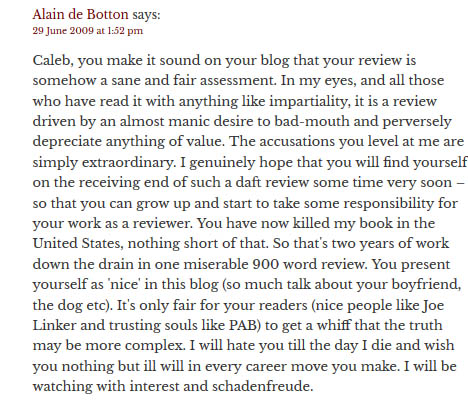
“He said that, as a literary biographer, he’d been asked to talk about Peter’s literary interests, which of course was absurd in a mere seven minutes: Peter deserved a literary biography of his own, and maybe he would write it — anyone with stories to tell should see him afterwards, in strictest confidence, of course. This got a surprisingly warm laugh, though Rob was unsure, after what Jennifer had said, whether he was sending himself up as a teller of other people’s secrets.” — Alan Hollinghurst, The Stranger’s Child

In more than a decade at New York Magazine, Boris Kachka has displayed a limitless knack for bumbling inquiry, suggesting an easily played and incurious rube who hopes and believes with every desperate palpitation of his hypoplastic heart that constant proximity to disinterested players will reveal some grand Talmudic truth.

Kachka is a “reporter” who has seen faux import in an osteoporosic Sally Field climbing fourteen flights of stairs in a midtown hotel. Mere months before Romina Puga, Kachka bombarded Jesse Eisenberg with vapid invasive questions, attempting to read sage significance in Eisenberg’s monosyllabic discomfort and leading one to wonder if Kachka had written his superficial queries on his palm in some headlong campaign to read the future. In April, Kachka visited Claire Messud and James Wood and, unable to spark it up with these two charming and gracious minds, littered his simpering copy with eight desperate New Journalism “[BARK!]”s (one sans brackets) and dwelt more on Wood’s mien than his thoughts.

At New York, Kachka established himself as a diseased mongrel who could barely push his debilitated legs off the porch to work his beat. He has littered his work with portentous phrases like “anomie of Lipsyte’s generation” and “Park Slope’s popular freelance perch,” and it all smacks of a desperate burnout raiding the low-hanging lexical fruit that hadn’t already been plucked for some “Talk of the Town” piece at a more august publication.

Kachka’s new book, Hothouse, comes out on Tuesday and purports to chronicle Farrar, Straus & Giroux with all the lapel-grabbing furor of Jacob Riis investigating the New York slums. Despite “more than 200 interviews,” the result is a dry, listless, tendentious, sexist, blinkered, and preposterous book which regurgitates insignificant facts, latches onto third-hand rumors, and fails to comprehend the way the publishing industry really works.

Yet Kachka’s insufficient history has inexplicably captured the imagination of a few gullible and unquestioning boosters, including Heller McAlpin at the Los Angeles Times and Carolyn Kellogg at Bullseye. Perhaps Hothouse has received a fair pass because journalistic standards have collapsed well beneath the lowest notches on the limbo bar. Or maybe these literary cheerleaders cannot comprehend that hearsay, which is impermissible testimony in a courtroom, is not acceptable in any work purporting to reveal the trajectory of an uniquely influential business.

Much like Leonard Zelig or, perhaps more accurately, Being There‘s Chauncey Gardner, Kachka has been allowed to commit solecisms for years, yet there’s an inexplicable hubris attached to his bungling, the telltale traits of a more famous Peter Sellers character. Kachka’s approach to the truth involves relying on inference without respect for person or underlying fact. Helene Atwan, now the Director of Beacon Press, leads Kachka to believe that FSG intended to change Peter Høeg’s last name to “Hawk” for the release of Smilla’s Sense of Snow, and Kachka laps this confabulation up so that he can grill Roger Straus III on this incredulous matter. Kachka specializes in the bold uncorroborated inference, writing like a man who isn’t getting any action at home: “By the early 1960s, [Roger Straus] was probably sleeping with three of his female operators.” Probably? The scuzziest TMZ reporters are more committed to accuracy. (There are, of course, no endnotes upholding this claim.)

If Kachka feels as if his subjects aren’t giving him the answers or the access that he believes he is entitled to by rightful decree of the tottering authority in his feeble delusional mind, or the quotes don’t match the story he believes he already knows, then he will burn them with his cheap prossy pen. Here, for example, is Kachka’s first description of Jonathan Galassi in Hothouse:

Galassi, on the other hand, is a patrician only by training, a bon vivant only by necessity, but a nerd through and through. He invited his fourth-grade teacher to his ninth birthday party. He seems to have learned the bold body language of an alpha male, but never quite vanquished his low, slightly nasal voice or downcast expression.

Instead of being curious about Galassi’s intriguing background, Kachka sees Galassi as a cartoon to be mocked. Kachka cannot be arsed to get his source to trust him. He is clearly not Richard Ben Cramer talking baseball with George W. Bush to get a stubborn man to open up. And stacked next to fellow New York journalist Robert Kolker (author of the recently released and well-received Lost Girls), he’s a total embarrassment, especially when he pursues an Oliver Stone-like trail suggesting that Straus had a secret telephone line and was working for the CIA. Had Kachka more time to push his plodding connections, he most certainly would have spotted Straus on the grassy knoll.

Like the despicable gossip peddler Paul Bryant in Alan Hollinghurst’s excellent novel, The Stranger’s Child, Kachka seeks any vaguely salacious angle to throw into his preordained template, whereby FSG is a “sexual sewer,” male employees fuck anything that moves, and Mad Men parallels snap into place like a smooth sudoku puzzle. In Hothouse, Kachka claims that, because someone may have seen long black strands of hair in a borrowed apartment, Susan Sontag and Straus were having an affair. He then spends the majority of his book calling David Rieff “an illegitimate son” to shove this unsubstantiated carnal connection down the reader’s throat. When Kachka finds former FSG assistant Leslie Sharpe, who tells him, “Everybody was fucking everybody in that office,” the reader feels the extremely unsettling aura of Kachka’s cock hardening at the news. But of course, Kachka has nothing reliable in his notes on the many affairs he claims went down. Any man close to the age of forty who wags his dry tongue for scuttlebutt scraps is a pathetic figure indeed.

Hothouse evinces how little Kachka understands wealth by pointing to “starter dachas,” opens chapters with journalism cliches (“If Jonathan Galassi didn’t exist, FSG would have to invent him”), and squeezes out strained efforts at Tom Wolfe-style savaging against agent Andrew Wylie:

It doesn’t help that his face tapers from a broad bald pate to an unshaped brow, icy eyes, and a chiseled, lupine chin, or that his laugh sounds like that of the world’s most cultured hyena.

Can a face taper? Is Wylie a hyena, a wolf, or a jackal? Given all the mixed metaphors, I don’t think Kachka even knows.

Kachka lacks one of the competent reporter’s primary skills: pretend to like a source you loathe (or, more ideal, find something to like about someone you despise). He’s long past the point where any true observer can feel sorry for him, although the pity blurbs accompanying his cotillion ball reveal a few noteworthy mensches who should be commended for their kindness. Still, Kachka is not significant enough to be put out of his misery with a pink slip and a peremptory blast in the human resources office. He trudges on, a bearded penguin known to harass people with multiple phone calls at 6 AM (including yours truly many years ago on a matter pertaining to Zadie Smith) and getting people so thoroughly wrong that one wonders if he has even read Philip Roth’s American Pastoral.*

Roth, like John McPhee and Edmund Wilson, was wooed by FSG without an agent. An assiduous journalist would look into whether or not Roger Straus, a notorious cheapskate (a man who operated FSG from a ramshackle Union Square West headquarters for years and a man who did not contribute a sou to Susan Sontag’s breast cancer fund), actively pursued writers who did not have representatives to protect their interests. (Kachka points out that Straus sought to discredit agents wherever he could, but he isn’t robust enough to construct a timeline or a concrete set of governing principles.) Given the sour grapes that developed between Straus and Wylie in the 1980s, to say nothing of the resentment expressed by writers for being underpaid, it is palpably obvious to look into the very business philosophy that permitted a publisher, often sustained by family wealth when times were lean, to subsist as long as it did. It would also seem natural to focus on how New Directions, who worked in the same building as FSG for many years, operated as FSG’s competitor, snapping up the poetry of Thomas Merton and John Berryman before FSG editor Robert Giroux.

Hothouse reveals that Straus was a poor businessman (“No FSG catalog would be complete without its impending announcement,” mocked one wag about the publisher’s long delayed titles), even as it promulgates the false myth that this apparent patriarch had “just enough of a personal financial cushion to keep from falling over the brink.” Nearly 250 pages later, Kachka writes, “The fact is that 1988-vintage FSG could have eaten 1982 FSG for lunch. In the old days, the cash simply hadn’t been there. Roger’s cheapness may have been inborn, but it was refined by forty years of hard, break-even experience.” Or maybe it wasn’t. Kachka is such an otiose journalist that he doesn’t follow the money, except through mere conjecture. He claims that Wilson, Sontag, Carlos Fuentes, Tom Wolfe, and Joseph Brodsky “received financial support far beyond standard contracts,” but provides neither source nor sums for this claim. Why did Straus really sell his townhouse? Is it not possible that Straus sold FSG to billionaire Georg von Holtzbrinck in 1994 because his coffers were light? Kachka lacks the diligence to pursue these questions, in large part because it contradicts his cheap thesis that FSG is the Greatest Publisher of All Time. On the other hand, Kachka is to be commended for inadvertently reminding us that Melville House’s Dennis Loy Johnson, arguably the most hypocritical man working in publishing today, is desperately trying to be a Roger Straus for the 21st century and will surely fail if he continues along the same trajectory.

Kachka does account for Straus’s tendency to skim his titles, but is too much of a milquetoast to probe: “The most common theory, especially among those who saw him lug manuscripts up to Purchase for the weekend, is that he didn’t so much read books as ‘read in’ them, as he sometimes put it — enough to get a nose for them, like fine wines.”

Hothouse is plagued by other contradictory assertions which quickly out Kachka as a squirmy journalist who cannot be trusted. He claims FSG as an innovative publisher, but confesses that Robert Giroux was not an especially edgy editor:

But though he was still approaching the peak of his professional power, he was no longer, if he ever really had been, at the vanguard of taste. By the sixties, even the Beats — most of them too extreme for Giroux — were old hat.

In other words, FSG was hoary from the get go. And it took careful line editors like Lorin Stein, progressive-minded editors like Sean McDonald, and gutsy publicists like Jeff Seroy to turn it into the publisher it is today. But all that happened under a German congolomerate’s watch, not Straus’s.

But what ultimately makes Kachka such an unpardonable scumbag is the way in which he wallows in the very sexism he tries so hard to expose. Aside from perpetuating a fantasy that publishing was a “gentleman’s profession” with “Roger and his publicity girls,” Kachka undermines Margaret Farrar (along with her barely mentioned husband), claiming that the woman who created most of the rules governing crossword puzzle design merely “enriched one publishing house.” (Later, Margaret is dismissed as “the crossword-puzzle creator and sometime editor.”) He introduces FSG supplies manager Rose Wachtel as “a prematurely elderly-looking woman.”

Peggy Miller, Roger Straus’s secretary of several decades, tells Kachka that she refuses to answer questions about whether or not she was romantically involved with her employer. But that doesn’t stop Kachka from deracinating her dignity by suggesting that she’s “a living homage to Straus” and claiming that she and Straus were a “couple,” with rampant fucking during their annual trips to the Frankfurt Book Fair. (Compare this with Ian Parker’s 2002 description of Miller as “a tall, chic, ironic woman.” In fact, save yourself the $28 on Kachka’s junk and just subscribe to The New Yorker to access Parker’s piece.)

The most prominent example of Kachka’s sexism is his deplorable depiction of Jean Stafford, a distinguished (if troubled) FSG writer. Kachka pits her husband Robert Lowell’s accomplishments over hers and has no sympathy for her nervous breakdown even as he points out that Lowell and Gertrude Buckman “spent unsavory amounts of time together headed for an affair.” Kachka’s vulgar and misogynist suggestion is that Jean Stafford should have suffered in silence. But he doesn’t stop there. Boris Kachka, a man who will never be a poet or a novelist or a journalist of any renown, actually has the temerity to write that “Giroux patiently endured broken deadlines,” as if Stafford’s great difficulty with a mentally unstable and philandering husband was some commonplace household task. It was likely that the pressure to produce in these conditions led Stafford to bolt to Random House, but the doltish Kachka actually writes this sentence: “It’s difficult to tell exactly what drove Jean Stafford away.” One can easily hear Peter Sellers speaking this line in a French accent.

Does Kachka stop embarrassing himself? Not at all. In 1963, A.J. Lebiling, Stafford’s third husband and the man who she experienced the most happiness with, died at the early age of 59. This premature death crushed Stafford and made it difficult for her to write fiction. But don’t tell that to the clueless and insensitive Kachka, who neglects to mention any of this when writing about FSG’s 1967 author compilation:

Giroux used it as a chance to prod another of his flailing depressives, Jean Stafford, to finish her autobiographical novel “A Parliament of Women,” only to receive the reply: “There is no book and I don’t know if there ever will be.” There never was.

A flailing depressive? Is that all she was? Never mind that Stafford would go on to win the Pulitzer Prize in 1970 for her Collected Stories — an FSG book. Kachka does not mention this Pulitzer at all. Nor does this sexist pig point out that Stafford was good friends with Roger’s wife, Dorothea Straus. How many author-publisher relationships did Dorothea salvage? We may never know, because it doesn’t fit into Kachka’s “gentleman’s profession” template.

But Hothouse‘s greatest folie de grandeur is the notion that FSG willfully positioned itself as the most distinguished American publisher under Straus’s watch. Many of the Nobel winners that FSG published in the pre-Galassi days emerged by accident. Indeed, the publisher then and now has stayed alive publishing blockbuster authors like Scott Turow, Thomas Friedman, and Tom Wolfe. But the big tell that Kachka is writing for a lonely audience of one is when he shakily assesses FSG’s stature based on its spine:

The Farrar, Straus logo is so engrained in the consciousness of savvy readers that seeing it on sixty-year-old Noonday compilations provokes cognitive dissonance. To say that FSC simply appropriated the logo is not enough.

Who are these savvy readers? Can they be found in Washington next to the savvy insiders? FSG survived not through loyal readers adhering to the brand, but because it gobbled up profitable publishers. But Kachka is so blind to his invented mythology that he calls Walker Percy “a true Giroux-Robbins team effort,” even though his best-known book, The Moviegoer, was published at Knopf, where editor Henry Robbins merely “had some input into Stanley Kauffmann’s heavy editing of the manuscript.” (Robbins was to flee FSG only a few years later under extremely difficult conditions. Kachka is not especially interested in investigating the high turnover among top editors, but he cannot resist inserting any moment where Straus barks, “You’ll be back,” to an FSG employee fleeing to stabler pastures.)

Perhaps Kachka’s inherent squareness and his lack of adventure, seen with his hilarious suggestion that pot passed around a publishing party was dangerous or his equally pathetic fear of legitimate 1960s actvism (“acts of protest bordering on personal threats”), is to blame for this turgid book. The title is surely no accident, given how large chunks of this book are as dull and as boring as the smooth jazz Bruce Hornsby album of the same name. If Kachka is foolish enough to continue with his floundering career as a book writer, it is almost certain that, like Hornsby, he will celebrate every 4th of July just a little tamer than most of the rest of us do.

* — During the last BookExpo America, I attended a party in which a marvelous woman I hadn’t seen in a while kissed me. Kachka stood next to her and looked at me: his small mouth agog, a pathetic paralysis infesting his slapdash bearing, a hilariously pointless anger in his insignificant eyes. He didn’t even have the balls to introduce himself or call me an asshole to my face. Some years before this, Kachka proved incapable of recognizing a clear case of performance art by telephone voicemail. He really seems to believe that it’s still the 1990s. He’s clearly not going to blossom on the clock. But I’ll be the first to buy him a drink if he does.

8/7/13 UPDATE: On Wednesday morning, prompted by a Twitter discussion of Boris Kachka’s book involving Alexander Nazaryan and Kera Bolonik, Boris Kachka told me to “go fuck yourself,” as seen in the screenshot below.

boriskscreenshot

Kachka’s tweet was quickly deleted. I responded to Kachka with this reasonable reply:

borisktweet1

Kachka replied:

borisktweet2

So Boris Kachka, unable to refute any of this essay’s charges, prefers to take the low road — a fitting path, given how his book is so obsessed with the vulgar.

Gabriel Roth (The Bat Segundo Show #508)

Gabriel Roth is most recently the author of The Unknowns.

Author: Gabriel Roth

Subjects Discussed: Leaving San Francisco for Brooklyn, observing the two dot com booms, how moving away from a city often makes you more aware of its dynamics, the benefits of isolation, National Novel Writing Month, descriptive restaurant cues, the delicate balance between invention and specific representation of a place, writing a character who is “a life support system for feelings of anxiety,” not fronting before other programmers, attempted parallels between programming code and writing prose, anxiety as literary ambiguity, My Little Pony used in flashback, brony culture, how the origins of geekdom become twisted over the course of dissemination, Maya Marcom as a loaded name, vacillating between a Bildungsroman and a social novel in the act of writing, capturing the spirit of being alive during a particular time and place, tips learned from being in an MFA program, the one-time advantages of in-state universities, reading books without understanding the mechanics behind the writing, the amount of work that a writer must do to create a vivid sensory world, systems-thinking reporting vs. the descriptive needs of fiction, the abstract nature of news writing, Bay Guardian philosophy, Bruce B. Brugmann’s “Write while you’re drunk, revise when you’re hungover” catchphrase, alt-weekly professionalism, exploring material that you are already steeped in, writing what you know vs. writing what you don’t know, what your subconscious knows, automatic writing, the revising process, ingesting drugs as a character trait, accounting for the sudden expository twist near the end of The Unknowns, repressed memory, the problems that occur after you’ve fallen in love with someone, maintaining a good-natured feel in a novel after a sexual abuse revelation, humor applied to a broader emotional spectrum, “lad lit,” Benjamin Kunkel, Nick Hornby, the glut of novels about twentysomething white males, whether style is enough to escape white male fiction trappings, judging a book by its flap copy, taking on other voices, The Orphan Master’s Son, why Roth zeroed in on Denver privilege, coming from an educated family, the help that comes from background, Eric’s lack of ideological background, selling personal data to evil corporations, characters who espouse pro-corporate values, the diminishing of principle in San Francisco, the difficulties of combining politics and fiction, the homogeneity of America’s two political cultures, the Iraq War, when people always agree, whether the idea of the overstuffed Great American Novel still applies in 2013, The Adventures of Augie March, Infinite Jest, Rachel Kushner’s The Flamethrowers, critics obliged to fight over Kushner, minituarist vs. maximist fiction, and how to get a TV-obsessed culture hooked on fiction.

EXCERPT FROM SHOW:

Correspondent: I wanted to first of all start off with you leaving San Francisco in 2006. I left in 2007. We both ended up in Brooklyn. And this is one of those interviews. Why didn’t we actually know each other during that decade that we were there? I’m wondering how aware you were that the City was falling apart, was being taken by the Google People, by the private buses. What caused you to flee to Brooklyn? And was this novel in some way a way of reckoning with that?

Roth: Well, I left mostly for personal reasons. I was living with a woman who is now my wife and who was starting a graduate program at Columbia.

Correspondent: Yes.

Roth: And so that was the immediate impetus for me to leave, although I had been in San Francisco for ten years. And as you probably know, ten years is a long time to spend in San Francisco.

Correspondent: I was there for thirteen.

Roth: Yeah. You start to feel that time passing under your feet a little bit. It was not yet clear in 2006 — or at least it wasn’t yet clear to me — what was going to happen with the second Internet boom and what was going to happen with the City as a result of that. I had been there since 1996. And so I had seen the first Internet boom which had sort of effloresced in the late part of the millennium and then died out very quickly in the first years of the oughts. And so I probably would have thought that any new economic activity was going to follow a similar boom and bust pattern. And now it’s not clear that that’s actually what’s going to happen. Or if there is a bust, then the City will have been pretty permanently changed and marked by the boom, it seems like.

Correspondent: Well, it is interesting. Because with the present boom underway, I remember the first one and that seemed brutal at the time. And I was very fortunate to have an apartment in which the rent had not gone up, as were many of my friends. And we somehow managed to secure apartments. Now I’m hearing reports from friends who are basically cleaving to their apartments, hoping that their building won’t be taken over and so forth. And I guess my tangent here was, if you weren’t entirely aware, does moving away from San Francisco and writing a novel actually allow you to think “Wow! All this was going on and, as shred as I was, I really wasn’t paying attention”?

Roth: Yeah. There is a certain amount of that obviously. I began the novel and I had gotten a good two thirds of the way into a draft by the time I left San Francisco. So a lot of the scenarios and the physical environment that I was describing was what was immediately around me as I was doing that first stage of writing. And then moving away — and I think this is probably true in general for writers — the act of writing is often, I think, an act of recapturing and of preserving your memories. Sort of freezing them in sentences. And I think it worked that way for me partly about the City of San Francisco and the environment around the first dot com boom, but then also about a time in my life. And of course, it’s very difficult to separate the place that you were in your early twenties from the experience of being in your early twenties.

Correspondent: Well, how so? Can you elaborate on that? It almost seems like you’re kind of mining through your own data and trying to separate it into emotion and tangible information.

Roth: Yeah. That’s absolutely right. I mean, the book is in part about San Francisco and about people working in technology and about collecting data. But then it’s also about a young man who’s preoccupied with looking for love and finding someone to be intimate with and close to. And it’s not an autobiographical book and the characters aren’t the same person as me. But that experience of being in my early twenties and really wanting to figure out how to love somebody and be loved by somebody — I was preoccupied with that for a long time. And those experiences, along with the experiences of the social world of San Francisco, are what went into the book and what got filtered through the fiction writing process and into the novel. And so there’s no way that I can say, “Oh yes. This is just a sort of satirical or an observational portrait of a little microcosm of the world.” Because it’s all wrapped up with my own subjective experience.

Correspondent: So you had two thirds of a draft before you moved here to Brooklyn. What did moving to Brooklyn produce in terms of clarity for both Eric [protagonist of The Unknowns] and for the view of San Francisco that you had?

Roth: Well, let’s see. Around the time that I moved out here, you know, I finished the MFA program at San Francisco State. I had a bunch of chapters. I was trying to figure out — I knew where the book was going to go, but I was trying to stick the landing, which is not straightforward and I think is not usually straightforward when writing a novel. And then we moved out here. And we were in our early thirties — mid-thirties even — and it was no longer a time when I would have moved to Brooklyn and gone out drinking every night or made a whole bunch of new friends. Or I wasn’t going to go out on dates. Because I was living with my girlfriend. And so moving to New York, which for many people is like stepping onto the big stage — for me, that was the time where I was a bit more isolated and I was going to work every day and getting my pages done and then coming home and eating dinner with my wife. And I think that was important in terms of finishing the thing.

Correspondent: So the isolation allowed you to finish the book.

Roth: Yeah.

Correspondent: It allowed you to come to terms with and put aside this particular part of yourself in your twenties.

Roth: Yeah. I think that’s right. It was putting a clean break on what I had been doing and what I was going to be starting to do from now on.

Correspondent: Did you have any other novels before this? I was curious.

Roth: Not that you would actually call a novel. I had like a pile of pages that I had written during National Novel Writing Month in 2003. Or something like that. That added to nothing but a pile of pages.

Correspondent: I think I remember reading one of your Bay Guardian columns. I think you wrote about it in the Bay Guardian, writing for the National Novel Writing Month.

Roth: I probably did.

Correspondent: Yeah, I remember that. I was a loyal Bay Guardian reader when I lived there. So that was you. You describe “a medium-expensive neo-Cuban restaurant with the kind of deserts that have names evocative of Catholicism” near Lazarus, your invented Valencia Street bar, which clearly evokes Cha Cha Cha. You have the photographs of tailfinned cars, which are sort of like Mel’s Drive-In, but not quite. Fiction — this is not reality. Imagination should be encouraged. But this does lead me to ask you about creating a believable San Francisco for this book. Obviously, you have to rely on things that actually exist. But are there any dangers in being too specific when you’re creating a sense of place like this? I mean, it seems that you want to alert people like me who have in fact passed and entered into Cha Cha Cha that this is indeed the San Francisco of that era. But I was curious about that fine line between telegraphing exactly what it is and just making shit up.

Roth: Yeah. I mean, I think the main issue you’re talking about is with the restaurants. Frankly, there’s a lot of restaurants. And most of the restaurants, as you point out, if you were going out to eat in the Mission in the early part of the 21st century, you’ve probably eaten in some of those restaurants. I didn’t worry about that. And I guess I think that’s fine. And if you’re reading it and you’re in the small subset of people who are going to recognize those restaurants, then hopefully that’s a sort of pleasant moment of recognition for you. Maybe it’s distracting, in which case my bad. But most people are not going to fall in that category. And I think without some amount of specificity, whether its based on real life’s specificity or completely fantastic specificity, without that, then it just becomes a generic restaurant. And the whole thing sort of looks flat. Putting in detail — in this case, often detail borrowed from actual restaurants where I ate most of my meals during the ten years I lived in San Francisco — putting in that detail hopefully gives the feeling of something that takes place in a real world that’s fully stocked with all the stuff of the real world.

Correspondent: But it is your world. It is Eric’s world. And I guess my question is not so much, “Ah! I’m going to go through The Unknowns and cut and paste all those phrases and put them on Yelp.” That’s not what I’m talking about.

Roth: (laughs)

Correspondent: What I am talking about is the idea that this is fiction. It does require invention. It is not going to be a pure 100% depiction of San Francisco. So where do you deviate between that specificity and just inventing something that doesn’t exist but is real enough for the reader to believe, whether the reader be from San Francisco or the reader be from somewhere else?

Roth: Yeah. I mean, really, it depends on the needs of the particular paragraph. You know what I mean? And what comes to my mind as I’m writing it. If, let’s say again, there’s a restaurant where I’m sending the two characters and I need to envision it, you know how sometimes in your dreams or your fantasies, sometimes there will be a place that doesn’t really exist. And sometimes all of the events will transpire in a place that does exist, but those things never happen there. Or it’s a place that does exist, only now they’re serving vegetarian food instead of Mexican food. And writing a novel seems to me exactly the same process. That you borrow these elements from the real world, but unless you’re writing a novel that’s just a direct transposition of real life — which this certainly isn’t — the filtering process is going to transform it to whatever degree is necessary.

Correspondent: So Eric describes himself to Maya as “a life support system for feelings of anxiety. The anxiety is the organism and I am the habitat.” Yet he tells his story in this book much like a programmer, almost as if he’s writing clean lines of code. The habitat of this book may indeed describe anxieties, but it seems like it’s reliant more upon nouns and adjectives rather than verbs. And I was curious about this. Did you impose any kind of stylistic ordinance upon your character to push his anxieties beneath the text? I mean, verbs are certainly the way that we absolutely spill out our emotion. And yet he seems to not use them as such. I’m wondering if this was something you were conscious of or whether it was designed or emerged through revision or what not.

Roth: That’s interesting. I certainly don’t, when I’m writing, think in terms of parts of speech like that. I’m not a sufficiently programmatic writer to be able to do that. I don’t think it would help me. I’m sure there’s some people for whom that would be a useful way to think about things. I do think — and the sentence that you quote is a good example of this — you know, he’s out on a date with this girl and she says to him — he says something that seems uptight or anxious and she says, “Do you consider yourself an anxious person?” And he says, “I consider myself a life support system for anxieties. The anxiety is the organism and I’m the habitat.” And on one hand, to some extent, that’s an accurate description. But on the other hand, hopefully on a date, that’s the clever thing to say. That’s sort of witty and self-deprecating, but also a self-revealing thing to say to a girl who you’re trying to make fall in love with you. And rather than imposing a restriction on Eric’s speech, I think of that character as being both messed up in all of these ways and having these real psychological difficulties, making life really difficult for him, and at the same time being to some useful degree self-aware about that and able to talk about and, as in that example, able to present it and able to sublimate it into a self-presentation that hopefully is a little charming and a little attractive and that Maya at least responds to. And hopefully, to some extent, the reader will respond to it in that way as well. He is an anxious person and he is a self-conscious person and yet his self-awareness about those things enables him to defuse their effects a little bit.

(Loops for this program provided by Dj4Real, chefboydee, and hamood.)

The Bat Segundo Show #508: Gabriel Roth (Download MP3)

This text will be replaced

A Brief Sabbatical

The summer heat has seared into the cultural fabric, smoking out closet racists among op-ed hash slingers, unmasking literary grand dames as xenophobic attention whores, and revealing other minds lightened of socioeconomic rumination thanks to reliable fingers plugged into ears. To anyone who feels or thinks, this is a difficult time. No response seems adequate. One races to comprehend the complexities of some latest development, amalgamating thought with heart, sans treacly pronouncement or crass sentiment. But then there’s some new nightmare around the corner, such as Juror B37’s tense-mangling ignorance, to which one can only feel despondent and contrite, with jaw agape and the determination not to shirk jury duty ever again.

But hopelessness isn’t an option. This was abundantly demonstrated on Sunday as I walked the march for Trayvon Martin, witnessing protesters stop traffic in Times Square amid conciliatory honks and watching those who were silenced from the initial shock rejuvenate into robust souls slapping high-fives with anyone with a spare hand.

Getting back on the digital treadmill isn’t viable either. As you grow and evolve and you learn and get better with the humility and the ceaseless struggle that your shaky bag of tricks affords, you begin to understand why it’s vital to raise the stakes and take risks and not become caught in the same routine. The examples of what not to become are now distressingly legion: the waning talents who grow bitter, the bright minds who settle and permanently extinguish the spark. That’s the double-edged sword in an age where we are expected to reveal all. You don’t want to go there, but your heart hangs when you spot the easily seduced.

I have been hit with an entirely unanticipated epiphany that has forced my hand. But it cannot be online. And it cannot be immersed in the immediate. It cannot involve courting an audience. It involves blocking out all distractions and kudos and admonishment and focusing on the very best I can do.

I am taking a brief sabbatical from the Internet. For two weeks, I will keep my online peregrinations to near zero. There will not be a Follow Your Ears show this month. There will probably not be any Bat Segundo episodes (save perhaps one), although I will continue conducting conversations for future episodes. I will stay momentarily off Twitter — not with the extreme gumption as the convivially sardonic Ben Anastas, but certainly with true priorities in mind.

You won’t find the way ahead through your computer or your phone. The real world is more munificent and embracing of the human spirit than anything the digital world can offer. This isn’t a retreat. It’s an awakening.

See you in August.

On George Zimmerman: Why Racist “Stand Your Ground” Laws Must Be Challenged

We believed we were long past the point where an unarmed boy would be gunned down because of his race. We were told by dulcet-voiced television pundits soothing us from their comfortable chairs that electing a black man twice as President had pushed all the problems away. We believed, despite racial profiling and the billions of dollars wasted on racially biased arrests, that our nation was “post-racial.” But on a hot Saturday night, a six woman jury demonstrated that this was little more then a myth with one of the most egregious verdicts of the 21st century. This jury acquitted George Zimmerman because virulent laws enacted to cater to these harmonious fantasies encouraged our worst instincts.

Trayvon Martin is dead. There is no verdict or legislation that can bring him back. The man who executed Trayvon from within the privileged gates of an affluent Sanford community has walked. The same statute* that permitted Zimmerman to flee without consequence has also caused an African-American woman to be sentenced to twenty years in prison** for firing warning shots. Clearly, there is something deeply injurious inside the “stand your ground” law that allowed all this to happen.

Trayvon has not been the only victim. The Tampa Bay Times has complied a list of casualties, with the accompanying stories revealing hurt and sorrow needlessly complicated by a law intended to create simple results. “Stand your ground” supporters, such as Florida State Rep. Dennis Baxley, have claimed that violent crime went down and that tourism went up, as if some modest spike in Walt Disney World visitors atoned for an instrument encouraging our basest vigilante instincts. But the facts demonstrate otherwise. Five years after SYG was put into Florida law, reports of justified homicides tripled. SYG cases are are more likely to increase the not-guilty finding of a person accused of killing a black person. A CU-Boulder study from last year revealed that 69 undergraduates and 254 police officers were more likely to shoot black suspects over Hispanics and whites. And all this is just the beginning.

But much as Arizona’s racist anti-immigrant law has spawned two dozen clones across state legislatures, 24 states have followed Florida’s racist lead, putting their own versions of SYG on the books. Ten of these states didn’t even bother to change the language, passing bills that were nearly identical to Florida. These political actions were as callous in deed as epithets or hate automatically assigned to a person because of skin color.

At Salon, Roxane Gay eloquently argued why no one should allow themselves to feel hopeless because of these developments. Beyond asking difficult questions about why racism’s cancer continues to infect the promising fabric of our nation, we need to examine the machinery that holds the quilt together. Libertarians have long parroted Justice Oliver Wendell Holmes’s famous maxim, “Detached reflection cannot be demanded in the presence of an uplifted knife.” But it is no longer 1921. And a strict federal mandate against cartoonish “stand your ground” laws which do not see a distinction between firing a submachine gun at an intrusive encyclopedia salesman and massacring some kid in a hoodie isn’t an unreasonable proposition in 2013.

* UPDATE: It has been rightfully observed by a few readers that Zimmerman waived his “stand your ground” immunity right during the trial. However, the jury instructions define self-defense very much in line with “stand your ground” under the “justifiable use of deadly force” section. The Tampa Bay Times has also pointed out that several “stand your ground” cases have shared qualities with the Trayvon Martin case.

** UPDATE: This CBS News article was updated a day after this piece was filed. The new version of the article pointed out that the Marissa Alexander “stand your ground” angle was not as cut-and-dry as previously stated. I have let this piece stand as is to reflect the information as it was reported at the time, proving that this issue is indeed a highly complicated one. Thanks to M. Smith for pointing out the revised article.

Anchee Min (The Bat Segundo Show #507)

Anchee Min is most recently the author of The Cooked Seed.

Author: Anchee Min

Subjects Discussed: Visiting Houston, Mary McCarthy, being the heroes of our own stories, writing Red Azalea as a way to learn English, owning your own material, repeatedly renting a pornographic tape, sex and loneliness, Love Story in Chinese translation, Western imports after the Cultural Revolution, the Chinese idea of Miss America, Caligula in Madame Mao’s film library, how Chinese restaurants operate during Thanksgiving and Christmas, Anchee Min’s incredible work ethic, living paycheck to paycheck, working multiple jobs, judging the homeless, how ideas of being “down and out” shift from nation to nation, having your daughter hold up sheets of drywall, managing a fixer-upper, deprived children, personal propaganda, Dr. Phil, results-oriented thinking, Americans taking their nation for granted, entitlement, the bare minimum to what people are entitled to, basic needs and health care, parallels between America and the Roman Empire, theoretical humanity, the fragile existence of living in America with a conditional visa, Min’s efforts to read English, the line between hard work and exhaustion, the eight hour day, whether Min ever has downtime, the first time in Min’s life when she felt hope, having the will to make it in America, coughing blood and passing out from overwork, feeling safe for the first time in your life, being swindled and taken advantage of by employers, being overly trustful towards the wrong people, perceptions of fast food, Mister Rogers’ Neighborhood, the influence of television, Edward Snowden, associating music with Chicago buildings, Chinese opera, Michael Jackson, Stevie Wonder’s “I Just Called to Say I Loved You,” working in a record store, Pearl Buck, what’s left of Min’s Chinese roots, Min’s love for Broadway, Phantom of the Opera, why it’s important to write about 95% of China (rather than the 5% elite), Kanye West, learning how to moonwalk like Michael Jackson, envying women with big butts, salsa queens, how memory defines life, memory as a mode of survival, the smartphone generation, acting in propaganda films at the Shanghai Film Studio, pretend tears, the importance of being well-fed and staying humble, Min writing about her first husband, when people forgive unflattering depictions of themselves in books, how people who immigrate to America from China have different perspectives, respecting differing approaches to the American Dream, gratitude for other perspectives, divorce proceedings and child custody, becoming a property owner because there were no job options, landlord-tenant relationships and equitable laws, Min’s views on deadbeats, the excuses of tenants, avoiding generalizations amidst hardships, notions of American childhood, China and the U.S. spying on each other, and how the future of Sino-American relations will play out.

EXCERPT FROM SHOW:

Correspondent: Mary McCarthy once famously remarked, “We all live in suspense, from day to day, from hour to hour.” And this makes us the hero of our own story. So when you wrote both Red Azalea and The Cooked Seed, my question to you is: What did you take to downplay your own heroine status? Is the judgment of whether you are a good person or not left up to the reader? Or is including such moments — such as the way you portray Lauryann, your daughter, or act as a landlord — open enough for the readers to judge for themselves?

Min: I guess I will leave them to judge for themselves. For me, writing Red Azalea was a way to learn English. And I believe that only when I write it and I have other people correct me and I correct it in the copy of the text, I learn English in a solid effective way. And I did not think about anything else. Because I had nothing. Actually, what I wanted was the opposite. I wanted to write like American classmates. But I didn’t have — I did not grow up with hamburgers. So it was amazing. I did not understand what McDonald’s meant. So it was fascinating when they took me to a Chicago Avenue McDonald’s for the first time and put on makeup for the first time. And I think I was just off the boat. Nothing else. It was just survival. Try not to be deported. With this one, The Cooked Seed, I was on the other end. Because I had been making a living as an author for twenty-five years. So I knew what I possessed. It was just how far I wanted to take the material. It’s the issue of honesty. And also bringing my daughter into the picture and my divorce and everything — I felt that as an American writer, I realize I did not own my own material. I had no right to own that. But it’s a conflict. How far did I want to go? It was my daughter who said, “Mom, if you want to leave me anything, I want you to leave me your story. But not the sugarcoated version.”

Correspondent: So here’s a question for you. If you don’t own your own material, do you feel that the more English you know, the less you actually own it? The less private it may very well be in the act of writing? If Red Azalea came from this moment of almost purity, where there was no expectation of audience and there was no expectation that it would be published, how do things change when you are sharing your story? Both from an English standpoint and also from an audience standpoint?

Min: I feel that it’s the guilt I was aware of. I know my material. I know how to write by now. And I knew one thing. That if I don’t tell the story, the second generation, like my daughter — if she decides to write a story about me, she will never get to the real life I live. Because there’s so much. An immigrant mother would not want to leave behind that kind of story. For example, my relationship with a pornography tape. Because that was my only comfort. And that was the most difficult part to review. And I knew that no immigrant woman would have wanted to reveal that. But for me, what I see is the cruelty of the loneliness that impaired me as a person. If you live ten years in storage, like mice, a city rat, and you’re busy with how to make a living, you have no relationship with anyone whatsoever. But you are human. And this material would get lost. And I felt like I had a platform for the voiceless.

Correspondent: Yeah. The bravery of revealing that masturbation sex video. And you also reveal how the video store owner wanted to sell you the tape for $25 and you talked him down to $20. It was the least rented tape in that video store. But it also reminded me of how you conveyed affection and sex in Red Azalea with Yan. How you were both each other’s imaginary boyfriends. And with that, it leads me to ask you. When you write about sex, it’s interesting to me how it comes from this place of loneliness. Almost as if that’s the truest place to write about sex. You don’t really write about sex in a pleasurable way or even a romantic way. And I wanted to ask why that is. Is it possible that the way you write about sex is the truest way on the page? To be honest about the fact that a lot of people get into this because of loneliness, because of need, and things like that.

Min: Actually, you put it very well. Yes, in real life, it is almost dispassionate. It is very cruel and matter of fact. Survival mode. But as literary material, it’s the most romantic, the most sensuous way. Because that’s the moment that you’re dealing with yourself. The innermost. And also you avoid. Even with my relationship in the labor camp, it was almost — you see each other and then you meet each other like ghosts. And nothing was said. It was just under the blankets. It was inside a mosquito net. And she was love with a boy. And I was craving for boys. And we knew the price to date a man was execution and punishment and imprisonment. And we realized that we were in touch with our humanity. But the guilt of it. Yeah, you have to move on as humans. Human animals. So by accident, we discovered the poetry of God.

Correspondent: Yeah. Well, it’s also interesting because I was going to mention, on a less austere note, that you did read Love Story in Chinese translation. And I was wondering if that had any kind of impact upon your notion of romance or love or even sex. How did that notion change when you came to Chicago? I mean, was this one of the things that you had to adjust your own internal feelings for?

Min: It’s quite bizarre. I did not read any Chinese romantic — anything that had that element — before the Cultural Revolution, which means before 1978. Mao died in ’76. And then that was two years later. The Western translations of first Western literature. Like Jane Eyre and Gone with the Wind started to pour into Chinese translations. But before that, the only book about relationship between a man and a woman was this medical book. The title is called From Head to Toe Looking from a Monkey’s Eye. And I was reading it when I was sixteen. And the only sentence in the book that intrigued me — I still remember — is this: “The highest form of a revolution comradeship was intercourse between a man and a woman.” And I thought, “What does it mean?” Highest form of revolution comradeship. And then the bizarre thing was, after I was picked by Madame Mao’s people and taken to be featured in a propaganda film, portraying Madame Mao’s ideal proletarian beauty, I mean, it was very much — the selection was like Miss America or Miss Universe. It’s just that the measurement’s the opposite. We have to have calluses on our shoulders and hands to prove we were real peasants and the weather-beaten face. And carry 300 pounds of manure. But I picked it up and did the screen test, and I had never learned acting before. And there were all these things. Imitating Madame Mao as a cartoonish opera. And Madame Mao decided that the test was awful. We needed to be educated. So we were cultivating in Madame Mao’s private screening room and viewed her favorite movies. Which featured — I remember one was like a battle of Rome sort of thing — like Caligula.

Correspondent: Caligula!

Min: Yeah.

Correspondent: The Bob Guccione film. (laughs)

Min: Yeah. Something like that. But I can’t recall exactly. Because the translator there was Mandarin. So mostly it was images. So for the first time, from that forbidden time, that primitive time, without any men, all of a sudden over that, you see the blue-eyed people turning your insides out. Even before that, we had sections of meetings on making sure we don’t get mentally poisoned by watching this movie. But in coming to America, I all of a sudden realize that I’m not unfamiliar with these brown-eyed, blue-eyed people, who are having orgies. And it’s really weird. And in Chicago, in my storage basement, where I lived alone and with a porno film, and then all these things stringed together. It makes pretty interesting material.

Correspondent: And the name of the video was Sex Education, which also makes it quite interesting in light of this idea of education in China as well. (laughs)

Min: (laughs) Right.

Correspondent: This is the gateway in. (laughs)

Min: Because the first time I was in a porno store, it was — Christmas and Thanksgiving, especially Thanksgiving evening, the restaurants. Nobody goes into Chinese restaurants. So I was let off early. And it’s the longest night. I couldn’t go home. Because if I’d gone back to China, I may not get a visa back. That was the terror. So I want to treat myself with a movie. And I did not know. Inside the movie store, I stepped into the porno section and that title, Sex Education, was the least threatening.

Correspondent: (laughs)

Min: But now I know it’s a cover. Because of that title, nobody borrowed that movie. That’s why the owner, after a few times, he tried to sell it to me.

Correspondent: He was lucky he had you as a customer, I guess. (laughs) You brought up the Chinese restaurant and nobody being in there during Thanksgiving. Much of your early life in America is very much concerned with living the cheapest possible existence, calculating how much money you lose when you take the train to and from work. I mean, there’s one chapter — I don’t want to give it away — in which you go straight to work after something extraordinarily terrible happens. I was reading a story this morning about how 76% of Americans are living paycheck-to-paycheck. This leads me to ask, well, this notion of saving. Obviously family was a big part of it and wanting to make sure that they had money and also the guilt of trying to get them over to America. But how did you develop this very no nonsense approach to using money and saving it and wanting to accrue more of it? It’s almost becoming less American, especially with our economy in the toilet right now.

Min: Well, I guess it’s survival if you are in that situation. First of all, I think it has to do with my sense of gratitude. I mean, it is hard to work five jobs at the same time. But when you own your life, that’s a different perspective. I think that, bizarre as it is, in my life back in China, I was eliminated basically by the society. And in coming here, given a chance, I remember. I still — it just, what I said back to the immigrant officer who tried to deport me and who called me on the spot for not speaking English when entering America, I said, “My feet are on American soil.” And that, I really meant it. And that means a whole world to me. From then on, every time I go, this is what’s ruling me. When I see the homeless, I think I wasn’t being nice. Because the homeless was begging for my quarters. And I said, “You English! You job!” Because I was thinking, if only I had known English, I would have been given job. And I was actually happy with my Taiwanese boss at the restaurant. When I walked faster, she came behind me. She says, “The house is not on fire.” Meaning: Why are you walking so fast? If I sat down, she’d come down, walk on my back, and say, “I did not hire you to be a lazy bone.” But I was happy. Because she let me know I could improve. Which was to find the balance. But if I were in China, I would not know why I was punished.

(Loops for this program provided by Jorge Daniel Ramirez, danke, MaMaGBeats, ShortBusMusic, kingADZ12, djmfl, and R01D.)

The Bat Segundo Show #507: Anchee Min (Download MP3)

This text will be replaced