The critics were not happy during the screening. The critic to my left fell asleep in his chair for an hour. The critic to my right — a jovial man who really wanted to like it — gradually realized that this was a film impossible to come to terms with.
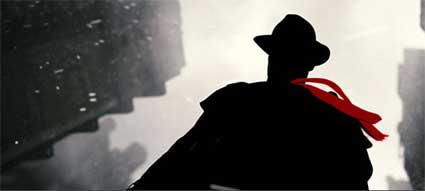
Gone were Eisner’s primary colors, replaced by muddy and amateurish black-and-white visuals with digitally added snow that never seemed to stick. The Spirit was so bad that it made Warren Beatty’s Dick Tracy look like a masterpiece.
Everyone was excited at the beginning, knowing that this was Will Eisner’s classic character finally brought to the screen and that it was Frank Miller who was going to steer it forward. But one of the fascinating aspects of this screening was observing the precise point in which each audience member would give up, knowing that Miller was cheapening a legend. Knowing that the film was wasting its cast and crew. Knowing that Miller was producing something even more odious than The Dark Knight Strikes Again or that crappy Robocop comic. (And let’s be honest. Has Miller truly contributed anything important to comics in the last ten years?) Knowing that it was Mr. Rodriquez who was the great force behind Sin City, and not Miller. (And to think that Rodriquez abandoned the DGA for this hack.) Knowing that just about everybody wanted to lock Miller into a room and punch him repeatedly in the face for about eight hours for producing this travesty. Knowing that something we all had hoped would be good was such a steaming turd.
I counted eight walkouts. There may have been more. But I can’t be sure. I was too busy slumping in my seat, stunned by the film’s relentless determination to sodomize Will Eisner’s corpse, assaulted by the film’s muddled script, which couldn’t even clear up the origin story until two-thirds of the way into the picture, its needless misogyny (women are either whores, nurturers, or kept in the background as laconic sidekicks), its inability to strike a single human note, and its failure to evince one note of fun.
Yes, Frank Miller should be punched in the face for this. It’s the only way to be sure.
There were jokes — one involving an ass on a copy machine — in which not a single person laughed. And again this was a friendly and rowdy crowd. But they all sunk into their chairs, feeling very angry that their time had been greatly wasted.
Oh, Stana Katic, how you tried as Morgenstern! You are as wonderful as Mageina Tovah, who played Ursula in the Spider-Man movies. I can now watch you in just about anything. And I feel so sorry for you for having your talent wasted. How much did you fight to keep the remainder of your quirks in? Bill Pope, I have admired your cinematography for quite a while. But this film was beneath your great talent and you should have known better. Samuel L. Jackson, signing on for a role just because you’re a geek simply isn’t worth it anymore.
Miller directs his cast as if they are statuary and handles his crew as if they are expected to generate magic simply by standing around. He is an ugly and crude man who does not know the human condition, and he is more interested in Eva Mendes’s ass than any innate personality she can use to sex up her role. He has tossed around crude pop culture references — including buildings and trucks named after Eisner’s collaborators — in an effort to win over the fanboys. But the fanboys will not bite. What Miller doesn’t understand is that geeks are too refined to swallow codswallop. What Miller doesn’t understand is that hell hath no greater fury than a fanboy spurned.
If there is any justice, the fanboys will lynch Miller at a future Comic-Con. If there is any justice, this film will fail at the box office and the money men will reconsider handing Miller the Buck Rogers reboot.
But there is rarely justice in Hollywood. The fact that this film was allowed to be made is testament to that.
© 2008, Edward Champion. All rights reserved.
Ed, you couldn’t see this coming from the trailers? I collected Eisner’s work (way back when) and the instant I heard about this project, I knew it was doomed to be a (standard) failed attempt at cashing in on an established brand; ie, irremediable shite. Next up: Marcel Duchamp’s Fountain: The Movie.
Growing up in the 70s and 80s, I read reprint volumes of Will Eisner’s THE SPIRIT and was fascinated by how it managed to be so different and enjoyable in so many ways:
– The daring and innovative artwork
– The amazing splash pages
– How The Spirit was often a secondary character in the lives of the many “ordinary” characters in Central City
– Eisner’s love of the common man, as shown in the many episodes where “dull” characters and their emotions become the center of action
– The friendship between The Spirit and his sidekick Blackie White (yes, his caricatured appearance did annoy me a bit)
– How the plots varied from humor to horror to thriller to sometimes sci-fi
– The many sexy and yet competent female characters
– The countless details that made Central City a living, breathing place: E-trains, slum blocks, trash-filled alleys, gutters flowing with scummy rainwater, clotheslines, commuters, etc. etc.
… and yet NONE of all that made it into Miller’s movie.
If Frank Miller had only tarnished his own reputation, I would have forgiven him. (I swear to you, I wrote to the guy years ago and warned him about creeping artistic self-indulgence…)
But to also spit on the reputation and work of Will Eisner, a man he called a “friend” (I read the book EISNER/MILLER, and noticed how different they are)…
… that’s low. A true friend would have backed away, knowing that he could not do his friend’s work justice.
Frank Miller, you’re no friend of Will Eisner.
Blackie White= Ebony White, my bad.
Yes, I know the character began as a stereotype, Eisner tried to make up for it later etc. But that’s a whole different discussion…