Review: The Next Three Days (2010)

A Paul Haggis movie inevitably makes you feel like a well-trained parrot who has recently learned to squawk, “Hey hey, ho ho, intolerance has got to go!” Instead of the stale cracker offered as reward, one is asked to sit dutifully through the end credits.

In attempting to understand Paul Haggis’s position in the film world, I’m considering the time-honored Monet chestnut: “People discuss my art and pretend to understand as if it were necessary to understand, when it’s simply necessary to love.” But Paul Haggis’s movies — all containing lack of logic, stock archetypes, and soupy storylines — are altogether too easy to understand. These movies are about as challenging as inking in a TV Guide crossword puzzle. But even the best stupid movies give us very good reasons to love them. By contrast, when The Next Three Days features an early moment (not in Pour Elle, the template for Haggis’s remake) with privileged scum making reductionist statements about gender to prove how “authentic” Haggis is in getting “real” people, it becomes almost effortless not to love it.

The Haggis apologists rebut with Casino Royale and Letters from Iwo Jima (and sometimes the overrated In the Valley of Elah) when presented with the perfectly reasonable observation that the Oscar-winning Crash, with its tawdry caricatures spouting racist sentiments like loutish anchormen reciting whatever is on the Teleprompter (instead of, say, communicating the origin point of a character’s deeply developed atavism through performance), was last decade’s answer to Guess Who’s Coming to Dinner. Haggis may very well be the Stanley Kramer of our time. Like Kramer, he is without subtlety. Like Kramer, his work will not date well. Like Kramer, he preaches to the converted. But there’s something more invidious about Haggis — something that goes beyond Kramer’s redolent earnestness — that I need to pinpoint here.

Casino Royale‘s “gritty” reboot was applied to a well-known and entirely fantastical archetype. Should Haggis really be commended for such ostensible authenticity? James Bond is enjoyable, but he is hardly a Doestoevsky character. (One can likewise make a similar claim about Christopher Nolan’s Batman films. Indeed, Jonathan Lethem did, writing in 2008 that he “couldn’t shake the sense that a morbid incoherence was the movie’s real takeaway, chaotic form its ultimate content.”) Letters from Iwo Jima is rightly considered to be a historical corrective to The Greatest Generation. But might not its cheap flips of the coin be similarly styled “morbid incoherence?” (It’s telling that screenwriter Iris Yamashita was able to interpret Haggis’s cornball situations in another language. American audiences, in turn, get these subtitles for lines that were adjusted from whatever vile banter Haggis brought to the table.) We see World War II from the Japanese side and we’re supposed to believe that the film is down with it because American soldiers incinerate the Japanese with a flamethrower. But what makes this narrative exercise any different from the old Twilight Zone episode, “A Quality of Mercy,” which uses the battleside switcheroo for the purposes of conceptual speculative fiction?

Haggis’s scripts are proud liberal exercises that make me profoundly ashamed to be a progressive. Real progressives don’t wave their fingers at their audience. They don’t bully people into enlightenment or self-awareness. Hell, good people of any political temperament don’t do this. They actually listen to people. They encourage. They plant clues. Accordingly, Haggis’s appropriation of genre tropes for movies that are condescending with their apparent “insight” into humanity makes me profoundly ashamed to be a moviegoer. It isn’t often that I’m so severely disappointed by a film. What the hell. I may as well go a few steps further and suggest that Paul Haggis has no business being declared a realist, a decent filmmaker, or even a worthy screenwriter. He’s using so many old inversion tricks that his films can never competently reflect the real world. When even the critics who like his movies — such as Moveiline‘s Stephanie Zacharek — feel compelled to point out that Haggis “doesn’t seem to know how to establish real couplehood closeness without equating it with hot, unfettered sex,” one detects an “artist” who is hardly curious about people and who is more interested in feeling superior when he sketches the kind of crude character doodles that would get him roundly bitchslapped at an MFA workshop or a bar. Or as Rolling Stone‘s Peter Travers succinctly noted, “It’s damn hard to enjoy a thriller when you don’t, won’t, can’t believe a word of it.”
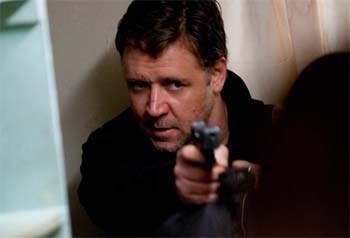
The Next Three Days is a remake of Pour Elle — a French film that did have a rather unbelievable storyline about a high school teacher trying to spring his wrongfully accused wife from jail. But Pour Elle managed to transcend its melodrama by imbuing its characters with passionate qualities, by making their struggles interesting to us. The Next Three Days is, rather curiously, without such vim and vigor. Pour Elle had the decency to give us carnal intensity from the get-go. With a few simple moments of visual lust established in the beginning, we could understand immediately why Julien Auclert (John Brennan in the remake) would do anything to rescue Lisa (Lara in the remake). But in the Haggis universe, John and Lara have to ask if their kid is asleep before opting to fuck each other blue. And this safe and hackneyed stance, calculated to appeal to unadventurous suburban audiences, is deeply offensive to me as an American. Because the ostensibly straitlaced are, let’s face it, more screwed up than they are willing to admit. But aside from this practical consideration, wouldn’t it be more interesting to have the Brennans screw each other ravenously with their kid awake? With their kid queasily aware at an early age (like many) of how intense his parents are fucking? How’s that for a family dynamic? If Haggis had the balls to play things out like this, then we’d have a far more interesting film. But that ain’t the way Haggis rolls. When it comes to sex, he’s nearly as virginal in his approach as Spielberg. One wonders if Haggis has ever had the guts to live a little on the wild side.

The Next Three Days is also too damn long. A good thirty minutes have been appended to Haggis’s adaption. But why? Pour Elle cut straight to the chase. After Lisa gets arrested, our next shot of her is in prison. Her son Oscar spurns his kisses when he comes to visit with Julien. Lisa asks about some girl from the parking lot. Julien informs his wife that a detective has been looking into this, but it’s been three years. This is near perfect narrative economy that permits us to fill in the gaps. Why would you want to mess with it?

Alas, Paul Haggis has. He’s adjusted a scene with an attorney (played in this remake by Daniel Stern; the attorney was a woman in the original), where John fires him when he reveals the insurmountable evidence against Lara. But in Pour Elle, Julien was more stoic. He is told by his attorney that he has to accept that his wife Lisa is in prison. And he walks away, without any tantrum. Now since we’ve seen Julien in wild lust with his wife earlier in the film, this makes us wonder if Julien’s energy is going to spill somewhere else. It provides a narrative tension that naturally connects with Pour Elle‘s cinematic momentum. But in the Haggis version, John is a passive guy prone to occasional outbursts that are more the result of convoluted plot advancement. In other words, where French writer-director Fred Cavaye was careful to alter his rhythm in relation to his characters, Haggis treats his characters more like automatons who must capitulate to a gilded template of Hollywood cliches.
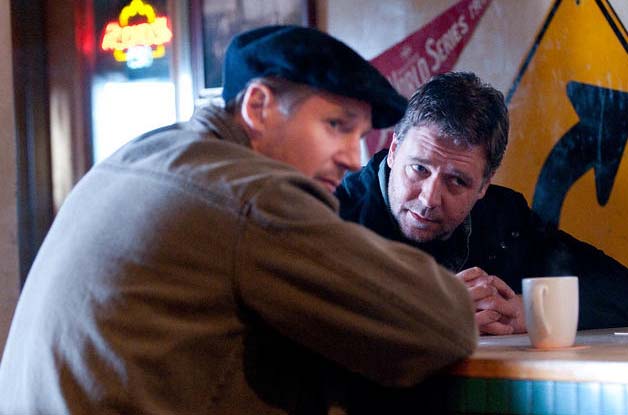
For example, why would you meet with a man in a bar (played by Liam Neeson, who adopts one of the most unpersuasive Brooklyn dialects I’ve ever heard from an actor), one who has escaped from several prisons, while other people sit very close by, and ask him about his methods? In Pour Elle, Julien meets this guy at a racetrack, with the camera establishing a reasonable crowd buffer with which to safely discuss the verboten topic. Furthermore, Julien asks Pasquet, this prison escape expert, if he can tape the conversation. Pasquet replies, “No, it’s not valid evidence.” So we immediately understand that Pasquet is a seasoned expert and we know why he would meet in public like this. Furthermore, the setting, which involves people blowing money on the horses, is one in which some guy giving cash to another isn’t going to draw much attention. Not so with Haggis’s bar, in which the dissemination of cash is likely to be more flagrant. Julien also offers the pretext that he wishes to “teach” Pasquet’s book. There’s no pretext at all with Haggis’s John.

There is also something unpardonably stupid about a movie in which a man breaks into a truck delivering supplies to a prison and the parking lot, rather remarkably, doesn’t include a single security camera or a guard. John even snaps photos with his iPhone (uh, ever heard of GPS tracking?) of documents he’ll need to forge. But given how shaky the light can be on an iPhone camera, how can he be expected to nab a decent image to forge the documents? Furthermore, if you’re going to learn how to forge a document for a prison escape, why would you attend a community college class on Photoshop and draw attention to yourself? Wouldn’t you learn it on your own? When John learns how to make a bump key, he does so by consulting YouTube videos. Does this guy even clear his browser cache? Is Haggis even understand how Google tracks its users? Cutting a bump key isn’t a skill that Alton Brown can teach you overnight.

I haven’t even discussed The Next Three Days‘s laughable attempts at streetcred. To offer just one example, John asks around the Pittsburgh underworld, trying to obtain fake passports. When he finds his first prospect, the bar John enters is as harmless and boisterous as a sports bar. (By contrast, in Pour Elle, the bar that Julien enters was committed to a silent intensity, letting the audience fill in the blanks about the possible danger.)
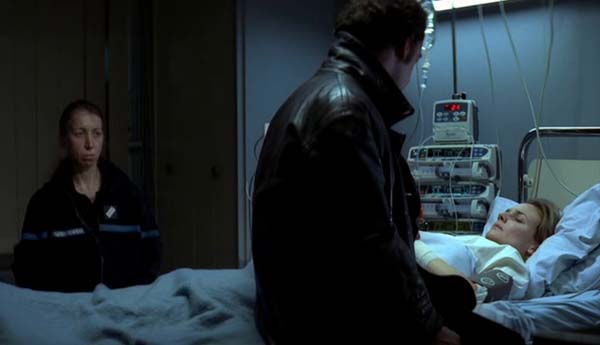
But it isn’t just these basic behavioral issues that Haggis has failed to parse from the original. He also hasn’t learned how the little visual details made Pour Elle work. In the above still, we see a police officer giving Julien a dirty look (on the left half of the frame) in the hospital room when he visits his wife after a suicide attempt (the moment captured on the right half of the frame). This visual bifurcation establishes the two separate worlds that the law and Julien’s predicament are going to be operating in. It’s a nifty psychological nudge to the viewer. Yet we don’t get anything this sly from Haggis. Then again, Haggis is not a man known for his visual chops.

Because I’ve been so hard on Haggis, I’ll give the man some small credit for casting Lennie James as a detective. James has proven to be quite watchable in everything. But even the confident expertise he establishes with his presence is undermined by the shoddy material.

The bottom line is that The Next Three Days gives its actors very little to do (the dependable Elizabeth Banks, in particular, is woefully underserved) and tries the audience’s patience. I can highly recommend the French original, but I cannot in good conscience declare Paul Haggis to be anything close to an essential filmmaker for our times.

Review: Morning Glory (2010)

It doesn’t matter if some generous groomsman (or bridesmaid) has plied me with good scotch or not. It doesn’t matter if the DJ or the band has the musical taste of a humorless military historian who blasts nothing more than John Phillip Sousa. If you encounter me at a wedding, chances are that you will find me dancing. There seems to be no better way to celebrate the union of two than putting two feet together. Very often, I will have no clue as to how I began dancing. Sometimes it will start with a trip to the men’s room. Upon relieving myself and washing my hands, I will often return with some terpsichorean fervor that astonishes the other wedding guests. I will dance with anybody. Grandmothers. Kids. Other men. I have been known to corrupt small children with some of my more libidinous moves, whereby I swing an invisible lasso around another man’s neck and proceed to rope him in, concluding my cowboy allemande with a rakish leer which suggests that I will be taking my partner to an indecent location. I have seen kids reproduce these moves.

What does any of this have to do with Morning Glory? Well, somewhere within this watered down Broadcast News knockoff is a mild audience-friendly satire screaming to cut the rug. Last week, with Due Date, we saw how director Todd Phillips and his co-writers managed to update the Planes, Trains, and Automobiles template into an enjoyable comedy that still had the smarts to include some dark observations about our present age. Morning Glory – with its egotistical anchors, its rider-mandated fruit platters, and its accidental caption beneath Jimmy Carter’s photograph – has a few promising steps. But it is too often that stiff partner that lacks the courage to get up and go, to take more than a few perfunctory chances. It is a movie in desperate need of some hip-shaking and a hip flask.

Rachel McAdams plays Becky Fuller, a television producer who foolishly believes that the Protestant work ethic still applies in the television industry. She longs for some higher rung because she has toiled for many years (sans boyfriend, sans many friends aside from her co-workers) as an assistant producer on the morning show, Good Morning, New Jersey. The big boss asks her in for a big meeting. And Becky thinks that she’ll at last land that promotion. Wearing a YES, I ACCEPT tee beneath her clothes, Becky is shitcanned instead. She then spends the early portion of the movie trying to land a job, with her chirpy go-go energy lacking Holly Hunter’s can-do spunk in Broadcast News. It’s really more of a fey merge between Hunter and a mid-1990s Renee Zellweger. Becky is so desperate to be liked that she is very often channeling the needy qualities contained within Aline Brosh McKenna’s script.

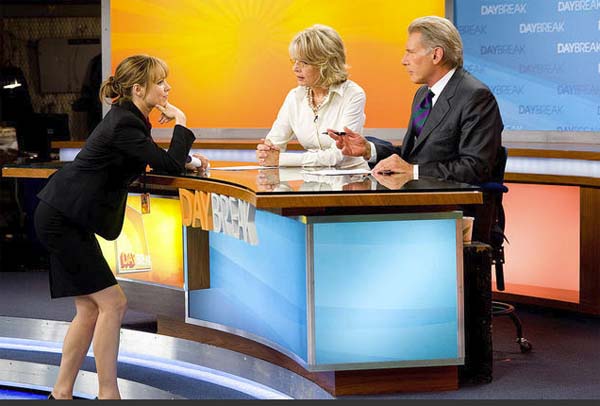
She somehow talks her way into a job as executive producer at Daybreak, a network morning show in last place. Becky must endure dull segments about weather vanes, sleazy reporters who wish to take photos of her feet, and a staff that expects Becky to fall through the revolving door. Certainly, the audience is inclined to sympathize with the Daybreak staff. McAdams’s relentless peppiness is, at times, a liability to our willingness to believe in the movie. One does not occupy a top perch in the media world without giving a few orders to ice the unruly subordinates. And while Becky does deliver at least one such ruthless move, we’re never entirely convinced that she has the organizational chops to keep this show together.

Becky places her faith in the aptly named Mike Pomeroy (Harrison Ford), a respected journalist with Pulitzers and Emmies in his closet who lost some vital television spot some years ago. Alas, he’s referred to as “the third worst person in the world” among some former co-workers. Still under contract to the network, Becky installs Pomeroy as Daybreak co-host. The big joke here is that Pomeroy would rather use words like “abrogate” on air or report on serious news stories rather than remark on Easter bunnies. While there’s some late stage conflict between Ford and McAdams, the comedy is hindered by Ford’s terrible performance. He shamelessly overacts in his part: widening his eyes, pointing his index finger, and barking his lines with a sad “Get off my plane!” gusto that transforms a chief character into a regrettable cartoon. It’s sad to remember that Ford was once an actor capable of great control in Frantic, Witness, and The Mosquito Coast. (On a positive note, I can report that Diane Keaton is wonderfully controlled, as always, as the grumpy host who has been on the show too long.)

The movie is most effective when it drifts away from its obvious inspiration. When McKenna and director Roger Michell comprehends that Rachel McAdams is not Holly Hunter, that Harrison Ford is not Jack Nicholson, that Patrick Wilson (McAdams’s love interest, whose receding hairline and look resembles William Hurt in 1987) is not William Hurt, and the guy with the half-grown facial hair playing McAdams’s producer who I’m too lazy to look up on IMDB is not Albert Brooks. (Sorry, guy with the half-grown facial hair playing McAdams’s producer. I had to turn around this review fast.) James L. Brooks certainly never needed a live camera capturing a reporter screaming while he rides a rollercoaster or howling in pain when getting a tattoo buzzed into his flesh. But our present epoch of reality television and YouTube does requires such moments.

It’s too bad that this promising satirical thrust couldn’t extend to the rest of the film. There are worse films than Morning Glory out there. But McKenna and Michell don’t seem to know that there was this writer named Ben Hecht and this director named Howard Hawks, and these actors named Cary Grant and Rosalind Russell, and this talent all came together and created an indelible comedy, with the dialogue gunning at a .45 Thompson’s pace. They can’t recall that we remember that film so well seventy years later because Hawks had the wisdom to swap gender roles from the original source (the play The Front Page), with Hawks agonizing over the casting. I have to wonder: Who will remember Morning Glory seventy years from now? What might have happened if McKenna and Michell had the courage to defy their straitlaced obligations and dance?

Review: 127 Hours (2010)

I’m relieved to report that 127 Hours, a very pleasant movie about mountain climber Aron Ralston quite literally giving up his right arm, cuts straight to the point. The early moments see director Danny Boyle slashing the screen, De Palma-style, into three partitions. Our introduction to Ralston (played by James Franco) involves a spastic man fumbling about for his Swiss Army knife (with the camera staying inside Ralston’s cabinets, much as it will later inhabit the inside of Ralston’s water bottle, where we will see the inside of James Franco’s throat, which is quite possibly an image that is more disturbing than the bloody hackwork to come), surreal shots of cyclists shooting past Ralston’s car in the dead of night, and James Franco leaping across canyons like some video game character unaware of real world physics.

At the risk of shortening my flourishes, Danny Boyle’s latest movie is a cut above Sean Penn’s Into the Wild – in part because, unlike Penn, Boyle has a rapier wit. He stabs at the regrettable inconvenience of getting one’s arm caught by a boulder from several points, approaching it as a laughably common Gordian knot, a psychotropic experience, and a wounding nightmare. But these methodical slashes into the predicament also inspire astonishing momentum. Like David O. Russell’s Three Kings, Boyle’s camera enter the very body itself. Like the final moments of Darren Aronofsky’s Pi, Boyle blurs out the soundtrack with distorted tones as Ralston has the nerve to feel his nerves as he saws away to the bitter end. I can also report that Boyle even has the balls to quietly broach the subject of how Ralston will jerk off without his dependable right palm. But I don’t want to give Boyle’s hand away here.

It helps that James Franco has the chops for the part, imbuing his Ralston with a crazy edge. This lacerating insanity comes in handy when Ralston slices through the last of his rational equanimity, concocting a radio show (with a laugh track added to the film) to pass the time when he’s not guzzling down his own piss. But it also slays at the truth: Ralston is a solitary man. (“You’re going to be so lonely,” says a prophetic ex-girlfriend as Ralston relives a lost relationship from the comfort of a shitty situation.) Our hero has driven himself to his sticky predicament because he didn’t bother to tell anyone where he was going. That has to hurt. And even though we know that Ralston will be saved in the nick of time, Franco arms his performance with enough ambiguity so that we wonder what torments are stabbing away inside, when we aren’t subjected to intriguing hallucinations of family and friends watching the proceedings unfold from a comfortable couch (much like the audience!).

One never feels strongarmed by this approach, although some audiences have reportedly fainted because they expected a shot of morphine or something. They are wrong. For Boyle has plenty of tricks up his sleeve. A raven always flies over the cliff at the early morning hour. For a brief period, even Scooby-Doo serves as an way to greet the possibilities of living with open arms.

I was almost determined to cut my losses just before the blood spurted, but, thankfully, the moment is almost anticlimactic when it arrives. I appreciated the way in which Boyle had caught me redhanded in my anticipation.

The upshot is that this is a bloody good movie – a handy reminder of the creature comforts we take for granted. Should I ever lose my hand, like Ralston, I’ll stay a betting man in the great game of life.

Review: Due Date (2010)

A comedy featuring a masturbating dog certainly hits the right stroke. Thankfully, there are capable hands behind Due Date, a gutsy and often side-splitting movie that further cements Todd Phillips’s rep as a comedy auteur far more interesting than Adam McKay and Nicholas Stoller. Like those two directors, Phillips often relies on stock situations – predominantly featuring men – to propel his unapologetically adolescent anarchy. Men in early middle age start a fraternity in Old School. Four men celebrating a bachelor party in Vegas can’t remember what happened the night before in The Hangover. And in Road Trip, The Hangover, and Due Date, it often takes a long drive to work out these lingering issues of rootlesness.

Despite all this late stage wandering, one detects a grown-up somewhere within Phillips. With his two most recent films, Phillips seems to be working the territory somewhere between Terry Zwigoff’s hilariously bleak assaults on the American climate and Seth MacFarlane’s free association. In The Hangover, Mike Tyson (playing Mike Tyson) factors into the plot. We see Carrot Top and Wayne Newton in the closing credits slideshow. In Due Date, the sitcom Two and a Half Men becomes a part of the story.* RZA turns up as a TSA man. .

Given such attention to the real and the imaginary, Slavoj Zizek could very well host a Lacanian kegger after taking in the Phillips oeuvre. (It’s worth pointing out that Phillips cut his teeth with the controversial documentary, Frat House, in which Phillips and co-director Andrew Gurland faced allegations that they paid fraternity members and staged several scenes.) But if Phillips’s films were only about this (and, more importantly, if his films weren’t flat out funny), they probably wouldn’t be worth considering. Any Family Guy viewer knows damn well that a promising installment often flounders when MacFalane’s writers rely too much on reference.

But Phillips has Zach Galifianakis’s Belushi-like presence to counterbalance all this. I enjoyed Galifianakis’s raucous mania in The Hangover, but felt that he had exhausted his possibilities in the HBO series, Bored to Death. It turns out that I was mistaken. Jonathan Ames’s lazy and ungenerous writing, which fails to view Galifianakis as anything more than a fat guy foil for Jason Schwartzman, was largely to blame. In Due Date, Galifianakis bustles as brightly as he did in The Hangover. The man has the talent to turn a physical gag on a plane with his belly into something that somehow makes us less aware of his physicality and more intrigued by his character. (Chris Farley was one of the few portly comic actors to do this as well: most notably in his famous Chippendale’s sketch with Patrick Swayze on Saturday Night Live.) As aspiring actor Ethan Tremblay, Galifianakis knows how to deliver his lines so that the audience is constantly recalibrating its estimation of Tremblay’s intelligence. (And in light of the film’s observations about underestimating people, and a nation that relies too much on swift judgment, this performance helps steer the film in the right direction.)

There’s a scene in which Galifianakis’s character is asked to perform material within a public restroom, so that he can prove to the disbelieving Downey that he’s a bona-fide actor. Tremblay delivers an unexpectedly poignant performance, using the edge of a bathroom stall as a wall. And this moment works on several interesting levels: (1) Todd Phillips is communicating to his audience that Galifianakis is more than just a funny fat man, (2) Ethan Tremblay is communicating to his snobbish white-collar traveling companion that he has some serious chops, (3) Ethan Tremblay is being asked to give it his all in a public restroom, quite possibly the most ignoble venue to prove himself (and the one you are least likely to see chronicled in the newspapers), and (4) the savvy symmetry between (1) and (2) gives Phillips some leverage to continue his exploration of the real and the fictional.

That all this is going on, while Phillips is presenting his populist audience with a genuine emotional moment, suggests very highly that the director who once gave us Starsky & Hutch has more moves than any half-literate moviegoer could have anticipated six years ago. How’s that for underestimation?

John Hughes’s Planes, Trains, and Automobiles serves as Due Date‘s obvious template. Yes, Phillips and his writers have taken the blue collar/white collar framework of Planes, updating the film to reflect a post-9/11 America. Yes, they have taken an actor known in part for his wackiness (here, Robert Downey, Jr., previously, Steve Martin) and made him grumpy and straitlaced. Yes, they’ve even taken whole lines from Hughes (“I have a winning personality”) and converted them over.

But Phillips has also paid close attention to what Hughes did so well visually in the motel room scenes: the blue colors for John Candy, the white colors for Steve Martin. In one notable moment from Planes, we see Martin grabbing a blue blanket covering Candy and putting it over his frame, a nice visual suggestion of class integration in a motel room bed (like the restroom moment in Due Date, also evocative of the dignity discovered within “low” environments).

Twenty-three years after Planes Trains, and Automobiles, the income disparity between the rich and the poor has worsened. So in Due Date, our white-collar protagonist now wears a purple shirt, as if his white collar had become somehow stained by blue-collar contact. (It is also interesting that, when Downey’s character breaks his arm, his cast is blue.) Meanwhile, the Tremblay character wears blue jeans (2010’s answer to Candy’s blue collar pajamas?) and a red shirt (post-Dubya assumption about red staters). Additionally, the pregnant white-collar wife stuck at home wears a pristine white sweater, bearing faint blue stripes. Is she imprisoned by class? Or is she besmirched by it? And what does it say that Downey’s character suspects a black man of having an affair with her? Might he be just as capable as Tremblay of rallying with an OBAMA = SOCIALIST sign? What does it say that Tremblay lets a “zebra baby” epithet slip from his lips that is entirely accidental? If our language and our actions remain under constant scrutiny, how then can we learn from our mistakes?

It’s a lesson that both sides can profit from. Because class lines are more ruthless than they were in 1987. In Due Date, the the yuppie is much meaner. At one point, Robert Downey’s architect character, Peter Highman, clips a kid in the stomach to get him to stop harassing him. Is this brutal solution a harbinger of fatherhood to come? (Or violent liberals to come?) Meanwhile, Ethan Tremblay commits far more destruction than John Candy’s Del Griffith. Forget Michael McKean’s cop. Phillips ups the stakes and brings in the border patrol. Minutes into the movie, Tremblay manages to get Highman on a no fly list. These skirmishes against authority make Due Date a more political film (think gleeful anarchism) than Planes, Trains, and Automobiles. But like Zwigoff’s movies, Due Date skillfully uses politically incorrect humor to defuse any hypothetical political agenda and thus make these considerations more palatable to the common man, which is very much where Due Date‘s heart is. And rightfully so. The reason why this movie works so well is because our fragmentation is more common than most of us are willing to accept.

* The use of Two and a Half Men is suspiciously well-timed, leading one to imagine an iniquitous PR flack, happily trading in misfortune for money, encouraging Charlie Sheen to engage in more headline-grabbing behavior right before the film’s release.

Review: The Girl Who Kicked the Hornet’s Nest (2009)

In my review of The Girl Who Played With Fire, I expressed my disappointment that writer Jonas Frykberg and director Daniel Alfredson had failed to include one moment relating to Billy’s Pan Pizza — that mysterious Swedish brand that could rev you up for a day of stealing motorcycles while your name was being smeared in the newspapers. While an unidentified pizza brand does factor into two moments of The Girl Who Kicked the Hornet’s Nest, the third film in the Millennium trilogy, I regret to report that these pizza moments fail to revive a cinematic snoozefest. One curious facet of the Millennium film trilogy is its inverse ratio to the books. As the books get better, the movies get worse. It’s a great disappointment to see our beloved Blomkvist played by Michael Nyqvist as if he is a narcoleptic. There were several times in which I felt compelled to brew a pot of coffee and send it through the screen. It’s also incredibly sad to see the page-turning trial scene transformed into commonplace courtroom drama, which isn’t helped by the film introducing a cost-cutting scene in which the judge orders all non-essential people to leave the courtroom due to the private nature of the matter. (Nice way to cut down on extras. But, man, does that grand courtroom look so lonely!)

The film appears to have suffered a severe shortfall in financial resources. It looks and feels cheap. Aside from the trial scene, it is so cheap that an early moment in the book, offering a reason for Blomkvist and Berger to spend the night at a hotel after some unknown nutjob has messed with Berger’s car, has been excised — presumably because the filmmakers couldn’t afford the car. The spontaneous decision for casual sex has no motivation (and furthermore, if it’s all for crass tits and ass, it’s seen off-screen!). During the press conference and paparazzi moments, there are laughably scant reporters covering this major news story. Larsson’s lurid book worked so well precisely because it demanded to be read as a pulpish opera. But little ambition can be found in this film adaptation.

Unlike the previous two films, the photography here is pedestrian, often containing little contrast or pizazz (this being a production originally made for television) save for a scene within the Constitutional Protection Unit in which cinematographer Peter Mokrosinski lights a cross on the wall behind Blomkvist and a window light hitting against the wall behind his interlocutors. These moody touches would have worked well, had there been more placed throughout the movie. Alas, it is not to be. For goodness sake, the novel constantly makes reference to “a glass cage” that Salander works in. Larsson, for all of his silliness, gripped us because of his hyper-specific detail, which often extended into the visual.

But it isn’t just the lackluster visual execution that sinks this movie. The film’s main problems are with Frykberg’s script. The compelling stalker subplot in the book, in which a creep is sending Berger emails reading WHORE, has been severely downplayed. Not only has the Svenske Morgon-Posten newspaper been eliminated (thus neutering the book’s competitive attitude about journalism, which nicely balances Salander’s redemption), but by merging the SMP subplot into Millennium, the total staff has been reduced to about four people. Thus, there’s hardly a threat or even a red herring (the lovely character Holm) for us to care about. And the stalker’s emails contain relatively silly messages compared to the book. Instead of the novel’s threatening messages (YOU’RE GOING TO GET FUCKED IN THE CUNT WITH A SCREWDRIVER. WHORE!), we get YOU SLEEP WITH THE LIGHT ON? ARE YOU SCARED? I get emails like that all the time. Not from enemies, but from friends. So when Millennium responds to these emails with hysterics, you have to wonder if some harmless YouTube cat video will be enough for them to file a restraining order.

The movie is better with Niedermann (that unfeeling giant who likes to sneak up behind family members and cheerfully announce, “Hello, little sister”) than the book is, balancing the blond titan better against the many subplots. But the women in this film aren’t nearly as badass as they are in the novel. (And on this point, screenwriter Frykberg doesn’t offer much of an alternative. Because he has watered down the subplots where women fight back, he has diminished the women — a strange choice in light of the novel’s curious gender politics. Oh well, let’s hope that Fincher and Zallian make this work, should they adapt the last two books into Hollywood movies.) Because the Berger stalker subplot has been toned down, we never get a chance to see her confront the man who’s harassing her. And because this is a cinematic medium, we don’t get anything close to Salander’s internal thoughts within the novel. She’s more of a laconic type who takes in what occurs around her when she isn’t using slings to stretch her legs against the bed (another cost-cutting tactic that cheapens Salander). This gives the perfectly capable Noomi Rapace very little to do. Sure, I liked her Goth appearance in the courtroom. But anyone who has read the book know that, with Salander, looks aren’t everything.

I enjoyed the first two films. But The Girl Who Kicked the Hornet’s Nest lacks the vitality that was there in the novel. It seems more of a contractual obligation rather than a fun pulp ride.