NYFF: Another Year

[This is the tenth in a series of dispatches relating to the 2010 New York Film Festival.]

“I’m concerned in making films that talk to people. Like anybody, I only want to talk to anybody who wants to listen, who wants to know, who wants to share, or have a conversation with me, as it were. I can’t deal with the kind of media-obsessed, decadent position that can’t decode the film for what it actually is. Which is to say an open, honest look at real people and how real people are, with their needs and all their vulnerabilities. Warts and all. If you can’t embrace that, then go away basically. You’re quoting people at Cannes. Journalists, no doubt, who say that these are people I wouldn’t want to meet at a cocktail party. Well, you know, you’re not going to meet these people at a cocktail party. Clear off to the cocktail party and don’t worry about this sort of film. Because you’re not interested basically. And if people are not interested, I can’t do anything about it.” — Mike Leigh, in a soon-to-be-aired Bat Segundo interview conducted on October 4, 2010

It is a ubiquitous truth that distinctive art often polarizes. But Mike Leigh’s films often cause some of the more catholic critics to reveal their unadventurous sensibilities. (One of Leigh’s masterpieces, Naked, was, by way of depicting particularly nasty behavior, declared misogynist.) While there’s nothing wrong with responding to a movie like one of Harry Harlow’s monkeys from time to time, a cinema intake composed of nothing more than genetically modified bananas will inevitably cause an otherwise sound mind to bray for his cloth mother.

Yes, I’m a Mike Leigh fan, but not slavishly so. Topsy-Turvy is overlong, but quite admirable in its historical ambition. (And it was absolutely the film Leigh needed to make to get to his next “historical” film, Vera Drake, which is one of his masterpieces.) Secrets & Lies, for all of its brilliance, resolves too tidily. I’ll take Abigail’s Party over Life is Sweet, even though I revere both flicks (and enjoy Alison Steadman in both). But aside from these very minor complaints, Leigh’s characters — whether you like them or not — may be more realized than those of nearly any other living filmmaker.

As Leigh’s films have defiantly chronicled the human in an age more concerned with calculating clinging, certain critics have revealed their not so closeted misanthropy — in other words, an innate disposition towards an unchallenging and predictable type of film.

Yes, Mike Leigh’s latest film, Another Year, features a very sad and troubling character clinquant in dimension played by Lesley Manville. The cookie-cutter protagonists and antagonists you asked for are available at the multiplex, thank you very much.

But I’m convinced that Another Year‘s mixed reception at Cannes (alas, a few rumblings were overheard in the Walter Reade Theater) can be squarely divided between those who are interested in life and those who are not. For Another Year dares to show several sides to kindness, a topic that has been very much at the forefront of Leigh’s films since Vera Drake. Leigh seems to share the sentiment behind Kurt Vonnegut’s famous declaration from God Bless You, Mr. Rosewater: “God damn it, you’ve got to be kind.” But he’s also smart enough to understand that societal forces threaten to crush this human spirit. Thus, housekeeper Vera Drake sees her illegal abortions as an act of kindness (and receives no pay for this) and is almost incapable of perceiving her actions as wrong, even as her family and others attempt to explain why she’s in such trouble. Merciless government permanently transforms her. Happy-Go-Lucky, by contrast, sees a very happy character, Poppy, finding her natural temperament tested — particularly, by a humorless driving instructor — and is, even at film’s end, asked not to be so nice (or kind) to everyone. She defies this. And in Another Year — the first of Leigh’s films to be squeezed into a yearlong sectional narrative (although certainly not the first to concern itself with cyclical behavior) — the human spirit’s effort to flourish is very much determined by vocational expectations. (And, as my moviegoing companion and I agreed, one minute of Another Year contains more understanding of people than the whole of Jonathan Franzen’s Freedom.)

But let’s first consider the naysayers (with much gratitude to David Hudson for rounding them all up). The Hollywood Reporter‘s Ray Bennett complained that most of the film’s characters would be the type “whom you would go out of your way to avoid at a party.” Time‘s Mary Corliss offered similar sentiments: “All the actors make the most of their time before the camera; eventually a plot emerges and a narrative crescendo is reached. It’s real life, processed for the cinema in Leigh’s practiced style. But the real life it simulates is too often that of an evening that turns into an endless night with friends one wishes might just get their coats and get out.” Never mind that Bennett and Corliss fail to see certain advantages to “meeting” such apparently unpleasant people on film. Yes, they rightly compare Leigh’s film to a cocktail party, but they don’t seem to understand that a forty foot screen protects them from social immersion. The audience is not chatting up these characters, but Leigh presents them so vividly (the final look on one character at the end of a long dolly shot, Manville’s masterful head and shoulder bobbing as Mary, a widower’s laconic vernacular and the look in his eyes as he observes the madness around him; to cite just three) that it is nearly impossible not to lose yourself (as my moviegoing companion and I did, sitting still and mesmerized for 129 minutes) and feel that You Are There. And the idea of going to a movie, whether for entertainment and enlightenment, to have your worldview confirmed strikes me as antithetical to existence — diametrically opposed to why any enthusiast soaks up culture. In other words, why did these critics bother to go to Cannes anyway?

And then there’s Todd McCarthy’s schematic assessment via blog: “For me the film is obvious, schematic and lacking in interesting undercurrents or subtext.” Never mind that McCarthy is unwilling to describe what precisely that “obvious” and “schematic” perception is. But thankfully, his tepid criticism can be easily rejoined by what is contained within the movie.

You cannot call Another Year‘s Tom and Gerri “obvious” and “schematic,” because, despite the fact that this couple is somewhat privileged (an apparently stable marriage, reliable middle-class income from geologist Tom and counselor Gerri, a garden allotment, and so forth) and permits maladjusted people into their home with a kind of liberal guilt and empathy that may not be entirely reconciled, they do not offer any defense when friends ridicule Mary (over the fact that she doesn’t know the precise engine type in the used car she has just purchased). Gerri, despite being trained to recognize a narcissist, nevertheless permits Mary to crash into her family home with the same shaky skill she has behind the steering wheel. And when there is the inevitable skirmish during the autumn, Gerri still waits until the winter to state, “You have to take responsibility for your own actions.” Which is something she has been meaning to say all along. There’s also something slightly predatory about the way Tom and Gerri invite friends who are less successful than they are into their house, such as their old portly friend Ken, who appears in the summer, but is a few beers short of a cardiac arrest. Yet Ken, despite being lonely and unhappy, has refused retirement. He is content to “eat, drink, and be merry,” but, from the vantage point of Tom and Gerri, he is “better” than Mary by way of remaining employed in a more lucrative job. (Mary toils as a secretary; interestingly enough, at the same workplace as Gerri. When Gerri invites her for a drink, Mary says that she has only an hour to spare — the exact amount of time that she would devote to a patient) One is left wondering whether Ken would be in worse mental shape, were he to be toiling in a similar position as Mary. (In an ironic bit of casting, no doubt entirely unintentional, Leigh has cast Peter Wight as Ken. Wight played the security guard in Naked, who urged Johnny not to waste his life.)

Aside from this intriguing relationship between happiness and class, there is also Janet (played by Vera Drake lead Imelda Staunton), who appears at film’s beginning (in spring). She is a cautionary character and, if we are to look at Another Year as a cycle, she represents what Mary may very well transform into. Janet is depressed. She cannot sleep. She rates herself 1 on a scale of 1 to 10 on how she feels. And when we are first introduced to her, the camera initially concentrates on little else but Janet’s face. We gradually see more of the doctor who is treating her, and the first detail we notice is that the doctor is pregnant. Thus, Janet (like Mary) is very much consumed by her own internal world. Does society then have a duty to treat people like Janet and Mary? Is it “kinder” to retreat from miserable people (as the above mentioned critics clearly have) or to let them into your home with the hope that your kindness will help them figure life out?

Since this is a Mike Leigh film, there aren’t any easy answers. But the film’s commitment to such concerns is a much needed reminder for any humanist, whether lapsed or well-practiced. Another Year, like the best of Leigh’s films, is very much a Rorschach test. It will be appreciated and understood and felt by anyone who understands that even the unpleasant and the marginalized have souls. I haven’t even begun to scratch the surface of this considerably embedded masterpiece, but it’s definitely one of the year’s best films. And I’ll probably have another go at it just before release date. Anyone who compares Another Year to “an endless night” probably doesn’t have the guts to leave her cloistered comfort zone.
NYFF: Hereafter

[This is the ninth in a series of dispatches relating to the 2010 New York Film Festival.]

It seems inconceivable that Clint Eastwood would direct a film that uses the facile falsehood of psychic ability to drive its story, and that Peter Morgan (Peter Morgan! The man behind Frost/Nixon!) would write the screenplay. Eastwood, who told the tale of a bigoted Korean War vet adjusting to multicultural reality in Gran Torino, explored moral complexities with The Unforgiven, and expressed a willingness to invert 20th century historical expectations with his 2006 pair of World War II pictures, is hardly a fool. And he’s certainly not the type who would suddenly show up on late night TV with a psychic hotline – even when one accounts for such late-career misfires as Space Cowboys and Blood Work. But I’m pained to report that Eastwood’s latest film, Hereafter, is so utterly preposterous and condescending that I actually longed to revisit The Eiger Sanction. At least that disastrous film had some soul in the unlikely George Kennedy.

Psychic ability is not only unscientific. It is one of the most egregious and overused plot devices used to advance a story, particularly those which are outside genre. Indeed, even the Star Trek: The Next Generation series bible – a document for a franchise that proved too complacent to steer out of its utopian comfort zone – was careful to forbid its writers from including such omnipotent character types. Psychic ability is the reason why the fourth Indiana Jones movie was such a dud. It is often the reason why some cheesy movies are best enjoyed with friends over beer. And when Spielberg’s regrettable name emerged as executive producer during Hereafter‘s end credits, I immediately wondered if Morgan and Eastwood had been pressured, much as George Lucas and Spielberg had muscled out Frank Darabont during Kingdom of the Crystal Skull, to insert such nonsense into a later draft. After all, consider one side character at a resort who offers the line, “As a scientist and atheist, my mind was closed to this,” and who then states that the evidence is “irrefutable.” It’s almost as if this script was designed to recruit wild-eyed naifs.

What the fuck, Clint?

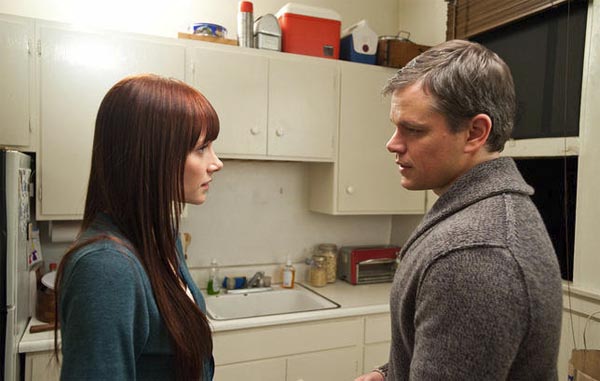
Whatever the film’s production history, I doubt that any of us will be privy to it anytime soon. There’s just too much money and too much power at stake to get an accurate glimpse through the dust motes. Maybe it’s possible that age has finally caught up with the old gunslinger and he’s now firing blanks. But what we have in the meantime is a colossal dud that is easily the worst film of Eastwood’s career. It’s as if Eastwood has traded in his class for the cash. Sure, Eastwood directs a pleasant scene with Matt Damon and Bryce Dallas Howard (who appears as a fresh San Francisco transplant escaping a bad breakup in Pittsburgh – or possibly Pittsburg, over by Antioch; whatever the case, she’s just about the only character in this movie with personality) flirting with each other in a cooking class. One wears a blindfold. The other spoons in mouthfuls of sauce. It’s hardly 9 ½ Weeks (or even Hot Shots), but the two confess their real reasons for attending night school. Alas, just as this promising relationship develops, Matt Damon’s George confesses his secret talent – which is the ability to find psychic connections within people, a “talent” that filled up the coffers in halcyon days. (That George asks each recipient to only reply to these sessions with yes and no answers, and that he wins them over with such painfully leading inquiries – “You’ve lost someone recently” and so forth – leads one to believe that he’s a con. Unfortunately, the film lacks the courage to view George’s ability as even vaguely illegit, and his internal conflict is narrowed as a result. This is too bad for Damon, who offers a quietly commendable performance here. Indeed, his graying hair and sad mug reminded me of a young Gary Cooper.)

In Hereafter, Eastwood is sometimes competent at conveying the visual isolation of his characters by having them depart into dark corners of a room, where their faces blend into the dark murk. Such old school panache would be welcome if Eastwood wasn’t operating off of a script that’s stacked with unacceptable and unpersuasive anti-human twaddle.

Hereafter is a three-plot story that takes place in three countries, and that ties up through several highly contrived circumstances at the London Book Fair. It is a movie so fundamentally stupid that it believes that some kid can call up a publisher and find out which hotel a famous Frenchwoman is staying. It is naïve enough to presume that someone who toils at a sugar factory can pay rent and live alone in what appears to be a spacious North Beach apartment. (The press information sheet I have laughably refers to this character as “a blue-collar American.”) It believes that book publishers will actually have the time and the decency to set up a failed manuscript (written by a troublesome author who can’t even turn in the Mitterrand book she promised) with another house.

What else can one expect of a flick that offers psychic ability as its great instigator? But nobody goes to a Clint Eastwood film to get frequent flashes into a shadowy white realm occupied by dead souls. That’s M. Night Shyamalan territory. And it’s extremely disheartening to see a living legend adept with human nuance debase himself like this.

I didn’t so much mind the surprise tsunami at the film’s opening or the unanticipated explosion close to the film’s end. Such melodramatic interventions are not only the stuff of crass Hollywood, but recent headlines. But I couldn’t abide Morgan’s veneer-thin stereotypes. Aside from the one-dimensional George, you have Marie, the celebrity journalist (so famous that she’s appearing in BlackBerry ads; how’s that for journalistic integrity?) suddenly incapable of asking the tough questions after surviving death and who doesn’t understand why her tale of phony psychic victimhood won’t sell. You have Marcus, the angry kid who pickpockets 200 pounds and won’t talk to an adult about his grief. (Hey, Peter Morgan, ever heard of a little thing called counseling? Social workers don’t just knock on doors.) Morgan doesn’t even nudge us towards how these three vapid and disparate stories will merge together. I mean, even Paul Haggis had the decency to do that. And he doesn’t give us much reason to care.

Amidst such anemic archetypes, Morgan makes a foolish move and references Charles Dickens, informing his audience of a novelist who created quirky and unforgettable characters and telegraphing that, with this script, he’s nowhere near the same league. And if that isn’t enough self-sabotage for you, believe it or not, Morgan actually has George visit Dickens’s house!

And consider these lines:

“I don’t want to be here without you!” (during a moment of angst-ridden confession)

“I promise you I’m not going to let you down.” (during a moment of overwrought crisis)

“It’s what you are! You can’t run from that forever!” (during a moment of confidence building)

“I didn’t know you were going to be here.” (during a “surprise” run-in)

If Peter Morgan is not nominated for a Razzie for these unpardonable cliches, and for such an unfathomable surrender of his faculties, I will be stunned.

But Morgan isn’t the only one here who should be thrown to the wolves. It was Clint Eastwood, a man of advancing years, who signed on for this nonsense. It was Eastwood who knew damn well that he has perhaps a handful of films left in him and who believed that this shoddy material was the place to deposit his talents. This film is beyond embarrassing. It’s indefensible.

NYFF: The Social Network

[This is the fifth in a series of dispatches relating to the 2010 New York Film Festival.]

A biopic which deals with a dead VIP is one thing, but the unceasing celerity of our present age demands art that skewers the self-important monsters enforcing their limited and autocratic viewpoints on the way we live (and, in the worst of cases, profiting from this egotism). The Social Network, which is one of David Fincher’s best movies and is among the sharpest material that Aaron Sorkin has ever written for film or television, is a highly entertaining movie possessed of such stones, with one endlessly intriguing, Asperger’s-like, socially clueless, self-made Napoleon (that is, Facebook founder Mark Zuckerberg) as its central character. It is so quietly yet deliciously brutal in its depiction of the world’s youngest (and loneliest) billionaire that the real-life Zuckerberg may have a tough time finding new bona-fide friends who don’t happen to share his continued entomological view of the human race. (Curiously enough, earlier this week, it was discovered that Zuckerberg donated $100 million to the Newark public school system, complete with the apparent allegation that Zuckeberg had intended to do so anonymously. The philanthropy’s suspicious timing, coming a week before The Social Network‘s release, carries the telltale whiff of a convenient distraction. The movie couldn’t come at a better time.)

Yet one is tempted to pity both the real-life Zuckerberg (and his cinematic representation) for this behemoth’s sheer failure to comprehend the totality of his possibly assholic nature. (In the film’s opening scene, Zuckerberg is literally declared an asshole at the aptly named Thirsty Scholar Pub. Later, he is told, “You’re not an asshole, Mark. You’re just trying so hard to be.” Perhaps due to legal reasons, the film chooses to dance around the question of whether Mark Zuckerberg really is an asshole. Or maybe Fincher and Sorkin wish the audience to determine its own answer. Unlike Facebook, “asshole” does not have to be a variable.) Whether Zuckerberg is an asshole or not, at film’s end, this Little Lord Fauntleroy is very much alone, despite the 400 million users on Facebook. He faces (if you’ll pardon the pun) a woman who can size him up without a computer and who can deactivate his likability (a variable just as applicable the courtroom, but one that doesn’t require a logarithm) with a single question. And not even the laptop or the considerable fortune that Zuckerberg clings to can save him from the pitiful truth of his solitary and outmoded existence.

I mention this plot development, while trying to be coy about this conclusive exchange, simply because I fear that Fincher and Sorkin will face some criticism for the way that women are treated in this film. They may be intending to remark upon the throwback “gentlemen from Harvard” virus that managed to seize the tech industry in the last decade (still seen in such overblown conferences as Tools of Change that feature more dicks, both literally and temperamentally, than a stag club or a fraternity in an elitist Ivy League school). Yes, there are women who practice law in the two trials framing the flashback narrative. But the film does make the choice to portray women as groupies who blow Zuckerberg and co-founder Eduardo Saverin in bathroom stalls. When two of these women ask what they can do during the early days of Facebook (then known as TheFacebook), it is implied that there is no role for them. And the men behind these dot coms (including Napster’s Sean Parker, also depicted in the film, of which more anon) have difficulty remembering the names of the women they sleep with – an interesting irony, in light of Facebook being built upon hard objective data and its later efforts to seize control of the words and images generated or shared by its users.

Thus, there can be no doubt that this misogyny originates from Zuckerberg, and that it was this very atavistic attitude that fueled Facebook’s massive development. With Sorkin wisely quoting Zuckerberg’s real-life LiveJournal entries (in which Zuckerberg called his ex-girlfriend a “bitch” and compared her to an animal), this is one of many brilliant instances in which Sorkin uses airtight facts (gleaned from Ben Mezrich’s The Accidental Billionaires and, as Sorkin intimated in the post-screening press conference I attended, independent research from anonymous sources) to not only reveal an asshole without naming him as one, but to damn a world that, as Joanne McNeil has recently observed of the Apple Store’s glass staircases, prefers clean and functional aesthetics to sound moral judgment.

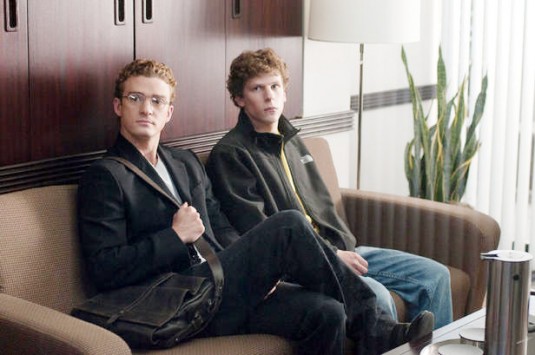
There are some very minor moments in which Fincher and Sorkin telegraph some of these points a bit too much, particularly with the needlessly ironic casting of Justin Timberlake as Napster founder Sean Parker. Timberlake is a charming enough screen presence, but he simply doesn’t have the sheer moth-attracting neo-blueblood light that the fast-talking Jesse Eisenberg has as Zuckerberg, much less the Harvard boy-next-door aw-shucks naivete of Andrew Garfield as Saverin. (Saverin, a business major, is so intoxicated by Facebook – even after Zuckerberg cuts loose to California without him – that he doesn’t even read the legal papers he has to sign, little realizing that he has been screwed over by Zuckerberg, his only real friend and co-founder.) But I think Fincher is smart enough to be cognizant of this imbalance. During the first meeting between Parker, Zuckerberg, and Saverin, Fincher stages a good portion of the scene with the dialogue remaining silent. Appletinis and enticing sushi are brought to the table, as yet another jagged yet rocking music cue from Trent Reznor and Atticus Ross plays, leaving Timberlake to bounce war stories off the wild-eyed admirer Zuckerberg. It is Parker who serves as an encouraging older brother figure to Zuckerberg (curiously, the film doesn’t mention anything about Zuckerberg’s family), who offers perfectly sound advice (“Lose the ‘The,’” he says during the TheFacebook.com days), and who sees entrepreneur Roy Raymund’s suicide not as a parable, but as a tale to inspire empowerment.

But I’m being needlessly pedantic. Really, this is an excellent movie that no self-respecting filmgoer of any type should miss. The Social Network breezes by at such a breaknecking speed that I truly believed a mere thirty minutes had transpired when The Beatles’s “Baby You’re a Rich Man” played during the closing credits.

Some might see The Social Network as “a departure” for Fincher (as one extremely idiotic journalist suggested at the post-screening press conference, leaving a visibly flustered Fincher to point out politely that he doesn’t work this way), because the film limits its technical tomfoolery to actor Armie Hammer playing a pair of identical twins (Cameron and Tyler Winklevoss – the “Winklevii,” as Zuckerberg condescendingly calls them – who saw the conceptual framework for their Harvard Connection stolen by Zuckerberg). These same people have forgotten that Fincher has managed to get great performances out of his actors (Robert Downey, Jr. in Zodiac, the cast of Seven, Brad Pitt and Edward Norton in Fight Club) and remains quirky enough to cast at least one musician in a supporting role (here, Timberlake; in previous films, Dwight Yoakam in Panic Room, Meat Loaf in Fight Club, and so forth).

Fincher has shot The Social Network on RED, an imperfect but evolving digital camera system that feels right for Facebook’s inevitably ephemeral legacy. Cinematographer Jeff Cronenwerth keeps the first hour’s palette confined to Bostonian browns and reds. A chicken ensnared within a cage recalls the incarcerated bird within Erich von Stoheim’s Greed. There’s a rapid-fire rowing race montage midway through the film that recalls Fincher’s early music videos, but it also signifies a slight narrowing of perspective for any of the audience members who haven’t yet caught onto one of the film’s visual motifs. For as the Facebook story unfolds, Fincher includes many shots in which the backgrounds are deliberately out-of-focus, a vicarious signal to the audience that Zuckerberg and his enemies can’t see much beyond their own hollow bubbles. (This includes one of Sean Parker’s conquests, in our first introduction to him, removing her clothes in the fuzzy background. And it’s also used quite well in another scene in which a silk scarf burns in a background blur.)

I haven’t yet commended Aaron Sorkin’s language. Sorkin, as usual, writes in a way that is, well, undeniably Aaron Sorkin. Like Mamet’s dialogue, Sorkin writes more with parallel precision than absolute verisimilitude. But it works incredibly well here. Sorkin finds a remarkably adept balance between his usual pursuits of heady-sounding but ultimately pedantic subject matter (the film starts off with a consideration that the United States has more people with genius IQs than China) and Matt Zuckerberg’s arrogant technobabble. This results in some great zingers that go well beyond the “I believe I deserve some recognition” now made famous by the trailer.* “Did I adequately answer your condescending question?” replies Zuckerberg in condescension to an attorney during a deposition. Larry Summers is depicted in one scene, when the Winklevii desperately petition him to seek early redress for Zuckerberg’s theft. “Punch me in the face,” he says to his secretary upon hearing the Winklevii’s feeble request. “You want to buy a Tower Records?” says Parker to Saverin, when attempting to demonstrate consequential change that the failed Napster was able to make.

So The Social Network isn’t just that rare film where popular and critical audiences will likely leave the theater happy. It’s very much a film of our times, for our times. It’s a near-perfect synthesis of pitch-perfect direction, great writing, and incredible characters. It’s a gripping two hour experience depicting the pleasures and pitfalls of living in a digital world, but, unlike its subject, The Social Network lets its audience question the authority, and, in so doing, respects them.

* – As an aside, considering the recent YouTube and Twitter parodies, I’m wondering if any movie trailer has generated nearly as many homages in recent memory.

Review: Enter the Void (2009)

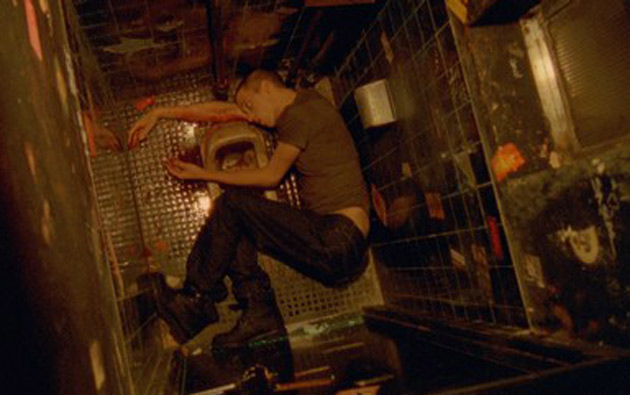
The Void, in Gaspar Noe’s third feature film, is a Tokyo nightclub. This being a Gapar Noe film, the Void is somewhat dicey. It isn’t nearly as bad as the Rectum, that sleazy nightclub with the annoying audio pulse and the vengeful men running in with the fire extinguisher, which appeared at the beginning (the end!) of Irreversible, or even another strip club down the street from the Void. But this does leave one to naturally wonder if Noe’s second film was originally titled Enter the Rectum.

Does Noe considers his audience to be on the receiving end of a two hour sodomizing session? I’m happy to report that I didn’t feel sodomized by Enter the Void – in large part because I think I’ve caught onto what Noe’s trying to do. He presents himself as a provocateur, but he’s really more interested in chronicling an entirely ridiculous human experience on film – masked by the “intensity” of ten minute rape scenes, creepy incest, crude drug addiction, and the like – and seeing if the audience will accept it. This makes Gaspar Noe more of a carnival barker (and personally I have no problem with this) than a bona-fide behavioral chronicler, although I suspect Noe, like any desperate man who thinks he is a revolutionary, would argue that he is serious. (This may also explain why his three feature films have become progressively less “real” and more centered around some outre cinematographic approach. In the case of Enter the Void, the film starts from the perspective of Oscar, a drug dealer tripping the not so fantastic in his Tokyo apartment. And when I say it is from his perspective, the film is literally what he sees through his eyes – a technique that hasn’t been attempted at length since Robert Montgomery’s Lady in the Lake.)

Because most audience members are likely to be shocked (four critics walked out of the press screening I attended: they clearly didn’t know what they were missing!), Noe wins the “game” by default. And for those who hate his movies, the ones who stick around out of obligation or because they don’t want Noe to win, Noe still wins because this audience doesn’t get it.

And then there’s the rest of us: the ones who accept Noe’s films, finding varying degrees of admiration (this funny Frenchman certainly isn’t devoid of talent), but who eventually grow out of them. The last time Noe tried to tie me up in one of his artistic dungeons, I was in my twenties and thus more impressionable. It was a badge of honor to sit through a Gaspar Noe film to the bitter end and find a way to appreciate it. And even though I still admire Irreversible (and, for that matter, I Stand Alone), I don’t think that Noe’s films are going to hold up very well. Before Enter the Void (and in tandem with my recent interview with Vincent Cassel), I decided to watch Irreversible for the first time in eight years. While I still appreciated Noe’s narrative technique (a scene unfolds, and is subsequently followed up with another scene before it), the handheld camera and the long takes (to say nothing of the homophobia) made the movie feel very much like a bad trip-hop band or an angry zine editor from the 1990s who didn’t realize he was repeating an endless cycle: it was something forgotten for a very good reason.

Noe’s approach is very similar to the behavior of an online troll. And it’s too bad that Noe feels the need to cloak his films like this. Because it will cause otherwise astute yet easily offended filmgoers from appreciating his visual innovations and his creative audacity. Here is a man who is willing to include a shot of a vagina, taken from the inside, with the cock sliding in and out. It’s a silly and brazen image, one that recalls the many giant penises throbbing within Ken Russell’s greatly underrated Lisztomania. But no real cultural appreciator can discount a filmmaker who has the balls (so to speak) to risk ridicule like this. (Childish, you say? Lowbrow? Obscene? Well, what makes Noe’s cock any worse than the asshole kissing in “The Miller’s Tale?” Which is not to suggest that Noe should be compared with Chaucer. I don’t want to feed the man’s ego if he’s reading this. But propriety is too delimiting a value with which to assess or experience art.)

So it’s frustrating that Gaspar Noe has given us his best film with Enter the Void, styling it with so many reckless yet incredible ideas (a drug experience captured from first-person; an effort to depict the experience of dying from several camera angles; the camera transcending voyeurism and actually entering a character’s head while fucking; a stripper dancing around a pole from a top angle, with the camera capturing the crude leers of the audience; an overview of Tokyo with cardboard cars and buildings rendered flat; the hilariously inappropriate end credits not appearing at the end, causing uncomfortable audience members to flee the theater before their thoughts are read by others – to name but a few), while lacking the courage to be an adult. Certainly the best way to appreciate a Gaspar Noe film is to accept Gaspar Noe as Gaspar Noe. And the film’s first hour is the most focused work that Noe has done as a filmmaker. It is steeped in isolation and loss, with an older figure, just as dissolute, approaching the young DMT-craving Oscar with new ideas on how to live (and giving him The Book of the Dead). This is all primitive philosophy, to be sure (as is the cosmic camera featured throughout the film, shuttling between live and dead characters; one is viscerally struck by the idea of stray souls conveyed as radio signals, yet when one stops to think about the idea…). As a filmmaker, Noe has never been what one might call a deep thinker. But I appreciated the way that Noe made an attempt to offer a crude framework for his shopworn street material. (And I would argue that Noe’s reliance upon silly character developments and his view of his own characters as mere playthings is his primary weakness, the very quality that prevents him from being one of our greatest filmmakers.) The film sustains this tone for quite a while before Noe the Adolescent returns yet again, playing the incest card in an utterly camp way. (“Do you remember that promise we made?” might almost be viewed as a postmodern line conveying the covenant between audience and filmmaker. There’s one moment midway through the film where “Gaspar” is named as the guy entering a character into a seedy locale. At least this time around, Noe is more transparent about the “game” at work here, which is also mirrored by a prominent portion of the film photographed solely from the back of a character’s head.)

No doubt Noe would accuse me of succumbing to petite-bourgoisie values in my older age for expecting more out of him or for hoping for artistic evolution beyond the visual. (I would reply by showing him by extremely shaky bank statement and my punkass book collection.) But while Enter the Void is very much a movie that I can recommend to a cineaste who doesn’t have a stick up his ass (and one that I will probably see again), I’m wondering if Gaspar Noe even has a persuasive fourth feature film in him, or even a movie that can stand toe-to-toe with someone like Bunuel or Pasolini, both of whom were more genuinely interested in perverse human behavior. You’d think that a man in his mid-forties would have worked out most of his adolescent expressive fixations by now. While the film world certainly needs a guy like Noe, maybe this is all Gaspar Noe has to give the film world.

NYFF: Le Quattro Volte

[This is the fourth in a series of dispatches relating to the 2010 New York Film Festival.]

Michelangelo Frammartino’s Le Quattro Volte is probably my favorite NYFF film so far. Its commitment to capturing animals on film (and the men who herd them) is reminiscent of last year’s excellent documentary, Sweet Grass. But its scope, which involves a church, an understated examination of the relationship between man and nature, and some intriguing glimpses into a local wood coal industry, is slightly broader and richer. With its soundtrack denuded of intrusive incidental music (the thwacks of manual labor replace the accustomed callow explosions in the rear speakers!), the film is compelling, philosophical, and often quite beautiful in its bucolic splendor. The film shares that Italian cinematographic devotion to capturing slivers of life within a vitrine mise-en-scene – a sort of artsy Where’s Waldo? recalling mid-career Antonioni, but, more importantly, it offers a respectful nudge for audiences to observe the world more closely. Do you notice that artificial bird tied atop a tree? Or the insect crawling across the canvas of an animal’s face (mimicking an earlier shot in which an ant crawls about a dying shepherd’s face)? And what exactly is that smouldering mound at film’s beginning? (No worries! For those bothered by “plotless” movies, there’s a payoff.) Why is dust swept off a church floor later blessed by its caretakers after it is wrapped within ripped magazine sheets? (And is this disposal method altogether sacrosanct?)

Le Quattro Volte is a humble yet moving 88 minute visual poem capturing the cycles of small town life – one that, at times, nearly had me in delightful tears. Frammartino keeps his audience slightly removed from what his human subjects are saying; their Italian words are often just outside earshot – as if to suggest that, because we are mere cinematic observers, these largely unseen toilers have the right to their privacy. Rather interestingly, he has photographed and edited his film as if we’re seeing these striking images from the vantage point of surveillance cameras, and yet the film doesn’t feel invasive of its “subjects.” Certainly, what’s captured could not be confused with scratchy footage. A door opens diagonally, directing us to a table, with its edge mirroring the door’s slant. And on this table, we see a man arranging objects into a bucket. What is he doing? An aging herder climbs a hill with several thin trees shooting up from the ground. With one simple pan to the right, we see not only what a physical burden it is for the man to climb this hill, but how the trees near the top of the hill grow at a less horizontal angle. With one elementary camera move, Frammartino establishes the relationship between man and nature in a matter of seconds. And he implicates the viewer by throwing us under a dark philosophical hood through the black leader edited into the film at strategic intervals.

And there’s one especially amazing long take in which goats sit safely behind a fence lined next to a road, with a protective dog on the other side. A small Catholic parade approaches from the distance, led by men dressed as Centurions. The dog barks at them. The Centurions chase him down the street. The camera pans with the dog. The dog hides in the forest. The parade passes, diminishing in the distance. The dog retreats from his hiding spot and returns to his original position, the camera panning with him. The dog encounters a stray figure from the parade, possibly a boy (we’re not sure, because it’s in the distance), and the boy tries to move past the dog. But the dog barks back, defending his territory. What follows is an amusing interplay, before the boy psychs the dog out with an illusory throw and passes onward. The dog searches about for the stone, and unrustles a vehicle, which proceeds to roll down the adjacent street and into the fence containing the goats. But instead of permitting us to see this collision, the camera moves away.

This moment was – well, for me, at any rate – dazzling cinema. The simple manner in which every behavioral moment led to yet another fascinated me. And keep in mind too that this was merely one poetic piece of the puzzle. And I was further pondering how Frammartino had tracked down such a well-trained dog to make this happen, along with the number of takes it must have required to get this single shot so right.

And yet, for a notable contingent of snobs chattering after the screening, Le Quattro Volte was considered a dud. “I don’t want to see animals falling out of animals,” muttered one such myopic specimen, who then proceeded to describe how she found another film containing a very conventional narrative quite gripping. Well, I certainly don’t want to listen to whiny critics who are interested in having their narrow viewpoints confirmed. But I respect the right of anyone who wishes to live so unadventurously, even if I don’t quite understand why they would be covering a film festival devoted to world voices. Shouldn’t these isolationists be picketing mosques?

For my own part, I was spellbound by the aforementioned animal birth, followed as it was by a mother licking the sticky dew from her fresh baby’s head. How could anyone interested in life not be moved by that? How could anyone not find joy with a goat bleating incongruously atop a table or rowdy men surfing atop a recently felled tree being trawled down a steep slope? Le Quattro Volte offers a wondrous floodgate of such moments. As some guy in Brooklyn seeking fresh perspectives outside his own, Le Quattro Volte was a totally unexpected surprise. This is a movie that reminds us of how inconsequential our actions may be, yet how magical our lives are when seen from afar.