
Review: Finding Bliss (2010)

It’s become increasingly impossible for any movie, whether mainstream or independent, to depict the porn industry with anything approaching accuracy. Show a penis — even a flaccid one — and you’ll be given the NC-17 stamp of death. Show any sexual act and, as the 2006 documentary This Film is Not Yet Rated sufficiently demonstrated, be prepared to get into a lengthy censorship battle with the MPAA. But feel free to maim or kill another human being and you’re likely to garner a PG-13. One of the ongoing hypocrisies about American culture is that violence remains fun for the whole family, while any hint of sexuality is considered Puritanical. Sex isn’t strictly verboten. Just don’t expect to get your film distributed within the present system.

In Finding Bliss, writer-director Julie Davis — who mined similar territory in Amy’s Orgasm — does her best to work her material around this problem, visualizing her adult entertainment production company (Grind Productions) as a locale with screwball possibilities. (It can’t be an accident that a poster of My Man Godfrey hangs in the main character’s apartment.) Leelee Sobieski plays Jody Balaban, a fresh film school grad who did not remind this writer of the actor Bob in any way. She can’t get a job. Even Garry Marshall (playing himself) won’t return her messages. She needs to make her movie, but she isn’t quite willing to pay her dues. Yet despite this steadfast drive, Jody proves quite diffidently vanilla in her sexual attitudes. She gets an editing job at Grind, figuring that she can secretly make her film at night using the surprising resources at her disposal at night while cutting together banging during the day.

The idea that true outsider art can only originate from porn’s “anything goes” exigencies isn’t a bad one for a comedy. Jody’s quest for clandestine respectability is shared, in part, by Grind, who hopes to make a film that can at long last play in mainstream theaters. This is also a production company where actors actually rehearse their lines around a table — an implausible joke that doesn’t quite pay off, but that permits a few meet cute moments. In one of the film’s surprisingly sparse concessions to perversity, Jody finds herself masturbating to the material she’s editing. She falls for disgraced director Jeff Drake (Matthew Davis), who is discovered to have once been a hot art house director and who is now pumping out porn at a steady clip. Drake, however, is remarkably faithful in his relationships. He eschews the casting couch favored by Hollywood and porn alike. When Jody’s initial cast learns of the ruse and flies the coop, Jody is forced to finish her film with porn actors. Jody’s opus is a run-of-the-mill coming-of-age drama that can be found in needless abundance at any third-tier film festival. The film seems to be suggesting that some middle-of-the-road adult entertainment company is now required to flood the marketplace with derivative independent films. (This is interesting when one considers that 1975’s Ilsa: She-Wolf of the SS was shot using the Hogan’s Heroes sets. Can one even imagine an underground film being made today using the sets for Modern Family?)

Davis’s film is somewhat entertaining. She’s helped in large part by her cast. Sobieski has been rightly heralded as a serious dramatic actress. It’s a pity, however, that this very talented actress isn’t cast in more comedies. Even when asked to go needlessly over-the-top in a few reaction shots, she manages to sell her character’s pigheaded predicament without coming across as needlessly steely. (Had Katherine Heigl been cast in this film, Finding Bliss surely would have been a disaster.) We very much believe in Jody’s hangups, even if we don’t quite believe in the material. Matthew Davis is also pretty good, imbuing his character with a cocksure unctuousness. The criminally underemployed Kirsten Johnston, whose snappy quirks haven’t quite been understood by casting directors since 3rd Rock from the Sun, is also on hand as a co-worker. Even Denise Richards, who is best known for bimboing it up ten years ago, daringly announces to Jody (and the audience) near film’s end, “I’m a better actress than you thought.”

So Davis has cast well. She knows how to appropriate the best moments from other romantic comedies, such as the rooftop scene from The Goodbye Girl, for emotional effect. And Finding Bliss is much better in using porn as a refuge for misfits than, say, Kevin Smith’s Zack and Miri Make a Porno. Unfortunately, Davis’s film (much like Jody’s) doesn’t entirely trust itself. Instead of letting the audience read the conflicted emotions on Sobieski’s face, the film prefers to bombard us with imaginary voices for Jody to react to. It’s almost as if Davis doesn’t entirely trust her character, much less Sobieski. There’s one scene that Sobieski plays, sitting in an awkward position with her knee up. And this comes across as desperate blocking that needlessly delimits the film’s potential. The film is also awkward when Jody’s parents enter the equation and when, during conversations between Jody and Jeff, it brings up the tired philosophy of women being aroused by more than just an emotional connection. It’s on firmer ground when trusting in the quite mythical Grind, and pursuing the film’s artificial disparity between mainstream and adult entertainment which reflects the very real discrepancies between how Americans live and what our national culture allows us to reveal about ourselves. This film didn’t need Ron Jeremy or Stormy Daniels — who both show up near the end. Had it called more bullshit on the self-imposed censorship system that prohibits real human emotion and real art from flourishing, it might very well have lived up to screwball subtext.
Review: The Karate Kid (2010)

Age has always been a dicey variable in the Karate Kid universe. In The Karate Kid, Part III — perhaps the most preposterous entry in the series — the 28-year-old Ralph Macchio passed himself off as a “kid” abandoning college, with his character dating the 17-year-old Robyn Lively (thus lending a creepy and statutory quality to the relationship). One of Daniel-San’s adversaries was the 27-year-old Thomas Ian Griffith, a scenery-chewing babyface who tried to pass himself off as a military man who served in ‘Nam with the 43-year-old Martin Kove. Meanwhile, the 57-year-old Pat Morita claimed battle experience for a war that went down when Morita was a preteen.

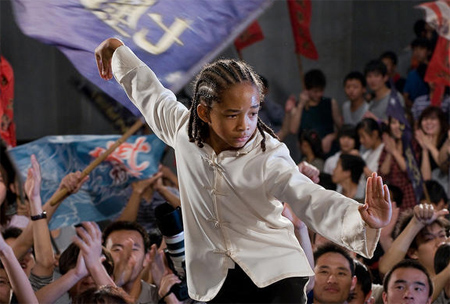
But these mathematical discrepancies are harmless solecisms when compared to the remake’s shaky moral framework. This time around, the “kid” is truly a kid — even if the “karate” is kung fu and not karate. (I must assume that Hollywood’s rule for any Karate Kid film is to get just one of the two right.) The martial arts here, a watered-down take on Yuen Woo-ping, are both hilarious and disturbing. Here is a film that asks us to celebrate Jaden Smith beating another 12-year-old in the face — a move that would surely have disqualified him from the 1984 original’s All Valley Karate Tournament — shortly after he has pinned his opponent on the mat. The remake’s aggressive sound mix invites us to revel in the bone-crunching prospects of children being thrown into the air and viciously attacked, demonstrating that America’s post-Guantanamo moral laxity has expanded considerably since Jack Bauer first waterboarded a suspect. And I’ll certainly be curious if some family values moralist emerges from the log cabin to condemn the film’s fondness for having kids beating the shit out of each other.

Here is a remake that imbues ridiculous infographics into the tournament finale, where digitized avatars of the participants rotate like some Ritalin-happy bastard progeny conceived between Mortal Kombat* and FOX News, and every round’s most violent moment is replayed for the crowd. This is all quite amusing, but it’s worth pointing out that John G. Avildsen only needed ringside cutaways, medium shots of the fighting, and Joe Esposito’s silly song, “You’re the Best” to generate suspense. (Watch that linked clip and you’ll see that Avildsen, who co-edited the movie, was smart enough to avoid long shots of the crowd. He photographed the tournament more as a vicarious experience. And because Robert Mark Kamen’s script was smart enough to layer Daniel’s predicament with serious stakes, we were very much invested in the outcome. It became surprisingly easy to forget that The Karate Kid was a film directed by the same guy who helmed Rocky.) The remake, by contrast, is more concerned with making the arena loud and large, rather than giving us ringside seats for a conflict that we hope will end all the needless violence.

Director Harald Zwart feels more compelled to give us spectacle with this remake. He scores some points with the supporting cast. If Jackie Chan’s Mr. Han can’t hold a thespic candle to the Oscar-nominated Pat Morita, Taraji P. Henson’s single mother is good enough to match Randee Heller in the original. (Heller was drawn to California for a computer job. But here’s one unsettling aspect of the remake. It’s intimated that Henson’s character, who has moved to China from Detroit and works in an “auto factory,” is a manager at some plant paying Chinese workers a pittance. I can only speak for myself, but the film’s inadequacies might best be expressed by the fact that I found myself far more troubled by this narrative aspect than anything that Jaden Smith was going through.) Even better is newcomer Wenwen Han as Meiying, Jaden Smith’s love interest, who displays a strong talent for expressing contained emotions, even if the material doesn’t give her the opportunity to slug a caddish boy in the face. (I feel compelled to point out that Lady Gaga’s “Pokerface” replaces Bananarama’s “Cruel Summer” for the film’s Golf N’ Stuff-like moment. This is an acceptable choice, but a DDR-like machine is hardly a substitute for a hockey machine’s conversational possibilities.) Zwart has a decent cinematographer (Roger Pratt) rigging some impressive Fincheresque dissolves between several shots using the same computer-controlled camera motion and opting for a more handheld feel for the coverage. Zwart is also sensible enough to hire a composer (James Horner) who is just as overblown (if not more so) than the original film’s composer (Bill Conti).

The problem here isn’t Zwart’s direction, but Christopher Murphey’s workmanlike script. While Murphey offers a few new spins on Miyagi’s “wax on wax off” training techniques and skillfully transposes many of the original film’s scenes (and even a good deal of the dialogue) into the new China setting, Jaden Smith’s Dre Parker isn’t nearly as winning as Daniel Larusso. Where Daniel was a decent kid from New Jersey who immediately introduced himself to a crazy old woman in the apartment building and brought her dog a bowl of water, immediately securing audience sympathy, Dre is more of a spoiled brat who drops his jacket on the floor, whines too much, and doesn’t even have Daniel’s soccer ball bouncing moves to impress the girl. (Instead, Dre, after attempting a vicious top spin move in a ping-pong match, gets his ass handed to him by an old man.) It also doesn’t help that Jaden Smith has an annoying habit of mugging for the camera. He rolls his eyes and folds his face to the spectator instead of inhabiting his character the way that Macchio did. Perhaps the charm Smith offered in The Pursuit of Happyness was less rooted in acting and more associated with being in close proximity to his real-life father. Whatever the case, in all my years, I never thought I would ever write the next sentence. I actually longed for Ralph Macchio.

Because of this, even though it’s more entertaining than most remakes, 2010’s The Karate Kid can’t come close to matching the original. And that’s because the 1984 movie was something of a masterpiece. Aside from the original’s clever method of using the Protestant work ethic as a pretext for “training” (one might make a case that Daniel’s dawn-to-dusk shifts are one of Hollywood’s greatest portrayals of efficacious slave labor), the movie was a sneaky parable about cultural appropriation. Kreese (the Martin Kove character), the military man turned dojo master, and the Cobra clan, with its Erhardian “No Fear! No Mercy!” mantra, not only presented us with a shameful bastardization of karate’s peaceful roots, but it certainly helped that Kreese, Johnny, and the various lieutenants acted like a cokehead asshole brigade. Miyagi lost his wife and daughter for reasons that involved a Japanese internment camp — one of the most disgraceful moments in American history. And the class divide between Daniel and “Ali with an I,” when taken with the feminism of Ali pursuing Daniel (rather than the reverse) and clocking the boorish Johnny, created an environment where hard work and a commitment to discipline could pull you through the American nightmare. Sure, these were Protestant values. But it did the trick for mainstream audiences.

But the remake has done away with most of this. Like Miyagi, Han has lost his wife and daughter. But it’s not rooted in historical precedent, and the scene is played out with Chan sobbing with overwrought tears. Avildsen was right to portray the moment in one long take, not have Miyagi break down, and center the scene around Daniel’s discovery. But in the remake, Dre exists to comfort Han. And the film itself exists to comfort the audience, who will instantly forget it.

All this is too bad. Because had the remake’s script considered the original film’s underlying principle — that resorting to violence is only applicable when there are no other choices — it might have packed a greater punch.

* — Maybe some reader can confirm this. This review has become much longer than I anticipated and I’m too lazy to look it up. But I understand that the first cultural usage of “Finish him!” originated in the 1984 version of The Karate Kid. Mortal Kombat then appropriated this phrase. And, sure enough, the phrase has returned to the 2010 remake. So the Mortal Kombat infographics do make a certain amount of sense. The only real surprise is that nobody thought to include this in 1994’s The Next Karate Kid, which appeared in theaters two years after Mortal Kombat enticed kids in video arcades.

New Review: Tom Bissell’s EXTRA LIVES

I don’t confess nearly as much as Tom Bissell in my review of his excellent book, Extra Lives. But I do nevertheless come out to some extent in today’s Barnes & Noble Review:

When Valve recently updated its shiny Steam client—that flashy desktop app permitting the user to waste numerous hours on video games and to spend precious dollars on special weekend sales—I received the soul-shattering news that I’d clocked in an alarming 131 hours of Team Fortress 2. I had not asked for this statistic, yet this seemingly benevolent software company had given it to me in the game launch window. And the size of this embarrassing timesink felt incommensurate with my daily duties as a books enthusiast. It was enough to make me wonder if I needed to register for some national time-offender database.

Far more important than any any of this introspective flensing, of course, is Bissell’s book. Read the rest of the review to find out why Extra Lives is a must read.

So Much for Shriver

My review of Lionel Shriver’s novel, So Much for That, runs in today’s Chicago Sun-Times. Here’s the first paragraph:

In We Need to Talk About Kevin, Lionel Shriver axed at the angst of self-absorbed parenting while spinning the unspoken psychological grindstone that sharpens school violence. In her severely underrated novel The Post-Birthday World, Shriver expertly established two parallel universes that exposed the delicate fissures buried within a seemingly grounded relationship. One would logically assume Shriver to be the ideal social novelist to fire up the Flammenwerfer for a blistering assault on the ongoing health care crisis.

You can also listen to my 2007 interview with Shriver on The Bat Segundo Show. While I was extremely disappointed by the latest novel, I still believe that Shriver has enough talent to recapture the momentum contained within her last three novels, which are all worth reading.

Review: Clash of the Titans (2010)

Even as a lad, I was not a fan of the 1981 version of Clash of the Titans. A grade school teacher, detecting some faint whiff of precocity, suggested that I needed to investigate Roman mythology. Not wishing to disappoint her, I checked out a 200-page book on Roman mythology from the school library. It contained striking illustrations and offered a kid-friendly overview of the gods. I spent several days alone in my bedroom, reading it over and over with more devotion than any variation on the King James Bible. Some of my mother’s wild-eyed friends, sensing that I was an uncommon reader, attempted to get me to read more ecumenical texts. But I was suspicious of these gestures. I didn’t understand then why one needed to choose a religion. If you had to select one, why not place your faith in these marvelous stories? Medusa! Cerberus! Narcissus! Prometheus! The tragedy of Orpheus and Eurydice! These tales all captured my imagination so much that I found myself flipping through the Yellow Pages, wondering if there were any churches devoted to Zeus or Aphrodite.

Seeing no division for “Roman” or “Greek,” I nervously telephoned a few churches when my mother was away, asking where one could go to worship the gods. One man told me that surely I meant a singular one. “No, no, no,” I replied. “I’m talking about the Gods of Olympus!” There were efforts to steer me towards the “true” faith, but I proved recalcitrant. I concluded that religion was not for me, but I still begrudgingly went to church when I was asked and I did my best to keep my mouth shut. Although one congregation member would later say, “There’s something of the devil in that boy.” For all I knew, he was probably right.

So when the Clash of the Titans lunchboxes started showing up in the cafeteria, and when some of the kids began speaking of this “great” film, and when I continued to wonder about the mechanical bird (who reminded me of Tick Tock from the Oz books), I felt obliged to figure out a way to see this movie. I knew the name “Ray Harryhausen” from the amazing stop-motion effects seen in the Sinbad movies that repeatedly aired on UHF stations. And while the Medusa sequence impressed me, the Perseus depicted in Clash (played by a doe-eyed Harry Hamlin) reminded me of the sleazy and self-absorbed men — some strange phase between disco king and yuppie — who drove loud sportscars when I looked out the car window. This Perseus couldn’t possibly compare to the one I had imagined from the books. What was the big deal?

So it’s safe to say that the original Clash didn’t make much of an impression. And now that I’ve had the misfortune of revisiting the original film, I can safely say that it contains very little of value aside from Harryhausen’s effects. Even with the prominent matte lines and the inconsistent lighting between the animation and the live action, Harryhausen remained a consummate master of the tiny gesture that spelled out everything you needed to know about a creature. The specific way that Pegasus kicks up his forelegs or the manner in which the giant hawk waits for Andromeda’s soul to enter the cage. And, most impressively, the way that the Kraken burrowed his three claws into the rocks and peeked his menacing head over the ravine. This attention to detail made these seemingly one-dimensional characters live in my mind.

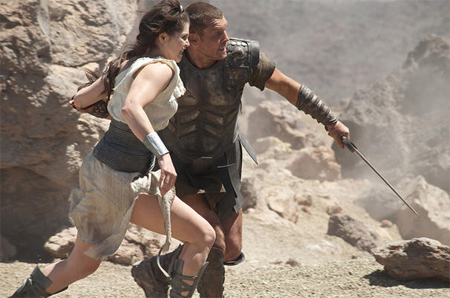
So it is my sad duty to report that the Clash remake, while not nearly as terrible as I expected, doesn’t possess a singular creature gesture to match Harryhausen’s. Gargoyles flap about into a giant mass. There are a few giant scorpions that prove somewhat enthralling. Pegasus, who is referred to not as “Pegasus, the last of the flying horses” (as he was in the original) but merely “the Pegasus” (well, if he isn’t unique, then what’s the big deal?), has been integrated, by way of jet hide, into some strange affirmative action program. It’s clear that the animators are inputting coordinates into a computer. The time for careful attention to monsters is now mostly finished.

Which is too bad. Because Sam Worthington is better as Perseus than that dreadful slab of inexpressive meat (the suitably named Hamlin) cast in the original. While there’s something more than a bit odd about seeing a 33-year-old actor referred to as “boy,” and Worthington appears remiss to show off his pecs in the exhibitionist manner that Hamlin (or director Desmond Davis) was all too eager to practice, Worthington is never insufferable. Alas, his Perseus is less committed to taking charge. He bitches about going back to his old life as a fisherman. He is never given an invisible helmet, as he was in the original, much less a shield from the gods.

Instead of Burgess Meredith, Perseus is accompanied by two mercenaries, who speak some bad dialect that is vaguely Russian and vaguely Slavic, but ultimately the product of lazy Hollywood acting. (When this duo first appears, the film is quick to insert some gypsy music track, as if we won’t notice just how terrible they are. All that money for the effects and the filmmakers couldn’t hire a dialect coach?) Indeed, one of this movie’s curious qualities is that there is no uniform dialect. Some actors speak with an Australian dialect; others, Santa Monica; still others, British. And this slipshod attention to language should give you a sense of where director Lewis Leterrier’s priorities are.

Perseus is constantly under the tutelage of Io (played by the inexpressive Gemma Arterton), who has been watching him all his life. (Never mind that we don’t see her until midway through the film.)

In other words, 2010’s Perseus reflects the vitiated masculinity often found in the insufferable hipster too intoxicated with his own indolence.

But that’s the least of the film’s problems. Given that the original film featured Ursula Andress’s ass and a breastfeeding moment, I was surprised that the remake’s eleventh-hour upgrade to 3-D (reportedly assembled in eight weeks) didn’t take advantage of these Z-axis possibilities. It becomes very clear early on that this movie was never designed with 3-D in mind, and that audiences are being gouged. Clash‘s 3-D “experience” merely involves accentuating planes of focus. One would get livelier surprises from a pop-up book. And the film’s reticence to display blood and visceral fluids (much less the nude form) makes one wonder how this movie landed a PG-13 rating. Yes, there’s a scene in which Perseus cuts his way out of the inside of a computer-generated scorpion. But it all seemed artificial to me. Not just because the film never lets a creature have even ten seconds of camera time to offer some personality, but because we are never given a gesture in which we can believe in the scorpion.

I should probably also mention the remake’s casual misogyny, which comes courtesy of screenwriters Travis Beacham, Phil Hay, and Matt Manfredi. The original film, you may recall, was somewhat careful with the gender balance. There was Thetis’s statue that came alive. Athena and Aphrodite were given some moments. When Perseus declared that he was going to pursue the Stygian witches on his own, Andromeda stood her ground, saying, “No, we will ride with you as far as their shrine. It is a long and perilous journey.” And when Perseus busted out some macho swagger, Andromeda pushed back. Then, with a schmaltzy music cue from Laurence Rosenthal, Andromeda rode forth with her horse, shortly announcing, “We follow the North Star.”

This may not have been much, but at least the women in the original Clash got the chance to engage in a little action. By contrast, the remake has pushed all the goddesses out of the narrative, leaving only Zeus (Liam Nesson) and Hades (Ralph Fiennes) to duke it out with humans as pawns. In the remake, Andromeda doesn’t accompany Perseus on his quest. And it isn’t too long before Io, in a preposterous moment aboard Charon’s ferry, soon becomes little more than a sex object, urging Perseus to “ease your storm.” And it was here that the film lost me. Granted, defenders of this remake (will there be any?) will no doubt respond to my criticisms by pointing out that Io tries to teach Perseus some moves to battle Medusa. But Io never makes any real effort to put Perseus in his place. The film’s anti-women attitude can also be found in the Medusa sequence. Medusa, in the original, was an ass-kicking serpent who fired arrows at Perseus’s comrades. She was a formidable villainess whose omnipresent rattle was enough to command attention. But in the remake, all Medusa does is offer random laughs and slither around her lair. And if that isn’t enough for you, consider the needless explanation for Medusa’s transformation in both films. The original simply mentioned that Aphrodite punished her. The remake offers a description of rape, painting Medusa as a once very beautiful woman. It’s almost as if the filmmakers are suggesting that the bitch had it coming.

So if some kid is coming into this movie, hoping to find some halfway house with which to move onto the likes of Edith Hamilton, then the Clash remake is mostly futile. As my pal Eric Rosenfield was adamant to observe, the film doesn’t even get the mythology right. (Perseus does not marry Andromeda in this movie.) It doesn’t even have the decency to give us Dioskilos, the cool two-headed dog that Perseus’s army fought before Medusa. It does wisely divest itself of Bubo, the mechanical bird from the original, giving it, quite literally, a throwaway cameo. And again, I cannot stress enough how anticlimactic the 3-D is.

I’ve seen movies that are worse. But when you’re dealing with mythological wonder, why settle for less?