Review: The Road (2009)

theroad

In 2006, an incalculable number of retroussé-nosed snobs — most possessing little understanding or appreciation of speculative fiction — were justly charmed by Cormac McCarthy’s YA novel, The Road. It was a common weakness for such ostensibly erudite essayists as James Wood to not comprehend that McCarthy, like nearly every other speculative fiction author, was extrapolating his own values of fatherhood and manhood onto his fantastical canvas. Functional illiterates, without even an elementary knowledge of the exciting New Weird and steampunk movements then in full bloom, raved that The Road was “unlike any book you’ve read in a long time,” and that sentiment was certainly true if your grasp of speculative fiction extended no further than a Ray Bradbury story read under duress in a high school haze. But McCarthy’s novel — simple yet effective in its execution — went on to earn the Pulitzer Prize and was even selected by the middlebrow television queen, who proudly gushed to McCarthy that he looked just like he did on the back of the cover.

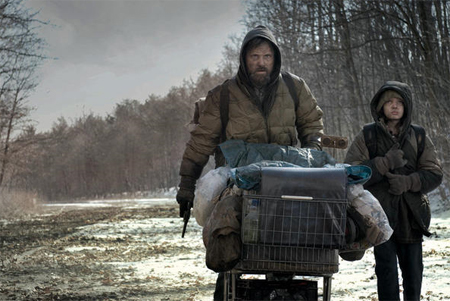
I am happy to report that The Road, in its cinematic version, lives up to this wanton accessibility. It lacks the apocalyptic punch of 1984’s Threads or 1982’s The Day After, and is far from bleak and depressing in its approach. But a liberal parent may very well argue that this family-centric film is fun for the whole family. I couldn’t help but wonder at times whether Viggo would coo, “Good night, John Boy,” under the acid rain of family values. The film does possess a streak of humanity comparable, at times, to 1983’s Testament, particularly since it is securely anchored by Viggo Mortensen, who conceals an effective bundle of husks, rasps, and laconic remnants within his spindly, half-starved frame. (He even delivers McCarthy’s contractions without apostrophes. This is a dedicated lead actor.) Joe Penhall’s adaptation is relatively faithful to the book, reproducing much of the narrative moments and the dialogue (although on film, the mind’s eye begins to see the question marks forming around lines, somewhat sullying McCarthy’s intent). There’s also gruff narration from Mortensen reading much of McCarthy’s prose, which I’m not sure was needed. Flashback moments involving Charlize Theron as the mother come perilously close to needless audience spoonfeeding.

But then McCarthy’s book was, in its own way, altogether too geared for mass consumption. One moment from the book, bearing the telltale indicator of a corporation wheeling over a rusty shopping cart of money, has been lovingly reproduced on screen. But director John Hillcoat and Penhall shouldn’t be held entirely accountable. They have indeed been true to the book, rendering every line of the following exchange:

He withdrew his hand slowly and sat looking at a Coca-Cola.

What is it, Papa?

It’s a treat. For you.

What is it?

Here. Sit down.

He slipped the boy’s knapsack straps loose and set the pack on the floor behind him and he put his thumbnail under the aluminum lip on the top of the can and opened it. He leaned his nose to the slight fizz coming from the can and then handed it to the boy. Go ahead, he said.

The boy took the can. It’s bubbly, he said.

Go ahead.

He looked at his father and then tilted the can and drank. He sat there thinking about it. It’s really good, he said.

Yes. It is.

You have some, Papa.

I want you to drink it.

You have some.

He took the can and sipped it and handed it back. You drink it, he said. Let’s just sit here.

The stuff of literature! A book and a smile! And a film and a smile.

On the big screen, the thinking audience member, troubled not only by this product placement coming at the expense of verisimilitude, notes that warm and unrefrigerated Coca-Cola nestled for so long would surely have gone flat. (Indeed, the subject was argued about on Metafilter.)

The apocalypse’s visual elements involve tilted telephone poles, burned out office parks, skeletal remains, bituminious detritus, and frequent flickers of past civilization (paintings within a gutted out church, portraits in houses) cannily mirroring the father’s desire to “carry on the soul” and stay “one of the good guys” in a landscape populated mostly by cannibals. Alas, the sordid cannibalism doesn’t include the book’s infamous roasted baby, which China Mieville rightly called “a little bit camp.” We do see bloody bathtubs and sinks, a basement populated by living human meat, and chops and screams in the distance. But Delicatessen and Eating Raoul this ain’t. This grisly stuff should jolt or horrify, as it does on the page. But the film’s cannibals are more or less actors daubed up with grease who wear trucker’s caps. The intent is to depict humanity debased by desperate impulses, but it comes off like a cheap shot at red staters.

Still, some of the film’s pulled punches are redeemed by the solid performances (Kodi Smit-McPhee is good as The Boy) and a sound mix that knows the value of silence and knows when to intrude with creepy creaks. Robert Duvall’s presence as the old man is quite welcome and possibly more of a humanizing influence than the character’s appearance in the book. And while David Edelstein has pooh-poohed the film’s seeming “monotonous” quality, I must commend the film for the same reason. (Then again, it’s doubtful that Edelstein paid much attention. He claims that “having Mom lurch off is quite an evolutionary statement,” but failed to note Molly Parker’s presence at the end.) This is a film about process. Surviving in a wasteland when there’s no real reason to survive — other than the nebulous idea of “going south” — is one of the film’s (and the duo’s) reasons for being. It also helps that the father is, as the flashbacks and the incident with the thief reveal, hardly a flawless and glowing patriarch, and that his mistakes don’t necessarily coincide with the conditions.

Make no mistake: This is a feel-good apocalypse movie. And while the film is more entertainment than art, it’s just loose enough to provide any number of comparisons to the present economic shitstorm. Because of this, I suspect it may perform quite well at the box office.
Review: The Missing Person (2009)

THe Missing Person

Noah Buschel’s The Missing Person (opening in New York today) is, as the title intimates, yet another entry from the Hey, I’ve Got a Clever Twist! school of filmmaking. Now several clever twists, nestled within a narrative at unpredictable points, are perfectly wonderful. Some American independent filmmakers, such as Darren Aronofsky and Shane Carruth (the latter regrettably absent from filmmaking since his low-budget breakthrough Primer), have fulfilled this grandiose requisite of complex storytelling, which shares some qualities with the “prodigious fiction” identified by literary critic Tom LeClair in 1996. But an embedded narrative, whether brainy or entertaining, is only as good as the character qualities and developments it pitches at unexpected arcs.

I’m quibbling with the very quality that prevents The Missing Person from fleshing out its seedy and goofy potential, which is more concerned with the singular twist: that one revealing moment on which all action hinges upon. We can probably blame the unitarian “clever” narrative impulse, a clunky can rattling around the halls of cinema for the last two decades or so, on such overrated offerings as The Usual Suspects and The Crying Game — both competently put together, but emotionally hollow and reliant upon strong acting once you know the Big Reveal.

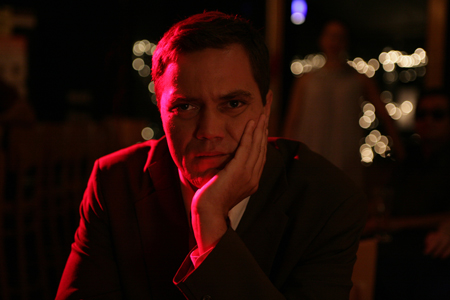
And like all Hey, I’ve Got a Clever Twist! films, The Missing Person is at its most interesting before we know the why. A former NYPD officer with the promisingly idiosyncratic name of John Rosow (played by Michael Shannon) lies in bed in a sparse rundown flat, complete with subway cars rattling noisily behind him and constructed of seemingly nothing more than blue concrete. We learn that he is an alcoholic, that his services now involve primitive forms of private investigation, and that he is not particularly adept at his job. Rosow’s work is ridiculously easy and ridiculous lucrative. $500 a day plus expenses. The missing man he must track on a train sits with his compartment door open. A middle-aged woman later throws herself at Rosow. A Los Angeles cop on a Segway hectors Rosow for smoking a cigarette. There is something of the Old World dying within Rosow. And the burned out quality is strangely augmented by Shannon’s mumbling and shuffling manner. Shannon even adds a tinge of Bogart to his inflections. (He isn’t the only actor mimicking a forgotten cultural figure. Frank Wood, playing the eponymous missing person, oscillates his deep voice so that it sounds eerily like Dick Cavett.)

We are therefore left to wonder why such an incompetent would not only get work — particularly during the present economic climate — but get handsomely paid for it. As one character says to Rosow, “You stick out like a broken nose.” This is an unusual character approach rarely seen in movies today, and Buschel manages to accentuate these incongruities with some understated humor. Rosow confuses the famous search engine with gogolplex. Rosow is more adept chopping up lemons and limes and pouring drinks rather than getting hard information. And while there are needless flashbacks to Rosow’s past interfering with his character qualities in the present, Rosow’s crude no-bullshit quality — seen when he defiantly fires up a cigarette in a cab and when he extracts a camera phone from a smarmy cell phone salesman — bears the funny conceit that even a relatively clueless man committed to single-minded pursuit can get results. This is, after all, an age more concerned with political correctness and passive aggressiveness.

But because The Missing Person is a Hey, I’ve Got a Clever Twist! film, the twist betrays these giddy possibilities. The talented Amy Ryan, who executive produced this film, is wasted as a throwaway Girl Friday. And her fate at film’s end is precisely what we expect. It doesn’t help that the Clever Twist, as is most frequently the case with such movies, isn’t very plausible. I won’t reveal what happens, but I must ask how the Missing Person can get away with his crime without any other government agency or insurance company locating him. He operates in plain sight. There’s a lot of money invested in his fate. Surely, someone would have found him before Rosow.

This major story flaw spoils what should have been a quirky little movie. I can commend Buschel for his blunt and slightly eccentric dialogue. “You’re putting me in a very idiosyncratic spot here,” says one character. A cabdriver states, “I’m not allowed to talk about directions. I’d get into big trouble.” There’s also a pair of FBI agents who offer Rosow an extra pair of sunglasses that they picked up from 7-11.

It’s evident that Buschel has a good knack for quirky moments that don’t feel particularly phony. And I regret that I haven’t seen his other two films. But after seeing The Missing Person, I suspect that Buschel has a movie in him that’s just as good as Wayne Kramer’s best films (The Cooler and Running Scared). He is clearly operating in the same mode. And since giddy filmmakers lifting from life (rather than Diablo Cody’s insipid cultural reference) seem to be in short supply these days, I certainly hope that, with future offerings, Bushel does away with his reliance on Clever Twists and trusts his crazy subconscious to offer us something more spontaneous and special.

Review: 2012 (2009)

2012

Roland Emmerich’s 2012 is slightly better than Independence Day and The Day After Tomorrow — the hack director’s two previous opuses involving mass devastation. But that’s a bit like saying that imbibing a thimble of urine is better than eating a shit sandwich or employing an embalmed corpse as a surrogate dining table. That one must pay ten George Washingtons for the privilege of drinking a soupçon of pee is hardly a recommendation. But the piss remains compelling. For it has become every dutiful American’s duty to sit through vile cinematic “entertainment” in order to remain on the same page. Still, there’s a part of me pondering 2012‘s potential.

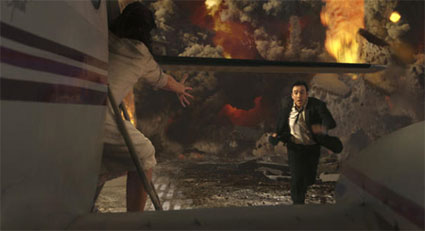
“Something like this can only originate in Hollywood,” says a character early in the film. And indeed, Emmerich is right on this point. Emmerich is only a mite more talented than Uwe Boll, his fellow German sellout. But one shouldn’t compare two cultural criminals who have both severely setback the intelligent possibilities of mass entertainment. The film presents a primitive political viewpoint to entice the kooky charlatans now banging out insipid and predictably contrarian viewpoints for the New York Press. Two African-American male characters are presented here with noble intent — a humanist geologist played by Chiwetel Ejiofor at loggerheads with the cold and clinical Oliver Platt (here, with an American accent) and Danny Glover’s President Thomas Wilson (beckoning phony comparisons to Woodrow, whose first name was actually Thomas), who stays behind at the White House as giant waves and dust clouds ravage the nation. And while it’s heartening to see African-Americans shift from “magical black” side characters and wiseacres into take-charge positions, the film also serves up a distressing sexism. The Speaker of the House is, three years hence, a “he.” When a giant plane heads to a safe point in China, the women are compelled to stay downstairs while the men are summoned to the cockpit to witness recent developments. President Danny Glover insists that the people have the right to know about forthcoming disaster because “a mother can comfort her children.” Why can’t a mother kick ass? These misogynistic politics are at odds with the film’s purported humanism. Make no mistake: This is a film designed for an Armond White pullquote.

On the other hand, I cannot deny the sheer pleasure I experienced in seeing the two centers of vapid American entertainment — Los Angeles and Las Vegas — destroyed by cheap-looking CG effects. (It should be noted that Emmerich also manages to obliterate the Sistine Chapel, complete with a crack forming between God and Adam. But the man is running out of landmarks to destroy. Will public memory permit him repeats?) I cannot deny being amused by the fact that one million Euros, not dollars, is the asking price to get on board one of the arks destined to save the remainder of humanity. (There’s even a nod to Douglas Adams’s Golgafrincham, where one of the arks is damaged, proving unsuitable for the flailing crowds clamoring to get on board.) I was even amused at times by Woody Harrelson’s wild-eyed, pickle-eating, radio-ranting mountain man. But Harrelson serves the same purpose as Brent Spiner’s wild-haired scientist in Independence Day: a forgettable cartoon providing as much human depth as a TV dinner. Not that anyone will remember the formulaic similarities. As Harrelson says at one point, just after urging Cusack to “download my blog,” “You lure them in with the humor. Then you make them think.” It’s safe to say that Emmerich cannot follow his own crude advice.

There comes a point in any Roland Emmerich film in which anyone with a brain must give up and ponder why such superficialities remain a draw. For me, it came about ninety minutes in, as certain characters defiantly survived even the most liberal geophysics. It is also profoundly insulting for Emmerich (and his co-writer and composer Harald Kloser, who is overwrought in both of his “professional” duties) to offer us a character who reads books (Ejiofor’s Adrian Helmsley, “moving on up” just like Sherman did a few decades ago) and a shah using an e-reader, while also offering us this shoddy science behind the Earth’s destruction: “Neutrinos are causing a physical reaction.”

Here is a filmmaker so utterly stupid that he takes us to “the deepest copper mine in the world” in the opening minutes, features buckets of ice, and yet provides only a single consumer fan to cool the expensive computer equipment residing at the bottom. Here is a filmmaker so happy to whore himself out to product placement that the most important government representatives all use Vaio laptops. Here is a filmmaker so tone-deaf to politics that the President of the United States actually utters, “‘I was wrong.’ Do you know how many times I’ve heard that? Zero.” At the risk of invoking Godwin, Roland Emmerich is Hollywood’s answer to a dutiful Sturmabteilung. He was only following orders. And he will be rewarded for his hubris and ignorance by the considerable cash that this film will generate worldwide.

John Cusack, who is one of our most underrated actors, gives this material more sincerity and dignity than it deserves. The man (or his agent) clearly needed the cash or a way to boost his box office standing. He is, much like Dennis Quaid in The Day After Tomorrow, the Believable Presence. The guy to identify with. That guy is a writer named Jackson Curtis, the author of Farewell Atlantis, which has sold only 500 copies. Curtis is driving a limo to pay the bills. And while every other actor in this film understands that this assignment represents a fat paycheck, and is only partially exonerated, it is Cusack alone who obdurately refuses to ham it up. He is therefore just as culpable and responsible as Roland Emmerich. Let him suffer a metaphorical car accident worse than Montgomery Clift’s.

The film has lifted a good deal from 1998’s Deep Impact — the broken family gathered at the beach as a giant wave is about to hit, the older African-American President addressing the nation with the grim reality, the millions killed along the coastlines, and the efforts to alert a senior scientist of the impending catastrophe. But Deep Impact, as problematic as it was, had two half-decent screenwriters (Bruce Joel Rubin and Michael Tolkin) attempting to imbue some humanity into the improbable scenario.

But 2012 doesn’t even provide the unadulterated fun of an unintentionally hilarious B movie. Emmerich, with considerable resources at his disposal, has made a dumb and unfulfillable movie. And instead of Emmerich using his exploitative skills to make his audience think, he has produced the cinematic equivalent of an audience member running out of toilet paper when she most desperately needs it. His audience is doomed to run around the house with pants around legs, hoping to seek out a Kleenex or paper towel substitute and praying to the deities that nobody else is home. But the film is so long (it runs a needless two hours and 38 minutes) and the quest so fruitless that it goes beyond any uncouthly rectified inconvenience. As such, 2012 is, to paraphrase Jefferson, the movie that the American public deserves.

[UPDATE: In a rare drift in sensibilities, Armond White has panned 2012 in what appears to be a hastily written review. The big surprise is Roger Ebert, who has awarded this film three and a half stars. I note Ebert’s review largely because he points out (correctly) that the Sistine Chapel’s ceiling has been inexplicably relocated within St. Peter’s Basilica — a detail that I failed to note in the above review.]

New Review

In all the NYFF madness, I failed to note that my review of Morris Dickstein’s Dancing in the Darkappeared in Friday’s edition of the Chicago Sun-Times. It begins:

While the intrepid academic Morris Dickstein has been noodling around on Dancing in the Dark: A Cultural History of the Great Depression (W.W. Norton, $29.95) for 29 years, the regrettable surprise is that the chapters read like airless lectures delivered to a fidgety audience that’s only sitting through the whole darn talk for a college credit or a free barbeque.

You can read the rest here.

NYFF: Broken Embraces (2009)

[This is the second in a series of posts relating to the 2009 New York Film Festival.]

brokenembraces

There once was a time in which I flocked to a new Pedro Almodovar film with a mad and unstoppable gusto, wondering just what iconoclastic ideas Almodovar would unleash upon the screen. You never knew if you were going to get an extended rape scene brazenly challenging gender assumptions (the notorious sequence in Kika) or Antonio Banderas confronting some dormant and out-of-left-field sexual feelings (well, just about every Banderas-Almodovar road show). But then came All About My Mother, a perfectly respectable film that softened Almodovar and revealed that there was a pedestrian melodramatic filmmaker underneath the madness. Almodovar, like many filmmakers in their fifties, lost his bite. And all he had left was the lachrymose material.

And it is my sad duty to report that Broken Embraces represents more of the same. Broken Embraces may offer a film within a film (Girls with Suitcases) that bears suspicious similarity to Almodovar’s Women on the Verge of a Nervous Breakdown. Girls with Suitcases is intended to be Mateo’s masterpiece, maligned by other hands. But when we actually see the footage, even the good takes that Mateo approves of aren’t particularly funny. And Almodovar falls into the all-too-common artistic trap of having other characters comment upon how brilliant and side-splitting an alleged comic masterpiece is, without injecting hilarity into the material itself. “Films have to be finished,” remarks a character at Broken Embraces‘s close. And it’s something you do blindly. But is Almodovar really all that blind?

Here’s a filmmaker fond of staging dialogue scenes by dollying the camera from character to character, instead of panning. Here’s a filmmaker fond of split diopters. Here’s a filmmaker who gets winning performances from his two leads. Here’s a filmmaker who can make a half-decent film in his sleep. So why does Broken Embraces feel like Almodovar settling for something less? Even a moment featuring a DJ doing drugs, with the obligatory MDMA reference, feels as if it’s been directed by a guy who hasn’t set foot in a club in at least a decade.

Almodovar certainly tries to inject his contrived story with a few interesting elements. He gives us filmmaker Mateo Blanco (winningly played by Lluís Homar), blinded by an automobile accident and denied his visual strengths. He also gives us a lip reader hired by a wealthy businessman named Ernesto Martel to make sense of secretly videotaped video. There’s the hint here of a broader moral dilemma concerning the relationship between sensory limitation and media saturation. Is Mateo really blind? When a mysterious stranger knocks on Mateo’s door, Mateo looks through the door’s eyehole. And we’re left to wonder whether Mateo is playing a role, just as the actors he once cast in his films played a role. (In the case of Penelope Cruz’s Lena, it’s an Audrey Hepburn wig.) We believe initially that the film itself may be using melodramatic elements to uproot our expectations. Unfortunately, Almodovar doesn’t quite follow through. It turns out that Mateo really is blind. And the roots of his blindness, both literally and metaphorically, are pounded home with all the subtlety of a jackhammer filling in for a clock radio at an early morning hour. Secret lovers? Check. Cliched fuck bunnies? Check. Animalistic sex scenes? Check, but the feral nature of these scenes just doesn’t ring true. Almodovar’s promising subtext subsides for an easy-to-guess storyline that is all about his father figure.

Almodovar’s strengths have worked best when there’s a natural edge and energy laced within his narrative. It’s not so much the story elements that have mattered, but the way in which Almodovar’s characters disclose wholly unexpected personality qualities at moments we can’t possibly predict. For Broken Embraces‘s first 30 minutes, Almodovar comes close to these instincts. He has Mateo (now in the self-made role of Harry Caine, a screenwriter who pretends to be a former adventurer) bed an attractive woman who has helped him cross the street. The camera dollies along the edge of a couch, eventually focusing on this woman’s raised foot and painted toenails, which fall beneath this line of demarcation upon seismic satisfaction. It’s a typical Almodovar moment: fun, perverted, and wildly improbable. One detects the indelible fingerprint of a younger and hungrier Almodovar. But this regrettably subsides to a pre-Internet flashback to the early 1990s, where Mateo falls in love with Lena, who is Ernesto’s mistress and the father of Ernesto, Jr., known in the present day as Ray X. Get it?

I was complaining on Twitter this morning about the needlessly bleak programming in this year’s New York Film Festival. I’m certainly not against depressing films, but the human spectrum also includes hope and felicity. But Broken Embraces‘s “comedy” feels stale and septuagenarian. And if Broken Embraces is the “comedy” to balance out all the heavy and esoteric dramas, then I suspect that this year’s programmers are probably humorless and terrified of letting anyone know that they enjoy ice cream. I don’t think it’s Hoberman’s fault. And for all I know, the insufferably smug Scott Foundas might even have a few decent jokes in him. But Broken Embraces isn’t comedy in the way that great films are comedy. It feels more like a Golden Girls rerun, which is strange given Penelope Cruz’s presence. It’s something you tolerate because nothing else is on. But you know deep down that Almodovar can deliver more. Let us hope he doesn’t calcify like Woody Allen.

* * *

On October 7, 2009, the New York Film Festival held a press conference with writer/director Pedro Almodovar and star Penelope Cruz. To listen to the press conference, as recorded and mastered by Edward Champion, click on the podcast below. Almodovar answered questions in both English and Spanish, with English translation provided by Richard Peña.

Press Conference: Pedro Almodovar & Pedro Cruz — October 7, 2009 (Download MP3)

This text will be replaced