The Strange Career of Jim Crow (Modern Library Nonfiction #70)

(This is the thirty-first entry in The Modern Library Nonfiction Challenge, an ambitious project to read and write about the Modern Library Nonfiction books from #100 to #1. There is also The Modern Library Reading Challenge, a fiction-based counterpart to this list. Previous entry: The Rise of the West.)

All historical reconsiderations have to start somewhere. And before C. Vann Woodward combed fastidiously through newspapers to change our perception of Jim Crow, he had to unseat a formidable (and wrongheaded) standard.

In 1941, a journalist by the name of W.J. Cash published a strange book called The Mind of the South and then hanged himself. This volume, aloof and offensive by 2020s standards, nevertheless reflected a good faith effort to attempt to document the Southern region of America: namely, the strains of thought and sensibilities that contributed to its distinctive character.

The problem was that Cash, more seduced by the filigree of writing in the assumed voice of a racist Southern white man rather than offering a coherent, inclusive, and well-sourced anthropological breakdown, was keen on wrapping the unruly region in a mighty blanket of generalizations. Cash believed that the South had no mind, was driven by a romantic instinct boxed into an inflexible historical continuity, and that this was all largely fueled by hedonism and paralogia. This is obviously extremely inaccurate when one considers, oh say, the birth of the blues, the fiction of Jesmyn Ward, Zora Neale Hurston, and William Faulkner, the fact that you will find some of the world’s best gumbo in Louisiana, or, even more importantly, the evolution of civil rights. Cash conveniently elided a great deal of the odious imperialism that jumpstarted the Civil War and, perhaps most criminally, he glossed over slavery (“a vastly wasteful system,” focusing on “the white victims of slavery” rather than Black people, lip service to the aristocrats occasionally huffing about “moral indefensibility,” et al.).

While Mind serves up occasionally smart insights into farmers and class loyalty, it is a largely unsatisfactory volume when it comes to the class and race divides. It is a bit too pat and conveniently poetic for Cash to say that the dominant mood of the South was “one of well-nigh drunken reverie — of a hush that seems all the deeper for the far-away mourning of the hounds and the far-away crying of the does” (and I could quote more from this ridiculously prolix passage, but you get the picture).

Cash’s most unpardonable characterization of the South is his failure to consider the origins and nuances of systemic racism. Black people are nigh invisible through large sections of the book. Yet his highly flawed study became the textbook tendance for postwar intellectuals because there were few other Mencken-endorsed volumes measuring up Southern identity at the time.

* * *

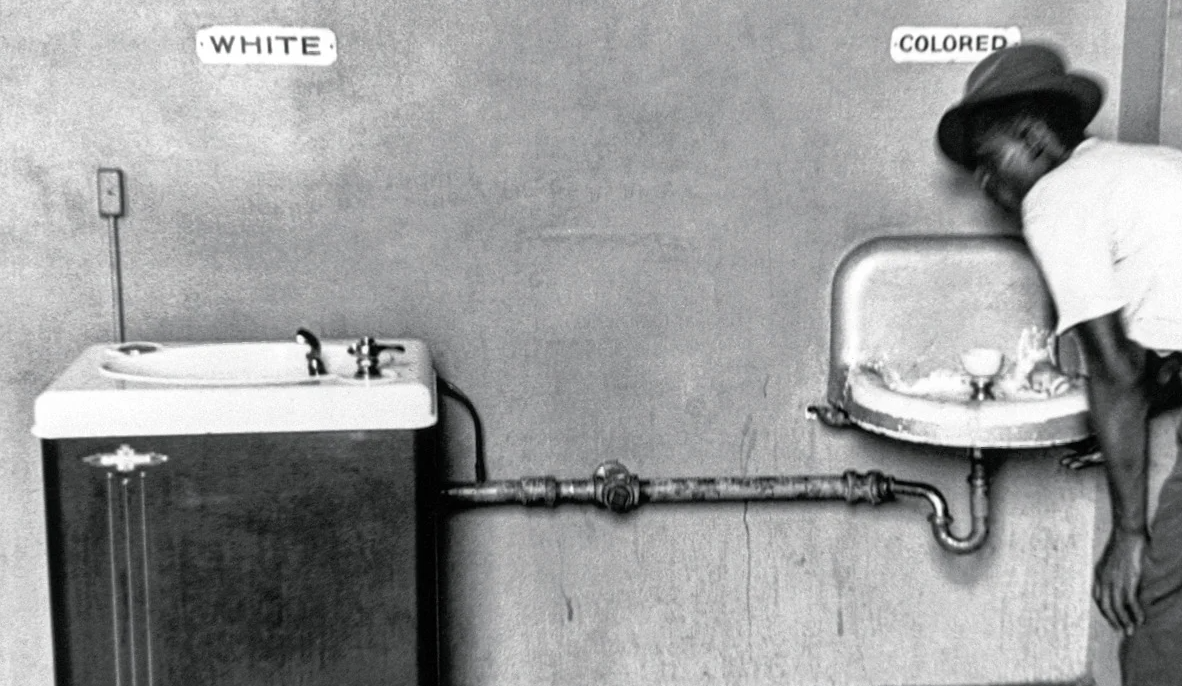
That’s when C. Vann Woodward — a Southern historian who had established himself as an expert on naval history and who quietly wrote recommendation letters for more Blacks to be appointed into academic positions — entered the picture with his excellent volume The Strange Career of Jim Crow. He introduced a vital thesis that was to challenge understanding of racial integration in a deeply important way: In the immediate decades after the Civil War, there were natural moments of social inclusion in which Blacks and whites lived and intermingled together. But these vital steps forward were completely overturned by a group of 19th century white supremacist “influencers” turned lawmakers who ensured that the evils of Jim Crow, which separated public facilities by race, were on most of the state law books south of the Mason-Dixon line and enforced by sinister men perhaps best epitomized by the likes of Bull Connor unleashing German Shepherds upon Black protesters in 1963.

It’s extremely important to understand that there were moments in the 19th century’s waning years in which Jim Crow legislation (which actually originated in the North) was mocked and ridiculed in major Southern cities. One can, in fact, make a persuasive argument that Southerners, in some cases, were willing to put aside their bigotry. Prior to Woodward, the dominant view held by historians was that racial segregation emerged rapidly as Reconstruction began to implode. But a close examination of the sources dredged up by Woodward reveals that his thesis of racial integration emerging in unanticipated spots, which was by no means Panglossian and certainly didn’t erase the repugnant racial violence of that postbellum epoch, holds up in 2026.
* * *

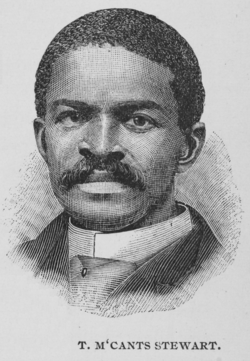
Woodward observed that, as late as 1885, T. McCants Stewart, a Black lawyer and journalist and a close friend of Booker T. Washington, journeyed to his homestate of South Carolina to see how life was shaking out after not stepping foot there for ten years. (Stewart’s extraordinary reporting, published on April 18, 1885 and April 25, 1885 and titled “Rambles in the South,” can be read in its entirety at the Library of Congress.) As he was traveling by rail, Stewart discovered much to his surprise that the car was full and white people were sitting on their luggage and he had a seat. But he was not asked by the conductor to give it up. If anything, the conductor had been gentle and courteous to Stewart when requesting him to move his luggage to accommodate a white passenger. He sat in a dining car in the same room as whites.

Perhaps most remarkably, Stewart said that he actually experienced more racism in Wilmington, Delaware than he did in Virginia and South Carolina. Indeed, white Southerners — in 1885 — made small talk with him. Stewart wrote (and this is not quoted by Woodward): “In the South it is no unusual thing for a man to ask the distance to the next point, to borrow your paper, to remark about the weather, to enter into conversation.” Stewart further remarked, “I feel about as safe here as in Providence, R.I. I can ride in first class cars on the railroads and in the streets. I can go into saloons and get refreshments even as in New York. I can stop in and drink a glass of soda and be more politely waited upon than in some parts of New York.”
* * *

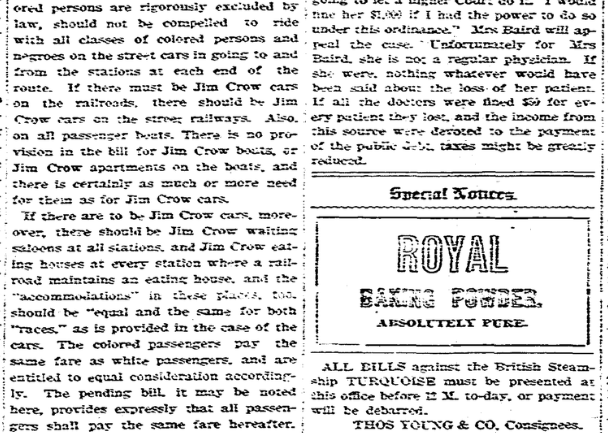
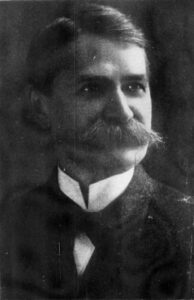
On January 25, 1898, the Charleston News and Courier published an item of devilish satire in response to a Jim Crow law then under consideration by the South Carolina Legislature. Much like people in 2024 never believing that ICE would become a massively budgeted paramilitary force randomly shooting American citizens and kidnapping taxpaying immigrants without due process, it then seemed unthinkable to call for railroad cars to be segregated by race. And so a shit-stirring editor by the name of James C. Hemphill, who had an extremely impressive mustache and who had written many editorials against lynching, had this to say (Woodward quotes some of it, but when I found the entire piece on Newsbank, I couldn’t resist offering more of it):

There should be a Jim Crow section in the jury box, and a separate Jim Crow deck and witness stand in every Court — and a Jim Crow Bible for colored witnesses to kiss. It would be advisable also to have a Jim Crow section in county auditors’ and treasurers’ offices for the accommodation of colored taxpayers. The two races are dreadfully mixed in these offices for weeks every year, especially about Christmas, and just afterward, when the time for making returns and paying taxes, without penalty, is about to expire. The cars are provided with seats, so that everybody can sit down and keep separate from everybody else. It is not so in the county offices. There the crowd stands together in a bench, or is strung out in a waiting and highly variegated line. There should be a Jim Crow “department” for making returns and paying for the privileges and blessings of citizenship.
Unfortunately, the Charleston News and Courier was taken over by a different editor (Robert Lathan, who did not have an amazing mustache or a sense of humanism), where the Jim Crow stance shifted from high 19th century snark to bona-fide xenophobia.

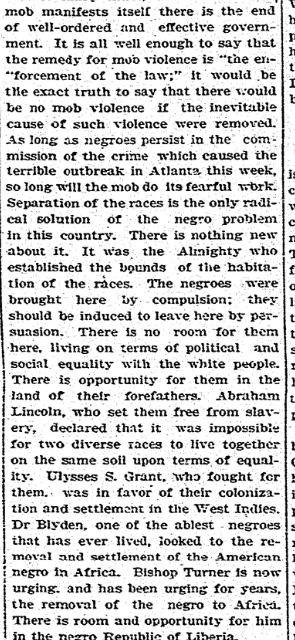
On September 26, 1906, in response to a massacre in Atlanta, one that was as vile and as forgotten as the 1921 Tulsa riots, in which whites murdered dozens of Black people because the Georgia gubernatorial race between then candidates Hoke Smith and Clark Howell stoked racist fears about a Black upper class, the News and Courier blamed racial integration on this:

As long as the negroes [sic] persist in the commission of the crime which caused the terrible outbreak in Atlanta this week, so long will the mob do its fearful work. Separation of the races is the only radical solution of the negro problem in this country. There is nothing new about it. It was the Almighty who established the bounds of the habitation of the races. The negroes were brought here by compulsion; they should be induced to leave here by persuasion. There is no room for them here, living on terms of political and social equality with the white people.

The item also notes that the “problem” “is worse now [1906] than it was ten or twenty years ago.” Never mind that only eight years before, the same newspaper roundly ridiculed any application of Jim Crow laws. But Lathan had no problem leaning into racism, concluding, “[The problem] can be settled effectively only by the separation of the races. The sooner it is settled the better for both races and for the sake of all humanity.” Fortunately, Lathan had the decency to drop dead at the early age of fifty-six before he could blow more racist dog whistles.

Woodward’s salient point still resonates today. Would some of these Jim Crow laws have been abandoned if the people had stood up to the racist lawmakers? Would some of the terrible violence in the aftermath of the Civil War and extending into the 20th century — the East St. Louis riot in 1917, the “Red Summer” of 1919, et al. — have been mitigated? Then and now, it takes only a handful of hateful demagogues delivering repugnant sermons from the mount to make a terrible idea stick.

* * *

Like any pithy historian with his finger firmly on the pulse of institutional ills, Woodward has had a few scholars challenge his thesis. In Bind Us Apart, Nicholas Guyatt observed that some abolitionists in the early 19th century (notably William Short) stumped for racial segregation (what Short called “amalgamation”) because they feared interracial sex. Interracial love could only be tolerated by covertly racist Jacksonian Democrats like President Andrew Johnson if it involved non-whites passing as white. Some ostensible “liberals” even argued that freed slaves should be sent off to Africa. (Lincoln himself was keen on sending freed slaves to Liberia in 1854. He also tendered famously abhorrent remarks against racial inequality in his 1858 debates with Douglas.)

These are all fair and unsettling observations, but it doesn’t entirely overturn Woodward’s thesis, particularly since Guyatt is vague about the timeline in his book. Woodward was explicitly talking about how Jim Crow laws were put onto the books and how this codification galvanized more whites to endorse what they had previously either disregarded or countered with high-caliber badinage, not hypocritical whites who professed to stick up for Blacks even as they simultaneously promoted versions of segregation. Unlike Woodward, Guyatt mentions “segregationist Jim Crow laws that had swept through southern legislatures after the collapse of Reconstruction in 1877,” but never cites the states, the dates these laws were passed, or, perhaps most importantly, the severity of these statutes. Woodward, by contrast, is far from ambiguous about what states did what:

Up to 1900 the only law of this type adopted by the majority of Southern states was that applying to passengers aboard trains. And South Carolina did not adopt that until 1898, North Carolina in 1899, and Virginia, the last, in 1900.

In 1896, Plessy v. Ferguson created the conditions for these “separate but equal” iniquities to flourish at the state level until Brown v. The Board of Education of Topeka overturned this interpretation in 1954, leading to what Woodward fairly describes as a volatile time.

Racism certainly did flourish after the Civil War. But Woodward’s more important point is that laws helped to enable white supremacy — to give Southern racists who were on the fence some terrible ideas about accepting Black people into their regular lives. It’s not unlike the way that Trump emboldened racists with his false claims that Haitian immigrants were “eating cats and dogs” during the September 2024 debate with Kamala Harris. And people, who often long to be law-abiding citizens, are more inclined to believe such racist malarkey, capitulating their natural ability to get along with each other, if an institution or a significant person in power tells them that bigotry is not only okay, but very much something enforced by malevolent legislation. This was why Martin Luther King adamantly declared in Why We Can’t Wait that “one has the moral responsibility to disobey unjust laws.”

But it isn’t just statutes we need to worry about. If there is no accountability for the manner in which well-meaning institutions operate, then these can also become enablers of regressive policy. Historian Eric Foner, in his great and massive volume on Reconstruction, noted that Woodward later observed that postbellum “progress” was, much like most of the Democratic Party in the 2020s, “essentially nonrevolutionary and conservative.”

Foner cited two later Woodward volumes — (1) 1960’s The Burden of Southern History, in which Woodward proposed that a “third war aim” (that is, racial equality) had been practiced by Union soldiers and (2) 1971’s American Counterpoint, in which Woodward retracted this. The Freedmen’s Bureau — a federal agency which existed from 1865 to 1872 to help integrate nearly four million formerly enslaved Blacks and poor whites — became a pale shadow of its lofty intentions. Union General Oliver Howard, in cahoots with President Andrew Johnson, went well out of his way to subvert the radical policy that had initiated the bureau. Howard sought to remove “virtually every subordinate who sought to fulfill the original mission of the Bureau and help the freedmen.”

C. Vann Woodward didn’t confine his studies to how the tyranny of law encouraged racism to triumph over equality and decency. He was also deeply worried about how well-meaning federal agencies become corrupted, neutered of their original purpose. Various editions of The Strange Career of Jim Crow became less optimistic with every new revision. Perhaps this is because a great historian always remembers that, even when he exhumes the vital scholarship revealing a more sophisticated understanding of the past, we are always contending with odious loudmouths in the present manipulating a potentially more humane population to settle for the worst.

(Next Up! Thomas S. Kuhn’s The Structure of Scientific Revolutions!)
Shadow and Act (Modern Library Nonfiction #91)

(This is the tenth entry in The Modern Library Nonfiction Challenge, an ambitious project to read and write about the Modern Library Nonfiction books from #100 to #1. There is also The Modern Library Reading Challenge, a fiction-based counterpart to this list. Previous entry: The Power Broker.)

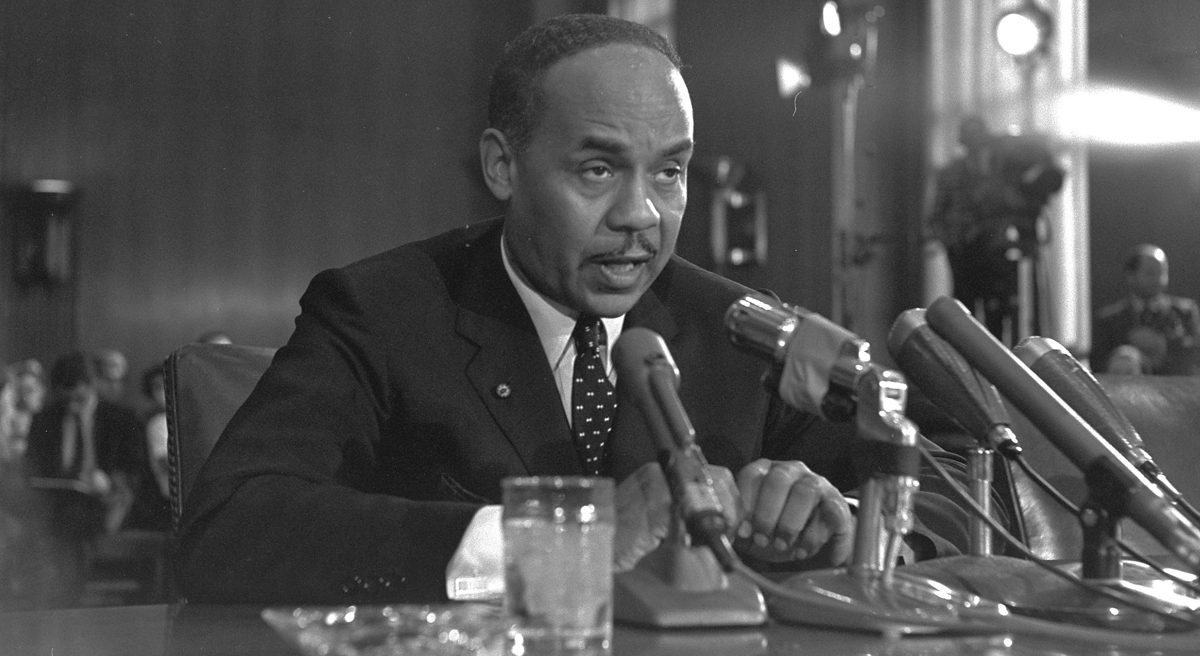
mlnf91When I first made my bold belly flop into the crisp waters of Ralph Ellison’s deep pool earlier this year, I felt instantly dismayed that it would be a good decade before I could perform thoughtful freestyle in response to his masterpiece Invisible Man (ML Fiction #19). As far as I’m concerned, that novel’s vivid imagery, beginning with its fierce and intensely revealing Battle Royale scene and culminating in its harrowing entrapment of the unnamed narrator, stands toe-to-toe with Saul Bellow’s The Adventures of Augie March as one of the most compelling panoramas of mid-20th century American life ever put to print, albeit one presented through a more hyperreal lens.

But many of today’s leading writers, ranging from Ta-Nehisi Coates to Jacqueline Woodson, have looked more to James Baldwin as their truth-telling cicerone, that fearless sage whose indisputably hypnotic energy was abundant enough to help any contemporary humanist grapple with the nightmarish realities that America continues to sweep under its bright plush neoliberal rug. At a cursory glance, largely because Ellison’s emphasis was more on culture than overt politics, it’s easy to see Ellison as a complacent “Maybe I’m Amazed” to Baldwin’s gritty “Cold Turkey,” especially when one considers the risk-averse conservatism which led to Ellison being attacked as an Uncle Tom during a 1968 panel at Grinnell College along with his selfish refusal to help emerging African-American authors after his success. But according to biographer Arnold Rampersad, Baldwin believed Ralph Ellison to be the angriest person he knew. And if one dives into Ellison’s actual words, Shadow and Act is an essential volume, which includes one of the most thrilling Molotov cocktails ever pitched into the face of a clueless literary critic, that is often just as potent and as lapel-grabbing as Baldwin’s The Fire Next Time.

For it would seem that while Negroes have been undergoing a process of “Americanization” from a time preceding this birth of this nation — including the fusing of their blood lines with other non-African strains, there has been a stubborn confusion as to their American identity. Somehow it was assumed that the Negroes, of all the diverse American peoples, would remain unaffected by the climate, the weather, the political circumstances — from which not even slaves were exempt — the social structures, the national manners, the modes of production and the tides of the market, the national ideals, the conflicts of values, the rising and falling of national morale, or the complex give and take of acculturalization which was undergone by all others who found their existence within the American democracy.

This passage, taken from an Ellison essay on Amiri Baraka’s Blues People, is not altogether different from Baldwin’s view of America as “a paranoid color wheel” in The Evidence of Things Not Seen, where Baldwin posited that a retreat into the bigoted mystique of Southern pride represented the ultimate denial of “Americanization” and thus African-American identity. Yet the common experiences that cut across racial lines, recently investigated with comic perspicacity on a “Black Jeopardy” Saturday Night Live sketch, may very well be a humanizing force to counter the despicable hate and madness that inspires uneducated white males to desecrate a Mississippi black church or a vicious demagogue to call one of his supporters “a thug” for having the temerity to ask him to be more respectful and inclusive.

Ellison, however, was too smart and too wide of a reader to confine these sins of dehumanization to their obvious targets. Like Baldwin and Coates and Richard Wright, Ellison looked to France for answers and, while never actually residing there, he certainly counted André Malraux and Paul Valéry among his hard influences. In writing about Richard Wright’s Black Boy, Ellison wisely singled out critics who failed to consider the full extent of African-American humanity even as they simultaneously demanded an on-the-nose and unambiguous “explanation” of who Wright was. (And it’s worth noting that Ellison himself, who was given his first professional writing gig by Wright, was also just as critical of Wright’s ideological propositions as Baldwin.) Ellison described how “the prevailing mood of American criticism has so thoroughly excluded the Negro that it fails to recognize some of the most basic tenets of Western democratic thought when encountering them in a black skin” and deservedly excoriated whites for seeing Paul Robeson and Marian Anderson merely as the ne plus ultra of African-American artistic innovation rather than the beginning of a great movement.

shriversombreroAt issue, in Ellison’s time and today, is the degree to which any individual voice is allowed to express himself. And Ellison rightly resented any force that would stifle this, whether it be the lingering dregs of Southern slavery telling the African-American how he must act or who he must be in telling his story as well as the myopic critics who would gainsay any voice by way of their boxlike assumptions about other Americans. One sees this unthinking lurch towards authoritarianism today with such white supremacists as Jonathan Franzen, Lionel Shriver, and the many Brooklyn novelists who, despite setting their works in gentrified neighborhoods still prominently populated by African-Americans, fail to include, much less humanize, black people who still live there.

“White supremacist” may seem like a harshly provocative label for any bumbling white writer who lacks the democratic bonhomie to leave the house and talk with other people and consider that those who do not share his skin color may indeed share more common experience than presumed. But if these writers are going to boast about how their narratives allegedly tell the truth about America while refusing to accept challenge for their gaping holes and denying the complexity of vital people who make up this great nation, then it seems apposite to bring a loaded gun to a knife fight. If we accept Ellison’s view of race as “an irrational sea in which Americans flounder like convoyed ships in a gale,” then it is clear that these egotistical, self-appointed seers are buckling on damaged vessels hewing to shambling sea routes mapped out by blustering navigators basking in white privilege, hitting murky ports festooned with ancient barnacles that they adamantly refuse to remove.

Franzen, despite growing up in a city in which half the population is African-American, recently told Slate‘s Isaac Chotiner that he could not countenance writing about other races because he has not loved them or gone out of his way to know them and thus excludes non-white characters from his massive and increasingly mediocre novels. Shriver wrote a novel, The Mandibles, in which the only black characters are (1) Leulla, bound to a chair and walked with a leash, and (2) Selma, who speaks in a racist Mammy patois (“I love the pitcher of all them rich folk having to cough they big piles of gold”). She then had the effrontery to deliver a keynote speech at the Brisbane Writers Festival arguing for the right to “try on other people’s hats,” failing to understand that creating dimensional characters involves a great deal more than playing dress-up at the country club. She quoted from a Margot Kaminski review of Chris Cleave’s Little Bee that offered the perfectly reasonable consideration, one that doesn’t deny an author’s right to cross boundaries, that an author may wish to take “special care…with a story that’s not implicitly yours to tell.” Such forethought clearly means constructing an identity that is more human rather than crassly archetypal, an eminently pragmatic consideration on how any work of contemporary art should probably reflect the many identities that make up our world. But for Shriver, a character should be manipulated at an author’s whim, even if her creative vagaries represent an impoverishment of imagination. For Shriver, inserting another nonwhite, non-heteronormative character into The Mandibles represented “issues that might distract from my central subject moment of apocalyptic economics.” Which brings us back to Ellison’s question of “Americanization” and how “the diverse American peoples” are indeed regularly affected by the decisions of those who uphold the status quo, whether overtly or covertly.

Writer Maxine Benba-Clarke bravely confronted Shriver with the full monty of this dismissive racism and Shriver responded, “When I come to your country. I expect. To be treated. With hospitality.” And with that vile and shrill answer, devoid of humanity and humility, Shriver exposed the upright incomprehension of her position, stepping from behind the arras as a kind of literary Jan Smuts for the 21st century.[footnote]To this litany of country bumpkin calumnies from a Literary Establishment that purports to Know All, one must also include the superficial contributions of the wildly overrated Joyce Carol Oates, whose novel The Sacrifice demonstrated equally ignoble failings to consider complex identity and authenticity in fictionalizing the Tawana Brawley case. These inadequacies were smartly called out by Roxane Gay in The New York Times Book Review. Rather than consider how she had failed as an author, Oates, true to the clueless xenophobia she regularly chirrups on Twitter, suggested that Gay had failed.[/footnote]

If this current state of affairs represents a bristling example of Giambattista Vico’s corsi e ricorsi, and I believe it does, then Ellison’s essay, “Twentieth-Century Fiction and the Black Mask of Humanity,” astutely demonstrates how this cultural amaurosis went down before, with 20th century authors willfully misreading Mark Twain, failing to see that Huck’s release of Jim represented a moment that not only involved recognizing Jim as a human being, but admitting “the evil implicit in his ’emancipation'” as well as Twain accepting “his personal responsibility in the condition of society.” With great creative power comes great creative responsibility. Ellison points to Ernest Hemingway scouring The Adventures of Huckleberry Finn merely for its technical accomplishments rather than this moral candor and how William Faulkner, despite being “the greatest artist the South has produced,” may not be have been quite the all-encompassing oracle, given that The Unvanquished‘s Ringo is, despite his loyalty, devoid of humanity. In another essay on Stephen Crane, Ellison reaffirms that great art involves “the cost of moral perception, of achieving an informed sense of life, in a universe which is essentially hostile to man and in which skill and courage and loyalty are virtues which help in the struggle but by no means exempt us from the necessary plunge into the storm-sea-war of experience.” And in the essays on music that form the book’s second section (“Sound and the Mainstream”), Ellison cements this ethos with his personal experience growing up in the South. If literature might help us to confront the complexities of moral perception, then the lyrical, floating tones of a majestic singer or a distinctive cat shredding eloquently on an axe might aid us in expressing it. And that quest for authentic expression is forever in conflict with audience assumptions, as seen with such powerful figures as Charlie Parker, whom Ellison describes as “a sacrificial figure whose struggles against personal chaos…served as entertainment for a ravenous, sensation-starved, culturally disoriented public which had but the slightest notion of its real significance.”

What makes Ellison’s demands for inclusive identity quite sophisticated is the vital component of admitting one’s own complicity, an act well beyond the superficial expression of easily forgotten shame or white guilt that none of the 20th or the 21st century writers identified here have had the guts to push past. And Ellison wasn’t just a writer who pointed fingers. He held himself just as accountable, as seen in a terrific 1985 essay called “An Extravagance of Laughter” (not included in Shadow and Act, but found in Going with the Territory), in which Ellison writes about how he went to the theatre to see Jack Kirkland’s adaptation of Erskine Caldwell’s Tobacco Road. (I wrote about Tobacco Road in 2011 as part of this series and praised the way that this still volatile novel pushes its audience to confront its own prejudices against the impoverished through remarkably flamboyant characters.) Upon seeing wanton animal passion among poor whites on the stage, Ellison burst into an uncontrollable paroxysm of laughter, which emerged as he was still negotiating the rituals of New York life shortly after arriving from the South. Ellison compared his reaction, which provoked outraged leers from the largely white audience, to an informal social ceremony he observed while he was a student at Tuskegee that involved a set of enormous whitewashed barrels labeled FOR COLORED placed in public space. If an African-American felt an overwhelming desire to laugh, he would thrust his head into the pit of the barrel and do so. Ellison observes that African-Americans “who in light of their social status and past condition of servitude were regarded as having absolutely nothing in their daily experience which could possibly inspire rational laughter.” And the expression of this inherently human quality, despite being a cathartic part of reckoning with identity and one’s position in the world, was nevertheless positioned out of sight and thus out of mind.

When I took an improv class at UCB earlier this year, I had an instructor who offered rather austere prohibitions to any strain of humor considered “too dark” or “punching down,” which would effectively disqualify both Tobacco Road and the Tuskegee barrel ritual that Ellison describes.[footnote]Earlier this year, in The Baffler, Ben Schwartz offered some cogent and provocative thoughts on the problems with such ultimatums. His essay is very worth reading if you’re interested in painting outside the lines as an artist or a thinker.[/footnote] These restrictions greatly frustrated me and a few of my classmates, who didn’t necessarily see the exploration of edgy comic terrain as a default choice, but merely one part of asserting an identity inclusive of many perspectives. I challenged the notion of confining behavior to obvious choices and ended up getting a phone call from the registrar, who was a smart and genial man and with whom I ended up having a friendly and thoughtful volley about comedy. I had apparently been ratted out by one student, who claimed that I was “disrupting” the class when I was merely inquiring about my own complicity in establishing base reality. In my efforts to further clarify my position, I sent a lengthy email to the instructor, one referencing “An Extravagance of Laughter,” and pointed out that delving into the uncomfortable was a vital part of reckoning with truth and ensuring that you grew your voice and evolved as an artist. I never received a reply. I can’t say that I blame him.

Ellison’s inquiry into the roots of how we find common ground with others suggests that we may be able to do so if we (a) acknowledge the completeness of other identities and (b) allow enough room for necessary catharsis and the acknowledgment of our feelings and our failings as we take baby steps towards better understanding each other.

The most blistering firebomb in the book is, of course, the infamous essay “The World and the Jug,” which demonstrates just what happens when you assume rather than take the time to know another person. It is a refreshingly uncoiled response that one could not imagine being published in this age of “No haters” reviewing policies and genial retreat from substantive subjects in today’s book review sections. Reacting to Irving Howe’s “Black Boys and Native Sons,” Ellison condemns Howe for not seeing “a human being but an abstract embodiment of living hell” and truly hammers home the need for all art to be considered on the basis of its human experience rather than the spectator’s constricting inferences. Howe’s great mistake was to view all African-American novels through the prism of a “protest novel” and this effectively revealed his own biases against what black writers had to say and very much for certain prerigged ideas that Howe expected them to say. “Must I be condemned because my sense of Negro life was quite different?” writes Ellison in response to Howe roping him in with Richard Wright and James Baldwin. And Ellison pours on the vinegar by not only observing how Howe self-plagiarized passages from previous reviews, but how his intractable ideology led him to defend the “old-fashioned” violence contained in Wright’s The Long Dream, which, whatever its merits, clearly did not keep current with the changing dialogue at the time.

Shadow and Act, with its inclusion of interviews and speeches and riffs on music (along with a sketch of a struggling mother), may be confused with a personal scrapbook. But it is, first and foremost, one man’s effort to assert his identity and his philosophy in the most cathartic and inclusive way possible. We still have much to learn from Ellison more than fifty years after these essays first appeared. And while I will always be galvanized by James Baldwin (who awaits our study in a few years), Ralph Ellison offers plentiful flagstones to face the present and the future.

SUPPLEMENT: One of the great mysteries that has bedeviled Ralph Ellison fans for decades is the identity of the critic who attacked Invisible Man as a “literary race riot.” In a Paris Review interview included in Shadow and Act, Ellison had this to say about the critic:

But there is one widely syndicated critical bankrupt who made liberal noises during the thirties and has been frightened ever since. He attacked my book as a “literary race riot.”

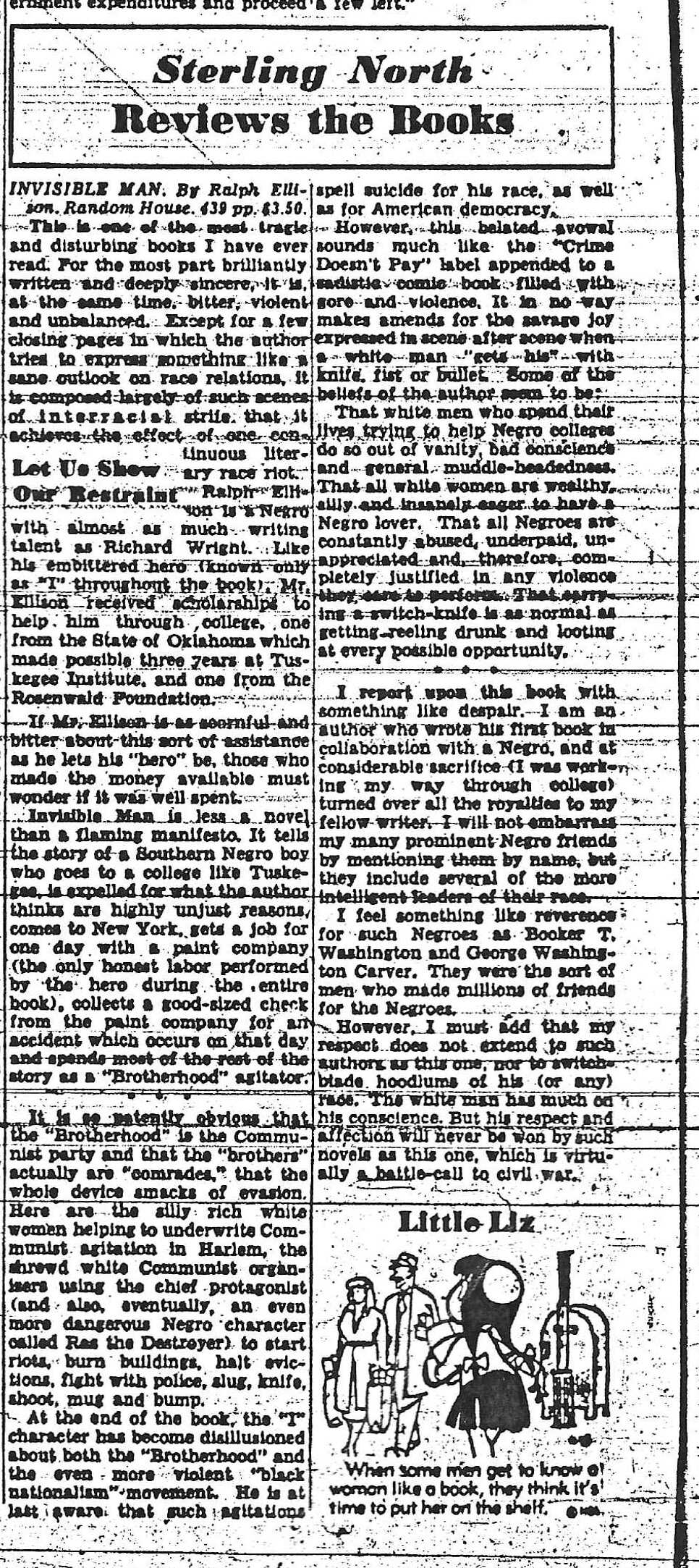
With the generous help of Ellison’s biographer Arnold Rampersad (who gave me an idea of where the quote might be found in an email volley) and the good people at the New York Public Library, I have tracked down the “widely syndicated critical bankrupt” in question.

sterlingnorthHis name is Sterling North, best known for the children’s novel Rascal in 1963. He wrote widely popular (and rightly forgotten) children’s books while writing book reviews for various newspapers. North was such a vanilla-minded man that he comics “a poisonous mushroom growth” and seemed to have it in for any work of art that dared to do something different — or that didn’t involve treacly narratives involving raising baby raccoons.

And then, in the April 16, 1952 issue of the New York World-Telegram, he belittled Ellison’s masterpiece, writing these words:

This is one of the most tragic and disturbing books I have ever read. For the most part brilliantly written and deeply sincere, it is, at the same time, bitter, violent and unbalanced. Except for a few closing pages in which the author tries to express something like a sane outlook on race relations, it is composed largely of such scenes of interracial strife that it achieves the effect of one continuous literary race riot. Ralph Ellison is a Negro with almost as much writing talent as Richard Wright. Like his embittered hero (known only as “I’ throughout the book, Mr. Ellison received scholarships to help him through college, one from the State of Oklahoma which made possible three years at the Tuskegee Institute, and one from the Rosenwald Foundation.

If Mr. Ellison is as scornful and bitter about this sort of assistance as he lets his “hero” be, those who made the money available must wonder if it was well spent.

North’s remarkably condescending words offer an alarming view of the cultural oppression that Ellison was fighting against and serve as further justification for Ellison’s views in Shadow and Act. Aside from his gross mischaracterization of Ellison’s novel, there is North’s troubling assumptions that Ellison should be grateful in the manner of an obsequious and servile stereotype, only deserves a scholarship if he writes a novel that fits North’s limited idea of what African-American identity should be, and that future white benefactors should think twice about granting opportunities for future uppity Ellisons.

It’s doubtful that The Sterling North Society will recognize this calumny, but this is despicable racism by any measure. A dive into North’s past also reveals So Dear to My Heart, a 1948 film adaptation of North’s Midnight and Jeremiah that reveled in Uncle Tom representations of African-Americans.

North’s full review of The Invisible Man can be read below:

sterling-north

Next Up: James George Frazer’s The Golden Bough!

A Conversation with Jack Butler (Bat Segundo Special)

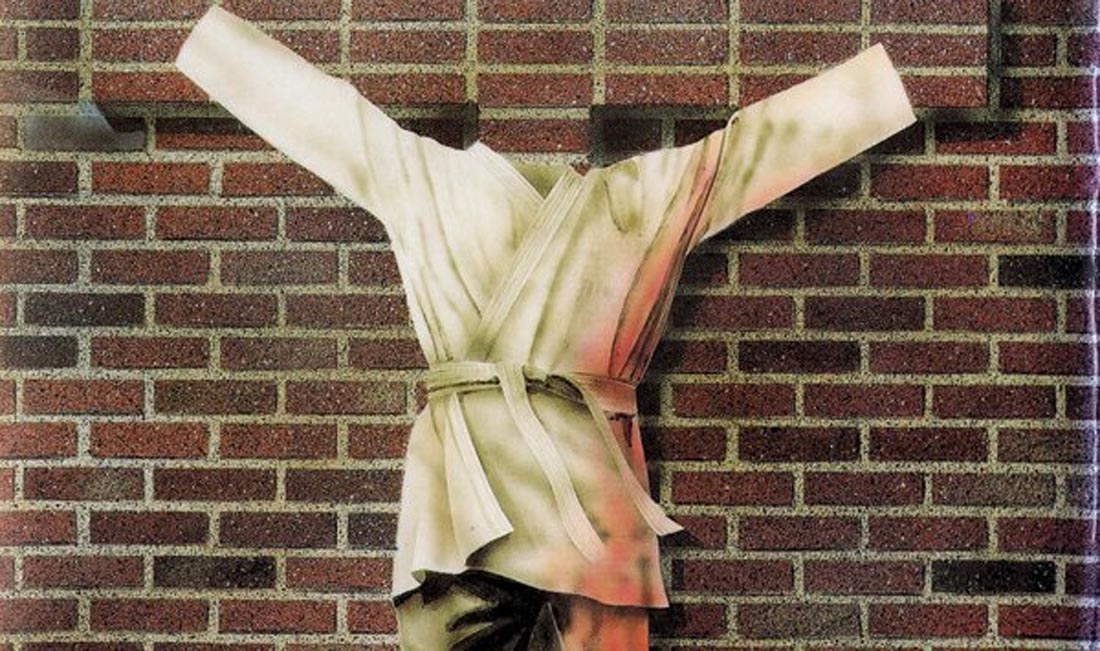
This one hour radio special is the first in a series of “at-large” conversations presently categorized under the old “Bat Segundo” label. It features a rare interview with Jack Butler, author of Jujitsu for Christ, a highly underrated novel that has recently been reissued by the University Press of Mississippi.

Author: Jack Butler

Subjects Discussed: Moving west over a lifetime, having a double bachelor’s in English and math, the yin-yang existence, reading science fiction as a boy, why the stars are so inspirational in the Delta, using the Holy Ghost as a narrative device, Lautréamont, narratives within the Bible, Ulysses and The Waste Land, theological implications within fables, Finnegans Wake, speaking in tongues, starting a book with only 60 pages, becoming an accidental novelist, the poet’s life, the strange yet highly modest financial incentives of novels, the Judo for Christ Club, Tom LeClair and “prodigious fiction”, comparing novels with a 7-Layer Burritos, how to present information within a story, the College of Santa Fe, Los Angeles as a source of escape, why Butler’s fiction left the South, writers who become unintentional spokesmen for the South, not being bound by assumptions, “authentic” vs. “smart,” Eudora Welty, Faulkner, science fiction and Southern literature as lowbrow inspirational territory, literary authors who scavenge from genre and write unsuccessful novels, how genre can be used to write meaningfully about humanity, African-American stereotypes, caricatures, missed opportunities because of bigotry, living in shanties, common experience, scavenging from comics and used books to form a borrowed bedrock of knowledge, the character “Jack Butler” in Living in Little Rock with Miss Little Rock, “autobiographical fiction,” the neediness of novelists, combating desperation in a world that increasingly devalues risk-taking authors who don’t sell, Bum Festrich modeled on the Clarion-Ledger‘s Tom Etheridge, using racist newspaper rhetoric as an unsettling guide for fictional perspective, writing about sex, religious blasphemy vs. sexual blasphemy, Hugh Hefner’s philosophy vs. the Baptists, being part of the way actuality goes, why religion in fiction often causes the author to create a comparative ideological construct to present contrast, gay rights, the Belgian Malinois making mysterious noises in the back, corporeal collision in debut novels, approaching the holy through the material, chalk talks, tragicomic side characters, when the ABA voted Jujitsu worst title, mixing the funny with the repulsive, writing about humidity in Mississippi, massive IBM clone computers in the 1980s, writing a book on a 400 pound computer, slowing down writing speed, whether or not a writer needs a sense of compulsion, chasing down a locale in one great shot, allowing the reader to experience life as Butler saw it, The Illumination of Elijah Lee Roswell, what happened with Butler’s agent, the dangers of writing with the idea of money in mind, the virtues of academics, forbidden styles, the benefits of rebellion, people who sell out, clearing the head of extraneous voices,

jujitsuchrist

EXCERPT FROM SHOW:

Correspondent: I wanted to first of all talk about how you got your start. You were a poet before you were a fiction writer. And I also know that you have a bachelor’s in English and a bachelor’s in math. And I was wondering. How does a guy like you have the yin-yang thing going on here? It seems that you have a yin-yang thing in terms of what you studied and what you ended up doing as a writer.

Butler: Yeah. A lot of that — at least as far as math and the arts go — is that I loved science fiction as a kid. I used to read it all the time. Most of it is literarily horrible. But I was in a Baptist conservatory in Mississippi and they weren’t really aware of science fiction. So that was something I could get away with and what I really loved was just the ability to speculate. You know, that the world might be different from what was right around you. For pretty obvious reasons. But I’ve always been interested in mathematics. I think one of the sad things about our culture is that we have such a dichotomy set up between art and science or math. I mean, the two things I say that people are most afraid of are poetry and mathematics.

Correspondent: Yeah. How has math and poetry encouraged you to speculate? Both in terms of your imagination and in terms of, for example, books like Nightshade?

Butler: I guess it’s just that they give me the tools. I’m pretty picky about details, even though I do get some things wrong. Just in case there’s anybody listening, I’m not a medical person at all and I gave the exact opposite cure for angina. I said digitalis. And that will kill you. (laughs)

Correspondent: (laughs)

Butler: Aside from that, I had to not only get the gravity of Mars right. I had to allow for it in every action. Which you just don’t really see very much. So it’s more nearly that it’s given me the tools to do what I’m psychologically inclined to do.

Correspondent: So with science fiction, do you feel that it’s that speculative nature that really makes it fiction or meaningful? That this was the drive for you when you were growing up reading a lot of it as a boy, as a young man. That kind of thing?

Butler: Yeah, right. And as I said in the interview with Brannon (PDF), I believe, the Delta had a big wide sky. Because of all the flatland and not too many trees. So in spite of the humidity, you could really see the stars. And I loved the stars. That got me going on that.

Correspondent: Your first three novels (Jujitsu for Christ, Nightshade, and Living in Little Rock with Miss Little Rock) all feature some intriguing narrative mode somewhere between direct first person and a quite literally godlike omniscient voice. It almost reminds me, to some degree, of Lautréamont’s narrator in the way that you suggest to the reader that the narrator has lived and this allows the narrator to share some experience with the reader. And I’m wondering. Why did you need this particular type of halfway narrator to tell a story for these first three books?

Butler: Well, I’ll go back to — it’s not really an anecdote, but when I first thought of having the Holy Ghost — and I hasten to add that I mean this as a model of the Holy Ghost. I’m not pretending to represent the actual thing, if it even exists. But it’s like what Wallace Stevens said. “Not as a god, but as a god might be.” Well, not as the Holy Ghost, but as the Holy Ghost might be. And I couldn’t believe that nobody had ever picked up on it. You had the ability to have both first-person narration and a justified reason to switch personas. It was wonderful. And, of course, I got all that Holy Ghost stuff, a lot of it, growing up. It was drilled into me. So it was a chance to play with that a little bit. The Holy Ghost is narrator in Living in Little Rock with Miss Little Rock, but one of the main problems with Westernized Christianity is that we don’t have a trickster god. And of the candidates, I felt the Holy Ghost was the best candidate for that. So the Holy Ghost is kind of a trickster there. As for the other, one of the things I really like to think about is the nature of individuals. The nature of the individual. Mind. And so playing on narrators lets me play on that.

Correspondent: I’m wondering if this reflects any kind of storytelling you heard growing up. That when people told you stories, either around the house or around the town, that people were telling you the absolute truth or perhaps inserting their own asides. Was it something like that?

Butler: Well, it’s true that people love anecdotes in the South. I think I’ve really gotten more of my tendencies from the fact that my father stood up in the pulpit every week and talked. So that’s always seemed to me to be a natural thing to do. And like you point out, there were a lot of things that didn’t scan for me with the stories I was told. And the Bible, it’s stories. I love the Bible. But I view it as a library, not as a book. It was written over several hundred years, maybe a thousand or more, by different people with different conceptions. And it’s more fascinating as a narrative than anything else. So my storytelling probably had more to do with that. But there’s a background nature that Southerners in general love language and they love to tell stories and there’s a premium put on wit. So I think that was so naturalized without thinking of it.

Correspondent: So if the Bible is a library, what is the Ulysses or The Waste Land of the Bible?

Butler: Well, it’s more beautiful than The Waste Land. Ecclesiastes is one of the more beautiful things ever written in my opinion and it’s very much — not quite nihilistic, but Ecclesiastes very plainly does not countenance belief in an afterlife. It says people are just like grass. Like the grass of the fields. We come from the same kind of place and we go to the same kind of place when we die. Nobody imagines a heaven for grass. So if we’re the same as grass, that has a lot of theological implications.

The Bat Segundo Show Special (“#499”): Jack Butler (Download MP3)

This text will be replaced