Alain de Botton on Responding to Critics

(This is the second of an interconnected two part response involving Alain de Botton. In addition to answering my questions, Alain de Botton was very gracious to send along this essay.)

Technology

Many people are only just waking up to how blurred web technology has made the boundaries between public and private. It used to be easy to know what a public statement was. It was one written for a newspaper or for a radio or television broadcast. But the web has made it harder to discern what is meant to be public and what private. A huge number of people now read newspapers only on the web, alongside other web windows like Facebook, Twitter and blogs. This equalises the difference between the two, it potentially places a Facebook status entry on the same level as the headline of the foreign affairs section of the New York Times. Simply on the basis of visual appearance, on your screen, there is no difference between the might and authority of a comment in the New York Times, and a note written in a blog run from the proverbial bedroom.

So it becomes hard, as a reader, to measure the degree of intent behind any statement one reads — and as a writer, it becomes hard to judge how seriously one’s words are going to be taken and how large the audience for them will be.

How to review a book

Mr. Crain reviewed my book for The New York Times on Sunday 28th June, 2009. The book was accorded a full page review, a relatively rare honour, and was the third review to run in the pecking order. In other words, this was a prestigious slot in the most prestigious paper in the largest book market on the planet. The power of the New York Times in the world of books can’t be overestimated. A review in the paper can close down a book or make its fortunes. With books pages being cut right across the world, it remains the authoritative place for information.
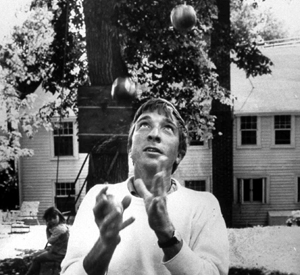
updikejugglingGiven this power, the onus on any reviewer is to use it wisely, a wisdom to which there is no finer guide than John Updike and his six rules of reviewing as laid out in his collection Picked Up Pieces. Updike’s concern was for fairness. This did not mean that he wanted every book to be praised. Rather, he wanted every book to be given it’s ‘fair due’. The end of a fair appraisal might mean the book was not recommended, but the author and reader could feel that the reviewer had kept his or her side of the bargain. Updike recommended that the reviewer try to understand what the author was up to, enter imaginatively into the project, and most of all avoid any kind of attack that felt ad hominem.

I have been in the writing business for 15 years and have received many bad reviews. However, when I read Crain’s review, it was apparent that it was unusually uninterested in adhering to Updike’s six golden rules of reviewing.

What can one do with a bad review?

There is no official right of reply to the judgement of reviewers. One cannot sue, complain or do anything that counts. One has two options: stoicism (batten the hatches). Or Christianity (turn the other cheek).

There is a third private option. To write to the reviewer in the hope of giving them a sense of their power and influence — and the effects to which they have used it. The hope is that by doing so, the reviewer may with time come to reflect on the matter and when they are next presented with a book, they may (and this is a very hopeful idea indeed) adhere a little more closely to Updike’s six golden rules.

I hence found my way to my reviewer’s website and there, in what I thought was a comparatively private arena, sent him a message that was deliberately hyperbolic and unstoic, the equivalent of a punch in words. The idea was to reveal honestly what effect he had on me.

The problem with overhearing people in private moments is that they don’t follow the rules of civilised society and hence offend our sense of propriety (that’s why the rules are in place). All of us, if cameras were turned on during our moments of rage, disappointment, fear and vengeance, would wince if the footage were then played back to us or – even worse – were played back to an audience of strangers. We value privacy for precisely this reason: it protects us our immaturities from wider display.

It can be appalling for all concerned if the private spills out – for example, if a guest was listening to a marital argument, both the guest and the marital couple would be appalled.

The reactions of others

My altercation with Caleb Crain has attracted a peculiar amount of interest at heart because its nature as a private communication has been misunderstood, both by me – and those looking on. It has widely been taken that I have written back to The New York Times directly to complain. Instead I wrote to Caleb Crain to speak very directly to him and not principally to the world at large. I feel very sorry that this tiff has been broadcast so widely. The embarrassment is as akin to an argument with one’s spouse being inadvertently broadcast to one’s work colleagues or a private letter appearing on a widely-read internet site.

I have been naive here. My conclusion is that one has to be extraordinarily careful about the internet. Nothing that one types here that others could potentially access should ever be phrased in ways that wouldn’t make one happy if a million other people happened to see it. There should only be measure and reason – or else it will be judged along exactly the same criteria as one would judge an op-ed piece in The New York Times.

I continue to maintain that the subjects of unfair criticism have the right to protest and perhaps in heartfelt ways too – they should simply take extreme care that absolutely no one is watching or recording them doing so.


Alain de Botton Clarifies the Caleb Crain Response

(This is the first of an interconnected two part response involving Alain de Botton. In addition to answering my questions, Alain de Botton was very gracious to send along this essay.)

In last Sunday’s New York Times Book Review, Caleb Crain reviewed Alain de Botton’s The Pleasures and Sorrows of Work. While regular NYTBR watchers like Levi Asher welcomed the spirited dust-up, even Asher remained suspicious about Crain’s doubtful assertions and dense prose.

debotton2But on Sunday, de Botton left numerous comments at Crain’s blog, writing, “I will hate you till the day I die and wish you nothing but ill will in every career move you make. I will be watching with interest and schadenfreude.”

As Carolyn Kellogg would later remark, this apparent enmity didn’t match up with the sweet and patient man she had observed at an event. While de Botton hadn’t posted anybody’s phone number or email address, as Alice Hoffman had through her Twitter account, de Botton had violated an unstated rule in book reviewing: Don’t reply to your critics.

But the recent outbursts of Hoffman, de Botton, and (later in the week) Ayelet Waldman — who tweeted, “The book is a feminist polemic, you ignorant twat” (deleted but retweeted by Freda Moon) in response to Jill Lepore’s New Yorker review — have raised some significant questions about whether an author can remain entirely silent in the age of Twitter. Is Henrik Ibsen’s epistolary advice to Georg Brandes (“Look straight ahead; never reply with a word in the papers; if in your writings you become polemical, then do not direct your polemic against this or that particular attack; never show that a word of your enemies has had any effect on you; in short, appear as though you did not at all suspect that there was any opposition.”) even possible in an epoch in which nearly every author can be contacted by email, sent a direct message through Twitter, or texted by cell phone?

I contacted de Botton to find out what happened. I asked de Botton if he had indeed posted the comments on Crain’s blog. He confirmed that he had, and he felt very bad about his outburst. I put forth some questions. Not only was he extremely gracious with his answers, but he also offered a related essay. Here are his answers:

First off, did you and Caleb Crain have any personal beefs before this brouhaha went down? You indicated to me that you found your response counterproductive and daft. I’m wondering if there were mitigating factors that may have precipitated your reaction.

I have never met Mr. Crain and had no pre-existing views. The great mitigating factor is that I never believed I would have to answer for my words before a large audience. I had false believed that this was basically between him and me.

What specifically did you object to in Crain’s review? What specifically makes the review “an almost manic desire to bad-mouth and perversely depreciate anything of value?”

My goal in writing The Pleasures and Sorrows of Work was to shine a spotlight on the sheer range of activities in the working world from a feeling that we don’t recognise these well enough. And part of the reason for this lies with us writers. If a Martian came to earth today and tried to understand what humans do from just reading most literature published today, he would come away with the extraordinary impression that all people spend their time doing is falling in love, squabbling with their families — and occasionally, murdering one another. But of course, what we really do is go to work…and yet this ‘work’ is rarely represented in art. It does appear in the business pages of newspapers, but then, chiefly as an economic phenomenon, rather than as a broader ‘human’ phenomenon. So to sum up, I wanted to write a book that would open our eyes to the beauty, complexity, banality and occasional horror of the working world — and I did this by looking at 10 different industries, a deliberately eclectic range, from accountancy to engineering, from biscuit manufacture to logistics. I was inspired by the American children’s writer Richard Scarry, and his What do people do all day? I was challenged to write an adult version of Scarry’s great book.

The review of the book seemed almost willfully blind to this. It suggested that I was uninterested in the true dynamics of work, that I was interested rather in patronising and insulting people who had jobs and that I was mocking anyone who worked. There is an argument in the book that work can sometimes be demeaning and depressing — hence the title: Pleasures AND Sorrows. But the picture is meant to be balanced. On a number of occasion, I stress that a lot of your satisfaction at work is dependent on your expectations. There are broadly speaking two philosophies of work out there. The first you could call the working-class view of work, which sees the point of work as being primarily financial. You work to feed yourself and your loved ones. You don’t live for your work. You work for the sake of the weekend and spare time — and your colleagues are not your friends necessarily. The other view of work, very different, is the middle class view, which sees work as absolutely essential to a fulfilled life and lying at the heart of our self-creation and self-fulfilment. These two philosophies always co-exist but in a recession, the working class view is getting a new lease of life. More and more one hears the refrain, ‘it’s not perfect, but at least it’s a job…’ All this I tried to bring out with relative subtlety and care. As I said, Mr. Crain saw fit to describe me merely as someone who hated work and all workers.

Caleb Crain’s blog post went up on Sunday. You responded to Crain on a Monday (New York time). You are also on Twitter. When you responded, were you aware of Alice Hoffman’s Twitter meltdown (where she
posted a reviewer’s phone number and email address) and the subsequent condemnation of her actions?

I was not aware.

Under what circumstances do you believe that a writer should respond to a critic? Don’t you find that such behavior detracts from the insights contained within your books?

I think that a writer should respond to a critic within a relatively private arena. I don’t believe in writing letters to the newspaper. I do believe in writing, on occasion, to the critics directly. I used to believe that posting a message on a writer’s website counted as part of this kind of semi-private communication. I have learnt it doesn’t, it is akin to starting your own television station in terms of the numbers who might end up attending.

You suggested that Crain had killed your book in the United States with his review. Doesn’t this overstate the power of the New York Times Book Review? Aren’t you in fact giving the NYTBR an unprecedented amount of credit in a literary world in which newspaper book review sections are, in fact, declining? There’s a whole host of readers out there who don’t even look at book review sections. Surely, if your book is good, it will find an audience regardless of Crain’s review. So why give him power like that?

The idea that if a book is good, it will find an audience regardless is a peculiar one for anyone involved in the book industry. There are thousands of very good books published every year, most are forgotten immediately. The reason why the publishing industry invests heavily in PR and marketing (the dominant slice of the budget in publishing houses goes to these departments) is precisely because the idea of books ‘naturally’ finding an audience isn’t true. Books will sink without review coverage, which is why authors and publishers care so acutely about them — and why there is a quasi moral responsibility on reviewers to exercise good judgement and fairness in what they say.

The outlets that count when publishing serious books are: an appearance on NPR, a review in the New Yorker and the New York Times Book Review. There are of course some other outlets, but they pale into insignificance besides these three outlets. Of the three, the New York Times Book Review remains the most important.

Hence I don’t for a moment over-estimate the importance of Mr Crain’s review. He was holding in his hands the tools that could make or break the result of two to three years of effort. You would expect that holding this sort of responsibility would make a sensible person adhere a little more closely to Updike’s six golden rules.

In the wake of Updike’s death, partly as a tribute to him, my recommendation is that newspapers all sign up to a voluntary code for the reviewing of books. This will help authors certainty, but most importantly it will help readers to find their way more accurately towards the sort of literature they’ll really enjoy.

If you were to travel back in time on Sunday morning and you had two sentences that you could tell yourself before leaving the comment, what would those two sentences be?

Put this message in an envelope, not on the internet.

Despotism (1946)

“A careful observer can use a respect scale to find how many citizens get an even break. As a community moves towards despotism, respect is restricted to fewer people. A community is low on a respect scale, if common courtesy is withheld from large groups of people on account of their political attitudes, if people are rude to others because they think their wealth and position gives them that right, or because they don’t like a man’s race or his religion. Equal opportunity for all citizens to develop useful skills is one basis for rating a community on a respect scale. The opportunity to develop useful skills is important, but not enough. The equally important opportunity to put skills to use is a further test on a respect scale.”

Inside BookTour.com: A Q&A With Kevin Smokler

ksmoklerIn 2006, Kevin Smokler, the speaker and editor behind Bookmark Now, partnered with Chris Anderson, editor of Wired, and software developer Adam Goldstein to determine just how information about bookstore events and authors might be collected at an online hub. That central place turned out to be BookTour.com, which purports to make “finding when a favorite author is coming to your town as easy as checking the weather.”

This sunny mission got a much needed dose of radiation back in April when BookTour received a $350,000 cash injection from Amazon.com. While the news was eclipsed by the Amazonfail contretemps at the time, the big financial push certainly suggested that BookTour.com wasn’t about to set into the sunset anytime soon.

At the time the deal was announced, nobody had remarked on the grand irony of an online giant like Amazon using events listed at independent bookstores to make a quick buck. Fortunately, BookTour CEO and Chief Evangelist Kevin Smokler was kind enough to take some time out to answer some vital questions.

BookTour is financially supported by Amazon. Isn’t there a conflict of interest here? If, for example, a customer sees the BookTour link on an Amazon Author Page but the customer is encouraged to purchase the book from Amazon (instead of the bookstore at an author appearance), doesn’t this result in a lost sale for the bookstore? What steps are you taking to ensure that independent bookstores are able to secure the sales they require to support the financial burden of an author appearance?

Ed, we’re in the awareness business. Our job is make author events known to the greatest number of people that we can. No doubt that some potential customers who spot an event on Amazon will buy the book there and either (a) not go to the event at all or (b) go to the event with that Amazon purchase in hand. However, there’s an entire other second class of potential event attendees who will go to an event and may wish to reserve judgment on buying a book until they see the author in person. At that point, only the bookstore is in a position to sell the book to them. Also, we must consider whether that person would have known of the event at all without it being listed in such a high traffic place like Amazon.

Bottom line: The level of awareness that an event receives when listed on Amazon, to our mind, far outweighs the potential loss of sales. As to whether a store can financially support an event, that’s up to them. There are plenty of ways to run a bookstore in the 21st century and we believe smart booksellers know much more about this than we do.

Since BookTour is reliant on the Amazon Author Page for its infrastructure, have you worked out a scenario in which an Indiebound link will be available on an Amazon Author Page?

Sort of. Amazon has a corporate policy which disallows any outside linking to anybody. It’s a policy that BookTour disagrees with and which we have made known to Amazon. We hope to change this as our relationship with them deepens and moves forward.

For now, any bookstore may include a link to their e-commerce operation inside the description of any event happening at their store, so long as they added the event to our database. If their store’s website is powered by IndieBound, they need only include that link in the event description and the feed arrangement we have with IndieBound takes care of the rest.

(That link is not a clickable link, only one that can be cut and pasted into a separate browser window.)

We realize this is far from an ideal solution and we have told Amazon as much. We hope to change this going forward.

You say in your press release that Booktour represents the largest database of author and literary events. Do you mean to say that you now have relationships with every publisher? What are you doing to ensure the reliability of this information? Do you have someone on board who is checking the data on your site against the bookstores and the publishers?

Many publishers, but not all. Via our syndication relationships with both chain and independent booksellers, we can assure that we cover nearly every event happening in America in a bookstore. Libraries, universities, corporations, civic institutions and individual authors and publicists all actively list with us as well.

Reliability: Every event that enters our database is checked against several automated scripts and algorithms. We also do an additional level of checking by human eyes. All told, incorrect event data rarely lives on BookTour for more than 24 hours.

Checking: For more than a year, we’ve had syndication relationships with the major bookstore chains and Indiebound. Meaning they send their upcoming events in an automated feed to us which we update every 24 hours. We just set up a similar relationship with Simon & Schuster and we have several such relationships under active development with other publishers.

Is the information on Booktour proprietary in any way?

No.

Are you applying any DRM?

No.

Is Amazon claiming it to be proprietary because it appears on their pages?

No.

If Booktour is open source, do you have a specific agreement in place with Amazon to ensure that the information, as disseminated through their pages, remains open source?

Yes. Part of the terms of our deal with Amazon was that anyone else is free to use our data exactly as Amazon does, now and in perpetuity.

You’ve introduced EventMinion, which will take author tour data in any format and permit professionals to enter it into your database at $1 a pop. Yet users will still be able to add events for free. How are you distinguishing between EventMinion-added events and user-added events?

We’re not. To us, an event is an event is an event.

Will you place greater priority to listing EventMinion events over the user-added events?

No. See above.

TourBuilder gives the author an opportunity to receive an automated itinerary of bookstores. Are you charging for this service?

No.

Are you prioritizing some cities over others for this?

No. Users choose which cities they want to visit. If they don’t, we suggest larger cities with more available venues.

Big box stores over independent stores?

No.

Then what is the methodology behind TourBuilder?

Venues are suggested based on where authors with similar books have toured in the past. Which means that the more authors that use TourBuilder, the smarter it gets.

If Amazon controls the minority stake, who controls the majority?

The three founders and our one employee.

To what extent is the majority committed to not being bought out by Amazon (as they are wont to do with such handy services that it deems valuable)?

We’ll certainly entertain an offer should they put one forward. But that also doesn’t preclude us from entertaining offers from other interested parties.