NYFF: Woman with Red Hair (1979)

[This is the first in a series of dispatches relating to the 2011 New York Film Festival. All of Reluctant Habits’s NYFF posts can be located here.]

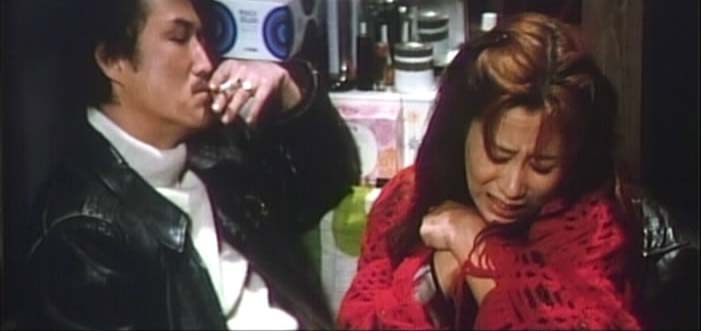
In considering the trashy pink film Woman with Red Hair, I must first ruminate upon the film’s commitment to verisimilitude, as well as its intricate moral framework. A young woman casually loses her virginity during a gang rape, becomes pregnant, and uses this as leverage to snag one of the two strapping young attackers – an unnamed jerk who often wears a blue headband – as her husband. This magnificent pillar to manhood has an equally upstanding companion with Kozo (Renji Ishibasi), who enjoys smiling smugly for the camera when not sexually humiliating the titular woman with red hair (Junko Miyashita), whose ass is often deliberately positioned to undulate before the audience. It is a tribute to this film’s hypnotic hypocrisy that, as Kozo forces the woman with the red hair to take his cock into her mouth, an oppressive black rectangle appears on the right side of the frame, with Miyashita’s legs flailing behind it. Despite this film’s firm commitment to debasing women (one charming ditty that the two men croon contains the lyric “She’ll say no when she means yes”), in 1979, it lacks the authority to show pussy.

We are informed that the young married couple living downstairs are junkies, but our only indication of their drug use is through their screechy wails (compared later in the film to a pig), leaving one to wonder if they are in a permanent state of withdrawal or if they represent some more enlightened viewer having to contend with this plodding movie, selected as part of a Nikkatsu celebration for the 49th New York Film Festival. In the middle of wanton carnality, our ruddy-maned heroine casually asks, “Ever try heroin?” While the two strapping young creeps talk to their boss about their special driving skills and discuss whether or not they need licenses, a young woman stands outside in the rain, a testament to their chivalry. She enters the room not long after, only to be slapped repeatedly. The woman with red hair alludes to having two young children, yet like the track marks and heroin supply downstairs, they remain unseen. In another episode, a somewhat older woman remembers a “foam dance,” which involves lathering yourself up with soap and gyrating upon a inflatable mattress next to a tub. Just wait for your husband (or really, given this film’s outlook, any man) to arrive and he’ll start schtupping you.

My favorite part of Woman with Red Hair was when Kozo, letting his pummeled paramour fuck another man, walks out into the pouring rain and starts jerking off in an alley. Why? Well, you see, he’s so turned on by the prospect of another man banging the woman he’s with that he just can’t wait to shoot his load. Alas, Kozo is interrupted in his perfervid pumping by a man (presumably, the pink film’s idea of comic relief) who asks him for some spare yen so that he can fuel his alcoholism. And because his request is understandably denied under the circumstances, he somehow accompanies Kozo to another apartment, where Kozo drinks and fucks another woman and the alcoholic remains plastered beneath him.

Welcome to the wacky worldview of filmmaker Tatsumi Kumashiro, who also gave us 1988’s Love Bites Back (but do the “victims” deserve it?), 1986’s Women Who Do Not Divorce (does that mean the women who do divorce shouldn’t be bothered with?), and two films in 1973 with “wet” in the title. Woman with Red Hair was one of the more acclaimed films of the Roman Porno line commissioned by Nikkatsu. In 1971, the revered Japanese studio faced bankruptcy and had switched from action movies and blockbusters to softcore films in a desperate effort to remain financially viable. (To give you a sense of how drastic this decision was, imagine if Paramount or Warner Brothers decided to start making softcore movies instead of Hollywood blockbusters.)

But Woman with Red Hair, despite ample justification by Japanese film buffs, is hardly In the Realm of the Senses. Most of its long stretches are dreadfully banal. Conversation about getting a new gas heater and the price of eggs at the local supermarket sounds like blue-collar authenticity, until you realize that it doesn’t actually articulate anything about the characters or their culture. So you’re left to rue upon why so many people are interested in red penises (and why one man in this film is fond of muddying his member with red lipstick). When the closing credits rolled, I was stunned to learn that Woman with Red Hair was based on a novel by Japanese intellectual Kenji Nakagami. And while there’s a definite working-class thrust to the film (workers become violent and sexual when they are not permitted work), I didn’t feel that the film presented any sexual subversiveness on the level with Lina Wurtmuller or early Almodovar. Once you confront the atavistic imagery, you’re left with a fairly pedestrian and toothless flick that no amount of metaphorical rain can flush into a meaningful realm.


The Bat Segundo Show: Alexander Maksik

Alexander Maksik appeared on The Bat Segundo Show #411. He is most recently the author of You Deserve Nothing.

Condition of Mr. Segundo: Staring into unreliable news outlets for confirmation of existence.

Author: Alexander Maksik

Subjects Discussed: Writing an anti-Parisian novel in Paris, experiential qualities that find their way into fiction, being seduced by a cliche, reading Camus in the original, English prose that is deliberately written as if it is translated from another language, thinking and feeling in French and writing in English, broaching philosophy in the simplest possible manner, designing a perspective that don’t seem like a voice, depression, whether a character’s fall from grace interpreted as “devastating” can also be liberating, institutional trappings in teaching, whether a novel about depression can be a positive book, explicit revelations toned down over the course of many drafts, the finale as a revelatory meter, experiencing fear as a novelist, being edited by Alice Sebold, character change, nervousness and writing a novel within a vacuum, being fearless, existentialism and being judged by others, Sebold’s editorial emphasis on sound and language, the similarities between changing lives and leading cults, living with a directionless viewpoint, dead characters as models, introducing monstrous characters to sympathize with “less monstrous” actions in a protagonist, pushing readers into a mode of sympathy vs. challenging a reader’s assumptions, working without outlines and without moral points, time, location, and place as the best narrative confines, seeing a situation unfold from two perspectives, worrying about playing into moral ambiguity, sex and affection portrayed as directional, the teacher-student power dynamic, using minor characters to depict interpersonal tragedy, John Fowles’s The Magus, worrying about protagonists being perfect, and parallels between the voluntary senior seminars class and the voluntary reading experience.

EXCERPT FROM SHOW:

Correspondent: I wanted to first of all start off by discussing the experiential requirements in writing an anti-Parisian novel in Paris. You told Largeheartedboy that you made it a point to avoid certain music while working on the novel. Now I’m going to have to ask you — do you also have to avoid certain people or certain locales when you’re writing this kind of novel? From an artistic position, isn’t avoiding some of these normal or privileged aspects of Parisian life just as bad as the other side? How do you fashion a perspective — or several perspectives, in this case — when you ignore certain aspects of Paris? Can’t you mine something from the totality of experience? Just to start out here.

Maksik: Yeah. I mean, I have to say that I lived in one of the most, if not the most, expensive neighborhoods in Paris. But I lived on the top floor of a building without an elevator, which allowed me to pay a lower rent.

Correspondent: Just like Will.

Maksik: Yes.

Correspondent: It makes me wonder about other experiential qualities. (laughs)

Maksik: Well, we can talk about that. We can talk about that. But when I first moved to Paris, I had this very clear sense of the kind of Paris I wanted to experience. And very quickly, it was boring to me. And I started to explore. Particularly the northern parts of the city. And I found those parts of the city to be far more interesting, and spent more and more time there, and started to read at a bar in the north of Paris. A bar called Cabaret Populaire. It was sort of there that I started to see the city as it really is. Because when I first moved to the city, it was all Hemingway and Boulevard Saint-Germain and all of that. And now I see the city in a far more different light.

Correspondent: What bored you specifically about the neighborhood you had to escape from?

Maksik: I mean, it is wonderful. Because it is a cliche. Because it is, at least physically, exactly as the postcards make it. The Luxembourg Gardens looks exactly as I imagined it would look. And the cafes remain — at least outwardly — Parisian. Like a Robert Doisneau photograph. And now it becomes — Paris is often criticized now as a museum city. Where there’s nothing behind those beautiful facades. I don’t think that that’s true. I just think that it requires a little investigation.

Correspondent: Well, you could have perhaps knocked on a few doors and asked to see the insides, introduce yourself…

Maksik: Yeah.

Correspondent: I mean, this whole idea of “I’m bored; I have to go somewhere else” intrigues me. Because a lot of novelists are determined to get at the wonder underneath the boredom or just find something that’s interesting.

Maksik: Right.

Correspondent: Why couldn’t you have found something that was interesting?

Maksik: Well, I did! I did. And, of course, it is simplistic to say that everything in the 6th [arrondissement] or the 5th or the 7th is one thing. I can’t make that argument. But because there’s so many tourists, because the city uses the center of Paris as an advertising campaign — you know, it’s very well preserved. It’s very clean. All of the gold is polished. All of the doors are kept in a certain fashion. And the outskirts of the city, in large part, are ignored by the city and by the government. Things are dirtier. The river is less elegant at the outskirts of the city.

Correspondent: It’s fascinating to have this conversation when we’re here in Midtown, which some might argue is the most boring aspect of Manhattan.

Maksik: Yeah, I would tend to agree.

Correspondent: Well, what of this? Do you think that hitting the outside of a city is really the only way to understand it? Both as a novelist and as a human being? Has this been the sort of pattern throughout your life?

Maksik: I mean, I don’t think. No. There’s never been a place in my life ever that has held so much appeal to me from afar. You know, I was never sort of caught up in New York, for example. It’s the city for many people. But I was never really seduced from afar by New York. So Paris is very particular to me.

Correspondent: What was it about it that seduced you?

Maksik: All of the cliches. All of the cliches. And I’ve said this before in other interviews. But Hemingway and Shakespeare & Company and Gertrude Stein and the whole deal. And I read A Moveable Feast many times. At a time when I was very impressionable. And I had these notions of wanting to be a writer. And I just thought — somehow it got in my mind that Paris would be the answer to all of my questions, all of my problems. This is where I would be my truest self. And that’s a recipe, I think.

Correspondent: Has this been the pattern throughout your life? Of essentially being seduced by a cliche and then pursuing the cliche and then finding out what’s around it? That this is really the only way for you to find this identity here?

Maksik: Yeah. I mean, I think I have this tendency to imagine that a place will solve the problems of my life. I will be another person in this place. Wherever it is.

Correspondent: A topographical panacea, basically.

Maksik: Yes. Absolutely. And I love to make plans. And I love to travel. And I think part of that love is this sense of reinvention. That I can be a different human being. That I can wipe the slate clean. And, of course, as I discovered in a very concrete way in Paris, you are who you are wherever you go.

The Bat Segundo Show #411: Alexander Maksik (Download MP3)

This text will be replaced

IKEA’s Billy Bookcase: The Real Story

On September 10, 2011, The Economist published a story suggesting that IKEA was changing its Billy bookcases because of decreased demand in books. The news spread like wildfire on Twitter, causing additional alarm as irresponsible reporters further fanned the flames without bothering to call anybody. But in a Tuesday afternoon telephone conversation with IKEA public relations manager Marty Marston, Reluctant Habits learned that the Economist‘s story is false and exaggerated.

“We are not removing the original Billy,” said Marston. “It’s interesting that everybody has jumped on this.”

The Billy bookcase with the 11 inch depth will still be stocked. Production will not be curtailed. An additional Billy bookcase, with a 15 inch depth, will be introduced in all countries — an effort to respond to how customers are presently living their lives.

“Billy has gone through transformation since it started in 1979,” elaborated Marston. “This is just one additional transformation. And we’ll probably see some other ones.”

Marston observed that Billy has been adapted numerous times to keep up with lifestyle developments. Ten to twelve years ago, there were new versions of the shelves introduced after customers required new methods of storing their CDs and DVDs. Much like those adaptations, the new 15 inch bookcases are being introduced to “give more flexibility” to consumers.

Are Scandinavian bigwigs aware of current developments in the book market?

“In speaking to people in Sweden,” said Marston, “they are certainly aware of ebooks. That was not part of their consideration when they considered the deeper option.”

As it turns out, not only had the 15 inch bookcase been in development for a period of eighteen months to two years. Ebooks didn’t factor at all into the decision.

“It really was to accommodate those people who wanted to use Billy as a display case.”

If Billy is being modified to store other items, is it still a bookcase? Does the firm truly reckon that “customers will increasingly use them for ornaments, tchotchkes and the odd coffee-table tome—anything, that is, except books that are actually read,” as The Economist claimed? Not at all.

“Its number one purpose is to hold books,” said Marston. “It is a bookcase and that’s how we describe it.”

Marston told me that ebooks were less of a concern to IKEA than other dazzling doodads taking up more of a market share. The biggest concern was how customers used furniture. And ebooks, while a modest factor, was hardly the whole enchilada. “We’re more focused in say a laptop or how they’re using an iPad,” said Marston. “How would that change the way a living room is configured? Or how people are taking their media?”

She suggested that the Swedish furniture giant was more interested in how people might use their flat screen TVs than ebooks.

“I hate to dispel those who think the bookcase is dead,” said Marston. “We do not see it that way. We really see books as decorative. Books will still continue to be something used to adorn. They’re rich and they’re textured.”

I considered telling Marston that a book was possibly more enticing after you cracked it open. But I stayed silent. Marston had, after all, been very helpful and was kind enough to answer all of my questions.

Perhaps the most alarming part of this story — aside from the silly idea that a Swedish furniture chain could unilaterally put a stop to the many woodworkers and designers who are still building robust bookcases despite this flimsy hysteria — is how quick so many alleged professionals jumped on the Economist‘s lead without bothering to check it out with IKEA. Indeed, cultural journalism has become so lazy in recent years that The Los Angeles Times, The Christian Science Monitor, The Wall Street Journal, The Week, Time, The Daily Mail, and The Consumerist all ran stories repeating this misinformation without bothering to investigate. Not less than a decade ago, such unpardonable amateurism would have earned at the very least a knuckle rap from the ombudsman.

Only The Village Voice‘s Rosie Gray thought to raise a skeptical flag. NPR, at least, thought to contact a spokesman for a short clarification.

The Billy bookcase is not going away. It is not being changed because of the book market. Now go drink your Lingonberry.

Loving (Modern Library #89)

(This is the twelfth entry in the The Modern Library Reading Challenge, an ambitious project to read the entire Modern Library from #100 to #1. Previous entry: Midnight’s Children)

Reading Henry Green’s Loving is a bit like going through a valise that a hardcore neat freak has spent many years packing for your once-in-a-decade vacation. You need to extract the chinos for that last summer blowout, but will your unseen friend berate you if you rustle the crisp blue oxford shirt from that fixed and implacable perch just above those promising pants? What Green has given us is a delicate book, difficult to unpack in a thousand words. It is so marvelous that you could spend a lifetime talking about it (certainly many have spent lifetimes teaching it). On the other hand, compared to Finnegans Wake (a Modern Library obligation so massive that I have started reading it early, devoting a Tumblr to my ongoing annotations), Loving may as well be a Parker novel.

We know from the outset what we’re in for. The book’s first four paragraphs alone introduce us to Eldon, Ellen, Miss Agatha Burch, Charley Raunce, and “Bert the yellow pantry boy” (a phrase almost suggesting a new band to argue about on Brooklyn Vegan) — all hired help within the sprawling confines of Kinalty Castle, a manse manifesting upstairs and downstairs shenanigans that is situated about a hundred miles from Dublin and carrying on during the early days of World War II (when Ireland was neutral). There is also an Edith and a Evelyn, perpetuating Green’s affinity for character names starting with the second vowel. And not long later, we meet another Bert who arrives at this estate. We learn that the IRA possesses two interpretive acronyms.

This perceptive flexibility within names is matched by a perceptive flexibility within sentences, many divested of commas: “Then one morning while they were at their dinner in the servants’ hall that telephone began to ring away in the pantry.” Green’s style suggests a fixed quality, but what kept me reading was the possibility of disorder and transgression. Miss Burch, the martinet-minded head housemaid, tells us, “Take someone out of their position in life and you find a different person altogether, yes.” And, yes, as peacocks and rings disappear and as couples are discovered in flagrante delicto, we learn that no amount of order, whether through style or action, can disrupt life’s inevitable antics. Different people are indeed revealed when they hew outside the hues with near farcical commitment. This is perhaps one of the reasons why Green has given Charley Raunce, the head footman pushing forty, eyes of differing color (“one dark one light which was arresting,” nearly matching the mysterious red and black notebooks containing shady business correspondence and creative accounting that Raunce is trying to make sense of). Raunce, a character who I liked a great deal, is sometimes good at tricking his employers (he refuses to go by the name “Arthur” upon taking Eldon’s post and offers additional demands to his masters, who are equally dismissive of Raunce and his peers out of earshot) and is sometimes a bit cruel (especially in relation to Miss Burch). But like any of us, his words and actions are understood, justified, and humanized by his love. He sends money to his mother and urges her to purchase an Anderson shelter. He is concerned about a sister who works in a gun factory. He confronts his love for Edith and the manner in which he proposes is strikingly diffident:

“You have it any way you want,” Raunce explained. “I thought just to mention her that’s all, Mrs. Charley Raunce,” he announced in educated accents. “There you are eh?” He seemed to be gathering confidence.

From passive explanation to “educated accents” to a nervous “There you are eh?” to prototypical confidence. Words, in some instances, are no match for living. Unsurprisingly, this was something that Green thought about a good deal. As he wrote in his memoir Pack My Bag:

Prose should be a long intimacy between strangers with no direct appeal to what both may have known. It should slowly appeal to feelings unexpressed, it should in the end draw tears out of the stone, and feelings are not bounded by the associations common to place names or to persons with whom the reader is unexpectedly familiar.

In a 1958 Paris Review interview, Terry Southern suggested that some people had referred to Green as a “writer’s writer’s writer.” And it may be this commitment to the unexpressed and to the unbound that has made Henry Green a tricky and needlessly neglected writer, despite his well-earned presence on the Modern Library list.

Weeks ago, I asked a savvy friend, who was rightly chiding me for my wine-infused malapropisms, over dinner if she had read Loving. She confessed that she had and that she had not understood it. And I must confess that it took me three attempts before I was in the right mood to finish Loving, with the final and fortuitous push occurring as I was housesitting in the Hudson Valley.

But my efforts were worth it. Because once you slow to Green’s pace and begin to understand that nearly every sentence contains some insight, Loving reveals itself in interesting ways. Just before proposing to Edith, Raunce says, “But it’s not the truth that matters. It’s what’s believed.” This paraphrase of Goebbels had me wondering if Raunce’s shyness had anything to do with invasion anxiety. When Mrs. Tennant loses her ring and, after considerable misunderstandings, confesses, “It’s not the money I’m worried about, the thing had memories for me that money couldn’t buy,” I had to ask why Mrs. Tennant couldn’t cleave to the memories inside her own head. Was the wild goose chase to find the ring (along with the wild peacock chasing seen elsewhere) merely an effort to fill a void?

And what are we to make of the unusually sensuous foot massages and naked frolicking beneath the eiderdown that Kate and Edith practice in the small room they share in the attic? This is especially interesting (and not the way you’re thinking), because Edith later discovers Mrs. Jack in bed with a man who is not her husband (“two humps of body, turf over graves under those pink bedclothes”) and, shortly after this startling discovery, Edith is drawn more to Raunce. Did Edith seek out a “normal” arrangement with Raunce because she was exposed to the naked truth of a dissolute marriage? (Does this also explain why Kate devotes herself to cleaning and grooming the dim and uncouth Paddy?) I spent some time poring over what scholars had to say about Loving over the years, and I was somewhat surprised that this development had not been remarked upon all that much. Was Green somewhat ahead of the curve on lesbian relationships? Or were Kate and Edith’s topless adventures yet another “loving” galvanized by innocent efforts to get through the day?

These intriguing uncertainties are mirrored by the limitless illusions contained within the castle. We encounter “a large map of the country elaborately painted over the mantlepiece,” part of a clock that Raunce needs to rewind. Outside the castle, we discover “the complete copy of a Greek temple.” And when Raunce becomes (love)sick, he contains his neck in a scarf, with Miss Burch quipping that “he makes out the glands are enlarged.” These descriptive facades permit us to understand that the castle is a trompe-l’oeil for human connection. No hard schematic will suffice. And yet look how much we think we know when presented with such precision!

Some of Green’s grandest groomsmen don’t quite understand this point. In How Fiction Works, James Wood appraises the moment when Raunce notices Edith’s dark eyes, which catch the light “like plums dipped in cold water.” He suggests that because this “metaphor is not explicitly tied into character,” it is a successful example of a metaphor that “has been newly painted before our eyes” or “the kind of [poetic] metaphor that this particular character or community would produce.” But this snap of the key doesn’t quite undo the lock. Wood doesn’t observe that Raunce has been laughed at by his fellow footmen for the hued duality in his eyes, and that this moment of beauty, cadged during a stray moment, connotes some common eccentricity that is both within the world and shared between Raunce and Edith.

John Updike was a big fan of Henry Green, especially impressed by how “the spaces between the words are warm, and the strangeness is mysteriously exact, the strangeness of the vial.” While it’s very easy for any impassioned style geek to lap up Green’s exactitude like an eight-year-old let loose in a candy store (and let me be clear on this: I certainly did), it is important to remember that Green’s fiction is, first and foremost, about the invitational qualities of inexplicable existence. Or as Raunce himself says, “It’s human nature you’ve got to keep count of.”

Next Up: Jack London’s Call of the Wild!

The Bat Segundo Show: Alex Shakar

Alex Shakar appeared on The Bat Segundo Show #410. He is most recently the author of Lumanarium.

Condition of Mr. Segundo: In search of a zendo to teach him a few cheap tricks.

Author: Alex Shakar

Subjects Discussed: Splitting novelists into scientists and mystics, how location and characters transmute over multiple drafts, novelists who are prescient about their health, spirituality, writing about the unknowable, learning how to sit and breathe properly from a zendo, the visual look of sentences and paragraphs, how experience translates into words, the icons at the head of each section in this book, design elements, 9/11 fiction, catastrophic post-ironic fiction, culture that makes meaning of historical events, the time needed to process a fictive response to a specific time, not naming specific New York landmarks, walking, Zeckendorf Towers vs. Zeckendorf’s theorem, Brounian vs. Brownian motion, finding significance in character names, Vartan and avatars, crafting a novel with meaning and mystery in equal proportions, “The Year of Wonders,” the question of whether fiction can still be dangerous when corporations co-opt irony and social satire, David Foster Wallace’s “E Unibus Pluram,” the gray areas within irony and sincerity, Richard Powers’s Plowing the Dark, conscious and subconscious literary influences, Middlemarch, Dostoevsky, humiliation in literature, devising a close third-person that is close to an unreliable first-person narrator, authenticity in narrative, the benefits of being horrified by surreal dreams, out-of-body experiences, the unusual sexual qualities of twin brothers, hostile T-shirts, President Bush and chimpanzees, adult characters who live with their parents, the boomerang generation, personal economic characteristics before the recession, thirtysomethings and Bildungsromans, 21st century fiction being identified as work trying to find the fresh and the human within the cold and the inhuman, novelists who don’t want to deal with cell phones, utopias and dystopias erected by novelists as a method of evading reality, faith in technology as a method of coping with the real, faith and atopia, and an approach to spirituality that is without belief.

EXCERPT FROM SHOW:

Correspondent: I wanted to start off by discussing a recent essay you wrote for The Wall Street Journal in which you divided novelists into scientists and mystics. You suggested that the scientist is someone who prethinks the story and the mystic is someone who kind of goes along for the ride, flies by the seat of her pants — that the best novelist is somewhere in between. And I’m curious, since Luminarium took ten years for you to write and since you were dealing with multiple drafts, hundreds of pages — my question is how you could shift gears. Because I know, for example, the twin brother George was a later addition. So it’s almost like you’re going from Earth being the center of the universe to the sun being the center of the universe. How does this work for you?

Shakar: It just seems to be my process. Even for The Savage Girl, my last novel, it started off as a novel that took place in Austin, Texas, and it was about slackers hanging out and smoking cigarettes and then, over the drafts, everything changed. Including the protagonist. She wasn’t even in the first draft and then she came into subsequent drafts. The city changed to a fictional city built on a volcano. So there’s usually some core that stays the same and then everything changes around it. And in the case of Luminarium, George is, in a way, what I consider now to be pretty much the center of the book. He’s not the protagonist, but he’s what the whole story revolves around. I spent a long time. Draft after draft. And the book kept sucking. And I couldn’t really figure out why. It just felt like the the pieces just weren’t coming together. And I couldn’t get beneath the surface of the subject. And I had this idea for George earlier on. Or, at least, for a twin brother. It was in the back of my mind. And I kept saying, “Oh no. That’ll just complicate it even more. It’s such a complicated story. Why add another component to it?” But I was amazed, once I started going in that direction, how it actually allowed everything else to really snap together around it. It was like a new backbone and a new heart for the book. And so it was nice for me to see how it was evolving in that direction.

Correspondent: I’m wondering. I’m presuming [the other brother] Sam was there in the earlier drafts.

Shakar: Yes.

Correspondent: And I’m wondering if he was possibly an overstuffed character, that the “big ideas” that George brought to this company were there within Sam in an earlier draft. Or did you have such items as the tweezers, which seemed to reflect the twin theme that was going on, and the Narcissus idea — did it just need to be more explicit? Is this one of the reasons why George came to fruition?

Shakar: Yeah. I think so. I think it helped me just manifest and physicalize and emotionalize a lot of the stuff that was going on in the story. It felt for a long time that I was looking for something. I kept trying to figure out — I mean, the main problem was what sends Fred on this journey. And it’s a hell of a journey that he goes on. So it really took something to set him off on it without just making him seem like a navel gazing type. I mean, that was the way he seemed in the earlier drafts to me. And so I experimented with giving Fred different illnesses. I gave him a heart condition. And then after a couple months, I started getting chest pains. I had to check myself into the hospital. So luckily that plot element didn’t pan out anyway. (laughs)

Correspondent: You were prescient about your own health. My goodness!

Shakar: Yeah, I don’t know. The chicken or the egg.

Correspondent: Yeah. Well, how do you determine what the right medical condition is? That’s an interesting question. I mean, clearly you don’t want to feel it. But perhaps it manifested in this unknown way. But how do you zero in on what seems to be right in this case?

Shakar: Yeah. Well, for Fred, it took externalizing it. It took giving him the brother. It was odd. Because the book is so much about selfhood and it’s so much about interiority that, at first, it seemed counterintuitive for me to give him the brother. But that actually helped manifest and externalize some of the stuff that was going on. So instead of talking to himself in his head all the time, he’s talking to George. And I think that really brings him down to earth in a way.

Correspondent: There are other Georges that are scattered throughout the book. I’m wondering if George the name was there before George the body, the comatose body in the hospital, was there.

Shakar: No. I don’t think so. I mean, I’m trying to remember if George Bush was…(laughs). Yeah, I think he was actually. That’s true. You’re right about that.

Correspondent: You told The New York Observer that you knew you wanted to write about spirituality, but that it took you a while to figure out that you didn’t understand it. Are the best fiction subjects those that are unknowable? At what point do you know in the writing that you really don’t know enough?

Shakar: Yeah. I wish I had figured that out sooner. But it took me about three or four years of work on the novel before I decided that I needed some hands-on experience. I had done a lot of reading before that point. And I was drawn to writing about mystics and contemplatives. And I saw that it was just something that wasn’t only for these people. It was something that seemed accessible for a human being. And so it was something that I wanted to go and try out. So I went to my neighborhood zendo. And I don’t know what I was expecting exactly. But I had a bunch of big questions on my mind. And the guy sat me down and, for an hour, just taught me how to breathe and how to sit. And these were things that I thought I knew how to do. So it was strange at first. But I stuck with it. I sat. I breathed. I counted to ten. So for the last five years, I’ve been doing it pretty regularly. Meditating. Going on retreats. I’ve found a lot of terrific things in it. And I think it helped me get a handle on the kinds of experiences that Fred was having. Or at least some of them. And it helped me feel like the material was my own a little bit more. And there’s a lot of elements of Zen which ended up coming into play in the book.

The Bat Segundo Show #410: Alex Shakar (Download MP3)

This text will be replaced