BAMcinématek: Red Desert (1964)

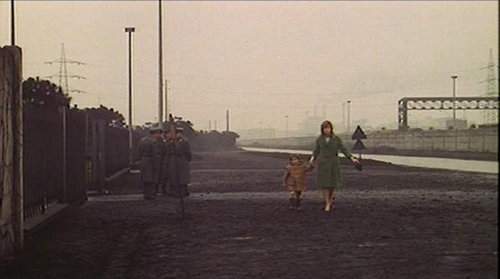
Michelangelo Antonioni’s Red Desert, which begins a ten day run at BAMcinématek this afternoon, is surely one of the most beautiful ugly movies ever made. The colors are largely gray and murky, and the apparent progress of red radar masts transform communication into something which looks more closer to derricks. Water isn’t just dark and polluted; it is oily and smoky, very much living up to its Lethean role. Sickly yellow enters near the end with a resigned acceptance. Rooms, painted with bright red, are cold and subject to random destruction. State-of-the-art robot toys crash around dark rooms over and over and over. Spoiled children don’t feel any special desire to get out of bed. They even willfully fool their mothers into believing that they have a serious illness. Large areas are filled up with endless bric-a-brac, with one wondering how it all got there in the first place.

Given all this bleak imagery and given the seemingly slim story (Giuliana, a young mother married to an engineer, is suffering mental breakdown), why then would anyone want to see Red Desert? Why then would anyone be so drawn to Monica Vitti’s miserable face, which seems equally tortured by environment and filmmaker and often dons a very sad smile for protection? Largely because of Antonioni’s audacity and largely because everything here is not as it seems. This was his first film in color and he was determined to paint nearly every building around him. Pipes, walls, the insides of a vacant cottage? Chances are that it was painted. Chances are that the actors were positioned not to show off their talent, but for Antonioni to show off his brush strokes. And it all makes Jean-Pierre Jeunet’s modifications of Paris by CGI look outright lazy by comparison. It’s hard to imagine anyone going to such trouble today, and I wish that they would. Red Desert reminds us of those halcyon days when filmmakers strewed their streets with serious trash and rolled up their sleeves to accentuate abject locales.

The other reason to see Red Desert is largely as a test in mood. Because Red Desert may be a depressing film, if you can still find something cheery about the world afterward, you may very well be an optimist. But in your quest to find beauty within the abject, does your soul become abject? Like anything in life, it’s all a matter of perspective.

The above sequence is about as alienating as art house cinema gets. Giuliana wishes to escape her increasingly populated environment. But instead of offering help or providing some fun aside from eating eggs (augmenting your fertility: is this really what frivolity is all about in the Antonioni universe?) or wanton destruction (red wooden walls destroyed, along with a chair), her friends can only stare into the world around them. They are statuary dissipating into the fog. Should Giuliana be blamed for this? Is this merely the way that she looks at the world? She decides to act by nearly driving a car into the watery abyss (an attempt at suicide or a response to this miasma?). She says, “Forgive me. A mistake.” She claims not to have seen the ship. All she wanted was to drive home. But what is home? And is what we are seeing here a mistake?

A 1965 review published in Life suggested that Antonioni was “getting to the point where he has nothing new to say about nothingness.” But this assumes that experiencing Red Desert is merely accepting “nothingness” without considering that it may be something else or that mood or style can suggest other emotions. Antonioni is all about confronting our perceptions about the way people live with colors. Giuliana commits an act (or does she?) near the end of the film — just before saying “Why do I always need other people?” and just before she seems to transform into a piece of human furniture (while clutching a chair, match) and just before tracing her fingers on a map that doesn’t have the place she’s looking for (home?). Much as Jack Nicholson’s David Locke assumes a dead man’s identity in The Passenger to atone for the rebels he can’t seem to locate, Giuliana’s response to malaise is to do something instead of nothing. And it takes observing a dark and slightly bent figure from a window — perhaps some future version of her — to understand that nothingness is a state of mind. What’s especially interesting is that her act causes the room she is in, and all of its objects, to shift into a fleshy pink. So did she actually commit the act? Or did she merely think it? And is thinking a form of doing? Whatever it is (and Antonioni is considerate enough of his audience to leave this open-ended), it does allow Giuliana to return to the world, with great pockets of steam pushing beneath her, and walk away from what seems poisonous without fearing it or worrying about it.

In a year that has given us revolutionary upheaval, natural disasters, and economic uncertainty seemingly without letup, Red Desert is fresher than ever in what it has to say about living.


The Bat Segundo Show: Lauren Beukes

Lauren Beukes appeared on The Bat Segundo Show #409. She is most recently the author of Zoo City.

Condition of Mr. Segundo: Avoiding roaming urban animals.

Author: Lauren Beukes

Subjects Discussed: Jet lags and hangovers, cultural references, I Can Haz Cheeseburger, whether or not books should be of their time, American Psycho and Phil Collins, violence and cheeseball songs, hyper-specific description, William Gibson, the influence of writing for animation, the differences in writing journalism, comics, and screenplays, considering the right level of detail, action scenes vs. dialogue, Hanna, implausible action movie scenes, getting the geography of an apartment block, the ability to get journalistic answers from people when you say you’re a novelist, magic and fantasy rooted in practical limitations and innate talent, Red, a personal belief system as a peer review process, Johannesburg’s geography, Nechama Brodie’s The Joburg Book, conversations with traditional healers, worldbuilding and getting the reader to believe, major clues hidden within conversation, bad worldbuilding involving two guys sitting in a bar, writing as a road trip, having a planned ending in advance, alligators, reclusive music industry producers who are in decline, establishing Zinzi’s streetcred, arriving at the right balance between ambiguity and just enough information, unreliable narrators, Melinda Ferguson’s Smacked, cinematography and photography references within Zoo City and Moxyland, similes throughout Zoo City, Raymond Chandler, phantasmagorical noir, Oryx and Crake, the problems of reading fiction while writing fiction, South African criminal slang, steering away from transcribed speech, The Wire, relying on other writers for certain chapters of Zoo City, conducting interviews with fictional characters, the problems with theories contradicting fictional worlds, being the “head writer” of your own novel, The Third Man, Paul Bowles, visual references, and internalizing influence.

EXCERPT FROM SHOW:

Correspondent: Lauren, how are you doing?

Beukes: I’m very, very, very jetlagged. Thank you for asking.

Correspondent: Yes, well, I’m hungover as well. So I think it’s an equal playing field. I wanted to first of all start with the issue of cultural references. This book has quite a number of recent ones. “I can haz murder weapon.” I don’t think I’ve even seen “I can haz cheeseburger” in a novel ever. Lady Gaga: well that’s comparatively recent. The 419 scams. I’m curious. When you deploy a relatively recent cultural reference, you’re dealing with a two year lag time in terms of the book coming out. What do you do to make sure that it’s right? Or that it’s actually something that will possibly be tangible in a matter of years? Or do you have this virtue here, in this case, of a sideways universe, as it were? So that, as a result, whether a reference is dated or not, this is not so much a distinction or a problem.

Beukes: I never really worried about references dating the book. I think books are of their time and I think they should be. You know, when I was doing my masters in creative writing at the University of Cape Town, my lecturer said, “You absolutely should not put any contemporary references. Because it dates the book horribly.” You know, The Great Gatsby has dated horribly. American Psycho has dated horribly. And they still work. Because the story is compelling enough and it’s actually a really interesting snapshot of the time. So, you know what, I don’t care. I like to think that it dates it. The book is set in 2011 and those are the cultural references.

Correspondent: Interesting that you mention American Psycho. Because near the end, there’s a Phil Collins reference. So it leads me to wonder if that was a possible influence on getting that sort of juxtaposition of violence and cheeseball songs.

Beukes: Yeah. I don’t know if it was conscious. But it might have been something that I internalized. Yeah.

Correspondent: A two stroke gash across the face of a menacing street urchin. The Maltese’s car polished and waxed to within an inch of its warranty. This is hyperspecific, very measurement unit-like description. Which I like by the way. Reminiscent to some degree of William Gibson. However, at the same time, I know that you have also written for animation. And I’m curious if some of that animation writing background has affected your ability to describe things in this very ultra-precise matter. What of this?

Beukes: I think there are two influences on my writing. I’ve basically got three day jobs. I’ve been a journalist. I’ve been a TV scriptwriter. I’ve been a novelist. And now I’m doing comics as well. And all those different fields have very, very specific things to their discipline. The animation, you have to describe things very, very precisely. The same with comics. You have to absolutely describe the scene. You have to describe the emotion that the character is going through. Which means I sometimes pull funny faces in character, trying to figure out, “Oh, what does this sneerer actually look like? And how are they sneering?”

Correspondent: Do you take photographs of yourself?

Beukes: No, I don’t. That would just be silly. But I should set up a webcam and kind of do a live streaming thing where people can log in and laugh at me.

Correspondent: So you need to know the precise expression of what’s going down. And then you have the option to describe it in detail or not, whether for animation or for prose.

Beukes: Absolutely. But I think journalism also has a lot to do with it. The details of journalism. And I think details make a story. I mean, I’m lucky to do a lot of — not news journalism, but narrative journalism and investigative features in finding those telling details. So I think my eye for detail probably comes from there. And then also the specifics of having to write for animation and having to track things very, very clearly and stage manage very clearly for the animators.

Correspondent: Well, I mean, how much of this is an organic process? And how much of it is considering the right level of detail to communicate the right information to the reader?

Beukes: I think it’s pretty organic. I don’t think about it too much. Dialogue comes very easy. Actions scenes are really hard — they don’t come naturally to me. I really have to work on them.

Correspondent: Why are action scenes tougher than dialogue?

Beukes: I don’t know. I think because I really like talking. You know, I’m a talker, not a fighter. I think dialogue is so much a part of who we are. And I really like using the subtext in dialogue. And of course, that’s very, very strong in animation. I think it’s also I’m not a really big action movie fan. And action has a lot to do with movement. I really enjoyed Hanna recently. I thought the way they did the action in there was just intense and amazing and surprising. And you really felt it. So many action scenes — you know, the truck falls off the bridge and there are multiple explosions. And they’re just empty. So it’s really trying to write meaningful action.

Correspondent: Is fighting similar to gestures and facial expressions for you? Do you have to like roll on the ground to get a sense of how things are working out here?

Beukes: Uh…

Correspondent: Do you have a sparring partner?

Beukes: (laughs) No, no. I wish. I did a little bit of kickboxing, but that was years ago.

Correspondent: Yeah.

Beukes: I do sometimes act certain stuff up, but not fight scenes. But I will really think about the choreography. And I’ll spend a lot of time thinking about it.

The Bat Segundo Show #409: Lauren Beukes (Download MP3)

This text will be replaced

Review: Love Crime (2010)

There are few thespians more capable of playing first-class bitches than Kristin Scott Thomas. Most good actors are considerate enough to open up windows into their souls, but Thomas’s eyes are haughty saucers that take in a room in the way that a professional assassin snaps a neck. It isn’t especially difficult to imagine Thomas’s blue orbs popping out of her head, perhaps running at you with plans for a murder weapon.

So it’s no surprise that Love Crime‘s best moments are when Thomas appears on screen as the appropriately named corporate executive Christine (did co-writer/director Alain Corneau have any other actress in mind?). Christine plucks ideas from her underlings without credit, humiliates her coworkers at a party by playing security camera videos that reveal their private emotional moments, and digs in the heel after a nasty betrayal by telling her opponent how easy it was to fool her. In other words, Christine is a woman you never want to cross, the kind of chilling villain that keeps me coming back to French cinema. I should probably confess that I experienced great pleasure in seeing Christine order an associate to clean up two to three months of financial chicanery in a mere week and that I further enjoyed the way that many of the women in this film were surrounded by weak and easily crushed men. When it comes to corporate intrigue, the truest films of this type are decent enough to give us jackals who go for the jugular. It certainly wasn’t a surprise to learn that Christine’s previous assistant had cracked.

Against such a compelling heavy, how then can Ludivine Sagnier compete? Sagnier, playing Christine’s assistant Isabelle, is a striking blonde who looks especially good running on a treadmill. (We’re told in the film’s early moments that Isabelle runs because it “blanks everything out.” I don’t believe this is why most people run, but it does explain why Isabelle would put up with Christine for so long.) But in this film, Sagnier doesn’t have the gravitas or the complexity to match Thomas. That’s somewhat surprising, given the way Sagnier held her own with Charlotte Rampling in Swimming Pool. When Isabelle pops pills as the fissures start forming and she confronts Christine over a threatening email, we can’t really speculate on her character or relate to her because of Corneau’s melodramatic direction, which works well in other places but, in Sagnier’s case, relies too much on the shattered static look and a doelike gaze. I mean, if Sagnier is such a naif, how then did she make it this far in the company? For that matter, why does the company include so many agreeable Americans saying things like “Thanks to you, our expectations were shot through the roof” and giving away jobs and trips to Cairo with the profligacy one expects from a pediatrician dispensing lollipops after an appointment? (To be fair, I actually enjoyed these cheeseball Yanks, who represent a fairly ridiculous fiction in a post-2008 economy. It’s amusingly easy for various characters to screw the company out of millions. On the other hand, this skewered logic does cause one to see gaping holes in the plot.)

Given that Love Crime relies on an intricate ruse and boardroom perseverance to hold our interest, this failure to give Sagnier much more than an apparent victimhood quality needlessly simplifies an otherwise entertaining thriller. It’s worth pointing out that mysteries which include a police investigation really need to make sure that they are ten steps ahead of the audience. Because by inviting the audience into vicarious inquiry, the audience is also encouraged to poke around. And if the audience feels smugly superior to the police, catching on to certain details well before they do, it invalidates the criminal horror, reducing it to comedy or camp. That’s perfectly fine. Murder and bumbling detectives can be very funny. But since Corneau spends so much time building up to the crime, I’m thinking that he wanted us to take the act seriously.

On the other hand, modest kitsch may have also been Corneau’s intent. If the film didn’t spend so much time trying to be smart, it may have found more confidence in its exuberance. There’s one amusing moment in front of a movie theater when Isabelle offers candy to everybody, suggesting a whimsical direction perhaps more natural for Corneau. I also liked the silly paranoia contained within the film’s finale, which suggests that, no matter where you rest on the corporate totem pole, there’s always someone out to get you.

Ultimately, I enjoyed Love Crime, but it was clear to me that it could have been something more than a conventional thriller. On the way out of the screening room, I overheard two people calling the film “cute,” a modifier better assigned to an effervescent romantic comedy. Why couldn’t this film have been more dangerous?

Review: Special Treatment (2010)

Prostitution and psychiatry both cater to a privileged class, where a considerable sum of cash is handed over to a specialist for one hour of release. Over the course of numerous sessions, one’s mental health or sexual desire may be sufficiently restored to its former levels. But it takes time. And it takes the right specialist. The client understands that remedy isn’t going to happen overnight, but there remains the dependable oxytocin rush of each discrete session. The client can count on trusting the psychiatrist to unload emotional catharsis or trust the prostitute to fire his load into the appropriate orifice and with the appropriate satisfaction. Both professions involve finding a specialist who must remain objective. The psychiatrist or the prostitute may “care” for the client in a purely professional way, so long as the client understands that he is merely one of many. So there’s no need for the client to consider his quirks or his perversions and his hangups especially special. So although the client’s ego (and his wallet) may be tinkered with during release, it is suggested that the client check his hubris at the door. The specialist has seen it all. In both cases, there may be a certain shame when confessing to certain friends that the client is seeing someone to fix something vital. Sometimes, when you run into a client just before one of these sessions, the client will have a worried and somewhat nervous expression on his face, much like an inexperienced actor enlisted at the last minute to appear in a community theater production. He just wants to get it over with. So the only way for the client to cure his unsated need is to see the specialist again. It’s always best to call ahead, even though last-minute appointments are dicey.

Given these parallels, it’s a wonder that a film like Jeanne Labrune’s Special Treatment didn’t come earlier. We might look to Alan J. Pakula’s Klute as one of the first films depicting a prostitute confessing how much she wants to leave the business to a psychiatrist, and 1987’s Nuts, which features Barbra Streisand as a high-class callgirl who must prove her sanity. But both films involved murder, suggesting that the simultaneous moral investigation of psychiatry and prostitution inevitably led one into gripping pulp narrative. (It’s worth noting that Luis Bunuel’s Belle de Jour, which didn’t deal with psychiatrists but certainly looked into dormant bourgeois desires and prostitution, also involved murder.)

It was surprising to discover that nobody dies in Special Treatment, although someone does pull a knife. Labrune’s film isn’t especially interested in depicting the act of congress, suggesting a firm commitment to the more pivotal actions occurring just before release. This refreshingly adult (as opposed to, ahem, adult) approach gives Labrune liberty to depict the two practices as procedure rather than prescription, dutiful vocation rather than spiritual translocation. We see numerous scenes of 43-year-old, high-class prostitute Alice Bergerac (Isabelle Huppert), committed to schoolgirl fantasies with one client (even recommending somebody younger when his rocks prove less fluid than anticipated) and submissive housewife with another, with lengthy stretches of Alice setting up her room in advance or catching a cigarette between johns. This boredom of routine can’t be perceived by Alice’s clients. Likewise, as the camera cranes in close on his face, the psychiatrist Xavier Demestre (Bouli Lanners) couldn’t be more disinterested with the visceral confessions of his clients — even when they are men who dress up in women’s clothes and make efforts to flirt with him. So when the emotionally crippled Xavier expresses a desire to leave his wife, one can’t help but feel that he’s more than a little of a shit.

But since Alice shares some of these professional qualities, why then did I feel more sympathetic towards her? The film does stack the deck towards Alice by having a particularly creepy client pull some sleazy moves on her and by having a mentally disabled man follow her near the end of the film. But is Alice’s own indecision — her desire to seek help without much of a plan — any worse than Xavier’s failure to state any specific ideas about what he wants when he sets up a preliminary consultation appointment with her?

Part of me wished the film didn’t play into conventions and ask me to choose sides like this. If Alice’s character had been a little less wholesome and a little less victimized, then this perilous proximity to the “hooker with a heart of gold” trope might have been avoided. By giving Alice and Xavier too many eccentric clients, the film detracts from its exploration of midlife ennui. Special Treatment is better when the people who Alice and Xavier have affected stand up and respond to their actions. When one of Xavier’s clients calls him out on his lack of professionalism and announces that he’s not coming back, it’s fascinating to see how this client has his life together (and his ability to recover) more than Xavier.

The film is somewhat entertaining, but its slow spots had me wondering what might happen if Labrune had thrown in a murder. Sure, it would have cheapened the film. On the other hand, if Alice and Xavier had been presented as more emotionally complex individuals, Special Treatment might have been, well, more special.