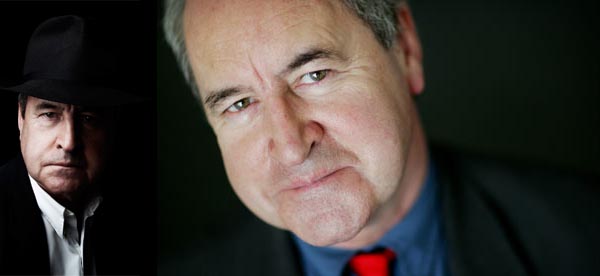
The Bat Segundo Show: Dana Spiotta II

Dana Spiotta appeared on The Bat Segundo Show #408. She is most recently the author of Stone Arabia.

Spiotta previously appeared on The Bat Segundo Show #28. This particular conversation was recorded before a packed audience at McNally Jackson on July 20, 2011. My thanks to Michele Filgate and Katie Monaghan for their help in organizing this event.

For additional details about Stone Arabia, please also see our 25,000 word roundtable discussion: Part One, Part Two, Part Three, Part Four, and Part Five.

Condition of Mr. Segundo: Confusing dendrites with dandruff.

Author: Dana Spiotta

Subjects Discussed: Impostors within fiction, people with secret lives, double lives and triple lives, maintaining truth in fiction while avoiding obvious tricks, the role of the obstinate artist, work created to protect one’s self, avoiding obvious dichotomy, artists with exclusive audiences, familial obligation, relating to a character as a responder, the youthful longing in experiencing music, working in the dark while also being somewhat familiar with something, starting with a subject that you don’t really understand, enacting complexity, the frustration of reducing complexity through explanation, Susan Sontag’s “Regarding the Torture of Others,” the difficulty of being alive without leaving artifacts, being overwhelmed by information, taking in art as a full-time obligation, being saved by illusion, the Spiotta script style in Lightning Field and Stone Arabia, whether novelists should give up dialogue description, inventing memory techniques, keeping organizing principles coherent, shifting first-person and third-person to reflect consciousness, references to Stone Arabia, finding refuge in hyperarticulateness, memory and physical urgency, devotion and artistic evaluation, the pre-Facebook age, the appeal of selecting 2004 as a terrible year, commerce as a curating principle on the Internet, the illusion of endless amounts of information as liberation, retaining selfhood from a generational standpoint, Don DeLillo, and navigating influences.

EXCERPT FROM SHOW:

Correspondent: I have noticed that all of your novels are guided by having some impostor who is at the center of the narrative. And I’m curious if that notion of an impostor being sort of a prism with which to view American society or American culture — what is up with that? I mean, we’re now in an age where, thanks to the Internet, which aids and abets thousands of Don Quixotes that unleash every second — I mean, this is something that Cervantes could never have even seen in the early 17th century. What motivates your interest in impostors? Especially in this. And maybe we can use this to talk about the lovely Nik Worth, who is a wonderful impostor!

Spiotta: Okay. I don’t really — I think the word that I would use instead of “impostor” is people that have secret lives maybe. It’s another way of putting it. And I do see that in all three books there are people with secret lives. I mean, Nik Worth, the character in this book, he’s not trying to make it a secret. Nobody’s really that interested. But he’s definitely an eccentric person and has a double life to a certain extent. One: he has a fictional career and his actual life. And they are somewhat at odds with each other. And then, in other ways, they overlap. I mean, clearly, it’s something I’m interested in. But I think to a certain extent, we all have these double lives and triple lives. And the part of me who writes novels is separate from the part of me who’s speaking today. So I think that it’s an exaggerated version of what we do all the time. And certainly the Internet is amplifying that, sure.

Correspondent: Yes. But characters who hide in plain sight.

Spiotta: Right.

Correspondent: I think that might be a better way to identify this common theme.

Spiotta: Okay.

Correspondent: I mean, is this really the role of the 21st century novelist? I hesitate to use a term like “postrealist.” But it is interesting that there is this balance between what is real and what is fake. You have Casa Real. You have The Fakes — the band name in this. So it’s very pronounced here. And I’m wondering if a novelist today is almost obligated to respond to this Pandora’s box, so to speak.

Spiotta: Sure. I mean, yeah, of course. I always feel that I have, as I said, this kind of doubleness, which is natural for me. And maybe that’s because I sit in a room and I make up people. And that’s kind of a strange thing to do. So I imagine everybody does this. And maybe that’s not true. But I sort of think of everyone as having multiple selves. And this is just a more amplified version.

Correspodnent: “Versions of Me” — one of the songs that Nik Worth is actually responsible for. Nik’s Chronicles — there is in this book a very lengthy multi-volume set where Nik Worth, this character, is fabricating selves of all sorts. You have critics. He’s writing critical reviews of his own work. He is doing parodies and pastiches of his family members. I’m curious because there’s a lot of specific artistic and musical references within Nik’s Chronicles and also your book. The fake Denise letter that Denise reads at the very beginning is almost a trick on Denise. How do you write something this true without it seeming like a trick for the reader? I mean, are you thinking more in terms of how Denise is feeling? Because Denise is responding to these Chronicles.

Spiotta: Right. So that’s an interesting question because, in the book, there are — well, in the Chornicles, one character is writing and pretending to be another character. And then you’re reading that. And how does that not seem sort of manipulative and silly? And I think that the key is that there has to be a genuine — you have to inhabit that character inhabiting that other character. And you have to make Nik pretty good at what he does.

Correspondent: Yes. He’s very good.

Spiotta: He has to sort of be a novelist. So it’s just an extra layer. And so in a way, it comments on the whole idea of the artifice of creating a novel and a character. But mostly, I think it’s really about his affection for his sister and his poking her at the same time. So, so much about this book — what I really wanted the book to be was anchored in the emotional reality of a family and a brother and sister as they age. And the decisions that they made about themselves when they were 25, what does that feel 25 years later? So you have someone who says, “I want to be an artist. And I’m going to be an artist no matter what. And I don’t care if anybody likes my work.” And that’s easy to say when you’re nineteen. But then 25 years later, what does that look like? What does it feel like? And then what does it feel like for the people around you? So Nik is a kind of dramatic version of that. And he has this other layer of this invented life that he does for his amusement and, I think, to keep his sanity to a certain extent. To give him — so he makes up his own audience. He makes up his own response. He’s in dialogue with himself. So I wanted to pull that out and always keep it anchored in the emotional truth of a brother and sister, and the family.

Correspondent: Is the family really the best way to anchor that emotional truth? I mean, this also concerns memory. This concerns context. This concerns fact vs. fiction. Did everything originate from the family? How did these little side quests come about?

Spiotta: Okay. So what I envisioned for the book was to have it to be very intimate and claustrophobic. And sort of distorted by emotion and subjectivity. And to be this intimate thing. And I think, to the extent that a family — all these things tie back. Because one of the concerns of the book is how do you retain yourself in the face of, let’s say, all these things that want to annihilate you. And not just the Internet or information and all the things that come at you, but also that you’re aging and you’re watching your parents age and you’re eventually going to die. And all the things that we all have to deal with. How do you retain your sense of self? And part of it is your memory. And part of it is the things that you’ve created to protect yourself. Like Nik has his retreat, which is his way of protecting himself. But then also it’s the people in your life, who tell you who you are to a certain extent. And that can trap you. But it also can save you. And it’s both things at once. And I’m always interested in things being both. More than one thing. Not either/or. But this and this. And I don’t think of this as being ambivalent. I think of it as feeling strongly about things in two ways.

The Bat Segundo Show #408: Dana Spiotta II (Download MP3)

This text will be replaced

When the Flock Changed: David Foster Wallace & Maud Newton

In a recent piece for The New York Times, Maud Newton makes the suggestion that David Foster Wallace’s essays — more than Cheetos, beer, amusing cat videos, and Jolt Cola — are largely to blame for chatty Internet discourse. Newton suggests that Wallace’s “Tense Perfect” (a review of Bryan Garner’s Dictionary of Modern American Usage collected in Consider the Lobster as “Authority and American Usage”) is “as manipulative in its recursive self-second-guessing as any more straightforward effort to persuade.” She tries pinning the mimetic transmission of Wallace’s syntax on “Dave Eggers’s literary magazine and publishing empire,” but doesn’t offer a single example (save for Eggers’s “Rules and Suggestions for Enjoyment of This Book,” a citation so overbroad that it can equally apply to the notice about shooting anyone in search of a plot at the head of The Adventures of Huckleberry Finn). Newton cites David Foster Wallace’s “E Unibus Pluram” as the “ur-text of this movement,” but fails to establish much beyond cannibalizing a thoughtful Keith Gessen essay from eleven years ago (as well as its AO Scott antecedent). She then concludes that “the idea of writing is to provoke and persuade, not to soothe. And the best way to make an argument is to make it, honestly, passionately, without regard to whether people will like you afterward.”

It’s too bad that Newton lacks the logos and the level head to heed her own advice, and that she can’t level with us about her bilious biases. Conflation is not persuasion, nor is cleaving to one’s syntactic prejudices a reliable way of responding to an argument. Newton’s essay comes off as the work of a careless and needlessly furious blogger who has been given an unanticipated platform, not someone who takes the art of writing (and thinking about writing) seriously. There are numerous problems with her argument, as sloppy and as derivative in its thinking as the self-congratulatory folderol Newton claims to have abandoned during an apparent halcyon intellectual period sometime after the age of 20, where she “was forced to confront serious practical and ethical questions” in law school. (Those ethics took Newton a long way in 2008, when Newton was offered a paid junket trip to England by a publisher, and, by her own admission, accepted the quid pro quo “within a half-hour of receiving the offer.”)

Like any common and overworked lawyer massaging boilerplate from practice guides, much of Newton’s “argument” about Wallace’s regular guy schtick has been cribbed from this 2002 Languagehat post. Newton complains of the “I’m-just-a-supersincere-regular-guy-who-happens-to-have-written-a-book-on-infinity approach.” Languagehat’s Stephen Dodson complains that “[t]his sort of smarmy regular-guy rhetoric from someone who knows you know he’s a famous author and who is setting himself up as an all-knowing authority makes me sick.” Dodson, however, had the decency to be transparent about his fury, confining his gripes to the article in question. What’s especially striking is that Newton, cognizant that she is writing for The New York Times, adopts the self-same “regular gal schtick” for her piece. And it is with this simplistic stance that Newton reveals her reductionist stature as a thinker.

Instead of using specific examples to provide a helpful lexical lineage for her claims (citing, for example, the very blogs impaired with Wallace-inspired banter), Newton offers little more than unfounded and dimly ironic speculation that has nothing to do with Wallace:

I suppose it made sense, when blogging was new, that there was some confusion about voice. Was a blog more like writing or more like speech? Soon it became a contrived and shambling hybrid of the two. The “sort ofs” and “reallys” and “ums” and “you knows” that we use in conversation were codified as the central connectors in the blogger lexicon. We weren’t just mad, we were sort of enraged; no one was merely confused, but kind of totally mystified. That music blog we liked was really pretty much the only one that, um, you know, got it. Never before had “folks” been used so relentlessly and enthusiastically as a term of general address outside church suppers, chain restaurants and family reunions. It’s fascinating and dreadful in hindsight to realize how quickly these conventions took hold and how widely they spread. And! They have sort of mutated since to liberal and often sarcastic use of question marks? And exclamation points! “Oh, hi,” people say at the start of sentences on blogs, Twitter and Tumblr these days, both acknowledging and jokily feigning surprise at the presence of the readers who have turned up there.

Let’s do the work that Newton couldn’t be bothered to do. Because if you’re going to promulgate information about the methods and manner in which people use language, then it’s important to consider the whole larder.

One can spend a lifetime ruminating upon “uh” and “um,” which psychologists have recently suggested play roles as conversational managers. But what Newton is trying to peg here is speech disfluency — specifically, those fillers often emerging as one is deliberating over a thought. Fillers hardly originate with Wallace, nor are they confined to English. To offer one historical example, here’s some glorious dialogue from The City Wives’ Confederacy — a 1705 play written by Sir John Vanbrugh:

Cor. Let me read it, let me read it, let me read it, let me read it, I say. Um, um, um, — Cupid’s — um, um, um, — Darts, um, um, um, — Beauty, — um, — Charms, — um, um, um, — Angel, — um, — Goddess, — um, [Kissing the letter.] um, um, um, — truest Lover, — um, um — eternal Constancy, — um, um, um, — Cruel, — um, um, um, — Racks, — um, um, um — Tortures, — um, um, — fifty Daggers, — um, um, um, — bleeding Heart, — um, um, — dead Man, — Very well, a mighty civil letter, I promise you; not one smutty word in it: I’ll go lock it up in my comb-box.

For full effect, try reading that passage aloud. What sounds seemingly annoying in textual form becomes positively poetic as you’re saying it. But Vanbrugh didn’t stop there. We find this exchange in Scene II:

Mon. Um — a guinea, you know, Flippanta, is —
Flip. A thousand times genteeler; you are certainly in the right on’t; it shall be as you say — two hundred and thirty guineas.
Mon. Ho — Well, if it must be guineas — Let’s see — two hundred guineas —
Flip. And thirty; two hundred and thirty.

Now imagine that some snotty journalist or critic had told Vanbrugh that he couldn’t use “um” or “you know” or “let’s see” in his dialogue because, if he had published these words, they might be codified as the central connectors in the theatrical lexicon. If Vanbrugh’s dialogue had been scrubbed, how then might we have known — in a time before movies, gramophones, and computers — how people talked? One can hardly imagine reading masterpieces like The Adventures of Huckleberry Finn or Finnegans Wake in anything other than their unique patois. Therefore, should one be so needlessly tendentious when it comes to blogs?

Newton’s feckless fig isn’t really about what Wallace (or any blogger) has to say. It’s about how they say it. As anyone who has waded through academic papers knows, there are often brilliant kernels contained inside dense and impenetrable style. But a person of true and eclectic intellectual rigor wouldn’t hold the thinker accountable based solely on the syntax.

Since Newton is unable to establish a clear connection between Wallace and “the stylized mess that is Gen-X-and-Y Internet syntax” (and unable to comprehend that many of these syntactical eccentricities have recirculated for centuries), we are therefore forced to conclude that Newton is needlessly hostile to any sentence that isn’t written in the plain and vanilla language that she holds so dear to her cold and humorless heart.

This is the position of a lexical reactionary, not just a Wallace hater. Because if Newton were genuinely interested in language or people or the often magical way that words are transmitted in our culture, she wouldn’t be so quick to condemn. She would actually do the legwork and use these findings to offer a persuasive argument instead of outsourcing it to her readership (“Visit some blogs…to see these tendencies writ large,” “The devices can be traced back to him, though…,”). Is that not persuasion? But Newton isn’t interested in listening to anything other than the sound of her own voice — the vitiated “plain question and plain answer” ideal plucked from Life on the Mississippi that, in Newton’s uncomprehending hands, becomes more inimical than imitable. She doesn’t understand that distinct writing can often be forged from imitation — as the many fresh talents who have mimicked Hemingway (Ann Beattie, Raymond Carver, Hunter S. Thompson) can attest. And in telling New York Times readers that imitation and repetition are wrong or “dreadful in hindsight,” Newton reveals herself to be committed to the act of expressive conformity. The Newtonian ideal, rooted in misanthropic nihilism, leaves no room for prototypes or apprenticeship — even though, having shed the burden of “her own archives,” she cannot actually lodge a proper argument here. In short, Maud Newton has transformed into a cultural atavist who argues along the lines of Lee Siegel. You can respond to her argument, but only using the words and the terms that she has established. (And as Joe Winkler has argued, why should Wallace be judged by foreign standards?)

When contemplating the state of culture and language, it helps to view the reuse of expressive terminology through context. A helpful linguistic anthropology volume authored by Alessandro Duranti suggests that “Oh, hi!” has been in use — largely over the telephone or after an awkward social encounter — decades before Wallace published a single word. “Oh, hi!” is modeled on “Ah ciao!” “Oh” initially appeared before “hi” when the answerer awkwardly attempted to return a greeting without knowing the greeter’s name. So it makes sense that someone using Twitter or Tumblr, unaware of the sheer scale of readers, would start a post this way. (And to return to Gessen’s essay, this might very well reflect his humorous aside that “in the long run books are not written for the editors of prestigious magazines or the professors of fashionable theories.” In other words, speculating on a readership is best left to the crass and artless marketers.)

Newton is right to suggest that the intersection between writing and speech is what led to the early conversational feel of blogs, but she never considers the possibility that those who were sending their thoughts and feelings into the electronic ether truly had no idea who they were reaching. (On the “Oh, hi” question, she does concede midway through the piece that those who write this way may be simultaneously “acknowledging and jokily feigning surprise.” But observe the strange suspicion here. Sometimes a cigar is just a cigar. It’s telling that Newton’s article offers no space for sincerity, that the Newtonian ideal involves directness without nuance or irony.) She assumes that most of the early bloggers were readers of Wallace and Eggers, rather than those who may very well have left the house and conversed with fun and interesting people. It doesn’t occur to Newton that, in using words like “folks,” bloggers were using the very voices they might employ in everyday conversation. And just as we’ve seen in the Vanbrugh play, the Internet’s early days (at least, what we’ve been able to preserve of them) offer us an unprecedented treasure trove of how certain phrases and words made their way into our vernacular. Much as digital cameras have ushered in an age that is the most photographed in human history, digital conversation has afforded us an equally vast and limitless tapestry.

So Newton’s blinkered prohibition of “folks” outside of some implied Midwestern setting is not only needlessly condescending, but it suggests that writing in one’s voice is rooted almost exclusively in mimicking trendy magazine articles rather than responding to conversational cadences. This isn’t a question of being liked or craving admiration and appeal. It’s about speaking in terms that keep the conversation, whether contentious or conciliatory, alive.

Internet culture was built in large part by smart people being trapped in soul-sucking jobs and desiring to connect with others. In “E Unibus Pluram,” Wallace identified television as “an absolute godsend for a human subspecies that loves to watch people but hates to be watched itself.” The time has certainly come to unpack some of these arguments into something that includes the Internet’s complexities. But Newton isn’t sharp enough to build from Wallace’s points, even as she disagrees with him. She cannot, for example, consider the obvious truth that, in an era of Twitter and Google Plus, the watchers have become the watched. Rather than serving up a plainspoken exemplar within her essay that articulates an original point and lives up to her declared ideal (or puts her on the line, as Zadie Smith did in her Facebook essay when confessing “not being liked is as bad as it gets”), the great irony here is that Newton herself has soothed her readership using the very methods that Wallace (and Newton in failed ironic mode) condemned. Newton, by publishing her essay at The New York Times instead of her blog, craves the very admiration and approval she dismisses as toxic. She wants to be read, but she is not especially interested in practicing the very intellectual rigor she champions. Because if she were, she would be crystal-clear in establishing her terms. She cannot identify even one of the many critics “making their arguments in this inherently self-undermining voice.” Who are these mysterious Wallacites wandering in the woods? Do they have axes and are they killing bitter attorneys who can’t finish their novels (and have an infuriating need to report constantly on this)? Does Newton really think so little of Wallace readers or bloggers that she cannot consider the possibility that they may very well be influenced by other authors? She thus undermines her own argument.

Newton’s spectacular failure to consider these subtleties may have something to do with not steeping herself in Wallace’s complete catalog. The phrases “plus, worse,” “pleonasm,” and “What this article hereby terms a ‘Democratic Spirit'” come from the very essay (“Tense Perfect”) she commends as “one of his best and most charming essays,” yet not from the same paragraph. “Totally hosed” comes from the famous 2005 Kenyon commencement. In other words, the only four Wallace texts that Newton has consulted for her piece are three essays: “E Unibus Pluram” (1993), “Authority and American Usage” (1999), “Big Red Son” (1998), and the Kenyon address. It seems to me that if you’re going to do a David Foster Wallace takedown, you should rely on a good deal more than the usual greatest hits. That’s a bit like writing about the Beach Boys when you’ve only heard “Good Vibrations” once.

Newton’s piece is less about offering a new argument or repudiating an old one, and more about expressing an uninformed position on Wallace and linguistics. It’s about standing against the possibilities of language and ideas. It’s about dictating the terms of how one should think while disingenuously suggesting that the reader can think for herself.

That’s a skill set that comes quite naturally to an embittered tax attorney. But it’s somewhat amazing that such a misleading and superficial approach would be welcomed by the ostensible Paper of Record.

UPDATE: Some additional responses:

(1) The New Inquiry‘s Matt Pearce, who notes that “Newton’s criticism obscures the fact that she and Wallace have more in common on intellectual honesty and integrity and straightforwardness than her essay lets on.”

(2) Callie Miller, who writes, “Life is short, wars are being fought, loved ones are dying every day…must we really be so intense about our books?” That’s a very good question.

(3) Alexander Chee, who agrees more with Maud Newton than I do, writes that Wallace “was a writer whose work gave back a vision of the world that pierced the scrim of the fear we were all feeling. If we imitated him, or imitated each other imitating him, really, I think we did it because of how we all wanted to find our way through. But it became like a game of telephone, but with style, and what had once been able to clarify something soon obscured them.”

(4) Glenn Kenny, who worked at Premiere when “Big Red Son” came in, clarifies what Wallace meant by the “sort of almost actually” fillers that Newton bemoans: “Each one, as we see, serves a different function, or I should say, implies a different state of mind, and each state is competing with the other. By the point in the essay at which the description of Goldstein arrives, the reader ought to have sussed out that Wallace has some very substantial problems with both pornography and the industry that produces it. But he’s also been bracingly honest about the attraction that walks hand in hand with his repulsion, and when he’s not going at his subject with something resembling all-out disgust (as in the passages about Paul Little, a.k.a. Max Hardcore), there’s a bracing and troubled honesty at work here, as in all of Wallace’s essayistic work, a desire to get at moral truth without being, well, moralistic; and a constant ambivalence.”

(5) CulturePulp’s Mike Wallace writes: “But for Maud Newton to also join a parade of lesser writers staking out lit-cred for themselves by throwing the freshly dead Wallace under the bus — and then to passive-aggressively blame him for all sorts of not-his-fault jackassery — is for me to sort of politely tell Maud Newton to piss off.”

(6) Matt Kiebus: “If Ms. Newton wants to live in a world where people make arguments ‘straightforwardly, honestly, passionately and without regard to whether people will like you afterward,’ that’s her choice. And although I think she may need a fucking time machine to find the world she’s looking for, I still respect her opinion.”

(7) The Oncoming Hope: “Newton seems to conflate unserious language with Southern dialectical norms, which is all the more surprising given how many times she’s blogged about the liveliness of Southern Texan vernacular.”

(8) Weeks later, the Huffington Post‘s Omer Rosen begins a multi-part offering (with Casey Michael Henry) on David Foster Wallace’s appropriation.

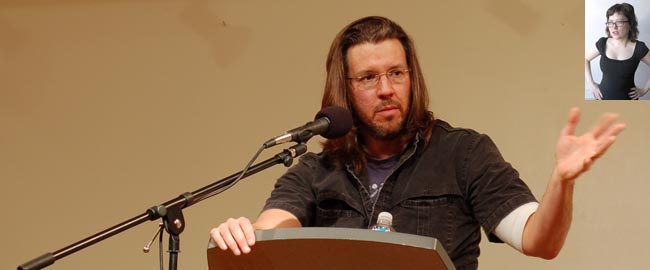
Review: Mozart’s Sister (2011)

Classical music is an estimable topic that I feel disinclined to write about. This diffidence has little to do with any shortage of enthusiasm or background knowledge (you’ll find Saint-Saens, Telemann, Cage, and Mozart all in my music collection, often played in rhythmic counterpoint to activities both sinful and innocently quotidian). It may reflect a quiet desire to keep this joyful terrain unsullied by scabrous assaults of the overly examined. It may have something to do with certain upper-class exigencies which I identify as ridiculous – the requirement to dress up and spend a lot of money just to hear a thunderous orchestra play something you love, the paucity of robust alcoholic beverages, the prohibition on spontaneous enthusiasm within dull and often overpraised buildings designed almost exclusively for fuddy-duddies, and the unshakable vibe of being sized up by condescending assholes pegging you as some bumpkin who inexplicably sneaked past the velvet rope. Whenever I have the pleasure of attending a swank cultural affair for something I am genuinely excited about, there remains a small part of me that wonders if I’ll suffer a fate not unlike the poor couple losing the necklace in the Guy de Maupassant story. A decade of my life gone because of a misunderstanding.

That sounds like hyperbole. Maybe I can explain it another way. I can summon words to describe or connote how I feel about tangible experiences, specific people, books, movies, and even pop music –- perhaps because these all feel sufficiently democratic and translatable. But if I am to be truthful here, it’s also because I have little to lose. I don’t wish to suggest that these topics are less significant simply because I can relate them with greater ease and facility. I know that I can get worked up enough by the Dorian mode in Michael Jackson’s “Billie Jean” to write about it somewhere down the line, but I can’t see myself writing about well temperament or Pythagorean tuning anytime soon. I can approach Finnegans Wake and The Tree of Life, amalgamating my genuine enthusiasm for these works of art with some detailed theory. Yet for classical music, it’s the emotional experience which counts more than any theory. I leave such expatiations (or perhaps expiations?) to minds greater than mine.

This sharp contrast between privileged appreciation and mass entertainment, which I am admittedly identifying from a highly subjective vantage point, may be one reason why cinema’s offerings about classical music remain, to my mind, fairly lackluster. Perhaps I complain because the music itself is loaded with greater life than some slanderous biography, but this is not altogether the case. The sole exception (indeed, one of the few directors who went well out of his way to claim this turf) may be Ken Russell, the underrated auteur who worked his way from bizarre television docudramas (see this glorious opening for The Debussy Film, if you don’t believe me) to such fearlessly libertine flicks as The Music Lovers and Lisztomania. Whether depicting Tchaikovsky confronting his sexuality on a moving train or Richard Wagner as a reanimated Nazi Frankenstein with a machine gun/guitar, Ken Russell valued eye-popping entertainment over historical accuracy. And if one examines the best classical music biopics (Amadeus, Thirty Two Short Films About Glenn Gould, Hilary and Jackie), one discovers additional resistance to the dry facts of life. Let’s face it: the classical music biopic, perhaps more than any other biopic subgenre, is at its best when the slander runs deep.

* * *

It wasn’t a surprise to see writer-director Rene Féret take silly liberties with Mozart’s Sister, suggesting not only that Maria Anna Mozart (played by Féret’s daughter, Marie) captured the romantic attentions of the kid who would grow up to be King Louis XVI (the monarch who eventually lost his head altogether), but that this Dauphin would ask young Maria Anna (disguised as a boy and singing quite high without skepticism from the heir apparent) for fresh compositions. The Dauphin was shy in real life. And at one point in the film, he remarks upon this shyness. Yet Féret has cast the somewhat vigorous Clovis Fouin in the role. Fouin doesn’t so much as quiver. He doesn’t so much as cower or blush. He’s some hipster plucked from the 20th Arrondissement, waiting for a ripe moment to languorously puff on his nonexistent Gauloise. I hope he was paid well.

Yes, it’s true that the Mozart Family traveled around Europe. But isn’t it convenient that the Mozarts break an axle a few miles from an abbey? And isn’t it convenient that the Dauphin’s sister is there (along with a few sisters more, who happen to be conveniently visiting)? And isn’t it also convenient that Maria Anna becomes an inadvertent messenger between clandestine lovers so as to kickstart a plot that isn’t in the history books and that isn’t even good enough for a trashy potboiler. If Féret had offered us something extremely preposterous along the lines of Russell, I might have gone along for the ride. But Féret has besmirched the Mozarts: not because he has offered us historical horseshit, but because it’s such ho-hum historical horseshit.

Féret’s mythical Maria Anna apparently plays the violin, but is confined to the clavichord by her father Leopold, who insists that women are unfit to be real musicians. Yet if Leopold was such a repressive patriarch, why did he give Maria Anna top billing in the advertisements he wrote for his family? It was Maria Anna reaching a marriageable age that felled her career. And that age was eighteen, not fifteen (as it is suggested here; or perhaps younger, given that we see Maria Anna have her first period and thus “become a woman”). It was also Maria Anna who surrendered control of her life to her father, including choice of suitors. While musical scholars have debated the question of what precisely Wolfgang owes Maria Anna, and it is clear from the documents that Mozart and his sister were very close, Féret’s film isn’t especially interested in using this preexisting information to build an enticing story. And if Maria Anna is such a thwarted feminist icon (so repressed that even her neighbors ask her to stop playing the clarichord when she’s on her own teaching piano later in the film), why doesn’t this film show her teaching young Wolfgang a few lessons (in anticipation of her own teaching) or picking up some of Leopold’s tricks? Well, it doesn’t really suit Féret’s convenient untruths, which establish Maria Anna as someone on backup vocals and clavichord to Wolfgang’s fiddling. In other words, if you’ll pardon my tacky yacht rock comparison, Maria Anna is Michael McDonald to Wolfgang’s Christopher Cross. And I’m pretty certain she was a bit more than this. We see Leopold teaching Wolfgang composition, with Maria Anna trying to listen in behind a closed door. But does this really represent the truth when one considers that, in 1764, it was Maria Anna who wrote down Wolfgang’s first symphony when Leopold fell ill?

Look, I’m hardly a Mozart expert. But when the historical record proves more compelling than the reductionist drama, one has to wonder why these prevarications were offered in the first place. If Féret wanted to make a film about a repressed woman composer, there were plenty of other stories to dwell from. Presumably, Féret settled upon Mozart’s Sister because it was the most dependable title for film financing. While I appreciated Féret’s punkass effrontery in offering Barry Lyndon-like slow zooms (although, to be clear, he is no Kubrick), I was not impressed by his middling efforts to sift and synthesize from the available record in a manner that mostly bores. Here was an opportunity to translate an elite interest for the hoi polloi, but Féret, in flattening the story and avoiding the juicy bits, only furthers the chasm.

The Bat Segundo Show: John Banville & Benjamin Black

John Banville and Benjamin Black appeared on The Bat Segundo Show #407. Banville is most recently the author of The Infinities. Black is most recently the author of A Death in Summer.

Condition of Mr. Segundo: Doubting that his alter ego is the work of a craftsman.

Author: John Banville (aka Benjamin Black)

Subjects Discussed: Efforts to sandwich two men into one voice, why John Banville hates his own books and likes the Black books, the quest for perfection, the sentence as a working unit, Beckett’s “Fail better,” why perfection can’t be fun, how a phrase like “louring turrets” manages to sneak its way into a Benjamin Black novel, craftsmen vs. artists, typing out terrible Joyce pastiches as a teenager, mimicking previous texts, Banville’s early flirtations with commercial fiction, The Untouchable as prototypical Black, fictional ghettos, literary fiction as a ghetto, compartmentalizing fiction, Henry James being forgotten, the decline of Beckett’s reputation in recent years, Donald Westlake’s Memory, the Parker novels, Georges Simenon, The Postman Always Rings Twice and Ulysses as respective masterpieces, Joanna Kavenna’s recent New Yorker essay, thematic commitment, mystery and sociological ambitions, Frank Kermode’s The Sense of an Ending, why Banville and Black bifurcated, the origins of Christine Falls, reaching a mass audience, The Sea, The Book of Evidence being shortlisted for the Booker, the best “reviews” originating from regular people, the disastrous status of being a “writer’s writer,” Hay-on-Wye as a writer’s nightmare, ebooks, [21]

EXCERPT FROM SHOW:

Banville: People constantly tell me things about my books that I don’t know, that I wasn’t aware of doing. But of course I did them. But I try not to plan. I try not to make links. I try to let a certain seeming incoherence — I try to work in a process of seeming incoherence, trusting that my subconscious or unconscious or whatever it is or just the sentences themselves will make the connections, will make the sense. Art has to be organic. It has to grow of itself. You can plan a certain amount, but the greatest effects in a novel or a painting or a symphony or whatever will always be the bits where the artist lost control. I don’t mean that he lost control of his material, but lost control of what he was doing. You know, the moment where you let something happen is an extraordinary moment.

Correspondent: You suggested that you don’t do that now. Did you do that before?

Banville: Well, I thought — I imagined that I was working according to strict rules. I mean, my book Kepler is divided into — it’s a system that mirrors Kepler’s system of the universe in five perfect solid states between the orbits and the planets and their twenty sides. It was immensely complicated. That was a way of working then. It was useful for me. I couldn’t work like that now. I wouldn’t want to.

Correspondent: Was it the speed? Or the fact that things became too complex? Or that it felt truer and more original to not plan?

Banville: I just got older. And my work methods changed. I changed. I began to realize that I didn’t know everything about the world. You know, the old thing: the older you get, the older you realize how little you know. And that is true. And that’s a very good thing for an artist, I think. That humility before the material, before the world.

Correspondent: The degree to which you ensure that you don’t use the same phrase and the same word in a manuscript — especially on the Banville side. What do you do? Is this a part of the process as well? ‘Cause I’ve noticed that, especially when a ten cent word shows up in the Banville books, it has its one appearance very often from book to book to book. What do you do to ensure that you don’t repeat yourself?

Banville: I take great care. I mean, this is the process of writing. You know, it’s just — it’s what I do every day. I’ve been doing it for fifty years now. So to a certain extent, I come naturally to being careful. But I still find silly things. Especially when I’m doing public readings. Like “Oh God. Look, I used that word at the bottom of the page. At the bottom of the page.” One can never be — as we began by saying, perfectionism is not of this world.

Correspondent: What of distractions? I did read one interview with you where you claimed you were addicted to email. Every thirty seconds.

Banville: Oh god yeah. I’m absolutely addicted to email. It’s become part of the rhythm of writing now. Checking my email. It’s pathetic. My wife got me a postcard to stick on my wall. This is a guy staring at a blank screen. And just on the screen, you’ve got “You haven’t got any fucking emails.” (laughs)

Correspondent: I suppose Twitter or something like Google Plus would be out to lunch with you.

Banville: I can’t. I can’t.

Correspondent: Or Facebook for that matter.

Banville: I can’t possibly let myself to any of those. Emails are quite enough. Well, emails are like the postman coming to your door every thirty seconds. Thirty seconds is a bit much. But there is that sense when you’re sitting there and you’re staring vacantly. “Oh! I haven’t checked my emails in at least ten minutes!”

Correspondent: The reviewer for the Los Angeles Times called this book “a brainy beach read.” How does that sit with you?

Banville: (despondently) Oh. Thanks very much.

Correspondent: Are you comfortable with the idea of “a brainy beach read” or “a beach read” for that matter? Is that the mark of a craftsman?

Banville: Oh yes, I would think so. That’s a compliment, I suppose. It will put people off, of course. But I wouldn’t, you know — you see, I have far more regard for the reading public than I think many publishers have and that many book reviewers have. People know what they want. If they want some piece of easy reading, they’ll buy that piece of easy reading. If they want something else, they’ll buy that. It will often be the same reader who will buy these at different times. So, yes, I’d love to think that people will take this book to the beach. I’d love to think that they’d take a Banville book to the beach. You know? It wouldn’t kill them.

Correspondent: Near the end of The Infinities, you have your wily narrator say, “Dogs are living creatures. Do not speak to me of their good sense.” And in 2009, you wrote about your Labrador for The Guardian. “How is one to write about a family pet without plunging feet-first into a slough of bilge and bathos?” I’m wondering if dogs represent an aspect of our lives, an aspect of living, that to some degree is almost incompatible with words. Is bathos one of those human qualities that sometimes fells John Banville, but that Benjamin Black may be able to pick up some sense of fluidity?

Banville: Well, I think dogs are extraordinary creatures. I mean, animals are, it seems to me, one of the great tragedies of the modern age is that we’ve almost lost contact with the animal world. We treat them as if we are masters of the universe, as if they’re just autonomous. Descartes, of course, has a lot to answer in that regard. Animals, to me, are endlessly fascinating. My wife has a dog at the moment. I think it’s the most magical creature I’ve come across in a long time. A big goofy dog. It came from a long line of dogs who worked on farms. He can’t believe his luck to be in the lap of luxury in our house. Clever, silly, funny, playful. I mean, don’t get me started on dogs. They’re wonderful creatures. But in the wider aspect, people often talk of me as being a postmodernist writer, which is nonsense. Although I think that’s a term that’s falling out of use now — thank god! Because it doesn’t really mean anything. But if I were to describe myself as anything, I would be post-humanist. In that I do not see humans as the center of the universe. My characters are characters that are landscapes. And the world that I create — that Banville creates and that even Black creates — is just as important as the people inhabiting it. This is a hard thing to accept, but it’s true for me. The world, for me, is a living object. And we happen to be viruses on it. The most successful virus the world has ever known. And, of course, a miraculously gifted virus. Look at the things we’ve done. For every Hitler, there’s a Beethoven. We have done miraculous things. But we’re still not as far away from the animals as we’d like to think we are. There’s this notion, which is latent in our minds, that at some point in the evolutionary scale, we took us through a skip. We took a step upwards that separated us from the animals. That we are now sort of demigods. And this is simply not the case. We are fantastically complicated, fantastically intelligent, fantastically inventive animals. And we should keep that in mind.

Correspondent: Can words capture all the complexities of this Cartesian dilemma? This animal-human dilemma?

Banville: Words can only suggest. They can’t capture. You know, in a way, all writing is a kind of conjuring trick. You’re setting up a world that looks like, as I said earlier, feels like, tastes like the real world. But it’s not. So it’s all to do with suggestion. And of course the power of suggestion depends on the artistic gifts of the writer.

Correspondent: What about the potential for manipulating the reader? Is this something that you try to avoid? You would rather suggest than manipulate?

Banville: I have no sense of reader whatever. I write entirely for myself. Then when it’s finished, it becomes the reader’s. But when I’m doing it, it’s for me. And I believe the same is true of all writers, whatever they say. You cannot write with a reader in mind. Unless you’re writing a textbook or a completely formulaic crime novel or something. But if you’ve got any self-respect and you’re a real writer, you write for yourself. And then the miracle is that other people find in your work things that seem absolutely personal to them. Which is a very strange process.

The Bat Segundo Show #407: John Banville/Benjamin Black (Download MP3)

This text will be replaced

The Book Reviewer’s Downgraded Credit Rating

On August 6, 2011, The Los Angeles Review of Books‘s Tom Lutz published an essay about the future of book reviewing suggesting some evolution of “old-school commerce” through a somewhat questionable “private philanthropy.” Rightly decrying The Los Angeles Times‘s recent decision to cut its entire freelancing budget devoted to books coverage (which included Susan Salter Reynolds, ignominiously diminished from staff position to freelancer in order to save her corporate employer of twenty-three years some money), Lutz lamented “the agonizing death of print journalism” while also expressing his hope that his own outlet could “raise the money from foundations, private individuals, and advertising to reemploy at least a few of the people who have been washed out to sea by the seemingly endless waves of firing and cutbacks in the print world.”

Lutz further claimed that there was “a missing generation of journalists” — with the last “youngster” at the Times being Carolyn Kellogg in her mid-forties. What Lutz failed to observe, however, was that Kellogg was plucked from the online world. What he also did not acknowledge is that The Los Angeles Review of Books is not a print outlet, but an online one. And while the quality of Lutz’s stewardship has been commendable so far — especially his recent efforts to find new regular perches for both Reynolds and Richard Rayner (another Times freelancer let go) — he has failed to be transparent about the degree to which he is paying his contributors. He has indicated that The Los Angeles Review of Books has “raised about 10% of what we need,” but he has not offered a specific dollar amount, much less any revenue-generating plans outside of selling T-shirts and tote bags.

Financially speaking, The Los Angeles Review of Books is no different from any other group blog or online magazine. As Full Stop‘s Alex Shephard observed, the question of basic survival is crucial to all writers, regardless of where they come from. The Los Angeles Review of Books‘s present interface relies on Tumblr and, even though it has featured close to 100 posts, it is just as dependent on volunteers and donated time as any other online outlet. As such, so long as it does not pay, it assigns zero value to the labor of its contributors, which makes it not altogether different from The Huffington Post.

Lutz’s biggest oversight — a blunder likely inadvertent, but one nevertheless insulting to the many journalists currently toiling online for free — was his failure to acknowledge the countless outlets that have sprouted up in response to a diminishing book reviewing climate. Missing generation of journalists? What of The Millions, The Rumpus, Full Stop, The Quarterly Conversation, the reviews recently introduced at HTML Giant, Open Letters Monthly, the monthly reviews over at Bookslut, Words Without Borders, and other quality outlets too numerous for me to list? Reynolds, Rayner, and Sonja Bolle have certainly read a great deal. But what of the twin deaths of Ed Park’s science fiction column (Astral Weeks) and Sarah Weinman’s mystery column (Dark Passages)? Both of these serious readers disappeared only a few months before the latest assault on Times contributors. Even if Park and Weinman were discouraged from continuing their vital columns, walking away from their respective gigs because of frustration with those running the show, they were nevertheless victims of the Los Angeles Times‘s ongoing war against books coverage. Real editors would have committed themselves to keeping Park and Weinman on board. And what of Reynolds’s comment at this Publishers Weekly article?

I offered to continue writing for very little money until things got better. Also the quote about continued commitment is insulting to readers’ intelligence. When I was laid off a year and a half ago I was assured by the editor of the book section that it was purely cost cutting and there would be no more hires. Next thing I knew he had become the book critic and then they hired a full time blogger one month later. I understand these are tough times but isn’t publishing a world in which expertise has some value?

* * *

Lutz’s essay is unwilling to swallow the bitter pill: in a world of free, expertise no longer has any value. The National Books Critics Circle can hold all the panels it likes about the state of book reviewing, but this clueless organization of ostensible professionals refuses to comprehend the present journalistic environment. On the books front, there are few places left for paying journalists.

Are times now so tough that we cannot find ways to prop up our peeps? Don’t journalists or books experts deserve to be paid for their work?

The above video, featuring the angry writer Harlan Ellison, has been watched more than a half million times on YouTube. In it, Ellison rightfully points to the fact that most writers offer their services for free and that he, as a professional, has been “undercut by all the amateurs.” Ellison, much like the majority of book reviewers left coughing in the dust of recent cutbacks, faces a ramshackle system in which those who want the content are so used to getting it for free that they expect writers of all stripes to surrender their labor for nothing.

While the many book websites I have mentioned above continue to offer quality material, the writers who spend their hours carefully reading books and carefully writing essays quietly turn in their work. They cultivate relationships with editors, hoping that their endless apprenticeships will eventually lead to stratagems that cover some sliver of the rent.

Meanwhile, those at the top continue to show no interest in offering a break or two to the next generation. But they are all too happy to lead them on. Organizations such as the NBCC offer “freelancing guides” as an incentive to woo a declining membership, while hiding the fact that The Believer only pays $75 for a review (and takes as long as two years to pay some of its contributors) and that the Boston Globe pays as little as $150 for a review. The dirty little secret is that freelancers get paid hardly anything. A fortuitous freelancer can count on a sum just under $200 if a review is commissioned by the Dallas Morning News, the San Francisco Chronicle, or the Philly Inquirer. But shouldn’t one expect more from three of the top 50 United States newspapers? If we translate that $200 into labor — let’s say that it takes about fifteen hours to read a book and five hours to write the review — the freelancer basically earns around $10/hour before paying taxes. You could probably make more money working at a touchless car wash. Small wonder that so many, including yours truly, have dropped out of this dubious racket, leaving it to increasingly sour practitioners. Book reviewing has reached a point where those who are left practically have to beg editors to get into a slot. And if book reviewing has become a vocation in which veteran and novice alike must debase themselves for scraps, one must legitimately ask if there’s any real point in such an uncivilized and undercompensated trade carrying on. Perhaps, like the ending of Barry Lyndon, it comes down to this: “good or bad, handsome or ugly, rich or poor, they are all equal now.”