The Bat Segundo Show: Aminatta Forna

Aminatta Forna appeared on The Bat Segundo Show #383. She is most recently the author of The Memory of Love.

Condition of Mr. Segundo: Trying to remember where his lost car keys are so he can learn to love again.

Author: Aminatta Forna

Subjects Discussed: Writing about Sierra Leone without naming the country, adopting a tone that is simultaneously universal and specific, combating the “news vision” of the Western mind set, the moon landing and the historical sense, “Kung Fu Fighting” in a different context, media mechanisms and attempts to memorialize, Albert Dada and roaming travelers, fugue controversy, narrative ideas emerging out of research, having to leave some research behind, entering other people’s lives, spending two weeks in an operating theater, carrying over the character of Adrian from Ancestor Stones, when “lesser” countries are asked to explain their existence, Adrian playing a role for the reader, the disparities between Kai and Adrian in The Memory of Love, kinship between cooking and surgery, challenging someone to a race on a beach and breaking an Achilles tendon, how similar character qualities can be a benefit and a risk, characters and a prefigured narrative, writing a perspective from the male vantage point, roadside stops and car moments used to foreshadow tragic events, getting arrested, the ethics of colluding with corruption, “writing like a scientist,” avoiding conscious thinking about metaphor, conflating fiction with fact, how a “unique” Sierra Leone story is ubiquitous in Sierra Leone, Argentina as an early influence for The Memory of Love, “pasting the facsimile of a smile on my face,” being a people person, why “not being evil” doesn’t necessarily make you good, PTSD as a normal characteristic, “write about what you know” versus “write about what you want to find out,” and the novel as a medium for relative normality.

EXCERPT FROM SHOW:

Correspondent: I wanted to talk about Albert Dada, who is a figure in A History of Mental Illness, the invented book within the book. You have Adrian come across the case of this guy, who decided to abandon his gas station. And this, interestingly enough, is a psychiatrist. And then he goes ahead and starts traveling at 70 kilometers a day. Just becoming this crazy, wild, roaming traveler. I’m curious how that served as this cultural reference point. Because he’s not exactly as popular as, say, Neil Armstrong.

Forna: Oh, well it went the other way around actually. It went the other way around. I was told a story about a woman. A true story. By a human rights worker. A Sierra Leone human rights worker. And I was told a story about what this woman had suffered during the war. How she had fled to a refugee camp in a neighboring country and then come back. And what she found, this human rights worker told me. And I don’t want to give the story away. But it was so shocking. It absolutely left me speechless. And that story returned to me when I came to write The Memory of Love. And I wanted to create a patient for Adrian. You know, Adrian is there looking — he’s there to help himself as well. But anyway, what happened was that I tried to think of, to actually imagine, if that happened to you, what your mind would do. Or what it would do to your mind. How can we survive that? And I came up with something that I had already seen happen a little in Sierra Leone, which was that people often did step out of their lives. And women in particular often did just step out of their lives and go walking. Not in that fugue state. Not in a dissociative state. It was just a self-healing thing. They would say, “I’ve got to get away from here for a bit.” And they would just go traveling and they would come back. And nobody thought this was curious. It was just part of the culture. So I thought, “Well, here’s something she might do.” Because she has suffered this extreme trauma.

So I began to read about fugue. And then I realized that there was this whole controversy around it. I wrote a book about it. And it all seemed to fit. It fit with what Adrian was there to do, which was try to find something that might advance his career. As well as help the country, of course. But you know, he had other motivations. It fit with Agnes: the character, the patient he sees. So these are wonderful moments where you get this perfect storm in your research. But that’s the way I work. I do quite a lot of research and after the research comes the ideas usually. I go places. I know some writers work like this and others have a plot and then they fit everything to the plot. But I tend to go and see. And then the stories arise out of that.

Correspondent: But there must be a danger in getting bogged down in too much research. The idea perhaps that you attempt a narrative, but that it doesn’t necessarily flesh out. Is this an issue with you?

Forna: Yes. Both of them. (laughs) The “too much research” — it’s less of a problem because I used to be a journalist. So we got used to having to leave some of our research out. We knew that you can’t get it all in. Which is always the danger. The first failing of young journalists. Attempt to use everything they’ve discovered. I know that there will always be a place for it in a later book. And I was once asked this by a creative writing class that I was talking to. “Well, what do you do with the research that you don’t use?” And I said, “Well, it’s usually the next book.” Or it’s the one after it. So nothing’s ever lost. I don’t worry too much about that. And what was the other part of the question?

Correspondent: Oh. It was about the amount of research and also what happens if some finding doesn’t work its way into the narrative. Yes.

Forna: Well, of course, my books are character-led rather than plot-led. So I will always refine the plot to what they are likely to do. But research is important for all kinds of reasons to me. Because it sparks so much. I love it. The reason I am a writer, the reason I was a journalist, is because I love entering other people’s lives. So in that period before I actually sit down to inhabit the character that I’ve created and become that person, I spend quite a lot of time trying on parts of their life. So for Kai, I spent two weeks in an operating theater. For Adrian and Attila, the African psychiatrist that is rather ill-tempered who he works with, I also spent two weeks in a mental hospital in Sierra Leone. So I try on their lives to see if they’ll fit when I come to create the characters. Somebody called it “method writing.” And maybe sometimes I go too far. But I enjoy it a great deal. I enjoy all of that. And when I come to write it, I feel that I fully constructed this person. And now I can be them.

The Bat Segundo Show #383: Aminatta Forna (Download MP3)
This text will be replaced

In Defense of Jaume Collet-Serra

It’s been two weeks since I attended a press screening for Unknown, and I am dilatory with my dispatch. But there’s been some distinctive quality about director Jaume Collet-Serra I’ve been trying to pin down. The hope here was that a few extra days of thinking would get me closer. After all, The Stranger‘s Paul Constant informed me that he received “drunken hate mail for weeks” after he praised Orphan – a movie that I also found to be fun and stylish and needlessly maligned by a few uptight critics.

But my interest quickly got out of hand. Now that I’ve seen all of Collet-Serra’s previous films (House of Wax, Goal 2, and Orphan), and I liked them all, I’m going to put forward the brazen suggestion that Jaume Collet-Serra may be another John Frankenheimer in the making. Like Frankenheimer, Collet-Serra includes several gradients of realist acting in his movies, however half-baked and unrealistic the scripts may be, to accentuate his more tasteful visual balance. Many of the complaints against House of Wax, for example, were leveled at Paris Hilton’s one-note acting (and I suspect that her overfrequent media presence in 2005 didn’t exactly help matters), but this severely discounted Elisha Cuthbert’s more realist performance and Brian Van Holt’s melodramatic double role. These complaints also weren’t especially fair when one considers Collet-Serra’s eye for the camera.


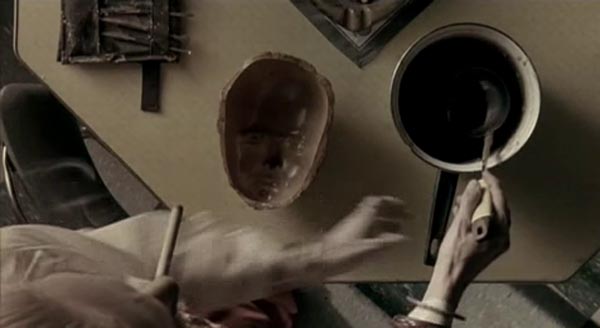
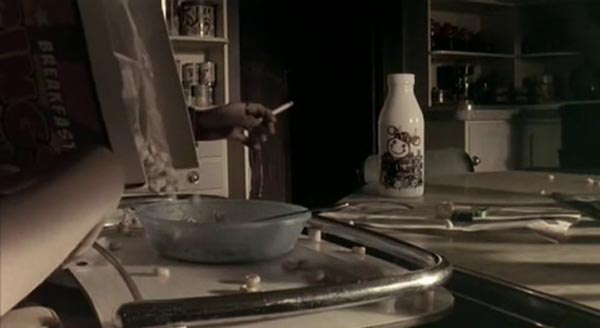
House of Wax: Certainly Collet-Serra’s background in commercials and music videos are largely responsible for this marvelous and unsettling opening sequence, in which we are introduced to a psychotic family. Notice the fine details contained within this montage. In the first shot, we see an older woman smoking her cigarette, the jasper angled askew and matching the wax bowl on the right. The table’s octagonal nature accentuates this psychology, especially since none of the hands or the cigarettes approach the table at a perpendicular angle. Then in the second shot, we see that the domestic scene is quite orderly. We see cereal poured into a bowl in a manner we might be familiar with. What’s unfamiliar here is the cigarette angled up in the air, neatly matching the arm clutching the cereal box. The milk bottle, with its smiling diagram, is also a nice touch, suggesting that some comical order or tranquility might be possible if you stick around long enough.

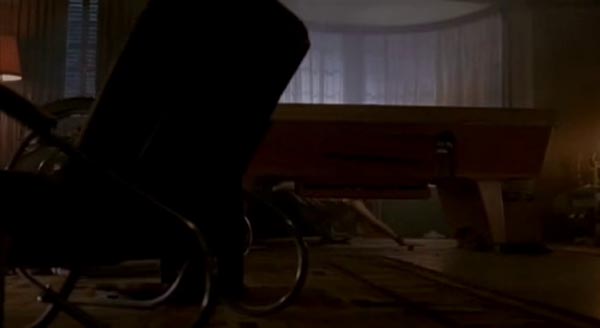
House of Wax: The camera, positioned very low, demonstrates that human life doesn’t matter much in Ambrose, the ghost town revealed to be a disturbing museum. We see a woman crawling beneath a pool table (underneath Ambrose’s “game”) in an effort to escape a mechanic who wants her to be part of this “museum.” Collet-Serra, who likes using shallow focus, makes the chair more prominent than the young woman. Even the lamp on camera left registers more than the woman.

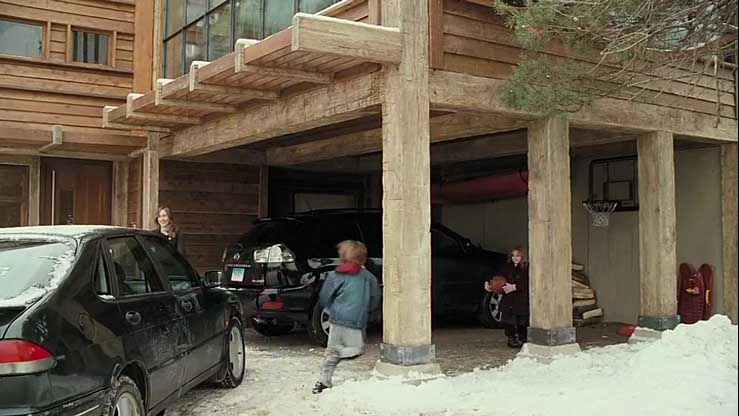
Orphan: Believe it or not, this striking visual is a throwaway shot. Like Tony Scott, Collet-Serra has this tendency to offer a magnificent composition and cut it into a sequence for less than a second. It’s almost as if he doesn’t want people to know that he’s got the chops. Or perhaps we’re meant to investigate further with the pause button. What we see here is the Coleman family before Esther’s arrival. Daniel runs from camera left to camera right towards Max, deaf and holding a basketball. Aside from the clever way in which Collet-Serra intimates that this family is as solid as the house itself (with mom hidden behind the car and Max very slightly occluded by the column), there’s also the muted burgundy (increasingly darker) from left to right: the car’s tail light, Daniel’s hood midway, and the basketball that Max is holding.

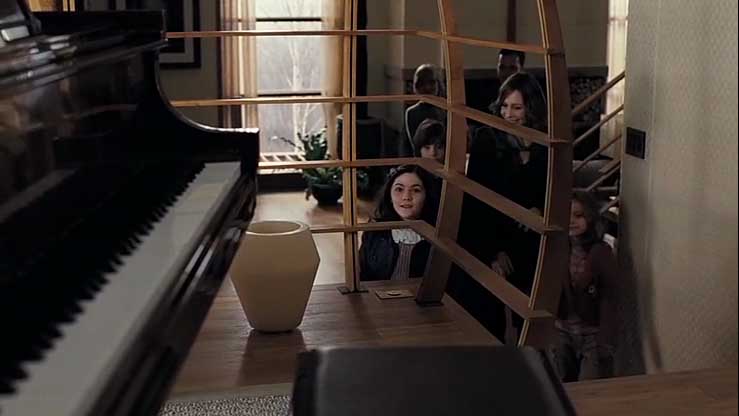
Orphan: Once Esther invades the family home, we see that, unlike the previous shot and unlike the Coleman stability, her face cannot be hidden by any architectural detail. She stares at the piano with materialistic delight. The back window tries to illuminate the situation to the Colemans (“Hey, family! You may have taken in a murderous little girl! Look around”), all clustered in the dark and too ensnared by domestic bliss to see what’s in front of them. And just as Collet-Serra placed the milk bottle on the table in the House of Wax opening sequence, we see that he’s placed an almost hexagonal vase on camera left.

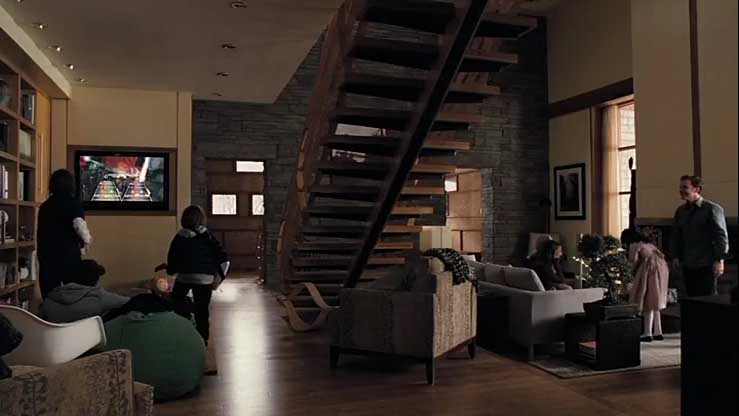
Orphan: This is one of my favorite shots in the movie. Who knew that Rock Band could portray a fragmented family? We see the boys having a grand old time tapping notes on the left. Meanwhile, the Old World girl with the old dress is inveigling her way in at the right. Again, Collet-Serra is careful to include a window near center frame, with its shaft of light trying to convey to the family that Esther is bad news. You wouldn’t know from the jagged diagonal staircase and the slightly incongruous textures that the production designer here was the same guy behind Blue Crush.

* * *

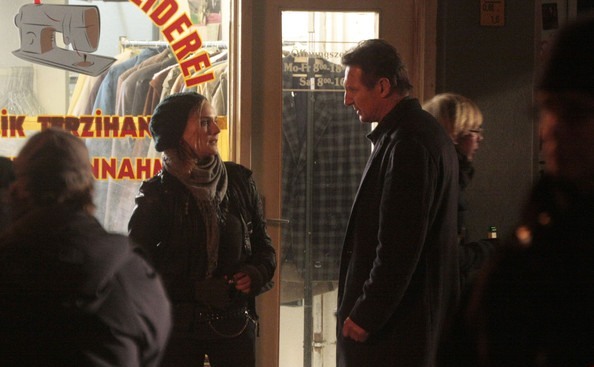
Unknown, Collet-Serra’s fourth feature film, from a screenplay by Oliver Butcher & Stephen Cornwell, based on a novel by Didier van Cauweleart, is well directed. Like Collet-Serra’s previous films, the cinematography is symmetrically stellar, its use of split focus reminiscent of early Brian DePalma (there’s one great shot where a body is being dragged away on camera right, while another body stays recumbent is on camera left) and a car chase shot with an idiosyncratic claustrophobia (many of the shots are confined inside the vehicle, but we don’t get too many driver’s perspective angles). The acting, especially by Bruno Ganz as a former Stasi man, is surprisingly realistic. The script contains an improbable series of coincidences (nearly every character is part of the conspiracy!) and a very forgiving German police force (if you carjack a taxi from an airport, I’m pretty sure the authorities aren’t just going to let you drive away). But Collet-Serra’s pacing is, for a good stretch of Unknown, so classy and so relaxing that I became more forgiving with these lapses in story logic.

Before seeing Unknown, it had never occurred to me that Liam Neeson was filling in the role once occupied by Harrison Ford. Ford, now a doddering and growling caricature of his former self, once charmed movie audiences as the forceful Everyman we could relate to. The whole “Get off my plane!” business was the point of no return for Ford. But before that, Ford was the star of The Fugitive and Frantic, playing a very believable middle-aged man on the run.

I’m certainly not the only person to have found Neeson’s recent reinvention as an action star to be somewhat peculiar. While this very tall slim actor can’t drift from his slightly Americanized Irish brogue to save his life, he has carried notable authority in Schindler’s List, Michael Collins, and Rob Roy.

But Neeson is also very good at melodrama. Most people forget that Sam Raimi made a marvelous comic book movie called Darkman starring Neeson in the title role. There’s a very fun scene in which Neeson is confronting a carnie over a pink elephant, and Neeson plays it so perfectly over-the-top: his voice grating with a gravelly bark, his face spasmodic (thanks to the limited time Darkman has wearing the “Neeson face” in daylight). While Collet-Serra doesn’t quite go off the glorious deep end the way that Raimi did in Darkman, one sees something close to this quality in Unknown, when Dr. Martin Harris is trying to persuade people that he is the genuine article.

Consider this question. Twenty years ago, if you had been told a video store clerk that Sam Raimi (director of Evil Dead 2) and Peter Jackson (director of Dead Alive) would be directing some of the most successful Hollywood movies of all time, you would have been laughed out of the store.

Unknown is enjoyable, but it does see Collet-Serra playing it a bit safe. But if Sam Raimi can serve us the gloriously vivacious jazz club scene in Spider-Man 3, then perhaps Collet-Serra’s visual panache will branch out in intriguing directions.

The Bad Prose Reading Project #1 (“Disinterested Thrusting”)

Every now and then, you encounter prose so wonderfully preposterous that it feels quite a crime not to share it with other appreciative readers. Some, of course, confine this morbid pleasure to the Bad Sex in Fiction Award handed out yearly by the Literary Review. (How easy it is for us to confront bad prose when it’s being declared “bad” by an independent authority!) Others test their mincing mettle by contributing their own exemplars to the annual Bulwer-Lytton Contest.

But as we all know, the best bad prose isn’t always planned. It’s written and discovered by accident.

With all these factors in mind, I offer The Bad Prose Reading Project, where I will be offering audio dramatizations of any bad prose I discover during my reading adventures.

During the course of these dramatizations, I won’t actually name the author, the story, or the novel that I’m reading. I feel this is fair to those who may judge the prose to be excellent. Needless to say, if I’m dramatizing it, it’s probably been published somewhere in the last few months. But that’s also part of the fun. Perhaps in dramatizing “bad” prose, the oral delivery may transform it into “good” prose because my dramatization is “bad.” Or perhaps I’m overthinking the experiment.

In any event, I invite listeners to judge the results. The first installment of The Bad Prose Reading Project features the phrase “disinterested thrusting” and can be listened to below.

Bad Prose Reading Project #1 (“Disinterested Thrusting”) (Download MP3)

This text will be replaced

Review: Of Gods and Men (2010)

Xavier Beuavois’s Of Gods and Men is a film so boring that it threatened to put me to sleep at least three times during its interminable 122 minutes. I have nothing in particular against the monastic life or unexpected political collisions or trying to understand why people remain inflexible when given clear mortal consequences in resisting common sense or the Trappists or the Algerians or films that are slow and long and, yes, even boring. Indeed, the film’s premise — based on the real-life assassination of seven monks who refused to leave Tibhirine in 1996 when terrorists entered their inner sanctum — is a fascinating one.

But this film ain’t Tarkovsky or Antonioni. The problem here — and I do realize this snoozefest has won the Grand Prix, along with unchecked fellatio from the film snob brigade; knock yourselves out — may be that Beuavois has so insisted on uncompromising authenticity (even going to the trouble of basing one shot around a shaky home video), of lining up every damn narrative moment to some scrap of a fact, that there’s little wiggle room to explore any discrepancies. These people lived, for fuck’s sake. And they were braver and more committed than most of us. I’m not necessarily against such orthodox recreation of reality, but it’s often most interesting when given a new context or a new framework that permits us to feel something. When Christian Marclay asks us to rethink images of clocks, as Art Fag City’s Will Brand recently suggested, he’s asking us, in breaking his own rules, to wonder if the viewing experience is too easy. What the hell is Beuavois asking us to do? By producing such a tepid timewaster, he encouraged me to walk out at several points and read a book on the subject. Alas, it was only my own stubborn self-discipline to sit through every damn minute that compelled me to stay. I am now writing a bitter review that vitiates the noble obduracy of the Trappist monks. And I feel terrible about it. But I cannot give this film a fair pass. It feels so trite in comparison to Wisconsin or Algeria or Libya or any other clusterfuck I could get sucked down when chasing the headlines.

The problem may be that I’m a reader and many of the film people who accept this malarkey as art are often not seen holding a book. I mean, even Ann Patchett’s melodramatic novel, Bel Canto, has more going on than Of Gods and Men. Beuavois seems to have avoided any deep or insightful investigation of the kind of temperament it takes to carry on with your low-key existence as terrorists abscond with your provisions and beat up on the people you’re trying so desperately to help. That kind of moral predicament should contain some element of horror. Is that too much of a concession to conventional narrative exigencies? Perhaps. While there is certainly some resistance to the decision to stay, and there is definitely a united front on the question, if the narrative intent here is to mimic what it feels like to be bullied, then I submit to the filmmakers that, no matter how tough or committed you are to a life of avoidance, you will still feel some modest trauma or shock. It’s certainly interesting that the monks here choose ritual as a panacea.

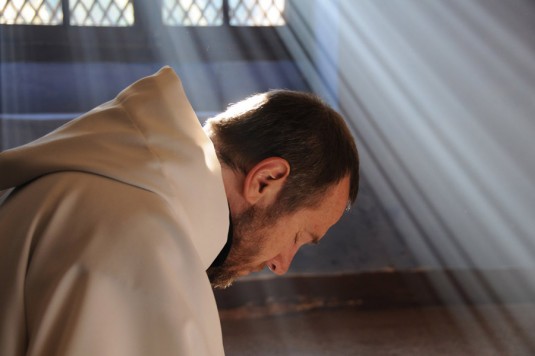
The film does looks beautiful. Shafts of light cascade against crumbling walls in need of new paint. There’s a quiet dignity in the way these monks share a meager meal — with one remarkably indigent celebration just before the monks concede to the inevitable, Swan Lake playing in the background and tearful eyes, that achieves a cinematic poignancy I’d be hard-pressed to dismiss. And I very much liked the way Beuavois shot many of these monks with the backs of their heads to the camera, a subtle visual suggestion conveying to the audience that we may very well be invading their holy lives.

But to get to these moments, one has to sit through a squirm-inducing concatenation of slow stretches. Endless and not especially sophisticated dialogue about how a love for God replaces a love for women. And so forth.

With so much attention to ornate aesthetics, I kept wondering why I felt damn near nothing for these monks. They receive letters and visits from the concerned. But they answer that they didn’t come to Algeria for personal interest and that there remains some circumstances in which men will not carry out evil. Stubbornness is an intriguing quality to contemplate, but up to a point. These dead monks demand more than technical recreation in order for us to feel.

The Sheltering Sky (Modern Library #97)

(This is the fourth entry in the The Modern Library Reading Challenge, an ambitious project to read the entire Modern Library from #100 to #1. Previous entry: The Postman Always Rings Twice)

When I first discovered the names Kit, Port, and Tunner, my mind instantly concluded that these must be debauched head honchos for some baleful corporate defense firm. This was then followed by a few inescapable jokes that I delivered to walls of books when nobody was around: Tunner getting Kit’s kit off, Port in a storm, and so forth. I am sad to report that the tomes offered no laughs or kind titters in return. Neither, for that matter, did my copy of The Sheltering Sky: a grim and largely humorless volume that did an impressive job filling about six hours of my life with a stupendous sense of dread. (I feel dreadful just remembering the experience of reading this book, even though I simultaneously recognize the book’s virtues and now see just how much Dan Simmons was channeling Bowles with his excellent debut novel, Song of Kali.)

It was especially interesting to see sundry uprisings break out in Africa shortly after I reached the end. It was almost as if world events were responding to my reading decisions! I suppose such a sentiment, however fleeting or half-formed, makes me a smug and clueless First World type. And I apologize to the Libyans, the Egyptians, and the Algerians for this. I cannot help the way my mind careens down certain paths. But then, unlike Kit, Port, and Tunner, I would never venture into unknown territory without bona-fide curiosity, a genuine sense of adventure, and, most importantly, a sense of collective inclusion. At least that’s what I’d like to think.

If you’re unfamiliar with The Sheltering Sky, it follows Port and Kit Moresby (impossible not to smile at the blunt accumulative connotation of this surname, eh? especially with the vapid type of American who, failing to see the magic within the “mundane,” mews out “More!” when asked about future plans and wonders years later why she’s so lonely and unfulfilled), a married couple who, presented with ravaged postwar home turf (both New York and Europe by natural extension), set out to Africa — in large part because they hope to find terrain untouched by global conflict. They are accompanied by Tunner, who isn’t quite as smart as the Moresbys. (“A bore, a bore, a bore!” whispers Port under his breath to Kit when Tunner is in the other room.) But one wonders if Kit and Port are really all that smart to begin with. At one point, when Port is remembering his reasons for the initial hegira, he compares himself to a pioneer: “he felt more closely identified with his great-grandparents, when he was rolling along out here in the desert than he did sitting at home looking out over the reservoir in Central Park.” A grand patriarchal tradition? Even so, Port is willing to travel to a rotting hotel in Ain Krorfa, and his initial check-in features some of the most remarkable putrescence I am likely to read in this Modern Library Reading Challenge:

The fountain which at one time had risen from the basin in the center of the patio was gone, but the basin remained. In it reposed a small mountain of reeking garbage, and reclining on the sides of the mountain were three screaming, naked infants, their soft formless bodies troubled with busting sores. They looked human there in their helpless misery, but somehow not quite so human as the two pink dogs lying on the tiles nearby — pink because long ago they had lost all their hair, and their raw aged skin lay indecently exposed to the kisses of the flies and the sun.

Now I don’t know about you. But my instinct when presented with such a scene — especially if I had a wife carrying all manner of trinkets and dresses, who was not exactly fond of the long-standing pilgrimage — would be to get the hell out of there. Yet Kit and Port stay. Two pages later, they’re eating soup with weevils, “sitting over coffee and waving away flies.” Kit himself pines for the sun. Never mind that he’s just seen what the flies and the sun do to these poor dogs. Not long after that, Port asks Kit the preposterous question, “Do you think you can be happy here?” After some pressing, Kit replies, “How can I tell? It’s impossible to get into their lives, and know what they’re actually thinking.”

Yet it’s very possible for us to get inside the Moresby heads and know what they’re actually thinking. Journeying for them is almost a hollow religion, one stumbled upon because there is little else to do. In the book’s early pages, Kit says, “The people of each country get more like the people of every country. They have no character, no beauty, no ideals, no culture — nothing, nothing.” With kvetching like that, one wonders the conversational industry it would it take to get these folks exploring Lake Victoria in a canoe.

In other words, these characters are selfish jerks who, unlike Sebastian Dangerfield or George Minafer, don’t invite further curiosity into their motivations. “You’re never humanity,” snaps Port to Kit at one point, “you’re only your poor hopelessly isolated self.” Yet Port considers himself to be clued in. And if that means heading down a dicey staircase to partake of a courtesan or rudely ringing for tea at an ungodly hour, that’s what he’ll do to get into the lives of others. Only a few pages into the book, Bowles tells us that Port considers himself a traveler rather than a tourist, with the distinction “moves slowly, over periods of years, from one part of the earth to another.” But slowing down in life doesn’t necessarily make you any more receptive than some caffeinated jackal flitting through on a bus (or, in the case of Kit and Port later, using their privileged positions to flee by bus and evade responsibility). The other important distinction, Bowles reports, is that, while the tourist accepts his own civilization without question, the traveler “compares [the new civilization] with the others, and rejects those elements he finds not to his liking.” And yet Port’s “comparison” involves the same superiority practiced by a tourist, such as the moment when he tells a lie about his wife being very sick to buy two bus seats:

He watched the Arab’s face closely, to see if he were capable of believing such an obvious lie. Apparently here it was as logical for an ailing person to go away from civilization and medical care as to go in the direction of it, for the Arab’s expression slowly changed to one of understanding and sympathy.

Now I have no problem with depressing books. I like to be moved to tears as much as I enjoy a few laughs. But when I read about Port, a spoiled American who absconds with common sense when a passport has been lost, and Kit, a spoiled American who commits adultery while her husband is traveling with two insufferable imperialists (the Lyles), and when she ventures into a fourth-class carriage, only to “shake violently” upon her return, and when none of these people can be straight about their feelings (Bowles often has his characters, especially Kit, “talking” in thoughts and words), I have zero sympathy. Still, I suppose it’s somewhat useful to be reminded that passive-aggressive deceit flourished just as much in 1949 as it does in 2011.

As I became more acquainted with this pampered ternion while turning the pages of Paul Bowles’s alleged masterpiece (“It stands head and shoulders above most other novels published in English since World War II,” reports The New Republic on my edition; it’s good for long stretches, but I beg to differ with this hyperbole), I found myself greatly pining for their deaths so that Bowles could continue his indefatigable duties describing the grand North African tableau, with its slanting landscapes and microscopic tents seen through grimy windows. Even the work of Frederic Prokosch, a now regrettably forgotten writer who was working the same beat (see The Seven Who Fled and The Asiatics) and who, like Bowles, favored ornate prose over dimensional character, speaks more on the subject of behavioral nuance.

My initial interest in Bowles’s characters flagged considerably by the time I had reached the second part, especially since Bowles shifted such supporting figures as the Bou Noura lieutenant d’Armagnac — a man who appeared to have more adamantine problems than these three entitled nincompoops:

During the third night of of her imprisonment a gray scorpion, on its way along the earthen floor of her cell, discovered an unexpected and welcome warmth in one corner, and took refuge there. When Yamnia stirred in her sleep, the inevitable occurred. The sting entered the nape of her neck; she never recovered consciousness. The news of her death quickly spread around the town, with the detail of the scorpion missing from the telling of it, so that the final and, as it were, official native version was that the girl had been assaulted by the entire garrison, including the lieutenant, and thereafter conveniently murdered.

Perhaps that passage is a wry reflection upon how difficult it is to convey an apparently exotic experience through narrative. Inevitably, your sense of a place or a person is bound to be vitiated and/or embroidered in the telling.

It’s probably worth pointing out that Bowles — in a letter to his wife Jane (a great writer in her own right) contained in the epistolary collection, In Touch — had planned to kill off Port halfway through the book: “He lingers on in agony instead of dying. But I’ll get rid of him yet, I assure you. Once he’s gone there’ll be only the heroine left to keep things going, and that won’t be easy. Still, it’s got to be that way; there’s no other possible design for it.”

On the other hand, the novel’s obvious conclusive crack about “the end of the line” — belaboring the distinction between “tourist” and “traveler” — made me feel more than a bit conned.

Still, I’m relieved that my understanding of Paul Bowles has become more sophisticated, if only because, up till now, I carried around a superficial understanding. Before The Sheltering Sky, I had not read Bowles. And I had long associated Bowles’s work with the glorious tuft of Debra Winger’s muff. That revelation may earn me a few detractors, but I must be candid. The truth is the truth. I like muffs. And I like Debra Winger (though certainly not just for her muff). You see, Bernardo Bertolucci tried to film the unfilmable back in 1990. And in a largely unsuccessful effort to spice things up, he gave us Ms. Winger’s delightful fur, Amina Annabi’s flesh, and John Malkovich’s hilarious hair. Other than these moments, the film is quite soporific. Even Bowles, in the introduction to a paperback edition, confessed that the film was “a fatal mess.” (Bowles, who also appeared in Bertolucci’s film, may have been sour because, according to a very bad hagiography* written by Virginia Spencer Carr, Bowles didn’t see a dime in royalties beyond the original $5,000 he received for selling the movie rights in 1952. Hurray for Hollywood! Perhaps this explains his appearance in the film. On the other hand, in an October 9, 1989 letter to Regina Weinreich, Bowles writes, “I like all three of the leads, and particularly Debra Winger, whom I go to visit often at her house on the Mountain.”)

That gossip may not accentuate your reading experience, but it does suggest very highly that, unlike Bowles’s fictional trio, Debra Winger is more of a traveler than a tourist.

Next Up: William Styron’s Sophie’s Choice!

Related Link: A Million Grains of Sand — a helpful index to The Sheltering Sky created by Frances McConihe.

* — How bad is Carr’s Paul Bowles: A Life? Very bad. Try this: “Bowles’s insistence that he never made plans and that his actions depended unfailingly upon who came along confirms his reluctance to be an initiator of anything, regardless of the act in question.” No skepticism whatsoever? No effort to confirm Bowles’s statements against other sources? The back flap of the hardcover I checked out from the library features a smiling Carr hunched on her elbow with a decidedly unhale Bowles in bed. The message here, undoubtedly subconscious, couldn’t be any clearer.