
Posts by Edward Champion

Edward Champion is the Managing Editor of Reluctant Habits.

Sven Birkerts and the Frightening Fitzroya

Being wrong is wonderful! It’s a bit like accidentally walking into a fitzroya and suddenly realizing that there’s this large evergreen that you didn’t know about. Suddenly, you’re forced to alter your existence to account for the fitzroya. And when you ponder the fitzroya a bit — as Darwin did, dutifully naming it in honor of the HMS Beagle’s captain — you begin asking a few questions. How did the tree get there? Why does it have such a mammoth diameter? And how can all this be used in tandem with other shards of understanding?

I suspect that Sven Birkerts is a man terrified of the fitzroya.

On Friday afternoon, I entered a Columbia University classroom. Birkerts had come into town for a debate with Jenny Davidson, moderated by Andrew Delbanco, styled Blogging: Good or Bad for Literary Culture? “I can’t tell if we’re positioned at odds,” whispered Birkerts to Davidson before the proceedings started, a foreshadowing of the stalemate to come.

The audience was composed of approximately twenty-five nimble-minded students, many of whom offered interesting inquiries. I felt a tad displaced wearing my The Brain That Wouldn’t Die t-shirt, but sitting in the front row with this sartorial choice seemed the right thing to do. As one of the “reputedly intelligent” figures mentioned in Birkerts’s 2007 Boston Globe article, I thought I’d see what this reputedly intelligent man had to say. After all, our man Sven had called the litblogosphere “too fluid in its nature ever to focus on widely diverging cultural energies” and railed against us being “predatory on print.” (Never mind that Birkerts, as a literary critic, is likewise predatory on print whenever he writes an essay concerning books.)

It should be self-evident by now that I find the idea of one form of writing deemed inferior solely on the basis of appearing in a different medium — whether it be a blog, a hypertext novel, or what not — to be an utterly ridiculous tautology. Sven Birkerts, I’m afraid to report, is a man who specializes in tautologies. This is not to suggest that he isn’t a smart man. Nor is he entirely against blogs. But he is certainly a weary man, a self-described “gradually graying book reviewer with several decades in the trenches.”

He opened his remarks by reading thoughts from a slightly crumpled piece of paper, hoping that in tossing around cerebral softballs, he could perform some off-the-cuff binomial expansion. Here were some of his phrases:

“A whole new paradigm of transmission.”

“We bring forward a technology. It begins to fashion and inform us.”

“Like the car, it has conditioned us and bent us to its shape.”

“The size an scope of an idea. Within the book, ideas formed in certain ways. Exigencies on the thinking life.”

“Notions of authority and gatekeeping and accountability.”

“The technology intricately bound to our mentality. All of the premises associated that will change.”

“One specific development within a very large, vastly distributed tendency fueled by the possibilities of the Internet.”

“Eroding the notion of the single subjective author as the locus of authority.”

“Organization now lateral and associative based on the link.”

“Loss of centralized top-down structure.”

And so on. Birkerts was much better speaking off the cuff. But one sees within this shaky torrent of phrases the main problem with Birkerts’s position. His complaints are centered exclusively around his own perceptive hang-ups. He did not cite any specific examples to justify his line of thinking. I pointed out to him that his gripes were primarily perceptive and conceptual, and he seemed to agree. Birkerts’s position was further parroted by Delbanco, who expressed a mild sense of terror at participating in a Slate roundtable because this involved sending his thoughts off into the ether. He was, however, slightly more open-minded than Birkerts. Slightly. Delbanco’s terror also equated to being unfamiliar with the form. It struck me that writers over a century ago must have had the same fear of the Remington typewriter that these guys have of the Internet today.

By far, the most reasonable participant was Davidson, who advocated blogging, but pointed out that blogging could not directly replace newspaper criticism. She pointed to both the constraints of word count within newspapers, and simultaneously observed that there were certain advantages of concision within the short-format blog post. She pointed to Caleb Crain’s behind-the-scenes approach to blogging, Colleen Mondor‘s well-rounded perspective, and numerous other blogs. She pointed to certain advantages to the blog form, including the ability to quote more of a textual example — something that newspapers were increasingly not in the habit of doing. I did hope that Davidson would be a little more contrarian about blogging. But unlike Birkerts, she had solid examples for her position. Birkerts, by contrast, essentially parroted the same stolid points over and over again, sounding very much like a broken 78.

I do not believe Birkerts to be an entirely inflexible intellect. He did address my line of questioning, which, in Birkerts’s defense, involved excessively effusive delivery on my part. But he did appear quite bored to be sitting in a Columbia classroom. When I came up to him afterwards, he wanted to get the hell away from me as quickly as possible. But I gave him my card.

It has become evident that the biggest problem with this “debate” is the surfeit of stubborn souls unwilling to consider the alternative form, whether it’s the blogger who refuses to consider the virtues of editing or thinking through his post a bit or the print advocate so terrified of anarchic fun that he cannot find it within himself to trust his instinct from time to time. I’d like to think that this can be bridged. But in the meantime, where does this leave the wondrous fitzroya?

(For another take on the talk, go here.)
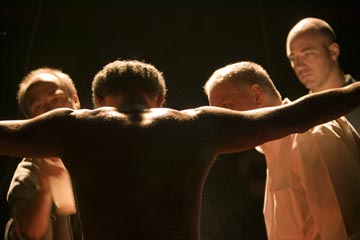
Standard Operating Procedure

It seems particularly fitting to remark upon Errol Morris’s latest film, Standard Operating Procedure, as Armond White offers yet another hysterical fulmination about how online culture is apparently destroying exegesis, ranting in particular about “the shame of middle-class and middlebrow conformity that critics follow each other when praising movies that disrespect religion, rail about the current administration or feed into a sense of nihilism that only people privileged with condos and professional can tenure.”

This colorful sentiment is, to say the least, a disingenuous generalization. For Morris’s documentary (and the accompanying book written by Philip Gourevitch) would seem to suggest that one cannot approach an important subject like Abu Ghraib without a sense of outrage. That no matter how rational one is in investigating the events behind this nightmarish aperçu into America’s dark underbelly, journalist, filmmaker, and audience member alike must shout to the high ethical heavens. But is it really an act of conformity — class-driven, no less — to be appalled by what is revealed in the photographs? Is it conformist to speculate upon why Sabrina Harman offered a thumbs-up signal or whether or not Lynndie England was coerced by Charles Graner into holding a dog leash?

An innate sense of inquiry cannot be called conformist if it involves an independent series of perceptions that involve grasping some aspect of the truth, subject to change upon additional thought and information. And yet the main problem with Morris’s fascinating new film is that, with the ancillary and rather fixed reenactments photographed by Robert Richardson, it is possible that Morris may be holding the viewer’s hand too much, urging her to care when the interviews alone offer enough unknowns and the horrific glimpses into a soldier’s dead eyes four years later are enough to make one uncomfortable.

In watching these soldiers, I couldn’t help but consider the scene in Claude Lanzmann’s Shoah in which barber Abraham Bomba works in his shop, reproducing the precise grooming moves he employed while cutting the hair of victims about to be gassed in Treblinka. It is an eerie echo from the past that cannot altogether be shaken off in the present. And in my painful determination to understand, however limited, why these soldiers had done what they did and how the Abu Ghraib experience had shaken them, I wanted to know more about how the idea of getting used to anything — even the rough interrogation and humiliation of prisoners — was carried back to the homeland. This may not be an entirely fair request of Morris. His film is, as he contends in the press notes, an investigation into the Abu Ghraib photographs. But if, as Susan Sontag observed, “the photographs are us,” is it entirely unreasonable to ask the investigator to venture further?

It isn’t mentioned in the film, but Javal Davis, who comes across as a smooth, free-wheeling raconteur, is revealed, in Gourevitch’s book, to be “in sales. The career path that I have now, you know — comfortable. I deal with people on the regular basis. I’m not handling anybody’s problems. I’m not dealing with anything violent. So I’m business to business, all personal, ‘How you doing? I’m Javal Davis. Nice to meet you.’ Everybody’s happy. I like that. Sales. I’m a salesman.” And because Morris has flown out Davis, along with all the other soldiers, to his Cambridge headquarters to conduct these interviews, we do not see these soldiers in their current habitat. For all we know, Davis could have viewed his trip to Cambridge as a business trip. Business to business. And he could have adjusted accordingly.

It’s possible that Richardson’s visuals serve as a device similar to Comte de Lautréamont’s unusual narrator. In Maldoror, Lautréamont offered a unique device in which the narrator often parodies feelings by willfully distorting or rethinking the sordid events that are presented. Likewise, by illustrating what his interviews are telling us through these visual reenactments, this may be Morris’s heavy-handed help to us that we must rethink our own thoughts and feelings concerning these photographs. Or perhaps it’s more visceral. As I learned in an interview I conducted with Morris this week, outrage was also involved in these reenactments.

The outrage is conveyed as a prisoner is described having his eyebrows shaved off, with Morris including a close-up of a razor deracinating a tuft of hair. Morris likewise dramatizes a dog that terrorizes another prisoner. But Morris has the dog menacing the prisoner in slow-motion, with a melodramatic sound mix depicting the dog’s bottom jaw snapping shut like a steel trap.

Given the intriguing ambiguities unearthed during the interviews, this seemed to me to spoon-feed the audience too much. And I wasn’t alone. In an essay for Artforum, Paul Arthur took umbrage with these visuals, observing:

Their style, however, belongs to a film genre that provides titillation through horror. To employ this rhetoric in a documentary about actual horror is obscene, yielding familiar aesthetic thrills as a substitute for specificity of meaning. We aren’t prompted to contemplate the Iraq occupation’s signature scandal as the product of a mercenary chain of executive decisions, cultural attitudes, venalities, and personal pathologies; we are, as it were, let off the hook. It’s only a movie.

If a generic sense of horror is what is required to get through to the average moviegoer, then I cannot quibble as strenuously as Arthur does (and perhaps White will). But if a complex issue requires complex consideration, then any reenactment that will help a viewer construct a “map of reality” must not dictate too much. It is reasonable to accept the shaved eyebrow, but the dog goes over the top.

Likewise, in the book, Gourevitch maintains a level-headed, mostly objective tone for almost 160 pages before writing:

There is a constant temptation, when rendering an account of history, to distort reality by making too much sense of it. This temptation is greatest when the history is fresh and deals with crises that are ongoing — crises that mold our understanding of our world and ourselves. Surely, if you have come this far in this sordid tale, you must crave some relief, some release, from the relentless, claustrophobic annihilation of the dungeon: a clear and cleansing note of sanity, an interlude of avenging justice or an eruption of decency, the entry of a hero. But surely you don’t want to be deceived. There is no such solace or sanctuary in this story.

Gourevitch then launches into a grand attack on what the Abu Ghraib atrocities say about America, pointing to the famous precedent of treating enemy prisoners well set by George Washington and fulminating against the Bush Administration. Not even a journalist as dutiful as Gourevitch can look at the photos and the complicit involvement of these bad apples without exploding.

Others will likely perceive this film to be mostly about the visuals atop the visuals, the analysis atop the analysis, the meta within the meta. But the real “standard operating procedure” explored in this film isn’t so much the pedestrian issue of how war caused the lines of basic human decency to become fuzzy, but the manner in which a great filmmaker has partially abandoned his subtleties to get Americans hopping mad. The faults lie not in the filmmakers and not, as White suggests, the critics. They’re doing their best to continue the dialogue, but their efforts have increasingly fallen upon deaf ears. For Abu Ghraib does not entertain. And neither does moral outrage.

(To listen to my podcast interview with Errol Morris, go here.)

Open Source Sodomy

“This should be a better world,” a science fiction convention attendee said. “A more honest one, where sex isn’t shameful or degrading. I wish this were the kind of world where you could say, ‘Wow, I’d like to sodomize you with my nightstick,’ and people would understand that it’s not a way of reducing you to an asshole and ignoring the rest of you, even though the request inherently objectifies the person you ask, but rather a way of saying that I may not know your mind, but your body is beautiful.”

We were standing in the hallway of ConStipation, about nine of us, three hadn’t had sex since the Twin Towers fell, and we all nodded. Then another friend spoke up.

“You can penetrate me,” he said to all of us in the hallway. “It’s no big deal.”

Now, you have to understand the way he said that, because it’s the key to the whole project. It was an Ayn Rand novel come to life. When dealing with a request along these lines, you have to completely ignore the meaning of the sentence in order to rationalize the manner in which you objectify someone. Consent is the important part of avoiding a sexual harassment lawsuit. You can tell your lawyer that you didn’t objectify the other person because they said yes. The spirit of everything was formed within those eight words. The Open Source Sodomy Project would have died had we not insisted that there was always a way to rationalize a request, to take the fun of seduction away, to simply pump my friend’s asshole right there in the hallway and ejaculate inside him.

Yet it wasn’t a come-on, either. There wasn’t that undertow of desperation because someone had said the sentence. When you skip out on hindsight, it’s always a marvelous thing. There was no promise of anything but a simple fuck.

We all dropped our pants in the hallway, our cocks erect and our friend quite willing to be part of our impromptu experiment. And lo, we all fucked our friend in the ass — taking turns to thrust, all of us coming. These were awesome asscheeks, plump but serviceable. And the sounds of all of us coming were beautiful. I understand that someone recorded all this and a podcast will be released soon.

And life seemed so much simpler.

It could have been base lechery. But in order for the Open Source Sodomy Project to work, we needed to flaunt our intellectual superiority, this quintessentially American way of justifying everything from looking at a complex moral dilemma with solipsistic naivete to stacking naked prisoners into a human pyramid and snapping pictures. There was always a reason. Always some excuse you could make to evade culpability. Now this wasn’t a case of only following orders, but of only following our desires. Innocence. We knew we couldn’t go further, but being allowed inside this area of somewhat restricted access with nothing more than a question was simply amazing.

We stood there afterwards, a little shocked, wondering if we should take some showers to get the smell of sex off of our bodies. Then someone else spoke in the same tone of voice.

“You can penetrate me, too!”

And my God! Many of us became hard and some of us exploded again! We weren’t degenerating into an orgy, but rather exploring the amazement of how beautiful the body was and how wonderful it was to have access to it. I should point out that those who requested sodomy only dropped their pants. They kept their tops on the whole time. Therefore, there was no objectification.

And every person in that hallway was then asked the question: “Can I penetrate you?” A few took offense and some of us were kicked in the nads. But some said yes. And the unfettered sex continued.

And my Lord, I’ve experienced sodomy in my time, but having so many sodomy opportunities in front of me was beautiful. We hadn’t even rented out a hotel suite! Who needed that when we could fuck anybody we wanted? And who needed to bother with getting to know a person? These were ripe assholes. Wondrous and mindless orifices to ejaculate into! We’d never consider sex with emotions again. We’d look at every person walking down the street and say to ourselves, “I wonder what it’s like to explode into his asshole! If he refuses, is he an asshole?”

We did not wish to offend. But one person we asked took offense when we asked to penetrate him. He was a large, muscular man who proceeded to beat the shit out of one of my friends after my friend posed the question. Something about assuming he was queer. We didn’t understand. Our friend’s in the hospital now. But, of course, he won’t be pressing charges. You simply don’t do that in an idealistic world. It’s like Esperanto. You believe in it no matter how problematic it is. Even though my friend was served with court papers and his attorney said that he’d require a five thousand dollar retainer. A small price to pay for the beauties of utopia!

By the end of the evening, others were coming up to us! Pretty soon, we were dropping our pants and there was more fucking.

I’ve left off the names, because frankly, people should reveal for themselves whether they’re Open Sourcers or not. People should speak out so that the natural spirit of evading the complexity of another person’s feelings can be sidestepped through this carnal simplicity. Who cares what the larger ramifications are? And who cares if an asshole is full of shit?

(Hat tip: Bookslut)

Simple as Pie

Ladies and gentlemen, you may have observed the relative silence around these parts of late. This is because I am very angry — furious about Hillary Clinton’s willingness to say anything to get elected, indignant about the White House’s denial about torture, prepared to apply a baseball bat to newspaper racks because the international food crisis and war casualties aren’t appearing in 42 point type on the front page, etcetera. I have been trying to figure out the precise way in which I can articulate my outrage, in which I can respond with something constructive. Why Americans aren’t storming the streets right now and why they continue to accept our slow slide into a Mad Max dystopic sideshow are mysteries I’m still trying to unravel.

But then my spirits were lifted by this YouTube video.

These kids may not know how to aim their pies properly. But it seems to me that throwing more pies at more figures is part of the solution.

And speaking of double standards, I wonder why we begrudge these merry pranksters, while we have no problem propping up a 75-year-old woman who took a hammer to Comcast. Casual dissent, it seems, is the new dissent.

New York ComicCon — Podcast

Over the course of the weekend, a number of people were interviewed by Our Young, Roving Correspondents on the floor of New York ComicCon. Thankfully, we have managed to assemble a rather strange collection of interviews into a podcast. We had no idea that we had recorded so much material. Many thanks to Eric Rosenfield for interview assistance and his laconic pal Phil for moral support and a shoulder to cry on. Scroll to the bottom to listen or download the 78 minute MP3!

1. Mike Pellerito — In this somewhat naughty conversation, Archie Comic Publications, Inc. Managing Editor Mike Pellerito offers his candid views on maintaining the purity of the Archie universe.

2. Joe Gonzalez — We venture into Podcast Arena to discuss the appropriate way of covering New York ComicCon with a fellow podcaster.

3. Aaron Goold — One of the folks behind Yo Yo Nation explains why he is a spokesman for Duncan. There is also some speculation on secret yo-yo societies in New York.

4. Jack Ringca — I am unsure what pernicious position Mr. Ringca holds within Duncan, but he seemed to have a few diabolical ideas involving Mr. Goold and conquering the universe with a yo-yo army.

5. Joseph Semling — The purchasing manager of Brian’s Toys offers a helpful explanation of the economics behind lightsabers.

6. David Williams — The co-founder of Fanlib insists that he’s flying fan fiction writers out to Hollywood. But we learn that this isn’t the case at all. He seemed especially convinced that all fans are protected from lawyers.

7. Dan Piraro — The man behind Bizarro explains the precise circumstances that help him generate ideas and reveals how some of his more daring strips end up in Scandinavia.

8. Ross Milhako — Attracted by the risque title, Our Young, Roving Correspondent questions the creator of Dead Dick — Zombie Detective upon the filthy and salacious qualities of his comic’s name.

9. Tim Fish — The Boston-based comic book writer behind Cavalcade of Boys explains precisely what he means by “cavalcade” and offers some insights on gay romance comics.

10. Patch — A gentleman who only referred to himself as “Patch” explains how Teddy Scares inverts the nature of the cute and cuddly teddy bear. There is also an ethical debate over whether zombie teddy bears can appeal to an UglyDoll audience. We dutifully pledge, per this interview, to investigate Teddy Scares in five years and determine, per Patch’s assured declarations, whether or not Teddy Scares retain their edge.

11. Kim Caltagrione, Mike McLaughlin & Steve Vincent — We talk with the New Jersey underground comics operation, Angry Drunk Grahics, about the fine line between angry and drunk and how Ms. Caltagrione ties this ontological spectrum together. Includes discussion of Mike Diana, the first artist to receive a criminal conviction for obscenity in the United States and who is published by Angry Drunk Graphics, and the Diana-drawn illustration of Jesus with a penis.

12. Brian Phillipson — The co-creator of God the Dyslexic Dog insinuates a forthcoming jihad involving canines. Or at least that’s what we’re left to conclude from this conversation that somehow manages to include nonoverlapping magisteria and dyslexic fundamentalists.

13. Chris Wozniak — Chris Wozniak insists, despite developments involving Kathy Griffin, that he is the Woz. But even though he has created bitter midgets, the Woz doesn’t have any explanation as to why his midgets are bitter.

14. Jeffrey Brown — A mention of Brown’s appearance on a Canadian sex program leads into an unexpected delineation between the real Brown vs. the invented Brown. (Partial transcript here.)

15. Kyle Baker — A conversation between Baker and McCloud is unexpectedly interrupted, but segues into issues of artistic control, television, people who don’t read comics, thwarted animation deals, families coming back in style, Special Forces, Nat Turner, the Haitian Revolution, mainstream publishers getting into graphic novels, and other assorted topics.

16. Scott McCloud — Scott McCloud reveals a future deal involving a graphic novel in New York, the present state of advocating graphic novels, the Creator’s Bill of Rights, and the failure of micropayment systems.